My father is no longer a butcher, he sold the shop after ~25 years, working every day to afford our family a comfortable life and having enough money to pay for a restaurant that he wanted to run. Again, no one asked about where the coffee beans would come from, and after ~10 years he closed the restaurant after again working tirelessly to support himself, his children and his new grandchildren. He had the money to buy kitchen equipment for a newly built restaurant that he has now been running for 5 years.
To make a long story short, he is certainly crazy and he is doing what he wants and, on some level, is meant to do. But if your takeaway from this article is that you need to unpack everything and know everything to the smallest detail, you might get lost or discouraged by the complexity. You can't plan it all out.
Lots of my colleagues dropped out of the industry in their first year because they didn’t like maths at all.
What really drove the point home for me though was that a decade later I got more satisfaction out of developing ETL pipelines for multidimensional analytics.
Think about how “nuts” that is! Everyone likes playing games but nobody installs SQL Server Analysis Services on their home PC for “fun”! Yet… it is, for a certain very select subset of the population…
We expanded to the point that we recorded 350 sessions in a single day, each with a coach with decades of experience, a professional studio engineer (usually), a studio room, and short lectures throughout the day. We had to move to bigger and bigger conference hotels to get enough rooms until Covid shut everything down. There were tons of "unknown unknowns" that had to be solved over time.
We were focused initally on protecting the people who probably shouldn't be spending money on training (very frustrating to watch them be ripped off), and produced the event both as a place they could learn a bit at low cost, as well as serving the mission of providing bite-size workshops for people who didn't want weeks or months (or years) or training.
I didn't want to be an "event provider". I wanted to figure out how to do something for people I saw being served poorly in an industry I loved, and then to find ways to give more and more to the people who were showing up.
When I was told to do this when I was like 14, and asked "waht did I want to do", I ran into all the exact traps that the article said in the form of overintellecutalization.
It takes a certain kind of maturity to just sit down and really try and observe, non-judgementally. Just what happened.
(then the intellectuals among y'all will say stuff like, "well perception isn't objective truth yada yada" this is also a big thought loop trap I had to get rid of. Just like, put it on hold, just say your thought, even if you think it's stupid, or it's some kind of "self strawman" and you want to elaborate more and justify etc.
Just say it.)
I've been able to do it for things I've really cared about, but often times I don't get into this state.
I should practice. I only even observed this thought pattern when I got good at math, and the whole thing was just sitting down, contemplating honestly pretty dumb thoughts, but if you thought loop yourself you get nowhere. Gotta say seemingly stupid stuff and just contemplate. Words are both the thing you should observe but not treat as truth, just... try to observe. idk.
I assume the main difficulty isn't that -- I assume it's the lack of comparative advantage, so competition eats into your margins until you're fighting a race to the bottom, not only making your customers happy, but doing it cheaper than someone else could, and I assume the stress from that makes it hard?
And also not being in control of your suppliers, so unpredictable events can affect your profit.
I supposed I just got called out -- is this actually a rare thing? I thought it was like, a meme to hate pineapple on pizza? Obviously some people do, but I have never thought of my opinion (liking the combination) as especially rare.
Doctors: you may spend many many hours in front of a mobile computer entering notes, medications, etc. You may also spend a good deal of time fighting insurance companies via email and/or phone. It's likely you feel you are rarely "helping people"; sometimes you have to help people in spite of themselves. Also patients rarely do what you tell them to, contrary to what you judge to be in their best interests.
Lawyers: you may never see the inside of a courtroom or even a client. You likely will spend the mass majority of your time using Microsoft Word redlining documents. Trial drama is the exception of the exception.
Many jobs are not what people think they are.
The worst advice was that writing software, after the dotcom bust, was dead as a career. This taught me a lot about the value of "conventional wisdom" vs looking at the underlying supply and demand dynamics of a career. Sort of adjacent to the theme of the essay, I think the best careers are those that you can tolerate and those that have favorable supply-demand curves.
The best advice was from a pre-med advisor, who asked me if I wanted to spend the rest of my life surrounded by people who were old, sick, dying, and - not in so many words - decrepit. At that moment I realized I was not a healer, I found most bodies to be gross, and I had no business considering a medical career.
I had a coworker ask a nephew in high school to sit with me at work to show them a software job. They said they wanted to be a game developer. It turned out they had never seen software code in any form, and had no idea what programing was generally. I asked them if they had any art skills, and they were baffled why that was relevant.
They had no concept of the job at all. They just liked video games. Apparently, I crushed their dreams.
Does everyone (or even most people) have a "right" career? I actually think this framing itself is harmful. If comparison is the thief of joy, then what could be worse than believing that there is some yet to be discovered perfect-for-you career out that you are missing.
No, I do not know this. I've moved ~29 times in my life. I've never once had a problem unpacking. I packed up shelves and drawers and dressers and closets. When I get to the new place I open a box, see what's in it, "oh, this was the stuff in bedroom drawers" so I go put the stuff in there in just a few seconds. In a few hours I'm 100% unpacked.
I've never really understood why it would be any different for anyone else except if maybe if they moved to a much smaller place.
Is it really that common of an experience?
More to the point of the article though - I'm not entirely sure I want to unpack my job - I feel like lots of people would not "do the thing" if they knew how hard it would be. But, looking back, they're proud they "did the thing". I know for me, I started some companies and projects years ago. I was able to do this because I didn't know how much work it would be. Now that I know, I find it extremely hard to get started again. I wish I could go back to my old naive self.
Maybe a better example, all though one I have unfortunately not experienced, would anyone have kids if you "unpacked" what having kids is actually like? I think you could list 100s or 1000s of "unpleasant on paper" things but I don't really think you could write the positives in a compelling way against that list of negatives. And, yet I believe the majority of parents would tell you having children was the most fulfilling thing in their lives. I think many of the things mentioned in the post might also have a similar issue.
> But luckily, success indexes less on IQ and more on consistency. The willingness to doggedly show up every single day can take you to some really suprising and amazing places.
I think the “get rich easy” reputation that software engineering gained somewhere around the 2010s really hurt the industry and a lot of people who are chasing the dollar.
I’m an unhinged lunatic who loves productivity software and user experiences. The type of kid who was setting up Outlook betas in 6th grade to try the new features. Watching videos about how the Ribbon was designed. Reading C++ for dummies even though I had untreated ADHD and couldn’t sit still long enough to get much past std::cout. Eventually daydreaming about walking into the office, tired from a hard sprint, getting coffee in corporate-sponsored coffee cups.
I wake up and reflect how profoundly lucky I am to have my dream job. Not just having the career I have, but having a dream at all and having a dream I could love in practice.
I think that when someone tells you they fantasize about starting a small local retail business, that we shouldn't just shit on their naivite; we should listen to what they're really trying to say and help them find something that checks the boxes for them:
1. Something in the real world, preferably with physical products/services on physical products
2. Something with a larger degree of independence
3. Something whose value to the customer is obvious
4. Something which improves the world or their community in some way, and is not just extracting value from others.
Personally, I love writing software, but I hate Software companies
> Do any aspects of this job resemble things you’ve done before, and did you like doing those things? Not “Did you like being known as a person who does those things?” or “Do you like having done those things?” but when you were actually doing them, did you want to stop, or did you want to continue?
I think people like Wolff like writing. Brandon Sanderson is another example. He can't stop. I think they'd do it even if they weren't able to make it as novelists. That's what separates a lot of those people from most others. Sure, some people have a goal and the grit to reach for it, to do that dribbling & shooting practice for six hours a day even if it's not actually fun. But some people have this sort of mania for their work. It's not really sensible to talk about being like them, unless you already are.
> Most of those students would go, “Oh, no I would not like to do those things.” The actual content of a professor’s life had never occurred to them. If you could pop the tops of their skulls and see what they thought being a professor was like, you’d probably find some low-res cartoon version of themselves walking around campus in a tweed jacket going, “I’m a professor, that’s me! Professor here!” and everyone waving back to them going, “Hi professor!”
I don’t know if there’s something wrong with me, but as a grad student I hated walking around at the front of class going “I’m a lecturer here” and having the students say “hi lecturer!” It was the least satisfying part of the job. Maybe it feels better if you have the real title.
Office hours were great, though. It’s is like debugging a program, you start at the symptoms and then try to trace your way up to the root cause. Except you have a conversation instead of a stack trace. Just like debugging, it can be really frustrating in the moment, but the end result is really satisfying.
Also, grading was fun, just because you can be an unusually good grader by doing the barest-minimum and including, like, any notes at all (the students just want to know that you actually understood why you took their points away).
It strikes me that those are two spots that seem hardest to automate away, and involve satisfying the customer the most. But they don’t really seem to be central to the professor’ actual identities, or to the general perception of them.
Like, I'm a hobby metal musician, and I do have a certain dream of being on stage with a band. Even if it's just a dive bar with 20 people. Gotta be realistic. And I have 15 - 20 years available for that, or even more if you look at Grave Digger or - rest in peace old chap - Ozzy. But I'm not certain if I have the passion to be a touring musician even if that happened (which most likely wont). Like what these people take on is entirely insane.
Brittney Slayes from Unleash the Archers had tours during which she worked full-time remote. 8 full hours of work, out of the hotel, soundcheck, gig, meet and greet, back into the bus, sleep, back to work. And from what I've heard they've also done that with a kid on top. That is just nuts.
And even without that, big tours are hell from what I've heard. The first one or two tours are an absolute test for bands because it's all a huge rush of adrenaline, excitement, nonsense, strange locations all at once without a second to breathe.
If you hear that, a 9-5ish tech job isn't that bad.
There are a couple caveats though. One is that the chance to make these kinds of choices is a privilege. I don't think most people working as supermarket checkers or delivery drivers are there because they had a desire to do it and then unpacked it and decided yeah, this is the job for me. A lot of people don't get to choose jobs because they want to do them.
On the flip side, a lot of people have jobs that they didn't choose with too much deliberation --- but still like their job. And that's partly because when you unpack many jobs, you get something like "would you like to hang around with a few pretty good people while you all do X?" Not that those people are part of the job per se, but if you wind up in an environment where your co-workers are reasonably fun to be with, and/or the customers are friendly, and the job itself isn't super demanding, it winds up being okay.
I don't want to open a coffee shop. But I have put some thought about the type of cup I like (not what is scientifically the best).
All this is in context of plain ceramic cups.
First, it shouldn't be too wide. It is an uncomfortable feeling holding such a cup. Relatively taller cups feel nicer to hold. Not sure if that helps with heat retention due to less wide mouth, if you don't have a cover.
Secondly, the handle should be just slightly wider than your fingers wrapped around it. Stupid fancy creative ones are the worst. Overly circular ones are terrible. If your fingers are going over each other while holding it, avoid it like plague.
Thirdly, the inner seam shouldn't be sharp but bevelled. That avoids buildup of deposit. I prefer black but white might be preferable for those particular about cleaning (also see last point).
Extension to previous point: glazed is better than matted - stuff doesn't stick so much.
Fourthly, avoid ones with uneven top/lip. Because you want to be able to put any available plate/cover without the steam escaping that much.
Tip for cleaning cups for lazy people: squirt some dishwasher liquid, fill it up to the brim with water and leave it until your next round. Make sure to hold it low so that the tap water generates some foam due to impact, basically avoid the soap lumped sitting at the bottom. It'll practically wash itself by the time you are back for your next cup and will be much more clean compared to having to clean a dirty cup that has been sitting for a while.
The thinking is interesting, and I agree that the question "what to do with my life" is a modern phenomenon. But on the other hand, if you know how difficult and challenging something is, you will never do it. There are parallels to analysis paralysis here.
So yes, be prepared and think things through, but if I have learned one thing in life, it's that the problems you will run into are not the ones you imagined in the beginning. Instead you will get some you never thought of, and the ones you did will not happen or will not be a big deal. How many people here worked on software changes, and had to estimate and got it all wrong?
The craziness is in finding ways to vary the experience within what tolerances you have, with whoever you have with you.
Workplace colleagues can make or break a "this is a good place to work" assessment.
It is one of those things that fall under the category "very enjoyable, but financially difficult". If you're already set financially, living a FIRE lifestyle, you can run a shop at a scale that:
- Doesn't burn you out
- Doesn't force you to cut corners
- Keeps it somewhere between a hobby and a "job"
Me and my partner are both both chasing FIRE, and I think we should get there within 4-5 years. So-called "Fat FIRE" in 10-12, if we decide to push on. We have both our dreams of focusing on the things we care most about. We both also know very well that the things we love to do, don't pay much.
"I want to be a successful startup founder", or even worse "I want to have a successful app!" (though that was more prevalent 10-15 years ago).
This is usually accompanied by no relevant industry experience, tech knowledge, or skills. So obviously doomed to fail, but there's so much bullshit around the community about just believing in yourself and your idea that they'll persist regardless (usually this is perpetrated by the various bits of the ecosystem that feed off newbie clueless founders).
The good ones quickly realise that they're in way over their head, and either learn fast or get out fast.
As TFA says, the focus is always on the perceived status of being a "successful startup founder" and never on the actual work of building a business from scratch and what that actually involves (usually 5-10 years of grinding poverty and stress).
(1) So many words to say "the devil is in the details".
(2) There are jobs that are not detail-oriented. Yes, there are some nuances to them, but they are not detail-oriented. Some people are irritated to death by having to fuck around with details, yet they excel at other jobs. There's nothing "nuts" about either group of people
(3) "Unpacking", as in, dumping all the details of a job on someone up-front, is silly. It's OK to have a plan, but it's unrealistic to expect to know everything in advance. "One step a day", "Rome wasn't built in a day". Uninformed choices and risk-taking are inevitable.
> When people have a hard time figuring out what to do with their lives, it’s often because they haven’t unpacked.
Strongly disagree. It's because financial pressure and time pressure do not let them experiment and test themselves at various studies and jobs. "Unpacking-as-you-go" should be the standard. Instead, we force people to commit to something particular when they're in high-school, and changing course later is prohibitively costly. Whenever someone pulls that off, it always counts as an exception, a big feat to write news articles about.
The flip-side of that is a quote from DHH on a recent Lex Friedman podcast: "I wouldn't go back and say a thing to my younger self. I would not rob my younger self of all the life experiences I have been blessed with due to the ignorance of how the world works."
That sounds great actually ... but you didn't mention the constant grant-writing and chasing funding, which is what universities actually value.
Got to go out with one of the rangers for a day which was actually a lot of fun.
I still remember what he said as we pulled into the car park for one of the parks they manage, "most of my time is actually spent making sure the toilets haven't run out of paper".
You can be good at a thing you don't enjoy, but if it is your dream you should better make sure it is a thing you enjoy. A thing everybody should understand is that enjoying the consuming of a thing, be it coffee, videogames, music, films or books is a vastly different experience from making them. I don't say worse, I don't say better, I say different.
And only a minority of those who love consuming a thing also love making it and having to deal with what comes with making it. But I suggest to everybody to try this for themselves.
I’m a professor, and I’d only add gesturing to represent teaching and banging head on a table to represent committee meetings.
But I freaking love my job.
1. When considering a career, people do a bad job of unpacking the detailed day-to-day activities that make it up.
2. When shown these detailed day-to-day activities people can do an excellent job of assessing whether they would be "happy" doing it or not.
Why would a person who is so bad at making the leap from the vague notion of being a professor to imagining the real-world actualities of that job, suddenly gain 100% detailed insight into whether or not those actual tasks would make them happy?
For a lot of people, they do the job they have because they have limited choices and need money to live.
We often picture this for minimum wage jobs, but i think its also true for more high status jobs.
I'm a computer programmer. Sometimes i like it and sometimes i don't, but at the end of the day its the only job i have the skills for. Sure i could learn to do something else if i was so inclined, but it took a long time to get good at computer programming, im not exactly eager to start that process over.
On days where im feeling frustrated, i might say i want a different job. If someone asked me what, i'd probably give some bullshit answer like run a coffee shop (except i hate customer service, so my go to fantasy is tree planter). But at the end of the day its a fantasy. I know i dont really want to do that. Nobody needs to unpack that for me to know that. I just am having a bad day and want to fantasize about the literal opposite.
Your vendors are always coming up with new ways to tack on extra charges. You have to deal with training, HR, bookkeeping, payroll, handyman tasks, cleaning, working shifts when your employees flake out, annoying customers, dangerous people, destructive customers, employee drama, the list goes on. If that is not what you enjoy, you will have a lot of your life doing things you do not enjoy. Sipping tasty coffee and chatting with your happy customers is a small part of the whole.
But to your point, yep. There's a coffee shop in town - one of the only ones! - that we go to because we like it. But two more just opened up, both in better locations for both foot & car traffic, which might genuinely kill the other place. And there's absolutely nothing they can do about it.
The follow questions are to establish if you are crazy about this, not sane about this.
Anecdote - Incredible introversion, if not social anxiety - and at one point I just up and drove to meet strangers at a cyber cafe to play video games, because I was obsessive about video games at that point. Same for cooking, writing papers, reaching out to people, and so on.
You overcome yourself, when it’s something that resonates with you.
Going back to your question - the lack of advantage, or bad margins etc - this is the “problem” vs “Challenge” view point issue.
IF you are crazy about this, then you will figure out ways to overcome those challenges - pivot business, learn to be lean, or find sustainable ways to build runway etc.
It's not that any of the things in that list are intrinsically difficult. But if you're a small business owner, imagine an endless series of those challenges and with each one, you've got only a few minutes to resolve it before the next one shows up.
They assume they'll be hanging out in a coffee shop all day, chatting with regulars, but in fact the tasks and problems they'll have to solve is very different from what they imagine.
So you have to be willing to take those risks, and want to be handling those mundane day to day details.
Speaking of which, if you're ever at a Mellow Mushroom, get the Pacific Rim.
Musician: you may never make it “big.” You might be making close to nothing in bars and other venues and only during later hours. People love covers even if you love your originals. Travel is brutal. Irregular hours make it harder to interact in the regular hour parts of life.
Ah yes, I came to the same realisation - my family were pressuring me to be a doctor because my marks were there - but spending all day touching sick people was not for me. Building machines is so much more fun and someone will pay me to do it! - crazy. I do this for free in my spare time.
Rather than figuring out the less glamorous side (i.e. coffee bean suppliers) and wondering if you'd like doing that thing, I think the opposite could be a good question too:
Do I love the upside enough to deal with the downside?
No cafe owner will enjoy getting permits rejected because your bathroom sink is too high to be wheelchair accessible, replacing a supplier because they no longer carry the butter you like or having a barista not show up for work (all real examples from cafe owner friends).
But they love it enough to go through with it anyway because they care about the result. I think we should view it more that way.
Ask an aspiring software engineer if they would like to do daily 9am standups, spend hours in Jira and be lectured by a product manager who last wrote code in 2012 and they'll say no.
Experienced software engineers don't enjoy that either. They do enjoy building software enough to put up with that stuff though.
Joke aside, this is particularly relevant for people who think they want to be entrepreneurs (most just want to not have a boss), and particularly those who think they want to build a VC-backed business (most just want to get rich magically)
Compared to trying to implement vague feature requests with no clear solutions under arbitrary deadlines and for probably a lot more pay and respect in general? Yes.
I think a major part of the reason is we like thinking about the packed thing. I'm sure that most people who fantasize about owning a coffee shop will never do so and probably deep down know they'll never do so. But the fantasizing itself is a pleasurable activity. Unpacking the job bursts that bubble and ends the enjoyable fantasy.
It takes a lot of self awareness to be mindful and deliberate about when you are planning (which requires unpacking and can be unpleasant but may be ultimately useful) and when you're fantasizing (which is deliberately low stakes and enjoyable but will not materially affect your life).
It's very easy to get stuck in the trap of fantasizing while falsely believing you are planning.
> For instance, shortly after college, I thought I would post a few funny videos on YouTube and, you know, become instantly famous2. I gave up basically right away. I didn’t have the madness necessary to post something every week, let alone every day, nor did it ever occur to me that I might have to fill an entire house with slime, or drive a train into a giant pit, or buy prosthetic legs for 2,000 people.
That's not the hard part.
The hard part is dealing with all the negative comments. My buddy posted a few videos on Tiktok a few weeks ago. Would any of you like to guess how many comments are straight up telling him to kill himself? Here's a hint: whatever you guess, it's likely much lower than the actual number.
Do you enjoy reading tables of letters and numbers from some dusty ISO standard in order to displays strings to a user who literally doesn't care and will never look at it? Under time pressure? With threats of getting replaced every few years by the new technology that will replace you?
Enjoy getting paged at 9pm in the middle of your kids' school play to put out the massive... oh the login to the intranet portal that only the one sales guy uses... not a fire.
Do you want to sweat bullets solving algorithms puzzles on a whiteboard in front of a bored reviewer... algorithms and data structures you will never use and will get chastised for writing on the job?
Enjoy letting others take credit for your work and ingenuity (yay team!) then taking the blame when you don't meet their impossible deadlines that they made up (how could you)?
Like getting angry emails from corporate shills that use code you write in your free time to release a new version with their requested features yesterday or else!?
Want to be able to remember op-codes from the data sheet of some processor nobody even uses anymore instead of your mothers' birthday?
Sure the money is good but they don't tell you that you're going to get hemorrhoids, astigmatism, carpal tunnel, a bad back, type-2 diabetes and a life long partnership with a therapist.
... and yet I still can't stop programming.
For instance (a bad example because I haven't done it yet, but it's illustrative:) I don't really think I'd enjoy the minutiae of running a coffee shop. But I do frequently imagine that I'm eventually going to quit everything else and try to open one. Not cause I fancy myself a cafe owner, but because I'm drawn to the project of creating a certain kind of space in the world, and having control over it so that it can stay close to my vision. Some of my favorite spaces in the world were cafes that have since disappeared or lost their charm and I'd like to try to bring some of that back. I suspect that I can survive and embrace the daily work if it is part of that overall vision.
This feels like a different angle than "you can do it because you're crazy". Actually you can do it because you really want to do it, no crazy required.
But this only works, I feel, if you're truly morally motivated by the thing you're trying to do. Very hard to pull off with modern jobs: corporate jobs seem to go as far out of their way as possible to destroy any sense of fulfillment; academic jobs (I'm told) subject you to torturous competition and bureaucracy as if to drain any inspiration you had left; menial jobs treat you as disposable and you're disempowered from effecting change. Probably this trend of making work unmeaningful is one of the great tragedies of our society. It is like the only acceptable way to be is for your meaning to come from "take your money and use it to do hobbies and buy things for your family", and it's much harder for the meaning in your life to come from the work itself, because there are so many things waiting to punish you if you try to live that way. But there are still certainly ways to do it.
In my opinion it should be a major goal of society to remove as many barriers to doing meaningful work as possible. Fulfillment ought to be seen as equally important to health. (As far as I am aware nobody has any idea how to fix this at a systemic level. The... cult? ... of capitalism opposes it too strongly.)
I know I’d be extremely happy doing what I want to do. Unpacking that might be uncomfortable for the unpacker, because you’ll realize that you hate your economic activity too.
Add to that all the bullshit jobs that don’t make any difference whether they exist or not.
That’s the tragedy. The money is already being wasted. I could take it and be happy. But I can’t. I have to put my time in on the job.
None of them competed on price. Price competition is real I’m sure, but most businesses don’t succeed that way. Most of us have more in common with Apple than Wal-Mart (though of course several orders of magnitude smaller).
I’m not necessarily saying I wouldn’t ever consider such a business, but you better have some edge if you do. If you invented some way to manufacture a widget for 25% less than anyone else, sure, go eat that market. That’s not most of us though.
Coffee shops (his example and one really close to what I know) for instance don’t. You don’t win in that game by being cheaper than Starbucks and most don’t try.
I feel like the author made it pretty clear that's exactly what he means by "bad at unpacking."
Person A likes to bake and has creative recipes that people like. Person B likes to develop companies and knows a baker who can make a recipe. Person A struggles to keep a bakery open and could really live to never see another pie in their life. Person B creates Cinnabon.
By examining the types of tasks you will be consistently faced with, you can ask yourself, "Do I actually want to do that?"
If I had sat down and "unpacked" what the actual job was like I doubt I'd have bothered. But that doesn't make it a bad choice for me. I'm still glad I work in the field, I get a lot of value from knowing I'm helping keep things motoring and sometimes it can be fun too.
Unpacking does not sound like a good way to figure out what you want to do. It sounds like a good way to argue yourself out of doing anything.
I tend to give junior devs as much rope as I can because they're just going to be awful until they get about 1000 hours in, and no amount of me scaring them is going to make that any better. And once in a while they surprise me by doing something they shouldn't have been able to do. We all have our preconceptions and nobody's are right all the time.
on the other hand i think unpacking is good because most people dont really know what they want to do coming out of high school, at least in the USA. in america adult jobs are a nebulous concept: i did well at accounting in DECA because i could do mental math better than peers. i assumed id be an accountant because i had to get some job. i assumed id wear a suit and do some math. its a good thing to tell adults because they approve. i took one database class and bailed on accounting to teach myself to code
maybe unpack a career path if there isnt passion and enthusiasm for the process
The coffeeshop example is great, i've seen that a couple times, where people that like drinking coffee, open a coffeeshop, and since they don't know a lot about beans, or equipment, they end up doing bad purchases, choosing bad providers, and the result is just bad.
Knowing a few people who work in surgery rooms, this kind of thing can happen with most surgeries. It is getting rare, but still possible.
I plan the time, place and activities, imagine things to discuss, how I feel, how other person might feel. Everything feels well thought out and detailed, unpacked.
But it never realizes quite like that, plans get cancelled, places are closed, feelings have changed, discussions are sidetracked or don't feel right. It's all revealed to be a fantasy.
I don't mean you shouldn't try to plan, but unpacking can also be fantasy as much as the packed thing is.
But it's definitely dependent on the topic you're posting videos about, the audience you're aiming at and I guess how unlucky you are when it comes to attracting trolls and other troublemakers.
You definitely do need a thick skin though.
Yup.
Also, "The Company is the Product," where the goal is to sell the company, and the end-users are just food for the prize hog.
Just start talking about improving software quality, or giving end-users more agency, privacy, and freedom, around here, and see the response.
I went to college in the late 1990s at the height of the dotcom boom. Saw a bunch of people who had this same feeling.
Which made no sense to me b/c I loved programming so much that I would do my homework assignments ahead of time!
1. I love my job because (1) CRUD apps are so immensely satisfying (2) turns out that optimizing ad metrics at FAANG was my innately-sought destiny (3) being acquired by GOOG is bitter-sweet because now my wife will complain that I am not retiring even though I can
2. As opposed to the normies that just have this job because they need a job
I think there are plenty of successful authors who don't have the same obsession as Sanderson and Wolff, but they are obsessed in different ways. And I think that's the key: if there's something that you enjoy doing and can find some aspect that you can really obsess over—it doesn't have to be the same as everyone else (probably better if not)—then you might be able to make that work as a fulfilling career.
Results are tangible, you are doing something with your hands, it only takes few hours (often much less) and you get to give something to people you love.
https://www.paulgraham.com/genius.html
In my life, I knew a guy who was obsessed with the Beatles. You couldn't get him to shut up about it. People hated listening to him but he didn't care, he just wanted to talk about the Beatles. Now imagine if he was obsessed with software development - he could change the world.
This is awesome, I love the way you phrase this and having that mindset.
You didn't like teaching like that. Some people really do, some people don't. Nothing wrong with individual preferences.
Standup comics try out new material on tour, and then save up the bits that work for big gigs and specials. Creative writing isn't that different from joke writing. Write yourself a bunch of short stories, try things out, see what sticks, novelize the good ones. Spinning Silver by Naomi Novik was a short story. There are some famous books out there that were originally done as serials.
Do more, but find ways to shed the unsuccessful attempts, or otherwise give yourself permission to fail. If you're not failing occasionally you aren't reaching far enough.
don't get me wrong, i LOVE playing live, and i hope you find a way to do so, because it really is great, but going to that next level really does take being a little nuts. stories about people shedding on their instrument for 8 hours, and then going out and jamming for 6 more hours until 4 am, every day. music is really important to my life, but when push comes to shove i don't care about it that much!
More often, there was some amount of disorder introduced along the way.
Boxes badly/not labelled, disparate contents mixed. Differences in house mix of drawers/cabinets/closets/etc means there's no direct equivalent for where something used to live. Unpacking that's blocked on other tasks like building the bookcase or deciding what this room will be used for. And if course the classic just having way too much stuff.
This all compounds for ADHD people, for whom the large stream of unpacking tasks coupled with their attendant stream of decisions can overwhelm and then depress, resulting in a quagmire as described in your quote.
It ain't pretty but I assure you it happens. My friend is going through it right now: six weeks after moving, their living room remains wall to wall boxes.
There are many things I started in my life that all led to wonderful places, but if I would've sat down and prepared myself about all the horrible steps in the middle, I wouldn't have done them. Even now my work has 'bad' aspects that would've kept me away from taking up the work in the first place, if I'd known about them. I still do them because the work needs to be done.
1. People grow into jobs and start to like stuff they didn't expect to like when they imagined doing them before.
2. The hour-to-hour things at a job like going to a meeting depends heavily on the people you're with. The same person might hate meetings at company 1, but like them at company 2, just because of other people and the atmosphere. The people-aspect is probably very important and impossible to unpack before you tried the job.
That being said it has some value but perhaps not much more than just a little critical thinking.
If they serve it, whether in "good" restaurant or in fast food in France, it's probably because the strange people that pay money to enjoy them do exist. Perhaps you need to enlarge your social circle.
In particular some things that stood out to me:
> No cafe owner will enjoy ...
I don't know about this specific case, but I'll bet you that, contrary to what the majority of people think, there are people who relish this challenge and don't see it as a downside.
> ... they care about the result.
I'm not sure if this is what you meant, but "result" to me here is precisely what was meant with the professor example. The point was you should enjoy the process, not the result.
> Ask an aspiring software engineer if they would like to do daily 9am standups, spend hours in Jira ...
I think that this statement is guilty of a rather typical sin on software forums which is assuming we all work similar jobs. I suspect you are right that a large portion of devs would agree with this.
However, I certainly have worked with, heck I have even been the dev who enjoys doing this. This is more true if you frame it as "lots of regular meetings with great process obsession, working with a product manager with a technical background".
A thought that occurred to me when reading your post was that TFA is somewhat guilty of being on the extreme side. Your framing to me, is actually quite helpful in providing balance, in the sense that it may not always be wise to chase for the white rabbit profession with no downsides. Rather accepting some downsides while still enjoying the process (unlike the dour university admins).
I think in this day and age, with the combination of a young & unruly audience plus the edginess allowed on many platforms, you're going to be exposed to shockingly unfiltered behavior.
I also think there are specific forms of content (and your strategy of engagement online) that can mitigate this, e.g. posting political content versus some non-topical artwork.
That's the easiest part for anyone who's been on the internet long enough.
> Would any of you like to guess how many comments are straight up telling him to kill himself?
I wouldn't and don't care and your buddy shouldn't either. Modern content creation aka TikTok is basically shouting into the void. Why would I care what the void shouts back?
I've noticed this as well; especially with the more abstract professions that have words like consultant or strategy in them. Even from friends you'll often get a surprisingly 'corporate-BS' answer.
The best answers I've gotten is by asking people to take me through their last work day hour by hour.
Then again, I've had plenty of people not understand my job either: "I build software applications" sounds obvious to us but I've had people ask the follow up "So how do you actually do that?". The answer they're expecting is something like "I sit in front of a computer and type text into something equivalent to notepad".
Unfortunately many people today got into for the money and not the passion (or at least the passion and the money). Those people look for shortcuts and are generally unpleasant to work with, in my opinion.
1) People who love programming, do it as a hobby, and love being in front of a computer all day.
2) People who doing it because it's a decent paying job, but have no passion (and probably therefore not much skill) for it, and the last thing they want when they clock off their job is to be back on a computer.
If you are from group 1) - getting paid to do your hobby, then being a developer is a great job, but if you are from group 2) I imagine it can be pretty miserable, especially if trying to debug complex problems, or faced with tasks pushing your capability.
Heh. And then they go become a "real" engineer (mechanical, electrical, whatever), and end up sitting in front of a computer all day, dealing with poor UI and poorly designed SW because a lot of CAD tools are either built in-house or owned by monopolies who have no incentive to improve the experience.
I've lived both worlds.
https://blog.nawaz.org/posts/2016/Jan/code-monkey-or-cad-mon...
George RR Martin possibly the most famous/contemporary example, but here's a page tracing back recorded instances of it. https://quoteinvestigator.com/2014/10/18/on-writing/
I think you're misusing the analogy completely. In the analogy, the cartoon version of the professor doesn't actually _do_ anything. I don't see how you could compare that to your real life, where you were actually doing something (teaching students). Unless you're dismissing the act of teaching students as a lecturer as a completely empty pursuit.
You sound like one of those rare souls who might both enjoy and be good at people management.
(Line management, at least. The higher up you go, the less fun it gets, unless you're a psychopath whose primary motivation is Number Go Up.)
I don't know any grad student (outside perhaps a first-semester master's student) who has delusions about what a professor does. First off, they know academia is publish-or-perish, they've been told it every day, and they're prepping for it right from the get-go, with qualifying papers that are going to turn into their dissertation which is going to turn into their first academic book -- the first of many they know they're going to need to write. And they know that it also involves a lot of face time with the students, since as grad students they spend a lot of face time with the professor. And they know about the teaching because they're having to do it too now, as barely-paid lecturers.
> "Then I’d send ‘em to my advisor Dan"
Did those students not have advisors?
Sorry, I got the point of the article, and it was fine, but this whole anecdote felt off.
Why does your post make it sound like you dunked on some poor high school student? Maybe you could have been a tad more supportive? Not everyone is fortunate enough to understand what goes into engineering in high school. I am personally really grateful that when I had my "I wanna make games" moment, and I didn't know engineering at all, that I had the right influences in my life to guide me in the direction of understanding how to get there.
Yeah totally, and I'd say that's exactly because of "status", which is mentioned:
High-status professions are the hardest ones to unpack
Status is the thing people tend to communicate socially, not what they actually do day to day
---
I remember a pg line that cuts to the core of this:
It might be a good rule simply to avoid any prestigious task. If it didn't suck, they wouldn't have had to make it prestigious.
How To Do What You Love - https://paulgraham.com/love.html
It seems like a good rule to me ...
This was a discussion that came up a few times in College. I argued that with hyper-specialization, you can't satisfy a desirable balance of cerebral and manual work, socializing, and being outdoors. Pick your poison. I didn't want to do shift work at the bottom of a mine pit so here I am.
You can have flexibility in your free time to do something else. My father was always tired from shift-work and did basically nothing at leisure even as we grew up.
There's no reason to believe you can be any more confident about your answer to this then the person in the article is about their hazy idea about what something is like.
If people "unpacked" marriage or childbirth to the extent suggested in the article everyone would be frozen in dread. That's not because they're smart and have just disovered what those things are truly like, it's because they overestimate their current emotional state and underestimate what they can grow into.
In fact the article I think is far removed from how people live. We don't chose professions because of our secret "true" interests, we make decisions based on circumstance, luck, financial security and then we adapt our emotional state. And that's a good thing, the emotional state of a young person isn't a good yardstick for anything.
But I highly recommend it, if thats not your day job - or if you are curious about making it so!
That's the thing: plenty of people want to do the fun or fulfilling jobs, so that drives the salaries down. When it's really enjoyable, people will even do it for free!
On the other hand, people won't do soul-crushing bullshit jobs unless the pay is good so companies have to give a compelling offer.
Unfortunately, you know pretty much nothing about what you really like when it’s time to start choosing what you’ll study or to start your career.
About two decades later, I still like programming but having the knowledge I have now about life, I don’t think I’d still make a career in programming, let alone in computer science.
Honestly I still think that I’m pretty lucky because most people don’t even know one thing they would like to do when they have to take those great early in life decisions.
At the end of the day, it really looks like enjoying your career has more to do with luck than anything else.
It’s unfortunate that most societies are built on the same schema of specializing early and doing more or less the same thing for your whole life.
However, expecting other people to accept personal behavioral choices is also ethically a big ask of society. In some ways, honesty is less insulting than disingenuous sycophancy, or demanding people change to suit your preferences.
One must accept there are bears in the woods, lions on the plains, and poisonous snakes in the grass. Have a great day =3
https://performanceexcellencenetwork.org/wp-content/uploads/...
Jobs are a combination of:
1. How much you enjoy the work
2. How good you are at it
3. How much it benefits the world
4. How well it pays
The ideal job will tap all four but those are rare. Most jobs are some mixture. Shit jobs tend to only do one or two.
I think what you're talking about is #3 which I think a lot of people undervalue in our culture today.
>because I'm drawn to the project of creating a certain kind of space in the world, and having control over it so that it can stay close to my vision.
So you have multiple success conditions. You just want a space, maybe it's a restaurant ? A bar ? A pub ? Maybe it's actually just decorating it, not owning it ? Co-managing it ? Could be as well a hackerspace ? A school ?
> it's much harder for the meaning in your life to come from the work itself, because there are so many things waiting to punish you if you try to live that way. But there are still certainly ways to do it.
I'd say untrue. I see many colleagues identifying with their job even though they are "just" employees. The global economy, to some extent I'd say, run because of such people. Managers, directors, lead whatevers...
>In my opinion it should be a major goal of society to remove as many barriers to doing meaningful work as possible.
I'd argue the barriers are a feature, not a bug : how do you know you truly want something ? Make it hard to get. So only deserving people will get it, and we will have the best of it.
Depending on the site and community, a comment section vs needing to find a way to email or phone or meet someone in person in order to give them something is often a make or break threshold for contributions. Sadly, it's often also the threshold for bad contributions.
But why do sites do it? Yes, like another commenter said, it boosts engagement. Both for the platform and the users. Creators and commenters and even lurkers.
The latter is still inexcusable by default, but I don't like seeing it miscategorized.
I've been on the internet for awhile. I've had people tell me to kill myself, I've had 3am phone calls insulting me, I've had to drop a handle on a social networking site because I got a death threat that was just plausible enough that I decided to adopt a pseudonym going forward.
But that doesn't compare to seeing dozens, hundreds, thousands of those comments directed at you day by day. I refuse to believe that it doesn't wear down your psyche after some time.
> I wouldn't and don't care and your buddy shouldn't either. Modern content creation aka TikTok is basically shouting into the void. Why would I care what the void shouts back?
I straight up told him to not read any of the comments, because you're right - it's better to shout into the void, than to attempt to make friends with it.
Thinking of myself, I guess it's kind of true. I work in marketing (content specifically) and while I consider myself a writer, I actually quite enjoy writing about things like usage-based pricing or product strategy.
For most writers, those things would be the thing they want to be liberated from so they can write speculative fiction while my desire to write speculative fiction doesn't extend beyond wanting to be "wrote a novel" guy.
On the other side, I was into photography as a teenager and thought I wanted to be a photographer. But when I read about the actual workday of photographers, I lost all interest.
---
> A thought that occurred to me when reading your post was that TFA is somewhat guilty of being on the extreme side. Your framing to me, is actually quite helpful in providing balance, in the sense that it may not always be wise to chase for the white rabbit profession with no downsides. Rather accepting some downsides while still enjoying the process (unlike the dour university admins).
I think the biggest problem with the article's take is that if we say you should enjoy the "underbelly" parts of a job, then wouldn't that select for people who don't care about the result?
Do we want the researchers who love writing grant applications and teaching hungover undergrads more than they do working on visionary ideas?
Ultimately, I guess one thing the article is missing is that sometimes you can have your cake and eat it too. In many situations, you can bring in a co-founder/creative partner who loves the stuff you hate and vice versa.
That is, until we got a new president who set a new strategic goal for being a top research school and adjusted all hiring and tenure standards for that.
Marketing, location, service, quality, ambiance. Lots of ways.
For me, I have a small business because I have a pathological aversion to bosses. Unfortunately, I would prefer to work on my own hobbies than make my business super great so it's stressful in its own way. But I do enjoy bookkeeping and some financial analysis.
Like you I programmed as a kid, but did a degree in music (could not get work though), moved back to IT and programming (could actually earn money!). But after a while decided I didn't want to do that either. Moved to info sec in my 30s.
So it is possible to change careers later on. By that time though I had already figured out I needed to earn enough money and I had IT and software skills and experience. Moving to info sec was more of a lateral move I guess.
Do you think nobody wants to write and debug code, or tend to plants, or write books, day in day out?
Humans feel evolved to attack one another with criticism to lower the fitness of rivals. Deflecting the garbage while still being able to receive and process valid criticism is a true skill.
I didn’t go all the way down that path, but got one step closer to the job, so I’m reflecting on the bits that were surprisingly rewarding and what wasn’t (for me).
This was baffling, of course. But the explanation was that every time it was an opportunity to listen to their problems and ask questions and figure out what the problem was and try to work out a solution. Might be their expectations or their situation or it might be the company product or service. Either way, they could usually find a way to make things better and the customer would end up being happier than they were before the talk.
It's still pretty far down the list of jobs that I'd ever want to do, but I can really relate to the motivation. Made a lot of sense.
On side projects, open source etc, you get to work on projects (and with tools) that you care about and/or want to use or work on.
This kind of thing probably applies in some other jobs, but not all. Music, writing, visual arts and design, and construction at least seem like something where the particular target or process may be a vital part of the interest and satisfaction.
People who are predisposed to having/developing a good "filter" suffer from false consensus effect (and in the case of internet personas, survivorship bias) that leaves them somewhat baffled as to why others don't-Just do whatever they do.
Like picking espresso machines and hiring/training employees, or "raw-dogging" long distance flights, successfully handling the vitriol of a tide of internet people hurling vitriol (whether it's someone's bad day or they're just crazy, tilting at windmills or containing a kernel of valid criticism) is highly personality-dependent in a way that many cannot just will themselves into powering through it every day forever (and will be absolutely miserable if they put themselves in a position where they have to).
They just want the code but they don't enjoy the coding, so they're trying to find something that will give them the former while sparing them the latter.
Someone on HN asked me "What's the point?"
I'm a hard group 1, and I don't really mind if LLMs take my job, just please don't take my passion.
Passion for me is a nasty world, in the mouth of bosses. It's almost always a way to ask people to work unhealthy hours, and it results in bad work being done, which I have to fix later. If people talk live their own passion, it's fine, but whenever I hear someone appeal to the passion of someone else, it's to sell them into doing something that's not in their best interest.
But even then, I was never interested in doing it as a career. I knew I’d hate it. And lo and behold here we are. I just don’t care about most of the crap products people pay me to work on.
But I was also young and way too broke to go to school so it was really the best financial option at the time. In retrospect, I’d have wasted my time doing something else.
The primary reason Bill Gates is a billionaire is because he was born at the perfect time for someone to be obsessed with how computers work. What would he have done if he was born 100 years earlier?
It sounded, and still sounds, like "Only run if running bursts from the soles of your feet and you feel like you'll go crazy if you don't." Well, no. It might be good advice for a professional athlete -- I wouldn't know -- but you can run whenever you damn well feel like it as an amateur. So too for writing.
Police officer actually has a really good balance of physical exertion, mental/social challenge, and indoor/outdoor exposure. And you get to write A LOT. But there are lots of adjacent roles, and many more not so close; e.g. I know someone who used to do field data collection and data analysis for some conservation nonprofit; lots of nature, physical exercise, and mental stimulation.
After a while I moved to a bigger city and I started having friends who work in gamedev. They told me about crunch, bad salaries etc. I decided to keep doing Boring B2B stuff. But I went to a few job interviews in gamedev companies.
Every time the questions on the interviews were FUN. Like doing 3d math, some low level C, writing a collision detection function or simple pathfinding.
Just solving these problems made me giddy.
Maybe it's the nostalgia for the time I've learned these things as a teenager with no stress, or maybe it's just that it's something completely different to what I'm doing normally - but I felt great during these interviews.
But I'd have to get a huge salary cut and abandon work-life balance and I'm too old for this.
TL;DR: I think there's a lot of value actually looking at day-to-day problems you need to solve in your dream job, even if you decide it's not for you for different reasons.
when i visited he showed me the setup and i had a bunch of questions to unpack the production situation. he told me id been more interested than anyone who had visited which surprised me because hes very popular with many local lifelong friends frequently parking in the cul-de-sac
its an engineers nature to want to take things apart
I suspect there is a strong evolutionary reason why Mom’s tend to forget the really tough part/pain in having kids though.
And then once you've built up a small nest egg, you can set yourself ridiculous editing challenges: "salvage the story I wrote this time last month, in two 20-minute editing sessions".
Should probably do something other than content creation or commenting on the internet. Luckily, there are hundreds of different fields where one can be useful that have professional, non-toxic work environments.
If you're gunning to be a creator with an audience, I don't think the answer is to completely ignore your audience. It's to learn how to cultivate a target audience, how to not engage with malicious people, how to be strategic about your messaging, outreach, branding...
Of course, if you're not interested in those (truthfully tiring) things, then your rule of thumb is a pretty good one for most people.
And they may be right to be worried! If you are in the game out of love and you like learning new things about computers you are well-positioned to do well in the AI era. If you just want to get paid forever to do the same thing that you learned to do in your bootcamp in 2018 when the job market was hot, not so much.
For a hobby I'm writing a little videogame in C using Raylib. I write a lot of the code myself, but sometimes there's an annoying refactor that won't be any fun. I have limited time and motivation for hobby programming, so if an AI can save me 10 minutes of joyless drudgery when I only have 30 mins to work on my project, that's fantastic. Then I get 10 more minutes to work on coding the stuff that's actually interesting.
Not to mention it's an invaluable source of information for how to do certain things. Asking Claude to give me guidance on how to accomplish something, without it writing the code explicitly, is a big part of what I use it for.
I do find that they’re pretty much only useful when I already know how I’m going to complete a task. If I can describe the implementation at the stack trace level I’ll do fine with AI. If I’m even a little lost the AI is a total crapshoot.
I'm a masochist, I like the challenges and pain I have to deal with everyday for a product I don't care about.
Mechanical Engineer: I build real things that I can touch!
Electrical Engineer: I get to play with oscilloscopes, and do soldering!
You get the idea.
I think this is because as students, a lot of engineering work is either labs, or on paper. They don't realize how much dependent on computers professional engineering work is.
Discovered I could make it do stuff.
I could make stuff, just by typing some white characters in the black screen.
Fell in love, was my main indoors hobby, bought books, learned enough C/C++ to try to mod games before I was 14.
The web started to be a thing. I asked for HTML books for Christmas. Then learnt about ASP, it had something to do with Visual BASIC, I knew BASIC.
Learnt the web, got a job, worked my ass off. 12 hours day and loving it, I was 18, and lucky. My hobby was my job.
20+ years later, it's a job, programming is a skill I have and I'm extremely grateful for being so lucky that it also made me a career, allowed me to live in other countries, and ultimately settle down in a very different place than what used to be my home.
But still, it's a job now, not my hobby. After working in many different places, seeing the transformation of this industry, me getting older, it's just all a bit jading, I don't aspire to do this for more than a job these days, the only figment left of the old hobby is the odd electronics project for artists.
I have other hobbies that fulfill me in a very different way, I think it's just life :)
Introducing the Microsoft Slide Rule
I'll also concede that some proponents for trades will argue that their work is cerebral, but this probably depends on the job. Dev can be like that too. I knew union guys who would describe their work as pretty rote and dull despite the long hours (even for electrical), and others who'd say it was interesting.
Other efforts to try and coordinate the time, finances and a team to accomplish the projects that I have in mind also failed miserably..
Am I (for example) so bad to believe that I could possibly accomplish some of my dreams with the help of LLMs as another attempt to be an accomplished human being?
(partly /s but partly not)
I like computers but I actually don't like programming that much as an action.
Programming is just a tool I use and try to master because it allows me to do what I like and that's building things.
I'm happy that AI is there to help me reduce the friction in building things.
I'd also argue that people who sees programming as an end and not as a mean are also going to either don't like working in most software companies or to be pretty negative contributors despite their mastering because, in my experience, those people tends to solve inexistant problems while having a hard time understanding that what pays their salary are boring CRUDs calling tangled ORM queries.
>they cannot have different occurrence rates
I can see how one might reason this to be true, but that is just not consistent with the data collected over the past hundred years.
Psychopaths are born that way, and often start harming pets or other kids very early in life. The Internet just supplied an ecosystem to normalize parasitic behavior, and satiate their demanding egos. Even when proven wrong, they often still insult people during an attempt to apologize.
Have a wonderful day =3
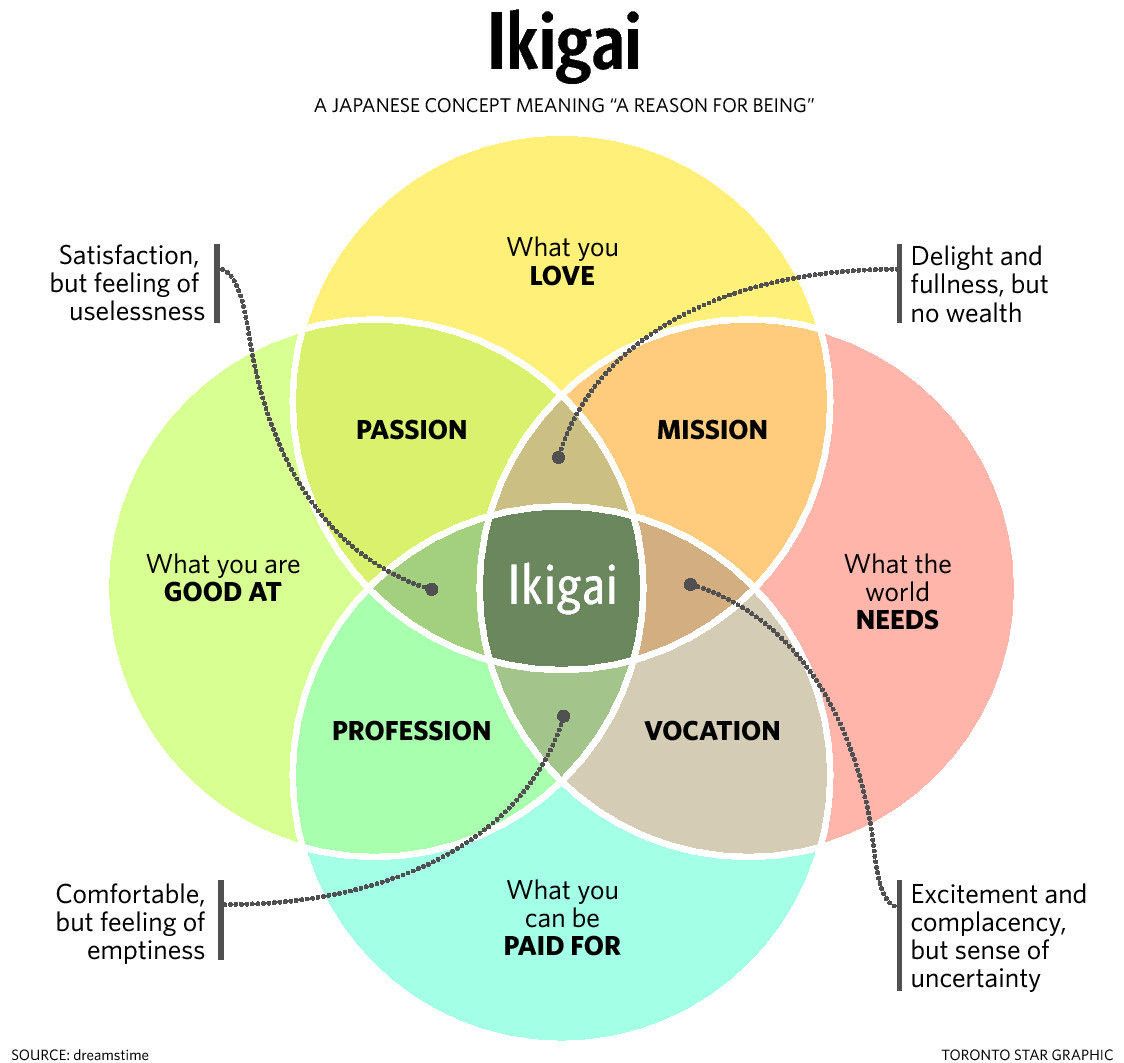
The reason I said "(perhaps inaccurately)" is because as far as I know, the Venn diagram came from an article from a European country and only later did someone slap the "ikigai" label on it and make it famous.
It was what they DON’T do that put me off.
Silly me, I thought they spent most of their time doing research!!!
https://www.tsa.gov/travel/security-screening/whatcanibring/...
i recently spoke with an extended family member who works a secure 9-5 job for which they are paid well, requires little effort, is physically active but not taxing. they feel pressured by society or internal expectations to reach for something more challenging
they are young and asked if i have advice. i told them them are in an ideal situation and not to care so much about work. they can consider that box checked and seek satisfaction outside collecting paychecks
this is like a lifelong smoker telling their relative never to smoke. programming is my biggest hobby
That sounds more like biomedical research than chemistry? At the risk of stating the overly obvious to you do keep in mind how great the differences are between subfields. Synthetic organic versus materials science labs will look like entirely different professions from the perspective of a layman glancing in the window (which they are I suppose).
photo cred: my dad
I meet a lot of people who don’t like their jobs, and when I ask them what they’d rather do instead, about 75% say something like, “Oh, I dunno, I’d really love to run a little coffee shop.” If I’m feeling mischievous that day, I ask them one question: “Where would you get the coffee beans?”
If that’s a stumper, here are some followups:
Which kind of coffee mug is best?
How much does a La Marzocco espresso machine cost?
Would you bake your blueberry muffins in-house or would you buy them from a third party?
What software do you want to use for your point-of-sale system? What about for scheduling shifts?
What do you do when your assistant manager calls you at 6am and says they can’t come into work because they have diarrhea?
The point of the Coffee Beans Procedure is this: if you can’t answer those questions, if you don’t even find them interesting, then you should not open a coffee shop, because this is how you will spend your days as a cafe owner. You will not be sitting droopy-lidded in an easy chair, sipping a latte and greeting your regulars as you page through Anna Karenina. You will be running a small business that sells hot bean water.
The Coffee Beans Procedure is a way of doing what psychologists call unpacking. Our imaginations are inherently limited; they can’t include all details at once. (Otherwise you run into Borges’ map problem—if you want a map that contains all the details of the territory that it’s supposed to represent, then the map has to be the size of the territory itself.) Unpacking is a way of re-inflating all the little particulars that had to be flattened so your imagination could produce a quick preview of the future, like turning a napkin sketch into a blueprint.1
When people have a hard time figuring out what to do with their lives, it’s often because they haven’t unpacked. For example, in grad school I worked with lots of undergrads who thought they wanted to be professors. Then I’d send ‘em to my advisor Dan, and he would unpack them in 10 seconds flat. “I do this,” he would say, miming typing on a keyboard, “And I do this,” he would add, gesturing to the student and himself. “I write research papers and I talk to students. Would you like to do those things?”
Most of those students would go, “Oh, no I would not like to do those things.” The actual content of a professor’s life had never occurred to them. If you could pop the tops of their skulls and see what they thought being a professor was like, you’d probably find some low-res cartoon version of themselves walking around campus in a tweed jacket going, “I’m a professor, that’s me! Professor here!” and everyone waving back to them going, “Hi professor!”
Or, even more likely, they weren’t picturing anything at all. They were just thinking the same thing over and over again: “Do I want to be a professor? Hmm, I’m not sure. Do I want to be a professor? Hmm, I’m not sure.”
Why is it so hard to unpack, even a little bit? Well, you know how when you move to a new place and all of your unpacked boxes confront you every time you come home? And you know how, if you just leave them there for a few weeks, the boxes stop being boxes and start being furniture, just part of the layout of your apartment, almost impossible to perceive? That’s what it’s like in the mind. The assumptions, the nuances, the background research all get taped up and tucked away. That’s a good thing—if you didn’t keep most of your thoughts packed, trying to answer a question like “Do I want to be a professor?” would be like dumping everything you own into a giant pile and then trying to find your one lucky sock.
When you fully unpack any job, you’ll discover something astounding: only a crazy person should do it.
Do you want to be a surgeon? = Do you want to do the same procedure 15 times a week for the next 35 years?
Do you want to be an actor? = Do you want your career to depend on having the right cheekbones?
Do you want to be a wedding photographer? = Do you want to spend every Saturday night as the only sober person in a hotel ballroom?
If you think no one would answer “yes” to those questions, you’ve missed the point: almost no one would answer “yes” to those questions, and those proud few are the ones who should be surgeons, actors, and wedding photographers.
High-status professions are the hardest ones to unpack because the upsides are obvious and appealing, while the downsides are often deliberately hidden and tolerable only to a tiny minority. For instance, shortly after college, I thought I would post a few funny videos on YouTube and, you know, become instantly famous2. I gave up basically right away. I didn’t have the madness necessary to post something every week, let alone every day, nor did it ever occur to me that I might have to fill an entire house with slime, or drive a train into a giant pit, or buy prosthetic legs for 2,000 people. If you read the “leaked” production guide written by Mr. Beast, the world’s most successful YouTuber, you’ll quickly discover how nutso he is:
I’m willing to count to one hundred thousand, bury myself alive, or walk a marathon in the world’s largest pairs of shoes if I must. I just want to do what makes me happy and ultimately the viewers happy. This channel is my baby and I’ve given up my life for it. I’m so emotionally connected to it that it’s sad lol.
(Those aren’t hypothetical examples, by the way; Mr. Beast really did all those things.)
Apparently 57% of Gen Z would like to be social media stars, and that’s almost certainly because they haven’t unpacked what it would actually take to make it. How many of them have Mr. Beast-level insanity? How many are willing to become indentured servants to the algorithm, to organize their lives around feeding it whatever content it demands that day? One in a million?
Another example: lots of people would like to be novelists, but when you unpack what novelists actually do, you realize that basically no one should be a novelist. For instance, how did Tracy Wolff, author of the Crave “romantasy” series, become one of the most successful writers alive? Well, this New Yorker piece casually mentions that Wolff wrote “more than sixty” books between 2007 and 2018. That’s 5.5 novels per year, every year, for 11 years, before she hit it big. And she’s still going! She has so many books now that her website has a search bar. Or you can browse through categories like “Contemporary Romance (Rock Stars/Bad Boys)”, “Contemporary Erotic Billionaire Romance”, “Contemporary Romance (Harlequin Desire)”, and “Contemporary New Adult Romance (Snowboarders!)”.
You may not like it, but this is what peak performance looks like. (source)
Wolff and Beast might seem extreme, but they’re only extreme in terms of output, not in terms of time on task. This is the obvious-but-overlooked insight that you find when you unpack: people spend so much time doing their jobs. Hours! Every day! It’s 2pm on a Tuesday and you’re doing your job, and now it’s 3:47pm and you’re still doing it. There’s no amount of willpower that can carry you through a lifetime of Tuesday afternoons. Whatever you’re supposed to be doing in those hours, you’d better want to do it.
For some reason, this never seems to occur to people. I was the tallest kid in my class growing up, and older men would often clap me on the back and say, “You’re gonna be a great basketball player one day!” When I’d balk, they’d be like, “Don’t you want to be on a team? Don’t you want represent your school? Don’t you want to wear a varsity jacket and go to regionals?” But those are the wrong questions. The right questions, the unpacked questions, are: “Do you want to spend three hours practicing basketball every day? Do you want to dribble and shoot over and over again? On Thursday nights, do you want to ride the bus and sit on the bench while your more talented friends compete, secretly hoping that Brent sprains his ankle so you could have a chance to play?” And honestly, no! I don’t! I’d rather be at home playing Runescape.
When you come down from the 30,000-foot view that your imagination offers you by default, when you lay out all the minutiae of a possible future, when you think of your life not as an impressionistic blur, but as a series of discrete Tuesday afternoons full of individual moments that you will live in chronological order and without exception, only then do you realize that most futures make sense exclusively for a very specific kind of person. Dare I say, a crazy person.
Fortunately, I have good news: you are a crazy person.
I don’t mean you’re crazy in the sense that you have a mental illness, although maybe you do. I mean crazy in the sense that you are far outside the norm in at least one way, and perhaps in many ways.
Some of you guys wake up at 5am to make almond croissants, some of you watch golf on TV, and some of you are willing to drive an 80,000-pound semi truck full of fidget spinners across the country. There are people out there who like the sound of rubbing sheets of Styrofoam together, people who watch 94-part YouTube series about the Byzantine Empire, people who can spend an entire long-haul flight just staring straight ahead. Do you not realize that, to me, and to almost everyone else, you are all completely nuts?
No, you probably don’t realize that, because none of us do. We tend to overestimate the prevalence of our preferences, a phenomenon that psychologists call the “false consensus effect”3. This is probably because it’s really really hard to take other people’s perspectives, so unless we run directly into disconfirming evidence, we assume that all of our mental settings are, in fact, the defaults. Our idiosyncrasies may never even occur to us. You can, for instance, spend your whole life seeing three moons in the sky, without realizing that everybody else sees only one:
the first time i looked up into the night sky after i got glasses, [I] realized that you can, in fact, see the moon clearly. i assumed people who depicted it in art were taking creative license bc they knew it should look like that for some reason, and that the human eye was incapable of seeing the moon without also seeing two other, blurrier moons, sort of overlapping it
In my experience, whenever you unpack somebody, you inevitably discover something extremely weird about them. Sometimes you don’t have to dig that far, like when your friend tells you that she likes “found” photographs—the abandoned snapshots that turn up at yard sales and charity shops—and then adds that she has collected 20,000 of them. But sometimes the craziness is buried deep, often because people don’t think it’s crazy at all, like when a friend I knew for years casually disclosed that she had dumped all of her previous boyfriends because they had been insufficiently “menacing”.
This is why people get so brain-constipated when they try to choose a career, and why they often pick the wrong one: they don’t understand the craziness that they have to offer, nor the craziness that will be demanded of them, and so they spend their lives jamming their square-peg selves into round-hole jobs. For example, when I was in academia, there was this bizarre contingent of administrators who found college students vaguely vexing and exasperating. When the sophomores would, say, make a snowman in the courtyard with bodacious boobs, these dour admins would shake their heads and be like, “College kids are a real pain in the ass, huh!” They didn’t seem to realize that their colleagues actually liked hanging out with 18-22 year-olds, and that the occasional busty snowman was actually what made the job interesting. I don’t think these curmudgeonly managers even thought such a preference was possible.
Another example: when I was a pimply-faced teenager, I went to this dermatologist who always seemed annoyed to see patients. Like, how dare we bother him by seeking the services that he provides? Meanwhile, Dr. Pimple Popper—a YouTube account that does exactly what it says on the tin—has nearly 9 million subscribers. Clearly, there are people out there who find acne fascinating, and dermatology is the one of the most competitive medical specialties, but apparently you can, through sheer force of will, lack of self-knowledge, and refusal to unpack the details, earn the right to do a job you hate for the rest of your life.
On the other hand, when people match their crazy to the right outlet, they become terrifyingly powerful. A friend from college recently reminded me of this guy I’ll call Danny, who was crazy in a way that was particularly useful for politics, namely, he was incapable of feeling humiliated. When Danny got to campus freshman year, he announced his candidacy for student body president by printing out like a thousand copies of his CV—including his SAT score!—and plastering them all over campus. He was, of course, widely mocked. And then the next year, he won. It turns out that people vote for the name that they recognize, and it doesn’t really matter why they recognize it. By the time Danny ran for reelection and won in a landslide, he was no longer the goofy freshman who taped a picture of his own face to every lamp post. At that point, he was the president.45
Unpacking is easy and free, but almost no one ever does it because it feels weird and unnatural. It’s uncomfortable to confront your own illusion of explanatory depth, to admit that you really have no idea what’s going on, and to keep asking stupid questions until that changes.
Making matters worse, people are happy to talk about themselves and their jobs, but they do it at this unhelpful, abstract level where they say things like, “oh, I’m the liaison between development and sales”. So when you’re unpacking someone’s job, you really gotta push: what did you do this morning? What will you do after talking to me? Is that what you usually do? If you’re sitting at your computer all day, what’s on your computer? What programs are you using? Wow, that sounds really boring, do you like doing that, or do you endure it?
You’ll discover all sorts of unexpected things when unpacking, like how firefighters mostly don’t fight fires, or how Twitch streamers don’t just “play video games”; they play video games for 12 hours a day. But you’re not just unpacking the job; you’re also unpacking yourself. Do any aspects of this job resemble things you’ve done before, and did you like doing those things? Not “Did you like being known as a person who does those things?” or “Do you like having done those things?” but when you were actually doing them, did you want to stop, or did you want to continue? These questions sound so stupid that it’s no wonder no one asks them, and yet, somehow, the answers often surprise us.
That’s certainly true for me, anyway. I never unpacked any job I ever had before I had it. I would just show up on the first day and discover what I had gotten myself into, as if the content of a job was simply unknowable before I started doing it, a sort of “we have to pass the bill to find out what’s in it” kind of situation. That’s how I spent the summer of 2014 as a counselor at a camp for 17-year-olds, even though I could have easily known that job would require activities that I hated, like being around 17-year-olds. Could I have known specifically that my job would include such tasks as “escorting kids across campus because otherwise they’ll flee into the woods” or “trying to figure out whether anyone brought booze to the dance by surreptitiously sniffing kids’ breath?” No. But had I unpacked even a little bit, I would have picked a different way to spend my summer, like selling booze to kids outside the dance.
It’s no wonder that everyone struggles to figure what to do with their lives: we have not developed the cultural technology to deal with this problem because we never had to. We didn’t exactly evolve in an ancestral environment with a lot of career opportunities. And then, once we invented agriculture, almost everyone was a farmer the next 10,000 years. “What should I do with my life?” is really a post-1850 problem, which means, in the big scheme of things, we haven’t had any time to work on it.
The beginning of that work is, I believe, unpacking. As you slice open the boxes and dump out the components of your possible futures, I hope you find the job that’s crazy in the same way that you are crazy. And then I hope you go for it! Shoot for the stars! Even if you miss, you’ll still land on one of the three moons.
There is also a “false uniqueness effect”, but it seems to show up more rarely, on traits where people are motivated to be better than others, or when people have biased information about themselves. So people who like Hawaiian pizza probably think their opinion is more common than it is (false consensus). But if you pride yourself on the quality of your homemade Hawaiian pizza, you probably also overestimate your pizza-making skills (false uniqueness).
I’m pretty sure every campus politician was like this. During one election cycle, the pro-Palestine and pro-Israel groups started competing petitions to remove/keep a brand of hummus in the dining hall that allegedly had ties to the IDF. One of the guys running for class rep signed both petitions. When someone called him out, his response was something like, “I’m just glad we’re having dialogue.” Anyway, he won the election.
A few years later, a sophomore ran for student body president on a parody campaign, promising waffle fries and “bike reform.” He won a plurality of votes in the general election, but lost in the runoff, though he did get a write-up in the New York Times. Now he’s a doctor.
Top-tier insanity can sometimes make up for mid-tier talent. I’ve been in five-ish different improv communities, and in every single one there was someone who was pretty successful despite not being very good at improv. These folks were willing to mortgage the rest of their life to support their comedy habit—they’d half-ass their jobs, skip class, ignore their partners and kids, and in return they could show up for every audition, every gig, every side project. Their laser focus on their dumb art didn’t make them great, but it did make them available. Everybody knew them because they were always around, and so when one of your cast mates dropped out at the last second and you needed someone to fill in, you’d go, “We can always call Eric.” If you’ve ever seen someone on Saturday Night Live who isn’t very funny and wondered to yourself, “How did they get there?”, maybe that’s how.
I want a nice lawn, but I don't want to mow it myself. I pay a landscaper. I don't think that makes me a bad person.
But it does make me a different person from someone who enjoys the process of manicuring a lawn.
> I actually don't like programming
Right, that's my point exactly.
> in my experience, those people tends to solve inexistant problems
Yes, that's definitely a risk with people who really just love writing code. Fortunately, most people who like to write code also like to have useful code written, so in my experience, the folks who will go off an yak shave a thing no one needs for months are fairly rare.
I guess you could say I'm passionate about testing and observability, though that doesn't really describe how I feel. It just puts me in a sour mood when something breaks and we could have prevented it with better practices from the start.
I dreamt of going to college just to learn the things I wanted to know, not to make money. Even imagined learning them and then finding a job don g something else.
Was just very fortunate that it ended up in a lucrative field.
One relative tried to persuade me to go into medicine or law to make more. Put it as “you’re going to work the same hours so might as well be better paid.”
So glad I didn’t take their advice…
Ideally. In reality, that's impossible to enforce.
But you have to do something, choose something. So it's almost better if you don't think too hard, just do it and find out, learn to become content with it.
>The more powerful the tool, the more responsible its wielder should behave.
I will argue that this is a false pretense, in part that you say it's impossible to enforce, but also for the fact that it does not happen in reality.Anyone with a will to an objective will utilize any tools at their disposal, only the observer from another perspective will judge that this is 'good or not'. To the beholder, this has become the only way to achieve their goals.
An anecdote goes by the lady who was using a ww2 era hand grenade to crush spices in her kitchen for decades without anything happening. Goals were met and nothing bad happened but general consensus states that this is bad for many reasons, to which nothing happened.
Maybe it's not only responsibility, but the capability for one to understand the situation one is in and what is at their disposal. ..and a hint of 'don't be evil' that leads to good outcomes despite what everyone thinks.
This understanding, and hint of broader/benevolent perspective, is what I meant by responsibility.
I'm not so naive as to expect it in general but I have known it to exist, that there are people who respect the responsibility implicit in proper use of their tools. The world is a labyrinth of prisoners' dilemmas so I get that there's a reasonable argument for being "irresponsible" whatever that means in the context.