
3I/ATLAS … still not an alien spacecraft! The Gemini Multi-Object Spectrograph on the Gemini North telescope on Maunakea in Hawaii is one of many Earth and space instruments that have caught images of the world’s 3rd-known interstellar object, 3I/ATLAS. And the images all look basically the same. They nearly all show a coma, a cloud of gas and dust that forms around a comet’s icy nucleus in the vicinity of the sun. Image via International Gemini Observatory/ NOIRLab/ NSF/ AURA/ B. Bolin. Image processing by J. Miller & M. Rodriguez/ T.A. Rector/ M. Zamani.
Comet 3I/ATLAS makes its closest approach to Earth
The world’s 3rd known interstellar object – 3I/ATLAS – made its closest pass of the sun back on October 29, 2025. It’s now heading out of the solar system. But not before it makes its closest pass by Earth, which happens today (December 19, 2025). At its closest point, 3I/ATLAS will pass within 1.8 AU (168 million miles or 270 million km) of Earth. So it’s not really close. It’s farther than the sun, Mercury, Venus and Mars all get from Earth. But it’s the closest this object will come.
The latest news on Comet 3I/ATLAS involves its source of acceleration. The comet is ripping through our solar system at around 130,000 miles per hour (210,000 kph). That’s the highest velocity ever recorded for a solar system visitor. In a paper published in the Research Notes of the AAS on December 9, 2025, scientists discuss the comet’s non-gravitational acceleration. Its gravitational acceleration is from passing the sun. But the non-gravitational acceleration is not – as some hoped – from an alien engine. It’s from outgassing. Because, of course, this interstellar object is a comet, and comets sublimate icy material when they get near stars. The scientists used data from multiple spacecraft to measure the small accelerations.

The Lucy mission captured interstellar object Comet 3I/ATLAS on September 16, 2025. Lucy is on a mission to the Trojan asteroids near Jupiter. It saw the comet from about 240 million miles (390 million km) away. Image via NASA.
NASA shared new images of Comet 3I/ATLAS
NASA held a press conference on November 19, 2025, to share the images that various space missions have collected of Comet 3I/ATLAS. Associate Administrator Amit Kshatriya started the conference by reassuring the public that this interstellar object is indeed a comet, and nothing related to extraterrestrial life, which has been widely speculated on social media.
You can rewatch the press conference in the player below. Read on for the newest images.
Rewatch the press conference from November 19, 2025, in this player. NASA revealed new images of interstellar object Comet 3I/ATLAS.
See the new images of the 3I/ATLAS from NASA
NASA turned many of its spacecraft and space telescopes at Comet 3I/ATLAS, only the 3rd-known visitor to our solar system. The closest to get a look at the comet was the Mars Reconnaissance Orbiter. Comet 3I/ATLAS was 19 million miles (31 million km) away when it took the image below on October 2, 2025.

The Mars Reconnaissance Orbiter (MRO) was the closest spacecraft to Comet 3I/ATLAS as it sped through the inner solar system. The HiRISE instrument on board MRO took this image on October 2, 2025, from about 19 million miles (31 million km) away. Image via NASA.

Another Mars spacecraft, MAVEN, captured the spectra of Comet 3I/ATLAS (along with the spectra of Mars). Looking at the wavelengths of light from an object helps astronomers better understand what it’s made of and how it compares to comets from our own solar system. Image via NASA.

Comet 3I/ATLAS from the solar-observing SOHO space telescope. SOHO took the image of Comet 3I/ATLAS from October 15-16, 2025, when it was otherwise too close to the sun for other instruments to see. Image via Lowell Observatory/ Qicheng Zhang/ NASA.

This animation shows PUNCH’s observations of Comet 3I/ATLAS from September 28 to October 10, 2025. At this time, the comet was between 231 to 235 million miles (372 to 378 million km) from Earth. Stars create streaks of light in the background as the comet moves across the sky. The bright object that appears near the comet in a couple of frames is the planet Mars. Image via NASA/ Southwest Research Institute.
See more images at NASA’s gallery.
3I/ATLAS is displaying multiple jets after passing the sun
The amazing astrophotographers Michael Jäger, Gerald Rhemann and Enrico Prosperi shared early images of 3I/ATLAS as it emerged from its closest passage near our star. Its closest approach to our sun was October 29, 2025. Now the object is in view – for telescope users – in the eastern predawn sky.
The trio posted images on the page ICQ Comet Observations on Facebook. There are a couple of other images there too, in addition to the one below. Wonderful work! Thank you for this image, which shows that the object – a comet from another star system – has been affected, as comets often are, by its close passage near our sun.
And now, the object displays multiple jets, streaming out in all directions.

M. Jäger, G. Rhemann, and E. Prosperi caught the interstellar object in a photo and wrote on November 8, 2025, at the Facebook page ICQ Comet Observations: “3I/ATLAS showed a complex tail structure early this morning. We observed it at 29 degrees elongation from the sun … At the time of exposure, the comet was 7-10 degrees above the [eastern predawn] horizon. At the end, twilight interfered with the observation, which took place under bright moonlight. We observed from a mountain location.” Image via M. Jäger, G. Rhemann, E. Prosperi.
Interstellar object captured as it passed the sun

Here’s 3I/ATLAS – the world’s 3rd-known interstellar object to pass through our solar system – around the time it passed nearest the sun. NOAA’s CCOR-1 coronagraph aboard the GOES-19 satellite caught this image. And citizen scientist Worachate Boonplod spotted the comet in this image. Way to go, Worachate! Image via Space Weather Prediction Center/ NOAA/ Worachate Boonplod.
Star chart for Comet 3I/ATLAS

Here’s a finder chart for 3I/ATLAS. This object passed behind the sun as seen from Earth in late October 2025. Now it has emerged in the morning sky. Use this chart to aim your telescope … and look for the “star” that appears fuzzy! Image via Bob King, aka AstroBob.
Interstellar object 3I/ATLAS is now leaving the solar system
3I/ATLAS – the world’s 3rd-known object to enter our solar system from interstellar space – made its closest pass by our sun at 11:47 UTC (6:47 a.m. CDT) on October 29, 2025. At that time, the object – which is thought to be a comet from another solar system – was about 1.36 AU (1.36 Earth-sun distances, about 126 million miles or 203 million km) from our star.
The object is now headed out of our solar system again. But 3I/ATLAS hasn’t yet made its closest pass by Earth. That will come later, around December 19, 2025, when it will be about 1.8 AU (168 million miles or 270 million km) from Earth. However, 3I/ATLAS will never be visible with the eye alone from Earth. Telescope party, anyone?

Interstellar object 3I/ATLAS sped toward our sun, presumably for billions of years. On October 29, 2025, it made its closest pass by the sun. As of now, its journey toward our sun has ended, and it’s leaving our solar system. But the chance still exists for you to see it with a telescope! Animation via Tony Dunn.
Is 3I/ATLAS visible to the unaided eye?
So 3I/ATLAS is not visible with the unaided eye from Earth. You’ll need at least an 8-inch (20 cm) telescope, or a larger scope. And the best time for seeing it will probably be late November, when the object is still in the morning sky.
If you spot it then, you’ll be in good company. Between November 2 and 25, ESA’s Jupiter Icy Moons Explorer (JUICE) is observing the comet with various instruments. As JUICE looks toward 3I/ATLAS so soon after its closest approach to the sun, it is likely to have the best view of the comet in a very active state, with a bright halo around its nucleus and a long comet tail stretching out behind it.
JUICE’s team doesn’t expect to receive data from its observations until February 2026. Find out why here.
In addition, there are 2 other comets visible (or nearly visible) in our night sky now:
Comet Lemmon might be the best comet of 2025

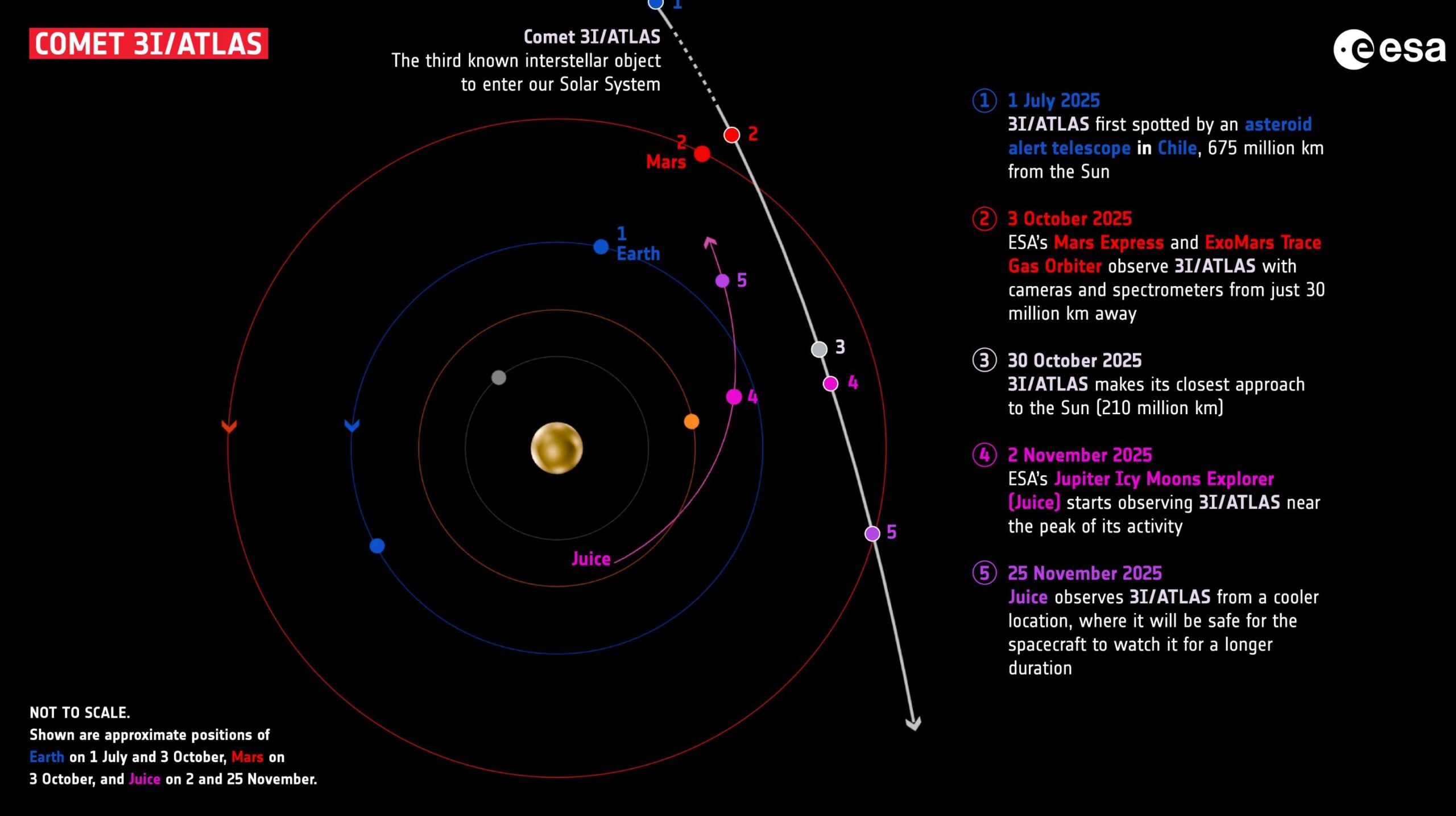
View larger. | Infographic showing the path of comet 3I/ATLAS, the 3rd interstellar object known to enter our solar system. It displays the orbits of Earth, Mars and ESA’s Juice spacecraft around the sun, along with key dates and events as comet 3I/ATLAS travels through the inner solar system in 2025. Colored and numbered dots mark important observation points by telescopes and spacecraft. Image via ESA.
EarthSky’s Deborah Byrd and veteran skywatcher Bob King, aka AstroBob, talked about seeing 3 comets in the sky in late October and early November. They are comets Lemmon, SWAN and the interstellar wonder 3I/ATLAS.
How to track the interstellar object 3I/ATLAS
If you’re interested in tracking the object, NASA’s Eyes on the Solar System tool offers interactive simulations of its path. Also, NASA recently launched a new page devoted to 3I/ATLAS.
There was a lot of excitement when this object passed Mars on October 3, 2025. The hope was that some Mars spacecraft might be turned to see the object. Keep reading to learn what happened.
Interstellar object 3I/ATLAS passed Mars on October 2-3, 2025
The world’s 3rd known interstellar object – 3I/ATLAS – made its closest approach to Mars at 4 UTC on October 3, 2025 (11 p.m. CDT on October 2). At that time, the comet was approximately 18 million miles (29 million kilometers) from Mars. It was the object’s closest approach to any planet during its one-time journey through our solar system.
According to the European Space Agency (ESA), both the ExoMars Trace Gas Orbiter (TGO) and Mars Express turned their cameras toward 3I/ATLAS as it passed near Mars between October 1-7, 2025.
TGO’s CaSSIS instrument captured a series of images on October 3, 2025, when the comet was approximately 20 million miles (32 million km) away from the spacecraft. The images showed the comet as “a slightly fuzzy white dot” amidst streaked stars. See an animated gif – made from these images – below.
The images were challenging because the spacecraft’s imaging system is designed for the bright surface of Mars (just hundreds to thousands km away), yet this target was orders of magnitude farther and much fainter. Read more about the flyby and the TGO images here.
So, ESA’s ExoMars Trace Gas Orbiter did capture an image, but it did not show much. So far, we have not seen an image from the Mars Express of 3I/ATLAS specifically.

Here are the images from ESA’s ExoMars Trace Gas Orbiter (TGO) as it turned its eyes toward interstellar object Comet 3I/ATLAS on October 3, 2025. Comet 3I/ATLAS is the slightly fuzzy white dot moving downward near the middle of the image. Despite not being designed to capture something so far away, ExoMars TGO revealed the coma of gas and dust surrounding the icy-rocky nucleus. Image via ESA/ TGO/ CaSSIS.
Interstellar object 3I/ATLAS: A look backward
Where did 3I/ATLAS come from? We know it came from the Sagittarius direction in our sky; that is, it came from the direction of the center of our Milky Way galaxy. But there are billions of stars in that direction. Which one is the home system of this object?
There have been many studies and ideas. One team of scientists, led by Xabier Pérez-Couto of the University of A Coruña in Spain, traced the path of interstellar object 3I/ATLAS back 10 million years. The astronomers were seeking its origin star, or any stars that might have perturbed its path as it traveled from its point of origin to our solar system.
Data from Gaia
The researchers examined 3I/ATLAS’s trajectory with the help of the Gaia space observatory’s data on stars. For 12 years, Gaia collected data on billions of stars in our Milky Way galaxy, precisely noting their positions again and again and thereby determining their motions. These astronomers’ calculations took them more than 100 million astronomical units (AU, or Earth-sun units) from our solar system. With these data in hand, researchers said they identified 93 nominal “encounters” for 3I/ATLAS, 62 of which were “significant.” Yet, they found that none of those encounters produced any meaningful perturbation of ATLAS’s orbit.
So, in other words, all of those 93 (or 62) encounters happened too fast, with the stars too far from 3I/ATLAS to meaningfully impact its trajectory. In the end, they didn’t find a star along 3I/ATLAS’s path that might have been responsible for bringing this 3rd-known interstellar object to us.

Here’s an image of interstellar object Comet 3I/ATLAS from the Gemini Multi-Object Spectrograph (GMOS) on the Gemini South telescope at Cerro Pachón in Chile. NOIRLab released this image on September 4, 2025. The colors of the background stars are due to 4 filters. The comet was fixed in the center of the telescope’s field of view, while the positions of the background stars changed, showing streaks. Image via International Gemini Observatory/ NOIRLab/ NSF/ AURA/ Shadow the Scientist. Image Processing: J. Miller & M. Rodriguez (International Gemini Observatory/NSF NOIRLab), T.A. Rector (University of Alaska Anchorage/NSF NOIRLab), M. Zamani (NSF NOIRLab).
Tracing 3I/ATLAS’ path, a daunting task
And, as you might imagine, tracing 3I/ATLAS’ path backward through the galaxy is a daunting task. That’s in part because small uncertainties in orbits and stellar motions grow rapidly over time. But based on the researchers’ analyses of the interstellar object’s vertical motion in the galaxy (its path is known to weave up and down in the galactic disk), they concluded that it likely originated from the Milky Way’s thin disk, not its thick disk as was mentioned some months ago. The thin disk contains somewhat younger objects than the thick disk. But the researchers’ paper said:
[3I/ATLAS] may nonetheless be an old object, consistent with ejection from a long-lived primordial planetesimal disk in an early-formed system.
The scientists published their not-yet peer-reviewed paper on arXiv on September 10, 2025.

This diagram shows the thin disk of the Milky Way in teal and the thick disk in yellow. A new paper says Comet 3I/ATLAS likely came from the Milky Way’s thin disk. Image via Gaba P/ Wikipedia (CC BY-SA 3.0).
Unlocking galactic mysteries with 3I/ATLAS
3I/ATLAS is thought to have been drifting through interstellar space for many billions of years before encountering our solar system. Pérez-Couto and team said that the interstellar comet is a:
… key probe of the galactic population of icy planetesimals.
In other words, the formation of solar systems is a messy process. In a solar system’s earliest days, rocks and pockets of gas and dust bang into each other and get swept up into clumps, which eventually get big enough to begin gathering yet more rocks, gas and dust to themselves via the force of gravity. Thus, planets come to be, astronomers think. According to theories of planet formation, clearing processes are also common, and those sometimes involve material – often the outer, icy regions of debris – getting ejected from a system altogether. As the paper said:
… interstellar space should be filled with planetesimals.

In mid-September, the data at the Comet Observation database (COBS), maintained by Crni Vrh Observatory, showed that interstellar comet 3I/ATLAS was outperforming expectations. It was brightening faster than expected. Image via COBS (CC BY 4.0).
Other possibilities
Plus, there are other ways these interstellar interlopers might have achieved their lonely paths through our Milky Way galaxy. The possibilities range from close passages of other stars to tidal fragmentation of comets. So, as the paper said:
Identifying the origin of interstellar objects is key to understanding planet formation efficiency, the distribution of volatiles and organics in the galaxy, and the dynamical pathways by which planetary systems evolve.
All that from a small chunk of icy stuff (we know it’s icy in part because 3I/ATLAS has formed a tail, as icy comets do)!
EarthSky interview with Colin Orion Chandler
On August 7, 2025, NASA shared an updated estimate of the size of the object’s nucleus, or core. Shortly after the object was first identified on July 1, 2025, 3I/ATLAS was estimated to have a diameter of about 12 miles (20 km). Then in late July – using data from the new Vera C. Rubin Observatory in Chile – the size estimate dropped to 6 miles (10 km). The latest analysis uses data from the NASA/ESA Hubble Space Telescope. It reduces the estimated diameter of 3I/ATLAS’s nucleus still further, to 3.5 miles (5.6 km).
And, the astronomers using Hubble data said, the object could be even smaller, as small as 1,050 feet (320 meters) across!
EarthSky’s Deborah Byrd interviewed Colin Orion Chandler of the DiRAC Institute of the University of Washington about size estimates for 3I/ATLAS. Watch in the player below, or on YouTube.
By the way, the two previously known interstellar objects are 1I/ ‘Oumuamua and 2I/Borisov. ‘Oumuamua’s size is thought to be about 656 feet (200 meters) across at its widest (you’ll recall it has an elongated shape). And Borisov is thought to be less than 3,280 feet (1 km) across.

View larger. | The Hubble Space Telescope captured this image of interstellar object 3I/ATLAS on July 21, 2025. It was the sharpest image yet of the object, acquired when the object was 277 million miles (446 million km) from Earth. This object is now generally believed to be a comet by most astronomers. In this image, a comet-like, teardrop-shaped cocoon of dust can be seen coming off its solid, presumably icy nucleus. Image via NASA/ ESA/ D. Jewitt (UCLA); Image Processing: J. DePasquale (STScI).

An early EarthSky interview with Matthew Hopkins
Shortly after the discovery of 3I/ATLAS – on July 1, 2025 – astronomers said it was likely the oldest comet we’ve ever seen. That claim came from University of Oxford astronomer Matthew Hopkins, whose analysis suggested 3I/ATLAS might be more than 7 billion years old, predating our solar system by more than 3 billion years! Hear him explain in the player below, or on YouTube.
EarthSky interview with Colin Snodgrass
Scientists first spotted 3I/ATLAS in early July 2025. And since then, people have asked one question countless times: will we send out a spacecraft to take a closer look? EarthSky’s Will Triggs spoke to University of Edinburgh astronomer Colin Snodgrass on August 21, 2025, to find out the answer. Colin essentially said, no, we don’t have time to organize a space mission specifically for 3I/ATLAS. But he talked about a future mission, the European Space Agency’s Comet Interceptor. This upcoming spacecraft will be primed to intercept future interstellar objects. Watch Will’s interview with Colin in the player below, or on YouTube.
It’s worth noting that the behavior of 3I/ATLAS is much like the signature of previously seen sun-bound comets originating within our solar system. But 3I/ATLAS is moving fast. In fact, it’s traveling through our solar system at roughly 130,000 miles per hour (210,000 kph). That’s the highest velocity ever recorded for a solar system visitor.
How they spotted interstellar object 3I/ATLAS
The Asteroid Terrestrial-impact Last Alert System (ATLAS) – a system of survey telescopes – detected our new interstellar visitor on July 1, 2025. And the Minor Planet Center confirmed its interstellar nature the following day (July 2, 2025), naming it 3I/ATLAS (or C/2025 N1). The “3I” means it’s the 3rd interstellar visitor that we’ve found. Its trajectory and speed revealed it as an object not from our solar system, but from another star system.
The Hubble Space Telescope imaged the object on July 21, 2025. See the post from Bluesky below.
Hubble Space Telescope images of interstellar comet 3I/ATLAS are out! These were taken 5 hours ago. Plenty of cosmic rays peppering the images, but the comet's coma looks very nice and puffy. Best of luck to the researchers trying to write up papers for this… archive.stsci.edu/proposal_sea… ?
— astrafoxen (@astrafoxen.bsky.social) July 21, 2025 at 4:28 PM

View larger. | A side-on view of the Milky Way, showing the estimated orbits of both our sun and Comet 3I/ATLAS. In this artist’s concept, 3I/ATLAS is the red dashed line, and the sun’s path is the yellow dotted line. The large extent of 3I’s orbit vertically into the outer thick disk is clear. Meanwhile, the sun stays nearer the plane of the galaxy. Image via Royal Astronomical Society/ M. Hopkins/ Otautahi-Oxford team. Base map: ESA/ Gaia/ DPAC, Stefan Payne-Wardenaar (CC BY 4.0).


On the left, the interstellar object Comet 3I/ATLAS streaks across a dense star field as seen by the Gemini North Telescope in Hawaii. The colors are courtesy of 3 filters: red, green and blue. On the right, an inset shows the comet’s compact coma, or cloud of gas and dust surrounding its icy nucleus. NOIRLab released this image on July 15, 2025. Image via International Gemini Observatory/ NOIRLab/ NSF/ AURA/ K. Meech (IfA/U. Hawaii). Image processing: Jen Miller & Mahdi Zamani (NSF NOIRLab).

3I/ATLAS, the white spot in the center, is approximately 126 million miles (203 million km) from the sun and made its closest approach on October 29. It poses no danger to Earth, coming no closer than 170 million miles (270 million km), which is more than 1.8 astronomical units (AU, or distance from the Earth to the sun). Image via ESA.

View at EarthSky Community Photos. | Filipp Romanov captured the interstellar object on July 2, 2025, when it was still named A11pI3Z. Filipp wrote: “I confirmed new interstellar object candidate A11pl3Z remotely using iTelescope.Net T72 (0.51-m f/6.8 reflector + CCD) in Chile.” Thank you, Filipp!
Morning star charts here
After Comet 3I/ATLAS makes its close approach to the sun, you can find it in the morning sky.

This star chart is for around 5 a.m. CST on December 12, 2025. On that date, the comet will be close to 2 stars and a dim spiral galaxy in the constellation Leo the Lion. Image via Eddie Irizarry/ Stellarium.
Bottom line: Interstellar object Comet 3I/ATLAS makes it closest pass by Earth today (December 19, 2025). How close will it come? And where will it go after this?
Via: