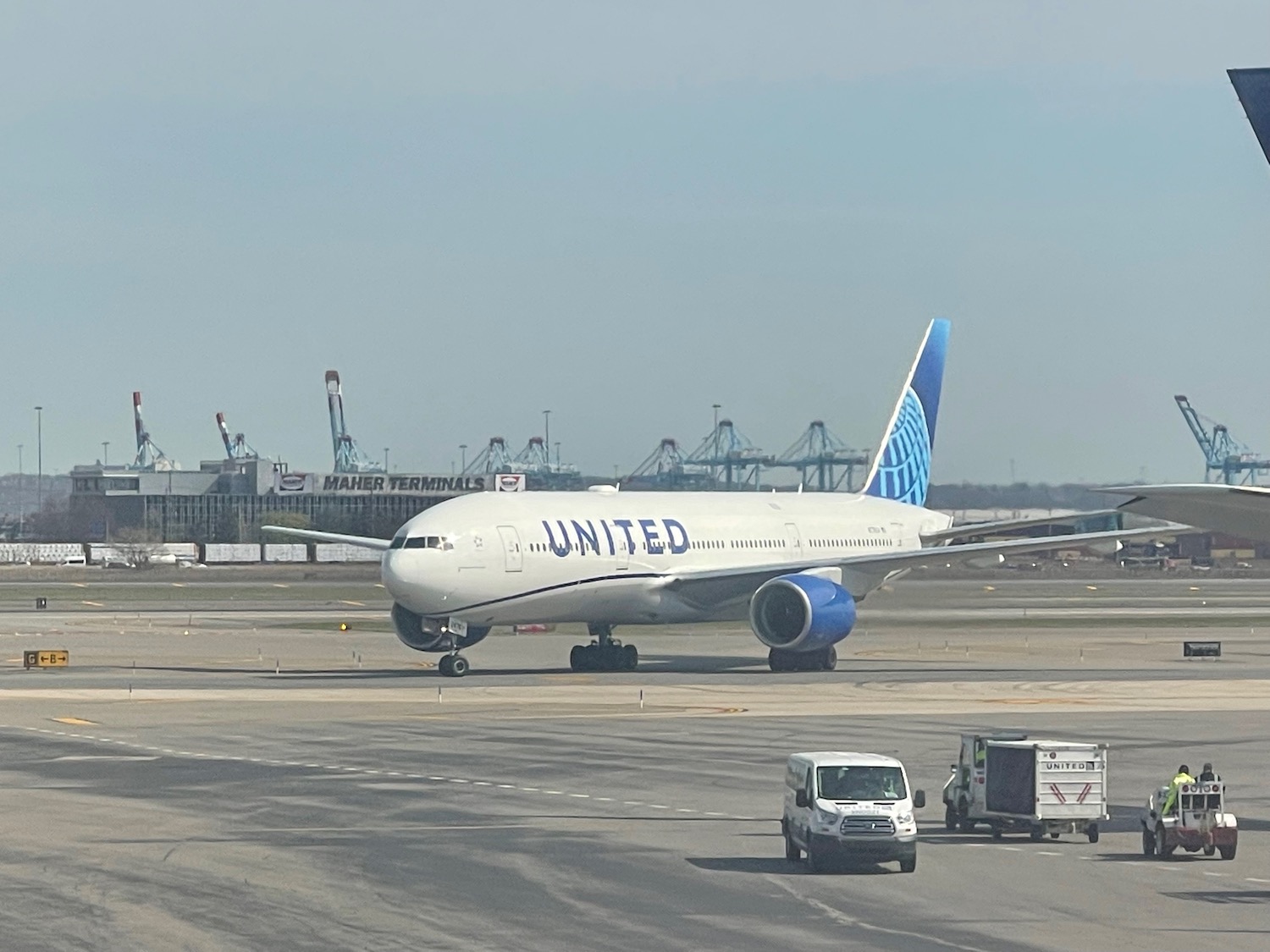
The B777 is probably the safest, most meticulously engineered commercial wide-body aircraft ever built.
They're also getting old, and airlines retire old aircraft.
> The Boeing 777-200 is not an unsafe airplane. As far as I can tell, that is not the issue even after the incident over Dulles over the weekend.
X after Y headlines are always technically correct. Sure, X is presently true. And remember scary/salacious/enraging thing Y that happened recently? So X is after Y. Click me.
There were actual commercials played before the safety video, the cabin crew warned passengers to make sure children cannot see the adult content they're watching (can you get more American than that?), and their credit card was offered multiple times during the flight. At least the WiFi was reasonably cheap.
Over here, that stuff would never fly (no pun intended), except maybe on Ryanair or other extremely low-cost carriers. On e.g. a Lufthansa longhaul flight, which are priced similarly and cover the same route I flew (fra-ord), it would be unthinkable.
To be fair, I read all of it, and both sides of the question interest me. But the engine failure and the economics of the 777 are totally different things.
Being this is the first time a GE90 popped on a 777-200 in a while? Eh, the future’s gonna keep flying ‘em.
A literally true sentence which falsely implies a correlation between events.
Discussion of the 777-200's economic viability has nothing to do with the Dulles incident.
The last pure Boeing product before the merger with McDonnell Douglas…
True, but they do keep the even older 757 flying.
I was on a Virgin Atlantic flight last week, and while there weren't ads before the safety video, there were three ads before every movie I tried to watch... and it was the same three ads each time.
I flew Turkish in October, and was annoyed to find the movies and TV shows heavily censored, including blanking out or dubbing over minor swear words. It was also wild to see the Qur'an in the entertainment system's reading library. (No judgement there, just notable as I've never seen the Christian Bible present on other airlines.)
I think you're just falling victim to the usual thing where what you're used to feels normal, and everything else seems weird. I've definitely experienced the same as an American, when flying on European, Latin American, and Asian airlines.
I fly both airlines regularly, United is _vastly_ better from a hard product perspective, a soft product perspective, and _especially_ a service recovery standpoint.
The credit card thing is easily ignored, but you used to heard it often on European flights too before branded credit cards got wiped out there. I've never heard an announcement about adult content, and have taken over 90 United flights this year.
The largest of the airlines in America make more profit from this than the airline aspect itself.
There is far more that could be said on this but, ironically, I am on a flight and about to land.
Try flying Lufthansa (or one of their half dozen subsidiaries created almost entirely to give worse service) anywhere inside of europe. Everything is a money grab and the service and boarding are terrible.
United maintains a relatively consistent experience between domestic and international, minus the free alcohol.
It's not hard to notice there are other major airlines that generally maintain newer widebody fleets.
They also substantiate the idea that the United 777-200 fleet does face an uncertain future.
On the flipside, what they are looking at replacing the fleet with is an interesting follow-up if you regularly fly United.
Most of flights today are glorified busses, with less room, that just happen to have wings attached and staff trying to sell you things.
American airlines actually lose money on passenger flights - the cash cows are loyalty programs and freight transport [1].
[1] https://www.investopedia.com/the-four-biggest-us-airlines-al...
I had to walk away from a $600 ticket that I booked at the last minute b/c in the 30 seconds between the time I paid for the ticket and the time the booking returned, the connecting flight filled up and I had to wait a day I didn't have for the next one. Couldn't get a single consideration from anyone, they said they couldn't cancel the ticket b/c the first leg was still available. Just had to walk away from the money and find another airline.
I'm sure it happens on every airline but man I was pissed. They go to the bottom of the list until the next tomfoolery occurs.
FWIW, I just took such a flight and didn't notice anything that compares unfavorably to a domestic U.S. airline. (To be clear, it certainly wasn't better either.) Is there anything specific you can point to?
A consistent extremely mediocre experience I guess. I've flown Lufthansa, Air France, Air Canada and United with a toddler and I'd get out of my way to avoid United in the future, never seen staff everywhere in that airline that was more unpleasant and unhelpful, especially with young children, as much as when flying United.
I’ve flown more than 50 flights this year with them.
https://www.theautopian.com/swissair-used-to-let-you-gamble-...
I fly on Lauda most often, who are operated by Ryanair. You show up, you get on, you sit down, a couple of hours you get off again. A trolley comes round with drinks and snacks, but it's a short journey even with a small child. Can't you just stick an orange and a bottle of water in your bag? It's what the Austrians do.
The first time I flew over with my small son he was three, and having been up since 5am was getting a little fractious and fidgety, so I explained he was probably a bit tired and bored and maybe he'd like to eat something and have a sleep, and I'd wake him up once we were back over land.
A bit later on someone further up the plane started remonstrating with the cabin crew that they didn't have the sandwich she wanted on the trolley, eventually shouting "IF IT'S ON THE MENU YOU GAVE ME I SHOULD BE ABLE TO HAVE THE DAMN SANDWICH!"
Well that shut everyone up.
And in the ringing silence that followed, a little voice, with the punch and clarity that only 3-year-olds have, that Brian Blessed or Meat Loaf would have given any limb you care to mention for, piped up:
"DADDY, DOES THAT LADY NEED A SNACK AND A WEE NAP TOO?"
Personally I'd be a lot more interested in the cause(s) of the failure and how it was handled.
It's like dunking on QSR, but worse. These things are practically on welfare.
Everything is fungible, high risk, extremely expensive, extremely regulated. The margins are almost nil. They all fly the same planes. You can compete on "experience", and that's basically it.
Their dingy little ads, baggage fees, and wifi upsells are the the best they can muster. That's the entire farm, and they're scraping by as best they can. This is every single airline.
What a awful, utterly unrewarding business to be in.
We in tech are unbelievably privileged.
A well optimized domestic USA airline makes money from credit cards, points, trip insurance, upsells, and segments the consumer into a dozen bins based on what they’re willing to spend for a couple more inches of leg room.
A revamp to the maintenance schedule that requires more frequent engine overhauls absolutely makes the economics of operating 777-200s even less appealing.
Boeing (Spirit division) does make the engine cowling for the 777-200, which is what separated from the aircraft and caused the fire on the ground. Even in the case of a catastrophic failure of the engine, the cowling and all of it's parts are required by regulation to remain attached to the aircraft.
There was a previous incident a few years ago also on a Pratt-powered 777-200 where an engine failure cascaded into a much more serious cowling failure. Here's an article on that previous incident. I'm unable to find a source on whether the design changes discussed were ever implemented.
https://simpleflying.com/boeing-777-engine-cover-change/
The FAA in the past several years has had a particular focus on engine cowling components departing the aircraft and causing secondary damage, the most critical example being the 737 fan cowling that separated from the engine, impacted the fuselage, broke a window, and caused a passenger to be sucked out and killed.
https://en.wikipedia.org/wiki/Southwest_Airlines_Flight_1380
Is it considered normal in Europe to watch pornography on public transit in public so children can see it?
>Lufthansa longhaul flight
My experience is different. Old planes, and Lufthansa cabin crew are cold and service was poor and inattentive.
Then there’s a whole paragraph stating “The Boeing 777-200 is not an unsafe airplane. As far as I can tell, that is not the issue even after the incident over Dulles over the weekend.”
Then just in case the reader jumped to conclusions, the first sentence of the conclusion again says it’s safe.
I was now not even in a premium economy row, but just a normal seat. I tried telling the flight attendant, who gave no shits - she just said "the plane isn't full, sit anywhere when we are in the air."
Fine, I found a premium economy aisle (still no extra legroom exit row seat, but whatever), and then filed for a refund when I landed.
They responded to my request for a refund with a form letter apologizing, but no refund. Then ignored any follow up. I had to do a charge back (no joke).
Them:
> I hope this message finds you well. I am writing to sincerely apologize for the seating issue you experienced during your recent flight. I understand that you requested an exit row seat and were not able to be accommodated, which is understandably frustrating.
> We strive to honor all seating preferences, and I regret that we were unable to meet your expectations in this instance. Please know that your feedback is important to us, and we will review our seating allocation processes to prevent similar situations in the future.
> Thank you for your understanding and patience. If there is anything further we can assist you with or if you have any other concerns, please don’t hesitate to reach out.
> We hope that you put your trust in Lufthansa and partners also in the future and continue to fly with us.
Me: This wasn't a seating preference, I paid $130 to reserve this seat. This is something I purchased. I'd expect you'd at least issue a refund and extend me some sort of credit to make up for this.
Them: crickets
As well as ITA and American Express, at least everywhere in Milan airport.
Not as lucrative for me the holder as you’d get it the US, but I can’t really imagine being without one.
https://www.planespotters.net/airline/Arizona-Cardinals
The huge question is what changes the FAA requires to unground it; if they decide design changes are needed to reduce the risk that an uncontained failure of engine 1 or 3 directly takes out engine 2, that could likely be economically infeasible.
They said the complicating factor was that the flight out of DUS was still available. ¯\_(ツ)_/¯
> just in case the reader jumped to conclusions
The author is correcting a problem of his own creation. He has already misled the reader with his headline. He means for the reader to misunderstand... and click.
I generally fly United (while they are also aggressively mediocre, they mostly fly direct to the places I need them to, and their pricing is generally good on the routes I take), and I'd honestly rate United higher than Virgin Atlantic, which surprised me. Maybe my single experience was a fluke, but it was a really bad first impression.
And I say this as someone who absolutely adored Virgin America back when it existed. Bizarre that the two could be so different.
US issuers are much less regulated. In the US there are cheap cards that offer no perks and take a small (0.2-1%) cut from the merchant, and the perks cards that have lots of perks and take a bigger (3.5%) cut from the merchant. The CC companies, naturally, want more people to use perks cards so they get more of a cut, so to encourage consumers to use these cards they give some of it back to the users in the form of these rewards.
This model recently came under attack when a whole bunch of merchants brought an anti-trust lawsuit against Visa and MC for their requirement that if you wanted to accept the cheap cards you had to accept the expensive cards as well, merchants want to be able to accept the cheap cards and reject the higher tier cards. The negotiations about that settlement continue, so we'll have to see how it all shakes out, but it could result in a major limiting of American reward cards. Or maybe not, always in motion the future is.
The EU parliament passed a law capping interchange fees at 0.3% (for local personal cards, business has some other limit that I don't remember) so there is just no money to offer rewards to customers of European banks. Much better for merchants, lower prices overall mean probably better for poorer folks, worse deal for wealthy people with good credit who pay attention and pay their bills in full every month. Speaking as an American one of those people who benefit from rewards cards, I think that it is better for society to go with the European choices than the American.
These days, with so much content expected to be available at your fingertips, both in your seat and people bringing iPads on board loaded with R-rated streams, it's expected to be mindful of your neighbor on such things.
How that is distinctly "American" I don't quite understand.
How long you'll have to wait is mostly a function not of the airline, but of the arrival airport and the competence of the handling company.
I also like to leave the airport after my plane arrives, not stand around a conveyor belt for some unguessable amount of time.
But I get your frustration; I'm the kind of person who barely breaks stride out of the aisle and into my row as I sling my bag up into the bin. It makes me want to scream when someone is standing there in the aisle for 30+ seconds, holding up the boarding process.
Then again, the airlines are to blame as well, most of them having terribly inefficient boarding processes.

A United Airlines 777-200 incident at Dulles and a quiet schedule shift raise a bigger question about a widebody that increasingly looks like it has no long-term home in United’s fleet.
A United Airlines Boeing 777 departing Washington Dulles (IAD) for Tokyo Haneda (HND) suffered an engine failure shortly after takeoff on December 13, 2025, shedding debris that ignited a brush fire near the airport. The aircraft returned safely, passengers were unharmed, and United emphasized that safety protocols worked exactly as intended:
“Shortly after takeoff, United flight 803 returned to Washington Dulles and landed safely to address the loss of power in one engine. There were no reported injuries. We’ve temporarily closed a United Club lounge at Dulles to help assist our customers and work to get them to their destinations. United is grateful to our crews and to the teams at Washington Dulles for their quick work to help ensure the safety of everyone involved.”
All of that may be true…and still miss the bigger story.
Because this incident comes as United is quietly pulling its remaining high-density domestic Boeing 777-200s from the schedule, it raises an obvious question. What exactly is the future of the 777-200 (-ER and non-ER) at United Airlines? Will the 787 Dreamliner fully replace it?
The aircraft involved was operating a routine departure from IAD when it experienced an engine malfunction that scattered debris beyond the airport perimeter. Fire crews responded to a brush fire, flights were disrupted, and the FAA opened an investigation.
Video of United flight UA803 circling above Stafford, VA this afternoon. It had loss of power in one engine at take off and had too much fuel to land immediately. It remained airborne until it was safe to return to IAD. There were no injuries. @fox5dc pic.twitter.com/h8werCAls7
— Julie Donaldson (@juliedonaldson_) December 13, 2025
I've been briefed on United Flight 803 from Dulles to Japan.
Here’s what we know:
-An engine failed on the Boeing 777-200ER shortly after take-off
-275 passengers, 15 crew members on board
-A piece of the engine cover separated and caught fire, sparking a brush fire on… https://t.co/IxkFJU2Fes— Secretary Sean Duffy (@SecDuffy) December 13, 2025
United deserves credit for how the situation was handled operationally. The aircraft returned safely, and this was not a repeat of the United 328 Denver incident from 2021. Still, engine failures on aging widebodies attract scrutiny for a reason: they are rare, expensive, and underscore fleet-planning realities airlines cannot ignore.
Separately, FlyerTalk users have been tracking United’s quiet removal of domestic Boeing 777-200 flights from the schedule. These are the infamous high-density aircraft configured with large economy cabins, minimal premium seating, and no true long-term role beyond domestic trunk routes.
For years, United used these aircraft to maximize capacity on Hawaii and hub-to-hub flying, where gauge mattered more than passenger experience.
As these aircraft age, that logic no longer holds. These aircraft are expensive to operate, inefficient by modern standards, and mismatched with United’s current premium-heavy strategy. Pulling them from domestic service is not a temporary tweak, even if driven specifically by supply chain challenges with Pratt & Whitney engines. It looks structural.
The Boeing 777-200 is not an unsafe airplane. As far as I can tell, that is not the issue even after the incident over Dulles over the weekend.
The issue is that United’s 777-200 fleet is old, maintenance-intensive, and increasingly difficult to justify economically. This is particularly true for the Pratt & Whitney PW4000-powered subfleet, where parts availability and long-term support have become growing challenges. But even the GE 777-200s are getting old.
United has not broadly retired all of its Pratt & Whitney-powered 777-200s. However, United has begun placing at least some of its oldest 777-200s into long-term storage in California’s Mojave Desert, including its very first Boeing 777, which recently marked 30 years of service. That move is widely viewed as symbolic of the aircraft’s shrinking role at the airline, even though United has not formally declared the entire subfleet permanently retired.
At the same time, United is investing heavily in:
There is no obvious niche left for a 25-plus-year-old widebody that feels like flying on a budget carrier (hopefully the 757-200s are not far behind, but that’s another issue).
Airlines rarely retire aircraft because of a single incident. But incidents like the IAD incident reinforce internal arguments that already exist.
Every disruption forces planners to ask whether the aircraft is still worth the complexity it brings to the network. Every unscheduled maintenance event tightens the math. Every FAA inquiry reminds management that aging fleets carry reputational risk, even when handled correctly.
The timing here is not coincidental.
The writing has been on the wall for years, but I think the UA803 incident crystallizes it.
Rather than an abrupt retirement, expect a slow drawdown:
I still like that non-ER aircraft in the dorm-style 8-across business class, but it really is like stepping 20 years back in time. Even the longhaul-conifugred 772s just feel old onboard with their smaller overhead bins and horrible fluorescent lighting.
The Dulles engine failure was handled professionally, and it does not mean the Boeing 777-200 is unsafe, whether we are talking about GE or Pratt-Whitney engine variant. But it does highlight why this aircraft no longer fits United’s future.
Between rising maintenance costs, declining efficiency, and a network strategy focused on newer aircraft and premium revenue, the 777-200 is running out of runway at United.
The quiet schedule changes say more than this freak incident over Dulles does.