This specific case worked well, I suspect, since LLMs have a LOT of previous knowledge with HTML, and saw multiple impl and parsing of HTML in the training.
Thus I suspect that in real world attempts of similar projects and any non well domain will fail miserably.
i think the fun conclusion would be: ideally no better, and no worse. that is the state you arrive it IFF you have complete tests and specs (including probably for performance). now a human team handcrafting would undoubtedly make important choices not clarified in specs, thereby extending the spec. i would argue that human chain of thought from deep involvement in building and using the thing is basically 100% of the value of human handcrafting, because otherwise yeah go nuts giving it to an agent.
As is mentioned in the comments, I think the real story here is two fold - one, we're getting longer uninterrupted productive work out of frontier models - yay - and a formal test suite has just gotten vastly more useful in the last few months. I'd love to see more of these made.
There are many OSe out there suffering from the same problem. Lack of drivers.
AI can change it.
^Claude still thinks it's 2024. This happens to me consistently.
It's an interesting assumption that an expert team would build a better library. I'd change this question to: would an expert team build this library better?
The big unlock here is https://github.com/html5lib/html5lib-tests - a collection of 9,000+ HTML5 parser tests that are their own independent file format, e.g. this one: https://github.com/html5lib/html5lib-tests/blob/master/tree-...
The Servo html5ever Rust codebase uses them. Emil's JustHTML Python library used them too. Now my JavaScript version gets to tap into the same collection.
This meant that I could set a coding agent loose to crunch away on porting that Python code to JavaScript and have it keep going until that enormous existing test suite passed.
Sadly conformance test suites like html5lib-tests aren't that common... but they do exist elsewhere. I think it would be interesting to collect as many of those as possible.
This blog post isn't really about HTML parsers, however. The JustHTML port described in this blog post was a worthwhile exercise as a demonstration on its own.
Even so, I suspect that for this particular application, it would have been more productive/valuable to port the Java codebase to TypeScript rather than using the already vibe coded JustHTML as a starting point. Most of the value of what is demonstrated by JustHTML's existence in either form comes from Stenström's initial work.
I personally think that even before LLMs, the cost of code wasn't necessarily the cost of typing out the characters in the right order, but having a human actually understand it to the extent that changes can be made. This continues to be true for the most part. You can vibe code your way into a lot of working code, but you'll inevitably hit a hairy bug or a real world context dependency that the LLM just cannot solve, and that is when you need a human to actually understand everything inside out and step in to fix the problem.
Verified Compliance: Passes all 9k+ tests in the official html5lib-tests suite (used by browser vendors).
Yes, browsers do you use it. But they handle a lot of stuff differently. selectolax 68% No Very Fast CSS selectors C-based (Lexbor). Very fast but less compliant.
The original author compares selectolax to html5lib-tests, but the reality is that when you compare selectolax to Chrome output, you get 90%+.One of the tests:
INPUT: <svg><foreignObject></foreignObject><title></svg>foo
It fails for selectolax: Expected:
| <html>
| <head>
| <body>
| <svg svg>
| <svg foreignObject>
| <svg title>
| "foo"
Actual:
| <html>
| <head>
| <body>
| <svg>
| <foreignObject>
| <title>
| "foo"
But you get this in Chrome and selectolax: <html><head></head><body><svg><foreignObject></foreignObject><title></title></svg>foo
</body></html>> Does this library represent a legal violation of copyright of either the Rust library or the Python one? Even if this is legal, is it ethical to build a library in this way?
Currently, I am experimenting with two projects in Claude Code: a Rust/Python port of a Python repo which necessitates a full rewrite to get the desired performance/feature improvements, and a Rust/Python port of a JavaScript repo mostly because I refuse to install Node (the speed improvement is nice though).
In both of those cases, the source repos are permissively licensed (MIT), which I interpret as the developer intent as to how their code should used. It is in the spirit of open source to produce better code by iterating on existing code, as that's how the software ecosystem grows. That would be the case whether a human wrote the porting code or not. If Claude 4.5 Opus can produce better/faster code which has the same functionality and passes all the tests, that's a win for the ecosystem.
As courtesy and transparency, I will still link and reference the original project in addition to disclosing the Agent use, although those things aren't likely required and others may not do the same. That said, I'm definitely not using an agent to port any GPL-licensed code.
https://martinalderson.com/posts/has-the-cost-of-software-ju...
This last post was largely dismissed in the comments here on HN. Simon's experiment brings new ground for the argument.
I'm curious if this will implicitly drive a shift in the usage of packages / libraries broadly, and if others think this is a good or bad thing. Maybe it cuts down the surface of upstream supply-chain attacks?
It is enormously useful for the author to know that the code works, but my intuition is if you asked an agent to port files slowly, forming its own plan, making commits every feature, it would still get reasonably close, if not there.
Basically, I am guessing that this impressive output could have been achieved based on how good models are these days with large amounts of input tokens, without running the code against tests.
I'm a bit sad about this; I'd rather have "had fun" doing the coding, and get AI to create the test cases, than vice versa.
> It took two initial prompts and a few tiny follow-ups. GPT-5.2 running in Codex CLI ran uninterrupted for several hours, burned through 1,464,295 input tokens, 97,122,176 cached input tokens and 625,563 output tokens and ended up producing 9,000 lines of fully tested JavaScript across 43 commits.
Using a random LLM cost calculator, this amounts to $28.31... pretty reasonable for functional output.I am now confident that within 5-10 years (most/all?) junior & mid and many senior dev positions are going to drop out enormously.
Source: https://www.llm-prices.com/#it=1464295&cit=97123000&ot=62556...
No, because it's a derivative work of the base library.
No, seriously. If you break your task into bite sized chunks, do you really need more than that at a time? I rarely do.
This run has (just in the last hour) combined the html5lib expect tests with https://github.com/validator/validator/tree/main/tests (which are a complex mix of Java RELAX NG stylesheets and code) in order to build a low-dependency pure OCaml HTML5 validator with types and modules.
This feels like formal verification in reverse: we're starting from a scattered set of facts (the expect tests) and iterating towards more structured specifications, using functional languages like OCaml/Haskell as convenient executable pitstops while driving towards proof reconstruction in something like Lean.
Turns out they're quite good at that sort of pattern matching cross languages. Makes sense from a latent space perspective I guess
It doesn't work for everything of course but it's a nice way to bug-for-bug compatible rewrites.
Also: it may be interesting to port it to other languages too and see how they do.
JS and Py are but runtime-typed and very well "spoken" by LLMs. Other languages may require a lot more "work" (data types, etc.) to get the port done.
The package import thing seems like a red herring
It'd be really interesting if Simon gave a crack at the above and wrote about his findings in doing so. Or at least, I'd find it interesting :).
However this changes the economics for languages with smaller ecosystems!
yes because this is what we do all day every day (port existing libraries from one language to another)....
like do y'all hear yourselves or what?
We are going to create a JavaScript port of ~/dev/justhtml - an HTML parsing library that passes the full ~/dev/html5lib-tests test suite. [...]
And later: Configure GitHub Actions test.yml to run that on every commit, then commit and push
Good coding models don't need much of a push to get heavily into automated testing.I used Codex for a few reasons:
1. Claude was down on Sunday when I kicked off tbis project
2. Claude Code is my daily driver and I didn't want to burn through my token allowance on an experiment
3. I wanted to see how well the new GPT-5.2 could handle a long running project
I'm ready to take a risk to my own reputation in order to demonstrate that this kind of thing is possible. I think it's useful to help people understand that this kind of thing isn't just feasible now, it's somewhat terrifyingly easy.
The license of html5ever is MIT, meaning the original authors are OK that people do whatever they want with it. I've retained that license and given them acknowledgement (not required by the license) in the README. Simon has done the same, kept the license and given acknowledgement (not required) to me.
We're all good to go.
To your q, I make huge effort in making my prompts as small as possible (to get the best quality output), I go as far as removing imports from source files, writing interfaces and types to use in context instead of fat impl code, write task specific project / feature documentation.. (I automate some of these with a library I use to generate prompts from code and other files - think templating language with extra flags). And still for some tasks my prompt size reaches 10k tokens, where I find the output quality not good enough
Coding agents are fantastic at these kinds of loops.
I picked JustHTML as a base because I really liked the API Emil had designed, and I also thought it would be darkly amusing to take his painstakingly (1,000+ commits, 2 months+ of work) constructed library and see if I could port it directly to Python in an evening, taking advantage of everything he had already figured out.
You are also looking at the test format of the tag, when serialized to HTML the svg prefixes will disappear.
I think that represents the bulk of the human work that went into JustHTML - it's really nice, and lifting that directly is the thing that let me build my library almost hands-off and end up with a good result.
Without that I would have had to think a whole lot more about what I was doing here!
The commenter you’re replying to, in their heart of hearts, truly believes in 5 years that an LLM will be writing the majority of the code for a project like say Postgres or Linux.
Worth bearing in mind the boosters said this 5 years ago, and will say this in 5 years time.
I think you can claim the prompt itself. But you didn't create the new code. I'd argue copyright belongs to the original author.
Most projects don't have a detailed spec at the outset. Decades of experience have shown that trying to build a detailed spec upfront does not work out well for a vast class of projects. And many projects don't even have a comprehensive test suite when they go into production!
Having a standard test input/output format would let test definitions be shared between libraries.
Here's the relevant folder:
https://github.com/mozilla-firefox/firefox/tree/main/parser/...
make translate # perform the Java-to-C++ translation from the remote
# sources
And active commits to that javasrc folder - the last was in November: https://github.com/mozilla-firefox/firefox/commits/main/pars...The MIT family of licenses state that the copyright notice and terms shall be included in all copies of the software.
Porting code to a different language is in my opinion not much different from forking a project and making changes to it, small or big.
I therefore think the right thing to do is to keep the original copyright notice and license file, and adding your additional copyright line to it.
So for example if the original project had an MIT license file that said
Copyright 2019 Suchandsuch
Permission is hereby granted and so on
You should keep all of that and add your copyright year and author name on the next line after the original line or lines of the authors of the repo you took the code from.
IANAL but regardless of the license, you have to respect their copyright and it’s hard to argue that an LLM ported library is anything but a derivative work. You would still have to include the original copyright notices and retain the license (again IANAL).
These two preconditions don't generally apply to software projects. Most of the time there are vague, underspecified, frequently changing requirements, no test suite, and no API design.
If all projects came with 9000 pre-existing tests and fleshed-out API, then sure, the article you linked to could be correct. But that's not really the case.
For solo devs this changes the calculus entirely. Supporting multiple languages used to mean maintaining multiple codebases - now you can treat the original as canonical and regenerate ports as needed. The test suite becomes the actual artifact you maintain.
(a) permit a fully mechanical, on-the-fly rederivation of the canonical TypeScript sources into Java, for Java consumers that need it (a lot like the ts->js step that happens for execution on JS engines), and
(b) compiler support that can go straight from the TypeScript subset used in the parser to a binary that's as performant as the current native implementation, without requiring any intermediate C++ form to be emitted or reviewed/vetted/maintained by hand
(Sidenote: Hejlsberg is being weird/not entirely forthcoming about the overall goals wrt the announcement last year about porting the TypeScript compiler to Go. We're due for an announcement that they've done something like lifted the Go compilers' backends out of the golang.org toolchain, strapped the legacy tsc frontend on top, allowing the TypeScript compiler to continue to be developed and maintained in TypeScript while executing with the performance previously seen mostly with tools written in Go vs those making do with running on V8.)
I agree with the overall conclusion of the post that what is demonstrated there is a good use case for LLMs. It might even be the best use for them, albeit something to be undertaken/maintained as part of the original project. It wouldn't be hugely surprising if that turned out to be the dominant use of LLM-powered coding assistants when everything shakes out (all the other promises that have been made for and about them notwithstanding).
No real reason that they couldn't play a significant role in the project I outlined above.
... and then when I checked the henri-sivonen tag https://simonwillison.net/tags/henri-sivonen/ found out I'd previously written about the exact same thing 16 years earlier!
That is significantly harder to do than writing an implementation from tests, especially for codebases that previously didn't have any testing infrastructure.
Doesn’t matter how quick it is to write from scratch, if you want varying inputs handled by the same piece of code, you need maintainability.
In a way, software development is all about adding new constraints to a system and making sure the old constraints are still satisfied.
Once you have that, you port over the tests to a new language and generate an implementation that passes all those tests. You might want to do some reviews of the tests but it's a good approach. It will likely result in bug for bug compatible software.
Where it gets interesting is figuring out what to do with all the bugs you might find along the way.
how do you distinguish this from injecting a vulnerable dependency to a dependency list?
They also frequently offer "liability shields" where their legal teams will go to bat for you if you get sued for copyright infringement based on your usage of their terms.
https://help.openai.com/en/articles/5008634-will-openai-clai...
https://www.anthropic.com/news/expanded-legal-protections-ap...
I'm not certain I should add the html5ever copyright holders, since I don't have a strong understanding of how much of their IP ended up in Emil's work - see https://news.ycombinator.com/item?id=46264195#46267059
if there exists a language specific test harness, you can ask the LLMs to port it before porting the project itself.
if it doesn't, you can ask the LLM to build one first, for the original project, according to specs.
if there are no specs, you can ask the LLM to write the specs according to the available docs.
if there are no docs, you can ask the LLM to write them.
if all the above sounds ridiculous, I agree. it's also effective - go try it.
(if there is no source, you can attempt to decompile the binaries. this is hard, but LLMs can use ghidra, too. this is probably unreasonable and ineffective today, though.)
This project is the absolute extreme: I handed over exactly 8 prompts, and several of those were just a few words. I count the files on disk as part of the prompts, but those were authored by other people.
The US copyright office say "the resulting work is copyrightable only if it contains sufficient human-authored expressive elements" - https://perkinscoie.com/insights/update/copyright-office-sol... - but what does that actually mean?
Emil's JustHTML project involved several months of work and 1,000+ commits - almost all of the code was written by agents but there was an enormous amount of what I"d consider "human-authored expressive elements" guiding that work.
Many of my smaller AI-assisted projects use prompts like this one:
> Fetch https://observablehq.com/@simonw/openai-clip-in-a-browser and analyze it, then build a tool called is-it-a-bird.html which accepts a photo (selected or drag dropped or pasted) and instantly loads and runs CLIP and reports back on similarity to the word “bird” - pick a threshold and show a green background if the photo is likely a bird
Result: https://tools.simonwillison.net/is-it-a-bird
It was a short prompt, but the Observable notebook it references was authored by me several years ago. The agent also looked at a bunch of other files in my tools repo as part of figuring out what to build.
I think that counts as a great deal of "human-authored expressive elements" by me.
So yeah, this whole thing is really complicated!
It’s a lot easier to argue that it’s a derivative work when you feed the copyrighted code directly into the context and ask it to port it to another language. If the copyrighted code is literally an input to the inference request, that would not escape any judge’s notice. The law may not have any precedent for this technology but judges aren’t automatons beholden to trivially buggy code that can’t adapt.
And you have no idea if that is necessary and sufficient at this point.
You are building on sand.
Laying claim to anything generated is very likely to fail.
Why are you making your stuff open source in the first place if you don't want other people to build off of it?
Because I enjoy the craft. I will enjoy it less if I know I'm being ripped off, likely for profit, hence my deliberate choices of licenses, what gets released and what gets siloed.
I'm happy if someone builds off of my work, as long as it's on my own terms.
There are strong parallels to the image generation models that generate images in the style of studio ghibli films. Does that benefit studio ghibli? I'd argue not. And if we're not careful, it will to undermine the business model that produced the artwork in the first place (which the AI is not currently capable of doing).
15th December 2025
I wrote about JustHTML yesterday—Emil Stenström’s project to build a new standards compliant HTML5 parser in pure Python code using coding agents running against the comprehensive html5lib-tests testing library. Last night, purely out of curiosity, I decided to try porting JustHTML from Python to JavaScript with the least amount of effort possible, using Codex CLI and GPT-5.2. It worked beyond my expectations.
I built simonw/justjshtml, a dependency-free HTML5 parsing library in JavaScript which passes 9,200 tests from the html5lib-tests suite and imitates the API design of Emil’s JustHTML library.
It took two initial prompts and a few tiny follow-ups. GPT-5.2 running in Codex CLI ran uninterrupted for several hours, burned through 1,464,295 input tokens, 97,122,176 cached input tokens and 625,563 output tokens and ended up producing 9,000 lines of fully tested JavaScript across 43 commits.
Time elapsed from project idea to finished library: about 4 hours, during which I also bought and decorated a Christmas tree with family and watched the latest Knives Out movie.
One of the most important contributions of the HTML5 specification ten years ago was the way it precisely specified how invalid HTML should be parsed. The world is full of invalid documents and having a specification that covers those means browsers can treat them in the same way—there’s no more “undefined behavior” to worry about when building parsing software.
Unsurprisingly, those invalid parsing rules are pretty complex! The free online book Idiosyncrasies of the HTML parser by Simon Pieters is an excellent deep dive into this topic, in particular Chapter 3. The HTML parser.
The Python html5lib project started the html5lib-tests repository with a set of implementation-independent tests. These have since become the gold standard for interoperability testing of HTML5 parsers, and are used by projects such as Servo which used them to help build html5ever, a “high-performance browser-grade HTML5 parser” written in Rust.
Emil Stenström’s JustHTML project is a pure-Python implementation of an HTML5 parser that passes the full html5lib-tests suite. Emil spent a couple of months working on this as a side project, deliberately picking a problem with a comprehensive existing test suite to see how far he could get with coding agents.
At one point he had the agents rewrite it based on a close inspection of the Rust html5ever library. I don’t know how much of this was direct translation versus inspiration (here’s Emil’s commentary on that)—his project has 1,215 commits total so it appears to have included a huge amount of iteration, not just a straight port.
My project is a straight port. I instructed Codex CLI to build a JavaScript version of Emil’s Python code.
I started with a bit of mise en place. I checked out two repos and created an empty third directory for the new project:
cd ~/dev git clone https://github.com/EmilStenstrom/justhtml git clone https://github.com/html5lib/html5lib-tests mkdir justjshtml cd justjshtml
Then I started Codex CLI for GPT-5.2 like this:
codex --yolo -m gpt-5.2
That --yolo flag is a shortcut for --dangerously-bypass-approvals-and-sandbox, which is every bit as dangerous as it sounds.
My first prompt told Codex to inspect the existing code and use it to build a specification for the new JavaScript library:
We are going to create a JavaScript port of ~/dev/justhtml - an HTML parsing library that passes the full ~/dev/html5lib-tests test suite. It is going to have a similar API to the Python library but in JavaScript. It will have no dependencies other than raw JavaScript, hence it will work great in the browser and node.js and other environments. Start by reading ~/dev/justhtml and designing the user-facing API for the new library - create a spec.md containing your plan.
I reviewed the spec, which included a set of proposed milestones, and told it to add another:
Add an early step to the roadmap that involves an initial version that parses a simple example document that is valid and returns the right results. Then add and commit the spec.md file.
Here’s the resulting spec.md file. My request for that initial version became “Milestone 0.5” which looked like this:
Milestone 0.5 — End-to-end smoke parse (single valid document)
- Implement the smallest end-to-end slice so the public API is real early:
new JustHTML("<html><head></head><body><p>Hello</p></body></html>")returns a tree with the expected tag structure and text nodes.doc.toText()returns"Hello"anddoc.errorsis empty for this valid input.- Add
scripts/smoke.js(no deps) that runs the example and asserts the expected structure/output.- Gate:
node scripts/smoke.jspasses.
Then I told it:
Implement Milestone 0.5
And off it went. The resulting code appeared to work so I said:
Configure GitHub Actions test.yml to run that on every commit, then commit and push
I ran git init and created a private GitHub repository for this project at this point, and set up the local directory to push to that remote.
Here’s that initial push. Then I told it:
OK do the rest, commit and push often
And that was almost it!
I set my laptop to not fall asleep and left it to its devices while we went off to buy a Christmas tree. The “commit and push often” meant I could monitor its progress on my phone by refreshing the commit log on GitHub.
I was running this against my $20/month ChatGPT Plus account, which has a five hour token allowance window for Codex CLI. That ran out at 6:35pm and Codex paused, so I waited until the reset point at 7:14pm and typed:
Keep going
At 9:30pm it declared itself done with the following summary message:
• What’s Done
- html5lib-tests now run in CI and pass: tokenizer 6810/6810, tree 1770/1782
(12 skipped: #script-on), serializer 230/230, encoding 82/83 (1 skipped:
scripted) (.github/workflows/test.yml:1).
- Public API expanded: stream() (src/stream.js:1), CSS selectors query()/
matches() (src/selector.js:1), and toMarkdown() (src/markdown.js:1), all
exported via src/index.js:1.
- Added no-deps unit scripts for selectors/stream/markdown (scripts/run-
selector-tests.js:1, scripts/run-stream-tests.js:1, scripts/run-markdown-
tests.js:1) and wired them into CI.
- Fixed TreeBuilder so <br> no longer closes <p> (src/treebuilder.js:647).
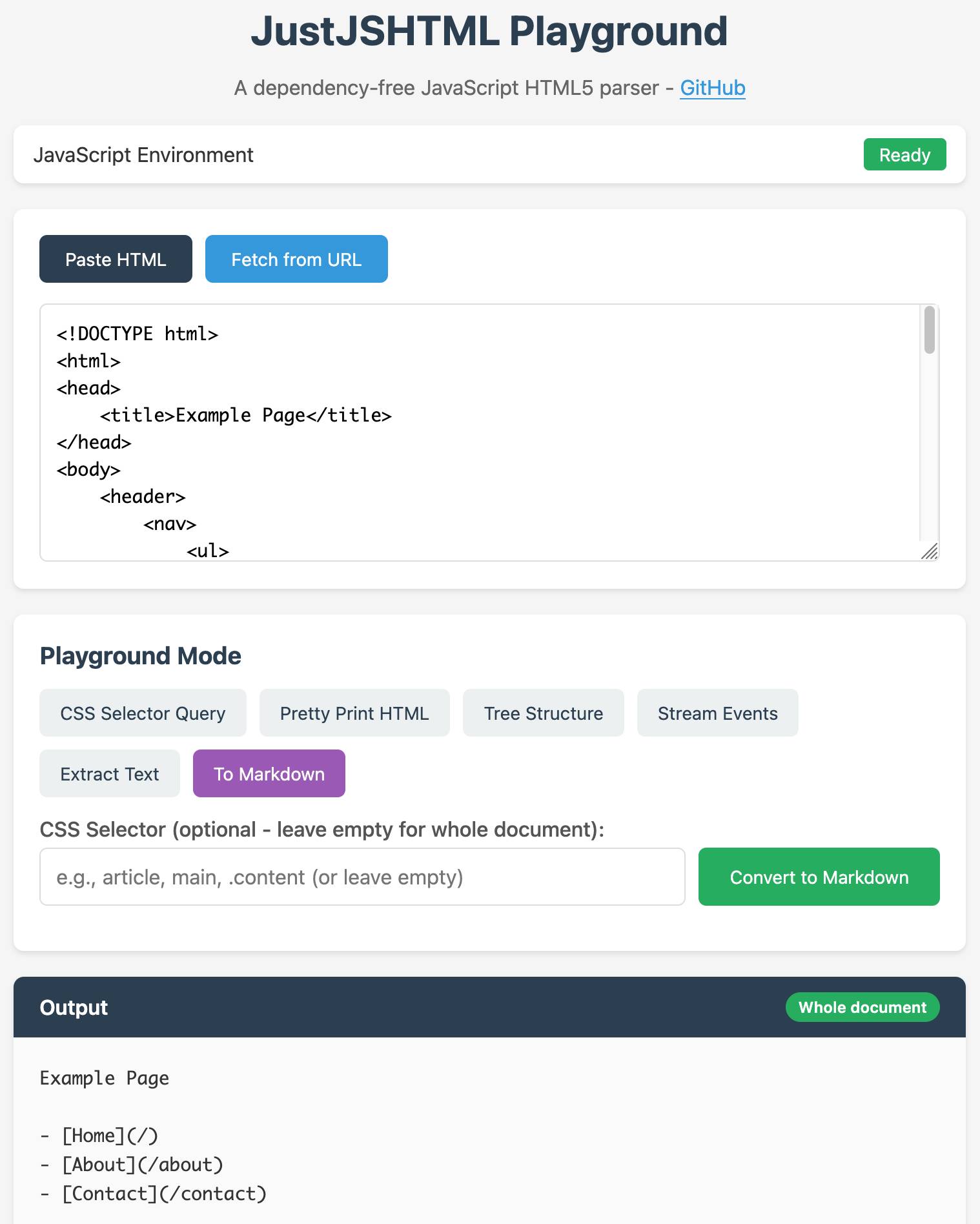
As a finishing touch, I had it add a playground interface so I could try out the new library in my browser. I prompted:
Add a playground.html in the top level folder which loads the necessary ES modules from ./src/... and implements the exact same functionality as seen on https://tools.simonwillison.net/justhtml but using the JavaScript library instead of Pyodide
It fetched my existing JustHTML playground page (described here) using curl and built a new playground.html file that loaded the new JavaScript code instead. This worked perfectly.
I enabled GitHub Pages for my still-private repo which meant I could access the new playground at this URL:
https://simonw.github.io/justjshtml/playground.html
1) Ensuring that there is no malicious code and enabling you to build it yourself.
2) Making modifications for yourself (Stallman's printer is the famous example).
3) Using other people's code in your own projects.
Item 3) is wildly over-propagandized as the sole reason for open source. Hard forks have traditionally led to massive flame wars.
We are now being told by corporations and their "AI" shills that we should diligently publish everything for free so the IP thieves can profit more easily. There is no reason to oblige them. Hiding test suites in order to make translations more difficult is a great first step.
Provided that the project is popular and has a community, especially a contributor community (the two don't have to go together.) Most projects aren't that prominent.
The rest is enshittified web, focused on attention grabbing, retention dark patterns and misinformation. They all exist to make a profit off our backs.
A pattern I see is that we moved on from passive consumption and now want interactivity, sociality and reuse. We like to create together.
Hmm, it is interesting to think about that situation. Intuitively it would seem to me like there's some nuance between whether work would need to be "thrown out" or whether it just can't be sold as their own creation, marking some kind of divide between code produced and used privately for commercial purposes vs code that is produced and sold/provided publicly as a commercial product. The risk in doing the latter, or entirely throwing out the code, seems like it would be a relatively cheap risk that those companies do anyway all the time.
However, if I as a small business owner made a tool to help other businesses based on LLM code that used some of my own prior work for context, then sold the code itself as a product or sold a product with it as a dependency, it would be a much greater liability for me if it turned out to include copyrighted && unlicensed work that was produced by an LLM that further can't be claimed as my own.
Privately, on servers or in internal tooling not sold commercially, it would perhaps be next to impossible to either identify or enforce those limits. Without explicit attribution to an agent, I have no idea (with certainty anyway) which code anyone on my team has produced with an LLM, and it's not available publicly—aside from pure frontend web stuff—so I wonder in what capacity it would even be possible to throw specific chunks out if it was hypothetically enforceable.