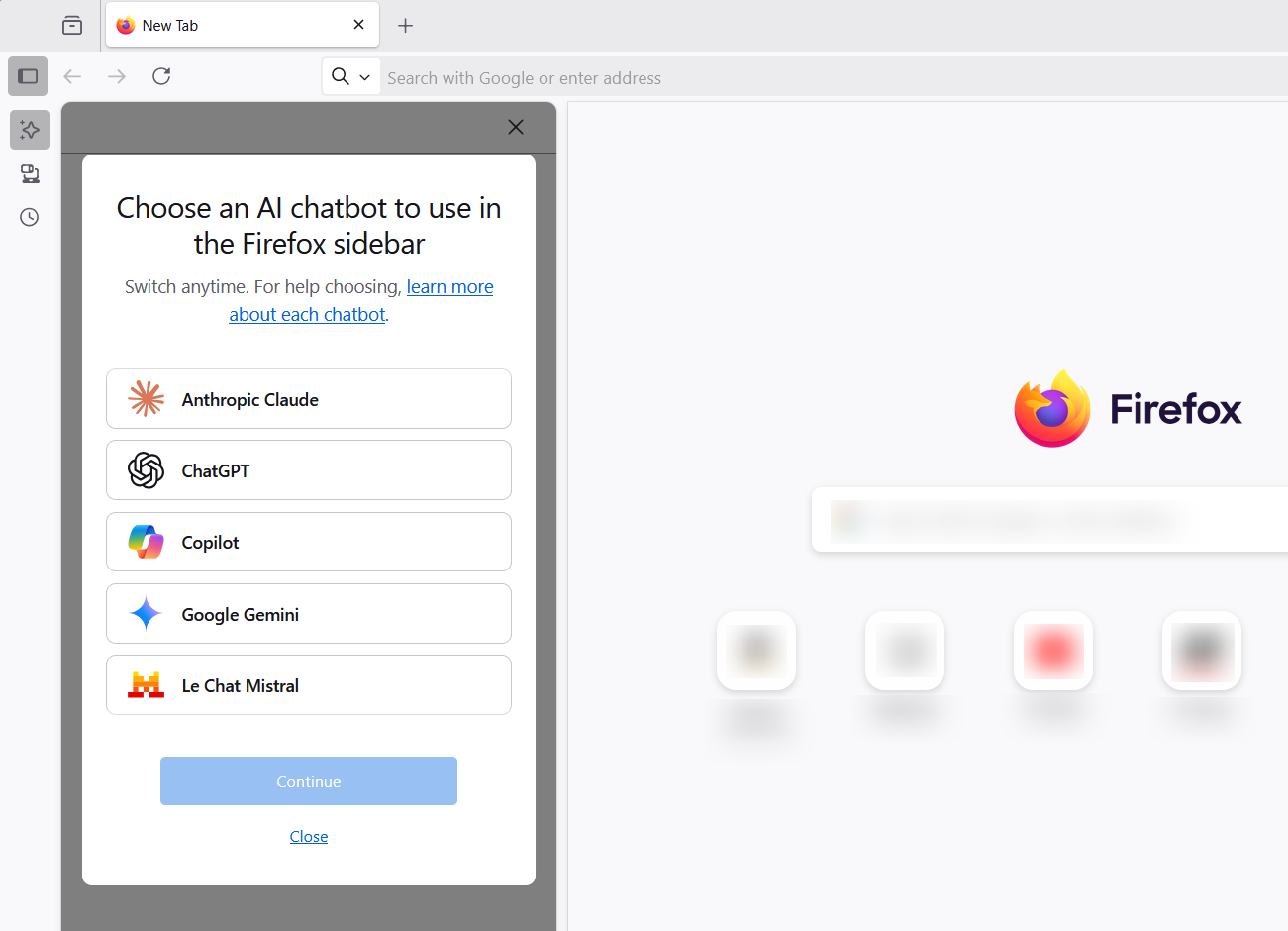
This is an old article but has some good examples:
https://lunduke.locals.com/post/4387539/firefox-money-invest...
Call me petty but I still can't let this one go. At the time they basically stole the Firebird name from the database project and did not hesitate to use AOL's lawyers to bully the established owners of the name. So they didn't actually become shady over night. It's in their DNA.
* Windows and Android. I even pay for their vpn because there is apparently no way to pay for the browser, which is what I actually use.
I feel like this question has been valid for almost as long as I can remember (e.g. the Mr. Robot extension incident). I find myself struggling to tell if Mozilla is an inherently flawed company or if it's just inherent to trying to survive in such a space.
It would be amusing if the only browser left that could run ad-blockers was Safari.
The Mozilla Foundation has received around USD ~26 million in 2023 in donation from the Mozilla Corporation (~70%) and other sources (~30%).
My image of Mozilla as a bastion for user first software just shattered.
The web standards are growing faster than non-profit engines can implement them. Google & Apple are bloating the web specs in what looks like regulatory capture.
If Blink/Webkit dominate for long enough, they will lock everything down with DRMs & WEI. Maybe it's time to work on lighter protocols like Gopher & Gemini that don't need 20GB of RAM to open 20 tabs ?
2018: $2,458,350
2020: Over $3 million
2021: $5,591,406.
2022: $6,903,089.
2023: ~$7m
Mozilla declined to detail the CEO's salaries for 2024+
It's sad, I'm sure there was a better path Mozilla could have taken, but they've had a decade or more of terrible management. I wonder if the non-profit / corp structure hasn't helped, or if it's just a later-stage company with a management layer who are disconnected from the original company's mission and strategy.
Do these people even know their users?
For example: Fedora Silverblue default Firefox install had an issue with some Youtube videos due to codecs. So I tried watching youtube on Chromium. Ads were so annoying I stopped watching by the second time I tried to watch a video. Stopped watching youtube until I uninstalled default firefox install and added Firefox from flathub. If the option to use a good adblocker gets taken away I 'll most likely dramatically reduce my web browsing.
P.S. Maybe someone ports Vanadium to desktop Linux? If firefox goes away that 'd be my best case desktop browser. Using it on my mobile ;)
> It may be just me, but I read this as “I don't want to but I'll kill AdBlockers in Firefox for buckerinos ”.
Yes, that does seem like a pretty uncharitable interpretation of that quote. I read it as "we won't do it, even though it would bring in $150M USD".
> He says he could begin to block ad blockers in Firefox and estimates that’d bring in another $150 million, but he doesn’t want to do that. It feels off-mission.
LOL the day that Firefox stops me from running what I want is the day I'll get rid of it.
I dropped firefox 9 months so after they updated their privacy policy and removed "we don't sell your data" from their FAQ: https://news.ycombinator.com/item?id=43213612
Mozilla has hired a lot of execs from Meta and bought an ad company, looking through a lot of their privacy policy at the time, a lot of it involves rewriting it to say that they can serve you sponsored suggestions when you're searching for things in their search bar and stuff and sharing out some of that data with third parties etc.
Firefox was bringing in half a billion a year for the last decade, if they would've just invested that money in low risk money market accounts (instead of paying their csuite executives millions of dollars in salary and putting the rest on non-Firefox related related social causes), the company would be able to easily survive off the interest alone.
I've been using Firefox since 2006 and have defended it for decades even when they've made questionable decisions that have gotten everybody upset with them. But this time it wasn't just making stupid decisions to try and fund the company, this time they actuality sold out their own customers.
In public announcement in the above link explaining why they removed "we don't sell your data" from the FAQ, the rationality was that some jurisdictions define selling data weirdly, they cited California's definition as an example but California's definition is exactly what I would consider the definition of selling my personal data.
They're justifying this by saying that they need it to stay alive since they're not going to be getting money from Google anymore, but I argue that you shouldn't sell out your customer base on the very specific reason anyone would choose you. I would rather pay a monthly fee to use Firefox to support them, but even if you gave them $500 million today they would just squander it away like they've done since forever so I really don't have any solution I can think of which frustrates me.
I switched to Orion (and use Safari if a site doesn't work in Orion), which can be a little buggy at times but I'm happy that it's not based on chrome at least.
If Mozzilla brings AI or removes ad blocks then they are every way just worse Chrome and there is zero reason to use them over Chrome.
I guess I should already start porting my Firefox extensions over to Chrome since this ship is sinking stupid fast.
Firefox is only good for getting forked into better browser like Mullvad Browser, LibreWolf and Tor Browser.
> and thus ad-supported
What a sad view of the web. Advertisement is a net-negative for society.
NObody trusts mozilla anymore, specially after they turned into an add company and started paying their CEOs exorbitating ammounts, considering what was being invested in their core business (supposedly making a better browser).
While it is not my main browser (Vivaldi is), I have 5 installs of Firefox Portable for different things, like one for YouTube, one for testing pages against Firefox and so on.
Obviously we are not happy about ads, but we all understand that having money is pretty neat (if only to pay ones salary). Help the CEO fella: What great, unused options is Mozilla missing to generate revenue through their browser?
As for calling it "off-mission": yes, what's even the point of FF if that's the route it goes on?
At any rate, I think their only good path of to get rid of Gecko.
The best would be to replace it with a finished version of Servo, which would give them a technically superior browser, assuming Google doesn't also drop Blink for Servo. It may be too late for this, but AI agents may perhaps make finishing Servo realistic.
The other path would be to switch to Chromium, which would free all the Gecko developers to work on differentiating a Chromium-based Firefox from Chrome, and guarantee that Firefox is always better than Chrome.
IMO they need to be more a crew of activists than they are now. Fight against stuff like intrusion of AI in every single part of our lives and such.
No they would get fired, unless Firefox found a new big project to earn money from, which at the moment is not very likely.
like hoping for the best, but planning for the worst, you must interpret people's intentions using the same methodology. By quoting that axing adblock could be bringing $150mil, but also saying that he doesn't want to do it, it's advertising that a higher price would work - it's a way to deniably solicit an offer.
That's because their users are driven by opinions and principles, and those are the worst, most disloyal kind of users. They're always threatening to leave, and will take the slightest offense to do so.
Chrome wins because its user base doesn't care. The browser is just a tool, not a religion. It's installed, they use it, they're barely aware it exists and most of Joe Public doesn't even know Google makes it.
So sure. For you it's ad blockers. For someone else it's their donation plan. Or Google funding. Or their corporate structure. Or their management.
When your marketing is about something else, other than the product itself, you always end up with edge-case-customers.
People use Chrome because it's the best browser. Less than 3% use Firefox. And all I read from Firefox users is how bad everything is (or will be).
No, Firefox's market share isn't a foil to monopoly (Safari has 5 times more users. Crumbs Edge has twice the users.)
I care about Firefox, but I really just wish all the whiners would just do what they threaten and use something else. But they won't because everything else is worse (for some or other principles reason.)
Now I fully expect to be downvoted because the only people reading this article in the first place are Firefox whiners. Which is kinda my point.
It's pretty hard to recommend Firefox to others when everything written by existing users is so negative.
In that set of circumstances, the main qualification for CEO is likely 'plays nice with Google'. Given that, I'm not surprised that Mozilla underperforms.
Beating Google in the browser market might be considered hostile to their sponsors.
Yes but keep in mind that’s not an individual problem that is solved by switching browsers. If a browser engine dies, the walls get closer and the room smaller. With only Chromium and WebKit left, we may soon have a corporate owned browsers pulling in whatever direction Google and Apple wants. I can think of many things that are good for them but bad for us. For instance, ”Web Integrity” and other DRM.
The original quote was apparently said without an understanding of the customer base as if ad blockers were not a core piece of their value proposition.
This person doesn't understand their customer if they think it's going to bring in more money to cut ad blockers... It would bring in far less money because they would lose most of their customer base. It's not off mission: it's off Target.
Edit: My Hitler parody of when Firefox introduced this (almost 10 years ago now!): https://www.youtube.com/watch?v=taGARf8K5J8
That is the most vexing part. I want to donate for Firefox development. Not marketing, not side projects, let me just fund the devs. But no, that is not possible.
Blender is a huge success story relying on sponsors and donations, Wikipedia is swimming in money but no we can't just have a free browser.
No we need to have a Mozilla Corporation that lives on Google money for being the controlled opposition i.e. technically avoiding monopoly situation thing. After all CEOs can't get rich on donations, can they?
Someone could try to merge e,g, V8 and Servo, once that's in decent shape. But even then it'll be time consuming to build an acceptable UI, cookie and history management, plugin interface, etc.
https://support.mozilla.org/en-US/kb/on-device-models
totally uncharitable interpretation of the quote linked here aside, how is providing an interface for using fully local models not user first software?
Once the users were trapped for exploitation, it doesn’t make sense to have a browser that blocks ads. How are they supposed to pay software salaries and keep the lights on? People don’t like paying for software, demand constant updates and hate subscriptions. They all end up doing one of those since the incentives are perverse, that’s why Google didn’t just ride the Firefox till the end and instead created the Chrome.
It doesn’t make sense to have trillion dollars companies and everything to be free. The free part is until monopolies are created and walled gardens are full with people. Then comes the monetization and those companies don’t have some moral compass etc, they have KPI stock values and analytics and it’s very obvious that blocking ads isn’t good financially.
Is that actually the case though? I find it hard to believe that Mozilla has anywhere close to 1500 senior developers working on just Firefox. My guess is that the bulk of that money is spent on unrelated adventures and overhead.
Who is Mozilla's core audience? From what I remember, it's not addon-users, as most users never have used even just a single addon.
> They literally have lost 90% of their market share from their peak,
To be fair, it's not entirely their own fault. Competition is strong, especially from Google and Apple. Even with perfect decisions, they likely would still have lost big since their peak. The market for alternative Browsers isn't as big any more as it used to be.
That being said, in the original context [0] it does sound a lot more like an option on the table. That original article presents it as the weakest of a list of things they're about to explore - but who knows, maybe the journalist has butchered what was said. It is an ambiguous idea without more context about how close it is to Mozilla trying to make life hard for ad-blockers.
[0] https://www.theverge.com/tech/845216/mozilla-ceo-anthony-enz...
That is a flimsy tissue paper statement about a concept that should be a bedrock principle.
It's irrationally charitable to give it any credit at all. Especially in context where anyone who's awake should understand they need to be delivering an unquestionably clear message about unquestionably clear goals and core values, because this ain't that.
Or rather, it is a clear message, just a different message to a different audience.
No, it will just kill the browser. The fact he thinks otherwise tells me how out of touch he is.
It’s an eyebrow raising comment at the very least.
Even better would be similar to the article sentiment: "we could get 150 million now but degrade one of our few features that distinguishes us from other browsers + break a lot user trust, which would bring greater losses in the long term".
That's supposedly The Verge paraphrasing the CEO (Unfortunately I can't verify because the full article requires subscription.) I would like to know what the CEO actually said because "it feels off-mission" is a strange thing for the leader of the mission to say. I would hope that they know the mission inside out. No need to go by feels.
Today the ability to run proper content blockers is still a selling point for Firefox but obviously wouldn't be if they started to meddle with that as well. (Has there ever been a more obvious case of anticompetitive behaviour than the biggest browser nerfing ad blocking because it's owned by one of the biggest ad companies?)
Other than customisation the only real advantage I see for Firefox today is the privacy angle. But again that would obviously be compromised if they started breaking tools like content blockers that help to provide that protection.
By selling browser UI real estate to AI companies[0] they reduce the power Google has over them. If they get to the point where no individual company makes up a majority of their revenue, it allows them to focus on their mission in a much broader way.
[0]These will be very expensive listings should this feature become popular: https://assets-prod.sumo.prod.webservices.mozgcp.net/media/u...
The way to interpret Mozilla is that they're a dying/zombie company, fighting heroically to delay the inevitable.
- They were ahead of the game with extensions. Then everyone copied them.
- They were ahead of the game with tabs. Then everyone copied them.
- They were ahead of the game with containers. Then everyone copied them.
- They are still the best browser to use for an ad free internet experience.
- The only flaw I can think of, is they are not leaders in performance. Chrome loads faster. But that's because Chrome cheats by stealing your memory on startup.
How would you make FireFox better? When you say they should be making FireFox better, what should they be doing? Maybe they should hire you for ideas.
Because to me, they seem to be constantly trying to make FireFox better. It's just hit or miss.
Extensions was a hit. Tabs was a hit. Containers was a hit. They had a shit tonne of misses over the decades. We just don't remember them.
The crypto and ai stuff just happens to be a miss.
The only problem is: what's the difference between the forks, and which is the best? I have no idea.
Apple doesn't collect your browsing data, they build in privacy controls that are pretty much as strong as they can manage given the state of the world, and while it doesn't support uBO, it supports a variety of pretty solid adblockers (I use AdGuard, which, AFAICT, Just Works™ and even blocks YouTube ads most of the time, despite their arms race).
And in turn my comment above is not a honest remark that your suggested interpretation strategy seems to be selectively applied, but rather an attempt to hurt your standing with your peers.
An ad blocker is a very useful tool. Being able to block ads effectively makes the browser much better. I'm not sure how you can call that "religion".
> People use Chrome because it's the best browser.
No they don't. They use Chrome because every Google service nags the shit out of them to use Chrome. People aren't as rational as you make them out to be.
[1] https://github.com/mozilla-services/syncstorage-rs
[2] https://mozilla.github.io/ecosystem-platform/tutorials/devel...
> Do any of these forks have the ability to sync, either with Firefox or something self hosted?
The Firefox Sync web service is provided by Mozilla but can be self hosted: https://github.com/mozilla-services/syncstorage-rs. That could also be used in forks. See e.g. https://librewolf.net/docs/faq/#can-i-use-firefox-sync-with-... . I don't understand what you mean by sync with Firefox.
> Or are they all just basically reskins with a single toggle added or such?
Hard to generalize, but definitely not all of them. see e.g. https://lwn.net/Articles/1012453/
I do not want to try your AI tools, Mozilla, yours or anyone else's.
The end users are not their customers. They haven't been for a long, long time.
Only what makes money has any value in their view. That's also why MBA types are the wrong type of person to run something like Mozilla.
But Firefox's users are the kind who choose the browser, not use whatever is there. And that choice is driven in part by having solid ad-blockers. People stick with Firefox despite the issues for the ad-blocker. Take that away and Firefox's userbase dwindles to even lower numbers to the point where nobody can pretend they are "competition". That's when they lose any value for Google.
Without the best-of-the-best ad-blocking I will drop Firefox like a rock and move to the next best thing, which will have to be a Chromium based browser. I'll even have a better overall experience on the web when it comes to the engine itself, to give me consolation for not having the best ad-blocker.
Their peak in share was also pre-chrome. They've basically been losing the battle slowly for over a decade.
I am thinking of it as: people who care about privacy and/or an independent web browser. That seems mostly in line with what the Mozilla Foundation's principles are stated to be.
Maybe it's not that. But if not, what is it? How do they otherwise have any positive differentiation versus their competition? It surely can't be claimed to be any sense of "users who want an AI browser" because surely those people are going to use ChatGPT's browser, not Mozilla's.
If you have the power to do something, saying you might do it but that you don't want to makes people imagine you'd do it. If you have a knife and talk about how you "might stab people, but don't want to", that's a very different message than having a knife and saying "obviously I'm not going to stab people, violence is not an option".
The latter reassures, the former depends heavily on what the recipient of the message thinks of you, and whether they can imagine you stabbing people.
If that quote was accurate, then either he just said something and wanted to wing it, or they should reconsider their communication strategists.
For me as a user it is, but is it for him as a CEO?
Surely Mac is the only place there is a viable non-Chromium alternative (Safari)?
What can Mozilla Firefox do to make their 500 million without Google?
Android blocking side loading is more or less in the same ballpark.
So far, the most useful "AI feature" Firefox has ever shipped is the page translation system, which uses a local AI to work. I wouldn't mind seeing more of things like that.
Eventually, "browser use" skill in AIs is going to get better too. And I'd trust Firefox with an official vendor agnostic "AI integration" interface, one that allows an AI of user's choice to drive it, over something like OpenAI's browser - made solely by one AI company for its own product.
Curious if LibreWolf can survive the next 25 years or even longer than Firefox.
Yes, No, Yes?
I don't demand constant updates. I don't want constant updates. Usually when a company updates software it becomes worse. I am happy with the initial version of 90% of the software I use, and all I want is bug fixes and security updates.
I currently pay zero for ad-blocking (FF + uBlock Origin) and it works perfectly; but I would pay if I had to.
Categorically untrue and weird revisionism. Basically the opposite of what actually happened.
> People don’t like paying for software, demand constant updates and hate subscriptions.
hate subscription?? may be. if it's anything like Adobe then yes, people will hate.
that constant update, is something planted by these corporates, and their behavior manipulation tactics. People were happily paying for perpetual software, which they can "own" in a cd//dvd.
Huh? Nexus was funded by CERN.
Newsgrounds was never investor funded.
Yahoo! Directory was just two guys, and you paid to be listed. There were no investors involved.
WebCrawler was a university project. Altavista was a research project.
If most users who install Firefox do so for superior adblocking and those same users are also very likely to turn off telemetry (which I think some privacy/adblock extensions probably do by default?), then at Mozilla's end one might get the impression that "most users don't use extensions" - even though the vast majority of users do.
So to answer the questions of:
> Who is Mozilla's core audience?
It's probably the kind of user that has telemetry off. You don't know much if anything about them.
Source?
1. Innovate
2. Dominate
3. Enshitify to cash in.
You can't skip step #2.
Right now, Firefox's market share is a rounding error compared to Chrome. Users are starting to switch away from Chrome because it's currently in step 3 (in spades). That trend will not continue if Firefox beats Chrome to the bottom of the pig-pen. Firefox's current focus on AI is concerning enough, but mirroring Chrome's shift to Manifest v3 (i.e. What killed full-blooded ad blocking in Chrome) would be outright suicide.
Mozilla needs to listen to their users. Most don't particularly want "let me run that through an AI for you" popups everywhere. Practically nobody running Firefox wants to be cut off from effective ad blocking.
Monetization is hard, for Mozilla in particular. It was always weird that most of their funding came from Google. Now that Google is yanking it, Mozilla needs to find alternative sources of filthy lucre. However, if they destroy their product's only competitive advantages, there will be nothing left to monetize. If Firefox remains a browser that can provide decent privacy and ad-blocking then Mozilla has a chance to find alternative revenue streams. If, instead, Mozilla throws those advantages away to make a quick buck, that's the last buck they'll ever make.
In an interview with “The Verge”, the new Mozilla CEO, Enzor-DeMeo, IMHO hints that axing adblockers is something that, at the very least, was on the table in some form and at some point. From the article:
He says he could begin to block ad blockers in Firefox and estimates that’d bring in another $150 million, but he doesn’t want to do that. It feels off-mission.
It may be just me, but I read this as “I don't want to 😜 😜 but I'll kill AdBlockers in Firefox for buckerinos 😂”. This disappoints and saddens me a lot, and I hope I'm wrong.
I've been using Firefox before it was called that. Heck, I even used the Mozilla Application Suite back in the day. It was its commitment to open standards and the open web, and its powerful add-on system, that attracted me to its software.
Honestly, that's what's been keeping me. I think that's also what's been keeping their loyal base of users with the project, the geeks and nerds that care about privacy. It's the same group of people who helped it get very popular at one point.
Killing one of its advantages over the Chromium engine, being able to have a fucking adblocker that's actually useful, and that nowadays is a fucking security feature due to malvertising, will be another nail in the coffin, IMHO. The core community will feel disenfranchised, and this may have negative consequences for the project. You know why? Because these are some of the people that the normies turn to when they want tech advice.
For fuck sake, for-profit side of Mozilla, get a damn grip!
We don't know what he really thinks. Maybe he knows it's a risk he wouldn't want to take but presents it as a goodwill
I agree, although if someone isn't the kind of person who would calculate that, they're probably not the person who will become the CEO of a company that size in the first place. I don't think organizations have the right incentives in place to push people with those values to the top.
You know, actual reporting sourcing something new. But in truth, it was just extrapolating a bunch of sweet nothings from the freezing of a quote already published in The Verge. It reminds me of Boston media market sports reporting. You're a sports writer, you have a deadline, and you have to take Curt Schilling's press conference and try and turn it into a story. So take something he said and squeeze it dry, trying to extract some implication of clubhouse drama, to drive the next new cycle and survive to your next paycheck as a reporter. That's the grift, that's the grind.
You very much can if all the competitors are either a) ad-ridden, ai-infested, bloated monstrosities or b) don't provide the functionality people want. In that case, there's apparently lots of demand which could easily support either a pay-once or a low-subscription-fee model.
I don't think the rest of the world likes their dependencies on US companies and their love for surveillance.
Of course, to do it right means ensuring there's enough non-US organizational structure with the know-how to take over the project should things go pear-shaped, and oversight to spot of the pear is taking shape.
But that's what governments can do, assuming they don't want to be under the thumb of the US. ("Oh, you think tariffs are bad? We'll do to you like we did those ICC judges and shut off all your accounts.")
They could be lean and focus on firefox only.
Now they get 150m from google, spend just a part on firefox and rest on failures and hobby projects to get promoted.
If they were focued on core business, 1) they would have a war chest 2) they could leave off donations
https://lunduke.locals.com/post/4387539/firefox-money-invest...
many people stated that they are happy to do targeted donations (ie. money earmarked strictly for Firefox development only, and it cannot be used for bullshit outreach programs and other fluff)
and if they figure out the funding for the browser (and other "value streams") then they can put the for-profit opt-in stuff on top
Eliminate - both in code and by policy - anything that compromises privacy. If a new feature or support of a new technology reduces privacy, make it optional. Give me a switch to turn it off.
Stop opting the user into things. No more experiments. No more changing of preferences or behavior during upgrade.
Give the user more control; more opportunities for easy and powerful automation and integration.
Not only would this win me back as a user, I'd pay for the privilege. I'm paying for Kagi and happy to be doing so. I'd love to pay for an open source browser I could trust and respect.
On my laptop I had to switch from Firefox to Chrome because it kept filling up all of my RAM resulting in other applications crashing.
They were ahead of the game with extensions, then they destroyed their own extensions. They copied everyone else, not the other way around.
> - They were ahead of the game with tabs. Then everyone copied them.
They were ahead of the game with tabs. Then while destroying their extensions they made vertical tabs harder, while still leaving it as a charitable contribution by the community instead of an internal project, and slow-walked it for a decade. I still have to do weird CSS to make them look right, because they decided to have an opinionated sidebar for no particular reason.
> - They are still the best browser to use for an ad free internet experience.
This, again, is not their fault. It's because of a man who they don't pay, who has had to battle with them on multiple occasions. Their only contribution is not accepting a Chrome standard completely. Imagine wanting to be given credit for not exactly copying your neighbor, after an enormous amount of pressure was brought to bear. It's my belief that Google decided that Firefox wouldn't kill ad blocking in the end, because it would have looked horrible in antitrust court. Now that's over (Obama judges don't believe in antitrust), and you can expect Firefox to kill it soon enough.
> Because to me, they seem to be constantly trying to make FireFox better. It's just hit or miss.
Nah. They kept telling me, while ignoring everyone's complaints about their actual experiences, that the most important thing was to reduce startup time for some unknown reason.
I wish Firefox would be that browser.
I don't know why bring up Android when it is already Google product.
Organizations with clear, focused missions are much more likely to be able to achieve them than organizations that want to be everything to everybody.
"Make and maintain Firefox as the best browser for people who care about internet freedom, privacy, and extensibility" would be a perfectly reasonable mission.
The only way to avoid this is to just block ads - even unobtrusive content-relevant ads. You may think ads can't trick you, but that has been shown time and time again to be false.
Speaking only for myself, and regardless of whether this is actually true (see sibling comment): yes. Absolutely. A non-privacy focused browser like Firefox has vulnerabilities/data leaks by design that are worse than hypothetical ones that I probably will not be subject to browsing my usual benign set of websites.
(Posted from Waterfox)
I’m not sure why this has become a thing - usually I either release Waterfox the week before ESR releases (the week the code freeze happens and new version gets tagged) or, if I’m actively working on features and they need to coincide with the next update I push, I will release on the same Tuesday the ESR releases.
You can check the GitHub tag history for Waterfox to see it’s been that way for a good while :)
People were trying to figure out how to make money off of the Internet from the early days of the Internet being publicly accessible (rather than a tool used by academic and military institutions). It can be attributed to the downfall of Gopher. It can be attributed to the rise of Netscape and Internet Explorer. While the early web was nowhere near as commercial as it is today, we quickly saw the development of search engines and (ad supported) hosting services that were. By the time 2000's hit, VC money was very much starting to drive the game. In the minds of most people, the Internet was only 5 to 10 years old at that point. (The actual Internet may be much older, but few people took notice of it until the mid-1990's.)
So the best situation for google would be to have borderline monopoly where they pay for the existence of their competition and the competition(Firefox) blocks adblockers too by default but leaving Chrome and Firefox is harder than forcing installin adblockers through the unofficial way.
So basically, all the people who swear they never clicked ads manage to block ads, Firefox and Chrome print money by making sure that ads are shown and clocked by the masses.
> It's probably the kind of user that has telemetry off. You don't know much if anything about them.
Don't think so, most people don't give a f** about this. Tech-people on that level are even in the industry a minority. And on the other side, those stealth-users are worthless for Mozilla, because they can't make money from google with them. So for a project needing to make money with usersnumbers, everyone who is out of this, isn't core audience anyway.
If less than 4% of users use uBO, which the kind of users you're referencing claim is the primary reason they use Firefox, I doubt many users disable telemetry either.
Fortunately it's not the only one and for example Adguard works perfectly fine.
I'm sorry but this is like borderline gibberish. You could rationally understand that there's a financial incentive to selling out... and choose not to sell out. Did you make it to the and? I didn't think so. The fact that you're simply able to assess that selling out has a dollar amount associated with it isn't a confession unless you're so pot committed to your Mozilla Derangement Syndrome that you've chosen to throw charitable interpretation out the window.
You're entertaining a hypothetical that was already rejected, and your point of emphasis is that they didn't reject it hard enough to satisfy you. I'm sorry but that's the nothingburger of the century.
edited to correct my misunderstanding.
> In our conversation, Enzor-DeMeo returns often to two things: that Mozilla cares about and wants to preserve the open web, and that the open web needs new business models. Mozilla’s ad business is important and growing, he says, and he worries “about things going behind paywalls, becoming more closed off.” He says the internet’s content business isn’t exactly his fight, but that Mozilla believes in the value of an open and free (and thus ad-supported) web.
> At some point, though, Enzor-DeMeo will have to tend to Mozilla’s own business. “I do think we need revenue diversification away from Google,” he says, “but I don’t necessarily believe we need revenue diversification away from the browser.” It seems he thinks a combination of subscription revenue, advertising, and maybe a few search and AI placement deals can get that done. He’s also bullish that things like built-in VPN and a privacy service called Monitor can get more people to pay for their browser. He says he could begin to block ad blockers in Firefox and estimates that’d bring in another $150 million, but he doesn’t want to do that. It feels off-mission.
> One way to solve many of these problems is to get a lot more people using Firefox. And Enzor-DeMeo is convinced Mozilla can get there, that people want what the company is selling. “There is something to be said about, when I have a Mozilla product, I always know my data is in my control. I can turn the thing off, and they’re not going to do anything sketchy. I think that is needed in the market, and that’s what I hope to do.”
Bonus points:
1. Multi layered approach to dealing with ads and other malware.
2. A committment to no AI or other bloat - that's not what I'm paying you for.
3. Syncable profiles.
The problem is the MBAs.
First, I would stop breaking up the stuff that works. Firefox was ahead of the game with extensions, then deprecated the long tail for a rewrite that took three years [1] (during which Firefox mobile had a grand total of 9 extensions) and even then it's hard for me today to know which extensions work on mobile. They were similarly ahead of the game with containers, and yet they still don't work on private mode [2] and probably never will. That's two out of three hits where they tripped over their own two feet[3].
Second, do the one thing that users have been requesting for decades: let me donate to the browser development. Not to the Mozilla Foundation, not to internet freedom causes, to Firefox. The Mozilla foundation explicitly says that they don't want to be "the Firefox company", and yet I'd argue they should.
Third, go on the offensive. I get the impression that, with the exception of ad-blocking, Firefox is simply playing catch-up to any idea coming from Chrome regardless of whether it makes sense or not. Would Firefox had removed FTP support had Chrome not done it before?
And fourth, make all these weird experiments extensions.
[1] https://techcrunch.com/2023/12/14/three-years-after-its-reva...
[2] https://support.mozilla.org/en-US/questions/1330109
[3] I always associated tabs with Opera, though.
[4] https://www.mozilla.org/en-US/foundation/annualreport/2024/a...
One time fee software ment that once your growth slows down you no longer make money and have plenty of customers to support for free. That's why this model was destroyed by the subscription and ad based "free" software.
The last example is Affinity which was the champion of pay once use forever model, very recently they end up getting acquired and their software turned into "free" + subscription.
But sure, if you think that we should start counting from these years you can do that and add a "public funded" era at the beginning.
> over 40% of Firefox users have at least 1 installed add-on
There was an article from Mozilla, some years ago, going more into the details about this, but I'm not sure where. Though, I found another one[1] from 2021, which starts with only one third of the users having installed an addon.
[1] https://addons.mozilla.org/blog/firefoxs-most-popular-innova...
Relevant part from the site: [..]Add-on usage measured here reflects multiple facets of browser customization, including web extensions, language packs, and themes.[..]
40% is a big minority, but not really what I would call core audience, especially when language packs and themes are also counted here. And 5 of the top 10-addons in that statistic are language packs.
Though, UBlock Origin is #1 with 9.6% user-share, and it's shown to have 10.5 million users on the store-page, which means there are at best only around 100 Million users left with Firefox on desktop? Seems worse than I thought.
https://blog.mozilla.org/en/firefox/extensions-addons/heres-...
Meaning they select each other, because they're all on each other's board.
So that extra money will never materialize. And usage numbers will again crater. This is the point.
(You can disagree with that assessment, but that has nothing to do with telemetry, which cannot gauge users hanging around with blocked .. adblockers)
If this happened it would be the final straw for me, if I wasn't already looking to change because of them confirming the plan to further descend into the great “AI” cult.
Can you elaborate? Are they winding down their their participation in search licensing deals?
How do Mozilla's costs look?
If Mozilla killed andblocking extensions I’d switch to Helium Browser in a heartbeat since they’re maintaining manifest v2 support for uBO and even ship it OOTB.
The web is unusable without a proper Adblock.
I haven't compared it in years, but Firefox's bookmark sync is better than Google's, it is a reason why I have stuck with it.
I think Firefox manages hundreds of tabs better than Chrome does as far as memory usage goes. I haven't used Chrome seriously in years, but people continue to complain about how RAM hungry Chrome is so I assume it is still an issue.
But Mozilla has been doing odd things that makes me question them. I would move to some Chromium based browser if ublock origin was... blocked... pun intended... because the web does prefer Chrome over Firefox. If this 3rd party browser is able to integrate some of the functionality of ublock origin that Firefox chose to remove; I would use it over the reasons I listed above in a heartbeat.
I found Chrome+adblockers NOT good enough. I like (and hate) Brave's shield, as I never figured out how to use wildcards to whitelist a whole domain / subdomain, it seems per-host. But that Brave shield WORKS.
Now people are going back to Chrome? Really?
However, it leads to Mozilla's earlier weird design choice where you have to install addon if you only want to disable JavaScript on sites - or allow it from only the selected domains.
Years later I haven't found a sensible explanation why they ditched that choice.
I've understood that you can still do it in Chrom(e/ium) and combined with a good updated blocklist in /etc/hosts or like it would provide most of the functionality of an adblock.
It shows even in the UI design. Features like tab pinning and tab groups work in ways that are sub-optimal to how users want to use them. A pinned tab should not be tied to a specific URL. If you go their forums you see a lot complaints, and weird thing is all the nonsensical arguments that their reps advance as to how these features should work the way they currently are. I as a longtime Firefox user can immediately see what is wrong with these features as implemented, but the devs won't listen. I wonder if they use FF themselves.
Firefox is also the only app on my MacBook that consistently brings the system to a crawl. Almost every single time my machines slows down, the solution is to kill Firefox. It's got to the point I don't even need to use Activity Monitor, I just kill Firefox and and system recovers.
It's gotten to the point I'm seriously looking at alternatives, trying out Orion and Helium browsers.
On day one he’s put his appearance on the top of hacker news under “is Mozilla trying to kill himself?”.
Yeah as someone who picked up Firefox when it was Phoenix, it was “free Opera with a less-odd-feeling UI”. That was basically the initial (great!) sales pitch.
What got me installing it on any computer belonging to a person I would have to help support was the auto-pop-blocking and that it performed a ton better than IE/Netscape/Mozilla. Opera also performed better and I think it also blocked pop ups out of the box, but it wasn’t free (well, kinda, but the free edition… had ads).
To convince people to buy they had to add genuinely useful features. I would have bought a new version with new features and better performance. I wouldn’t have bought a new version same as the previous one with AI crammmed in it
What do you mean. Support contracts were not included by default. Consumers had some initial support to fight off instant reclamations.
The core reasoning system here is probably moral intuitionism: if you have an explanation for why something is bad, it is not something you consider intuitively bad and consequently you must be wanting to do it.
I think I've seen it in online communities a lot more in the last couple of decades, and I suspect it's just a characteristic of the endless march of Eternal September.
The CEO of an organization like Mozilla even considering blocking adblockers for profit is like the president of Amnesty International considering to sell lists of dissidents to the secret police.
On the other hand, the clean web feels more direct, to the point, and passionate. I prefer to read content written by passion, not by money seeking purposes.
There's no world in which 75% of your revenue coming from Google doesn't influence what you do. Even if it's not the main driver of all decisions, pissing off Google is a huge risk for them.
In 2021 they got $500M "royalties" (this is their payment from Google) with only $75k revenue from all other sources, including $7.5k donations.
is that too much money for one person? well, apparently it depends on who do you ask. and even if the board members who approved it might thought it's too much, it still could have been cheaper than to fire the CEO and find a new one and keep Mozilla on track.
CEO compensation is usually a hedge against risks that are seen as even more costly, even if the performance of the CEO is objectively bad.
https://www.ecgi.global/sites/default/files/working_papers/d...
framing Mozilla/Firefox as some kind of bastion is simply silly - especially if it's supplied by the gigantic fortress kingdom of G, and makes more money on dividends and interest than on selling any actual products or services.
it's a ship at sea with a sail that's too big and a rudder that's unfortunately insignificant.
but whatever metaphor we pick it needs to transform into a sustainable ecosystem, be that donation or sales based.
(Yes it's technically a company, but it's a company owned by a non profit.)
It's a privacy nightmare as well. Few people reason how much data they give away to a host of shady companies just by letting ads display.
(JS has few good uses, but is too excessive. Less code is always better - and an art.)
whenever i'm off my home wifi network, i have wireguard configured to connect home and get me that ad blocking. it's so nice.
yes, i prefer to use brave for personal stuff and i use edge for work stuff (reasons,,, don't ask)
Yeah but they haven't and they're not going to, so what's the point of fantasizing about what you would do in that situation? It's like tough guy syndrome, where a person constantly fantasizes about what they would do in the imaginary situation where one of their friends or family is disrespected, or doomsday preppers who spend their life imagining what they would do in an apocalypse that never comes.
That stuff belongs on archiveofourown.com, not news.ycombinator.com.
Wherever I've worked as a dev in a decade I've always developed Firefox-first and let the testers turn up Chrome issues. So the products that I am involved with just work with Firefox all the time.
I know there are a lot of people like me, people who are passionate and engaged with technology but have problems with "big tech" and if they turn people like me away than it really will be a "niche browser that nobody tests"
Thank you, gorhill! And thanks to all the people maintaining it and all the filter lists!
Not sure if that's legal or whatever but killing ad blockers is probably worth it for Google.
And believe it or not, human behavior is such that something that is not even i in the space of possibilities is much less likely to occur that something that has been considered and rejected. It might have been rejected ow, but what the calculus changes?
No, for Amnesty International it would be more like not considering somebody a political prisoner because the country that took the prisoner is a 1st world country and they don't want to expose themselves on a matter that would risk the donations from a certain population.
Yes, that happened in the aftermath of the Catalan attempt at peaceful independence in October 2017 by Amnesty International Spain.
The mentality of the age was portrayed like this in SV: https://www.youtube.com/watch?v=BzAdXyPYKQo
There were companies that were making some money but those were killed or acquired by companies that give their services for free. Google killed the blogs by killing their RSS reader since they were long into making money stage and their analytics probably demonstrated that it is better people search stuff than directly going to the latest blog posts.
It's the same thing everywhere, the whole industry is like that. Uber loses money until there's no longer viable competition then lose less money by jacking up the prices. The tech is very monopolistic, Peter Thiel is right about the tech business.
There is server-side now (and previously) hosted by the site owner.
It’s a lost cause to fight this. I admire you all for using FF because uBO just for the experience, but it’s only a partial data block. Serverside and thumbprinting- you can’t be anonymous even with Tor, VPN, etc.
https://addons.mozilla.org/en-US/firefox/addon/auto-tab-disc...
These days I’m using AdGuard on iOS and ublock origin with Firefox on everything else.
But let's not kid ourselves. We're an absolute minority. For every one of us, there are hundreds, thousands of developers who literally do not give a shit so long as their paychecks hit their accounts. Actually they're likely to write Firefox off as some irrelevant niche market the company can afford to lose because it's less work for them if they do.
It's also a closed source browser developed by Apple. It's not competing with Firefox. Everyone contemplating switching to safari over Firefox are not being honest - they're not even on the same playing field.
So if you believe gay marriage undermines your own straight marriage like Brendan does, then use Brave to virtue signal your bigotry, and while you're at it, find a better spouse you love enough that the gays can't destroy your own marriage by getting married to each other!
Edit: eudamoniac, your enthusiastically performative homophobia proves my point! [chef's kiss] Thank you, and enjoy your crypto scams. I hope gay marriage doesn't undermine your own hope of ever being in a straight marriage, GamerGate incel.
Why? They have ample free cashflow. They haven't had money problems in 10 years. If they're worried about Google withdrawing support they should save money in an endowment, not do things to help Google.
If something being free ever mattered to your privacy, it hasn't for a long time. Today no matter how expensive something is you are probably a product anyway. Unethical and greedy companies don't care how much money you paid them, they'll want the additional cash they'll get from selling you out at every opportunity. Much of my favorite software is free and doesn't compromise my privacy.
Why would there be any proof?
I contribute to open source projects and nobody "gave me something", as I did it because I wanted to make it better. Like me, there are many others. Nobody is "the product" there.
What the saying you are misrepresenting means is "carefully check free things as you may be the product". Not "free things cannot exist, you either are the product or you pay".
(- it's kind of behavior extension on tag level, yet has JS - and it's orthogonal, like CSS or XSLT (BTW. see that hack: https://news.ycombinator.com/item?id=41245159), unlike JS which is.. untamed and invasive; i.e. there is video (any) tag but you could (+)DIY not touching the document - like custom playing with MPlayer or VLC as a plugin there for all AV formats or sorting filtering editing whatever, all aside custompacks? :)
- or, what about the other way, like a firewall ??
It amazes me that every link the kid's school sends is a tracking link, and not always the same tracker.
May our new AI co-workers put those thousands into the poorhouse for shoddy worksmanship.
(2) It just takes one on the team to make the difference
(3) Practically compatibility with Firefox is pretty good. Maybe once a month I use an e-commerce site or other e-business site where I have to drop down to Chrome, Edge or Safari.
You could always secretly continue helping the adblocking mission under a different name. Even if you signed a contract not to.
Raymond got overwhelmed with managing an open source project of uBlock's size and let Chris Aljoudi take over. Adblock later purchased it from Chris.
Meanwhile, Raymond had forked uBlock, creating uBO, and continued to improve it on his own terms. After seeing what happened with Adblock, he has no intention of selling either uMatrix or uBO.
People need to eat and have a roof over their heads.
.. but didn't one of those extensions had an option to regexp replace text in JS files ?
https://github.com/gorhill/uMatrix
I don't know the implications of that, it's the only tool I've ever found that lets me feel in control of what programs my browser is executing.
You're right, let me try to amend my statement: at the point uBlock Origin was forked, Raymond disowned the earlier uBlock, and it had become unrelated to him, hence "not the same author" (even if it was started by him). My point was that Raymond didn't want to become involved in the pay-per-ads-let-through scheme the commenter I was replying to mentioned.