Contact the ISS
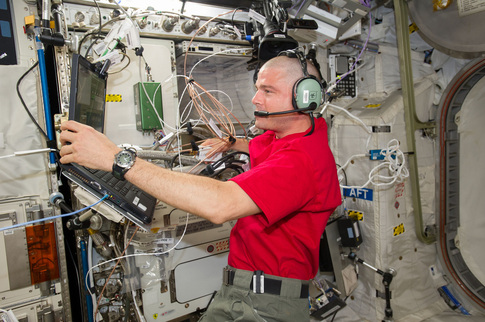
Astronaut Reid Wiseman, KF5LKT makes personal contacts with hams during the US Field Day exercise in June 2014. | Some ISS crew members make random, unscheduled, amateur radio voice contacts with earth-bound radio amateurs, often called "hams". They can make radio contacts during their breaks, pre-sleep time and before and after mealtime. Astronauts have contacted thousands of hams around the world. The work schedules of the ISS crew dictate when they are able to operate the radios. The crew's usual waking period is 0730 - 1930 UTC. The most common times to find a crew member making casual periods are about one hour after waking and before sleeping, when they have personal time. They're usually free most of the weekend, as well. |
The crew can operate the Kenwood radio in the crossband repeater mode, and hams can make contacts with the ISS station when the crew members are working. Hams can also communicate with each other using the ISS packet (computer) radio mode, or receive slow scan television mode images. It all depends on what equipment is in service in space.
A typical ground station for contacting the ISS station includes a 2-meter FM transceiver and 25-100 watts of output power. A circularly polarized crossed-Yagi antenna capable of being pointed in both azimuth (North-South-East-West) and elevation (degrees above the horizon) is desirable. But successful contacts have even been made with vertical and ground plane antennas.
Visit the the "Beginners" sections of the AMSAT-NA or AMSAT-UK websites for information on getting started with all modes of amateur radio satellite operation.
Frequencies in Use
The following frequencies are currently used for Amateur Radio ISS contacts (QSOs):
Voice and SSTV Downlink: 145.80 (Worldwide)
Voice Uplink: 144.49 for ITU Regions 2 and 3 (The Americas, and the Pacific and Southern Asia)
Voice Uplink: 145.20 for ITU Region 1 (Europe, Russia and Africa)
VHF Packet Uplink and Downlink: 145.825 (Worldwide)
UHF Packet Uplink and Downlink: 437.550
VHF/UHF Repeater Uplink: 145.99 (PL 67 Hz)
VHF/UHF Repeater Downlink: 437.80
For a description of ITU regions, consult the ITU map.
Most ARISS operations are split-frequency (each station uses separate receive and transmit frequencies). The downlink is the earth station's receiving frequency. The uplink is the earth station's transmitting frequency. Earth stations can listen to the downlink frequency and transmit on the uplink frequency when the ISS is in range and crew members are on the air. Please do not transmit on the ISS downlink frequency.
Call Signs in Use
The following call signs are available for use on the ISS:
Russian: RS0ISS
USA: NA1SS
European: DP0ISS, OR4ISS, IR0ISS
Other call signs may come into use as the station and crew change.
QSL Cards
QSL cards are offered to confirm radio contacts with the ISS. Here's how to obtain one.
Orbit Prediction Software
Commercial and public domain software is available to help track when the ISS will be in range of your station, and where to point your antenna. Various online programs allow you to follow the path of satellites, including the ISS.
You'll find one such pass prediction tool on the AMSAT website. Use the drop-down menu to select the "ISS" as the satellite you want to track and enter your longitude and latitude information. Click on the link provided on that page to view the current location of the ISS. You'll find this and other tools for satellite tracking on the AMSAT website at
www.amsat.org/amsat-new/tools/.Radios, Modes and Antennas on the ISS
The ISS amateur radios are a Kenwood D710E and a Kenwood D710GA.
The Kenwood TM-D710GA radio is located in the ISS Columbus Module, supports 2 meter (144-146 MHz) and 70 cm (435-438 MHz) operation. This radio provides a higher output power capability (restricted to a maximum of 25 Watts in ISS operation) supporting FM and packet operations. The higher power capability allows nearly horizon-to-horizon signal reception using simple hand-held radios or scanners. A set of 5 default options, or Programmable Memories, are embedded in the D710GA to support ISS operations.
The Kenwood TM-D710E radio is located in the ISS Service Module (Zvezda), supports 2 meter (144-146 MHz) and 70 cm (435-438 MHz) operation. This radio provides a higher output power capability supporting FM and SSTV operations. The higher power capability allows nearly horizon-to-horizon signal reception using simple hand-held radios or scanners. A set of 5 default options, or Programmable Memories, are embedded in the D710E to support ISS operations.
There are numerous channels programmed in the radios. Two of these channels on the 2 meter radio band support voice operations (145.80 down/144.49 up for ITU Regions 2 &3 & 145.80 down/145.20 up for ITU Region 1). It is necessary to use two uplink frequencies to operate in accordance with region-to-region IARU band plan differences.
The crew switches between one frequency to the other; scanning is not used. For example, if a crew member begins a QSO over the US, they can track US stations until they hit the Atlantic and then they will quickly lose US stations. They can then switch over to the other frequency and pick up stations in Europe or Africa.
Packet Operations
There is one radio on the ISS that operates as a packet digipeater. T
he Columbus D710GA can support those operation at about 10 watts and uses NA1SS. It will respond to the alias "ARISS".
For information about using the ISS packet system, check out this resource provided by JoAnne Maenpaa, K9JKM.
SSTV Operations
Slow Scan Television (SSTV) images can be transmitted from the International Space Station. An SSTV system is an integral part of one of the ARISS ham radio stations, NA1SS/ RS0ISS in the Service Module. It transmits and receives JPEG still images.This system utilizes the Kenwood D700 and D710 radios and the ARISS antennas mounted on the Service Module. The SSTV equipment also includes SpaceCam and MMSSTV software, a radio/computer interface module and data cables. A Kenwood VC-H1 is also used to provide near real-time automatically transmitted images (usually earth views) once every 3 minutes, when active.
A Kenwood D710 radio located in the Service Module was deployed by the Russian Space Agency, Energia to provide extended support of imaging experiments using various SSTV formats. It employs SpaceCam and MMSSTV software to transmit stored images.
See the European Space Agency's video, How to get pictures from the International Space Station via amateur radio
In preparation for future ISS SSTV events, a video demonstration of receiving SSTV from the ISS was created by avid ARISS supporter, John Brier, KG4AKV. In addition, John has provided an excellent online tutorial explaining in more detail how to configure a simple system to acquire and view the SSTV images. Links to both can be found at https://www.youtube.com/watch?v=7to9uX1sWC4 and https://spacecomms.wordpress.com/iss-sstv-reception-hints
/.
To view or submit SSTV received images transmitted from the ISS, and to follow SSTV operations, check out the ISS SSTV blog site.
HamTV System
Currently available
Antennas
A set of four antenna systems are deployed in the ISS Service Module supporting the current installation of the Kenwood TM-D710GA radio. Each of the four antennas can support amateur radio operations on multiple frequencies and allow for simultaneous automatic and crew-tended operations. Having four antennas also ensures that ham radio operations can continue aboard the station should one or more of the antennas fail. Three of the four antennas are identical and each can support both transmit and receive operations on 2 meter, 70 cm, L band and S band. They also support reception for the station's Russian Glisser TV system, which is used during spacewalks. The fourth antenna has a 2.5-meter (8 foot) long vertical whip that can be used to support High Frequency (HF) operations, particularly on 10 meters. Currently, one of the 3 VHF/UHF antennas is disconnected and the HF antenna has no radio hardware available for use.
Three antennas are installed on the Columbus module, currently serving the Kenwood TM-D710GA radio deployed there. Frequencies available for transmission to and from Columbus are 2 meters, 70 centimeters, L-band and S-band. These antennas will also support the Ham TV DATV transmitter.