Marmot v2

What & Why?
Marmot v2 is a leaderless, distributed SQLite replication system built on a gossip-based protocol with distributed transactions and eventual consistency.
Key Features:
- Leaderless Architecture: No single point of failure - any node can accept writes
- MySQL Protocol Compatible: Connect with any MySQL client (DBeaver, MySQL Workbench, mysql CLI)
- WordPress Compatible: Full MySQL function support for running distributed WordPress
- Distributed Transactions: Percolator-style write intents with conflict detection
- Multi-Database Support: Create and manage multiple databases per cluster
- DDL Replication: Distributed schema changes with automatic idempotency and cluster-wide locking
- Production-Ready SQL Parser: Powered by rqlite/sql AST parser for MySQL→SQLite transpilation
- CDC-Based Replication: Row-level change data capture for consistent replication
Why Marmot?
The Problem with Traditional Replication
MySQL active-active requires careful setup of replication, conflict avoidance, and monitoring. Failover needs manual intervention. Split-brain scenarios demand operational expertise. This complexity doesn't scale to edge deployments.
Marmot's Approach
- Zero operational overhead: Automatic recovery from split-brain via eventual consistency + anti-entropy
- No leader election: Any node accepts writes, no failover coordination needed
- Direct SQLite access: Clients can read the local SQLite file directly for maximum performance
- Tunable consistency: Choose ONE/QUORUM/ALL per your latency vs durability needs
Why MySQL Protocol?
- Ecosystem compatibility - existing drivers, ORMs, GUI tools work out-of-box
- Battle-tested wire protocol implementations
- Run real applications like WordPress without modification
Ideal Use Cases
Marmot excels at read-heavy edge scenarios:
| Use Case | How Marmot Helps |
|---|---|
| Distributed WordPress | Multi-region WordPress with replicated database |
| Lambda/Edge sidecars | Lightweight regional SQLite replicas, local reads |
| Edge vector databases | Distributed embeddings with local query |
| Regional config servers | Fast local config reads, replicated writes |
| Product catalogs | Geo-distributed catalog data, eventual sync |
When to Consider Alternatives
- Strong serializability required → CockroachDB, Spanner
- Single-region high-throughput → PostgreSQL, MySQL directly
- Large datasets (>100GB) → Sharded solutions
Quick Start
# Start a single-node cluster
./marmot-v2

# Connect with MySQL client
mysql -h localhost -P 3306 -u root

# Or use DBeaver, MySQL Workbench, etc.
Testing Replication
# Test DDL and DML replication across a 2-node cluster
./scripts/test-ddl-replication.sh

# This script will:
# 1. Start a 2-node cluster
# 2. Create a table on node 1 and verify it replicates to node 2
# 3. Insert data on node 1 and verify it replicates to node 2
# 4. Update data on node 2 and verify it replicates to node 1
# 5. Delete data on node 1 and verify it replicates to node 2

# Manual cluster testing
./examples/start-seed.sh              # Start seed node (port 8081, mysql 3307)
./examples/join-cluster.sh 2 localhost:8081  # Join node 2 (port 8082, mysql 3308)
./examples/join-cluster.sh 3 localhost:8081  # Join node 3 (port 8083, mysql 3309)

# Connect to any node and run queries
mysql --protocol=TCP -h localhost -P 3307 -u root
mysql --protocol=TCP -h localhost -P 3308 -u root

# Cleanup
pkill -f marmot-v2
WordPress Support
Marmot can run distributed WordPress with full database replication across nodes. Each WordPress instance connects to its local Marmot node, and all database changes replicate automatically.
MySQL Compatibility for WordPress
Marmot implements MySQL functions required by WordPress:
| Category | Functions |
|---|---|
| Date/Time | NOW, CURDATE, DATE_FORMAT, UNIX_TIMESTAMP, DATEDIFF, YEAR, MONTH, DAY, etc. |
| String | CONCAT_WS, SUBSTRING_INDEX, FIND_IN_SET, LPAD, RPAD, etc. |
| Math/Hash | RAND, MD5, SHA1, SHA2, POW, etc. |
| DML | ON DUPLICATE KEY UPDATE (transformed to SQLite ON CONFLICT) |
Quick Start: 3-Node WordPress Cluster
cd examples/wordpress-cluster
./run.sh up
This starts:
- 3 Marmot nodes with QUORUM write consistency
- 3 WordPress instances each connected to its local Marmot node
┌─────────────┐  ┌─────────────┐  ┌─────────────┐
│ WordPress-1 │  │ WordPress-2 │  │ WordPress-3 │
│ :9101       │  │ :9102       │  │ :9103       │
└──────┬──────┘  └──────┬──────┘  └──────┬──────┘
       ▼                ▼                ▼
┌─────────────┐  ┌─────────────┐  ┌─────────────┐
│  Marmot-1   │◄─┤  Marmot-2   │◄─┤  Marmot-3   │
│ MySQL: 9191 │  │ MySQL: 9192 │  │ MySQL: 9193 │
└─────────────┘  └─────────────┘  └─────────────┘
       └──────────────┴──────────────┘
              QUORUM Replication
Test it:
- Open http://localhost:9101 - complete WordPress installation
- Open http://localhost:9102 or http://localhost:9103
- See your content replicated across all nodes!
Commands:
./run.sh status   # Check cluster health
./run.sh logs-m   # Marmot logs only
./run.sh logs-wp  # WordPress logs only
./run.sh down     # Stop cluster
Production Considerations for WordPress
- Media uploads: Use S3/NFS for shared media storage (files not replicated by Marmot)
- Sessions: Use Redis or database sessions for sticky-session-free load balancing
- Caching: Each node can use local object cache (Redis/Memcached per region)
Architecture
Marmot v2 uses a fundamentally different architecture from other SQLite replication solutions:
vs. rqlite/dqlite/LiteFS:
- ❌ They require a primary node for all writes
- ✅ Marmot allows writes on any node
- ❌ They use leader election (Raft)
- ✅ Marmot uses gossip protocol (no leader)
- ❌ They require proxy layer or page-level interception
- ✅ Marmot uses MySQL protocol for direct database access
How It Works:
- Write Coordination: 2PC (Two-Phase Commit) with configurable consistency (ONE, QUORUM, ALL)
- Conflict Resolution: Last-Write-Wins (LWW) with HLC timestamps
- Cluster Membership: SWIM-style gossip with failure detection
- Data Replication: Full database replication - all nodes receive all data
- DDL Replication: Cluster-wide schema changes with automatic idempotency
Comparison with Alternatives
| Aspect | Marmot | MySQL Active-Active | rqlite/dqlite | TiDB |
|---|---|---|---|---|
| Leader | None | None (but complex) | Yes (Raft) | Yes (Raft) |
| Failover | Automatic | Manual intervention | Automatic | Automatic |
| Split-brain recovery | Automatic (anti-entropy) | Manual | N/A (leader-based) | N/A |
| Consistency | Tunable (ONE/QUORUM/ALL) | Serializable | Strong | Strong |
| Direct file read | ✅ SQLite file | ❌ | ❌ | ❌ |
| JS-safe AUTO_INCREMENT | ✅ Compact mode (53-bit) | N/A | N/A | ❌ 64-bit breaks JS |
| Edge-friendly | ✅ Lightweight | ❌ Heavy | ⚠️ Moderate | ❌ Heavy |
| Operational complexity | Low | High | Low | High |
DDL Replication
Marmot v2 supports distributed DDL (Data Definition Language) replication without requiring master election:
How It Works
Cluster-Wide Locking: Each DDL operation acquires a distributed lock per database (default: 30-second lease)
- Prevents concurrent schema changes on the same database
- Locks automatically expire if a node crashes
- Different databases can have concurrent DDL operations
Automatic Idempotency: DDL statements are automatically rewritten for safe replay
CREATE TABLE users (id INT)
→ CREATE TABLE IF NOT EXISTS users (id INT)

DROP TABLE users
→ DROP TABLE IF EXISTS users
Schema Version Tracking: Each database maintains a schema version counter
- Incremented on every DDL operation
- Exchanged via gossip protocol for drift detection
- Used by delta sync to validate transaction applicability
Quorum-Based Replication: DDL replicates like DML through the same 2PC mechanism
- No special master node needed
- Works with existing consistency levels (QUORUM, ALL, etc.)
Configuration
[ddl]
# DDL lock lease duration (seconds)
lock_lease_seconds = 30

# Automatically rewrite DDL for idempotency
enable_idempotent = true
Best Practices
- ✅ Do: Execute DDL from a single connection/node at a time
- ✅ Do: Use qualified table names (
mydb.usersinstead ofusers) - ⚠️ Caution: ALTER TABLE is less idempotent - avoid replaying failed ALTER operations
- ❌ Don't: Run concurrent DDL on the same database from multiple nodes
CDC-Based Replication
Marmot v2 uses Change Data Capture (CDC) for replication instead of SQL statement replay:
How It Works
- Row-Level Capture: Instead of replicating SQL statements, Marmot captures the actual row data changes (INSERT/UPDATE/DELETE)
- Binary Data Format: Row data is serialized as CDC messages with column values, ensuring consistent replication regardless of SQL dialect
- Deterministic Application: Row data is applied directly to the target database, avoiding parsing ambiguities
Benefits
- Consistency: Same row data applied everywhere, no SQL parsing differences
- Performance: Binary format is more efficient than SQL text
- Reliability: No issues with SQL syntax variations between MySQL and SQLite
Row Key Extraction
For UPDATE and DELETE operations, Marmot automatically extracts row keys:
- Uses PRIMARY KEY columns when available
- Falls back to ROWID for tables without explicit primary key
- Handles composite primary keys correctly
CDC Publisher
Marmot can publish CDC events to external messaging systems, enabling real-time data pipelines, analytics, and event-driven architectures. Events follow the Debezium specification for maximum compatibility with existing CDC tooling.
Features
- Debezium-Compatible Format: Events conform to the Debezium event structure, compatible with Kafka Connect, Flink, Spark, and other CDC consumers
- Multi-Sink Support: Publish to multiple destinations simultaneously (Kafka, NATS)
- Glob-Based Filtering: Filter which tables and databases to publish
- Automatic Retry: Exponential backoff with configurable limits
- Persistent Cursors: Survives restarts without losing position
Configuration
[publisher]
enabled = true

[[publisher.sinks]]
name = "kafka-main"
type = "kafka"                    # "kafka" or "nats"
format = "debezium"               # Debezium-compatible JSON format
brokers = ["localhost:9092"]      # Kafka broker addresses
topic_prefix = "marmot.cdc"       # Topics: {prefix}.{database}.{table}
filter_tables = ["*"]             # Glob patterns (e.g., "users", "order_*")
filter_databases = ["*"]          # Glob patterns (e.g., "prod_*")
batch_size = 100                  # Events per poll cycle
poll_interval_ms = 10             # Polling interval

# NATS sink example
[[publisher.sinks]]
name = "nats-events"
type = "nats"
format = "debezium"
nats_url = "nats://localhost:4222"
topic_prefix = "marmot.cdc"
filter_tables = ["*"]
filter_databases = ["*"]
Event Format
Events follow the Debezium envelope structure:
{
  "schema": { ... },
  "payload": {
    "before": null,
    "after": {"id": 1, "name": "alice", "email": "alice@example.com"},
    "source": {
      "version": "2.0.0",
      "connector": "marmot",
      "name": "marmot",
      "ts_ms": 1702500000000,
      "db": "myapp",
      "table": "users"
    },
    "op": "c",
    "ts_ms": 1702500000000
  }
}
Operation Types (per Debezium spec):
| Operation | op |
before |
after |
|---|---|---|---|
| INSERT | c (create) |
null |
row data |
| UPDATE | u (update) |
old row | new row |
| DELETE | d (delete) |
old row | null |
Topic Naming
Topics follow the pattern: {topic_prefix}.{database}.{table}
Examples:
marmot.cdc.myapp.usersmarmot.cdc.myapp.ordersmarmot.cdc.analytics.events
Use Cases
- Real-Time Analytics: Stream changes to data warehouses (Snowflake, BigQuery, ClickHouse)
- Event-Driven Microservices: Trigger actions on data changes
- Cache Invalidation: Keep caches in sync with database changes
- Audit Logging: Capture all changes for compliance
- Search Indexing: Keep Elasticsearch/Algolia in sync
For more details, see the Integrations documentation.
Edge Deployment Patterns
Lambda Sidecar
Deploy Marmot as a lightweight regional replica alongside Lambda functions:
- Local SQLite reads (sub-ms latency)
- Writes replicate to cluster
- No cold-start database connections
Read-Only Regional Replicas
Scale reads globally with replica mode:
[replica]
enabled = true
master_address = "central-cluster:8080"
reconnect_interval_seconds = 5
- Follows master via streaming replication
- Zero cluster participation overhead
- Auto-reconnect on network issues
Hybrid: Edge Reads, Central Writes
- Deploy full cluster in central region
- Deploy read replicas at edge locations
- Application routes writes to central, reads to local replica
SQL Statement Compatibility
Marmot supports a wide range of MySQL/SQLite statements through its MySQL protocol server. The following table shows compatibility for different statement types:
| Statement Type | Support | Replication | Notes |
|---|---|---|---|
| DML - Data Manipulation | |||
INSERT / REPLACE |
✅ Full | ✅ Yes | Includes qualified table names (db.table) |
UPDATE |
✅ Full | ✅ Yes | Includes qualified table names |
DELETE |
✅ Full | ✅ Yes | Includes qualified table names |
SELECT |
✅ Full | N/A | Read operations |
LOAD DATA |
✅ Full | ✅ Yes | Bulk data loading |
| DDL - Data Definition | |||
CREATE TABLE |
✅ Full | ✅ Yes | Replicated with cluster-wide locking |
ALTER TABLE |
✅ Full | ✅ Yes | Replicated with cluster-wide locking |
DROP TABLE |
✅ Full | ✅ Yes | Replicated with cluster-wide locking |
TRUNCATE TABLE |
✅ Full | ✅ Yes | |
RENAME TABLE |
✅ Full | ✅ Yes | Replicated with cluster-wide locking |
CREATE/DROP INDEX |
✅ Full | ✅ Yes | Replicated with cluster-wide locking |
CREATE/DROP VIEW |
✅ Full | ✅ Yes | Replicated with cluster-wide locking |
CREATE/DROP TRIGGER |
✅ Full | ✅ Yes | Replicated with cluster-wide locking |
| Database Management | |||
CREATE DATABASE |
✅ Full | ✅ Yes | Replicated with cluster-wide locking |
DROP DATABASE |
✅ Full | ✅ Yes | Replicated with cluster-wide locking |
ALTER DATABASE |
✅ Full | ✅ Yes | Replicated with cluster-wide locking |
SHOW DATABASES |
✅ Full | N/A | Metadata query |
SHOW TABLES |
✅ Full | N/A | Metadata query |
USE database |
✅ Full | N/A | Session state |
| Transaction Control | |||
BEGIN / START TRANSACTION |
✅ Full | N/A | Transaction boundary |
COMMIT |
✅ Full | ✅ Yes | Commits distributed transaction |
ROLLBACK |
✅ Full | ✅ Yes | Aborts distributed transaction |
SAVEPOINT |
✅ Full | ✅ Yes | Nested transaction support |
| Locking | |||
LOCK TABLES |
✅ Parsed | ❌ No | Requires distributed locking coordination |
UNLOCK TABLES |
✅ Parsed | ❌ No | Requires distributed locking coordination |
| Session Configuration | |||
SET statements |
✅ Parsed | ❌ No | Session-local, not replicated |
| XA Transactions | |||
XA START/END/PREPARE |
✅ Parsed | ❌ No | Marmot uses its own 2PC protocol |
XA COMMIT/ROLLBACK |
✅ Parsed | ❌ No | Not compatible with Marmot's model |
| DCL - Data Control | |||
GRANT / REVOKE |
✅ Parsed | ❌ No | User management not replicated |
CREATE/DROP USER |
✅ Parsed | ❌ No | User management not replicated |
ALTER USER |
✅ Parsed | ❌ No | User management not replicated |
| Administrative | |||
OPTIMIZE TABLE |
✅ Parsed | ❌ No | Node-local administrative command |
REPAIR TABLE |
✅ Parsed | ❌ No | Node-local administrative command |
Legend
- ✅ Full: Fully supported and working
- ✅ Parsed: Statement is parsed and recognized
- ⚠️ Limited: Works but has limitations in distributed context
- ❌ No: Not supported or not replicated
- N/A: Not applicable (read-only or session-local)
Important Notes
Schema Changes (DDL): DDL statements are fully replicated with cluster-wide locking and automatic idempotency. See the DDL Replication section for details.
XA Transactions: Marmot has its own distributed transaction protocol based on 2PC. MySQL XA transactions are not compatible with Marmot's replication model.
User Management (DCL): User and privilege management statements are local to each node. For production deployments, consider handling authentication at the application or proxy level.
Table Locking:
LOCK TABLESstatements are recognized but not enforced across the cluster. Use application-level coordination for distributed locking needs.Qualified Names: Marmot fully supports qualified table names (e.g.,
db.table) in DML and DDL operations.
MySQL Protocol & Metadata Queries
Marmot includes a MySQL-compatible protocol server, allowing you to connect using any MySQL client (DBeaver, MySQL Workbench, mysql CLI, etc.). The server supports:
Metadata Query Support
Marmot provides full support for MySQL metadata queries, enabling GUI tools like DBeaver to browse databases, tables, and columns:
- SHOW Commands:
SHOW DATABASES,SHOW TABLES,SHOW COLUMNS FROM table,SHOW CREATE TABLE,SHOW INDEXES - INFORMATION_SCHEMA: Queries against
INFORMATION_SCHEMA.TABLES,INFORMATION_SCHEMA.COLUMNS,INFORMATION_SCHEMA.SCHEMATA, andINFORMATION_SCHEMA.STATISTICS - Type Conversion: Automatic SQLite-to-MySQL type mapping for compatibility
These metadata queries are powered by the rqlite/sql AST parser, providing production-grade MySQL query compatibility.
Connecting with MySQL Clients
# Using mysql CLI
mysql -h localhost -P 3306 -u root

# Connection string for applications
mysql://root@localhost:3306/marmot
Recovery Scenarios
Marmot handles various failure and recovery scenarios automatically:
Network Partition (Split-Brain)
| Scenario | Behavior |
|---|---|
| Minority partition | Writes fail - cannot achieve quorum |
| Majority partition | Writes succeed - quorum achieved |
| Partition heals | Delta sync + LWW merges divergent data |
How it works:
- During partition, only the majority side can commit writes (quorum enforcement)
- When partition heals, nodes exchange transaction logs via
StreamChangesRPC - Conflicts resolved using Last-Writer-Wins (LWW) with HLC timestamps
- Higher node ID breaks ties for simultaneous writes
Node Failure & Recovery
| Scenario | Recovery Method |
|---|---|
| Brief outage | Delta sync - replay missed transactions |
| Extended outage | Snapshot transfer + delta sync |
| New node joining | Full snapshot from existing node |
Anti-Entropy Background Process:
Marmot v2 includes an automatic anti-entropy system that continuously monitors and repairs replication lag across the cluster:
- Lag Detection: Every 60 seconds (configurable), each node queries peers for their replication state
- Smart Recovery Decision:
- Delta Sync if lag < 10,000 transactions AND < 1 hour: Streams missed transactions incrementally
- Snapshot Transfer if lag exceeds thresholds: Full database file transfer for efficiency
- Gap Detection: Detects when transaction logs have been GC'd and automatically falls back to snapshot
- Multi-Database Support: Tracks and syncs each database independently
- GC Coordination: Garbage collection respects peer replication state - logs aren't deleted until all peers have applied them
Delta Sync Process:
- Lagging node queries
last_applied_txn_idfor each peer/database - Requests transactions since that ID via
StreamChangesRPC - Gap Detection: Checks if first received txn_id has a large gap from requested ID
- If gap > delta_sync_threshold_txns, indicates missing (GC'd) transactions
- Automatically falls back to snapshot transfer to prevent data loss
- Applies changes using LWW conflict resolution
- Updates replication state tracking (per-database)
- Progress logged every 100 transactions
GC Coordination with Anti-Entropy:
- Transaction logs are retained with a two-tier policy:
- Min retention (2 hours): Must be >= delta sync threshold, respects peer lag
- Max retention (24 hours): Force delete after this time to prevent unbounded growth
- Config validation enforces:
gc_min >= delta_thresholdandgc_max >= 2x delta_threshold - Each database tracks replication progress per peer
- GC queries minimum applied txn_id across all peers before cleanup
- Gap detection prevents data loss if GC runs while nodes are offline
Consistency Guarantees
| Write Consistency | Behavior |
|---|---|
ONE |
Returns after 1 node ACK (fast, less durable) |
QUORUM |
Returns after majority ACK (default, balanced) |
ALL |
Returns after all nodes ACK (slow, most durable) |
Conflict Resolution:
- All conflicts resolved via LWW using HLC timestamps
- No data loss - later write always wins deterministically
- Tie-breaker: higher node ID wins for equal timestamps
Limitations
- Selective Table Watching: All tables in a database are replicated. Selective table replication is not supported.
- WAL Mode Required: SQLite must use WAL mode for reliable multi-process changes.
- Eventually Consistent: Rows may sync out of order.
SERIALIZABLEtransaction assumptions may not hold across nodes. - Concurrent DDL: Avoid running concurrent DDL operations on the same database from multiple nodes (protected by cluster-wide lock with 30s lease).
Auto-Increment & ID Generation
The Problem with Distributed IDs
Distributed databases need globally unique IDs, but traditional solutions cause problems:
| Solution | Issue |
|---|---|
| UUID | 128-bit, poor index performance, not sortable |
| Snowflake/HLC 64-bit | Exceeds JavaScript's Number.MAX_SAFE_INTEGER (2^53-1) |
| TiDB AUTO_INCREMENT | Returns 64-bit IDs that break JavaScript clients silently |
The JavaScript Problem:
// 64-bit ID from TiDB or other distributed DBs
const id = 7318624812345678901;
console.log(id);  // 7318624812345679000 - WRONG! Precision lost!

// JSON parsing also breaks
JSON.parse('{"id": 7318624812345678901}');  // {id: 7318624812345679000}
TiDB's answer? "Use strings." But that breaks ORMs, existing application code, and type safety.
Marmot's Solution: Compact ID Mode
Marmot offers two ID generation modes to solve this:
| Mode | Bits | Range | Use Case |
|---|---|---|---|
extended |
64-bit | Full HLC timestamp | New systems, non-JS clients |
compact |
53-bit | JS-safe integers | Legacy systems, JavaScript, REST APIs |
[mysql]
auto_id_mode = "compact"  # Safe for JavaScript (default)
# auto_id_mode = "extended"  # Full 64-bit for new systems
Compact Mode Guarantees:
- IDs stay under
Number.MAX_SAFE_INTEGER(9,007,199,254,740,991) - Still globally unique across all nodes
- Still monotonically increasing (per node)
- No silent precision loss in JSON/JavaScript
- Works with existing ORMs expecting integer IDs
With Marmot compact mode:
const id = 4503599627370496;
console.log(id);  // 4503599627370496 - Correct!
JSON.parse('{"id": 4503599627370496}');  // {id: 4503599627370496} - Correct!
How Auto-Increment Works
Note: Marmot automatically converts
INT AUTO_INCREMENTtoBIGINTto support distributed ID generation.
DDL Transformation: When you create a table with
AUTO_INCREMENT:CREATE TABLE users (id INT AUTO_INCREMENT PRIMARY KEY, name VARCHAR(100)) -- Becomes internally: CREATE TABLE users (id BIGINT PRIMARY KEY, name TEXT)DML ID Injection: When inserting with
0orNULLfor an auto-increment column:INSERT INTO users (id, name) VALUES (0, 'alice') -- Becomes internally (compact mode): INSERT INTO users (id, name) VALUES (4503599627370496, 'alice')Explicit IDs Preserved: If you provide an explicit non-zero ID, it is used as-is.
Schema-Based Detection:
Marmot automatically detects auto-increment columns by querying SQLite schema directly:
- Single-column
INTEGER PRIMARY KEY(SQLite rowid alias) - Single-column
BIGINT PRIMARY KEY(Marmot's transformed columns)
No registration required - columns are detected from schema at runtime, works across restarts, and works with existing databases.
Configuration
Marmot v2 uses a TOML configuration file (default: config.toml). All settings have sensible defaults.
Core Configuration
node_id = 0  # 0 = auto-generate
data_dir = "./marmot-data"
Transaction Manager
[transaction]
heartbeat_timeout_seconds = 10  # Transaction timeout without heartbeat
conflict_window_seconds = 10    # Conflict resolution window
lock_wait_timeout_seconds = 50  # Lock wait timeout (MySQL: innodb_lock_wait_timeout)
Note: Transaction log garbage collection is managed by the replication configuration to coordinate with anti-entropy. See replication.gc_min_retention_hours and replication.gc_max_retention_hours.
Connection Pool
[connection_pool]
pool_size = 4              # Number of SQLite connections
max_idle_time_seconds = 10 # Max idle time before closing
max_lifetime_seconds = 300 # Max connection lifetime (0 = unlimited)
gRPC Client
[grpc_client]
keepalive_time_seconds = 10    # Keepalive ping interval
keepalive_timeout_seconds = 3  # Keepalive ping timeout
max_retries = 3                # Max retry attempts
retry_backoff_ms = 100         # Retry backoff duration
Coordinator
[coordinator]
prepare_timeout_ms = 2000 # Prepare phase timeout
commit_timeout_ms = 2000  # Commit phase timeout
abort_timeout_ms = 2000   # Abort phase timeout
Cluster
[cluster]
grpc_bind_address = "0.0.0.0"
grpc_port = 8080
seed_nodes = []                # List of seed node addresses
cluster_secret = ""            # PSK for cluster authentication (see Security section)
gossip_interval_ms = 1000      # Gossip interval
gossip_fanout = 3              # Number of peers to gossip to
suspect_timeout_ms = 5000      # Suspect timeout
dead_timeout_ms = 10000        # Dead timeout
Security
Marmot supports Pre-Shared Key (PSK) authentication for cluster communication. This is strongly recommended for production deployments.
[cluster]
# All nodes in the cluster must use the same secret
cluster_secret = "your-secret-key-here"
Environment Variable (Recommended):
For production, use the environment variable to avoid storing secrets in config files:
export MARMOT_CLUSTER_SECRET="your-secret-key-here"
./marmot
The environment variable takes precedence over the config file.
Generating a Secret:
# Generate a secure random secret
openssl rand -base64 32
Behavior:
- If
cluster_secretis empty andMARMOT_CLUSTER_SECRETis not set, authentication is disabled - A warning is logged at startup when authentication is disabled
- All gRPC endpoints (gossip, replication, snapshots) are protected when authentication is enabled
- Nodes with mismatched secrets will fail to communicate (connection rejected with "invalid cluster secret")
Cluster Membership Management
Marmot provides admin HTTP endpoints for managing cluster membership (requires cluster_secret to be configured):
Node Lifecycle:
- New/restarted nodes auto-join via gossip - no manual intervention needed
- Nodes marked REMOVED via admin API cannot auto-rejoin - must be explicitly allowed
- This prevents decommissioned nodes from accidentally rejoining the cluster
# View cluster members and quorum info
curl -H "X-Marmot-Secret: your-secret" http://localhost:8080/admin/cluster/members

# Remove a node from the cluster (excludes from quorum, blocks auto-rejoin)
curl -X POST -H "X-Marmot-Secret: your-secret" http://localhost:8080/admin/cluster/remove/2

# Allow a removed node to rejoin (node must then restart to join)
curl -X POST -H "X-Marmot-Secret: your-secret" http://localhost:8080/admin/cluster/allow/2
See the Operations documentation for detailed usage and examples.
Replica Mode
For read-only replicas that follow a master node without participating in the cluster:
[replica]
enabled = true                       # Enable read-only replica mode
master_address = "master:8080"       # Master node gRPC address
reconnect_interval_seconds = 5       # Reconnect delay on disconnect
Note: Replica mode is mutually exclusive with cluster mode. A replica receives all data via streaming replication but cannot accept writes.
Replication
[replication]
default_write_consistency = "QUORUM"      # Write consistency level: ONE, QUORUM, ALL
default_read_consistency = "LOCAL_ONE"    # Read consistency level
write_timeout_ms = 5000                   # Write operation timeout
read_timeout_ms = 2000                    # Read operation timeout

# Anti-Entropy: Background healing for eventual consistency
# - Detects and repairs divergence between replicas
# - Uses delta sync for small lags, snapshot for large lags
# - Includes gap detection to prevent incomplete data after GC
enable_anti_entropy = true                 # Enable automatic catch-up for lagging nodes
anti_entropy_interval_seconds = 60         # How often to check for lag (default: 60s)
delta_sync_threshold_transactions = 10000  # Delta sync if lag < 10K txns
delta_sync_threshold_seconds = 3600        # Snapshot if lag > 1 hour

# Garbage Collection: Reclaim disk space by deleting old transaction records
# - gc_min must be >= delta_sync_threshold (validated at startup)
# - gc_max should be >= 2x delta_sync_threshold (recommended)
# - Set gc_max = 0 for unlimited retention
gc_min_retention_hours = 2   # Keep at least 2 hours (>= 1 hour delta threshold)
gc_max_retention_hours = 24  # Force delete after 24 hours
Anti-Entropy Tuning:
- Small clusters (2-3 nodes): Use default settings (60s interval)
- Large clusters (5+ nodes): Consider increasing interval to 120-180s to reduce network overhead
- High write throughput: Increase
delta_sync_threshold_transactionsto 50000+ - Long-running clusters: Keep
gc_max_retention_hoursat 24+ to handle extended outages
GC Configuration Rules (Validated at Startup):
gc_min_retention_hoursmust be >=delta_sync_threshold_seconds(in hours)gc_max_retention_hoursshould be >= 2xdelta_sync_threshold_seconds- Violating these rules will cause startup failure with helpful error messages
Query Pipeline
[query_pipeline]
transpiler_cache_size = 10000  # LRU cache for MySQL→SQLite transpilation
validator_pool_size = 8        # SQLite connection pool for validation
MySQL Protocol Server
[mysql]
enabled = true
bind_address = "0.0.0.0"
port = 3306
max_connections = 1000
unix_socket = ""              # Unix socket path (empty = disabled)
unix_socket_perm = 0660       # Socket file permissions
auto_id_mode = "compact"      # "compact" (53-bit, JS-safe) or "extended" (64-bit)
Unix Socket Connection (lower latency than TCP):
mysql --socket=/tmp/marmot/mysql.sock -u root
CDC Publisher
[publisher]
enabled = false  # Enable CDC publishing to external systems

[[publisher.sinks]]
name = "kafka-main"              # Unique sink name
type = "kafka"                   # "kafka" or "nats"
format = "debezium"              # Debezium-compatible JSON (only option)
brokers = ["localhost:9092"]     # Kafka broker addresses
topic_prefix = "marmot.cdc"      # Topic pattern: {prefix}.{db}.{table}
filter_tables = ["*"]            # Glob patterns for table filtering
filter_databases = ["*"]         # Glob patterns for database filtering
batch_size = 100                 # Events to read per poll cycle
poll_interval_ms = 10            # Polling interval (default: 10ms)
retry_initial_ms = 100           # Initial retry delay on failure
retry_max_ms = 30000             # Max retry delay (30 seconds)
retry_multiplier = 2.0           # Exponential backoff multiplier
See the Integrations documentation for details on event format, Kafka/NATS configuration, and use cases.
Logging
[logging]
verbose = false          # Enable verbose logging
format = "console"       # Log format: console or json
Prometheus Metrics
[prometheus]
enabled = true  # Metrics served on gRPC port at /metrics endpoint
Accessing Metrics:
# Metrics are multiplexed with gRPC on the same port
curl http://localhost:8080/metrics

# Prometheus scrape config
scrape_configs:
  - job_name: 'marmot'
    static_configs:
      - targets: ['node1:8080', 'node2:8080', 'node3:8080']
See config.toml for complete configuration reference with detailed comments.
Benchmarks
Performance benchmarks on a local development machine (Apple M-series, 3-node cluster, single machine):
Test Configuration
| Parameter | Value |
|---|---|
| Nodes | 3 (ports 3307, 3308, 3309) |
| Threads | 16 |
| Batch Size | 10 ops/transaction |
| Consistency | QUORUM |
Load Phase (INSERT-only)
| Metric | Value |
|---|---|
| Throughput | 4,175 ops/sec |
| TX Throughput | 417 tx/sec |
| Records Loaded | 200,000 |
| Errors | 0 |
Mixed Workload
| Metric | Value |
|---|---|
| Throughput | 3,370 ops/sec |
| TX Throughput | 337 tx/sec |
| Duration | 120 seconds |
| Total Operations | 404,930 |
| Errors | 0 |
| Retries | 37 (0.09%) |
Operation Distribution:
- READ: 20%
- UPDATE: 30%
- INSERT: 35%
- DELETE: 5%
- UPSERT: 10%
Latency (Mixed Workload)
| Percentile | Latency |
|---|---|
| P50 | 4.3ms |
| P90 | 14.0ms |
| P95 | 36.8ms |
| P99 | 85.1ms |
Replication Verification
All 3 nodes maintained identical row counts (346,684 rows) throughout the test, confirming consistent replication.
Note: These benchmarks are from a local development machine with all nodes on the same host. Production deployments across multiple machines will have different characteristics based on network latency. Expect P99 latencies of 50-200ms for cross-region QUORUM writes.
Backup & Disaster Recovery
Option 1: Litestream (Recommended)
Marmot's SQLite files are standard WAL-mode databases, compatible with Litestream:
litestream replicate /path/to/marmot-data/*.db s3://bucket/backup
Option 2: CDC to External Storage
Enable CDC publisher to stream changes to Kafka/NATS, then archive to your preferred storage.
Option 3: Filesystem Snapshots
Since Marmot uses SQLite with WAL mode, you can safely snapshot the data directory during operation.
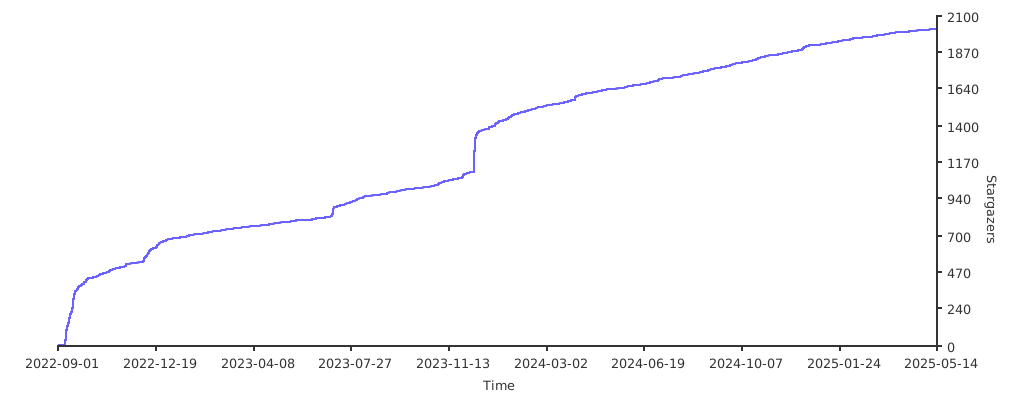
Stargazers over time