https://www.bbc.co.uk/news/articles/cp37g5nxe3lo
> It comes as EVs are facing scrutiny from safety watchdogs around the world after a number of deadly incidents, including two fatal crashes in China involving Xiaomi EVs in which power failures were suspected to have prevented doors from being opened.
You had one job, door handles... but being made sleek and sexy and unlike normal door handles also made you a fucking liability.
in the article, it shows a Magna-Steyr handle on a Mercedes Gelaendewagen, which looks like those on the Ineos Grenadier, and not very different than the ones that Ford uses on various trucks.
that contrasts with those on Audi and BMW evs, for examples i see often, where the CoD is a stated spec for ev shoppers, and the handles have motion to them, but are flush (but not Tesla vanishingly flush). Weirdly, some Porsches (intimately related to Audi...just read the shared parts) use flush handles and some the protruding handles with an actual handle.
i admittedly pay an unusual amount of attention to car componentry, sort of a hobby really.
Simply put vehicles are at the point where we need a rule that says "The doors can be unlocked and open if the battery is dead" Full stop, no ifs, ands, or buts.
Manual windows roll up and down for decade after decade...
Electric door locks are bad, too. After a while, they won't lock or unlock.
Flush handles exist as brand differentiators. They're a "futuristic" feel-good feature that consumers want, like engine noise, tablets, and colorful dashboards.
This bans new cars from having clamshell bodywork like that found on classics like the Jaguar E-type and Ford GT40. I suspect it also results in many cars having narrower truck/hatch openings than they would have if they could put mandated lights on the trunk lid or rear hatch.
It's not hard to imagine the partially legitimate reason that on occasion, someone will drive with the trunk open, but do we really need a law about it?
If you want to do that stuff, do it with a performance test or criteria, not with stupid whack-a-mole rules. And don't think that weasel wording the test to the same effect is any better. If you want to do this the not stupid way you need to actually do the hard work and figure out what the over-arching general case performance characteristics need to be.
With better styling cues and design that make it obvious how to use the Tesla handles (and all the degrees of copycats) it wouldn't be an issue. But that isn't the kind of sleek sext angular bullshit modern car designers like so it never got made and here we are.
https://media.landrover.com/new-range-rover-sport-press-kit-...
https://usa.infinitinews.com/en-US/releases/2025-qx80-press-...
That is around the seven minute mark of this video: https://www.youtube.com/watch?v=32u6KPTALxg
These are not in conflict. The energy you save from drag stacks with the energy you save from "learning how to drive".
No, it's a much more serious and likely reason -- people stopping on a highway at night, getting out, and opening their trunk for some reason (like a spare tire, fluids, etc)?-- then their lights (and the reflectors in the lamp housings) are pointed at the sky.
That particular blood was probably people stopped at night with the trunk open to access a spare tire or tools. And then there was more blood because sometimes those people forget to leave their lights on, or their lights don't function because the battery has died, so we got more regulation requiring ugly reflectors.
And so on.
As commonly said by the libertarian at heart, right up until the point their loved one gets injured or killed, then they are at the forefront of regulation.
> But that isn't the kind of sleek sext angular bullshit modern car designers like
Who likes safety and security? These features commonly make every day use more difficult. Who needs unblocked fire exits, that takes up too much room in the building. Who needs a common interface for a safety critical device, that removes the 'cool' factor.
I've had three cars where the electric windows failed and two where the electric door locks failed.
Bureaucracies have many fathers, the society we have is the result of conflict and incentives.
You wind up with smaller gaps with the qualitative and rules based approach than you do with the whack-a-mole list.
>then government agencies get in trouble (isn't it your job to stop this kind of thing?), so government agencies issue strict rules.
Government agencies tend to grow in scope and resources when they screw up. Even when punished, it's not like they go bankrupt and everyone is out of a job.
>Bureaucracies have many fathers, the society we have is the result of conflict and incentives.
And ideology. You can incentivize the Taliban all you want they won't send their girls to school. I postulate that the failure of american regulatory to systems to regulate without sucking is driven in large part by what goes on in the heads of the subset of people who spec out, create and operate said systems.
Headlights get out of alignment sometimes. I posit that likelihood goes up if the lights are themselves mounted on a hood/door/whatever that can also go out of alignment.
And that’s before we consider the other aspects of these door handle designs that make the cars a death trap.
Maybe as legal and reputational backlash spreads the pros will not outweigh the cons. But someone designing a car a decade ago, marketed towards early adopter types, would have had no reason not to.
And I say this as someone who hates these handles designs personally.
I have a car with a "novel" handle situation. (Ford Mustand Mach E) The door is operable from the inside with a dead battery. Maybe this particular one isn't as challenging as some of the other designs, but calling it a "puzzle" definitely overstates the case. I think it took me maybe 4 seconds to figure out the first time.
The production vehicles designed after these concepts often used flush pull-up handles for aerodynamics. Those handles later disappeared in favor of the more reliable pull-bar handles we're familiar with because improved CFD made it clear how minimal their benefit actually was for the tradeoffs.
Of course, even if we accept that all the mechanical complexity of flush handles is necessary for aerodynamic reasons, it's not the only alternative to pull-bars. Look at the Volvo EX60 for an example. Designing a flush handle is hard. Tesla spent years working on it. It's not something undertaken for negligible aerodynamic benefits.
The pull-up latches also caused issues for people with long nails. In some places spiders liked to nest inside them. Places with snow had issues with a sheet of ice forming over the entire panel, an issue that also occurs with modern flush latches.
In some ways, the humble door handles we use to open our vehicles haven’t changed much in over five decades. In others, today’s modern handles represent a leap forward in technology.
In the formative years of automotive design, vehicle door handles were nearly identical to those being used in people’s homes and workplaces. A simple bar or pin was attached to a rotating handle to latch or release the door. These grew into the twist handles most often associated with vehicles made into the 1950s.
From there, door handles became varied, with a “flap” style, pull-up or pull out style, push-button, and other variations. All of these worked on the same general principle. Unlike the earlier handles, these were no longer always physically in-line with the latch that held the door shut. Instead, rods or cables would transfer the human hand motion of opening the door to the latch itself. This change happened sometime in the 1950s, but which vehicle used it first is unclear.
The style of the exterior door handle was usually dictated by the style of the vehicle and what was popular at the time. In the 1960s and 70s, for example, the push-button style of handle was popular. The user simply gripped a handle to pull the door open and used a thumb to press a button to unlatch the door. The 2025 Mercedes-Benz G-Wagen uses this type of handle as one of many nostalgic throwbacks in its design.
Around the same time, pull-up style handles also became popular on more affordable vehicles. These designs were prized for their simplicity, providing both a functional grip and a direct mechanism to activate the latch. Today, these handles are more often seen on luxury sports cars, having come full circle in design prestige.
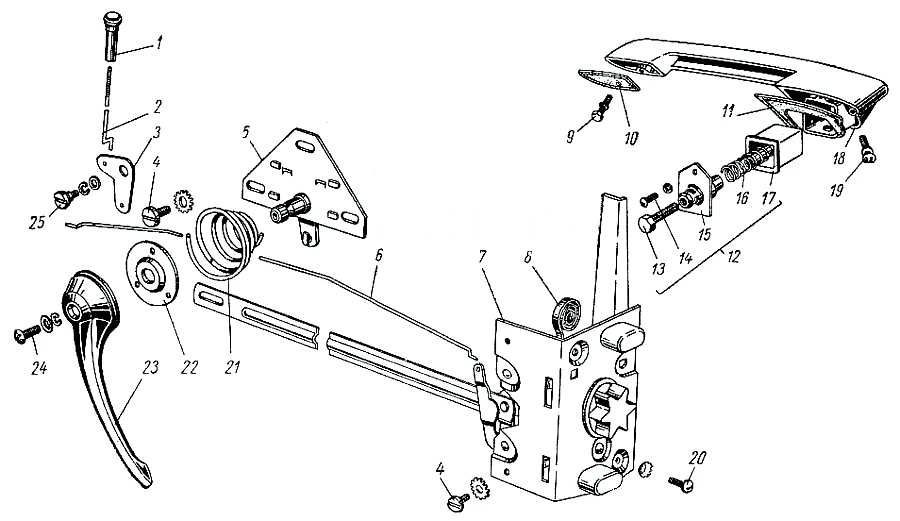
This OEM repair illustration from Chevrolet shows the pull-latch and twist-handle interior/exterior on a 1962 model
Chevrolet
The most enduring type of door handle, however, and the one with the longest use in automotive production, is the pull out style. These are similar to the pull-up, but pull away from the vehicle rather than upwards. These are simple, intuitive, and relatively easy to manufacture. Most of today’s popular “flush” handles are pull-out styles once revealed.
The latest handle type, the flush handle, comes in two basic varieties. Their primary difference lies in how they extend outward from the vehicle. Some use an actuator to push the handle away from the car and pull it back in. Others are spring-loaded, using the actuator only to hold the handle in. This latter type addresses the safety concerns of power outages disabling car door access. They work in a way similar to the air brakes on a heavy-duty vehicle: as long as there’s power to keep the actuator active, the handle stays in. If power is lost, the springs in the handle automatically release it.
Inside the door, the changes in door handle design haven’t been as dramatic. Most door handles today still physically pull a rod or (more often) cable that manipulates the latch. Even modern electronically actuated door latches have a physical backup using this simple mechanism in case the vehicle loses power. The linkage used in this part of the door handle/latch connection hasn’t changed much since the 1970s.
What has changed significantly is the position of the latch itself. Once door handles were no longer required to be in line with the latch, that freed engineers and designers from rigid placement and allowed experimentation in both how the handles looked and how they were used; as well as in where the latch was located. This greatly improved both design aesthetics and safety.
Today, most car doors have a striker or lock to which the door latch attaches when the door is closed. These are usually U-shaped and attach directly to the body frame of the vehicle.
Because the door handle and latch are no longer required to be in line with one another, strikers/locks are positioned for safety rather than convenience. They are usually lower down than the actual door handle, at the door’s mid-point by mass (rather than shape) – generally geometrically in line or near to in line with the center point of the door hinges opposite. Both the latch and striker combination and the door’s hinges are designed to remain intact even after significant body buckling.
As crash testing improved, so did our understanding of safety. During Insurance Institute for Highway Safety (IIHS) tests, for example, if a car’s door opens at any point during a crash test, the vehicle’s score is automatically downgraded to a low score of “Poor.” Open doors mean the potential for much more significant injuries. Preventing this requires precise engineering of both the latch and hinge.
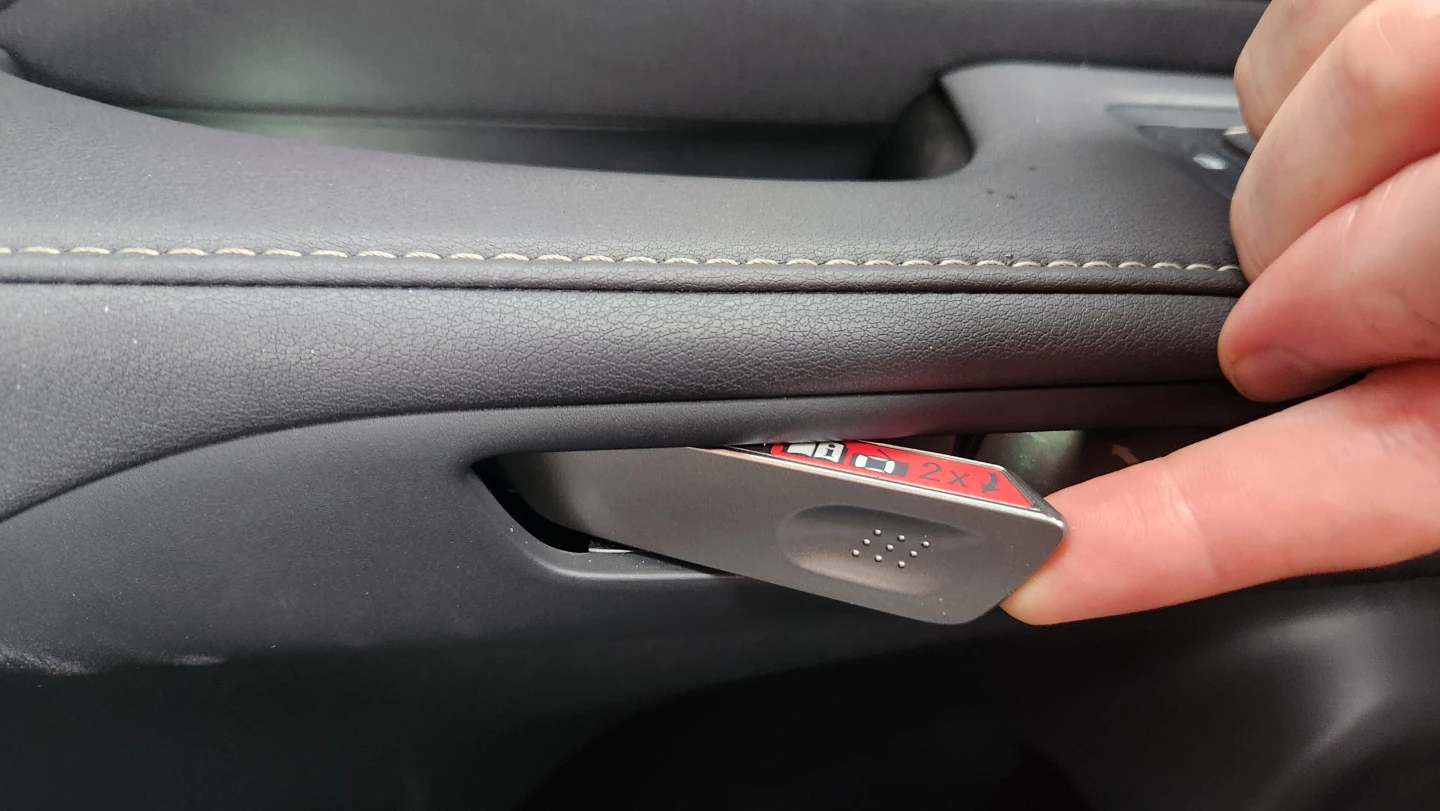
When pushed, the combination latch handle on today's Lexus vehicles electronically releases the latch – when pulled, as shown, it acts as a physical handle, pulling a cable to manually unlatch
Aaron Turpen / New Atlas
Returning attention to the door handles we interact with to open the car’s door, there have been numerous design changes in the past 50 years or so. And not only for aesthetic reasons.
Door handles can be a significant drag for aerodynamics. So smoothing, tucking in, and other changes have happened over the years to address that. Until recently, most of those changes involved either streamlining the handle itself with a sharper profile and thinner protrusion from the vehicle’s body or moving the handle to a more aero-favorable position. The C8 Corvette, for example, has its exterior handles tucked in behind an aerodynamic tunnel in the bodywork. Many vehicles have used this tactic in the past few decades.
More recently, there's been a trend of “suck-in” handles that are flush with the body. As noted earlier, flush handles come in two basic varieties. All of them have the same goal: streamlining aerodynamics. Hopefully without compromising usability or aesthetics. Aesthetically, the two varieties are traditional, bulky grip handles that attach to either side of the handhold and the flap-out style that connect on only one side. Mercedes-Benz, Tesla, and others use the former type while Kia, Rivian, and others use the latter.
While physical handle mechanisms have changed little, how we interact with them has evolved. Whether you’re using a smartphone, chipped card, keyless fob, or even a voice command to unlock the car, the final act of opening the door often still involves a mechanism that hasn’t changed much in half a century.
This blend of old and new is emblematic of automotive design. While we often focus on what’s novel, the enduring functionality of elements like the door handle reminds us that innovation often builds on what already works.
Like the humble door handle.