
Product manager here. Cynically, this is classic product management: simplify and remove useful information under the guise of 'improving the user experience' or perhaps minimalism if you're more overt about your influences.
It's something that as an industry we should be over by now.
It requires deep understanding of customer usage in order not to make this mistake. It is _really easy_ to think you are making improvements by hiding information if you do not understand why that information is perceived as valuable. Many people have been taught that streamlining and removal is positive. It's even easier if you have non-expert users getting attention. All of us here at HN will have seen UIs where this has occurred.
https://github.com/anthropics/claude-code/issues/15263
https://github.com/anthropics/claude-code/issues/9099
https://github.com/anthropics/claude-code/issues/8371
It's very clear that Anthropic doesn't really want to expose the secret sauce to end users. I have to patch Claude every release to bring this functionality back.
Maybe Claude Code web or desktop could be targeted to these new vibe coders instead? These folks often don't know how simple bash commands work so the terminal is the wrong UX anyway. Bash as a tool is just very powerful for any agentic experience.
It still does what I need so I'm okay with it, but I'm also on the $20 plan so it's not that big of a worry for me.
I did sense that the big wave of companies is hitting Anthropic's wallet. If you hadn't realized, a LOT of companies switched to Claude. No idea why, and this is coming from someone who loves Claude Code.
Anyway, getting some transparency on this would be nice.
> Compacting fails when the thread is very large
> We fixed it.
> No you did not
> Yes now it auto compacts all messages.
> Ok but we don't want compaction when the thread isn't large, plus, it still fails when the compacted thread is too large
> ...
Often a codebase ends up with non-authoritative references for things (e.g. docs out of sync with implementation, prototype vs "real" version), and the proper solution is to fix and/or document that divergence. But let's face it, that doesn't always happen. When the AI reads from the wrong source it only makes things worse, and when you can't see what it's reading it's harder to even notice that it's going off track.
Seems like a dashboard mode toggle to run in a dedicated terminal would be a good candidate to move some of this complexity Anthropic seems to think “most” users can’t handle. When your product is increasing cognitive load the answer isn’t always to remove the complexity entirely. That decision in this case was clearly the wrong one.
This is spreading like a plague: browser address bars are being trimmed down to nothing. Good luck figuring out which protocol you're using, or soon which website you are talking to. The TLS/SSL padlock is gone, so is the way to look into the site certificate (good luck doing that on recent Safari versions). Because users might be confused.
Well the users are not as dumb as you condescendingly make them out to be.
And if you really want to hide information, make it a config setting. Ask users if they want "dumbo mode" and see if they really do.
Codex/Claude would like you to ignore both the code AND the process of creating the code.
Regarding the thoughts: it also allows me to detect problematic paths it takes, like when it can't find a file.
For example today I was working on a project that depends on another project, managed by another agent. While refactoring my code it noticed that it needs to see what this command is which it is invoking, so it even went so far as to search through vs code's user data to find the recent files history if it can find out more about that command... I stopped it and told it that if it has problems, it should tell me. It explained it can't find that file, i gave it the paths and tokens were saved. Note that in that session I was manually approving all commands, but then rejected the one in the data dir.
Why dumb it down?
Set minimal defaults to keep output clean, but let users pick and choose items to output across several levels of verbosity, similar to tcpdump, Ansible, etc. (-v to -vvvvv).
I know businesses are obsessed with providing Apple-like "experiences", where the product is so refined there's just "the one way" to magically do things, but that's not going to work for a coding agent. It needs to be a unix-like experience, where the app can be customized to fit your bespoke workflow, and opening the man page does critical damage unless you're a wizard.
LLMs are already a magic box, which upsets many people. It'll be a shame if Anthropic alienates their core fan base of SWEs by making things more magical.
Ads in ChatGPT. Removing features from Claude Code. I think we're just beginning to face the music. It's also funny that how Google "invented" ad injection in replies with real-time auction capabilities, yet OpenAI would be the first implementer of it. It's similar to how transformers played out.
For me, that's another "popcorn time". I don't use any of these to any capacity, except Gemini, which I seldom use to ask stuff when deep diving in web doesn't give any meaningful results. The last question I asked managed to return only one (but interestingly correct) reference, which I followed and continued my research from there.
I’ve been persistently dealing with the agent running in circles on itself when trying to fix bugs, not following directions fully and choosing to only accomplish partial requests, failing to compact and halting a session, and ignoring its MCP tooling and doing stupid things like writing cruddy python and osascripts unnecessarily.
I’ve been really curious about codex recently, but I’m so deep into Claude Code with multiple skills, agents, MCPs, and a skill router though.
Can anyone recommend an easy migration path to codex as a first time codex user from Claude code?
ChatGPT or Gemini: I ask it what I wish to do, and show it the relevant code. It gives me a often-correct answer, and I paste it into my program.
Claude: I do the same, and it spends a lot of time thinking. When I check the window for the result, it's stalled with a question... asking to access a project or file that has nothing to do with the problem, and I didn't ask it to look for. Repeat several times until it solves the problem, or I give up with the questions.
I care A LOT about the details, and I couldn't care less that they're cleaning up terminal output like this.
Meanwhile OpenCode is right there. (despite Anthropic efforts, you can still use it with a subscription) And you can tweak it any way you want...
We treat a stateless session like a colleague, then get upset when it forgets our preferences. Anthropic simplified the output because power users aren't the growth vector. This shouldn't surprise anyone.
The fix isn't verbose mode. It's a markdown file the model reads on startup — which files matter, which patterns to follow, what "good" looks like. The model becomes as opinionated as your instructions. The UI becomes irrelevant.
The model is a runtime. Your workflow is the program. Arguing about log verbosity is a distraction.
With stupidity like this what do they expect? It’s only a matter of time before people jump ship entirely.
> “Searched for 1 pattern.”
Hit Ctrl-o like it mentions right there, and Claude Code will show you. Or RTFM and adjust Output Styles[1]. If you don't like these things, you can change them.
Like it or not, agentic coding is going mainstream and so they are going to tailor the default settings toward that wider mainstream audience.
If Claude Code can replace an engineer, it should cost just a bit less than an engineer, not half as much.
It is entirely due to Opus 4.5 being an inflection point codingwise over previous LLMs. Most of the buzz there has been organic word of mouth due to how strong it is.
Opus 4.5 is expensive to put it mildly, which makes Claude Code more compelling. But even now, token providers like Openrouter have Opus 4.5 as one of its most popular models despite the price.
On the other end are the hardcore user orchestrating a bunch of agents, not sitting there watching one run, so they don’t care about these logs at all
In the middle are the engineers sitting there watching the agent go
Or, it could serve as a textbook example how to make your real future long term customers (=fluent coders) angry… what a strategy :)
Meanwhile all evidence is that the true value of these tools is in their ability to augment & super-charge competent software engineers, not replace them.
Meanwhile the quality of Claude Code the tool itself is a bit of a damning indictment of their philosophy.
Give me a team of experienced sharp diligent engineers with these coding tools and we can make absolutely amazing things. But newbie product manager with no software engineering fundamentals issuing prompts will make a mess.
I can see it even in my own work -- when I venture into doing frontend eng using these tools the results look good but often have reliability issues. Because my background/specialization is in systems, embedded & backend work -- I'm not good at reviewing the React etc code it makes.
I do wonder if there is going to be much of a difference between using Claude Code vs. Copilot CLI when using the same models.
And then this. They want to own your dev workflow and for some reason believe Claude code is special enough to be closed source. The react TUI is kinda a nightmare to deal with I bet.
I will say, very happy with the improvements made to Codex 5.3. I’ve been spending A LOT more time with codex and the entire agent toolchain is OSS.
Not sure what anthropic’s plan is, but I haven’t been a fan of their moves in the past month and a half.
One of the hard things about building a product on an LLM is that the model frequently changes underneath you. Since we introduced Claude Code almost a year ago, Claude has gotten more intelligent, it runs for longer periods of time, and it is able to more agentically use more tools. This is one of the magical things about building on models, and also one of the things that makes it very hard. There's always a feeling that the model is outpacing what any given product is able to offer (ie. product overhang). We try very hard to keep up, and to deliver a UX that lets people experience the model in a way that is raw and low level, and maximally useful at the same time.
In particular, as agent trajectories get longer, the average conversation has more and more tool calls. When we released Claude Code, Sonnet 3.5 was able to run unattended for less than 30 seconds at a time before going off the rails; now, Opus 4.6 1-shots much of my code, often running for minutes, hours, and days at a time.
The amount of output this generates can quickly become overwhelming in a terminal, and is something we hear often from users. Terminals give us relatively few pixels to play with; they have a single font size; colors are not uniformly supported; in some terminal emulators, rendering is extremely slow. We want to make sure every user has a good experience, no matter what terminal they are using. This is important to us, because we want Claude Code to work everywhere, on any terminal, any OS, any environment.
Users give the model a prompt, and don't want to drown in a sea of log output in order to pick out what matters: specific tool calls, file edits, and so on, depending on the use case. From a design POV, this is a balance: we want to show you the most relevant information, while giving you a way to see more details when useful (ie. progressive disclosure). Over time, as the model continues to get more capable -- so trajectories become more correct on average -- and as conversations become even longer, we need to manage the amount of information we present in the default view to keep it from feeling overwhelming.
When we started Claude Code, it was just a few of us using it. Now, a large number of engineers rely on Claude Code to get their work done every day. We can no longer design for ourselves, and we rely heavily on community feedback to co-design the right experience. We cannot build the right things without that feedback. Yoshi rightly called out that often this iteration happens in the open. In this case in particular, we approached it intentionally, and dogfooded it internally for over a month to get the UX just right before releasing it; this resulted in an experience that most users preferred.
But we missed the mark for a subset of our users. To improve it, I went back and forth in the issue to understand what issues people were hitting with the new design, and shipped multiple rounds of changes to arrive at a good UX. We've built in the open in this way before, eg. when we iterated on the spinner UX, the todos tool UX, and for many other areas. We always want to hear from users so that we can make the product better.
The specific remaining issue Yoshi called out is reasonable. PR incoming in the next release to improve subagent output (I should have responded to the issue earlier, that's my miss).
Yoshi and others -- please keep the feedback coming. We want to hear it, and we genuinely want to improve the product in a way that gives great defaults for the majority of users, while being extremely hackable and customizable for everyone else.
I understand the article writers frustration. He liked a thing about a product he uses and they changed the product. He is feeling angry and he is expressing that anger and others are sharing in that.
And I'm part of another group of people. I would notice the files being searched without too much interest. Since I pay a monthly rate, I don't care about optimizing tokens. I only care about the quality of the final output.
I think the larger issue is that programmers are feeling like we are losing control. At first we're like, I'll let it auto-complete but no more. Then it was, I'll let it scaffold a project but not more. Each step we are ceding ground. It is strange to watch someone finally break on "They removed the names of the files the agent was operating on". Of all of the lost points of control this one seems so trivial. But every camels back has a breaking point and we can't judge the straw that does it.
DEVELOPERS, DEVELOPERS, DEVELOPERS, DEVELOPERS
I write mainly out of the hope that some Anthropic employees read this: you need an internal crusade to fight these impulses. Take the high road in the short-term and you may avoid being disrupted in the long-term. It's a culture issue.
Probably your strongest tool is specifically educating people about the history. Microsoft in the late 90s and early 00s was completely dominant, but from today's perspective it's very clear: they made some fundamental choices that didn't age well. As a result, DX on Windows is still not great, even if Visual Studio has the best features, and people with taste by and large prefer Linux.
Apple made an extremely strategic choice: rebuild the OS around BSD, which set them up to align with Linux (the language of servers). The question is: why? Go find out.
The difference is a matter of sensibility, and a matter of allowing that sensibility to exist and flourish in the business.
There are no vibes in “I am looking at files and searching for things” so I have zero weight to assign to your decision quality up until the point where it tells me the evals passed at 100%.
Your agent is not good enough. I trust it like I trust a toddler not to fall into a swimming pool. It’s not trying to, but enough time around the pool and it is going to happen, so I am watching the whole time, and I might even let it fall in if I think it can get itself out.
I had used a Visa card to buy monthly Pro subscription. One day I ran out of credits so I go to buy extra credit. But my card is declined. I recheck my card limit and try again. Still declined.
To test the card I try extending the Pro subscription. It works. That's when I notice that my card has a security feature called "Secure by Visa". To complete transaction I need to submit OTP on a Visa page. I am redirected to this page while buying Pro subscription but not when trying to buy extra usage.
I open a ticket and mention all the details to Claude support. Even though I give them the full run down of the issue, they say "We have no way of knowing why your card was declined. You have to check with your bank".
Later I get hold of a Mastercard with similar OTP protection. It is called Mastercard Securecode. The OTP triggers on both subscription and extra usage page.
I share this finding with support as well. But the response is same - "We checked with our engineering team and we have no way of knowing why the other Visa card was declined. You have to check with your bank".
I just gave up trying to buy extra usage. So, I am not really surprised if they keep making the product worse.
You can control this behavior, so it's not a dealbreaker. But it shows a sort of optimism that skills make everything better. My experience is that skills are only useful for specific workflows, not as a way to broadly or generally enhance the LLM.
Usually I hate programming but it feels like a nice little tool to create
Map it to a workplace:
- Hey Joe, why did you stop adding code diff to your review requests?
- Most reviewers find it simpler. You can always run tcpdump on our shared drive to see what exactly was changed.
- I'm the only one reviewing your code in this company...
True vibe coders don't care about this.
I'm using it for converting all of the userspace bcachefs code to Rust right now, and it's going incredibly smoothly. The trick is just to think of it like a junior engineer - a smart, fast junior engineer, but lacking in experience and big picture thinking.
But if you were vibe coding and YOLOing before Claude, all those bad habits are catching up with you suuuuuuuuuuuper hard right now...
I like that people who were afraid of CLIs perhaps are now warming up to them through tools like Claude Code but I don't think it means the interfaces should be simplified and dumbed down for them as the primary audience.
Sure you can press CTRL+O, but that's not realtime and you have to toggle between that and your current real time activity. Plus it's often laggy as hell.
for example Amp "feels" much better. Also like in Amp how I can just send the message whenever and it doesn't get queued
* I know, lots of "feels" in there..
I'm guessing you're not aware of how their newest game, Starfield, was received. In the long term, that direction did not work out for them at all.
Anthropic is the market leader for advanced AI coding with no serious competitor currently very close and they are preparing to IPO this year. This year is a transition year. The period where every decision would default toward delighting users and increasing perceived value is ending. By next year they'll be fully on the quarterly Wall Street grind of min/maxing every decision to extract the highest possible profit from customers at the lowest possible cost.
This path is inevitable and unavoidable, even with the most well-intentioned management and employees.
I would argue that the true value of these tools is in marketing and social media manipulation.
In my experience the code they generate sucks dick, and has sucked dick for 3 straight years.

Version 2.1.20 of Claude Code shipped a change that replaced every file read and every search pattern with a single, useless summary line.
Where you used to see:
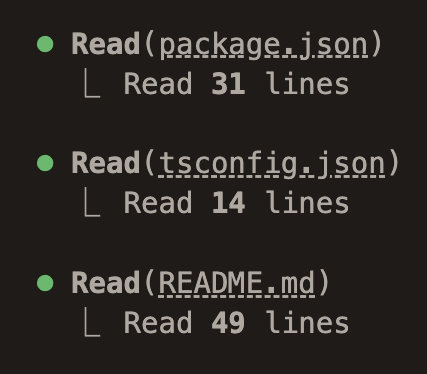
You now get:

That’s it.
“Read 3 files.” Which files? Doesn’t matter.
“Searched for 1 pattern.” What pattern? Who cares.
You’re paying $200 a month for a tool that now hides what it’s doing with your codebase by default.
Across multiple GitHub issues opened for this, all comments are pretty much saying the same thing: give us back the file paths, or at minimum, give us a toggle.
The response from Anthropic:
For the majority of users, this change is a nice simplification that reduces noise.

What majority? The change just shipped and the only response it got is people complaining.
Then when pressed, the fix offered wasn’t to revert or add a toggle. It was: “just use verbose mode.”
Fucking verbose mode.
A big ‘ole dump of thinking traces, hook output, full subagent transcripts, and entire file contents into your terminal. People explained, repeatedly, that they wanted one specific thing: file paths and search patterns inline. Not a firehose of debug output.
The developer’s response to that?
I want to hear folks’ feedback on what’s missing from verbose mode to make it the right approach for your use case.

Read that again. Thirty people say “revert the change or give us a toggle.” The answer is “let me make verbose mode work for you instead.”
As one commenter put it:
If you are going to display something like ‘Searched for 13 patterns, read 2 files’ there is nothing I can do with that information. You might as well not display it at all.
Several versions later, the “fix” is to keep making verbose mode less and less verbose by removing thinking traces and hook output so it becomes a tolerable way to get your file paths back. But verbose mode still dumps full sub-agent output onto your screen, among other things.

Before, when Claude spawned multiple sub-agents you’d see a compact line-by-line stream of what each one was doing, just enough to glance at. Now you get walls of text from multiple agents at once. So what’s the plan? Keep stripping things out of verbose mode one by one until it’s no longer verbose? Where does it end? At some point you’ve just reinvented a config toggle with extra steps.

And the people who were using verbose mode for thinking and hooks now need to press Ctrl+O to get what they had by default. So instead of fixing one problem, you created two.
People are pinning themselves to version 2.1.19 and in the meantime the fix everyone is asking for, a single boolean config flag, would take less effort to implement than all the verbose mode surgery that’s been done instead.
Anthropic during the Super Bowl: we’d never disrespect our users.
Anthropic on GitHub: have you tried verbose mode?
Sighted users lost convenience. I lost the ability to trust the tool. There is no "glancing" at terminal output with a screen reader. There is no "progressive disclosure." The text is either spoken to me or it doesn't exist. When you collapse file paths into "Read 3 files," I have no way to know what the agent is doing with my codebase without switching to verbose mode, which then dumps subagent transcripts, thinking traces, and full file contents into my audio stream. A sighted user can visually skip past that. I listen to every line sequentially.
You've created a situation where my options are "no information" or "all information." The middle ground that existed before, inline file paths and search patterns, was the accessible one.
This is not a power user preference. This is a basic accessibility regression. The fix is what everyone in this thread has been asking for: a BASIC BLOODY config flag to show file paths and search patterns inline. Not verbose mode surgery. A boolean.
Please just add the option.
And yes, I wrote this with Claude to tone my anger and frustration down about 15 clicks from how I actually feel.
If that's the case, it's important to asses wether it'll be consistent when operating on a higher level, less dependent on the software layer that governs the agent. Otherwise it'll risk Claude also becoming more erratic.
Can we please move the "Extended Thinking" icon back to the left side of claude desktop, near the research and web search icons? What used to be one click is now three.
That said, Cursor Composer is a lot faster and really nice for some tasks that don't require lots of context.
The value isn't just the models. Claude Code is notably better than (for example) OpenCode, even when using the same models. The plug-in system is also excellent, allowing me to build things like https://charleswiltgen.github.io/Axiom/ that everyone can benefit from.
Or, it decided it needs to get API documentation out and spends tens of thousands of tokens fetching every file in a repo with separate tool use instead of reading the documentation.
Profitable, if you are charging for token usage, I suspect.
But I’m reaching the point where I can’t recommend claude to people who are interesting in skeptically trying it out, because of the default model.
If they hide how the tool is accessing files (aka using tokens) and then charging us per token - how are we able to track loosely what our spend is?
I’m all for simplification of the UX. But when it’s helping to hide the main spend it feels shitty.
The real annoying thing about Opus 4.5 is that it's impossible to publicly say "Opus 4.5 is an order of magnitude better than coding LLMs released just months before it" without sounding like a AI hype booster clickbaiting, but it's the counterintuitive truth, to my personal frustration.
I have been trying to break this damn model by giving it complex and seemingly impossible coding tasks but this asshole keeps doing them correctly. GPT-5.3-Codex has been the same relative to GPT-5.2-Codex, which just makes me even more frustrated.
just 6 months more and like $200B in capex and we’ll be there, trust the process
But this one isn't? I'd call myself a professional. I use with tons of files across a wide range of projects and types of work.
To me file paths were an important aspect of understanding context of the work and of the context CC was gaining.
Now? It feels like running on a foggy street, never sure when the corner will come and I'll hit a fence or house.
Why not introduce a toggle? I'd happily add that to my alisases.
Edit: I forgot. I don't need better subagent output. Or even less output whrn watching thinking traces. I am happy to have full verbosity. There are cases where it's an important aspect.
I just find that very hard to believe. Does anyone actually do anything with the output now? Or are they just crossing their fingers and hoping for the best?
Edit: I can't post anymore today apparently because of dang. If you post a comment about a bad terminal at least tell us about the rendering issues.
Those are fightin’ words as someone who has dumped more hours than I can count into Skyrim but…
I had never heard of this game, but it has a lot going for it (source engine) and I watched a little of the gameplay you linked and I’m intrigued. I’m probably gonna pick this up for the steam deck.
A friend recommended the Might and Magic games to me a long time ago and I bought them off GoG, but wasn’t a fan of the gameplay and just couldn’t get hooked. This looks very different from what I remember (probably because this is a very different game from the earlier ones).
Thank you for mentioning this game!
Some greatest hits:
- CoreAudio, Mac OS memory management, kernel in general, and many other decisions
- Google's internal dev tooling, Go, and Chrome (at least, in its day)
- C#, .NET, and Typescript (even Microsoft does good work)
One of the hallmarks of heroic engineering work is that everyone takes it for granted afterward. Open source browsers that work, audio that just works, successors to C/C++ with actual support and adoption, operating systems that respond gracefully under load, etc. ... none of these things were guaranteed, or directly aligned with short-term financial incentives. Now, we just assume they're a requirement.
Part of the "sensibility" I'm talking about is seeking to build things that are so boring and reliable that nobody notices them anymore.
shhh don't say that, they will never fix it if means you use less tokens.
More details here: https://news.ycombinator.com/item?id=46982177
i guess they were blocking OpenCode for a reason
this will put people to the test that use mainly Anthropic, to have a second look at the results from other models
To try it: /config > verbose, or --verbose.
Please keep the feedback coming. If there is anything else we can do to adjust verbose mode to do what you want, I'd love to hear.
Sam wants money. Dario wants to be your dad.
I'm going with Sam.
The thinking mode is super-useful to me as I _often_ saw the model "think" differently from the response. Stuff like "I can see that I need to look for x, y, z to full understand the problem" and then proceeds to just not do that.
This is helpful as I can interrupt the process and guide it to actually do this. With the thinking-output hidden, I have lost this avenue for intervention.
I also want to see what files it reads, but not necessarily the output - I know most of the files that'll be relevant, I just want to see it's not totally off base.
Tl;dr: I would _love_ to have verbose mode be split into two modes: Just thinking and Thinking+Full agent/file output.
---
I'm happy to work in verbose mode. I get many people are probably fine with the standard minimal mode. But at least in my code base, on my projects, I still need to perform a decent amount of handholding through guidance, the model is not working for me the way you describe it working for you.
All I need is a few tools to help me intervene earlier to make claude-code work _much_ better for me. Right now I feel I'm fighting the system frequently.
I actually miss being able to see all of the thinking, for example. That was useful, because I could tell more quickly when the model was making a wrong assumption.
It's not an easy UI problem to solve in all cases since behavior in CC can be so flexible, compaction, forking, etc. But it would be great if it was simply consistent (ctrl+o shows last N where N is like, 50, or 100), with ctrl+e revealing the rest.
“Did something 2 times”
That may as well not be shown at all in default mode?
What useful information is imparted by “Read 4 files”?
You have two issues here:
1) making verbose mode better. Sure.
2) logging useless information in default.
If you're not imparting any useful information, claude may as well just show a spinner.
That said, we recently rewrote our renderer to make it much more efficient, so we can bump up the default a bit. Let me see what it feels like to show the last 10-20 messages -- fix incoming.