> Our experience as the only company operating a fully autonomous service at this scale has reinforced a fundamental truth: demonstrably safe AI requires equally resilient inputs. This deep understanding of real-world requirements is why the Waymo Driver utilizes a custom, multi-modal sensing suite where high-resolution cameras, advanced imaging radar, and lidar work as a unified system. Using these diverse inputs, the Waymo Driver can confidently navigate the "long tail" of one-in-a-million events we regularly encounter when driving millions of miles a week, leaving nothing to the imagination of a single lens.
Nice abbreviation.
(Disclaimer: former Cruise employee)
(Also former Cruise employee)
If you look at it from an outside point of view, right now Tesla is worth $1.6T, Waymo is worth $130B, and GM is worth $72B. If Cruise were actually a third viable competitor in this race, it would probably be worth more than the rest of GM. Self-driving is just a far more valuable business than car-making.
So from that point of view it would make sense to say, don't worry about the rest of GM too much, you should be willing to sacrifice all of that to increase the changes of making Cruise work.
It's hard to change the culture at a place like GM though. Does the GM CEO really want to take a huge amount of risk? Would they be willing to take a 50-50 shot where they either 10x the company's value or lose it all? Or would they prefer to pay a few billion dollars to avoid that risk.
Car arrives. I get in. The car is sitting there getting ready to depart but not moving. After a few minutes I hit the button to call support. Someone tells me it's about ready to go. Ten minutes later it starts leaving.
I have no idea why it took so long to start but it wasn't a great experience.
If you (or anyone else from Cruise) can explain what was going on, that would settle the difference in experience to me.
But I also don't think we can take anything from what Waymo claims about the feasibility of vision-only.
The fact that people still trust him on literally anything boggles my mind.
At the same time, if Musk went away, the stock would crash back to reality but a non-idiot leader could just do impossible, crazy, hard stuff, like ... working on obvious new models and basic steady improvements.
Tesla PE is 398 today (after a drop). Toyota's PE is 13. Toyota at the least is not hemoraging market share, sales, revenue, profits. Tesla is losing on all thoes things. Tesla would need a 30x price reduction to get down to much much more stable and profitable toyota. It's gets worse because Tesla's sales and profit keep going down each quarter.
There's no doubt value in self driving but the overall value is questionable. If there are many companies providing it, and at least waymo is doing great, plus there are many many other companies in China in good shape, the value multiple won't be there.
What's the market value of all taxi compannies combined in the us? It was about $230 billion in 2024 (https://www.skyquestt.com/report/taxi-market). Will tesla get 100% of the us self driving business in the future? No, waymo at least will be a serious market competitor, tesla's service doesn't really work.
Because there are going to be muiltiple competitors with working products (we'll see if/when tesla ever gets there), Tesla's huge valuation will never make sense. Robots are much farther behind than robotaxis (there's no brain, no prototype of a learning system, maybe one day).
This got way too long, I think GM just saw it as a money sink. I think that was a big mistake, though.
GM pulled the rug on us a day or two before announcing. The current Cruise CEO wasn't aware at all either. I have my own conspiracies of why GM did this, but GM also has a long history of fumbling the ball.
[1] https://www.cbsnews.com/sanfrancisco/news/nhtsa-robotaxi-cru...
[2] https://www.theautopian.com/here-are-five-times-gm-developed...!
(Another former employee)
Having experience and capability to manufacturer cars has approximately zero benefit to create a self-driving software/sensor stack. It would make more sense for Adobe to create a self-driving car than GM.
Cruise was always destined to be "like Waymo, but worse". Tesla, on the other hand, is taking a very different path than Waymo, they have a chance at beating Waymo at their own game and even if they don't beat Waymo, they can be a winner in some specific niche. (For the record, I'm a fan of Waymo.)
A favorite of mine: https://x.com/dmitri_dolgov/status/1900219562437861685
No single sensor can ever give you that kind of resilience. Sure, it is easy in that you never have ambiguity, but that means that when you're wrong there is also nothing to catch you to indicate something might be up.
This goes for any system where you have such a limited set of inputs that you never reach quorum the basic idea is to have enough sensors that you always have quorum, and to treat the absence of quorum as a very high priority failure.
This is - to me - entirely separate from the fact that his companies routinely revolutionize industries.
(Another former).
Long-distance amateur psychology question: I wonder if he's convinced himself that he's a smart guy, after all he's got 12 digits in his net worth, "How would that have been possible if I were an idiot?".
Anyway, ego protection is how people still defend things like the Maga regime, or the genocide; it's hard for someone to admit that they've been stupid enough to have been fooled to vote for "Idi Amin in whiteface" (term coined by Literature Nobel Prize winner Wole Soyinka), or that the "nation's right to self-defense" they've been defending was a thin excuse for mass murder of innocents.
I shit on Tesla and Elon on any opportunity, and it's a shame they basically have the software out there doing things when it probably shouldn't, but I don't think they're that far behind Waymo where it really matters, which is the thing actually working.
Instead they chopped it up for spare parts, specifically, sending some Cruise personnel to work on deadend GM driver assistance tech and firing the rest. Baffling.
That's how we get Uber, Lyft, DiDi, Grab, Bolt, WeRide, BlackWolf...
I love this argument because it is so obviously wrong: how could any self aware person seriously argue that hearing, touch, and the inner ear aren't involved in their driving?
As an adult I can actually afford a reliable car, so I will concede that smell is less relevant than it used to be, at least for me personally :)
So while he might turn out to be wrong, I don't think his opininon is uninformed.
Not to mention possibly the most complex structure in the known universe, the human brain: 86 billion neurons, 100 trillion connections.
If it makes you happy, you can read "only vision" as "no lidar or radar." Cars already have microphones and IMUs.
2. since this is in context of Tesla: tesla cars do have microphones and FSD does use it for responding to sirens etc.
Beating human sensors wasn't hard for over a decade now. The problem is that sensors are worthless. Self-driving lives and dies by AI - all the sensors need to be is "good enough".
However, if you think about this for 2 seconds with even a rudimentary understanding of sensor fusion, more hardware is always better (ofc with diminishing marginal value).
But ~10y ago, when Tesla was in a financial pinch, Musk decided to scrap as much hardware as possible to save on operational cost and complexity. The argument about "humans can drive with vision only, so self-driving should be able to as well" served as the excuse to shareholders.
Admitting this would be admitting their Tesla will never be self driving.
Well, in TFA the far more successful manufacturer of self driving cars is saying you're wrong. I think they're in much better position to know than you :)
There is an argument for sure, about how many sensors is enough / too much. And maybe 8 cameras around the car is enough to surpass human driving ability.
I guess it depends on how far/secure we want the self-driving to be. If only we had a comprehensive driving test that all (humans and robots) could take and be ranked... each country lawmakers could set the bar based on the test.
I would firmly disagree with that.
What Musk has done is bring money to develop technologies that were generally considered possible, but were being ignored by industry incumbents because they were long-term development projects that would not be profitable for years. When he brings money to good engineers and lets them do their thing, pretty good things happen. The Tesla Roadster, Model S, Falcon 9, Starlink, etc.
The problem with him is he's convinced that he is also a good engineer, and not only that but he's better than anyone that works for him, and that has definitively been proven wrong. The more he takes charge, the worse it gets. The Model X's stupid doors, all the factory insanity, the outdoor paint tent, etc. Model 3 and Model Y arguably succeeded in spite of his interference, but the Dumpstertruck was his baby and we can all see how that has basically only sold to people who want to associate themselves closely with his politics because it's objectively bad at everything else. The constant claims that Tesla cars will drive themselves, the absolute bullshit that is calling it "Full Self Driving", the hilarious claims of humanoid robots being useful, etc. How are those solar roofs coming? Have you heard of anyone installing a Powerwall recently? Heard anything about Roadster 2.0 since he went off claiming it would be able to fly? A bunch of Canadian truckers have built their own hybrid logging trucks from scratch in the time since Tesla started taking money for their semis and we still haven't seen the Tesla trucks haul more than a bunch of bags of chips.
The more Musk is personally involved with a project the worse it is. The man is useful for two things: Providing capital and blatantly lying to hype investors.
If he had stuck to the first one the world as a whole would be a better place, Tesla would probably be in a much better position right now.
SpaceX was for a long time considered to be further from his influence with Shotwell running the company well and Musk acting more as a spokesperson. Starship is sort of his Model X moment and the plans to merge in the AI business will IMO be the Cybertruck.
Waymo will begin fully autonomous operations with its 6th-generation Driver —an important step in bringing our technology to more riders in more cities. This latest system serves as the primary engine for our next era of expansion, with a streamlined configuration that drives down costs while maintaining our uncompromising safety standards. Designed for long-term growth across multiple vehicle platforms, this system’s expanded capabilities allow us to safely broaden our footprint into more diverse environments, including those with extreme winter weather, at an even greater scale.
The 6th-generation Waymo Driver is the product of seven years of safety-proven service amassed from driving nearly 200 million fully autonomous miles across the densest cores of 10+ major cities and an expanding network of freeways. Our experience as the only company operating a fully autonomous service at this scale has reinforced a fundamental truth: demonstrably safe AI requires equally resilient inputs. This deep understanding of real-world requirements is why the Waymo Driver utilizes a custom, multi-modal sensing suite where high-resolution cameras, advanced imaging radar, and lidar work as a unified system. Using these diverse inputs, the Waymo Driver can confidently navigate the "long tail" of one-in-a-million events we regularly encounter when driving millions of miles a week, leaving nothing to the imagination of a single lens.
By leveraging breakthroughs in AI and validating the system through our rigorous safety framework, we can now accelerate our journey to the road with unprecedented velocity and confidence. Today, we're lifting the lid on our 6th-generation Waymo Driver's sophisticated sensing technology delivering expanded capabilities at a lower cost.
Vision System
The Waymo Driver’s vision system goes far beyond the capabilities of human sight or standard automotive cameras. While it interprets the same semantic details we do, such as traffic light colors and road signs, it operates with a level of awareness no person can match. Our vision system can see everywhere at once and possesses a dynamic range that allows it to pull critical details out of deep shadows while being hit with the direct glare of high-beams or emergency vehicle lights.
Your web browser does not support this video.
Compared to a traditional automotive camera (right), the 6th-generation Waymo Driver camera (left) delivers significantly higher resolution at cost parity, allowing the system to make better-informed driving decisions.
At the core of this system is our next-gen 17 megapixel imager, a breakthrough in automotive vision technology. This high-resolution sensor captures millions of data points for incredibly sharp images while offering exceptional thermal stability across automotive conditions. These imagers allow the Waymo Driver to see around the vehicle with fewer cameras than if we used 5 or 8-megapixel sensors. The result is a system a generation ahead of other automotive cameras in terms of resolution, dynamic range, and low-light sensitivity.
A vision system that is reliable in inclement weather needs to keep itself clear. While cameras on conventional cars can struggle with raindrops, road grime, and ice, our system features integrated cleaning systems to maintain visibility. In conditions where a camera’s view may be limited, our lidar and radar provide the necessary redundancy to maintain the Waymo Driver’s perception.
This focus on high-performance sensing extends throughout our hardware system. We've pushed more processing complexity into Waymo’s custom silicon chips rather than relying on multiple hardware components. This approach delivers superior results with remarkable efficiency—our new cameras outperform the highly capable system on our 5th-generation vehicles, even as we continue to reduce costs by using less than half the number of cameras.
Lidar
Unlike cameras that rely on light reflected from the environment to see, lidar lights up its own way by using laser beams to paint a 3D picture, also known as a point cloud image, of the world around it. If you drive in the rain or snow on dark freeways, you know how hard it is to see with vision alone.

Waymo’s lidar sees the world in exceptional detail, distinguishing smaller objects like pedestrians near larger ones like vehicles, day and night.
Our 6th-generation lidar leverages the significant cost reductions the industry has seen over the last five years, especially as affordable lidar increasingly appears in consumer vehicles. By harnessing these market efficiencies alongside our custom-designed chips and optical designs—with core components designed and built in California—we have developed a system that sees at greater distances with better fidelity and higher robustness, all at a cost profile optimized for expansion.
Strategically placed short-range lidars provide redundant coverage to our cameras, enabling the Waymo Driver to associate accurate distance measurements with camera imagery. This is critical when navigating alongside vulnerable road users, opening car doors, and other urban situations where centimeter-scale range accuracy matters. Beyond physical placement, we have reengineered how our lidar illuminates a scene and processes data internally. These upgrades help the lidar penetrate weather and avoid point cloud distortion near highly reflective signs, expanding the Waymo Driver's ability to see through heavy roadspray on freeways and other complex edge cases.
Radar
Waymo’s imaging radar creates dense, temporal maps that instantly track the distance, velocity, and size of objects in all lighting and weather conditions. By leveraging radar chipsets that have become more sensitive and affordable, we benefit from industry-wide cost reductions while continuing to expand our own capabilities.


Waymo’s imaging radar can operate in a range of severe weather conditions, providing our system more time to discern an object and inform our next move.
Our next-generation radar builds on the foundation of the 5th-generation Waymo Driver, using new in-house algorithms to deliver improved performance in rain or snow. This 6th-generation system maximizes the benefit of sensor fusion by leveraging lightweight, powerful machine-learned models to extract maximum information from each sensor and dynamically optimize the performance of every sensing component.
External Audio Receivers (EARs)
To complement our visual sensors, the Waymo Driver has long utilized several external audio receivers, or EARs, that help the Driver detect important sounds on the road, such as approaching emergency vehicles and railroad crossings, and respond accordingly. The Driver’s EARs are strategically placed around the central perception dome to optimize its ability to hear sirens and localize where the sounds are coming from while reducing the amount of wind noise it is susceptible to, especially at high speeds. Thanks to its EARs, the Waymo Driver can often hear and identify which direction a siren is traveling before it can even see it.
One driver, different vehicle platforms
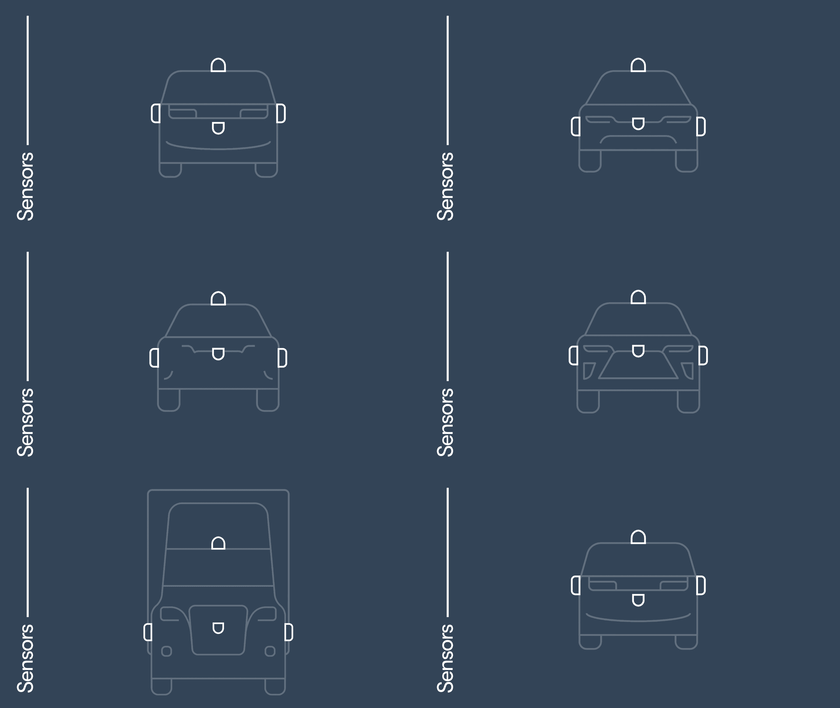
The Waymo Driver can be applied to different platforms and use cases.
Because we are focused on building a Driver and not a vehicle, we’ve designed a versatile, integrated autonomous driving system that can be adapted to various platforms and use cases over time. Our versatile hardware approach allows us to reconfigure our sensors and generalize our AI to meet each platform's unique needs—whether it is the Ojai or the Hyundai IONIQ 5—providing the Waymo Driver an optimal view of its surroundings while streamlining for efficiency. This 6th-generation system marks a major shift at our autonomous vehicle factory in Metro Phoenix, where we are beginning to meaningfully scale toward a capacity of tens of thousands of units per year. By collaborating with OEM partners to ensure base vehicles are Waymo Driver ready, we have engineered a system built for high-volume production, allowing us to unlock greater economies of scale as we bring our technology to more people.
As we transition to fully autonomous operations with the 6th-generation Waymo Driver on the Ojai, we'll continue providing our employees and their guests trips as we refine the rider experience. We can’t wait to open our doors to the public soon.
We’re looking for innovators and visionaries to join us to build the next generation of sensing technology and custom compute. From the silicon up, we’re designing the hardware that allows the Waymo Driver to see, think, and scale globally.
I never claimed he‘s a good engineer, nor that he has high EQ, nor that he is honest, nor that he has sole responsibility for the success of his companies.
The cameras on Teslas only really lose visibility when dirty. Especially in winter when there's salt everywhere. Only the very latest models (2025+?) have decent self-cleaning for the cameras that get very dirty.
However, notice that deaf people are allowed to drive, ie. you are not expected to be able to have full hearing to be allowed on the road.