Until the funding stops for one reason or another and then everyone loses all their money at once like a star that collapses into a black hole singularity in a femtosecond.
Wild although not entirely surprising. Congrats, Anthropic.
wonder how much of that $30B will make it their way and pay that down
If you give me $1T to spend, I, too, can probably make $14B (this is a metaphor)
Only for well defined tasks. There's not really a practical upper bound. We will keep throwing more complex tasks at it to the extent that it can handle them. Like if you just need fancy OCR, then a specific model will probably suffice, but there will be an appetite for human- or superhuman-level intelligence that never gets tired and has no rights.
It’s the new kids in the block that will make the difference.
You know those lists on twitter about how many companies US has in top 10 and are presented as a win? Those are actually lists of capital concentrations blocking innovation. It looks like US is winning but for some reason life is better in EU and innovation is faster in China.
It’s companies like OpenAI Anthropic that will move US ahead. Even if some core innovation or and capital comes from the establishment.
Two years ago, I considered investing in Anthropic when they had a valuation of around $18B and messed up by chickening out (it was available on some of the private investor platforms). Up 20x since then ...
It was always obvious that Anthropic's focus on business/API usage had potential to scale faster than OpenAI's focus on ChatGPT, but the real kicker has been Claude Code (released a year ago).
It'd be interesting to know how Anthropic's revenue splits between Claude Code, or coding in general, other API usage, and chat (which I assume is small).
Some technical advancements are not worth it if you do not respect your users.
The product they released so far are all half assed experiments.
Gemini 3 Pro is now being beaten by open source models because they can't fix or don't want to fix the problems with the Gemini models being completely useless.
The same for Microsoft.
Microsoft had GitHub Copilot, and Microsoft Copilot and both of them are useless to Claude Code and Claude Cowork.
You can have all the money in the world, but nothing is stopping you from building useless garbage.
Some of the Big Techs are building their own in house stuff (Meta, Google), but it wouldn't be crazy to see acquisitions by the others, especially if the market cools slightly. And then there's the possibility that these companies mature their revenue streams enough to start actually really throwing off money and paying off the investment.
Anthropic went from zero to $14 billion in revenue in less than 3 years, growing at 10x per year.
That's what they're investing in.
Also Anthropic seems laser-focused, unlike some of their competitors who are throwing stuff against the wall to see what sticks.
https://www.thesaasnews.com/news/databricks-raises-1b-series...
My sense is that startup mission statements are ~meaningless. Builders try to build great things that lots of other people will find valuable.
Numerous companies have tried and failed competing with SoTA foundational models. If Anthropic had no moat, Apple and Meta wouldn't be paying them billions for coding asistance.
Meta, Amazon, Apple, and Nvidia would all have SoTA competitors to Claude. They all tried and have not produced a competitor.
Instead you have three companies that stand alone making billions from foundational models.
As millipede, clearly therefore millicorn.
SaaS and legal market caps have already contracted a multiple of the combined OpenAI + Anthropic valuations just based on the _threat_ of what they may be able to accomplish.
They'll have the data + knowledge edge over open alternatives and be able to implement + deploy (see the story about Anthropic employees being at GS for 6 months already[0])
[0] https://www.cnbc.com/2026/02/06/anthropic-goldman-sachs-ai-m...
The GP was talking about Google specifically, and their outcomes on AI are nothing to scoff at. They had a rocky late start, but they seem to have gotten over that. Their models are now very much competitive with the startups. And it's not just that have more money to spend. They probably have more training data than anyone in the world, and they also have more infrastructure, more manpower, more of a global footprint than the startups.
The Innovator's Dilemma is an anecdotal, maybe a statistical relationship at best, but not a fundamental law of nature. When an established company has everything it should take to become a leader in a new industry in theory, and in practice their products are already on par with the industry leaders, you know at some point it becomes rational to think that maybe they might become a leader.
In the long term, big kids win no? The big kids are also going to have an easier time with hardware at scale too
NVIDIA, and contractors who build data centers, and manufacturers who supply them, will all get rich.
I’ve poked around on EquityZen and was shocked at how little information is available to investors. In some cases I did not even see pitch decks, let alone one of the first companies I looked at had its top Google result: CEO recently arrested for fraud and business is almost worthless now.
Unless you are willing to take a blind punt or have insider information, those platforms are opaque minefields and I don’t fault you for not investing.
Matt Levine has a fun investment test: when presented with an opportunity, you should always ask, “and why are you offering it to me?”
Meaning, by the time it gets offered to retail investors (even accredited ones are retail) we’re getting the scraps that no one else wants.
I also tried open code cli and desktop, but how well copilot is integrated into the ide is a plus for me.
What makes them "useless garbage"?
That isn’t nothing.
Valuation behemoth OpenAI has been forced by the market to use Anthropic standards a couple times, having no comparable solutions of their own.
… I can see it.
These are all moats.
Step 1, find something to innovate on, sell the promise of it to investors. Step 2, build a prototype or worst case, build it for real and start generating income from your truly innovate and unique product. Step 3, get acquired by a large company and then shut down because your product competed with theirs.
End result, general public possibly benefited from your innovation, but in the long run, it was temporary.
Maybe the incentives would be better if it were harder for large companies to acquire small ones? If the path to riches where driven primarily by delivering value to customers. Would love to hear other's opinions on this.
OpenAI figured this out: it’s awesome marketing when people send each other links to the app with a convenient text box to continue the conversation. It’s viral.
Google meanwhile set this up so that “anyone with the link can view” is actually “anyone with the link and a Google account”.
That’s grade A failure of marketing.
The PM in charge of that decision ought to be walked off a plank.
It was obviously DOA and waaaayyy outside G'scompetence.
I wouldn't argue it's that risky. Look at their past entanglements:
1. Google Default Search Bribe - brings in $20B a year for literally doing nothing
2. Google Maps: Google let them build their own custom app using Google's backend, and it worked fine all the way up until Apple chose to exit that arrangement
actually I can't think of any others, but is there an example of Apple getting burned by Google?
Look to GCP as an example. It had to be done, with similar competitive dynamics, it was done very well.
Look to Android as another.
Gemini is absurdly expensive for low quality (3000 USD of tokens are not even worth what you get @ Anthropic for 200 USD).
In my opinion though this is a race to the bottom rather than a winner takes all situation so I don't think anyone is coming out ahead once the dust settles.
Quite the fantasy, you mean.
They're engaged in computing research and merely engage in consumer capitalism as a consequence of political and social constraints.
Products are a means to an end not the goal.
OpenAI and Anthropic are product companies and are more likely to fail like most product companies do as they will lack broad and wide depth.
Google has experience in design, implementation, and 24/7 ops with every type of SaaS there is. They can bin LLMs tomorrow and still make bank. Same cannot be said for OAI or Anthropic.
$200/mo is nothing compared to what that time is worth. and it keeps getting better with each model release, which is the opposite of what usually happens when you pay for developer tools (they get acquired, enshittified, or abandoned).
the meta point about this funding round imo: competition between anthropic, openai, and google is the best thing happening for small builders right now. it keeps the tools improving fast and pricing competitive. if any one of them had a monopoly we'd be paying 10x for worse output.
This was in the middle of the boom when companies were fighting over talent, so I found it odd.
Google does things I hate with their products. But the money printing machine keeps going whrrr faster and faster.
Beat OpenAI. The Founders came from OpenAI so there was obviously some disagreement about the direction there or they simply wanted more control.
Big companies are handcuffed by Innovators Dilemna etc.
We have raised $30 billion in Series G funding led by GIC and Coatue, valuing Anthropic at $380 billion post-money. The round was co-led by D. E. Shaw Ventures, Dragoneer, Founders Fund, ICONIQ, and MGX. The investment will fuel the frontier research, product development, and infrastructure expansions that have made Anthropic the market leader in enterprise AI and coding.
Significant investors in this round include: Accel, Addition, Alpha Wave Global, Altimeter, AMP PBC, Appaloosa LP, Baillie Gifford, Bessemer Venture Partners, affiliated funds of BlackRock, Blackstone, D1 Capital Partners, Fidelity Management & Research Company, General Catalyst, Greenoaks, Growth Equity at Goldman Sachs Alternatives, Insight Partners, Jane Street, JPMorganChase through its Security and Resiliency Initiative and Growth Equity Partners, Lightspeed Venture Partners, Menlo Ventures, Morgan Stanley Investment Management, NX1 Capital, Qatar Investment Authority (QIA), Sands Capital, Sequoia Capital, Temasek, TowerBrook, TPG, Whale Rock Capital, and XN. This round also includes a portion of the previously announced investments from Microsoft and NVIDIA.
“Whether it is entrepreneurs, startups, or the world’s largest enterprises, the message from our customers is the same: Claude is increasingly becoming more critical to how businesses work,” said Krishna Rao, Anthropic’s Chief Financial Officer. “This fundraising reflects the incredible demand we are seeing from these customers, and we will use this investment to continue building the enterprise-grade products and models they have come to depend on.”
It has been less than three years since Anthropic earned its first dollar in revenue. Today, our run-rate revenue is $14 billion, with this figure growing over 10x annually in each of those past three years.
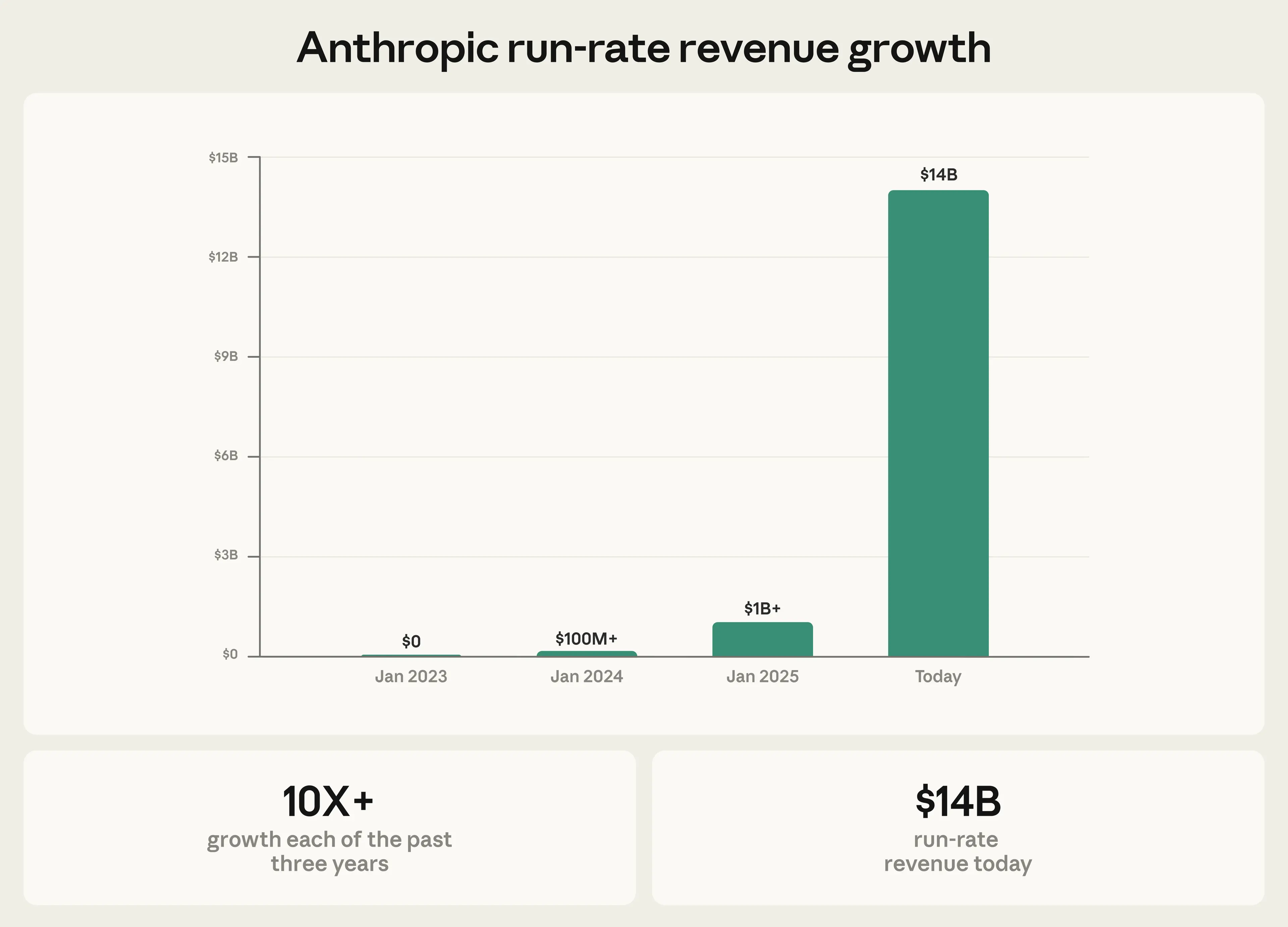
This growth has been driven by our position as the intelligence platform of choice for enterprises and developers. The number of customers spending over $100,000 annually on Claude (as represented by run-rate revenue) has grown 7x in the past year. And businesses that start with Claude for a single use case—API, Claude Code, or Claude for Work—are expanding their integrations across their organizations. Two years ago, a dozen customers spent over $1 million with us on an annualized basis. Today that number exceeds 500. Eight of the Fortune 10 are now Claude customers.
Claude Code represents a new era of agentic coding, fundamentally changing how teams build software. Claude Code was made available to the general public in May 2025. Today, Claude Code’s run-rate revenue has grown to over $2.5 billion; this figure has more than doubled since the beginning of 2026. The number of weekly active Claude Code users has also doubled since January 1. A recent analysis estimated that 4% of all GitHub public commits worldwide were being authored by Claude Code—double the percentage from just one month prior.
Business subscriptions to Claude Code have quadrupled since the start of 2026, and enterprise use has grown to represent over half of all Claude Code revenue. The same capabilities that make Claude exceptional for coding are also unlocking other new categories of work: financial and data analysis, sales, cybersecurity, scientific discovery, and beyond.
In January alone, we launched more than thirty products and features, including Cowork, which brings Claude Code’s powerful engineering capabilities to a broader scope of knowledge work tasks. Cowork includes eleven open-source plugins that let customers turn Claude into a specialist for specific roles or teams, like sales, legal, or finance. We also expanded our reach into healthcare and life sciences, with Claude for Enterprise now available to organizations operating under HIPAA.
“Since our initial investment in 2025, Anthropic’s focus on agentic coding and enterprise-grade AI systems has accelerated its progress toward large-scale adoption,” said Philippe Laffont, Founder & Portfolio Manager of Coatue. “The team’s ability to rapidly scale its offerings further positions Anthropic as a leader in a highly competitive AI market.”
Claude’s frontier-setting intelligence continues to advance. Our newest model—Opus 4.6, launched last week—can power agents that manage entire categories of real-world work, generating documents, spreadsheets, and presentations with professional polish. And Opus 4.6 is the world’s leading model on GDPval-AA, which measures performance on economically valuable knowledge work tasks in finance, legal, and other domains.
“Anthropic is the clear category leader in enterprise AI, demonstrating breakthrough capabilities and setting a new standard for safety, performance, and scale that will drive their long-term success,” said Choo Yong Cheen, Chief Investment Officer, Private Equity, GIC.
The Series G will also power our infrastructure expansion as we make Claude available everywhere our customers are. Claude remains the only frontier AI model available to customers on all three of the world's largest cloud platforms: Amazon Web Services (Bedrock), Google Cloud (Vertex AI), and Microsoft Azure (Foundry). We train and run Claude on a diversified range of AI hardware—AWS Trainium, Google TPUs, and NVIDIA GPUs—which means we can match workloads to the chips best suited for them. This diversity of platforms translates to better performance and greater resilience for the enterprise customers that depend on Claude for critical work.
The demand we are seeing from enterprises and developers reflects the trust they place in Claude for the work that matters most. As AI moves toward scaled implementation, we will continue to build the models, products, and partnerships to lead that transition.
We’re upgrading our smartest model. Across agentic coding, computer use, tool use, search, and finance, Opus 4.6 is an industry-leading model, often by wide margin.
The current AI market is going to destroy anyone who's specialized into it compared to having alternative revenue streams to subsidize it.
Google makes money selling ads. Nothing else matters.
Source??
seems like there are a lot of those out there these days, and the costs are falling
> a massive concentration of talent and experience
Apparently 3000 employees? There's plenty of talent to be found elsewhere. Plus employees can be hired away.
> brand
meh.
> one of, if not the best, coding experiences
Seems easy enough to replicate, given how quickly they built it.
Google somehow manages to fumble the easiest layups. I think Anthropic et al have a real chance here.
In the end I'd rather if both had failed. Although one can argue that they actually did. But that's another story.
+ r&d costs
Of course, if one does not "pay" for investment, benefits are easily made ..
But I guess it's easier to make a glib comment than look these things up.
"Get bankrolled by the state at the state's discretion until they get what they want, even if they need to burn $1B to get $1M of value"
and in Europe it's
"Just buy it from the US or China".
So maybe Google is lagging on truly new products (btw, does Gemini itself with its TPUs count as a new product? I'd say yes), but "old" products are entrenched enough to carry them and compete.
I've yet to see anything that threatens Google's ad monopoly.
But project out forwards.
- What happens when Google builds a similar model? Or even Meta, as far behind as they are? They have more than Anthropic in cash flow to pour into these models.
- What happens when OSS is "enough" for most cases? Why would anyone pay 60% margins on inference?
What is Anthropic's moat? The UX is nice, but it can be copied. And other companies will have similarly intelligent models eventually. Margins will then be a race to the bottom, and the real winners will be GPU infra.
Tech stocks with all the hype are second only to crypto in terms of how easy and fast are to sell (hence BTC dropped and now tech stocks IMHO).
Btw, I was too young to fully remember, but wasn't the year before the dot com crash also full of IPOs?
The fish rots from the head and marketing depends on being relatable.
https://www.youtube.com/watch?v=qMAg8_yf9zA
Take a scroll through the comments.
If that's how it worked, they wouldn't lead in anything, they'd be bankrupt already. They burn state money like VCs burn cash. DeepSeek, Alibaba, Tencent, Xiaomi, Huawei, etc., disprove your point.
E.g.: https://aistudio.google.com/app/prompts?state=%7B%22ids%22:%...
chromeos is 17
android is 18
chrome is 18
google docs is 20
google translate is 20
No comment on Google+, Google has a storied history of failure on any kind of social media/chat type products.
Where Google wins is just simply having enough money to outlive anyone else. As the saying goes "the market can remain irrational longer than you can remain solvent" In this case, Google is the market and they can just keep throwing money at the wall until OpenAI, Anthropic, etc. go under.
It's not that a dominant position goes away overnight. In fact that would be precisely the impetus to spur the incumbent to pivot immediately and have a much better chance of winning in the new paradigm.
It's that it, with some probability, gets eaten away slowly and the incumbent therefore cannot let go of the old paradigm, eventually losing their dominance over some period of years.
So nobody really knows how LLMs will change the search paradigm and the ads business models downstream of that, we're seeing that worked out in real time right now, but it's definitely high enough probability that Google see it and (crucially) have the shareholder mandate to act on it.
That's the existential threat and they're navigating it pretty well so far. The strategy seems balanced, measured, and correct. As the situation evolves I think they have every chance of actually not being disrupted should it come to that.
Others are made of different stuff, and are going to go right back to work, even though they could go off to a beach for the rest of forever somewhere.
Google used to have a motto "don't be evil"
Who enforces the definition of language? Who demands compliance?
Soon as we go down the path of policing and insistence on one true dogma, we veer into religious holy war type behavior.
Obsession with semantics of syntax is a sort of theism even if the syntax and semantics do not refer to the commonly accepted tropes of a specific religion.
If you are NOT knowledgeable and simply have money ... well it'll soon be parted.
Ghost cities, empty high speed rail lines, solar cells being mass produced at a loss.
All these things also produced end products the state wanted, no doubt. But the capital allocation strategy is basically a "throw all the money the leader gives in that direction until the leader says stop".
Delete all American software, American defense, American energy, and Chinese hardware from the EU tomorrow. That's the deep-seated unease that keeps EU leaders up at night. Europe needs to be doing 3-4% GDP growth annually and have a globally competitive top to bottom tech an defense industry, and it needs that years ago.
The problem is that the EU needs to become more like the US to do this, and for people who grew up under the protective overhang of the soviet collapse, this is mostly unthinkable. Just like the US not bankrolling half of Ukraine's defense would be unthinkable...
And there was collaborative editing long before Google Wave.
Anecdotally GPT was also smarter than Claude which prompted my move from Claude in the first place: Gemini and Claude back in October failed to get their own harness PID.
Outside of anecdata I rely on https://artificialanalysis.ai/models/capabilities/coding for now.
Doesn't this require their private market valuations to go well into the trillions?
You MUST accrue the lifetime value of the assets against the capital expense (R&D in this case) to determine the answer to this question.
The company (until this announcement) had raised $17B and has a $14B revenue rate with 60% operating margin.
It is only negative on margin if you assume the prior 14B (e.g. Claude 4.6 plus whatever’s unreleased) will have no value in 24 months. In that case, well, they probably wasted money training.
If you think their growth rate will continue, then you must only believe the models have a useful 9 months or so life before they are break even.
Anthropic is, according to Dario, profitable on every model <<—- they have trained if you consider them individually. You would do best to think “will this pattern continue?”
And thinking about it it makes sense since the decision to pay the outrageous rates for an ad during the Superbowl must be driven by strong emotions (confidence or desperation). In this case, considering there's no clear moat for any of the big players, I believe it's the latter.
I'm not a lawyer (I don't even play one on TV, damn you Odenkirk) so I can't tell you what that means as far as case law for companies getting punished for behaving badly, but in this case, there is supposedly some sort of legal backing for the classification.
> A heavily bureaucratic system of bureaucrats incentivized to spend massively to boost their own appearance, and cover up losses/inefficiencies.
In China, if you want to move up politically, you generally need to show results, meaning the province or area you govern is expected to deliver measurable performance (even if politics and connections still matter too). In that sense, you could argue it's more performance driven in some respects than the US.
EVs and solar were clear priorities, and China has been very successful at scaling both and driving costs down. Domestic competition has been so intense (especially in EVs) that margins have gotten extremely thin, and officials have recently signaled they want to curb "irrational" price wars.
> Ghost cities
Sure, some exist, but many of the developments that were circulated online years ago have filled in over time. That said, there's no question a lot of projects stalled or collapsed during the property downturn, especially after China Evergrande and other developers ran into trouble.
> empty high speed rail lines,
I can't speak to every route, but overall the high speed rail network is heavily used. When I traveled in China, it was excellent and extremely extensive. Some lines and stations likely see weaker demand than others, but the idea that it's broadly "empty" doesn't match reality.
> solar cells being mass produced at a loss
With overcapacity and price wars, many firms have faced serious margin pressure and losses though that doesn't mean every producer is losing money on every panel.
In the end, the real question is whether the capital allocation is efficient enough for citizens to benefit and for the country to remain competitive. Empirically, the answer looks closer to yes in industry and infrastructure, while real estate has been a major exception, with real costs and inefficiencies.
> That's why euro leaders have been kowtowing to Trump despite him being a deranged lunatic.
Less to do with economy, more with security. Europe still needs a credible deterrent against Russia, and the US is still its best bet.
[1] https://www.reddit.com/media?url=https%3A%2F%2Fi.redd.it%2Fl...