> The commons of the internet are probably already lost
That depends. If people don't push back against AI then yes. Skynet would have won without the rebel forces. And the rebels are there - just lurking. It needs a critical threshold of anger before they will push back against the AI-Skynet 3.0 slop.
If I were to be honest, going to where the fish aren't is also going to help. Almost certainly there are very few LLM generated websites on the Gemini protocol.
I'm setting up a secondary archiver myself that will record simply the parts of the web that consent to it via robots.txt. Let's see how far I get.
The open internet has been going downhill for a while, but LLMs are absolutely accelerating it's demise. I was in denial for the last few years but at this point I've accepted that the internet I grew up on as a kid in the late 90s to mid 2000s is dead. I am grateful for having experienced it but the time has come to move on.
The future for people that valued what the early internet provided is local, trusted networks in my opinion. It's sad that we need to retreat into exclusionary circles but there are too many people interested in making a buck on the race to the bottom.
Previously you might get burned with some bad information or incorrect data or get taken in by a clever hoax once in a while.
Now you get overwhelmed by regurgitation, which itself gets fed back into the machine.
The ratio of people to bots reading is crashed to near zero.
We have burned the web.
And at that point does it even matter? Zuckerberg wins.
On the internet no one knows if you're a dog, human or a moltbot.
My question is -why? Is it really worth the ad revenue to trick a few people looking into a few niche topics? Say you pick the top 5000 trending movies/music/games and generate fake content covering the gamut. What is the payback period?
There's been a huge uptick in this sort of brigade like behavior around current events. First noted it around LK99, that failed room temperature semiconductor in 2023, but it just keeps happening.
Used to be we only saw it around elections and crypto pump and dumps, now it's cropping up in the weirdest places.
Google did all the innovation it needed to and ever is going to. It needed to be broken up a decade ago. We can still do it now. Though I don't know how much it will save, especially if we don't also go after Apple, and Meta, and Microsoft.
1. Don't believe everything or anything you read or see on the Internet.
2. Never share personal information about yourself online.
3. Every man was a man, every woman was a man and every teenager is an FBI agent.
I have yet to find a problem with the Internet thats isn't because of breaking one of the above rules.
My point being you couldn't ever trust the Internet before anyways.
Enshittification strikes again.
And it doesn't have appear to have any means to rid itself of the bad apples. A sad situation all around.
You could also, for instance, develop your own DNS alternative.
Email in profile (deref a few times)
Perhaps AI-Skynet will not win - but they have a lot of money. I think we need to defund those big corporations that push AI onto everyone and worsen our lives.
For example, a huge fraction of the world's spam originates from Russia, India and Bangladesh. And we know that a lot of the romance scams are perpetrated by Chinese gangs operating out of quasi-lawless parts of Myanmar. Not so much from, say, Switzerland.
The difference is that there historically weren't much to be gained by annoying or misleading people on the internet, so trolling is mainly motivated by personal satisfaction. Two things changed since then: (1) most people now use the internet as the primary information source, and (2) the cost of creating bullshit has fallen precipitously.
There's nothing anyone can do about it. No matter how many guidelines dang deploys, no matter how much negative social pressure we apply (and we could apply much more but doing so would just run afoul of the tone policing of the guidelines) people will use AI because they want to, and because it's a part of their identity politics, specifically to spite people who don't want to see it. They currently bother to mention when they use ChatGPT for a comment. It's just a matter of time until people don't even bother, because it's so normalized.
The Fediverse is currently good, the culture there is rabidly anti-capitalist and anti-AI. I like Mastodon. But that will eventually, inevitably get ruined as well, and we'll just have to move on to the next thing.
Jokes aside, probably 10-20% of my browsing is related to local things, up to the country scale. From finding local restaurants or businesses, to finding about relevant laws or regulations, news, etc. That's not negligible.
Classic HN. Focus on the tech to avoid looking at the problem.
"A report by the Global Initiative on Transnational Organised Crime (based on United States Institute of Peace findings) estimated that revenues from “pig-butchering” cyber scams in Laos were around US $10.9 billion, which would be *equivalent to more than two-thirds (≈67–70 %) of formal Lao GDP in a recent year."
https://globalinitiative.net/wp-content/uploads/2025/05/GI-T...
What we have here is worse; LLMs give you bullshit. A bullshitter does not care if something is true or false, it just uses rhetoric to convince you of something.
I am far from being someone nostalgic about the old internet, or the world in general back then. Things in many ways sucked back then, we just tend to forget how exactly they sucked. But honestly, a LLM-driven internet is mostly pointless. If what I am to read online is AI generated crap, why bother reading it on websites and not just reading it straight from a chatbot already?
The consumer internet has become platformized, and the dominant platforms are going through enshittification: early user subsidy, then advertiser/seller favoritism, now rent extraction that is degrading outcomes for everyone.
The motivation for content online has changed over the last 20 years from people wanting to share things they're interested in to one where the primary goal is to collect eyeballs to make a profit in some way.
You can still make that overlay network geofenced and vetted. Heck, running it over a local ISP's last mile would probably yield wonderful latency.
We need vetted webrings on the existing Internet, not a new Internet.
Everyone serving a website is being ddos by AI agents right now.
A local mesh network is one way to make sure that no one with a terabit network can index you.
Jumping to an invite only network isn't the most ridiculous idea imo.
I love the idea.
It's also interesting in that a local mesh doesn't necessarily need to operate using the TCP/IP/HTTP stack that has been compromised at every layer by advertising and privacy intrusions.
Great piece btw
For that reason, and because of limited English proficiency, Russian netizens rarely visit foreign resources these days, except for a few platforms without a good Russian replacement like Instagram and YouTube (both banned btw, only via a VPN), where they usually stay mostly within their Russian-speaking communities. I'm not sure why any of them would be the reason the Internet as a whole has supposedly become low-trust. The OP in question is some SEO company using an LLM to churn out sites with "unique content." We already had this stuff 20 years ago, except the "unique content" was generated by scripts that replaced words with synonyms. Nothing really new here.
It literally started meaning that hours after it was first posted to HN and being used. Sorry, that's just how language works. Enshittification got enshittified. Deal with it and move on.
Isn't that what's driving the pollution of the Internet by LLMs?
Maybe it's problem space exploration via pollution? Said creators of pollution (bullshit asymmetry theory in practice) have very little cost in creating said pollution and there is the possibility of a payback larger than that cost.
AI needs to be kept up to date with training data. But that same training data is now poisoned with AI hallucination. Labelling AI generated media helps reduce the amount of AI poison in the training set, and keeps the AI more useful.
It also simply undermines the quality of search, both for human users and for AI tool use.
3a. ... and nobody knows if you're a dog.
Now you can collate a list of thousands of titles and simply instruct an LLM to produce garbage for each one and publish it on the internet. This is a real change, IMO.
Also I think the name vetted webrings or just the vetted web is simple enough to be a movement.
As in the vetted web movement.
… gotta start somewhere.
I believe the misinformation is largely by self-interested parties. Politicians as well as influencers trying to push agendas, and the engagement/attention farming for advertising revenue, which are largely indifferent to truth.
SEO is a slippery slope on both sides because a little bit is good for everyone. Google wanted pages it could easily extract meaning from, publishers wanted traffic, and users wanted relevant search results. Now there's a prisoners dilemma where once someone starts abusing SEO, it's a race to the bottom.
Yes, there was: becoming the primary contributor by volume to Scots Wikipedia (which probably doesn't have many contributors to begin with, but there you are). Some people just have to have attention, no matter how.
This is a "byte" post. It may not be as detailed as other posts.
I like things that are strange and a bit obscure. It’s a habit of mine, and a lot of this blog is to document things I haven’t heard of before, because I wanted to learn about them. I mean, jeez, I’m certainly not writing blog posts about strip mahjong because the people demand it. But I can’t stop seeing misinformation everywhere, and I have to say something. This post is just a rant.
This is Phantasy Star Fukkokuban, a Japanese Sega Genesis game released in 1994 to commemorate the release of Phantasy Star IV by re-releasing the original. It has an interesting component: it is the Master System game, just packaged into a Genesis cart. The PCB wires the Genesis lines the same way your Power Base Converter would. My guess is the reason for this is because the Master System wasn’t very popular in Japan, and Phantasy Star IV tied together the whole series with a lot of tiebacks to the first one in particular.

As a Master System game disguised as a Genesis one, this game is technically interesting. Some Genesis consoles can’t play Master System games, and those ones can’t play this game either. Also, I love the Phantasy Star series; even if 2 is my favorite. This makes this cartridge a perfect subject for my interest, so I’ve talked about it before and will talk about it again. In fact, I have a post I’m working on where I mention it.

So there I was, writing a blog post, and wanted to look up the release date. The first result I found in DuckDuckGo, my search engine?
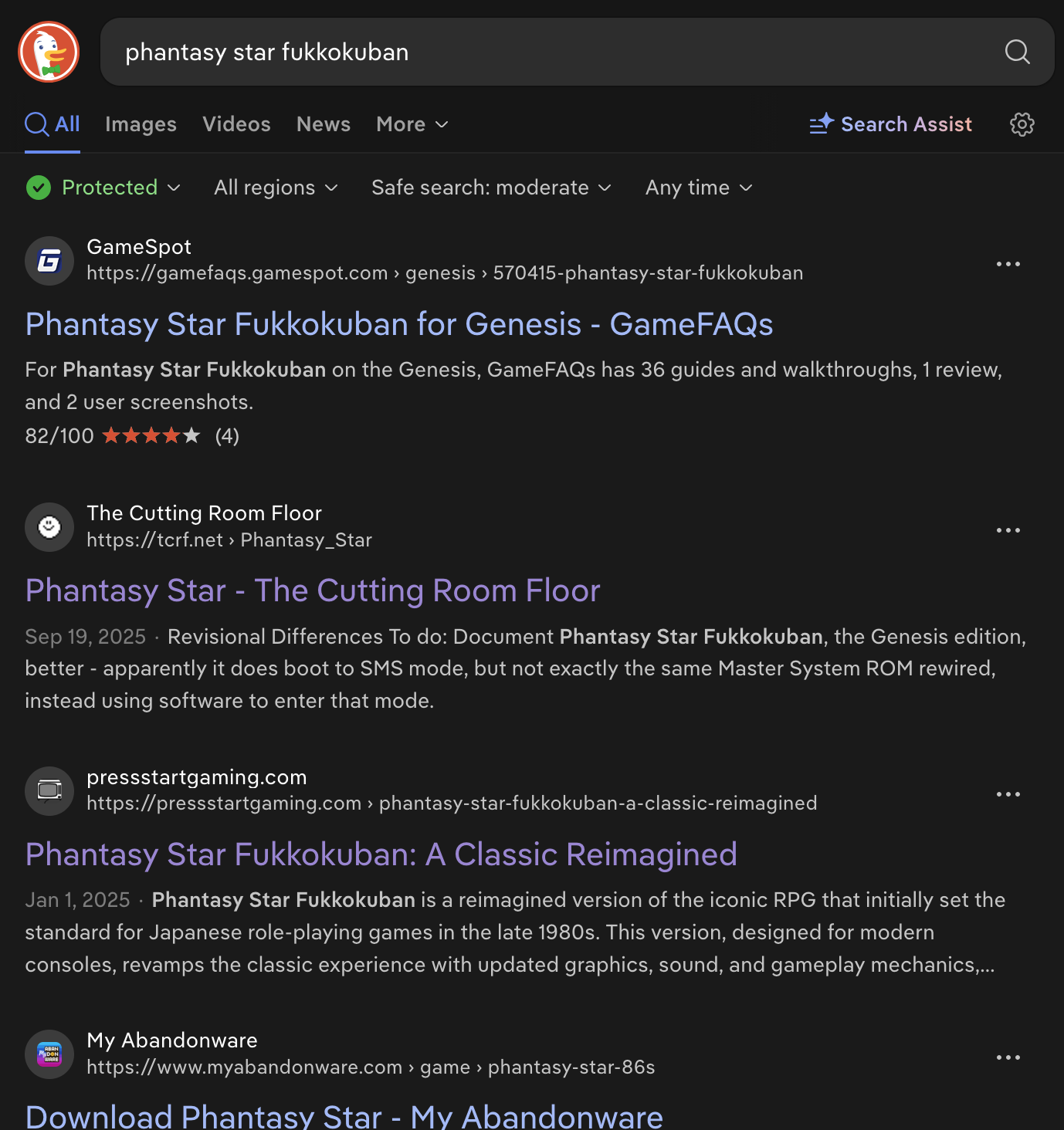
GameFAQs is at the top; a titan since the 1990’s. The second result is The Cutting Room Floor, a wiki much beloved by myself. And then the third result is “Press Start Gaming”.

And here’s a thing about me. I want to trust new websites. I have a bias towards clicking on articles from sites I don’t know, because to be quite honest, I’ve read the TCRF page on Phantasy Star a thousand times. How else do you learn something new?

Also, I clicked it because the headline was “Phantasy Star Fukkokuban: A Classic Reimagined”. Because here’s the thing. It talks about how the graphics were improved:
Phantasy Star Fukkokuban breathes new life into the classic with its updated graphics and sound design. The visual overhaul retains the charm of the original’s 8-bit aesthetics while incorporating modern graphical techniques. Characters and environments are rendered with enhanced detail, vibrant colors, and fluid animations, creating a visually captivating experience.
The art style honors the game’s roots, with character designs and enemy sprites redesigned to reflect contemporary standards while maintaining their recognizability. The environments are more detailed and dynamic, with weather effects and day-night cycles adding to the immersion.
Well, compare the title screen shots of Phantasy Star above. Which one is Fukkokuban and which one is my personal copy, played through the same Genesis? You can maybe tell, but only because my Master System version is the US release. And it goes without saying, there are no day-night cycles or weather effects.
I should’ve known. The first sentence of the article was “Game data not found,” after all.
Large language models are described sometimes as “fancy autocorrect”; this is dismissive, but not inaccurate, in the sense that the core loop of an LLM is to predict the next token in a sequence. Phantasy Star Fukkokuban is an obscure title that is likely not well-represented in the training data. But relations do exist:
So, lacking sufficient factual data in the training set, it describes what a remake of Phantasy Star might plausibly be like. There might even be knowledge in the data set of the actual remake, Phantasy Star generation:1 that gets looped in.
To reproduce this myself, I went to ChatGPT, and asked it Please describe the game "Phantasy Star Fukkokuban". Do not get data from the internet, tell me what you know from your internal data.. And what did I get in response?
Phantasy Star Fukkokuban is not a brand-new entry in the series, but a retro compilation release of the original Phantasy Star, created for the Sega Sega Saturn era…
There was a retro compilation release of Phantasy Star for the Sega Saturn in Japan; it’s called Phantasy Star Collection. Indeed, the description of the game it continued from there isn’t too far off from that game’s version of Phantasy Star.
And it’s not just Phantasy Star Fukkokuban. I describe in my post on Mahjong Daireikai that that game is so obscure, the only Japanese source I could find was another “this is plausibly what a game called ‘mahjong daireikai’ might be like”. Well, what Mahjong Daireikai is actually like is a lot different than what’s in your training data, and that’s exactly the sort of information people want to read websites to find out.
And here’s the thing– this blog post can’t do anything about it. I don’t know who Press Start Gaming is; the site’s footer says “©2025 Cloud Gears Media”, who might be this marketing company (but it might not be! Company names don’t have to be unique globally); Press Start Gaming is almost certainly a tool for making money off of ads and sponsored posts, and posts like the Phantasy Star Fukkokuban misinformation exist mostly to give the site more juice of looking like a real website. If someone goes out and buys a copy of Fukkokuban expecting a new and improved Phantasy Star with better graphics and new sidequests, what do they care? The article wasn’t really meant to provide information.
The trampling of the internet with SEO-mongers predates AI, but what LLMs do is massively increase the ease it can be done, and also hallucinate a ton. If they hired a person to write about Phantasy Star Fukkokuban for pennies, maybe that person would’ve found the Sega Retro page or something and at least grabbed some facts. Now you don’t need to do even that. And no one making these decisions reads Nicole Express, or even cares about actually providing information with their sites. That’s not what they’re for.
Anyways, eventually models will do a better job integrating Nicole Express, and will know more information about Phantasy Star Fukkokuban. And is this the worst thing the AI boom is doing? No, not even close. Even the fully automated hit piece against an open-source developer is probably worse than this.
But it’s a real shame. The commons of the internet are probably already lost, and while I might want to learn new things from new sites, I’ll just have to stick to those with pre-LLM reptuations that I trust. Well, until those sites burn their reputations to make a few extra pennies with AI, like Ars Technica seems to just have. (link goes to a Mastodon thread in lieu of a better source for now)
This post is just a rant. Thanks for listening, at least.
AI slop thrives in anonymity. In a community that's developed its own established norms and people who know each other, AI content trying to be passed off as genuine stands out like a sore thumb and is easily eradicated before it gets a chance to take root.
It doesn't have to be invite-only, per se, but it needs to have its own flavor that newcomers can adapt to, and AI slop doesn't.
Chinese have their own internet anyway- it was a shock to me at first just how little the average Chinese citizen really cares about Western culture or society. They have their own problems ofcourse but it has nothing to do with us
No it's the tens of billions of mostly American capital going into AI data centers and large bullshit models.
I'd normally be the first to agree with and push your point about language evolving, but it's not time to apply that to a neologism this young.
> Enshittification, also known as crapification and platform decay, is a process in which two-sided online products and services decline in quality over time. Initially, vendors create high-quality offerings to attract users, then they degrade those offerings to better serve business customers, and finally degrade their services to both users and business customers to maximize short-term profits for shareholders.
I reject this emphatically. Google should never have been in the business of shaping internet content. Perhaps they should have even gone out of their way to avoid doing so. Without Google (or a better-performing competitor) acquiescing to the game, there is no SEO market.
My understanding is that people tend to cooperate in smaller numbers or when reputation is persistent (the larger the group, the more reliable reputation has to be), otherwise the (uncommon) low-trust actors ruin everything.
Most humans are altruistic and trusting by default, but a large enough group will have a few sociopaths and misunderstood interactions; which creates distrust across the entire group, because people hate being taken advantage of.
Maybe it wasn't literally hours, but it was really fast. I remember noting how quickly people began to complain about it being used "improperly." The earliest instance I could find was this thread[0] from 2023 where user Gunax complained about it. I couldn't find an earlier reference in Algolia, it probably exists but I honestly don't care enough to put in the effort.
[0]https://news.ycombinator.com/item?id=36297336
>and also in that "things become shittier" was and is still a perfectly common expression
...perfectly encapsulated and described by the term "enshittification." Which is why people use it for that now. It's more descriptive in the general sense than it is as a specific term of art. You're complaining that a word that means "the process of turning to shit" is being used to describe "the process of turning to shit." What did people expect to happen? If you want to keep it as a precise and technical term of art, keep calling it "platform decay." A shit joke is not a technical, precise term of art.
You can be as much of a prescriptivist crank about this as you want, it doesn't matter. "Enshittification" now refers to any process by which things "turn to shit."
...and not on Hacker News. Too many pseudo-anonymous jerks, too many throwaways, too much faith placed in gamified moderation tools.
Though all that stuff is a very different thing from what's being discussed in this thread.
Also see https://en.wikipedia.org/wiki/Enshittification#Impact which talks of the broadening of the usage of that term.
... towards an in-group, yes. Not towards out-groups, as far as I can tell.
Though for some reason this tends not to apply to solo travellers in many, many parts of the world.
Lots of debate, yes, but very little about the basic fact that Hardin's formulation of "the tragedy of the commons" doesn't describe actual historical events in pretty any well documented case.
If you trust your government's propaganda that is used to jusitfy "hackbacks" and buying 0-days on the darkweb that fucks us all.
asserted without evidence and likely false.
Don't get me wrong the west isn't doing much to enforce Russian or Chinese complaints either. It's really just a messy diplomatic situation all around.