That's some sweet quality of life fixes!
That and the AI assistant have really changed how I operate day to day. I'm super excited about the Index, and I hope it has the same capability my app has (mostly, sending a webhook with the transcription with exponential backoff, so I'm sure all my notes will eventually be sent).
Has anyone else successfully recovered a dormant package name from Google Play recently? I was under the impression that once an original developer account goes inactive, those namespaces were effectively burned forever? Is that an incorrect assumption on my part?
Aahhh. Finally the mystery of how my old pebble died is solved. Hopefully . One fine morning, the display came off. It was supposed to be waterproof and there was no puffed up battery either.
Edit: https://diyusthad.com/2021/04/top-5-open-source-smartwatch.h...
(Tried looking on your blog, but ended up instead reading your article about the little ESP8266 clock which convinced me to buy one to play with myself, thanks!)
What are you using for your AI assistant?
https://repebble.com/watch says the Pebble Time 2 has
> Heart rate, step and sleep tracking
Isn't that what you want?
If that's all you use your smartwatch for, you may as well skip the watch and get a payment bracelet or ring though.
For me, its value lies more in nostalgia than anything else. I don't expect it to ever compete with the likes of my Apple watch for smart features, or a Garmin for activity tracking.
That said, it's an e-paper display so battery life is pretty good. Plus it had (and probably will have) an active community of small apps and watchfaces, which kept (and probably will keep) it from becoming stale quickly.
I was an original Pebble Kickstarter wearer from 2012, then got the initial Time, then the first Android smartwatches (Moto 360!) then basically every Apple Watch from then to now. Even used Google Glass a few months in 2013.
I like my wearables. I use features on my Apple Watch constantly: NFC payments, voice reminders, fitness and sleep tracking, make my iPhone yell out so I can find where I put it, etc.
But not a single damn wearable I've had has captured a fraction of the charm the original Pebble and Pebble Time had. Their UIs are low-res by modern standards, and greyscale or largely solid colors, but wow.
Dug up some videos as reference. Here's one that highlights what the core system UI aesthetic is like. Notice the transitions as you use the UI. I remember it feeling really snappy too, and it feels great to use a UI that moves like that with physical tactile buttons, as opposed to scrolling a Digital Crown or using the touch screen on an Apple Watch:
https://www.youtube.com/watch?v=SdRENEQcymQ
And aside from the system UI, the community of apps that existed for it back then and no doubt will continue to grow now has a lot of charm too. The creators of all the apps are making them out of love, not to be a Top 10 on an Apple app store. And they don't exactly have a strong cohesive system UI to comply with unlike Apple. Human Interface Guidelines are wonderful for phones and tablets and for serious app ecosystems I depend on, but watches are Not That Serious as far as I'm concerned so the individuality and love within each app just fills me heart with joy every time I look down at my wrist.
I see they haven't handed over https://pebble.com though, that still forwards to Google's smartwatch lineup.
I spent all day out in below freezing temps, when I got back to my hotel room and my smartband (not pebble) started to warm up, the screen just fell off. Everything still worked and the screen was lit up. Fortunately I discovered it before I ripped the screen off on something. When I got home I was able to glue the screen back on and it's been operating just fine, of course it's probably no longer waterproof.
Hoping this thing holds out until I get my Pebble.
But if you just need that, almost any watch will do. The Pebble is clearly not made for those people.
But nonetheless, that is a rare occurrence, and I don't think for me it's worth paying the battery life and complexity cost of an Apple Watch (or similar full featured wearable) for that 1% use case. I'd rather have a simpler device that just focuses on health tracking and a few notifications, basically what FitBit was if it had a better battery and didn't suck.
That it's hackable and there will likely be lots of community-maintained apps that link into services I use is gravy on top.
https://github.com/skorokithakis/middle
I'll take some photos, it's larger now than it will be, because I don't have a MEMS mic (and a small battery). It looks like this now:
https://github.com/skorokithakis/stavrobot
I love it, it's amazing. I want to add a small section to the README about how to use it well (how to manage memory and the database, basically), but it's just fantastic. It has had basically zero bugs, as well.
But GPS is really hard to get right, especially if you want weeks of battery life.
Garmin have been a decent company (in the ethical/moral sense) to be a customer of for many years, but I think they're slowly losing that reputation. Yes, my 2018 hardware still does everything it did in 2018, no, I don't pay for or currently have a need for Connect+, but they're running out of hardware optimization opportunities to push people to new devices, and appear to be seeking alternative ways to maintain growth.

Things are busy in Pebbleland! We’re getting close to shipping 3 new hardware products and all the associated software that comes along with them. Overall, things feel good. I’d say the amount of last minute shenanigans is at the normal amount. Getting new hardware into ‘production’ is a pretty wild and exciting process. Building hardware is an exercise in balancing competing priorities of cost, quality and speed. In the last mile push to get into production, things can change quickly for the best (woohoo! the waterproof test finally passes, we can move to the next stage), or less good (uh, the production line needs 3 more test fixtures to test Index 01 mic performance, and a major production test software update…that’ll be a lot more money). Unlike with software, you can’t easily fix hardware issues after you ship! Making these last minute decisions is sometimes pretty stressful but hey, that’s the world of making hardware.

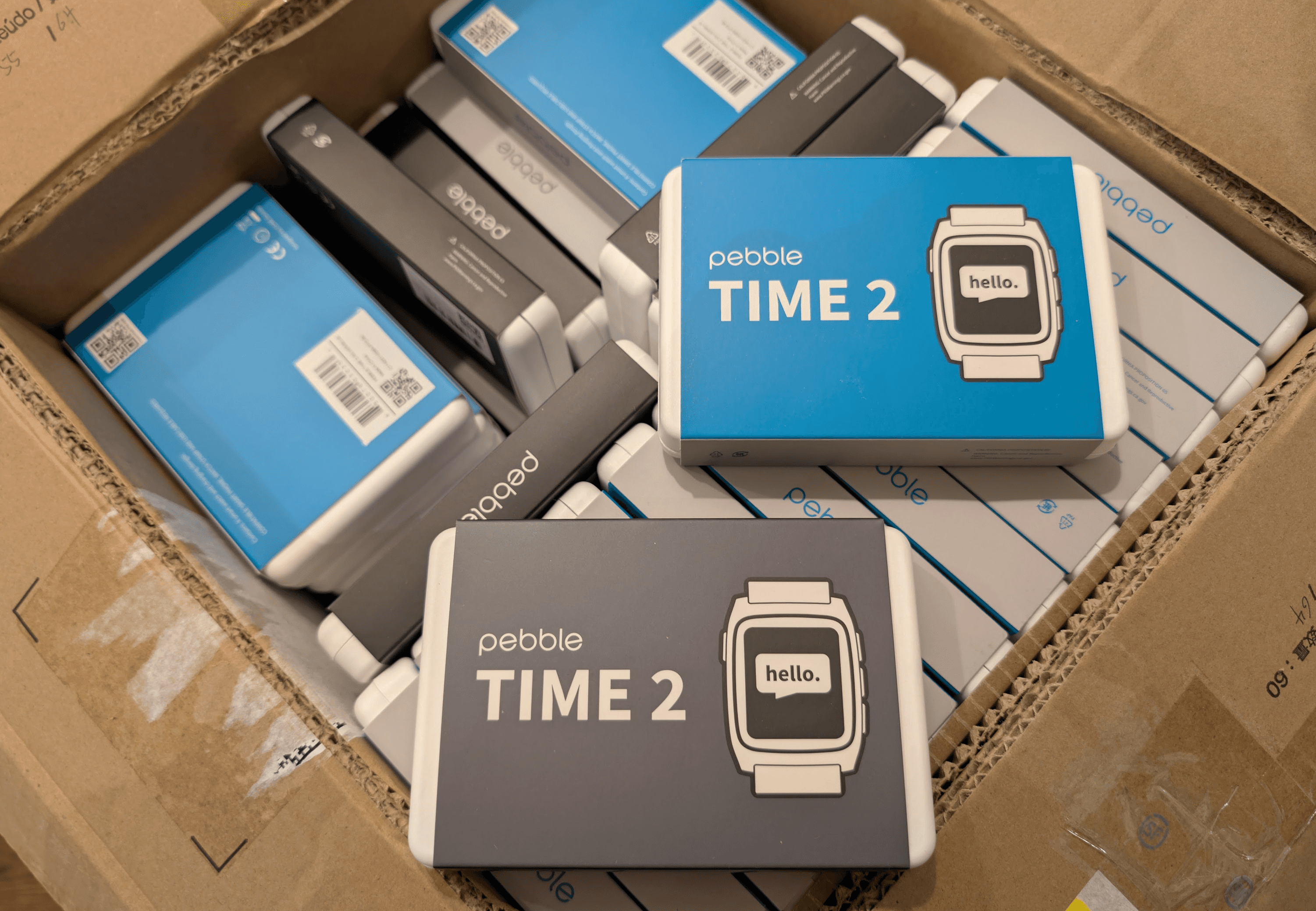
We’re in the Production Verification Test (PVT) phase right now, the last stop before Mass Production (MP). During this phase we manufactured hundreds of PT2s in a series of test builds, uncovered a bunch of issues, and fixed a bunch of issues. Just before the factories shut down for the lunar New Year, we got the good news that all the tests passed on the last build!
We focused most of January on improving the waterproofing on the watch (flash back to last summer when we worked on this for Pebble 2 Duo!). I traveled to visit the factory (travelogue here) and worked through a lot of open issues. Above is a video of the speaker waterproof testing from the production line. Good news is that we fixed all the issues, tests are passing and it looks like we’ll be able to certify PT2 with a waterproof rating of 30m or 3ATM! This means you can get your watch wet, wear it while swimming (but not in hot tubs/saunas) and generally not worry about it. It’s not a dive watch, though. Also, don’t expose it to hot water (this could weaken the waterproof seals), or high pressure water. It’s not invincible.
Entering PT2 Mass Production on March 9
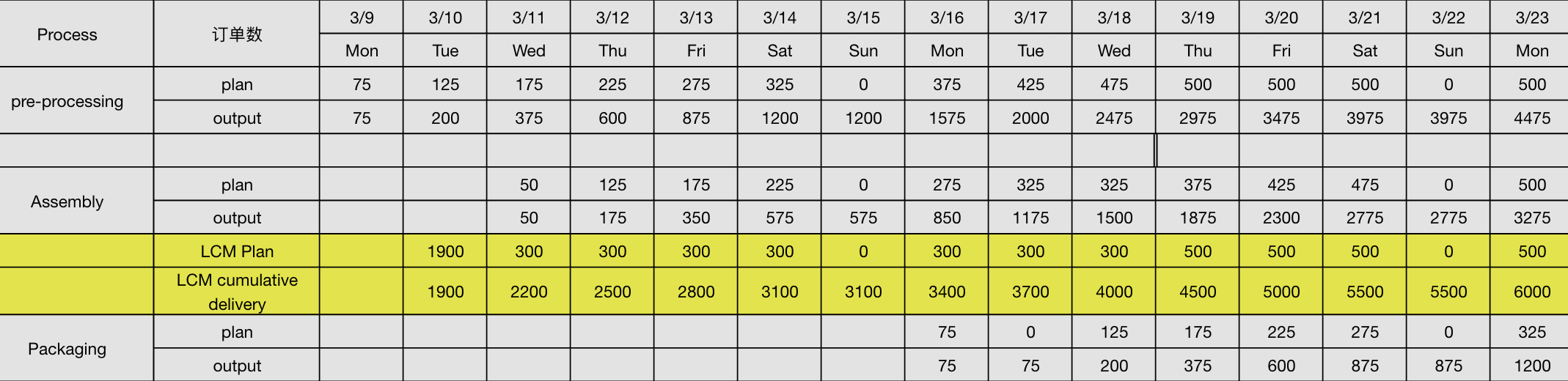
Snapshot of our mass production plan (output counts are cumulative)
The factory is closed now for Lunar New Year and will reopen around the end of Feb. As of today, mass production is scheduled to start on March 9. It will take the production line a little while to spin up towards our target output of 500 watches per day. Finished watches ship from the factory once a week to our distribution center (which takes 1 week), then get packed for shipping (a few days to a week), then get delivered to you (7-10 days). These dates and estimates are ALL subject to change - if we run into a problem, production shuts down until we fix it. Delays can and most likely will happen.
What everyone’s been waiting for…when will your PT2 arrive 🙂
Based on current schedule, the first mass production PT2s will arrive on wrists during the beginning of April. We should wrap up delivering all pre-ordered Pebble Time 2s two months later by the beginning of June. If your watch had an initial date of December, it should arrive in April and if your initial date was April, it should arrive in June. Unfortunately we can’t predict when your specific watch will arrive - please don’t email to ask, we’ll just send you a link to this blog post.
A few weeks before your watch is scheduled to ship, we’ll email link for you to confirm your address (change if now if you’d like), pick optional accessories (extra chargers and straps) and pay any tariffs/VAT/taxes owed. For US orders, the tariff amount is $10 per watch. For other countries, VAT/taxes will be calculated and charged during order confirmation. When the watch is delivered you won’t need to pay anything else or deal with customs forms.

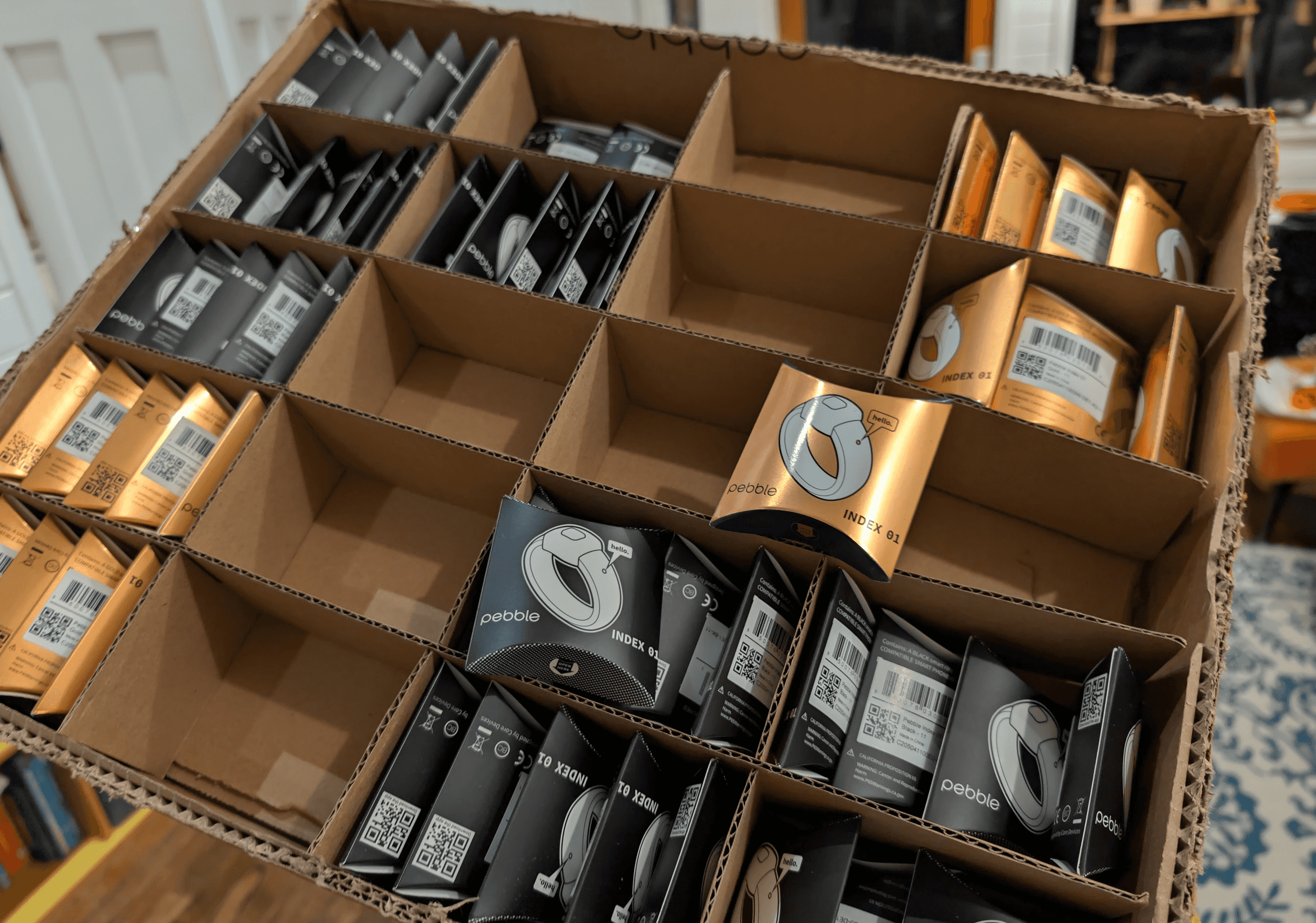
Index 01 is also in the Production Verification Test (PVT) phase. We’ve manufactured several hundred so far. Waterproof testing went well (it’s rated 1m of submersion, ipx8). You’ll be able to wash your hands, wash dishes, shower, get it wet etc but you can’t swim with it on. PTV is proceeding well, but we’re not finished yet. We’re still aiming to start mass production during March, but we don’t have a firm start date yet.
In order news, we’re working an Index 01 ring sizer kit that will be available for $10 (hopefully including worldwide shipping, working on that now). This will let you measure your index finger and find your exact Pebble-specific ring size. We will ask everyone to measure their ring size, either by ordering an Index 01 sizer kit or 3D printing the kit, because our sizes are different than Oura or other rings.
We’re also considering offering size 14 and 15. It’s a big upfront expense (~$50,000) to offer these sizes due to additional tooling that will be needed, so we’re collecting interest - sign up here if you would like Index 01 in these sizes!
Things are rolling along. We finished the Design Verification 1 (DVT1) phase just before the Lunar New Year holiday started. Work is progressing well. One of the huge speed-ups to the program overall is that the electrical design is almost identical to Pebble Time 2. This means our (two person) firmware team can code new features or bug fixes for PT2 and they work immediately on PR2! After the lunar new year, we’ll focus on waterproof testing and last minute tweaks before the current estimated production start date in late May.
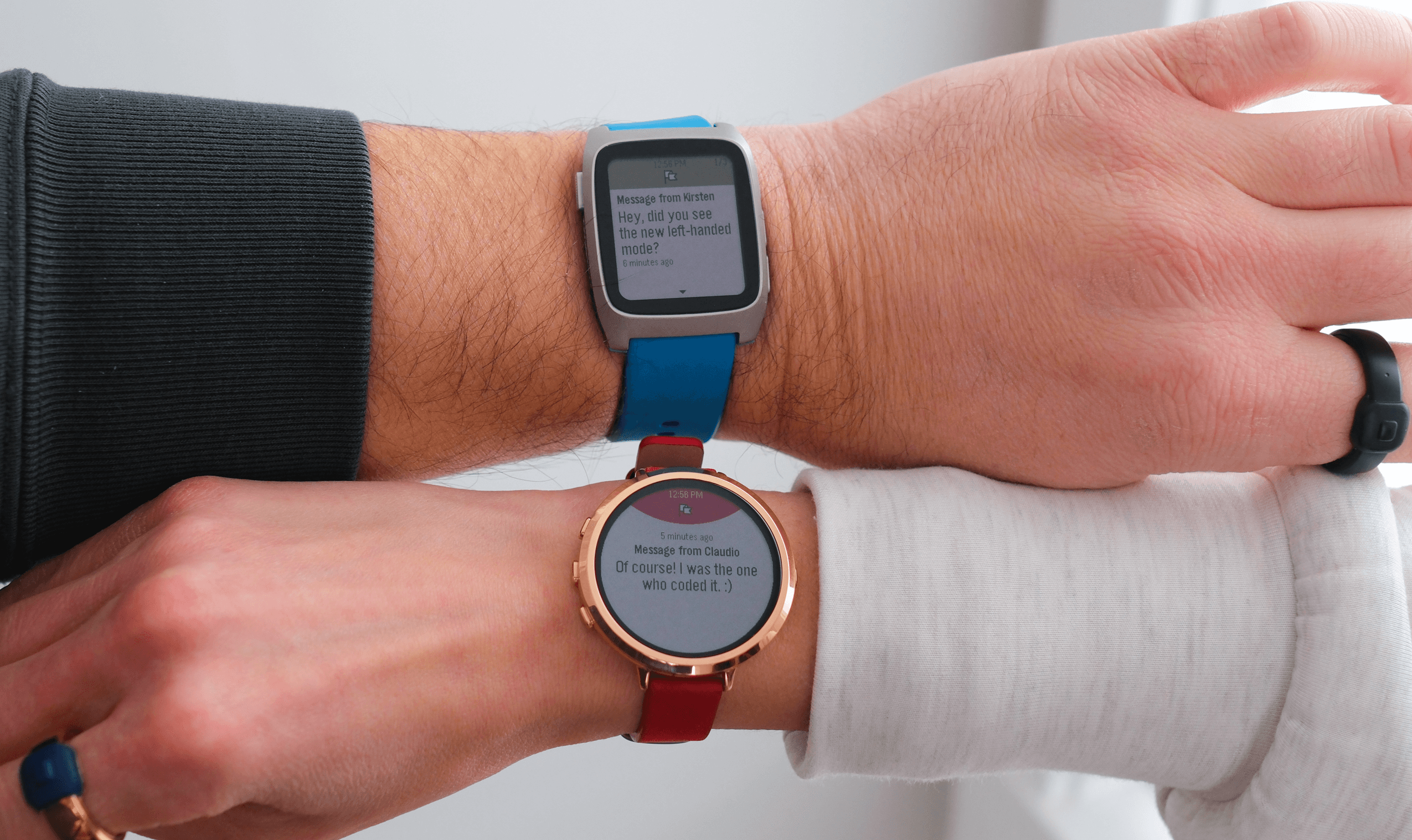
Our software output has been tremendous - we’re fixing bugs left, right and center and adding lots of new features to PebbleOS (changelog) and the Pebble mobile app (changelog).
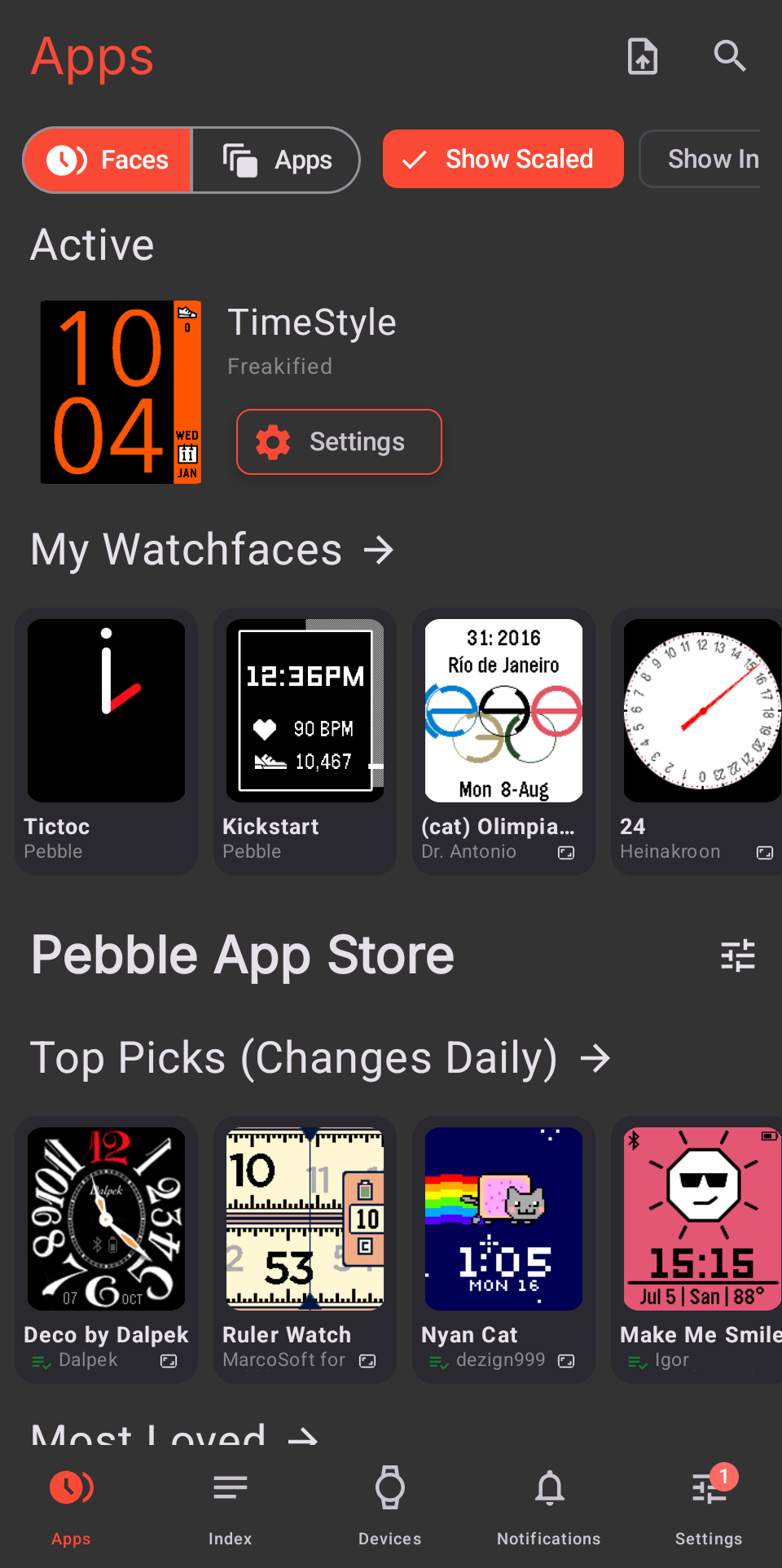
Here are some highlights:
com.getpebble.android.provider.basalt). But devs - please upgrade your apps to PebbleKit 2.0 Android for new companion apps (more info and repo)We’ve also made some great advances on the SDK and developer front…expect an update very soon 😉
That’s exactly why I have it. It’s hard to get distracted by it as yet another screen in my life. Plus since I use an iPhone it currently doesn’t do text or calls, it just alerts me if I have a call coming (and calendar alerts). Basically I call it my “advanced beeper.”
Having to write C on the watch-side isn't everyone's cup of tea but they are actively working on a replacement for rocky.js so that you can write everything in JS.
https://www.reddit.com/r/pebble/comments/1qr1npj/pebble_roun...
It's like trying something so good it ruins every other one for you. The UX was just so well thought through i don't know how to explain it.
I guess the one other feature I like of the Apple Watch is the rings/daily fitness goals functionality. I'll have to look into the Pebble more to see if that's possible. I also like the background monitoring features the Watch has (hypertensions, etc.), but I'm assuming that's a little too much for the Pebble.
Far has I know, pebble user have spent the last 10 years searching for another pebble without luck.
Shame because you can get some nice watch straps with curve integration, which would neatly solve the missing payment feature on Pebble watches.
That being said - feature I LOVE added recently-ish that made really happy I’ve upgraded my many years old garmin was a flashlight (proper one, not screen brightness). It seemed like a gimmick but it’s now one of most used features on my watch - walking dog at night, looking for kids toys under the bed, fixing things around the house, looking for things in the bag, etc.
I had Basis first and this is the most loved watch from me, then Pebble.
I'd pay more for being able to fumble about in the codebase and add exactly what I want.
I may be mixing terms in my brain, though. Happy to be corrected.
Sounds like a cool concept to speak into your watch/wearable which automatically saves or performs tasks on the fly.
What is the general execution time from:
Prompt received -> final task executed?
Pebble hadn't been in this mess in the first place, if it wasn't for him. Going back to him a second time, is just unresponsible in my opinion.
You can get the same thing in watches from Garmin, Coros, Polar, Suunto, Casio and probably more.
Battery life is real.
Yes, or more precisely: reflective displays without backlight. There were many such display technologies a while ago (when the Kindle took off and various companies tried to compete with E Ink), but most have since been abandoned.
Pretty much all colored e-paper screens have much lower contrast than color printing on paper, since they mix colors by using can conventional RGB sub-pixels and darkening them individually, just like regular lit screens, which reduces the amount of reflected light.
You can't really avoid the coder exfiltrating your tool secrets, but at least it's separated. I also want to add a secondary container of "trusted" tool that the main LLM can call but no other LLM can change.
This way you're assured that, for example, the agent can't contact anyone that you don't want it contact, or it can read your emails but not send/delete, things like that. It makes it very easy to enforce ACLs for things you don't want LLM-coded, but also enables LLM coding of less-trusted programs.
Are there other examples besides just his Pebble company version 1?
Isn't that how color images printed paper works, too? We use inks (often in CMYK coloration, but a galaxy of other options exist) to subtract light from what would otherwise be reflected by a plain white paper.
What makes e-paper screens worse in this way?
Yeah, other wearable manufacturers who use the same display technology usually call it MIP instead. Pebble are pretty much the only ones who call it e-paper, which has led some to think theirs is a distinct thing, but it's just MIP.
> The watch featured a 32-millimetre (1.26 in) 144 × 168 pixel black and white memory LCD using an ultra low-power "transflective LCD" manufactured by Sharp
Later generations are color, but it's the same tech. If you've ever used actual e-ink then it should be obvious enough that the Pebble displays are something else, it would be nowhere near responsive enough to keep up with pebbleOS's animations.
No. When you print a piece of paper some color, e.g. red, it will be completely red. But most e-paper screens will only be 33% red (optimistically) and 66% black. This is because physical pixels usually can't change color themselves, only brightness, so you use three of them, and darken the RGB components, to produce a colored pixel.
For displaying white on color e-paper screens you will have three non-dark RGB sub-pixels, but each color component only reflects at most a third of the incoming spectrum, either red, green, or blue wavelengths, while white paper (or monochromatic e-paper screens) will reflect all three wavelengths everywhere.