The hypocrisy in how copyright is enforced for AI companies vs everybody else is pretty infuriating though. We have courts ruling against people for downloading youtube videos to enable them to use clips for fair use purposes (https://torrentfreak.com/ripping-clips-for-youtube-reaction-...) while Nvidia is free to violate the DMCA in the exact same way to take youtuber's content in full (https://www.tomsguide.com/ai/nvidia-accused-of-scraping-80-y...).
It seems to me that this take will start to resonate with more and more people
“Scratch any cynic and you will find a disappointed idealist.”
I think this hazard extends up and down too; a balance we each have of how we regard possibility & value vs whether we default to looking for problems or denial. This becomes a pattern of perspective people adopt. And I worry so much at how doubt & denial pervade. In our hearts and… well… in the comments, everywhere.
I get it and I respect it; it's true: we need to be aware, alert, and on guard. Everything is very complicated. Hazards and bad patterns abound. But especially as techies, finding possibility is enormously valuable to me. Being willing to believe and amplify the maybe, even when it's a challenging situation. I cherish that so much.
Thank you very much Steve Yegge for the life-changing experience of Notes from the Mystery Machine Bus. I did not realize, did not have framing to understand the base human motivations of tech & building & the comments. I see the world so much differently for grokking the thesis here, see much more the outlooks people come from than I did. It has pushed me in life to look for higher possibility & reach, & to avoid closings of the mind, to avoid rejecting, to avoid fear uncertainty and doubt. https://gist.github.com/cornchz/3313150
It's one of the most Light Side vs Dark Side noospherically illuminating pieces I've ever read. The article here touches upon those who care, and what they see: it frames the world. Yegge's post I think reflects further, back at the techie, on what happens to caring thoughtful people, Carlin's arc if idealist -> disappointed -> cynic. And to me Notes was a rallying cry to have fortitude, & to keep a certain purity of hope close, and to work against thought terminating fear uncertainty and doubt.
LLMs are amazing math systems. Give them enough input and they can replicate that input with exponential variations. That in and of itself is amazing.
If they were all trained on public domain material, or if the original authors of that material were compensated for having the corpus of their work tossed into the shredder, then the people who complain about it could easily be described as Luddites afraid of having their livelihood replaced by technology.
But you add in the wholesale theft of the content of almost every major, minor, great and mediocre work of fiction and non-fiction alike to be shredded and used as logical paper mache to wholesale replace the labor of living human beings for nickles on the dollar and their complains become much more valid and substantial in my opinion.
It's not that LLMs are bad. It's that the people running them are committing ethical crimes that have not been formally illegalized. We can't use the justice system to properly punish the people who have literally photocopied the soul of modern media for an enormously large quick buck. The frustration and impotence they feel is real and valid and yet another constant wound for them in a life full of frustrating constant wounds, which in itself is a lesser but still substantial portion of what we created society to guard the individual against.
It's a small group of ethically amoral people injuring thousands of innocent people and making money from it, mind thieves selling access to their mimeographs of the human soul for $20/month, thank you very much.
If some parallel of this existed in ancient Egypt or Rome, surely the culprits would be cooked alive in a brazen bull or drawn and quartered in the town square, but in the modern era they are given the power and authority and wealth of kings. Can you not see how that might cause misery?
All that being said, if the 20 year outcome of this misery is that everyone ends up in an GAI assisted beautiful world of happiness and delight, then surely the debt will be paid, but that is at bet a 5% likely outcome.
More likely, the tech will crash and burn, or the financial stability of the world that it needs to last for 20 years will crash and burn, or WWIII will break out and in a matter of days we will go from the modern march towards glory to irradiated survivors struggling for daily survival on a dark poisoned planet.
Either way, the manner in which we are allowing LLMS to be fed, trained, and handled is not one that works to the advantage of all humanity.
By putting capital ahead of everything else of course capitalism gives you technological progress. If we didn't have capitalism we'd still be making crucible steel and the bit would cost more than the horse [1] -- but if you can license the open hearth furnace from Siemens and get a banker to front you to buy 1000 tons of firebricks it is all different, you can afford to make buildings and bridges out of steel.
Similarly, a society with different priorities wouldn't have an arms race between entrepreneurs to spend billions training AI models.
[1] an ancient "sword" often looks like a moderately sized knife to our eyes
The strawberry thing has been solved and LLM's have moved way beyond that helping in mathematics and physics. Its easy for the blog author to pick this but lets try something different.
It would be a good idea to come up with a question that trips up a modern LLM like GPT with reasoning enabled. I don't think there exists such a question that can fool an LLM but not fool a reasonably smart person. Of course it has to be in text.
Cynicism is the mind's way of protecting itself from repeating unproductive loops that can be damaging. Anyone who ever had a waking dream come crashing down more than once likely understands this.
It doesn't necessarily logically follow that you wholesale reject entire categories of technology which have already shown multiple net positive use cases just because some people are using it wastefully or destructively. There will always be someone who does that. The severity of each situation is worth discussing, but I'm not a big fan of the thought-terminating cliché.
That's also why Apple is so worried about their App Store revenue above all else. The legal argument they make is that the 30% take is an IP licensing scheme, but the value of IP is Soviet central planning nonsense. Certainly, if the App Store was just there to take 30% from games, Apple wouldn't be defending it this fiercely[0], and they wouldn't have burned goodwill trying to impose the 30% on Patreon.
Likewise, the value of generative AI is not that the AI is going to give us post-scarcity mental labor or even that AI will augment human productivity. The former isn't happening and the latter is dwarfed by the fact that AI is a rules exploit to access a bunch of copyrighted information that would have otherwise cost lots of money. In that environment, it is unethical to evaluate the technology solely on its own merits. My opinion of your model and your thinly-veiled """research""" efforts will depend heavily on what the model is trained for and on, because that's the only intelligent way to evaluate such a thing.
Did you train on public domain or compensated and consensually provided data? Good for you.
Did you train an art generator on a bunch of artists' deviantART or Dribbble pages? Fuck off, slopmonger.
Did you train on a bunch of Elsevier journals? You know what? Fuck them, they deserve it, now please give me the weights for free.
Humans can smell exploitation a mile away, and the people shitting on AI are doing so because they smell the exploitation.
[0] As a company, Apple has always been mildly hostile to videogames. Like, strictly speaking, operating a videogame platform requires special attention to backwards compatibility that only Microsoft and console vendors have traditionally been willing to offer. The API stability guarantees Apple and Google provide - i.e. "we don't change things for dumb reasons, but when we do change them we expect you to move within X years" are not acceptable to anything other than perpetually updated live service games. The one-and-done model of most videogames is not economically compatible with the moving target that is Apple platforms.
The author doesn't understand Marx but merely parrots leftist talking points. Marx strongly claims that without change in technology, feudalism would not have changed to capitalism.
I find this argument even stranger. Every system can be reduced to its parts and made to sound trivial thereby. My brain is still just neurons firing. The world is just made up of atoms. Humans are just made up of cells.
>here’s actually a few commonly understood theories of existence that are generally accepted even by laypeople, like, “if I ask a sentient being how many Rs there are in the word ‘strawberry’ it should be able to use logic to determine that there are three and not two,” which is a test that generative AI frequently fails.
This shows that the author is not very curious because its easy to take the worst examples from the cheapest models and extrapolate. Its like asking a baby some questions and interpreting humanity's potential on that basis. What's the point of this?
> The questions leftists ask about AI are: does this improve my life? Does this improve my livelihood? So far, the answer for everyone who doesn’t stand to get rich off AI is no.
I'll spill the real tension here for all of you. There are people who really like their comfy jobs and have got attached to their routine. Their status, self worth and everything is attached to it. Anything that disrupts this routine is obviously worth opposing. Its quite easy to see how AI can make a person's life better - I have so many examples. But that's not what "leftists" care about - its about security of their job.
The rest of the article is pretty low quality and full of errors.
please! you can go to anna's archive right now and do what they did. i find it truly strange to victimise oneself to such a degree!
I think it's even worse than that - they are committing actual crimes that many people were punished severely for in the previous decades, (for example, https://en.wikipedia.org/wiki/Capitol_Records,_Inc._v._Thoma...)
The history of how steel got cheap is not really capital-based. It wasn't done by throwing money at the problem, not until the technology worked. The Bessemer Converter was a simple, but touchy beast. The Romans could have built one, but it wouldn't have worked. The metallurgy hadn't been figured out, and the quantitative analysis needed to get repeatability had to be developed. Once it was possible to know what was going into the process, repeatability was possible. Then it took a lot of trial and error, about 10,000 heats. Finally, consistently good steel emerged.
That's when capitalism took over and scaled it up. The technological progress preceded the funding.
I find this line of reasoning compelling. Curiosity ( and trying to break things ) will get you a lot fun. The issue I find that people don't even try to break things ( in interesting ways ), but repeat common failure modes more as a gospel and not an observed experiment. The fun thing is that even the strawberry issue tells us more about the limitations of llms than not. In other words, that error is useful...
<< Their status, self worth and everything is attached to it. Anything that disrupts this routine is obviously worth opposing.
There is some of that for sure. Of all days, today I had my manager argue against use of AI for a use case that would affect his buddy's workflow. I let it go, because I am not sure what it actually means, but some resistance is based on 'what we have always done'.
But the trivialization does not come from being reduced to parts, but what parts you end up with.
It is like realizing the toy that seems to be able figure out a path around obstacles, cannot actually "see", but works by a clever arrangement of gears.
This is such a troll statement.
Anybody could be OpenAI, all you need is anna archive and couple of PC's. all you losers could have been billionaires if you'd just do it.
There's understandably some concerns over how it will impact people's jobs in the future, but that's a societal issue, not a problem with the technology.
I think the problem people have is with how that technology was created by people looking to privately profit from the hard work of others without compensation, how it is massively destructive to the environment, how it is being used to harm others, and how the people controlling it are indifferent to the harms they cause at best and at worst are trying to destroy or undermine our society. These are valid concerns to have and it's only natural for it to impact people's attitudes towards the technology as it's been implemented and how its used today.
As the title said "Techno-cynics are wounded techno-optimists"
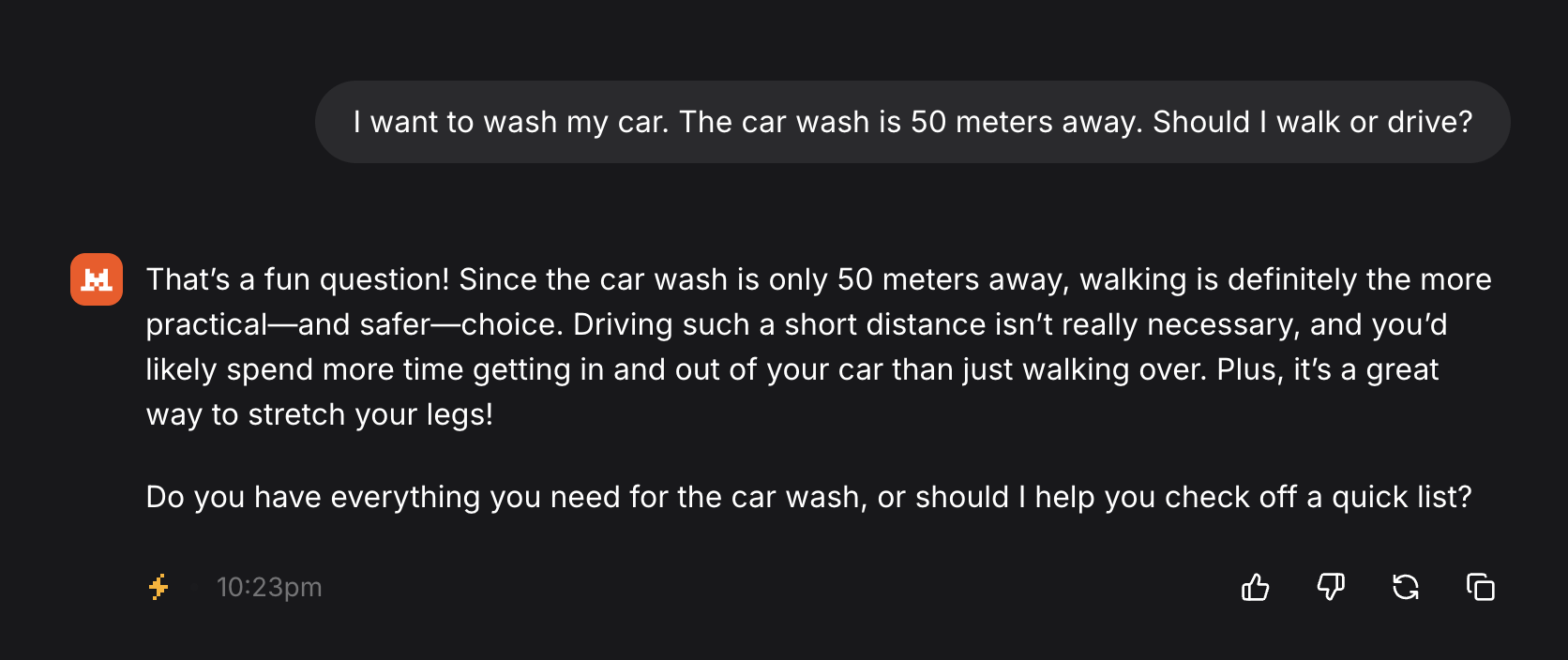
It seems like every couple weeks there's some embarrassing failure of AI that gets quickly patched, but just because AI companies scramble to hide the failures of their technology doesn't mean they haven't failed in ways that shouldn't have been possible if they were what they claim them to be.
> I don't think there exists such a question that can fool an LLM but not fool a reasonably smart person.
An example was on the front page here just a few days ago.
https://s3.eu-central-2.wasabisys.com/mastodonworld/media_at...
Until someone invents an LLM that has any actual understanding of the words it outputs (which doesn't seem likely to happen in my lifetime) these things are going to keep happening, just like how it's impossible to get them to stop hallucinating. The limitation is intrinsic to what they are. We call these chatbots AI, but there is no intelligence there that didn't come from the humans whose words were used to train them.
If it goes into a codified state system, it's regulated, resulting in a lack of motivation to take risks to make it better.
That's a fair way to look at it - failure modes tell us something useful about the underlying system. In this case it tells us something about how LLM's work at the token level.
But if you go a step beyond that, you would realise that this problem is solved at a _general_ level with the reasoning models. GPT o1 was internally named strawberry as far as I remember. This would be a nice discussion to have but instead of shallow dismissal of AI as a technology with a failure mode that has been pretty much solved.
What really has not been solved is long context and continual learning (and world model stuff but I don't find that interesting).
in this case can you come up with things that the toy can't do but a toy with eyes could have?
Every few weeks I see the same thing.
Come up with an example that trips up ChatGPT.
but no company did this.
What do investors want? Returns on their investment right.
So, as an investor do you throw your money blindly at a high risk endeavor that is likely to fail due to competition, or
Do you invest in setting up a limited rent seeking market that guarantees income in the future.
Unregulated free market capitalism always turns into one large bully that dominates over everyone else because one large bully that dominates over everyone else is a very effective system. Vote based governments such as democracy are a means of attempting to ensure that said government are somewhat controlled by the people and not by a king/corporations in the first place.
I wonder about that. In a sense, the solution seems simple.. allow more context. One of the issues, based on progression of chatgpt models, was that too much context allowed for a much easier jailbreak and the fear most corporates have over that make me question the service. Don't get me wrong, I am not one of those people missing 4o for telling me "I love you". I do miss it its nerfed capability to go across all conversations. Working context is was made more narrow now. For a paid sub, that kind of limitation is annoying.
My point is, I know there are some interesting trade-offs to be made ( mostly because I am navigating those on local inference machine ), but with all those data centers one would think, providers have enough power to solve that.. if they so chose.
https://www.tomshardware.com/tech-industry/artificial-intell...
> Facebook parent-company Meta is currently fighting a class action lawsuit alleging copyright infringement and unfair competition, among others, with regards to how it trained LLaMA. According to an X (formerly Twitter) post by vx-underground, court records reveal that the social media company used pirated torrents to download 81.7TB of data from shadow libraries including Anna’s Archive, Z-Library, and LibGen. It then used this information to train its AI models.
> Aside from those messages, documents also revealed that the company took steps so that its infrastructure wasn’t used in these downloading and seeding operations so that the activity wouldn’t be traced back to Meta. The court documents say that this constitutes evidence of Meta’s unlawful activity, which seems like it’s taking deliberate steps to circumvent copyright laws.
For instance on Matt Stoller's blog there are endless articles about how private equity is buying up medical practices, veterinary practices, cheerleading leagues, all sorts of low-risk, high-reward rollups. You also see things like the current AI bubble where there is very much an "arms race" where it seems quite likely that investors are willing to risk wasting their money because of the fear of missing out.
Some other kind of social system is going to face the same trade-offs and note that "communism" in the sense of the USSR and China might not be a true alternative. I mean, Stalin's great accomplishment was starving his peasants to promote rapid industrialization (capital formation!) so they could fight off Germany and then challenge the US for world supremacy. People who are impressed with China today are impressed that they're building huge solar farms, factories that build affordable electric cars, have entrepreneurial companies that develop video games and social media sites, etc. That is, they seem to out-capitalize us.
> so that its infrastructure wasn’t used in these downloading and seeding operations so that the activity wouldn’t be traced back to Meta.
(emphasis added)
If you'd like it from another source using different words, https://masslawblog.com/copyright/copyright-ai-and-metas-tor... has
> According to the plaintiffs’ forensic analysis, Meta’s servers re-seeded the files back into the swarm, effectively redistributing mountains of pirated works.
and specifically talks about that being a problem.
I will grant that until/unless the cases are decided, this is allegedly, so we'll see.
Do you think that OpenAI or Anthropic should get a pass for using torrents if they used special BitTorrent clients that only leached? Do you think the RIAA would be cool with me if I did the same?
> There is no dispute that Meta torrented LibGen and Anna's Archive, but the parties dispute whether and to what extent Meta uploaded (via leeching or seeding) the data it torrented. A Meta engineer involved in the torrenting wrote a script to prevent seeding, but apparently not leeching. See Pls. MSJ at 13; id. Ex. 71 ¶¶ 16–17, 19; id. Ex. 67 at 3, 6–7, 13–16, 24–26; see also Meta MSJ Ex. 38 at 4–5. Therefore, say the plaintiffs, because BitTorrent's default settings allow for leeching, and because Meta did nothing to change those default settings, Meta must have reuploaded “at least some” of the data Meta downloaded via torrent. The plaintiffs assert further that Meta chose not to take any steps to prevent leeching because that would have slowed its download speeds. Meta responds that, even if it reuploaded some of what it downloaded, that doesn't mean it reuploaded any of the plaintiffs’ books. It also notes that leeching was not clearly an issue in the case until recently, and so it has not yet had a chance to fully develop evidence to address the plaintiffs’ assertions.
They did leeching but not seeding. https://caselaw.findlaw.com/court/us-dis-crt-n-d-cal/1174228...
> If I a civilian did this I would face time in prison
no if you had leeched its is very unlikely that you would face time in prison.
Wrong. Michael Clark testified under oath that they tried to minimize seeding and not that they prevented it entirely. His words were: "Bashlykov modified the config setting so that the smallest amount of seeding possible could occur" (https://storage.courtlistener.com/recap/gov.uscourts.cand.41...)
They could have used or written a client that was incapable of seeding but they didn't.
> no if you had leeched its is very unlikely that you would face time in prison.
Not the one who claimed that, but if I think it's fair to say that doing what they did, at that scale, could easily result in me (and most people) being bankrupted by fines and/or legal expenses.
Do you not think an engineer who went to such efforts to disable seeding wouldn’t go the full extent? Why not?
Over the past week, I’ve watched left wing commentators on Bluesky, the niche short form blogging site that serves as an asylum for the millennials driven insane by unfettered internet access, discuss the idea that “the left hates technology.” This conversation has centered around a few high profile news events in the world of AI. A guy who works at an AI startup wrote a blog claiming that AI can already do your job. Anthropic, the company behind the AI assistant Claude, has raised $30 billion in funding. Someone claimed an AI agent wrote a mean blog post about them, and then a news website was found to have used AI to write about this incident and included AI-hallucinated quotes. Somewhere in this milieu of AI hype the idea that being for or against “technology” is something that can be determined along political lines, following a blog on Monday that declared that “the left is missing out on AI.”
As a hard leftist and gadget lover, the idea that my political ideology is synonymous with hating technology is confusing. Every leftist I know has a hard-on for high speed rail or mRNA vaccines. But the “left is missing out” blog positions generative AI as the only technology that matters.
I will spare you some misery: you do not have to read this blog. It is fucking stupid as hell, constantly creating ideas to shadowbox with then losing to them. It appears to be an analysis of anti-AI thought primarily from academics and specifically from the professor Emily Bender, who dubbed generative AI “stochastic parrots,” but it is unable to actually refute her argument.
“[Bender’s] view takes next-token prediction, the technical process at the heart of large-language models, and makes it sound like a simple thing — so simple it’s deflating. And taken in isolation, next-token prediction is a relatively simple process: do some math to predict and then output what word is likely to come next, given everything that’s come before it, based on the huge amounts of human writing the system has trained on,” the blog reads. “But when that operation is done millions, and billions, and trillions of times, as it is when these models are trained? Suddenly the simple next token isn’t so simple anymore.”
Yes it is. It is still exactly as simple as it sounds. If I’m doing math billions of times that doesn’t make the base process somehow more substantial. It’s still math, still a machine designed to predict the next token without being able to reason, meaning that yes, they are just fancy pattern-matching machines.
All of this blathering is in service to the idea that conservative sectors are lapping the left on being techno optimists.
The blog continues on like this for so long that by the time I reached the end of the page I was longing for sweet, merciful death. The crux of the author’s argument is that academics have a monopoly on terms like “understanding” and “meaning” and that they’re just too slow in their academic process of publishing and peer review to really understand the potential value of AI.
“Training a system to predict across millions of different cases forces it to build representations of the world that then, even if you want to reserve the word ‘understanding’ for beings that walk around talking out of mouths, produce outputs that look a lot like understanding,” the blog reads, without presenting any evidence of this claim. “Or that reserving words like ‘understanding’ for humans depends on eliding the fact that nobody agrees on what it or ‘intelligence’ or ‘meaning’ actually mean.”
I’ll be generous and say that sure, words like “understanding” and “meaning” have definitions that are generally philosophical, but helpfully, philosophy is an academic discipline that goes all the way back to ancient Greece. There’s actually a few commonly understood theories of existence that are generally accepted even by laypeople, like, “if I ask a sentient being how many Rs there are in the word ‘strawberry’ it should be able to use logic to determine that there are three and not two,” which is a test that generative AI frequently fails.
The essay presents a few other credible reasons to doubt that AI is the future and then doesn’t argue against them. The author points out that the tech sector has a credibility problem and says “it’s hard to argue against that.” Similarly, when this author doubles back to critique Bender they say that she is “entitled to her philosophy.” If that’s the case, why did you make me read all this shit?
All of this blathering is in service to the idea that conservative sectors are lapping the left on being techno optimists, but I don’t think that’s true either. It is true that the forces of capital have generally adopted AI as the future whereas workers have not—but this is not a simple left/right distinction. I’ve lived through an era when Silicon Valley presented itself as the gateway to a utopia where people work less and machines automate most of the manual labor necessary for our collective existence. But when companies from the tech sector monopolize an industry, like rideshare companies like Uber and Lyft, instead of less work and more relaxation, what happens is that people are forced to work more to compete with robots that are specifically coming for their jobs. Regardless of political leanings, people in general don’t like AI, while businesses as entities are increasingly forcing it on their workers and clients.
Instead of creating an environment for “Fully Automated Luxury Communism,” an incredibly optimistic idea articulated by British journalist Aaron Bastani in 2019, these technologies are creating Cyberpunk 2077. Hilariously, although the author of this blog references Bastani’s vision of an automated communist future as the position leftists should be taking, Bastani does not appear to be on board with generative AI.
Part of the reason I made a hard leftwing turn was because I was burned by my own techno-optimism.
Friend of Aftermath Brian Merchant points out something important about all this discourse: most of this conversation serves as advertising.
“We’re in the midst of another concerted, industry-led hype cycle, this time driven more visibly by Anthropic, which just landed a $30 billion investment round,” Merchant writes. “This time the hype must transcend multibillion dollar investment deals: It must also raise the stock of AI companies ahead of scheduled IPOs later this year and help lay the groundwork for federal funding and/or bailout backing.”
Part of the reason I made a hard leftwing turn was because I was burned by my own techno-optimism. I am part of a generation that believed it could change the world, and then was taught a harsh lesson about money and power. The first presidential election I voted in featured a platform of “Hope and Change” and then did not deliver hope or change, and that administration embraced Silicon Valley in their ambitions. Techno-cynics are all just wounded techno-optimists.
In fact it is following those two things—money and power—that have made me a critic of AI and the claims of corporations like Anthropic and OpenAI. More than anything, understanding that tech companies will just say things because it may benefit their bottom line has led me to my current political ideology. After President Barack Obama allied with Silicon Valley, these same companies have been happy to suck up to President Trump. Asking the question “who benefits from this?” is what has created my criticism of AI and the companies pushing these models. As far as I can tell the proliferation of the technology mainly benefits the people making money off of it, whereas, say, a robust and fast train network would provide a lot more obvious benefits to working people in the country where I live.
Like Merchant, I do feel more and more like the Luddites were right, a view that is bolstered by leftist theory. But as Merchant has argued, Luddites did not hate technology. They were skilled workers who understood the potential for technology to exploit them. So much of how technology integrates into my life also feels like exploitation—watching Brian Merchant destroy a consumer grade printer with a sledgehammer at a book reading several years ago unlocked this understanding for me. Does that printer actually make printing easier, or is it primarily a device that eats up proprietary ink cartridges and begs me for more?
The questions leftists ask about AI are: does this improve my life? Does this improve my livelihood? So far, the answer for everyone who doesn’t stand to get rich off AI is no. I’ve been working as a writer for the past decade and watching my industry shrivel up and die as a result, so you’ll excuse me if I, and the rest of the everyday people who stand to get screwed by AI, aren’t particularly excited by what AI can offer society. One thing I do believe in are the words of Karl Marx: from each according to their ability, to each according to their need. The creation of a world where that is possible is not dependent on advanced technology but on human solidarity.