The article mentions some building blocks like microlearning, explains how researchers test people with, for example, fictional words and shapes to avoid that you draw on prior knowledge, states that "experts make a case for human instruction" (but not which case or how that human instruction should be shaped or structured), and shares shards of how well the author did on the different tests. There's a lot of links, which is nice, so I can dive deeper into the things mentioned (I've read a bit about 'statistical learning' and plan to read the linked paper on microlearning which is new to me), but I am not a step further in what (combination of) method(s) is the "best way" up learn a new language. Did I overlook it or fail to put some pieces together?
Edit: that microlearning paper (10.22034/meb.2022.355659.1066) is a waste of time if you've read the submission whence it was linked and know about spaced repetition. The paper makes a case that society has become more fast-paced since Charles Babbage made the difference engine in the 1800s and so microlearning can help us by breaking down lessons to fit into our day, lowers costs per lesson etc., but might also fragment the learning (and other obvious pros and cons). The most interesting part was a forgetting curve cited from another paper
1. I get new sentences from Glossika (they've thought through which sentences to present, and in what order — i.e., the curriculum). I get a few at a time — between 5 and 50, depending on how difficult the target language is / how close it is to one I already know.
2. I put those sentences into Mochi, with a template that automatically creates and embeds audio files of the target language.
3. I do the learning, memorizing, and reviewing of the sentences in Mochi using FSRS. I practice writing and pronunciation as I go along with the cards. (Using Mochi also helps me maintain languages I've learned in the same place.)
4. I return to Glossika and occasionally cram pronunciation practice from the human-generated audio there (Mochi is TTS, after all).
5. I supplement with TV and radio for immersion. When I reach a higher level, I start reading books.
6. Travel or living abroad, when I can.
The real trick is getting a couple new sentences and using SRS every day. Consistency moves mountains!
Then learn (in all tenses) the below verbs that are (usually) followed by infinitives
Can / am able Must/ to have to To want to
Then, 'to be' and 'to have' (to go with the above).
Vocabulary...including a boatload of infinitives.
After several years away from Spanish I picked it back up in college and began traveling and living off and on in Latin America
I remember the first times I started dreaming in Spanish, or the first time I had a screaming match with someone trying to steal money from me. I would unconsciously think of a phrase in English and constantly be trying to convert it to Spanish all day long. It was the most fluent I’ve ever felt
A few months ago I went on a trip to Central America and was worried my Spanish would have been lost after over a decade away. Turns out that quite a bit is still there
Folks regularly compliment me on my pronunciation(which is hugely important and shows that you’re trying, folks give you so much grace if you don’t know the words but are trying)
I also find that I can speak far better than I can listen. I regularly have to ask people to repeat themselves or slow down, which is frustrating to me but what can you expect after not staying sharp?
Last thing: I’ll echo another commenter who said to listen to music. My high school Spanish teacher had us listening and singing shakira. She’d print off the lyrics and we’d sing along. This was hugely valuable for pronunciation and flow. Also, old Shakira stuff is great
Nothing beats the pressure of using a language all day in a place where they don’t speak your language.
I remember meeting a backpacker from another country who spoke English but would only speak Spanish to when we traveled and would pull out her dictionary regularly and make notes in her notebook. I learned that Germans are crazy disciplined and that that discipline pays off. Her Spanish was amazing after only a few months in the country
I'm guessing the answer is making small things, but what exactly? I've made so many to do list apps I don't know what to do with them
Her reason for why: Context and various slang words are grasped much quicker compared to the cumbersome process of repeating of words and phrases (She did not omit the need of the latter though).
She was great, 60 years old at the time and had us repeat the lyrics of Rammstein songs in class, her favorite band.
BBC made a documentary about him where he teaches a French gcse to the 6 worst kids in the school, in I think 2 weeks. https://youtube.com/playlist?list=PL94A517B00A16C187&si=4eAv...
He was also in the French resistance, survived concentration camps and is generally a very interesting person.
I mostly just focused on real, practical vocab. And the verb conjugation came with time.
I ignored verb conjugations at first - eg "He eat food."
Then learned present tense and used tricks to speak past and future tense "Tomorrow he eats food" (but you don't even need present tense for that!)
Then learned the simpler of the two ways to speak in the future - it's equivalent to "I am going to __" rather than "I will __" (in Spanish each verb needs conjugation when saying I will, but you use infinitive when saying going to.
Likewise I picked one of the past tenses (one refers to specific point in time, other is just "in the past"). Doesn't matter, in practical usage.
The rest - progressive, imperative, etc all comes with time. You don't really "need" them though. I still don't know the subjunctive tenses (which are sort of hypothetical, feeling etc) and effectively communicate with people about literally anything.
Most important of all, you just have to be humble, get rid of your pride/shame, and be willing and eager to make mistakes. I've spoken with thousands of native speakers and never had a bad experience due to lack of proficiency, even when I knew nothing. This is what most learners of language (or anything) lack, and they therefore are too afraid to ever actually practice. They need a psychologist more than a language teacher.
That's likely because it is far more "controlled by you". You set the pace, marshal your thoughts, and then carefully speak the line.
With listening you have to deal with a lot of components out of your control:
- Speed of delivery
- background noise
- different speakers means subtly different accents
- a "clock" that starts as soon as they await your reply
Interesting. I'm learning Italian while living in Italy at the moment. I'm much better at listening than speaking. I can eavesdrop quite easily. I am still relatively new to the language so maybe there comes a point where it flips?
TL:DR;
What the article ultimately says is “best”
From the researchers’ perspective:
Early learning is driven by exposure and statistical pattern recognition
Progress requires sustained immersion-like input
True fluency demands long-term interaction, feedback, and social use
Technology helps but does not replace traditional instruction or real communication
There is no endorsement of one magic method. The article’s conclusion is essentially:
Language learning is slow, exposure-driven, cognitively grounded, and requires long-term human interaction.
--- long summary ---
1. We learn languages through statistical pattern detection
The experiment highlights cross-situational learning (CSL) — the brain’s natural ability to:
Track recurring sounds
Notice patterns in how words co-occur
Gradually infer meaning from frequency and context
Do this even without explicit instruction or feedback
The researchers argue this reflects how language learning works in real immersion environments: You are exposed to lots of ambiguous input and your brain extracts structure from repetition.
People can learn very fast by keeping track of statistics in the environment.
So the article emphasizes that language acquisition begins with pattern recognition under exposure, not formal grammar lessons.
2. Microlearning can help — but only at an early stage
Short, repeated sessions (30 minutes per day in the experiment) produced measurable improvement in both Portuguese and Mandarin tone tasks.
However, this was:
Basic vocabulary mapping
Artificial or simplified input
Early-stage acquisition
The article does not claim this leads to fluency.
3. Prior language experience improves pattern extraction
The author performed unusually well in Portuguese partly because:
Knowledge of French and Spanish helped detect grammar patterns.
Familiarity with how languages work improves recognition of structure.
So experience strengthens your ability to exploit statistical learning.
4. Memory capacity and phonological sensitivity matter
The researchers identify core abilities involved in language learning:
Good ear for pronunciation and rhythm
Ability to detect subtle sound differences
Working memory capacity (holding sentences in mind while processing them)
These cognitive factors influence success.
5. Fast fluency claims are unrealistic
The article is explicit:
Achieving fluency requires sustained exposure, interaction, feedback and social use over many months or years.
It references the US Defense Language Institute:
Up to 7 hours per day
~64 weeks to reach basic professional proficiency
So rapid-fluency marketing claims are contradicted by real-world data.
6. Technology is supplementary, not sufficient
Apps, chatbots, VR, and microlearning tools:
Provide additional practice
Improve access
Offer feedback
But they do not replace high-level, deep language study or human interaction.
7. Real proficiency requires human interaction and cultural nuance
The article stresses that:
Knowing words is not the same as understanding what people say back.
A large portion of language is common vocabulary, but real conversation includes rarer words and cultural meaning.
Cultural nuance and idiomatic understanding come from social use.
You can learn word "investigation" without context, but not get or set
In fact the term does not appear to exist at all.
Beware free lists on Ankiweb. They are very variable in quality. Frankly better to build your own.
Nothing beats immersion I'd agree. I found self-studying very difficult because sure I could try and read or listen, but I had no one to really judge my writing/speaking responses back. Or you learn how to speak like a textbook written in the 80s.
> I also find that I can speak far better than I can listen.
I had the same problem when traveling with a non-fluent understanding of the local language. It logically makes sense though - you only need to learn 1 way to say a thing, but theres 100s of ways for someone to respond to you.
> Folks regularly compliment me on my pronunciation
Conjugation/grammar & pronunciation go a long way. You can fill in vocabulary gaps by reaching for similar enough words, describing the thing, or offering up the English word for the thing and get there often... provided you can place it within a decently constructed sentence.
I also find knowing the local way of saying umm/uhh helps a lot so people understand you are slowing down/thinking/struggling for the right words.
I don't know how true it is, but there is a perception that Spanish is often spoken very rapidly by native speakers. I'm sure this is more true of some languages than others, but I noticed it very early on when I attended a bilingual elementary school for a couple years.
Were you trying to learn a language or did it just happen to you?
I’ve used a platform called Baselang, which basically gives you unlimited access on demand to get in zoom with people in Latin American countries to have conversations in Spanish. They do have a structured curriculum but actually having direct 1:1 conversations is not too far from actually being in country and practicing.
I have no connection to the service except as a customer and there may be others as well. It’s a model I recommend. I’m already fluent in Spanish but it gets pretty rusty and my vocabulary fades so I’ve been using it to stay current.
At some point I felt the drive to move on from Python as my main language. There was no question of “how”: when I needed or wanted to build anything, I would simply go with Go (later TypeScript) and plow on. It is hard to pinpoint exactly what motivated that drive, but I think it was probably curiosity after seeing examples in other languages, wanting to be more competitive, and—let’s be honest—the basic desire to feel a little cooler in the eyes of peers.
Be mindful of second-order volition here. Like when someone says “I want to quit %BAD_HABIT%”, what they really say is “I want to want to quit %BAD_HABIT”—if they really wanted to quit, they would have already done it. Similarly, if you want to learn a programming language, you are all set (unless it is so esoteric that there are no suitable resources or references, which never happens), but if you want to want to learn a programming language then what you need is some lateral move (tricking yourself, putting yourself in some situation, etc.) that makes you actually want to learn it.
These days learning a new programming language is a more sketchy question, because LLMs drain a few major sources of motivation: you can hardly feel cool for knowing how to program in a new language, because anyone would rightfully assume it was written with an LLM; you increasingly do not actually need to know a language, because a model writes everything for you; the competitive advantage is decreasing. Unlike speaking some human language, there is no society of native speakers that would accept you more or treat you better thanks to you speaking their language.
My favorite way has always been to not just build small things, but build small useful things. There is always something that could be better, and there is always a subset of languages best for the task at hand. If it's a CLI, then a language that can compile to binary tends to be best (for me at least), so that already limits the languages somewhat. Then depending on what the task is, it might make sense to learn a new language for it.
Then naturally over the years I've picked up 10-15 languages this way, by just following what each language seems best at, and not being afraid of spending 2-3 weeks writing something basic.
Then for each language you learn, next one gets a lot easier, especially when most mainstream languages today are Algol-like languages and more similar to each other than different.
On the other hand, if you do have a goal in mind try to do tiny bits of that.
My goal for natural languages is always connecting with another culture at a deeper level than just using English. If that's the case, you get someone to talk/write to and slowly do it. It won't be instantaneous or dopamine fueled but after a few years you might realise that you've been chatting with someone completely in their language without major hiccups.
For programming languages, I understand that filling a CV is tantalising and useful, so you've got to come up with projects and things you'd actually like to be doing with such a language.
You could say you want to pick up COBOL for a future job, well figure out what would make sense to use it for and go with that.
And if you really cannot think of anything, then you can fall back to make something up: make a game with such a language (even better if it is not meant for games), automate something, recreate a small tool which you find frustrating. And even if after you have read this and still cannot find a thing which gets you, maybe learning this language is not within your current interests and you might start considering to move on.
I needed a tool to get the contents of a remote zip file without downloading the whole file. I wanted to learn Go, so I created the tool with Go, then I ported it to Rust when I wanted to learn Rust.
Then I gave my first 100 cards to a native speaker and somehow it's still full of subtle issues and not infrequently also actual mistakes >.<
The two dozen decks I've downloaded aren't always perfect either, but making your own doesn't guarantee it'll be better than another uploader's honest attempt at making a good deck. I do wish Ankiweb was more collaborative though, at least having a bugtracker where people can report mistakes and additions, if not full on code forge functionality. If I'm not mistaken, all you can currently do is leave a review
Instead, I would go with cartoons or children/preteen's shows first. In adult shows, even when not R-rated, characters usually speak way too fast, or, what is most common, the voices are not mixed very clearly, unlike cartoons.
What worked for me best (for English) was watching Disney movies, the same ones I watched in Spanish.
> She was great, 60 years old at the time and had us repeat the lyrics of Rammstein songs in class, her favorite band
This is hilarious, like "Now, kids, repeat after me, 'te quiero puta'"
So much so, in fact, that the owners of the Michel Thomas IP tried to sue him for stealing the methodology. The EFF, back when they actually did anything, shredded them.
https://arstechnica.com/tech-policy/2018/07/no-you-cant-pate...
Please check Language Transfer out and support him how you can.
I agree. I’d be wary of this as a beginner, but when you get more advanced, it becomes helpful in untangling your hearing from the isolated, intentionally clean and slowed-down setting of a class.
People don’t actually talk like that. Some slur their speech, others have a heavy accent, and others just place emphasis wherever they feel like it. Some kinds of music* work well for giving you an ear for the changes that matter (And even with all the changes, natives still are able to understand most music, so it is a skill to learn).
* I love me some guturals in my music, but it's probably not the best way to train your ear for every day conversation
Just be careful. I was watching Dora en Francais, and whenever Monsieur Diego was talking, I was like, woah, I understand it now, but that's cause he was speaking english.
Now I am learning Swedish. It has been taking me _way_ too long and unfortunately LT doesn't have a Swedish course. Looking at one of these documentaries about Michel Thomas it does indeed look like exactly that kind of approach! And I see he has a Swedish course. I'm excited to give it a try!
They seem so perfectly weighted and with exactly the right increase in difficulty that I assumed they must have been heavily edited / selected.
But basically he kept his methodology secret - literally locked in a safe - because he didn’t trust anyone after his experience in ww2.
It wasn’t until he was really old that someone convinced him to make the recordings. And the tapes are just that.
18 hours ago
Krupa Padhy


Getty Images
Krupa Padhy uncovers how we really learn foreign languages – in a dual challenge involving both Portuguese and Mandarin.
There was a time when my oversized hardback Collins Roberts French dictionary took pride of place on my bookshelf of my student accommodation. I owned an edition from the late 1980s, almost 1,000 pages long, handed down from my elder brothers. It travelled with me to Paris in the early 2000s, taking up half the space of my little case as a non-negotiable.
It was a sad day when a decade later, bursting at the seams of our one-bed flat with two babies, I decided it had to go. It had gathered dust since leaving university but had equally screamed that I had once been serious about language-learning.
Multilingualism has always been a part of my fabric. I was born into a Gujarati-speaking household, my Indian-origin parents having immigrated to the UK from Tanzania in the 1970s. My reading and writing skills were topped up with lessons at the local temple every Saturday as a kid. In 1995, Zee TV arrived in the UK on cable network, and I became hooked on watching cheesy Hindi serials every evening with the subtitles on. I took French to degree level and headed for my year abroad to Paris. Finally, a tinge of Spanish came to me after a few terms of evening classes. All these languages (bar the holiday-Spanish) have taken time and commitment.
Understandably maybe, I've reacted reluctantly to the countless advertisements on my Instagram feed promising to teach me a language in 30 days (if not sooner) by giving up less than 30 minutes a day.
The benefits of language-learning for our long-term brain health and happiness are well noted, so no regrets there. But had my four years of studying a language to degree level conjugating verbs and memorising vocabulary become an outdated way of learning? (Read more about the benefits of bilingualism here).

Krupa Padhy
Krupa Padhy during her year abroad in Paris where she worked in a high school (Credit: Krupa Padhy)
Along with the promise of becoming fluent at lightning speed, a range of new methods and technologies have transformed how we pick up languages in an increasingly time-poor age. One is "microlearning", an approach that breaks down new information into small chunks that are meant to be absorbed quickly, sometimes within minutes or even seconds. It's rooted in a concept known as the forgetting curve, which states that when people take in large amounts of information, they remember less of it over time.
In addition, there's a wealth of new technologies, from chatbots offering instant feedback, to virtual reality and augmented reality technologies which drop you into conversations with virtual native speakers. However, some argue that the promise of fast fluency misses crucial elements of actually learning to speak to people in another language, such as developing cultural understanding and nuance.
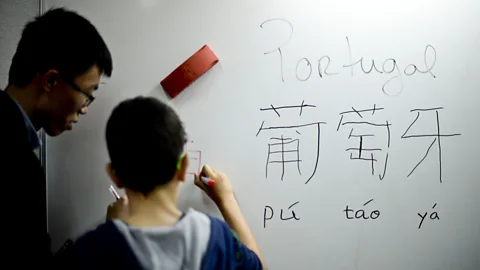
So, with all this choice, what's actually the best, science-backed way to learn a language? To find out, I teamed up with two researchers at Lancaster University's Language Learning Lab: Patrick Rebuschat, a professor of linguistics and cognitive science, and Padraic Monaghan, a professor of cognition in the department of psychology. They let me try out an experiment they designed to mirror language-learning in the real world, and reveal how our brain picks up and makes sense of new words and sounds. The tasks basically simulate how we would cope if we were dropped into a foreign country with an unknown language, and just had to use our innate skills to figure out the new, mysterious sounds around us, and start to make sense of them.
Having not learnt a language in two decades, I was about to learn some Mandarin and Portuguese. Over six days I would be spending just 30 minutes per day on the tasks and tests. I was to complete them, not ask any questions and wait until the end of the experiment for feedback.
Getty Images
Experiments to mirror language-learning in the real world can have surprisingly quick results (Credit: Getty Images)
Monaghan explains that such experimental studies are used to establish how people begin to get a foothold in a language.
I was intentionally not told from the outset what the tasks were about. But the researchers later explained that they were designed to activate my brain's cross-situational learning (CSL) skills: that's our natural, instinctive ability to use statistics to gradually work out the meanings of words and basic grammar. You can learn more about statistical learning in language acquisition here, but it is essentially our brain's inherent ability to recognise patterns and regularities in speech (such as which words pair well with each other) based on the frequency of their use.
"People can learn very, very fast simply by keeping track of the statistics in the environment," says Rebuschat. "This type of task is designed to mimic real-world learning under immersion settings, where things are often ambiguous and we rarely receive immediate feedback."
Ahead of starting the experiment, I assumed that with my prior knowledge of French and basic Spanish, Portuguese would come naturally. Mandarin on the other hand was for me as foreign as a foreign language gets.
I'd also predicted that as I had done with most of my other languages, lesson one would comprise of basic greetings. Far from it.
"If you were dropped into Portugal, Brazil, or another Portuguese-speaking country, the language you encounter would not unfold in a tidy pedagogical sequence starting with greetings," explains Rebuschat. "Instead, you would hear a wide range of language in context: people ordering food in cafés, conversations on the street, a football commentary in the background."

Getty Images
Our brain makes sense of foreign languages we've never heard before by detecting patterns, such as recurring sounds (Credit: Getty Images)
Thus, my exercise with Portuguese was to choose whether the word or sentence I was hearing matched one of two scenes, both featuring animated animals. This continued on repeat across three days, an example of statistical learning in action, says Rebuschat. "It is a basic learning ability that humans use from infancy – before infants know any language at all – to pick up patterns in the world around them. We use it to learn regularities in sounds, images, and events over time."
I was quick to lean on my prior language knowledge. I know for example in Hindi saap means snake, and upon hearing the word sapo and seeing a frog on the screen, I matched the word to the image.
Soon after, I figured out that each noun appeared in both singular and plural forms performing one of four physical actions like pushing or pulling. The grammar was somewhat trickier but not unfamiliar from the French I had studied.
By day three of Portuguese, results showed my accuracy sat consistently between 90–100%, which I was told was higher than the typical English-speaking learner (presumably, because I was able to use those insights from my other languages). My brain was extracting meaning based on the frequency upon which the same nouns and verbs were appearing on screen.

Getty Images
Our brain makes sense of foreign languages we've never heard before by detecting patterns, such as recurring sounds (Credit: Getty Images)
My Mandarin learning journey started out somewhat differently.
As with Portuguese, I completed four short tasks and tests each day, but this time I was matching 12 incomprehensible sounds to images of 12 never-seen-before objects. As I later learnt, these weren't real objects or real words. What I was saying out loud were in fact Mandarin tones, which are a core feature of the language as a different tone can change the meaning of a word.
Each made-up word was assigned to a specific object. Using artificial words, known as pseudowords, allows researchers to compare results and improvements fairly because students can't draw on prior knowledge.
At times, repeating the same tones made me comatose and admittedly, I came to my answers with zero scientific reasoning. Lu-fah for example sounded like a loofah which I matched with an object that had soft spikes!
Linguistics students who are native speakers of Mandarin at Lancaster University looked at how I did. By the end of my first session matching the pseudoword to the right made-up object I had reached 75% accuracy, rising to 80% in sessions two and three.
Getty Images
True fluency in a language requires dedicated practise and exposure for years (Credit: Getty Images)
My production test results (where I was asked to say the tone out aloud) were not as impressive, ranging from 38% rising to 55% by the third day, although I was reassured by Rebuschat that my scores were far above chance.
More like this:
• The language that doesn't use 'no'
• Why we can dream in more than one language
• How toddlers in Finland are saving an endangered Sámi language
Both Rebuschat and Monaghan concluded that I am in good possession of the building blocks needed to pick up languages well. These include having a good ear and being able to pick up subtle differences such as pronunciation, intonation and rhythm. My previous language-learning experience also helped me to recognise recurring patterns and features.
"A third factor, likely just as important as language-learning experience, is memory capacity," Rebuschat tells me. "Unlike the Mandarin study, which used isolated pseudowords, the Portuguese CSL task required you to process and hold entire sentences in mind (determiners, nouns, verbs, number marking) while comparing them to two animated scenes. This places a substantial load on temporary storage, sequencing, and retrieval."
Considering my decent report, would I be on course to learn at least one of these languages to a good standard in a matter of days?
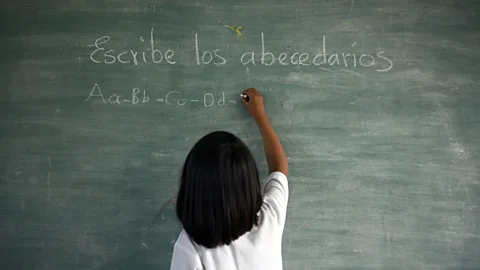
"Achieving fluency in the real world requires sustained exposure, interaction, feedback, and social use over many months or years," says Rebuschat.
He also points me in the direction of the US Defense Language Institute's Foreign Language Center, which provides some of the most intensive language training available. From Persian to Japanese, even with up to seven hours of learning per day plus homework, it takes around 64 weeks to reach basic professional proficiency.
In order to take my learning to the next level, the experts also make the case for traditional human instruction, something that is under threat at many schools and universities.
Rather than seeing new technologies as a threat to human teachers, Rebuschat considers them as complimentary, offering students additional practice and feedback, and widened access.
How else but through human interaction would I know that when my elders say 'don't drink my blood' in Gujarati, they are asking me not to annoy them?
Monaghan also points out that learning to speak is one thing, but understanding what is said back to you is quite another.
"An interesting feature of language is that 70% of [a given] language is composed of just a few hundred words," says Monaghan. "But what isn't possible quickly is being able to understand what people say back to you, because they'll be using those other, rarer words now and then."
How else but through human-to-human interaction for example would I know that in Gujarati when my elders say "maru loi na pee" ("don't drink my blood") they are actually asking me not to annoy them? Or understand the practical phrase "ça a été" in French, which translates "as it has been", but in conversation is one of the most versatile ways of expressing something was well?
Monaghan stresses that such intricacies throw into question some of the big promises made by new language learning technologies.
"It's not going to replace that really high-level study of a language," he says. "Being able to speak English and being able to read books in English doesn't end studying English literature at university." His words bring this nostalgic linguist some comfort. Whilst the dictionary may have gone, the yellowing copies of works by Jean-Paul Satre, Frantz Fanon and Aimé Césaire still have a safe space on my bookshelf for now.