Feels to me like it’s similar to dumping a binary with an image, the format being entirely custom.
And/or trying to decode a language or cipher, trying to recognize patterns.
https://gist.github.com/alexspurling/598366d5a5cf5565043b8cd...
Knowing the input text was two words separated by a space, I was able to use hashcat and the unix wordlist (/usr/share/dict/words) to find the solution almost immediately. It's a shame that Alex didn't find it this way on his first attempt as the two words are fairly common.
I don’t think I’m close to making progress on stuff like this. Interesting to note. Glad they wrote out this behind the scenes thing.
> Alex had actually tried to brute force the hash earlier, but had downloaded a list of the top 10,000 most popular words to do it, which turned out not to be big enough to find it. Once he had a big enough word list, he got the answer.
They don't reveal the answer.
> After looking at the final two layers I was somewhat quick to intuit that this was some sort of password check, but wasn’t entirely sure where to go from there. I tried to reverse it, but it was proving to be difficult, and the model was far too deep. I started evaluating the structure and saw the 64 repeated sections of 84 layers that each process 4 characters at a time. Eventually I saw the addition and XOR operations, and the constants that were loaded in every cycle, and the shift amounts that differed between these otherwise identical sections.
> I thought it was an elaborate CTF cryptography challenge, where the algorithm was purposely weak and I had to figure out how to exploit it. But I repeatedly was getting very stuck in my reverse-engineering efforts. After reconsidering the structure and the format of the ‘header' I decided to take another look at existing algorithms...
Basically it took a lot of trial and error, and a lot of clever ways to look at and find patterns in the layers. Now that Jane Street has posted this dissection and 'ended' this contest I might post my notebooks and do a fuller post on it.
The trickiest part, to me, is that for about 5 of the days was spent trying to reverse-engineer the algorithm... but they did in fact use a irreversible hash function, so all that time was in vain. Basically my condensed 'solution' was to explore it enough to be able to explain it to ChatGPT, then confirm that it was the algorithm that ChatGPT suggested (hashing known works and seeing if the output matched) and then running brute force on the hash function, which was ~1000x faster to compute than the model.
Can you imagine human potential if it was somehow applied to crop harvesting efficiency, new medicines, etc?
Not everything has to be perfectly efficient but it just saddens me to see all these great minds doing what, adversarially harvesting margin from the works of others?
I have strong math for the question they’re asking but f them.
We already have very efficient crop harvesting and Eli Lilly is nearly a $1 Trillion dollar company. Interestingly, the new medicine is designed to keep us from eating so many cheap calories (new weight loss drugs).
> Not everything has to be perfectly efficient but it just saddens me to see all these great minds doing what, adversarially harvesting margin from the works of others?
The traders and investors who work in this space also go to where they are need, aka where the big money is. So few of these folks are trading corn and soybeans, though some do, rather most are trading drug stocks, tech stocks, and recently sovereign debt related trading (e.g. things like gold and bonds). The focus is around the big questions of our time, like "Are AI investments going to pay off?", or "Is the US going to default/soft default?", and so on.
Deciding how a society allocates its resources, or places its bets, is an important function. Otherwise, you end up with planned economies by disconnected leaders, which often leads to massive failures and large social consequences. Unfortunately, the US is trending in that direction to some degree with it's giant fiscal deficits, tariffs, and tribal politics creeping into economic policy. Nevertheless, traders will weigh these outcomes in their trades, and you'll see a quick reflection from any major change in policy almost immediately, which is a helpful feedback mechanism. For example, the tariff tantrums caused by trump proposing 100%+ china tariffs where he crashed the markets last spring, leading to a moderation in policy.
No doubt many of us agree with you, but this is not the kind of comment that should be stuck at the top of a thread, choking out more specific and interesting conversation.
Generic-indignant comments always get heavily upvoted, which is a failure mode of the upvoting system (and perhaps the human brain, who knows).
https://huggingface.co/spaces/jane-street/puzzle
It's not "hot dog". I wrote in another comment how I found the solution but to give you a clue it is AI related.
"Eschew flamebait. Avoid generic tangents."
"Please don't post shallow dismissals, especially of other people's work. A good critical comment teaches us something."
"Have curious conversation; don't cross-examine."
If these sectors offered competitive salaries - sure, talent would flock to them. As a former chemist, I struggled to find a job that didn't pay scraps, no matter the industry - from big pharma to advanced materials. Eventually, I just gave up and went into the IT, which is 3x-10x better paid (at the very least).
But don’t fool yourself, they don’t make their money with intelligence.
They just do fees and insider trading.
[1] https://www.reuters.com/sustainability/boards-policy-regulat...
[2] https://www.bloomberg.com/news/articles/2026-02-24/jane-stre...
If you want to solve meaningful problems you need a different kind of intelligence; you need to be open to risk, have a lot of naivety, not status orientated, and a rare ability to see the forest among the trees (i.e. an interesting problem isn't necessarily a important one).
What they could achieve in spending their attention on real problem would be massive.
Which begs the question: what would actually be a good field to apply human potential towards? I agree that finance, sales and ads are very low on that list.
For some crops we have. But it would be nice to have more diversity, so that the cheapest food options wouldn't be just wheat and corn because they happen to be the crops that are most amenable to mechanized agriculture.
https://x.com/1914ad/status/2026757796390449382
Haven't read it yet but seems spicey
And then there are the guys managing things like pensions, skimming a percentage every year, just because they happen to be locked into that position, meanwhile underperforming a basket of index funds. Just happily eating away at the retirement savings of thousands-millions.
> For example, the tariff tantrums caused by trump proposing 100%+ china tariffs where he crashed the markets last spring, leading to a moderation in policy.
"Akshually traders are good bcuz they crash the market when the president does insane things" is not the own you think it is.
Sometimes that's getting information a few seconds faster, sometimes a data source no one else has exploited, but more often than not its something that feels a bit more "unfair".
It’s also missing that advancements in one field, particularly computer science, computation, and AI creates significant infrastructure that can be applied to those tasks in never before seen ways.
And finally, physical problems evolve much more slowly and is more capital intensive and requires a lot more convincing of other people. Digital problems by comparison are more “shut up I’m right, here’s the code that does X”. It’s easier to validate, easier feedback resulting in quicker mastery, etc. Not saying it’s completely bulletproof in that way, but more true than in physical sciences these days. So just throwing more people at the problem may not necessarily yield results without correct funding which historically was provided by the government (hence the huge boom in the 60s) but as the low hanging fruit were picked and government became more dysfunctional, this slowed to a crawl.
For example, personally I probably could have ended up working on fusion research if I had more economic security growing up and it felt like the nuclear industry was booming instead of constantly underdeveloped (both fission and fusion). But instead I’ve worked with computers because I felt like it was a boom segment of the economy (and it has largely been while I’ve worked) and the problems felt interesting (I’ve worked on embedded OSes, mobile OSes, ML, large distributed systems, databases, and now AI) and like there’s always interesting products to build to help improve the world.
Should we view those who chase status as a bad thing, or look to those who assign status that is then chased? If the average person cares more about who won last night's big game than some work done to improve medication, should we really have anything to say about those who decide to optimize their lives by what society actually rewards?
I noticed this way back in grade school. Good grades were, if anything, a net negative prestige, while sports were a positive prestige. It made me wonder what the school was actually optimizing for, because the day to day rewards weren't being given to the studious. (The actual reward function was more complicated, such as good grades being a boost if one was already a sports star, but these were exceptions to the norm.)
While the pharmaceutical industry is large, the marginal researcher does still seem to have a pretty positive impact from an outside view.
The most positive use of human time probably looks something like antiwar advocacy, but I don't really think that most quants have the social skills for that tbh.
IMO, the "smartest people" are really fucking bored and doing nothing meaningful right now. You really think "the smartest" people are people who find working on Google's ad machine enjoyable? That they are programmers or traders?
Since when has "smartest" meant seeking the highest wage? Einstein didn't look for the highest paying job he could get, he took a do-nothing job and worked on what he cared about instead.
Fermi too took jobs that allowed him to pursue his passion, rather than accumulate wealth.
Newton blew a shitload of money on a pump and dump scam and spent all his time on proto-chemistry and calculus.
Bell basically ignored his company after patenting the telephone, giving almost all of his shares of the company to his new wife, who in turn entrusted them to her father, the guy who helped Bell make the company and who was defacto in control of the company. Bell spent a good amount of time studying the new field of Heredity.
The brilliant people involved in the invention of computing as a field during WW2 were doing it because it fascinated them. The military would have been happier with simpler computing machines. Von Neumann distributed a document describing EDVAC that helped nullify patent claims of the inventors.
The internet itself runs nearly entirely on free software and volunteer work!
It's insane that people are so utterly propagandized in the US "Hyper capitalism is best" mindset that even those who think the system doesn't work still implicitly believe that the system works to put the smartest people in the top earning jobs! Why do you believe smart people are primarily motivated by money?
Maybe, just maybe, smart people don't actually align their preferences to a market system at all! Maybe their priorities aren't actually money, or fame, or power.
How does Jane Street skim money from those who hold passive index funds?
> Bitcoin should be at least $150,000 right now and everyone knows it.
Based on what? I'm a fan of Bitcoin, but "should be" is utter nonsense. As is "everyone knows it". HN doesn't, for one.
> Every trading day at 10am Eastern, coinciding with the U.S. stock market open, Bitcoin experienced sudden and sharp sell-offs. The drops were precise, algorithmic, and wildly disproportionate to broader market conditions. They wiped out leveraged long positions, triggered cascading liquidations, and then reversed within hours.
> [...] This happened every day, day after day.
If these swings are so predictable, why isn't everyone else getting wildly rich off them at the expense of Jane Street?
> Selling into thin order books at the open would depress the price, trigger liquidation cascades among leveraged traders, and create buying opportunities at lower levels. The firm could then re-enter at the bottom of a move it had manufactured.
Yea well don't be overlevered on Bitcoin I guess?
> Simultaneously, the firm boosted its holdings of MicroStrategy stock by 473%, accumulating 951,187 shares worth roughly $121 million
> Basically, Jane Street has direct access to the pipe that connects the Bitcoin ETF to actual Bitcoin, and almost nobody else does.
You too can buy and sell MSTR and BTC.
> In either scenario, the firm has every incentive to use its privileged position as authorized participant to suppress the spot price, trigger liquidations, and harvest the spread.
Yea well don't be overlevered on Bitcoin I guess?
> In other words, the 21M cap only works if the market sitting on top of it is honest.
No. Hell no.
> It has been accused of running algorithmic sell programs that suppressed Bitcoin's price for months.
Cheap Bitcoin sponsored by Jane Street. Cry me a river.
If you try to seize or reduce, what you perceive as excess, wasted money supply, that money supply will simply cease to exist.
Most of the people I know do not spend their free time doing research into the satisfaction of society, and do not donate (even what they could!) to great causes. It is not the "market dictates" is "most of people dictate".
And still. I am writing this in an open-source browser, on an open-source operating system. The existence of this tools helps society no matter how you put it. So in fact, if you think of it, there are many people that do not "obey" the market. And this is only one way, there are others.
So maybe rather than "blame the market" be positive and tell us what way did you find to make a difference.
At that point the historical correlations between money and basically everything, which had sustained for centuries - even though the industrial revolution, began completely breaking down, and infinitely began skyrocketing to levels never seen before, in the US at least.
If you buy that (not everyone does) then it follows that an industry can be compensating beyond its social value.
That is, the value of providing market liquidity is not zero. The value of figuring out the optimal next video on YouTube is not zero. But in my opinion there is also social value in making sure poor kids can read.
compound interest is a rare exponential force, and it is available to most citizens of a developed country through the stock market
financial futures remain important for farmers to have predictable pricing, and increase crop yields
science is limited by funding at least as much as it is limited by ideas or intelligence
I understand why finance is a popular bogeyman, but the world is rarely black and white
The biochem industry is extremely bad at creating things that increase the satisfaction and well-being of society; the vast majority of products are failures with few users. The reason tech companies make money is because they make things people actually want to use.
I have good news and bad news for you. Good news: we've known the solution to that for more than a century, which is to reduce livestock consumption, a cause which many smart people have dedicated their lives pushing vegetarian/vegan culture and producing alternatives. Bad news: from my point of view, the masses are not going to give up meat and eggs faster with each additional alternative meat.
there is a ton of things that are there simply because at some point people made money out of it, and then lobbied politicians to death to avoid regulation.
Of course the suspicion towards this is eternal. People always hated the traders as opposed to the farmers. But trade is crucial. And it relies on estimating what value things have and rewards correcting over the incorrect beliefs of uninformed people. This kind of information based knowledge work was always disliked by most people as it seems lazy. And for sure there are zero sum and rent seeking aspects or insider trading etc. But it's not so simple as to say that all investment and finance jobs are negative and working on farm efficiency is always better.
Just look at what happened when AI took off in the US and our ongoing struggle to get global warming under control - only China is taking a serious stab at this which is why they’re absorbing AI more effectively than we are.
Also semiconductor manufacturing has clearly gotten way too concentrated and there’s not enough experimentation with new designs (eg throwing more at existing DRAM designs instead of building new designs like in-RAM compute to shift the power and performance by an order of magnitude or 2 thereby easing the pressure of how much is built).
Who would've guessed - a dip in price means more sellers than buyers :mindblown:
I didn’t say anything about excess money supply, though, were you responding to a different comment?
This endless money-spinning & the larger monetary system is a big scam to steal from actual productive work. How is it fair to normal people that the whole system is rigged such that if they DON'T indulge in all this gambling (ignore the fact that most retail traders are on the sucker-end of the trade), they lose whatever wealth they've stored to inflation ?
Wages simply go to the industries that make the most money. There’s nothing more insightful than that.
I think the comment is about the marginal utility of additional workers at Jane St over, perhaps, DE Shaw Research. The caliber and education of roughly the same kind of person might be applied to understanding drug mechanisms, or shaving off trading milliseconds.
Is the marginal benefit to the world greater if someone is advancing financial engineering? I don't think it's obvious that our increased complexity is, itself, yielding further increases in 'allowing more ideas and companies to be funded' except in the sense where already-wealthy people gain more discretionary income which they may decide to spend on their pet projects. Futures have existed for much longer than derivative markets; are we helping farmers more when we allow futures to be traded more quickly?
But I disagree that the limit is funding—it's simply a lack of concerted interest. We accept that we should spend tax money on rewarding certain financial activities, and we create a system that disproportionately rewards people who facilitate these activities. But we might restructure things so people are incentivized to do research instead of financial engineering.
I think the fundamental idea is that things of value need to be extracted or manufactured at some point and we're not set up to reward people studying new extractive tools or new manufacturing processes when those people could instead work on finance products.
I'd argue the "satisfaction" of society has been hijacked. We cannot even, as a society, understand the impact on medicine, nutrition, agriculture and the well-being we could harness from focusing on the long term, rather than seeking dopamine hits through screens.
I blame Moloch. https://www.slatestarcodexabridged.com/Meditations-On-Moloch
For example, the US government is pretty interested in having really good weapons. So the market responds by developing weapons for the government.
> each additional alternative meat
As a side note, for many vegetarians and vegans, “alternative meats” actually mean hundreds of different legumes (fresh, dried, milled, split, fermented…) and other delicious plant foods. They’re packed with macro and micronutrients that can replace[0] those found in meat.
Taste is a bit trickier: nothing will ever taste more like flesh than… flesh — and taste is subjective anyway. Meat substitutes can be tasty, but they’re not the same. Which brings me to this:
the masses are not going to give up meat and eggs
That’s true. At first, giving up meat just to eat “fake meat” can feel like a downgrade. But the real key to change is curiosity. There are so many ingredients and recipes to explore. Classic egg-and-milk pancakes are great — but why eat the same thing all the time when there are so many combinations of plant milks and oils to try? I used to love pig and chicken. Now my favorite staples are fried tempeh and lentils with nutritional yeast.
0: I like to joke that meat replace beans, you get the idea. Fun fact: meat is viande in French, from latin vivenda which mean "which sustains life" and used to describe any edible. I think english meat have a similar etymology from mete.
But as you pointed out, this is not the actual issue. Getting food to people who need it is almost entirely a political and logistical issue at this point. War (especially civil war), natural disaster, with local power stealing international aid, etc, are mostly the biggest responsible for hunger in the 21' century. We have the technology and logistics to accurately drop-ship huge amount of food in even the most remote places in the world, even when the local infrastructure is heavily damaged or inexistent. We cannot deal with local power decision to voluntarily starve a place.
From this outsider's point of view it's failed to have a positive impact; people nowadays are far less healthy and happy than they were half a century ago when the pharmaceutical industry barely existed.
Did they lie about the financial health of the securities they traded?
If we want local, small, or niche businesses to exist.
>do we need instant financial trades and people optimizing instant transactions?
If we want people to easily get a fair price when they want to buy or sell something.
A lot of “capture-the-flag” style ML puzzles give you a black box neural net, and your job is to figure out what it does. When we were thinking of creating our own ML puzzle early last year, we wanted to do something a little different. We thought it’d be neat to give users a complete specification of the neural net, weights and all. They would then be forced to use the tools of mechanistic interpretability to reverse engineer the network—which is a situation we sometimes find ourselves facing in our own research, when trying to interpret features of complex models.
We published the puzzle last February. At the time, we weren’t even sure it was solvable. The neural network we’d designed would output 0 for almost all inputs. A reasonable solver might assume that the goal was to furnish an input that produced 1 or some other nonzero value. But we’d engineered the network in such a way, as you’ll soon see, that you couldn’t use traditional methods to brute force your way to an answer—say, by backpropagating a nonzero output all the way back to the input layer. You had to actually think about what the net was doing.
We were amazed by the response the puzzle got. Mostly by luck, it seemed like we’d calibrated the difficulty just so: it wasn’t so hard that no one could solve it, and wasn’t so easy that we were flooded with responses. In fact if you can solve this puzzle, there’s a decent chance you’d fit in well here at Jane Street.
We’ll restate the problem below, but be warned that the rest of this post contains huge spoilers. If you want to try solving the puzzle yourself, avert your eyes. The rest of this post will walk through the process that an actual solver took, with all the twists and turns before they finally cracked it.
Today I went on a hike and found a pile of tensors hidden underneath a neolithic burial mound! I sent it over to the local neural plumber, and they managed to cobble together this.
Anyway, I’m not sure what it does yet, but it must have been important to this past civilization. Maybe start by looking at the last two layers.
Model Input
vegetable dogModel Output
0If you do figure it out, please let us know.
That model.pt file is basically just a pickled PyTorch model.
A senior at university named Alex was in his dorm room when a roommate told him about a puzzle that was making the rounds on Twitter. The roommate had tried it himself but given up after two nights. Alex, in his final winter at school, was looking for something to do and decided to have a look.
He started by downloading the model and poking around, focusing on the last layer in particular:
import torch
import plotly.express as px
model = torch.load('./model.pt')
linears = [x for x in model if isinstance(x, torch.nn.Linear)]
px.imshow(linears[-1].weight.detach())
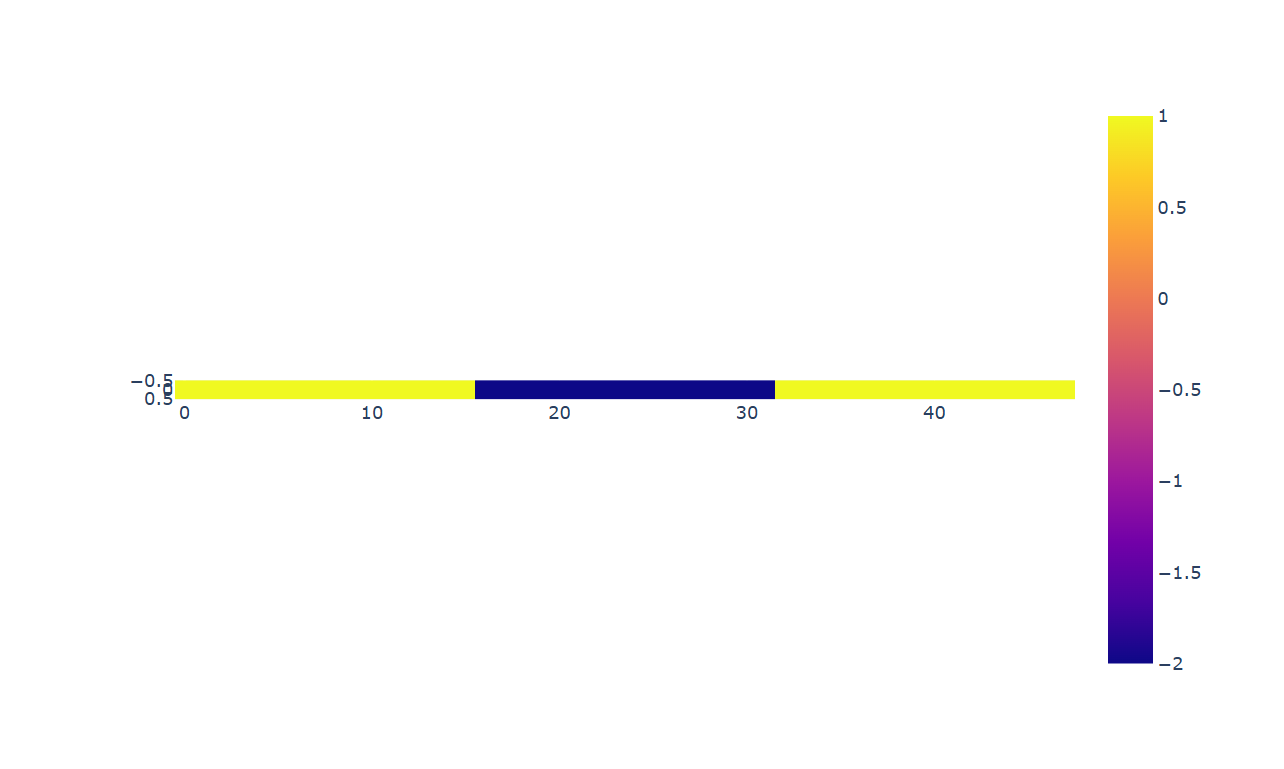
Immediately it was plain that this was not an ordinary neural network. It clearly hadn’t been trained: all the weights had integer values. Instead, it had been designed by hand, probably to carry out some very specific computation.
The last layer was a 48x1 matrix, but apparently broken into three sections. And indeed if you looked at the activations from the previous layer, they were always three repetitions of the same thing. The second-to-last layer appeared to be three repetitions of the same weights, while its bias contained the same 16 bytes, but incremented by 1 each time, as if encoding a vector v, then v + 1, and v + 2. Here’s what the weights on that second-to-last layer looked like:
px.imshow(linears[-1].weight.detach())
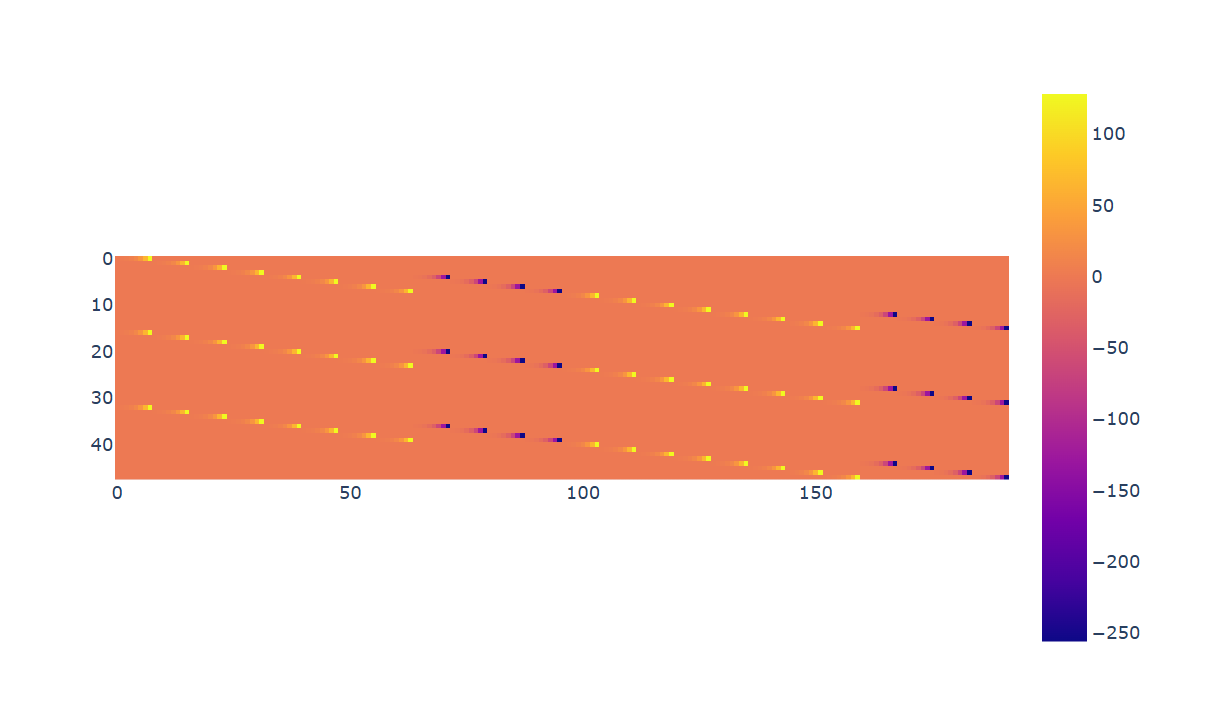
and the biases:
px.imshow(linears[-2].bias.detach().unsqueeze(0))
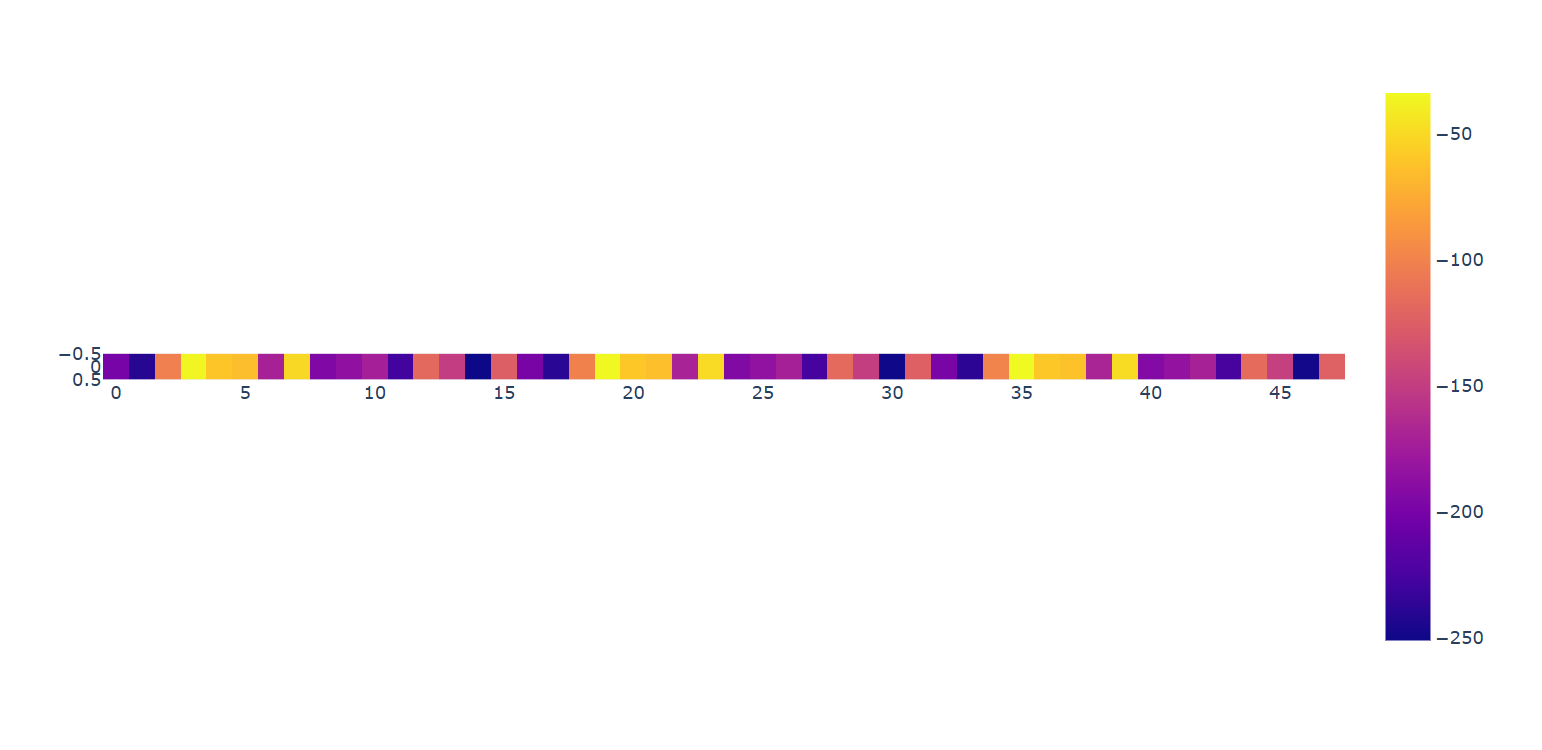
Thinking about it some—and about the fact that the last layer emitted a single bit—Alex realized that this second-to-last ReLU layer must be computing whether two 16-byte integers were equal to one another (with one byte per neuron). The way it seemed to work is that it made three copies of the input vector v, a 16-byte number. It tried to check that against a reference number x (which was determined by the bias of the second-to-last layer). So the three copies would actually represent v - x - 1, v - x, and v - x + 1. The last layer applied weights 1, -2, and 1 to these cases respectively. We can do some casework on an individual value here: consider the value of ReLU(v-x-1) - 2ReLU(v-x) + ReLU(v-x+1). If v=x, then this is equal to 1. We won’t show the rest of the cases here, but they all result in 0. The bias on the last layer was -15, so the final neuron would only fire when v=x for all 16 bytes.
So now the question became, how do we get the activations of the second last layer to equal x?
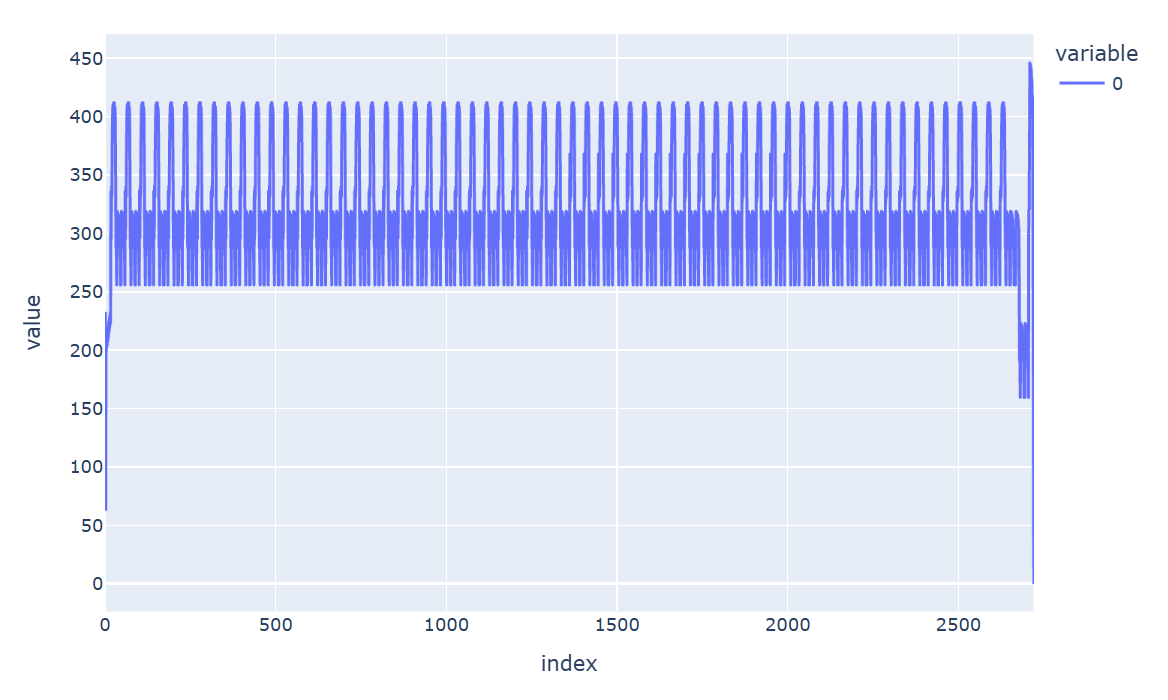
Alex figured that if there’s some number that the network is checking against at the very end, then the rest of the network must be some sort of big equation. There indeed appears to be a lot of structure in the network, as you can see just from plotting the size of the 2500 linear layers (about half the full network):
px.line([l.out_features for l in linears])
So Alex began looking at various sub-networks, tracing their dependencies. This involved staring at a lot of graph structures:
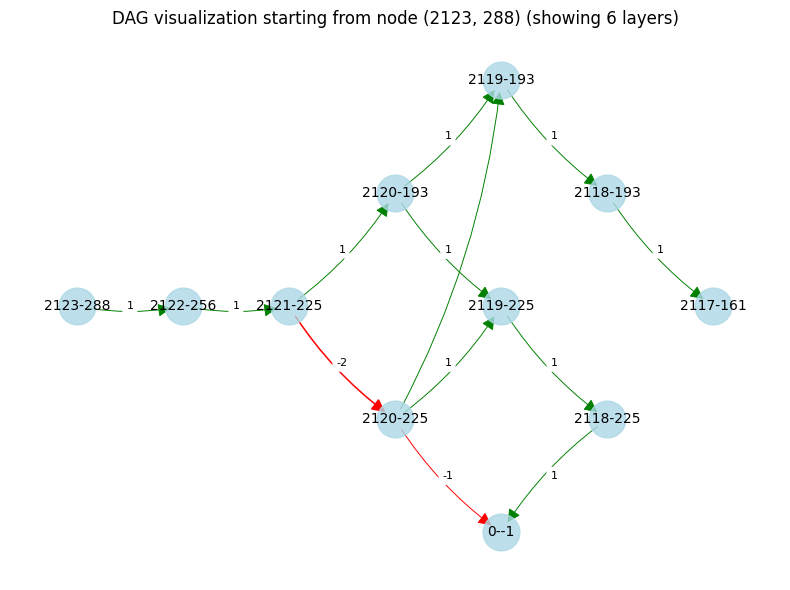
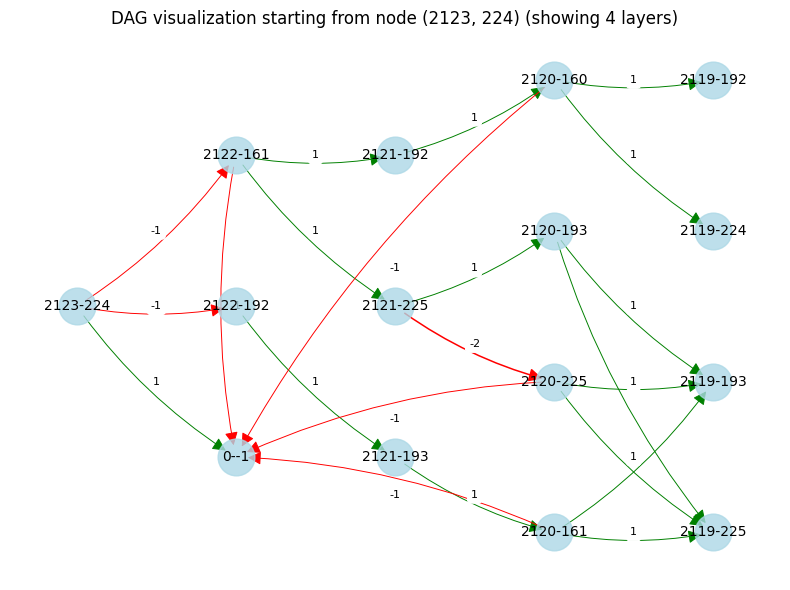
But after hours of searching for legible sub-circuits, he came up short. For the moment there just seemed to be too much complexity to trace by hand. So he had a new idea: what if I treat this thing as a linear program and just solve it?
This is, of course, not possible with so many ReLU layers—ReLUs aren’t linear—but they can be modelled by adding an additional integer value, corresponding to the statement “this activation is negative.” You can thereby treat it as an integer linear program and use a constraint solver capable of integer programming. So that’s what Alex did: he dutifully wrote some code to convert the layers of the neural network into a giant linear program and let it run.
And let it run.
That seemed to be going nowhere—so Alex now attempted to reduce the number of variables in the program. Perhaps there were some reductions you could do? Alex found that if you looked at a bunch of layers, they mostly looked like identity matrices. In fact in 1500 or so layers, 80% of the nodes were just performing an identity operation.
Alex treated each neuron in the network as a node in a DAG, where each node goes into the nodes in the next layer with some weights; but if you ever have a node with in-degree 1 and whose weight is exactly 1, you can combine those two nodes. (You know this is safe to do because the network has integer values everywhere: all the inputs are integers, as are all the weights.)
There were slightly fancier reductions. For instance, if you have a node whose every incoming edge has positive weight, then the fact that you’re doing ReLU doesn’t matter, because it’s never going to hit the negative clamp—and so you can forward its in-edges to its children, directly passing them to the next layer. Also, if two neurons in a layer have exactly the same input vector, you can combine them, and redirect their descendents to the new merged neuron. And you can repeat this process many times.
Alex by now had poured hours into this analysis. He’d found circuits that appeared to be repeated across many layers. He’d print out different equivalence classes of nodes, looking at the sequence of weights that each node had as input, discovering that there were only a few kinds of nodes. For instance there was one class of nodes which effectively would forward a value from two layers back. Collapsing these, among other similar reductions, brought down the size of the linear program from something like 2 million nodes, to 75,000.
But after all that, Alex ran the solver again and again it churned without terminating.
A new idea: what if you propagated bounds through the network? Just by reasoning through one layer at a time, you could figure out the maximum value that any given node could achieve; you’d do this simply by looking at the bounds on its inputs. It turns out that with fairly conservative assumptions, many nodes end up with very tight bounds, e.g. from 0-1. Maybe this was enough to make the program tractable?
At this point Alex switched from a linear program to a SAT solver, since the total number of values had gotten so much smaller. In the SAT version, you had a boolean variable for each node equalling each value in its range. All told this resulted in 200,000 variables after all the reductions. After a day of running, the SAT solver reduced the program to 20,000 variables. From there it didn’t seem to reduce further.
In effect Alex had discovered that inside this neural network there was a core program, irreducibly complex, that—much to his disappointment—was still too large to brute force. So after many days, he had to take a step back, effectively having gotten nowhere.
He thought meta: this has to be a solvable puzzle, right? How would someone build a puzzle like this that would be interesting to solve? If you generated random weights, a SAT solver would probably be able to solve it by brute force. This network was created by a human. At its core there seemed to be a function that you couldn’t just use search or optimization to recover. It was an irreversible function. What were some go-to examples of irreversible functions?
Alex asked ChatGPT for some common hash functions, and compared them against some basic plots of the layer widths, which looked periodic. In fact there were 32 periods of length 48, repeating exactly each time. Maybe the network was doing 32 blocks of the same computation? To ChatGPT again: are there any common hash functions that use 32 blocks of computation? Bingo. It turned out that roughly all of them do.
To determine which one was in play here, he explored by hand: he’d input some string into the network, compute various hash flavors with separate programs, then look at the second-to-last layer. It turned out that md5 lined up and the other common hash functions didn’t.
This was nice, because he already knew what the hash was supposed to be by looking at the second-to-last layer’s biases. So the problem reduced to finding an input string that produced that particular md5 hash. But it was not obvious how to solve that—especially since he didn’t have a real proof that this network always produces an md5 hash. Maybe the solution was to dig deeper, and hack the network to make it reversible?
Alex noticed something odd in the network. It seemed to have a bug: if your input was greater than length 32, it no longer produced the correct md5 hash. Perhaps somewhere in that bug was a key to reversing the hash value that was built into the network?
He spent the next two days reverse-engineering the bug. To start, he got Gemini to write an implementation of the md5 hashing function. Then he matched up every neuron in the network to the corresponding variable in the md5 algorithm. He wrote some code that would store the sequence of values for a given intermediate variable, then search each of the 32 blocks in the network for that value; this would pick out which ranges of neurons corresponded to the bits for each variable. It turned out that some ranges of bits exactly corresponded to the variables, and others were intermediate computation values.
Then, with inputs that were >32, he could painstakingly trace through the blocks to find the exact spot where the network diverged from the correct algorithm.
The crux of it was in the first 7 layers—there was a circuit that would compute the length of the input, and attempt to store it in 4 bytes, in little-endian order. But when the length was 256 bits or greater, you’d have a length variable that contained the value 256, instead of the correct encoding. That is, if the length were >384 bits, the length bytes should be 128 1 0 0, but what the network encoded instead was 384 0 0 0.
Then the question was, is it possible to exploit this bug, by crafting a message of length 256 or greater? Some more painstaking tracing revealed a few observations: First, there aren’t that many possible lengths. There were only 55 inputs, so he could do an exhaustive search to see how the network behaved with respect to these weird values. Second, the broken length value was converted to binary, and then propagated through every layer in the entire network. In binary, all of the bits would equal 1, and the rest of the number was concentrated in the lowest-order bit, so 384 would be encoded as 130,1,1,1,1,1,1,1. Third, the invalid bytes from the length of the message were only used in a few blocks of the md5 computation, which always reads bytes from the input in the same order.
Using these observations, it’s possible to write down a modified version of the md5 algorithm, which corrects itself at the necessary blocks to be in line with the neural network. Looking closely at this, however, it still seems very difficult to reverse in general.
This took about two days to figure out, but—disappointment again—didn’t lead Alex any closer to the solution. He wrote to the email address provided on the puzzle with what he’d discovered so far. What he heard back surprised him. The bug was not intentional. With that in mind, why don’t you try to solve it one last time?
It turned out that once you knew the hash encoded in the bias of the second-to-last layer, you were done. Figuring that out was the meat of the puzzle. The puzzle creator had intentionally made the hash easy to brute force, leaving various small hints in the puzzle description and Python code that the solution was composed of two English words, lowercased, concatenated by a space.
Alex had actually tried to brute force the hash earlier, but had downloaded a list of the top 10,000 most popular words to do it, which turned out not to be big enough to find it. Once he had a big enough word list, he got the answer.
One of the things that made this puzzle challenging was designing a network of the right complexity. Using logic gates means the network won’t be differentiable; but if you make the program encoded by those gates too complex, there’d be little hope of reverse engineering it. Md5 felt like a good compromise, though it was by no means trivial. Because md5 uses modular addition, creating the puzzle required implementing a parallel carry adder in 20ish layers of a neural network. Not easy! We were impressed that some solvers managed to figure that out—and Alex’s discovery of the >32 bug was unexpected and quite extraordinary.
The experience of creating and releasing the puzzle, and engaging with the folks who solved it, went well enough that we’ve done it again. Here you’ll find the latest. In this new puzzle, a neural network whose layers have been jumbled up needs to be put back in the right order… Can you help?
If this kind of thing is interesting to you, consider applying. You’ll join a close-knit group of brilliant, supportive colleagues, harnessing tens of thousands of GPUs, petabytes of training data, and the agility and resources to invest in the best ideas.
Ricson has worked on the Jane Street research desk since 2020. In this spare time, he enjoys astrophotography and language modeling.
In this case they buy slowly to avoid artificially propping up the price, then sell all at once to artificially drop the price, only momentarily. They don’t have to cause the entire price drop through selling everything they acquired, they just have to move the price down enough to trigger stop loss orders that they know about.
With this strategy they can accumulate assets while also taking profits on the shorts. It’s the retail investors who put in market orders or stop loss orders that get taken for a ride.
In their role as market maker they have all the information needed to minimize the risk of this strategy.
the point again is that nobody says that certain mechanism of the market can have positive effects. the point is that way overestimated. we have extremely complex procedures that cost insanely amounts of money for stuff like ads. we could have a fraction of that power and people would still know about the products they need, etc.
The second person was essentially unpacking the phrase "the market" to reveal who it actually represents. Here are the top 3 interpretations of their point:
1. The market isn't a neutral arbiter — it's a voting system where money is the vote. When we say "the market decides," we're really saying that people with more money have more say. A billionaire's preference for a luxury yacht counts for vastly more than a poor person's need for affordable housing. So "market outcomes" aren't some objective measure of what society wants — they reflect what wealthy people want.
2. The first person's critique is correct, but misdirected. By saying "the market" is indifferent to people's well-being, the first commenter was almost treating the market like an external, autonomous force. The second person is saying: it's not some mysterious system — it's just rich people's preferences given structural power. The problem isn't the abstraction called "the market"; the problem is inequality in who gets to participate meaningfully in it.
3. The language of "the market" obscures a political reality. Calling something a "market outcome" makes it sound natural, inevitable, and impersonal. But framing it as "rich people's preferences dominate resource allocation" makes it sound like what it actually is — a political and social choice about whose interests get prioritized. The second person is essentially calling out the ideological function of the word "market" as a way to launder what is really a power structure.
The three interpretations overlap, but they emphasize different things: the mechanics of how markets work, the validity of the first person's critique, and the rhetorical/political role of market language respectively.
This is outside my domain, and I don’t know the details, but in many cases Jane street functions as a market maker, market makers have access to information they can exploit to skim from anyone that trades through them, especially retail investors who place market orders.
Pump and dump is a strategy that whales can use to bully smaller traders, not unlike how in poker the smaller your stack is in relation to the minimum bet, the easier it is for someone with a big stack to squeeze you out. This is possible for whales even when they don’t have access to the information that market makers have, and it’s not allowed on many regulated exchanges.
It’s like the reverse of the GameStop short squeeze, except instead of retail investors ganging up, propping up the price to liquidate institutional short positions, it’s an institution using its fat stacks to cause little crashes which they have opened short positions to exploit.
One arm of the firm creates a waves in the price, and the other arm rides the wave.
Please correct me if I’m wrong.
So yes it is textbook insider trading if you are placing options just before you move the whale.
The average per capita is closer to 2,600 kcal/day. Not sure how that breaks down when normalized by the individual country population. It also doesn't include waste. In the US at least, waste is near 40%.
You are, about pretty much all of this.
Being a market maker doesn't provide any special information. I'm guessing someone misunderstood something like Level II quotes (https://www.investopedia.com/articles/trading/06/level2quote...) as being information that hedge funds / investment banks / pros have that retail traders don't... but it's just semi-public information that anyone can pay for access to.
Jane Street also isn't doing pump and dumps, they're not in crypto discord channels hyping some coin or running bot farms of twitter accounts to talk up some stock.
They run several different types of trading that might interact with other people attempting pump & dumps though, which could impact in either direction- plausibly they might do a momentum trade that follows the direction of movement or they might recognize a price discrepancy happening and trade against it.
More accurately, they have complex models pulling in many, many signals to inform trading, and I'm being a bit reductionist to categorize it as these two things.
For decades before that policy, a policy even the Bank of Canada holds, inflation was crazy high. The 80s saw inflation, in Canada, briefly hit over 20%, and double digit inflation was a regular thing.
Everyone decided 2% would be a good rate to aim for, that more control was better, to prevent inflation from flying out of control.
Then some dude comes along and tries to spin it like it's a conspiracy to hurt people.
Please, read a little history. Please.
Ad blockers are not products of tech companies but enthusiasts, as I understand it.
But we cannot just dispute this basic economic model and thinking that 0 or negative inflation (which would cause the stop of investment), or no consensus(that would just cause more chaos) is better. That's just absurd
For example, this comment https://news.ycombinator.com/item?id=47181837 is wrong; even if you had large amount of people acting like that person does, you would still likely have a system that doesn't work in the interest of society.