(246 comments)
Otherwise it can be a dangerous fool's errand on which many projects go to die. My younger naive self can attest to this, he loved trying to build his own overly-ambitious engines. But he never finished any games.
Another thought if you do roll your own - keep it simple stupid. When your brain tells you that some amazing nested scene graph with integrated occlusion culling would be the coolest thing in the world, but you lack evidence that you'll actually need all that functionality, tell your brain that it's being stupid and just implement some kind of basic flat scene structure. You can always retrofit it later.
Also - study the code of the likes of Carmack. Consider that he produced the likes of the quake engines in only a couple of years. Reflect long and hard on the raw simplicity of a lot of that code.
Do not worship complexity.
These are the words of someone who has walked both roads!
I was really enjoying reading this piece until I read the above, then I realized I am reading for a big developer, the maker of, Celeste [1]. I am definitely adding this to my list of favorite articles about making games.
Also, you may want to check a previous discussion from nine months ago (573 points, 246 comments ): https://news.ycombinator.com/item?id=44038209
_____________
It's kinda sad SFML never get quoted, It was my framework ( after ALLEGRO ) where i learned c++ and I think it dosen't get much love nowdays even if it is very light and strong
I honestly don't see anything wrong with using the engine for its UI and "some rendering" kind of sweeps a lot of the complicated 3d light handling under the rug. I think the biggest mistake large engines have made is baking in features as first class citizens instead of those features being part of a standard plugin you could have written yourself from scratch once you reach that stage.
I've contemplated building my own editor UI, but after four weeks I realized that I'm just rebuilding the same UI structure you see in FreeCAD, Blender, Isaac Sim, Godot, etc. There's always a 3D viewport, there's a scene tree and there is an inspector panel for looking at the properties. So why not just use the Godot editor as a UI and provide my own custom nodes? By the time I've outgrown the training wheels, I've spent months working on the actually differentiating features.
Seems like if you're doing this for a hobby or solo/small team then maybe it's reasonable.
For most people where they want to be a game dev but they probably will just work in industry, it seems like learning the major engines to competency cannot be ignored.
Things like the famous fast inverse square root are short, but I would hesitate to describe it as simple.
Ironically one of the things that the Quake engine relies on is clever culling. Like Doom, the level is stored in a pre-computed binary space partition tree so that the engine can uniquely determine from what volume you're in what the set of possibly visible quads is (if my memory is correct, oddly the engine uses quads rather than triangles) AND how to draw them in reverse order using painter's algorithm, because the software renderer doesn't have a z-buffer.
https://www.fabiensanglard.net/quakeSource/quakeSourceRendit...
The BSP partitioning used to take several minutes to run back in the day.
Anyway, the point I was trying to make was that Carmack used a few, clever, high-impact techniques to achieve effects, which were also "imperfect but good enough".
If you're not Carmack, don't over-optimize until you've run a profiler.
they used NeXT workstations to develop it, the programming tools on PCs were too weak for such a project
today it might look simple, but it's easy to say that when you open it in VS Code and have Intellisense, autocomplete, go to definition, ultra fast compilers, tons of RAM, and google for everything
While most of the stuff is one off assets that do not fit together there are also some nice sets by some creators such as Kenney or Emcee Flesher
Also the Liberated Pixel Cup (LPC) stuff is pretty nice.
Mind you I mostly just look for 2D assets.
https://opengameart.org/users/kenney
Godot is more or less built that way. The entire node system is an abstraction over the various “servers” and you can even completely forgo it if you want, providing your own MainLoop implementation (instead of the included SceneTree implementation of MainLoop) and then just use the servers directly.
A lot of the editor features are also implemented as plugins. It’s been very easy turning the Godot editor into a custom editor for my game by writing some simple plugins
Heck, I've seen someone build a visual novel-type game with WinForms. That was actually a sensible choice for the game's presentation and interaction needs.
Of course if you want to become a game dev at a studio then you should be competent with whatever the studio uses (or something comparable so you can pivot to their stack). If you only want to make your hobby project and maybe publish it later it doesn't matter if your engine is Unreal, MonoGame, RPG Maker 2000, or vanilla JS/DOM.
Rust (the top 10 most downloaded game ever on Steam) is built with Unity. However they ended up to write their own netcode anyway. Of course Unity isn't known for the best netcode, but how much an engine helps is often overstated. Genshin even bought Unity's source code to customize it.
I would say that one of the "Miscellaneous Thoughts" at the end of your article answers your question pretty well:
> I need only the best fancy tech to pull off my game idea
Then use Unreal! There's nothing wrong with that, but my projects don't require those kinds of features (and I would argue most of the things I do need can usually be learned fairly quickly).
Also says something about the accumulation of complexity. At that time Carmack (and his team) were able to create a state of the art engine in a few years. Now consider the task today, if you were to create a state of the art engine today it'd take tremendously more work.
> AI tools will allow the best to reach even greater heights, while enabling smaller teams to accomplish more, and bring in some completely new creator demographics.
No need to brag about that.
I could never jell with C++ until I had Cursor hold my hand (especially around the build system), and now I feel like I am developing games with a razor sharp knife that I could never before access. The patterns associated working directly with memory suddenly clicked and now it’s the only I want to build games.
But I haven't reached to the more tedious parts, like doing skeleton animation on GPU and testing cross platform (SDL should be naturally cross platform, but I never tested it...), etc. The most tedious part, imo, is to build your own 3D scene editor.
At very least I can say SDL has reached a passable state for 3D. It doesn't support some modern features like bindless though.
And one doesn't need to stich with C++ if they don't want to. SDL is pure C and if your favorite language can call foreign function it's not that hard to make it work with SDL.
Like what? If you can already program your game and create art for it, what is it going to be doing?
People are so obsessed with using AI stuff for the sake of it, it’s nuts
I still don't use it (AI) for the game programming as it sucks the joy out of it for me. Especially when AI usage is currently being pushed hard at work.
But at the moment it's also helping me solve more complex issues with building applications - it's JS, so you can imagine how complex it can be.
I yearn for a simpler workflow to be honest, I don't want to rely on SO or LLMs to solve build issues. I want to work in Go but there's only a handful of companies using it in my country, plus my CV basically says I mainly did front-end in the past ~15 years.
1. advanced autocomplete -- if you have or paste the structure of a JSON or other format, or a class fields, it is good at autocompleting things like serialization, case statements, or other repetitive/boilerplate code;
2. questions -- it can often be difficult to find an answer on Google/etc. (esp. if you don't know exactly what you are looking for, or if Google decides to ignore a key term such as the programming language), but can be better via an AI.
Like all tools, you need to read, check, and verify its output.
It's 2025 and I am still making video games, which according to archive.org is 20 years since I started making games! That's a pretty long time to be doing one thing...

Screenshot of my website circa 2011
When I share stuff I'm working on, people frequently ask how I make games and are often surprised (and sometimes concerned?) when I tell them I don't use commercial game engines. There's an assumption around making games without a big tool like Unity or Unreal that you're out there hand writing your own assembly instruction by instruction.
I genuinely believe making games without a big "do everything" engine can be easier, more fun, and often less overhead. I am not making a "do everything" game and I do not need 90% of the features these engines provide. I am very particular about how my games feel and look, and how I interact with my tools. I often find the default feature implementations in large engines like Unity so lacking I end up writing my own anyway. Eventually, my projects end up being mostly my own tools and systems, and the engine becomes just a vehicle for a nice UI and some rendering...
At which point, why am I using this engine? What is it providing me? Why am I letting a tool potentially destroy my ability to work when they suddenly make unethical and terrible business decisions? Or push out an update that they require to run my game on consoles, that also happens to break an entire system in my game, forcing me to rewrite it? Why am I fighting this thing daily for what essentially becomes a glorified asset loader and editor UI framework, by the time I'm done working around their default systems?
The obvious answer for me is to just not use big game engines, and write my own small tools for my specific use cases. It's more fun, and I like controlling my development stack. I know when something goes wrong I can find the problem and address it, instead of submitting a bug report and 3 months later hearing back it "won't be fixed". I like knowing that in another two decades from now I will still be able to compile my game without needing to pirate an ancient version of a broken game engine.
Obviously this is my personal preference - and it's one of someone who has been making indie games for a long time. I used engines like Game Maker for years before transitioning to more lightweight and custom workflows. I also work in very small teams, where it's easy to make one-off tools for team members. But I want to push back that making games "from scratch" is some big impossible task - especially in 2025 with the state of open source frameworks and libraries. A lot of popular indie games are made in small frameworks like FNA, Love2D, or SDL. Making games "without an engine" doesn't literally mean opening a plain text editor and writing system calls (unless you want to). Often, the overhead of learning how to implement these systems yourself is just as time consuming as learning the proprietary workflows of the engine itself.
With that all said, I think it'd be fun to talk about my workflow, and what I actually use to make games.
Most of my career I've worked in C#, and aside from a short stint in C++ a few years ago, I've settled back into a modern C# workflow.
I think sometimes when I mention C# to non-indie game devs their minds jump to what it looked like circa 2003 - a closed source, interpreted, verbose, garbage collected language, and... the language has greatly improved since then. The C# of 2025 is vastly different from the C# of even 2015, and many of those changes are geared towards the performance and syntax of the language. You can allocate dynamically sized arrays on the stack! C++ can't do that (although C99 can ;) ...).
The dotnet developers have also implemented hot reload in C# (which works... most of the time), and it's pretty fantastic for game development. You can launch your project with dotnet watch and it will live-update code changes, which is amazing when you want to change how something draws or the way an enemy updates.
C# also ends up being a great middle-ground between running things fast (which you need for video games) and easy to work with on a day-to-day basis. For example, I have been working on City of None with my brother Liam, who had done very little coding when we started the project. But over the last year he's slowly picked up the language to the point where he's programming entire boss fights by himself, because C# is just that accessible - and fairly foot-gun free. For small teams where everyone wears many hats, it's a really nice language.
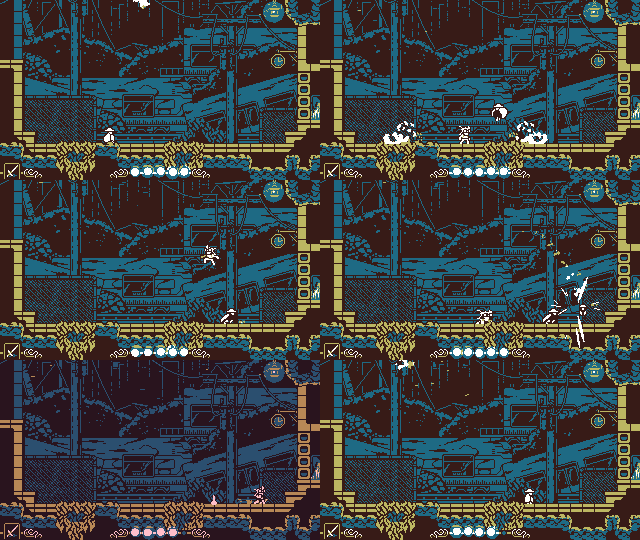
A boss fight that Liam coded
And finally, it has built in reflection... And while I wouldn't use it for release code, being able to quickly reflect on game objects for editor tooling is very nice. I can easily make live-inspection tools that show me the state of game objects without needing any custom meta programming or in-game reflection data. After spending a few years making games in C++ I really like having this back.
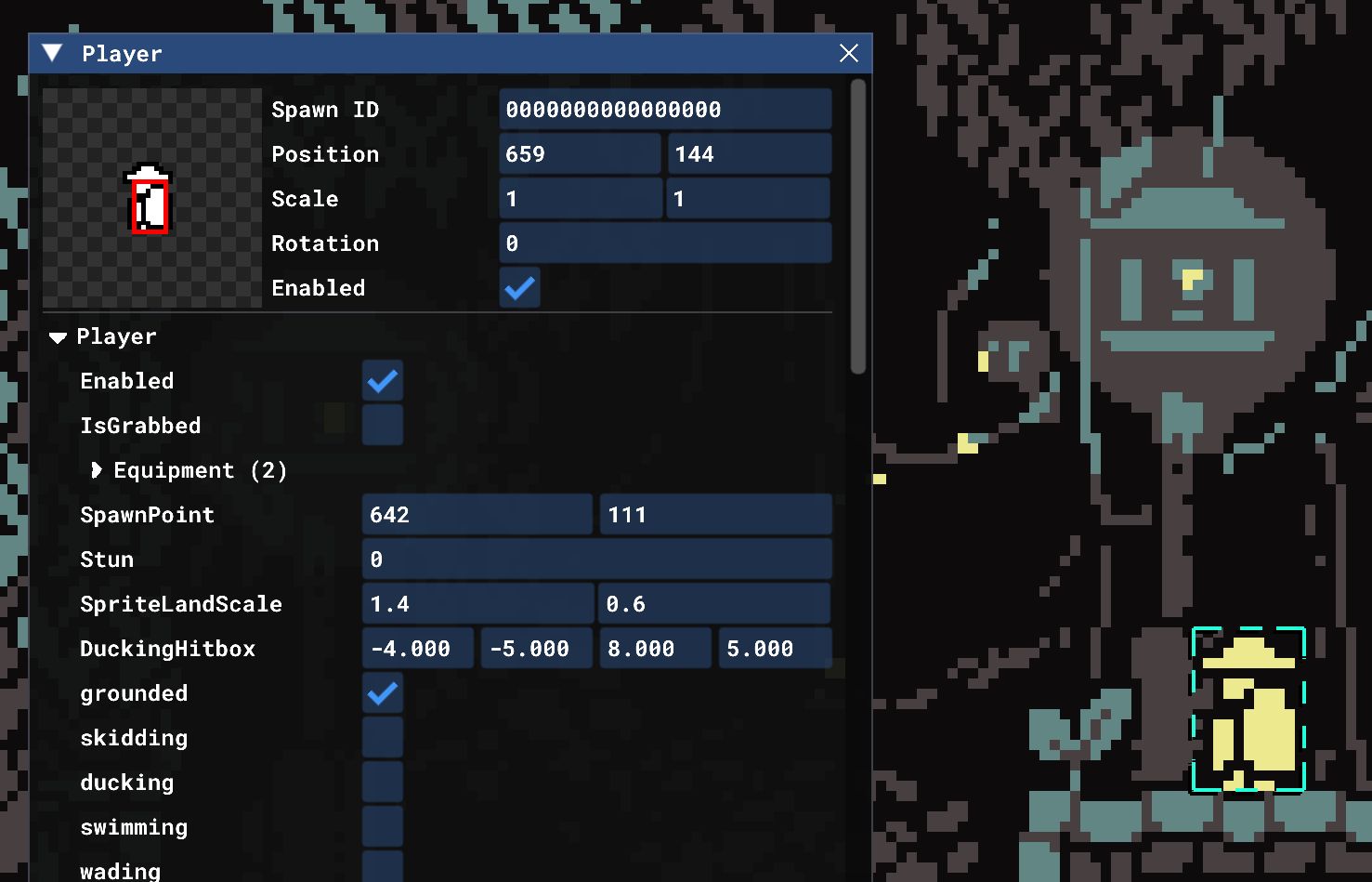
Inspecting an object with reflection in Dear ImGui
This is kind of the big question when writing "a game from scratch", but there are a lot of great libraries to help you get stuff onto the screen - from SDL, to GLFW, to Love2D, to Raylib, etc.
I have been using SDL3 as it does everything I need as a cross-platform abstraction over the system - from windowing, to game controllers, to rendering. It works on Linux, Windows, Mac, Switch, PS4/5, Xbox, etc, and as of SDL3 there is a GPU abstraction that handles rendering across DirectX, Vulkan, and Metal. It just works, is open source, and is used by a lot of the industry (ex. Valve). I started using it because FNA, which Celeste uses to run on non-Windows platforms, uses it as its platform abstraction.
That said, I have written my own C# layer on top of SDL for general rendering and input utilities I share across projects. I make highly opinionated choices about how I structure my games so I like having this little layer to interface with. It works really well for my needs, but there are full-featured alternatives like MoonWorks that fill a similar space.
Before SDL3's release with the GPU abstraction, I was writing my own OpenGL and DirectX implementations - which isn't trivial! But it was a great learning experience, and not as bad as I expected it to be. I am however, very grateful for SDL GPU as it is a very solid foundation that will be tested across millions of devices.
Finally, for Audio we're using FMOD. This is the last proprietary tool in our workflow, which I don't love (especially when something stops working and you have to hand-patch their library), but it's the best tool for the job. There are more lightweight open source libraries if you just want to play sounds, but I work with audio teams that want finite control over dynamic audio, and a tool like FMOD is a requirement.
I don't have much to say about assets, because when you're rolling your own engine you just load up what files you want, when you need them, and move on. For all my pixel art games, I load the whole game up front and it's "fine" because the entire game is like 20mb. When I was working on Earthblade, which had larger assets, we would register them at startup and then only load them on request, disposing them after scene transitions. We just went with the most dead-simple implementation that accomplished the job.
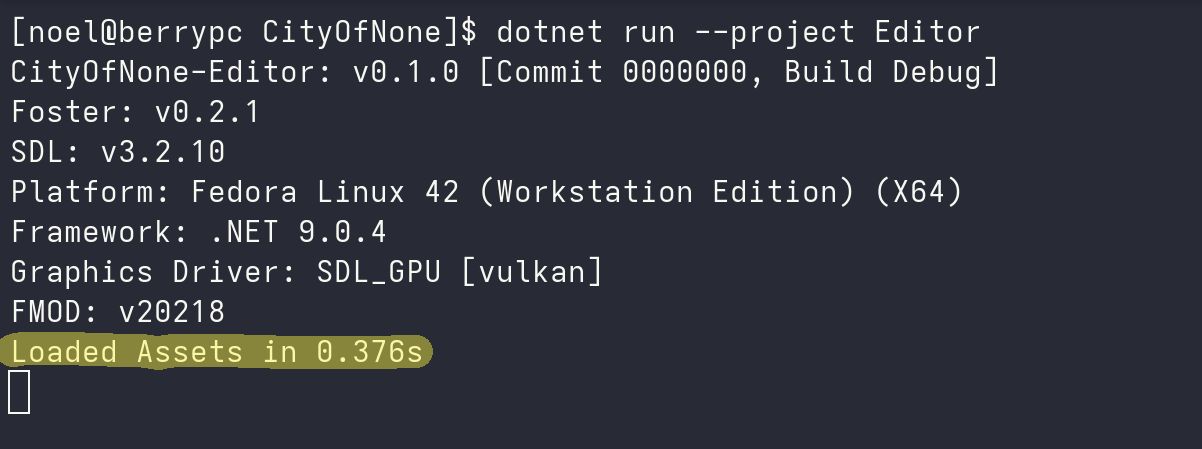
All the assets for City of None loading in 0.4 seconds
Sometimes you'll have assets that need to be converted before the game uses them, in which case I usually write a small script that runs when the game compiles that does any processing required. That's it.
Some day I'll write a fully procedural game, but until then I need tools to design the in-game spaces. There are a lot of really great existing tools out there, like LDtk, Tiled, Trenchbroom, and so on. I have used many of these to varying degrees and they're easy to set up and get running in your project - you just need to write a script to take the data they output and instantiate your game objects at runtime.
However, I usually like to write my own custom level editors for my projects. I like to have my game data tie directly into the editor, and I never go that deep on features because the things we need are specific but limited.
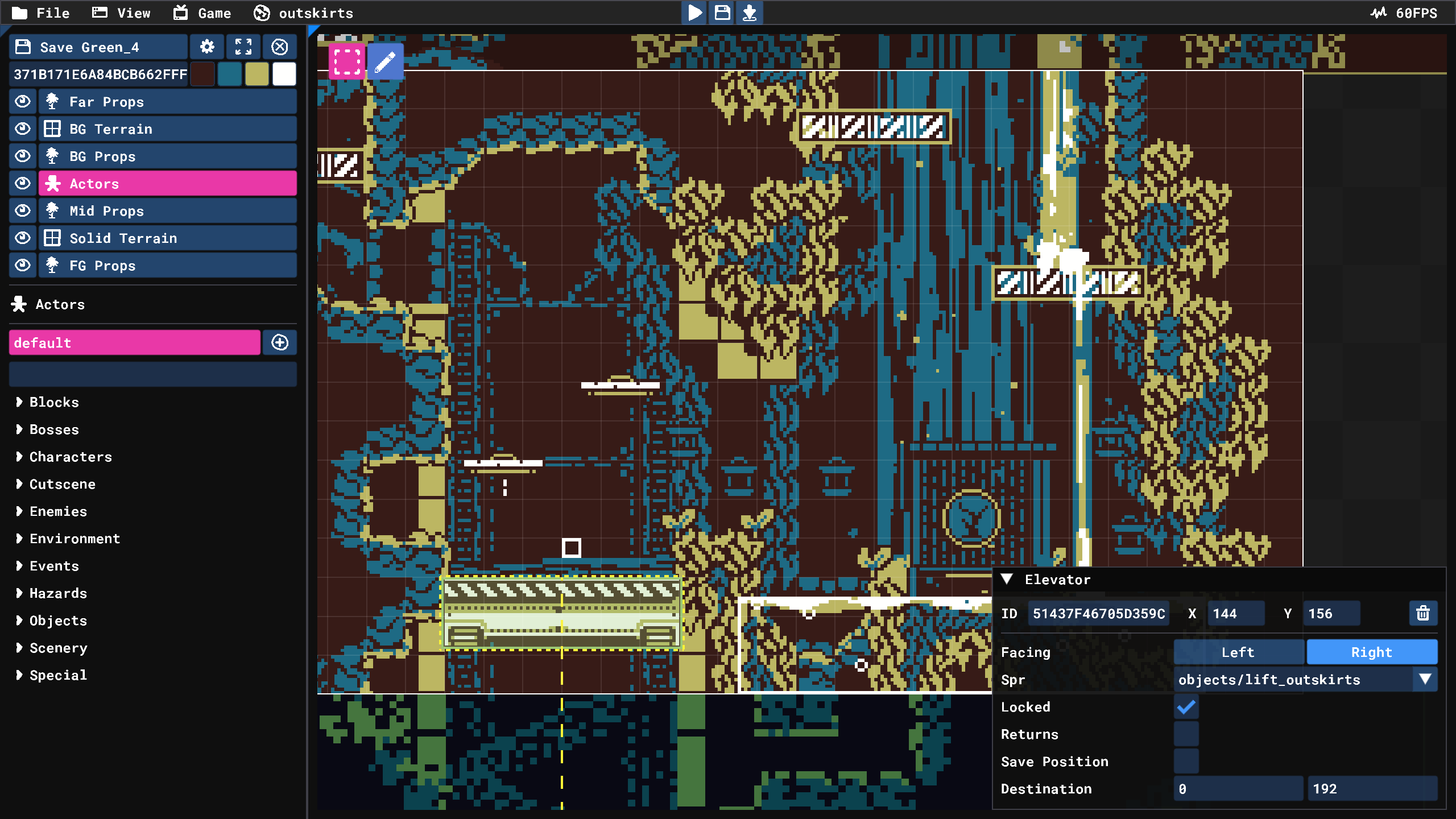
A small custom level editor for City of None using Dear ImGui
But I don't want to write the actual UI - coding textboxes and dropdowns isn't something I'm super keen on. I want a simple way to create fields and buttons, kind of like when you write your own small editor utilities in the Unity game engine.
This is where Dear ImGui comes in. It's a lightweight, cross-platform, immediate-mode GUI engine that you can easily drop in to any project. The editor screenshot above uses it for everything with the exception of the actual "scene" view, which is custom as it's just drawing my level. There are more full-featured (and heavy-duty) alternatives, but if it's good enough for all these games including Tears of the Kingdom it's good enough for me.
Using ImGui makes writing editor tools extremely simple. I like having my tools pull data directly from my game, and using ImGui along with C# reflection makes that very convenient. I can loop over all the Actor classes in C# and have them accessible in my editor with a few lines of code! For more complicated tools it's sometimes overkill to write my own implementation, which is where I fall back to using existing tools built for specific jobs (like Trenchbroom, for designing 3D environments).
The main reason I learned C++ a few years ago was because of my concerns with portability. At the time, it was not trivial to run C# code on consoles because C# was "just in time" compiled, which isn't something many platforms allow. Our game, Celeste, used a tool called BRUTE to transpile the C# IL (intermediate language binaries) to C++, and then recompiled that for the target platform. Unity has a very similar tool that does the same thing. This worked, but was not ideal for me. I wanted to be able to just compile our code for the target platform, and so learning C++ felt like the only real option.
Since then, however, C# has made incredible progress with their Native-AOT toolchain (which basically just means all the code is compiled "ahead of time" - what languages like C++ and Rust do by default). It is now possible to compile C# code for all the major console architectures, which is amazing. The FNA project has been extremely proactive with this, leading to the release of games across all major platforms, while using C#.
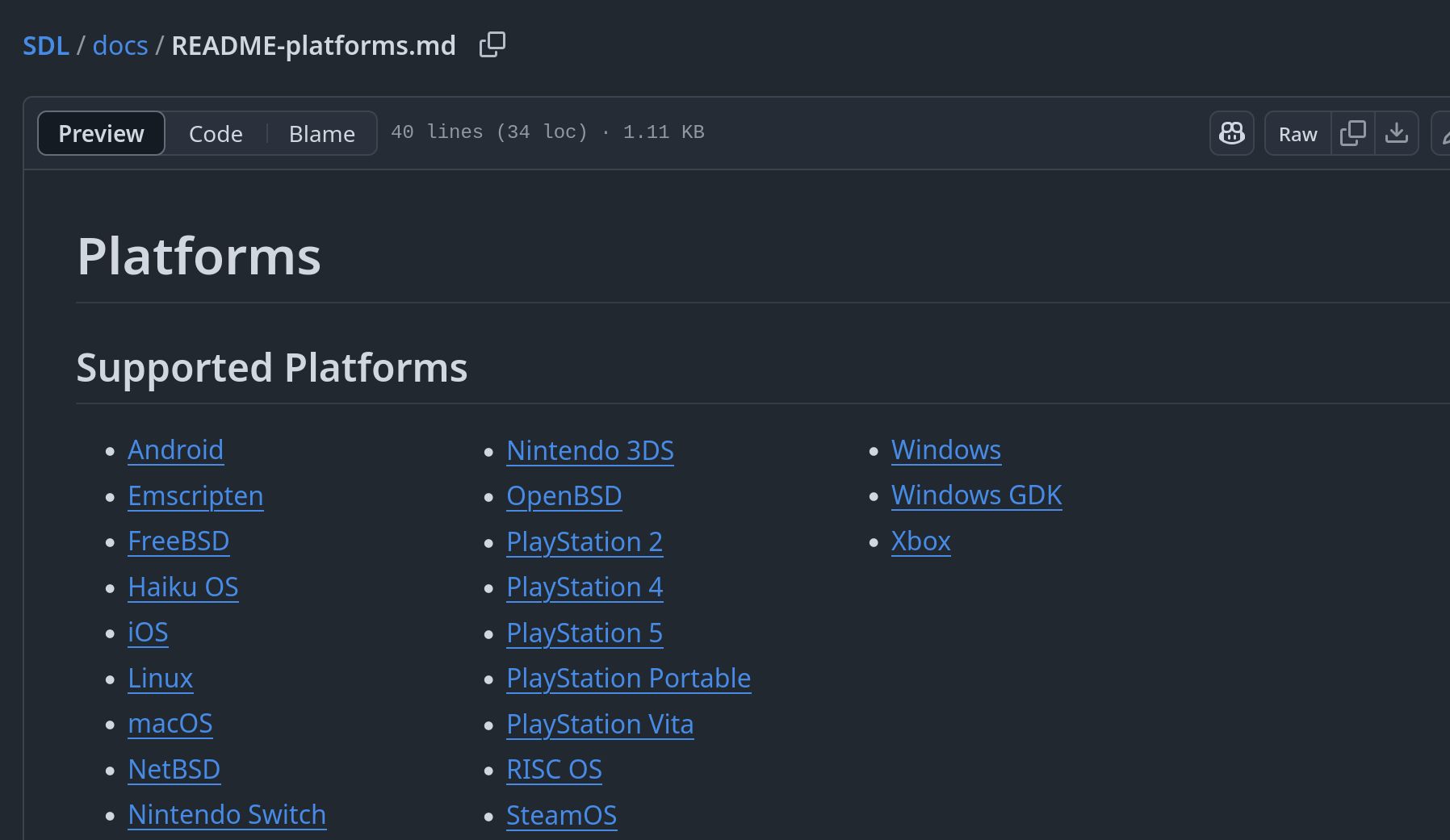
Platforms supported by SDL3
And finally, SDL3 has console ports for all the major platforms. Using it as your platform abstraction layer (as long as you're careful about how you handle system calls) means a lot of it will "just work".
Finally, to wrap all this up ... I no longer use Windows to develop my games (aside from testing). I feel like this is in line with my general philosophy around using open source, cross-platform tools and libraries. I have found Windows increasingly frustrating to work with, their business practices gross, and their OS generally lacking. I grew up using Windows, but I switched to Linux full time around 3 years ago. And frankly, for programming video games, I have not missed it at all. It just doesn't offer me anything I can't do faster and more elegantly than on Linux.
There are of course certain workflows and tools that do not work on Linux, and that is just the current reality. I'm not entirely free of Microsoft either - I use vscode, I write my games in C#, and I host my projects on github... But the more people use Linux daily, the more pressure there is to support it, and the more support there is for open source alternatives.
(as a fun aside, I play most of my games on my steam deck these days, which means between my PC, game console, web server, and phone, I am always on a Linux platform)
What about Godot?
If you're in the position to want the things a larger game engine provides, I definitely think Godot is the best option. That it is open-source and community-maintained eliminates a lot of the issues I have with other proprietary game engines, but it still isn't usually the way I want to make games. I do intend to play around with it in the future for some specific ideas I have.
What about 3D?
I think that using big engines definitely has more of a place for 3D games - but even so for any kind of 3D project I want to do, I would roll my own little framework. I want to make highly stylized games that do not require very modern tech, and I have found that to be fairly straight forward (for example, we made Celeste 64 without very much prior 3D knowledge in under 2 weeks).
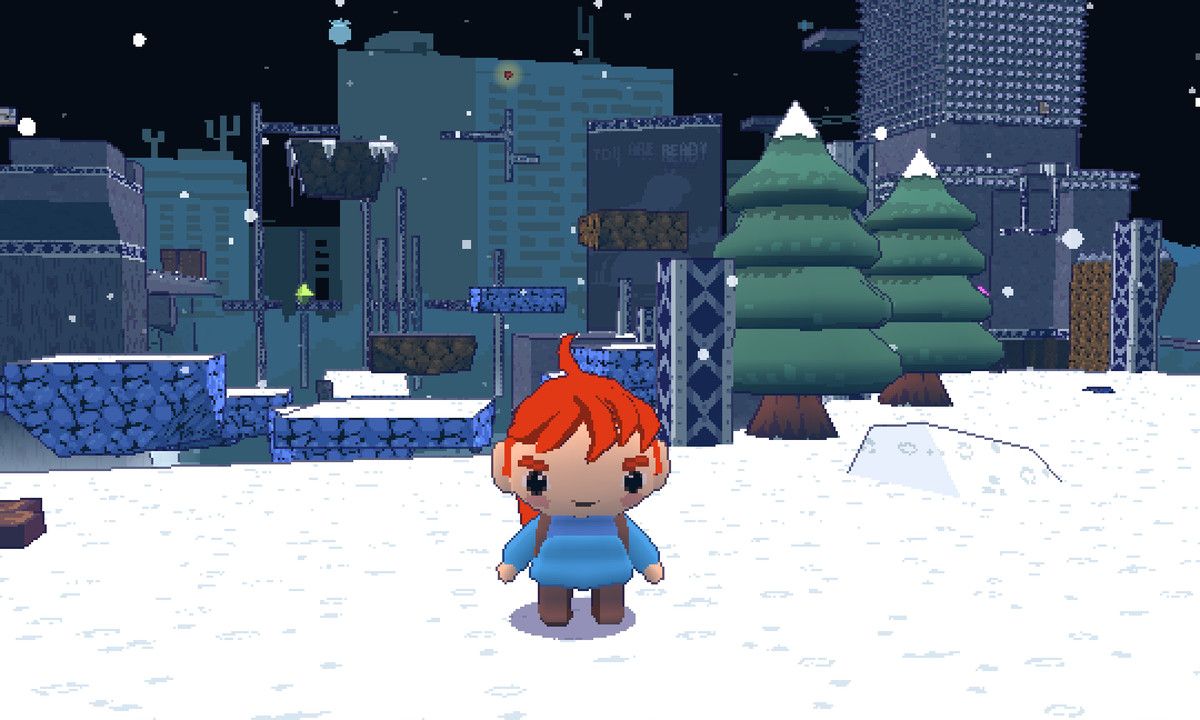
Celeste 64 Screenshot
I need only the best fancy tech to pull off my game idea
Then use Unreal! There's nothing wrong with that, but my projects don't require those kinds of features (and I would argue most of the things I do need can usually be learned fairly quickly).
My whole team knows [Game Engine XYZ]
The cost of migrating a whole team to a custom thing can be expensive and time consuming. I'm definitely talking about this from the perspective of smaller / solo teams. But that said, speaking from experience, I know several middle-sized studios moving to custom engines because they have determined the potential risk of using proprietary engines to be too high, and the migration and learning costs to be worth it. I think using custom stuff for larger teams is easier now than it has been in a long time.
Game-specific workflows

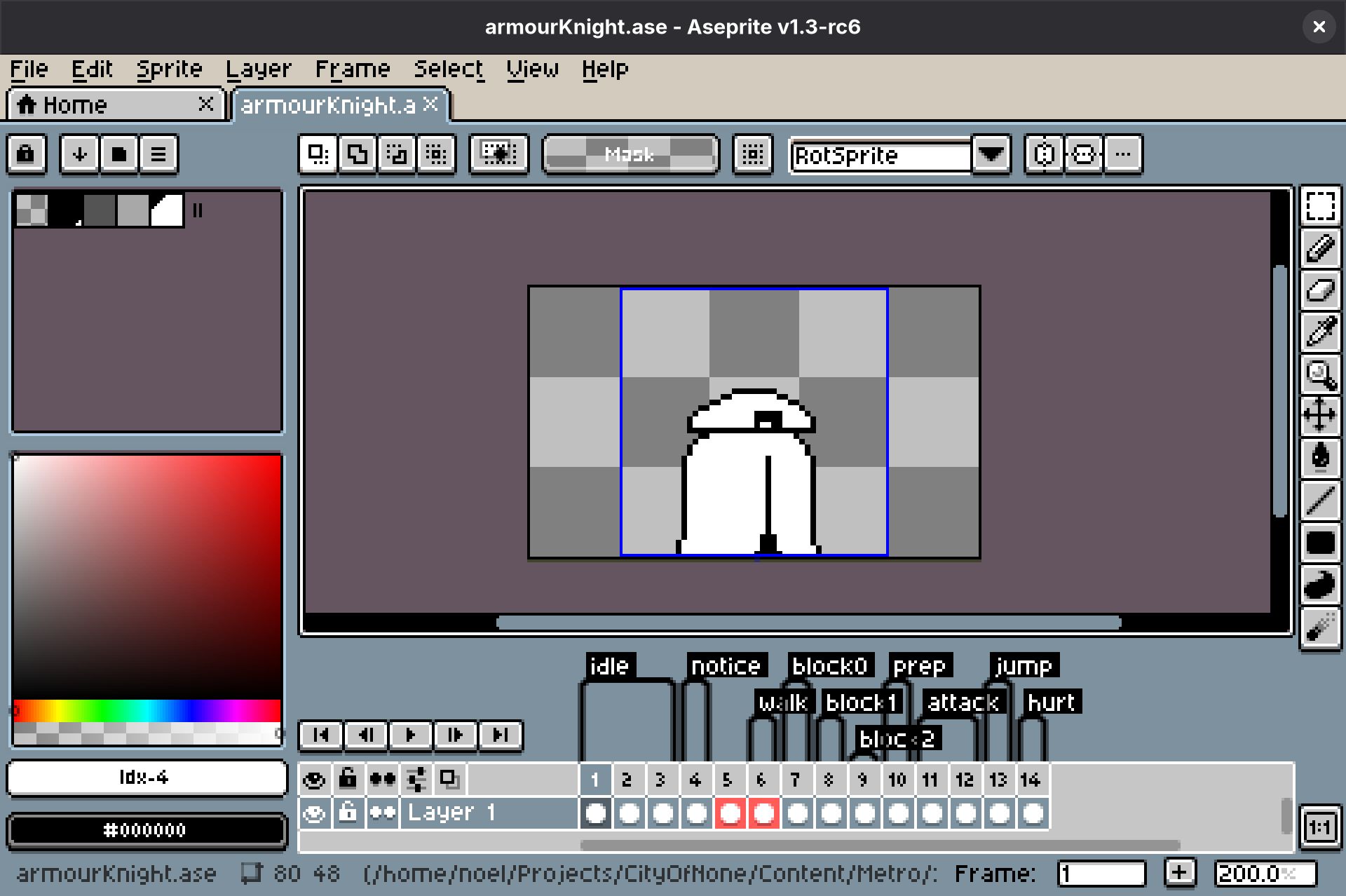
Aseprite assets are loaded in automatically
I load in Aseprite files and have my City of None engine automatically turn them into game animations, using their built in tags and frame timings. The format is surprisingly straight forward. When you write your own tools it's really easy to add things like this!
That's it from me! That's how I make games in 2025!
Do I think you should make games without a big engine? My answer is: If it sounds fun.
-Noel
I think the issue was when I used an engine the scope was too large and I never completed the work so I never released the game (or I released it for free because I felt it was incomplete and wasn't worth charging for)
It's great to work in a constrained environment
• There is overhead in learning how a specific game engine works.
• Often, due to a game engine API, it seems to herd you into writing the same game everyone else is writing with that engine.
I wanted just enough "game engine" to abstract away the pixel-buffer, windowing, user-events on the various target platforms and then do no more.
"I have been using SDL3 as it does everything I need as a cross-platform abstraction over the system - from windowing, to game controllers, to rendering."
And that is exactly where I landed as well. SDL3 [1] absolutely matched what I wanted. Then again, I enjoy writing sprite-based games. If you want to write a 1st-person shooter though I'm sure you will still want to go with one of the giant game engines.
(Actually it was SDL2 since it was two years ago I was exploring it: https://store.steampowered.com/app/2318420/Glypha_Vintage/)
But yeah, it is like learning a new language. But that's not a bad thing! I found messing around / following some tutorials for e.g. pico-8 to be both liberating (two characters are enough for a variable name) and educative (using functions like min/max to the fullest)
I saw this documentary on how celeste was made [1], which completely inspired me and got me into indie game dev community. Unfortunately I haven't made any games as of now that I would proudly showcase but the seed that your effort put is still there and one day I will get back to making games. Thanks a lot for making celeste I absolutely love it! ---- 1. https://youtu.be/MSKOQr_YS-U?si=AGzl5ILzxkoIB-j9
If journey is more important to you than the destination then developing games without an engine can be a great adventure.
But if you bank on shipping your product within budget and scope then you'd better pick up one. Any one. And stick with it.
[0]: https://ookigame.com
I'm also not sure if it's still in the installer, but it used to ask you what you would be using unity for, and I don't remember most of the options, but one of them was "military simulations" or something like that, so they are aware of the possibility
In theory, yes. In practice 99.9% of the games developers want to make are feasible with an off the shelf engine.
This is a GREAT observation. Thank you!
But I'm still not too enthusiastic about having GC in C# which is why ideally I'd like to start making a small 2D game just with SDL3 and C++ but how could I get this nice hot reload workflow there? I don't have the money to pay for expensive proprietary tools like https://liveplusplus.tech so what can I do? I guess there's the "game as dynamic library" trick from Handmade Hero (see https://www.youtube.com/shorts/seWAIURXxH0) so maybe that would work good enough? Maybe https://github.com/fungos/cr would do most of what's needed here?
Also, how does one even do modern C++ these days? Is it possible to have big C++ code bases that still compile fast these days? Is CMake 4 good™ now? Are modules really there yet? I rely on clangd as LSP for working with C++ but I read that clangd still fundamentally struggles with C++ modules https://chuanqixu9.github.io/c++/2025/12/03/Clangd-support-f... and it's so bad that there has even been some effort going into making a new C++ LSP https://github.com/clice-io/clice
I'd really love to go all-in with C# and SDL3 to make an engine-less cross-platform game but I still miss a good way to make complex game UIs without doing everything from scratch. Does anyone have a good suggestion for making non-trivial game UIs without using a full game engine? So far, I only found https://github.com/vchelaru/Gum and https://github.com/mikke89/RmlUi but I think there's not really something super mature and feature packed, or is there? I'm aware of https://github.com/ocornut/imgui, as the article also mentioned, but that's more for debug UIs, right?
Creating my own engine was both a personal and strategic decision for me. I was really worried about running into performance issues with generalist engines, and I did not want the friction of working with someone else's mental model. Pretty sure that friction would have caused so much burnout for me. There's also the long payoff of operating in an environment that you understand top to bottom.
I ignored all the advice about making smaller games first, creating an engine first, etc. Metropolis 1998 is my first game and so far it's working out just fine. But your mileage will vary.. I started development with 10+ years of software experience and fond memories of Rollercoaster Tycoon and SimCity 2000/4.
I only add what I need. There's no level/scene editors (outside of the game being one itself :P ). No scene graphs. Shaders are coded by hand. Right now the entire game is about 45MB.
[1] https://store.steampowered.com/app/2287430/Metropolis_1998/
I liked when games all felt very distinctly different and I feel like part of that was that they all varied on ‘engine’
The same goes for software libraries in general, I think. Just make your program. Don't make an overly general library for something you won't need anyway. If the code proves useful for reuse, just factor it out after the fact and generalize as needed.
EDIT: Typos, wording
Also, pretty sure it was a small indie team rather than a “big developer”
Then you start it hit the more tedious stuff. loading animated characters, blending animations on selective subtrees of a character hierarchy. Making a level editor. Adding quality of life feature to it like undo. Etc…
I’m not saying you shouldn’t do this. It’s fun to do. just don’t delude yourself that that’s making progress on your game. It’s instead making progress on a game engine. That’s a different thing.
I've shipped 18 games, 4 of them AAA. I wrote the engines for most fo them. I wouldn't do it again.
All that said, some nuance. If the game you are making is simple for some defintion of simple, Celeste, Dead Cells, Geometry Wars. Then making your own engine isn't much work and there maybe some benefits.
On the other hand, see all the tiles made with engines. Silksong is Unity. A Short Hike is Unity. Blue Prince is Unity. Valheim is Unity. Peak is Unity. Dredge is Unity. You don't need to make your own engine to make an indie game.
Godot, Unreal, CryEngine, and even Unity... all solve edge-cases most don't even know they will encounter. Trying something custom usually means teams simply run out of resources before a game ships, and is unlikely stable on most platforms/ports. =3
It’s easy for me. I just know C and raylib’s API is small. I got cross platform compilation going in an afternoon.
I’ve worked through some things with Godot. There’s just so much to learn that it’d take me longer to learn Godot than to get running with C.
Feel much the same as the author.
With ai it add several lines of code at once as soon as it thinks it recognizes a common pattern.
It’s not perfect and it can get in the way but it’s amazing when it guesses right and spits out the next 3-4 lines I would have typed
JetBrains also has local line-based LLM models for various languages.
With the LLM-based autocomplete it a) generally autocompletes more code at once, and b) will often pick up on patterns in the existing code. E.g. if you have a similar method, list of print/string buffer write statements, or other repetitive code in the file it will often use that as a model for the generated code.
But even more complex custom/inhouse engines are usually not written from scratch, those are often mostly glued together from specialized middleware libraries which solve the tricky problems (e.g. physics engines like Jolt, vegetation rendering like SpeedTree, audio engines and authoring tools like FMOD or WWise, LOD solutions like Simplygon, etc etc...)
- Desktop: Windows, MacOS, Linux
- Mobile: Android, iOS, iPadOS
- Console: Playstation 4, Playstation 5, Xbox One, Nintendo Switch
It used to be XNA but then Microsoft discontinued and the community created the API compatible MonoGame.
Notable games: Terraria (when it was XNA), Stardew Valley, Celeste, Terraria and Fez.
--
0: https://cityofnone.com/And any new stuff regarding Celeste or from their devs will forever be relevant to me! Highly recommend to any who haven't played it.
Most game engines are broken by default. Modern customers just aren't very discerning ("It's for the pigs. Pigs eat slop."). You can feel holes and rough edges in the vast majority of new releases, including AAA titles.
Unreal is the worst for this and Unreal-based games almost always have two things in common: a very particular, soft, sticky and unresponsive look & feel (often alleviated but never fully corrected by turning off some combination of motion blur, AA and VSync), as well as a UI that mishandles mouse pointers.
Unity devs seem to rely on a (more diverse but still quite) small pool of subsystems and renderers; possibly some mix of baseline and Asset Store components. This gives each Unity game a specific subset of flaws from a wider common pool. That is, you can tell that game A uses the same movement subsystem as games B and C (but not D), that game B uses the same UI subsystem as games C and D (but not A), and that game D uses the same rendering subsystem as games A and B (but not C).
Builds: https://github.com/hez2010/Satori/releases
how to use? do self-contained publish (but not single file), replace 3 files in the folder with the one from Satori release you can check if it's in use with GC.GetConfigurationVariables().ContainsKey("SatoriGC")
It is a far, far superior experience to touching anything C++.
(Also thanks this is exactly the kind of game I'm into.)
I always thought CMake was good enough. I use FetchContent for all external dependencies and git submodules + add_directory for all internal dependencies. It took me a while to figure out that this was the simplest thing that works reliably though. I have used vcpkg and conan extensively and have completely given up on them.
I don't use C++ modules, because afaik they are still mostly broken. Without modules clangd works wonderfully and has been working wonderfully for a few years. I really, really like it. I think it can be done! I am missing reflection though, but if I would really want to use it, I'd probably just use clang -ast-dump instead of the new reflection functionality.
React Native uses Skia under the hood as far as I recall.
If I remember correctly it was a team of 2.
For certain personality types I think making an engine can make it very easy to get distracted and wind up in the weeds of something you don't actually need, overoptimizing, fence-painting etc. Using an engine can help with self-discipline and focus on the end rather than the means, although then you need to make sure you don't just wind up with a ton of mostly finished tutorial projects and no game.
This is the mantra of the past decade of game dev.
that's probably what you mean by highest level of complexity
but even just a regular turn-based game there's a lot of questions you need to answer and decisions to make regarding latency, packet loss, and disconnects that all have to be solved in a coherent and consistent way
"I thought if I made a really good engine, making a game would be the easy part!" I had similar thoughts when I was younger. Surely if I just upgrade my tools, the hard part will become the easy part!
Jonathan Blow says making engines is easy, because enginedev only takes a relatively small part of development — the game itself takes way more time and energy.
So his argument is, in the grand scheme of things, the engine is not that much work. (Since you're gonna spend ten years working on the game anyway, of course ;)
Solo? Or part of a team?
What's wrong with Netcode for GameObjects, and what are the odds I'll regret going with it?
I guess they might finally get me to use those things since they take the “configuring” and “remembering shortcuts” part out, but so much of this doesn’t look new at all. Super old, actually.
Forcing devs to use a mid-grade GPU also tends to reduce chasing performance issues later. For example, high frame-generation artifacts users often perceive as "floats" or "wobbly". =3
If I have a JSON structure, I can paste that into the file as a comment, e.g.:
# {"foo": 1, "bar": "test", "baz"}
@dataclass
class FooBar:
foo:
and the AI will/can autocomplete/generate that to: @dataclass
class FooBar:
foo: int
bar: str
baz: int
using the JSON example. Then if you type: def __str__(self):
the AI could then contextually generate, e.g.: return f'Foo(foo={self.foo}, bar={self.bar}, baz={self.baz})'
Or if you have a SQLAlchemy model: class Foo(Base):
__tablename__ = 'foos'
bar_id: Mapped[int | None] = mapped_column(ForeignKey('bars.id'), default=None)
typing `bar:` the AI can autocomplete: bar: Mapped[Optional['Bar']] = relationship()
picking up that you have a `Bar` class in the file. Especially if you have other similar id/object definitions in the file.It's just that I quite dislike using such a scripting language. It's personal preference, for sure, but here's a bit more context https://news.ycombinator.com/item?id=47220602
Unity indeed is still using Mono instead of CoreCLR and is kinda stuck in that sense. But to be fair, they are trying to migrate to CoreCLR which will let them profit from all the crazy optimizations that Microsoft has poured into the runtime and ecosystem.
Godot is kind of a hate love for me when it comes to C#. Godot gives me the most hope that there can be a free, community-driven but powerful game engine and it having C# support built-in seems great at first glance until you realize that GDScript, which is veeeeery dynamic language, pretty much nullifies a lot of the advantages you'd get from using C# because you find yourself doing weird type system stuff that GDScript imposes on all the other languages. The best you can do is doing as much as possible in C# and use Godot as kind of a input and rendering abstraction layer. But then you're missing out on a lot of the functionality that Godot offers which should raise the question why use a game engine in the first place. It's difficult, at least for me. Others might have figured it out much better.
I think even `dotnet watch` at some point nopes out when you change too much. I think they call it "rude edit" and ask you to completely restart the program in that case. So I don't expect every possible C++ edit to be manageable by hot reload. But changing a few if conditions or constants should be fine or not?
I'm more and more questioning scripting languages in games. What are the main reasons to use something like Lua? I think it's having not to rebuild the engine, no compile times, changing stuff while the game is running and being more accessible to non-programmers. But I think it's rather infuriating, all those points could be less relevant if the tooling for "real" programming languages was better. And with coding agents becoming more wide-spread I guess accessibility to non-programmers also becomes less of a point. I guess it's just my personal dislike for scripting languages in games, but really, it would be so much nicer imo if there was only need for one language that does it all. But seems like a difficult thing to achieve.
> I quite like modern C++, so I really tried to make it work for gamedev, but I think you can't really do it.
What exactly do you mean? What parts of modern C++ did not work for you?
> You can use all the modern C++ features that are not in the standard library though!
> I just decided to not use any of the C++ standard library (I just use a few C headers)
So what do you do with C++ that C alone couldn't do?
- - Total days - 1631
Engine: 610
Pathing / Roads: 287
Features: 477
Marketing: 45
Burnout: 130
Other: 82
The game engine is cross-platform ready, but as a solo dev I'm just targeting Windows for now.You're welcome!
But I suspect that when you have multiple years to build Tetris, you can spend a lot of time crafting your own style.
Programming an engine requires dedication, but pretty much every other area in gamedev require similar dedication to get to an acceptable result.
Im sure NfG is fine
What I do like and use is overloading, references, templates, concepts, lambdas, enum classes, user defined literals, constexpr, operator overloading for math (!), little syntax stuff like structured binding declarations, "auto" and range based for. I also made my own little fmt (like https://riki.house/fmt). C++ is a much nicer language than C imo, even without the standard library.