Launch cadence across NASA programs:
https://x.com/NASAAdmin/status/2027456699175497741
An infographic showing the new architectures:
https://x.com/NASAAdmin/status/2027456713507356713
It's interesting how Artemis III (the new one) will try to prove out both HLS landers in one LEO mission.
Godspeed to them, hopefully I'm being overly dour.
Explaining Why NASA's Starliner Report Is So Bad > https://www.youtube.com/watch?v=L96asfTvJ_A
SLS, a rocket derived from Shuttle tech, takes astronauts on the Orion spacecraft to the vicinity of the moon. From there, a lander built by either SpaceX or Blue Origin will take the astronauts to the surface and then back to Orion. The astronauts will then return to Earth in Orion.
Artemis I flew a couple of years ago and took an uncrewed Orion spacecraft around the moon and back to Earth.
Artemis II, which should hopefully fly in April, will take 4 astronauts around the moon--the first time humans have been that far in space in 50+ years.
Artemis III was going to be a crewed moon landing, planned around 2028, but between delays in the lander development and the complexity of this mission, no one expected it to happen on time.
The major change that NASA has announced is to launch SLS more often--ideally once every 10 months. There are two major advantages to this:
1. More frequent launches will improve reliability because the team/engineers will understand the system better. There will be more commonality between launches.
2. With more launches before the end of the decade deadline there are more opportunities for intermediate milestones. In particular, Artemis III will turn into an Earth-orbit mission in which Orion will dock with one or both of the landers. This will test out the system before heading to the moon. Moreover, NASA plans to have at least two lunar landing attempts in 2028, which means that even if the first attempt is scrubbed, they will still have a chance to land before the end of the decade.
The difference in philosophy between NASA's current approach and SpaceX is quite stark. SpaceX has launched 11 Starships in the two and a bit years, with a lot of them blowing up. Where as Artemis is trying to get it near perfect on each run.
I wonder if NASA could start to adopt SpaceX like approaches? Where one doesn't try to get everything correct before acting?
I wonder which approach is more capital efficient? Which is more time efficient?
(It seems that Artemis cost is $92B, where as SpaceX's Starship costs are less than $10B so far, give or take. So it seems that SpaceX is a more efficient approach.)
Artemis II is a disaster in progress.
NASA programs today are mainly about creating/maintaining jobs and keeping private industry contractors busy. They lost the political agency and freedom to move fast that they had in the 60s.
But there's no lack of huge achievements. The Mars rovers are amazing: super-sonic parachutes, retro rockets, deploying a little helicopter with no real-time control is huge. So is planting JWST at the L2 point and unfolding it a million miles from earth.
Also, the NASA budget in the 1960's was 10 times higher.
Artemis objectives are less well defined, more ambitious and with way less money. The big budget is being allocated to brutes killing people in the streets and a decadent ballroom for the emperor. The difference in importance between the two is the cause of all the failures.
(I don't know what the current policies are but you used to be able to apply in advance for VIP tickets, or buy them on the secondary market, which gives you much closer viewing of the launch)
back then TVs weren't that popular and those that had one were stuck with very low definition video, today our 2k and 4k screens would be able to spot their flaws easily
If you've never seen a gator then looking in the ditches by the road during the bus tour is a good bed.
We unanimously agreed KSC was by far the best of all. If you only do one thing in Florida, that would be it.
The reason modern projects take so long is that so many of them are stuck in design or awaiting funding stage for what feels like interminable ages; once the construction phase starts, they tend to go fairly quickly. But if you look at projects 100 years ago, well, they also seem to have fairly lengthy pre-construction timelines. It's just that we conveniently forget about those when we look back on them nowadays.
I think that's probably important framing for how things were reported back then. But also, I'm wrong like 99.9999999% of the time. So!
The ability to pick a small-but-well-defined goal as an interim milestone - and stay focused on it - is a key skill, and too often I've seen waterfall-like companies slowly scope-creep their first MVP until it's a lumbering mess. You almost always need someone with a strong personality to push team to 'get it done', and that level of ownership is really hard to come by in an organization historically built around ass-covering.
I think Commercial Crew is the right model for NASA. Pick the design objectives, provide some level of scaffolding regulation (i.e loss-of-crew calculations), and then contract out to private sector to actually 'get it done'. (Yes Starliner was a failure, but Dragon is definitely a success. A 50% hit rate and success of the program overall is better than Artemis)
They should not adopt spacex practices, they should adopt spacex lift vehicles (once proven).
If you look at the unmanned side of NASA, that's going great. NASA can get amazing stuff done.
The manned side gets political attention, and the nature of current politics makes it a bad kind of attention. Results are essentially irrelevant. Jobs and cronyism are the point.
The overall design of the Space Launch System makes very little sense. We know all too well that solid rockets are a bad idea for crewed spaceflight. Hydrogen is a bad fuel for a first stage. It's horrendously wasteful to use expensive, complicated engines designed to be reused, and then throw them away on every launch. Early estimates were over $2 billion per launch, which in the current age is total clownshoes. The actual costs will be much higher still.
So why are they doing it? Because using all this old, rather inappropriate tech allows them to keep paying the contractors for it. If you gave NASA a pile of money and told them to build a moon program, they wouldn't build this. But it's not their choice.
> I wonder if NASA could start to adopt SpaceX like approaches? Where one doesn't try to get everything correct before acting?
My understanding is the difference is politics. The US political system is dysfunctional, and so riven by anti-government factions, that there's too much pressure to not fail.
If NASA tried the SpaceX approach, after the second rocket blew up NASA's administrator would have been hauled in front of Congress and interrogated over the "waste of taxpayer money" and then the program may get canceled.
This idea is captured nicely in the book "Art and Fear" with the following anecdote: "The ceramics teacher announced on opening day that he was dividing the class into two groups. All those on the left side of the studio, he said, would be graded solely on the quantity of work they produced, all those on the right solely on its quality.
His procedure was simple: on the final day of class he would bring in his bathroom scales and weigh the work of the “quantity” group: fifty pound of pots rated an “A”, forty pounds a “B”, and so on. Those being graded on “quality”, however, needed to produce only one pot – albeit a perfect one – to get an “A”.
Well, came grading time and a curious fact emerged: the works of highest quality were all produced by the group being graded for quantity. It seems that while the “quantity” group was busily churning out piles of work – and learning from their mistakes – the “quality” group had sat theorizing about perfection, and in the end had little more to show for their efforts than grandiose theories and a pile of dead clay."
Each F1 rocket engine was hand tuned by drilling holes into the "plate" so it would not cause the combustion mixture to vibrate the engine into smithereens.
Such an approach would never be tolerated today by NASA.
SpaceX hasn't even had the confidence to put Starship in LEO yet, and has not carried 1kg of real payload (and barely a few kg of test payloads) - while SLS did an orbit of the Moon, with real payload satellites.
Good thing we have a large number of CRUD SaaS experts to tell us what's wrong with the space program
I have no skin in this game other than to say the old school methods resulted in a janky ship that stranded two astronauts in space for months until they could catch a ride home on a SpaceX ship.
Some regs are worth it, certainly, but being overly cautious is in itself unsafe.
I mean does it sound like that was faster then what we can do today?
If we're putting humans into rockets into space, I'd like to think we adopt a balanced approach.
But even assuming we do view it as a deadline, the Apollo 1 losses are a pretty good argument that maybe we shouldn't repeat that.
The current Starship launches are part of a development and testing program. They expect quite a few failures (though probably not as many as they've experienced). But since each Starship launch is only 1/25th the cost of an SLS launch, SpaceX can afford to blow up a lot of them. And they won't put people on them until they have a track record of safe operation. Falcon 9 didn't have crew on it until the 85th launch.
1. The number of landing attempts is higher than the number of launches because Falcon Heavy results in multiple landings per launch.
Politicians have pressured NASA for launches previously and it has killed astronauts.
NASA/Congress pushes the armchair quarterback approach. Analyze forever, fail because analysis isn't the same thing as real world experience, get stuck using 50 year old rocket technology. Each engine on SLS cost more than the entire Starship super heavy launch vehicle.
By weight the RS-25 engines cost about 70% of that of building their 7000lb mass dry mass out of gold. That's insane.
To OP's point, Artemis has cost $92 billion over 14 years. This has produced exactly one launch.
It's hard to put an exact timeline on Starship since a lot of its development overlaps with Falcon 9 using the same components, but it's inarguable that it has cost one tenth Artemis so far.
I agree that Starship has been plagued by delays and the capabilities are so far mostly just talk. However, it has flown a number of times, and I would be willing to make a strong bet that it will orbit the moon with real payload long before it catches up to Artemis in budget.
Then you had Challenger, when experts were not listened to, and people died when they shouldn't have.
I don't understand the hostility.
The historical comparisons are complete BS: they wind up at "if we sacrifice enough people to the industrial god he will reward us" rather then discussing anything real.
And it works because we all know that repetition and practice are, in fact, important. So it feels believable that having people just repeat something over and over is the answer.
Similarly, people can be swayed by the master coming in and producing a single artifact that blows away everyone. You see this archetype story as often as the student that learns by just repeating a motion over and over. (Indeed.... this is literally the Karate Kid plot...)
The truth is far more mundane. Yes, you have to repeat things. But also yes, you have to give thought to what you are doing. This is why actual art classes aren't just "lets build things", but also "lets learn how to critique things that you build."
New NASA Administrator Jared Isaacman announced a major overhaul of the agency's Artemis moon program Friday, acknowledging that the agency's plan to land astronauts on the moon in 2028 was not realistic without another preparatory mission first to lay the groundwork.
He said NASA will now add an additional flight in 2027 in which astronauts will dock with new commercial moon landers in low-Earth orbit for detailed tests of navigation, communications, propulsion and life support systems and to verify rendezvous procedures.
That flight, in turn, will be followed by at least one and possibly two lunar landing missions in 2028 that incorporate lessons learned from the preceding flight.
The goal is to accelerate the pace of launches of the huge Space Launch System rocket while carrying out Artemis flights in evolutionary steps — not attempting missions that rely on too many untested technologies and procedures at once.
"We're going to get there in steps, continue to take down risk as we learn more and we roll that information into subsequent designs," Isaacman said told CBS News. "We've got to get back to basics."
Isaacman outlined the plan in an interview with CBS News space contributor Christian Davenport and then again during a news conference Friday.
The announcement came two days after release of a sharply-worded report from NASA's independent Aerospace Safety Advisory Panel that deemed the existing plans too risky.
The panel raised concerns about the number of "firsts" required by the original Artemis III moon landing mission and recommended that NASA "restructure" the program to create a more balanced risk posture.
"It is interesting that a lot of the things that we are addressing directly go to the points they raised in their report," Isaacman said Friday. "I can't say we actually collaborated on it because I generally think these were all pretty obvious observations."
The revised plan also comes as NASA has been struggling to launch the delayed Artemis II mission on a flight to send four astronauts on a trip around the moon.
Launch had been planned for early February, but it was delayed to repair a hydrogen leak and, more recently, to give engineers time to fix a helium pressurization problem in the rocket's upper stage. Launch is now on hold until at least April 1.
![]()
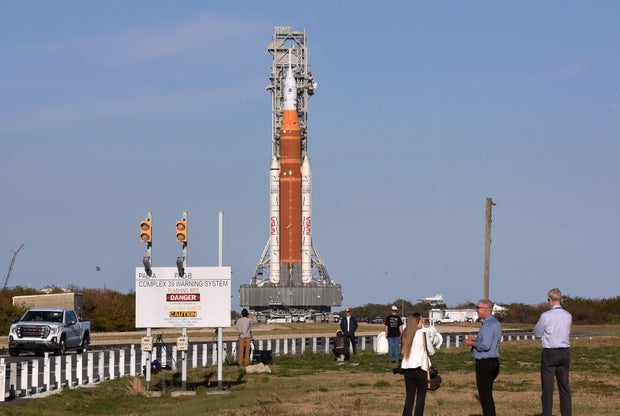
NASA's Artemis II Space Launch System (SLS) rocket is rolled back from the launch pad to the Vehicle Assembly Building at the Kennedy Space Center on Feb. 25, 2026. Paul Hennesy/Anadolu via Getty Images
The Artemis III mission, which had been expected to land astronauts near the moon's south pole in 2028, now will be redefined and rescheduled — launching in 2027 but not to the moon, Isaacman said. Instead, the yet-to-be-named astronauts will rendezvous and dock in orbit closer to home with one or both of the commercially built lunar landers now under development at Elon Musk's SpaceX and Jeff Bezos' Blue Origin.
The idea is to gain valuable near-term flight experience before attempting a moon landing with astronauts on board. With Artemis III under its belt, NASA hopes to launch two moon landing missions in 2028, Artemis IV and V, using one or both landers, and to continue with one moonshot per year thereafter.
"What helps us get to the moon? Well, for sure, rendezvous and docking with one or ideally both landers, that gives you an opportunity to do some integrated testing of a vehicle that we are going to depend upon the following year to take those astronauts down to the surface of the moon," Isaacman told CBS News.
The revised Artemis III mission will also give astronauts a chance to test out new spacesuits that future moonwalkers will use.
"It's an opportunity to … actually have the suits in microgravity, even if we don't go outside the vehicle in them. You get a lot of good learning from that," Isaacman said.
The Artemis III test flight with one or two lander dockings in Earth orbit is similar in concept to Apollo 9, which launched a command module and lander to Earth orbit for flight tests in 1969 and helped pave the way to the Apollo 11 landing four months later.
Isaacman said SpaceX and Blue Origin are "both looking to do uncrewed landing demonstrations as part of the existing agreement."
"So we want to just take advantage of this to set up both vendors for future success on a lunar landing," he said. "This is the proper way to do it, if it works out from a timing perspective, to be able to rendezvous and dock with both. ... This, again, is the right way to proceed in order to have a high confidence opportunity in '28 to land."
The Artemis IV and V missions in 2028 will use whichever landers are deemed ready for service. If only one company's lander is available, that lander would be used for both missions, an official said. If both are available, one would be used for one flight and one for the other.
Launching Artemis III, IV and V before the end of 2028 will not be easy, and Isaacman said it is essential that NASA rebuild its workforce and regain the technical competence to support a higher launch cadence, moving from one flight every 18 months or so to a flight every year. That pace, he argued, will reduce risk.
"When you regain these core competencies and you start exercising your muscles, your skills do not atrophy," he said. "It's safer. And yes, you are buying down risk, because you're able to test things in low Earth orbit before you need to get to the moon, which is exactly what we did during the Apollo era."
He said he did not blame NASA's contractors for the current slow pace of Artemis launches. Instead, "we should have made better decisions (in the past) and said, you don't go from Artemis II to landing on the moon with Artemis III."
The Artemis overhaul was announced two days after the release of a report by the lAerospace Safety Advisory Panel that said the original plan to move directly from Artemis II to a lunar touchdown in 2028 using a SpaceX lander did not have the proper margin of safety and did not appear to be realistically achievable.
The panel raised concerns about the number of "firsts" required by that mission in its current form and recommended that NASA "restructure the Artemis Program to create a more balanced risk posture for Artemis III and future missions."
The plan outlined by Isaacman appears to address many of the core issues raised by the safety panel.
Officials said Isaacman had discussed accelerating lander development with both SpaceX and Blue Origin and that both were on board. He also discussed the accelerated Artemis overhaul with Boeing, which manages the SLS rocket and builds its massive first stage; with United Launch Alliance, builder of the rocket's upper stage, Orion-builder Lockheed Martin and other Artemis contractors.
All, the official said, were in agreement.
"Boeing is a proud partner to the Artemis mission and our team is honored to contribute to NASA's vision for American space leadership," Steve Parker, the president and CEO of Boeing Defense, Space & Security, said in a statement. "We are ready to meet the increased demand."
SpaceX said, "We look forward to working with NASA to fly missions that demonstrate valuable progress towards establishing a permanent, sustainable presence on the lunar surface."
And Blue Origin responded, "Let's go! We're all in!"
Isaacman also said the agency would halt work to develop a more powerful version of the SLS rocket's upper stage, known as the Exploration Upper Stage, or EUS. Instead, NASA will go forward with a "standardized," less powerful stage but one that will minimize major changes between flights and utilize the same launch gantry.
Under the original Artemis architecture, NASA planned on multiple versions of the SLS rocket, ranging from the "Block 1" vehicle currently in use to a more powerful EUS-equipped Block 1B and eventually an even bigger Block 2 model using advanced solid rocket boosters. The latter two versions required use of a taller mobile launch gantry, already well under construction at the Kennedy Space Center.
"It is needlessly complicated to alter the configuration of the SLS and Orion stack to undertake subsequent Artemis missions," Amit Kshatriya, NASA's associate administrator, said in a statement.
![]()
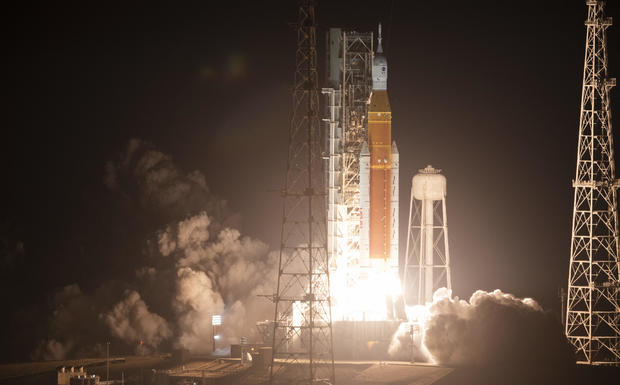
An uncrewed Space Launch System (SLS) rocket carrying the Orion spacecraft launches on the Artemis I flight test, on Nov. 16, 2022, at the Kennedy Space Center, Florida. Joel Kowsky/NASA via Getty Images
"The entire sequence of Artemis flights needs to represent a step-by-step build-up of capability, with each step bringing us closer to our ability to perform the landing missions. Each step needs to be big enough to make progress, but not so big that we take unnecessary risk given previous learnings."
As a result, NASA will stick with the current version of the SLS with the addition of the "standardized" upper stage. No other details were provided.
Isaacman closed out the CBS interview by saying flight-tested hardware, a revitalized work force and a more Apollo-like management strategy are only part of the story.
"There's another ingredient that's required, and that's the orbital economy, whether it happens in low-Earth orbit or on the lunar surface," Isaacman said.
"We've got to do something where we can get more value out of space and the lunar surface than we put into it. And that's how you really ignite an economy, and that's how everything we want to do in space is not perpetually dependent on taxpayers."
Christian Davenport contributed to this report.
In:
lol what? They've caught and successfully reflown the super heavy booster, and they've mostly successfully done a soft landing of Starship in the sea. How is that remotely "just talk"?
What SLS currently has achieved had been achieved by Falcons and Dragons years ago, only way more cheaply and successfully.
No matter what we may think about Mr Musk, SLS is dead end.
[0]https://www.latimes.com/california/story/2019-12-12/golden-g...
The Chinese are basically going to launch a few astronauts up there with a modern Saturn 5. But for them that would be a success because it is their first time.
You only get to land on the moon once before people stop giving a shit.
Challenger was lost because NASA ignored a critical flight risk with the SRB joint O-rings. And by "ignored", I mean "documented that the risk existed, that it could result in loss of vehicle and loss of lives of the crew, and then waived the risk so the Shuttle could keep flying instead of being grounded until the issue was fixed". They didn't need more unmanned testing to find the issue; they needed to stop ignoring it. But that was politically unacceptable since it would have meant grounding the Shuttle until the issue was fixed.
Columbia was lost because NASA ignored the risks of tile damage due to their belief that it couldn't be fixed anyway once the Shuttle was in orbit. But that meant NASA also devoted no effort to eliminating the risk of tile damage by fixing the issue that caused it. Which again would have been politically unacceptable since it would have meant grounding the Shuttle until the issue was fixed.
Depends on what happens once on the moon. If all you do is send 2 people at a time to collect rocks, then it does get boring to the general public. If each landing assembles the next section of a moon habitat, then I think the interest sticks around longer.
If you consider declared goals for Starship to be too hard (I assume not impossible), what aspect makes them that hard?
And since we talk about the Moon here, not stated goals of using Starships for Mars flights - what part of the Starship design makes it hard to believe that Starships may in next few years be regularly used for flights to the Moon?
I'm curious what it is which makes it so hard to believe.
If America (or China) says the best spots on the moon belong to America (or China), suddenly it's Space Race 2.0 and everyone cares.
This is what will happen once any building actually starts happening.
Should such testing have been needed? No.
Was such testing needed, given NASA's political pressures and management? Maybe. Unmanned testing in similar conditions before putting humans on it might've resulted in a nice explosion without loss of life that would've been much harder to ignore than "the hypothesizing of those worrywart engineers," and might've provided the necessary ammunition to resist said political pressures.
Which mission are you referring to?
If it's STS-1, AFAIK there were no close call incidents during the actual flight, but the mission commander, John Young, did have to veto a suggestion to make that mission an RTLS abort instead of an actual orbital flight. Doing that would have been reckless, yes: Young's reason for not doing it was "Let's not practice Russian roulette."
The SLS has already proven it can fly to lunar orbit and back on one single launch. In contrast, even if everything goes according to plan, Starship requires at least a dozen re-fueling flights while it hangs in orbit around the Earth to be able to then fly to the Moon.
Will one Starship launch, when it eventually works, be cheaper than SLS? Very likely. Will 12+ Starship launches + the time in orbit be cheaper than a single SLS launch? Much, much less likely.
IMO the Blue Origin hate was overhyped. They're clearly the only ones who know what they're doing. NASA and SpaceX both are way in over their heads.
The loss of the Challenger was the 25th manned orbital mission. So we can expect that it might have taken 25 unmanned missions to cause a similar loss of vehicle. But what would those 25 unmanned missions have been doing? There just wasn't 25 unmanned missions' worth of things to find out. That's also far more unmanned missions than were flown on any previous NASA space program before manned flights began.
Even leaving the above aside, if it would have been politically possible to even fly that many unmanned missions, it would have been politically possible to ground the Shuttle even after manned missions started based on the obvious signs of problems with the SRB joint O-rings. There were, IIRC, at least a dozen previous manned flights which showed issues. There were also good critiques of the design available at the time--which, in the kind of political environment you're imagining, would have been listened to. That design might not even have made it into the final Shuttle when it was flown.
In short, I don't see your alternative scenario as plausible, because the very things that would have been required to make it possible would also have made it unnecessary.
Starship in contrast has a variety of meaningful objectives. Even if Starship only achieves proving that cryogenic fuel transfer in LEO is possible that's a valuable mission goal in and of itself.
If you really think "the whole moon thing is pointless" NASA is pointless.
That doesn't follow. If those were unmanned test flights pushing the vehicle limits you can't just assume they would have gone as they actually did.
One thing I wonder about is whether it would have been possible to test the flap while in orbit, to see if the hydraulic lines were actually ruptured or not.
They are great at pretending to deliver value, but there's no "there" there.