It's almost like bureaucracy. The systems we have in governments or large corporations to do anything might seem bloated an could be simplified. But it's there to keep a lot of people employed, pacified, powers distributed in a way to prevent hostile takeovers (crazy). I think there was a cgp grey video about rulers which made the same point.
Similarly AI written highly verbose code will require another AI to review or continue to maintain it, I wonder if that's something the frontier models optimize for to keep them from going out of business.
Oh and I don't mind they're bashing openclaw and selling why nanoclaw is better. I miss the times when products competed with each other in the open.
It’s the monkey with a gun meme.
This reminds me of a very common thing posted here (and elsewhere, e.g. Twitter) to promote how good LLMs are and how they're going to take over programming: the number of lines of code they produce.
As if every competent programmer suddenly forgot the whole idea of LoC being a terrible metric to measure productivity or -even worse- software quality. Or the idea that software is meant to written to be readable (to water down "Programs are meant to be read by humans and only incidentally for computers to execute" a bit). Or even Bill Gates' infamous "Measuring programming progress by lines of code is like measuring aircraft building progress by weight".
Even if you believe that AI will -somehow- take over the whole task completely so that no human will need to read code anymore, there is still the issue that the AIs will need to be able to read that code and AIs are much worse at doing that (especially with their limited context sizes) than generating code, so it still remains a problem to use LoCs as such a measure even if all you care are about the driest "does X do the thing i want?" aspect, ignoring other quality concerns.
1. Don't let it send emails from your personal account, only let it draft email and share the link with you.
2. Use incremental snapshots and if agent bricks itself (often does with Openclaw if you give it access to change config) just do /revert to last snapshot. I use VolumeSnapshot for lobu.ai.
3. Don't let your agents see any secret. Swap the placeholder secrets at your gateway and put human in the loop for secrets you care about.
4. Don't let your agents have outbound network directly. It should only talk to your proxy which has strict whitelisted domains. There will be cases the agent needs to talk to different domains and I use time-box limits. (Only allow certain domains for current session 5 minutes and at the end of the session look up all the URLs it accessed.) You can also use tool hooks to audit the calls with LLM to make sure that's not triggered via a prompt injection attack.
Last but last least, use proper VMs like Kata Containers and Firecrackers. Not just Docker containers in production.
Also and this is just my ignorance about Claws, but if we allow an agent permission to rewrite its code to implement skills, what stops it from removing whatever guardrails exist in that codebase?
> If you want to add Telegram support, don't create a PR that adds Telegram alongside WhatsApp. Instead, contribute a skill file (.claude/skills/add-telegram/SKILL.md) that teaches Claude Code how to transform a NanoClaw installation to use Telegram.
Why would you want that? You want every user asks the AI to implement the same feature?
I thought containers were never a proper hard security barrier? It’s barrier so better than not having it, if course.
OpenClaw
NanoClaw
IronClaw
PicoClaw
ZeroClaw
NullClaw
Any insights on how they differ and which one is leading the race?
The act of "typing" code was technically mixed in with researching solutions, which means that code often took a different shape or design based on the outcome of that activity. However, this nuance has been typically ignored for faff, with the outcome that management thinks that producing X lines of code can be done "quickly", and people disagreeing with said statements are heretics who should be burned at the stake.
This is why, in my personal opinion, AI makes me only 20% productive, I often find disagreeing with the solution that it came up with and instead of having to steer it to obtain the outcome I want, I just end up rewriting the code myself. On the other hand, for prototypes where I don't care about understanding the code at all, it is more of a bigger time saver.
I could not care about the code at all, and while that is acceptable to management, not being responsible for the code but being responsible for the outcomes seems to be the same shit as being given responsibilities without autonomy, which is not something I can agree with.
Also, AI is better at reading code than writing it, but the overhead to FIND code is real.
Just as an example, I should easily be able to give each program an allowlist of network endpoints they’re allowed to use for inbound and outgoing traffic and sandbox them to specific directories and control resource access EASILY. Docker at least gets some of those right, but most desktop OSes feel like the Wild West even when compared to the permissions model of iOS.
Perhaps over half of engineering managers unconsciously or admittedly take the amount of PR and code additions as a rough but valid measure of productivity.
I recall a role in architecture, senior director asking me how come a principal engineer didn't commit any code in 2 weeks, that we pay principals a fortune.
I asked that brilliant mind whether we paid principal engineers to code or to make sure we deliver value.
Needless to say the with question went unanswered, so called Principal was fired a few months later. The entire company in fact was sold for a bargain too given it had thousands of clients globally.
The LLM can replace engineers is a phenomenon that converge from two simple facts, we haven't solved the misconception of the engineering roles. And it's the perfect scapegoat to justify layoffs.
Leaders haven't all gone insane, they answer to difficult questions with the narrative of least resistance.
Even with supposedly expert human hand written software powering our products for the last decades, they frequently crash, have outages, and show all sorts of smaller bugs.
There are literally too many examples to count of video games being released with nigh-unplayable amounts of bugs and still selling millions and producing sequels.
Windows 95 and friends were famously buggy and crash prone yet produced one of the most valuable companies in the world.
But any action with side-effects ends up in a Tasks list, completely isolated. The agent can't send an email, they don't have such a tool. But they can prepare a reply and put it in the tasks list. Then I proof-read and approve/send myself.
If there anything like that available for *Claws?
My personal anecdote: I used an LLM recently to basically vibe code a password manager.
Now, I’ve been a software engineer for 20 years. I’m very familiar with the process of code review and how to dive in to someone else’s code and get a feel for what’s happening, and how to spot issues. So when I say the LLM produced thousands of lines of working code in a very short time (probably at least 10 times faster than I would have done it), you could easily point at me and say “ha, look at ninkendo, he thinks more lines of code equals better!” And walk away feeling smug. Like, in your mind perhaps you think the result is an unmaintainable mess, and that the only thing I’m gushing about is the LOC count.
But here’s the thing: it actually did a good job. I was personally reviewing the code the whole time. And believe me when I say, the resulting product is actually good. The code is readable and obvious, it put clean separation of responsibilities into different crates (I’m using rust) and it wrote tons of tests, which actually validate behavior. It’s very near the quality level of what I would have been able to do. And I’m not half bad. (I’ve been coding in rust in particular, professionally for about 2 years now, on top of the ~20 years of other professional programming experience before that.)
My takeaway is that as a professional engineer, my job is going to be shifting from doing the actual code writing, to managing an LLM as if it’s my pair programming partner and it has the keyboard. I feel sad for the loss of the actual practice of coding, but it’s all over but the mourning at this point. This tech is here to stay.
This puts reading email for example as a risk.
Probably not impossible to create a worm that convinces a claw to forward it to every email address in that inbox.
And then exfiltrate all the emails.
Then do a bunch of password resets.
Then get root access to your claw.
But not just email. Github issues, wikipedia, HN etc. may be poisoned.
See https://simonw.substack.com/p/the-lethal-trifecta-for-ai-age... but there may be more trifectas than that in a claw driven future.
Your assistant can literally be told what to do and how to hide it from you. I know security is not a word in slopware but as a high-level refresher - the web is where the threats are.
> and maybe a browser
does not compute
I’ll bet I could even push someone on the margins into divorce.
- OpenClaw: the big one, but extremely messy codebase and deployment
- NanoClaw: simple, main selling point is that agents spawn their own containers. Personally I don't see why that's preferable to just running the whole thing in a container for single-user purposes
- IronClaw: focused on security (tools run in a WASM sandbox, some defenses against prompt injection but idk if they're any good)
- PicoClaw: targets low-end machines/Raspberry Pis
- ZeroClaw: Claw But In Rust
- NanoBot: ~4k lines of Python, easy to understand and modify. This is the one I landed on and have been using Claude to tweak as needed for myself
AI is similar to a person you dont know that does work for you. Probably AI is a bit more trustworthy than a random person.
But a company, needs to let employees take ownership of their work, and trust them. Allow them to make mistakes.
Isnt AI no different?
“An experienced programmer told me he's now using AI to generate a thousand lines of code an hour.“
https://x.com/paulg/status/2026739899936944495
Like if you had told pg to his face in (pre AI) office hours “I’m producing a thousand lines of code an hour”, I’m pretty sure he’d have laughed and pointed out how pointless that metric was?
"Adding manpower to a late software project makes it later -- unless that manpower is AI, then you're golden!"
An AI actions and reasons through probabilistic methods - creating a lot more risk than a human with memory, emotions, and rationale thinking.
We can’t trust AI to do any sensitive work because they consistently f up. With & without malicious intent, whether it’s a fault of their attention mechanisms, reward hacking, instrumental convergence, etc all very different than what causes most human f ups.
If there's a mistake, you can't blame the computer. Who is the human accountable at the end of it all? If there's liability, who pays for it?
That's where defining clear boundaries helps you design for your risk profile.
What happens if AI agent you run causes a lot of damage? The best you can do is to turn it off
One problem I'm finding discussion about automation or semi-automation in this space is that there's many different use cases for many different people: a software developer deploying an agent in production vs an economist using Claude Vs a scientist throwing a swarm to deal with common ML exploratory tasks.
Many of the recommendations will feel too much or too little complexity for what people need and the fundamentals get lost: intent for design, control, the ability to collaborate if necessary, fast iteration due to an easy feedback loop.
AI Evals, sandboxing, observability seem like 3 key pillars to maintain intent in automation but how to help these different audiences be safely productive while fast and speak the same language when they need to product build together is what is mostly occupying my thoughts (and practical tests).
You can see here that it’s only given write access to specific directories: https://github.com/qwibitai/nanoclaw/blob/8f91d3be576b830081...
But that’s not an agent, that’s a webhook.
Even without disk access, you can email the agent and tell it to forward all the incoming forgot password links.
[Edit: if anyone wants to downvote me that's your prerogative, but want to explain why I'm wrong?]
Because
I
write
like
this
-- signed
AI
Yes. It's actually an amazing change of paradigm of thinking. Not everyone needs Telegram so the folks who want it can have the ai create it locally for themselves.
I personally spent way too much time looking at this in the past month:
https://nanovms.com/blog/last-year-in-container-security
runc: https://www.cve.org/CVERecord?id=CVE-2025-31133
nvidia: https://www.cve.org/CVERecord?id=CVE-2025-23266
runc: https://www.cve.org/CVERecord?id=CVE-2025-52565
youki: https://www.cve.org/CVERecord?id=CVE-2025-54867
Also, last time I checked podman uses runc by default.
Right now there's no way to have fine-grained draft/read only perms on most email providers or email clients. If it can read your email it can send email.
> 3. Don't let your agents see any secret. Swap the placeholder secrets at your gateway and put human in the loop for secrets you care about.
harder than you might think. openclaw found my browser cookies. (I ran it on a vm so no serious cookies found, but still)
I installed nanoclaw to try to out.
What is kinda crazy is that any extension like discord connection is done using a skill.
A skill is a markdown file written in English to provide a step by step guide to an ai agent on how to do something.
Basically, the extensions are written by claude code on the fly. Every install of nanoclaw is custom written code.
There is nothing preventing the AI Agent from modifying the core nanoclaw engine.
It’s ironic that the article says “Don’t trust AI agents” but then uses skills and AI to write the core extensions of nanoclaw.
It feels like, just like SWEs do with AI, we should treat the claw as an enthusiastic junior: let it do stuff, but always review before you merge (or in this case: send).
I used to think that LLMs would replace humans but now I'm confident that I'll have a job in the future cleaning up slop. Lucky us.
For right now my trick is to say I have a problem that is more recognizable and mundane to the ai (i .e. lie) and then when I finally get the human just say “oh that was a bunch of hooey here’s what I’m trying to do”. For PayPal that involved asking for help with a business tax that did not exist. For my bank it involved asking to /open/ a new account. Obviously th AI wants to help me open an account, even if my intention is to close one.
That will only work for so long but it’s something
Does your life have so much friction that you need a digital agent to act on your behalf?
Some of the use cases I saw on the OpenClaw website, like "checking me into a flight", are non-issues for me.
I work in business automation, but paradoxically I don't think too much about annoyances in my private life. Everything feels rather frictionless.
In business, I see opportunities to solve friction and that's how I make money, but even then, often there are barriers that are very hard to surmount:
(a) problems are complex to solve and require complex solutions such as deterministic or ML systems that LLMs are not even close to being able to create ad-hoc
(b) entrenched processes and incumbent organizations create moats that are hard to cross (ex: LinkedIn makes automation very hard)
(c) some degree of friction, in some cases, may actually be useful!
I imagine there are similar dynamics in the consumer space, but more than anything, I may not be seeing issues with such a critical eye (I like to relax after work, after all)
So, do you have problems in your private life that you'd want to take on the risks - and friction - of maintaining these agents?
Isn't OpenClaw just ...
while(true) {
in = read_input();
if(in) {
async relay_2_llm(in);
}
sleep(1.0);
}
... and then some?For example: I enjoy industrial music and asked it for the tour data of the band KMFDM which returned they will be in Las Vegas in April for a festival(Sick new world). This festival has something like 20 bands most of which I never heard of. I asked nanoclaw to search all of the band list and generate a listing grouped by the type of music they play: Industrial, rap, etc. It did a good job based on bands I do know.
I was pleased as I certainly did not want to do 20 band web searches by hand. It’s still at a bar trick level. It gives me hope that an upgraded agent based Siri-like OS component could actually be useful from time to time.
Another persons trust issues are your business model.
Just generate a mailto Uri with the body set to the draft.
> harder than you might think. openclaw found my browser cookies. (I ran it on a vm so no serious cookies found, but still)
You should never give any secrets to your agents, like your Gmail access tokens. Whenever agents needs to take an action, it should perform the request and your proxy should check if the action is allowed and set the secrets on the fly.
That means agents should not have access to internet without a proxy, which has proper guardrails. Openclaw doesn't have this model unfortunately so I had to build a multi-tenant version of Openclaw with a gateway system to implement these security boundaries.
I did my best to communicate this but I guess it was still missed:
NanoClaw is not software that you should run out of the box. It is designed as a sort of framework that gives a solid foundation for you to build your own custom version.
The idea is not that you toggle on a bunch of features and run it. You should customize, review, and make sure that the code does what you want.
So you should not trust the coding agents that they didn't break the security model while adding discord. But after discord is added, you review the code changes and verify that it's correct. And because even after adding discord you still only have 2-3k loc, it's actually something you can realistically do.
Additionally, the skills were originally a bit ad-hoc. Now they are full working, tested and reviewed reference implementations. Code is separate from markdown files. When adding a new integration or messaging channel, the agent uses `git merge` to merge the changes in, rather than rewriting from scratch. Adding the first channel is fully deterministic. The agent only resolves merge conflicts if there are any.
Their niche is going to be back office support, but even that creates risk boundaries that can be insurmountable. A friend of mine had a agent do sudo rm -rf ... wtf.
My view is that I want to launch an agent based service, but I'm building a statically typed ecosystem to do so with bounds and extreme limits.
Could skill contributions collapse into only markdown and MCP calls? New features would still be just skills; they’d bring in versioned, open-source MCP servers running inside the same container sandbox. I haven’t tried this (yet) but I think this could keep the flexibility while minimizing skill code stepping on each other.
Even if we count the whole lifetime of the repo, including when it wasn't so active, the averages are still absurd.
96 days / (4,239+9,170) issues = one issue every 10 minutes, continuously
96 days / (5,082+10,221) pull requests = one PR every 9 minutes, continuously
One pathological example: if you’re running a server-based product, quite often what stands between you and a new feature launch is literally couple of thousands of lines of Kubernetes YAML. Would adding someone who’s proficient in Kubernetes slow you down? Of course not.
One may say, hey, this is just the server-side Kubernetes-based development being insane, and I’ll say, the whole modern business of software development is like this.
Yesterday, I was responding to a client ticket about what I knew wasn't a bug. It was something the client had requested themselves. The product is complex, constantly evolving, and has spawned dozens of related Jira tickets over time. So I asked my agent to explore the git history, identify changes to that specific feature, and cross-reference them with comments across the related tickets. Within minutes, I had everything I needed to write a clear response. It even downloaded PDF and DOCX files the client had attached. All of this was possible because my agent is connected to GitHub and Jira, and can clone repos locally since it runs on a VPS.
A second example: I was in an online meeting, taking notes as we went. Afterward, I asked the agent to pull the meeting transcript from Fireflies and use it to enrich my notes in Obsidian. I could have also asked it to push my action items straight into Todoist.
Thats what youll find when you try to make these bag-o-words do reasonable things.
Excited to explore more use as time permits. Very optimistic based on email experience.
My next use case is personal notes system.
You can't tell people that. People see the obvious benefits of using agents, so the many will always take the leap regardless of what detractors say. Continually iterating on the security model and making it all transparent is the way to go.
I just watched a youtube interview with the creator. He actually explains it well. OpenClaw has hundreds of thousands of lines you will never use.
For example, if I only use iMessage, I have lots of code (all the other messaging integrations) that will never be used.
So the skills model means that you only "generate code" that _you_ specifically ask for.
In fact, as I'm explaining this, it feels like "lazy-loading" of code, which is a pretty cool idea. Whereas OpenClaw "eager-loads" all possible code whether you use it or not.
And that's appealing enough to me to set it up. I just haven't put it in any time to customize it, etc.
When you’re building with AI agents, they should be treated as untrusted and potentially malicious. Whether you’re worried about prompt injection, a model trying to escape its sandbox, or something nobody’s thought of yet, regardless of what your threat model is, you shouldn’t be trusting the agent. The right approach isn’t better permission checks or smarter allowlists. It’s architecture that assumes agents will misbehave and contains the damage when they do.
That’s the principle I built NanoClaw on.
OpenClaw runs directly on the host machine by default. It has an opt-in Docker sandbox mode, but it’s turned off out of the box, and most users never turn it on. Without it, security relies entirely on application-level checks: allowlists, confirmation prompts, a set of “safe” commands. These checks come from a place of implicit trust that the agent isn’t going to try to do something wrong. Once you adopt the mindset that an agent is potentially malicious, it’s obvious that application-level blocks aren’t enough. They don’t provide hermetic security. A determined or compromised agent can find ways around them.
In NanoClaw, container isolation is a core part of the architecture. Each agent runs in its own container, on Docker or an Apple Container on macOS. Containers are ephemeral, created fresh per invocation and destroyed afterward. The agent runs as an unprivileged user and can only see directories that have been explicitly mounted in. A container boundary is enforced by the OS.
Even when OpenClaw’s sandbox is enabled, all agents share the same container. You might have one agent as a personal assistant and another for work, in different WhatsApp groups or Telegram channels. They’re all in the same environment, which means information can leak between agents that are supposed to be accessing different data.
Agents shouldn’t trust each other any more than you trust them. In NanoClaw, each agent gets its own container, filesystem, and Claude session history. Your personal assistant can’t see your work agent’s data because they run in completely separate sandboxes.
SHARED CONTAINER Personal Assistant Work Agent Family Group Agent Shared filesystem All credentials accessible All session histories visible All mounted data shared All agents see everything PER-AGENT CONTAINERS Personal Assistant /data/personal own session ro × Work Agent /data/work own session rw × Family Group Agent /data/family own session ro Agents isolated from each other
The container boundary is the hard security layer — the agent can’t escape it regardless of configuration. On top of that, a mount allowlist at ~/.config/nanoclaw/mount-allowlist.json acts as an additional layer of defense-in-depth: it exists to prevent the user from accidentally mounting something that shouldn’t be exposed, not to prevent the agent from breaking out. Sensitive paths (.ssh, .gnupg, .aws, .env, private_key, credentials) are blocked by default. The allowlist lives outside the project directory, so a compromised agent can’t modify its own permissions. The host application code is mounted read-only, so nothing an agent does can persist after the container is destroyed.
People in your groups shouldn’t be trusted either. Non-main groups are untrusted by default. Other groups, and the people in them, can’t message other chats, schedule tasks for other groups, or view other groups’ data. Anyone in a group could send a prompt injection, and the security model accounts for that.
OpenClaw has nearly half a million lines of code, 53 config files, and over 70 dependencies. This breaks the basic premise of open source security. Chromium has 35+ million lines, but you trust Google’s review processes. Most open source projects work the other way: they stay small enough that many eyes can actually review them. Nobody has reviewed OpenClaw’s 400,000 lines. It was written in weeks with no proper review process. Complexity is where vulnerabilities hide, and Microsoft’s analysis confirmed this: OpenClaw’s risks could emerge through normal API calls, because no one person could see the full picture.
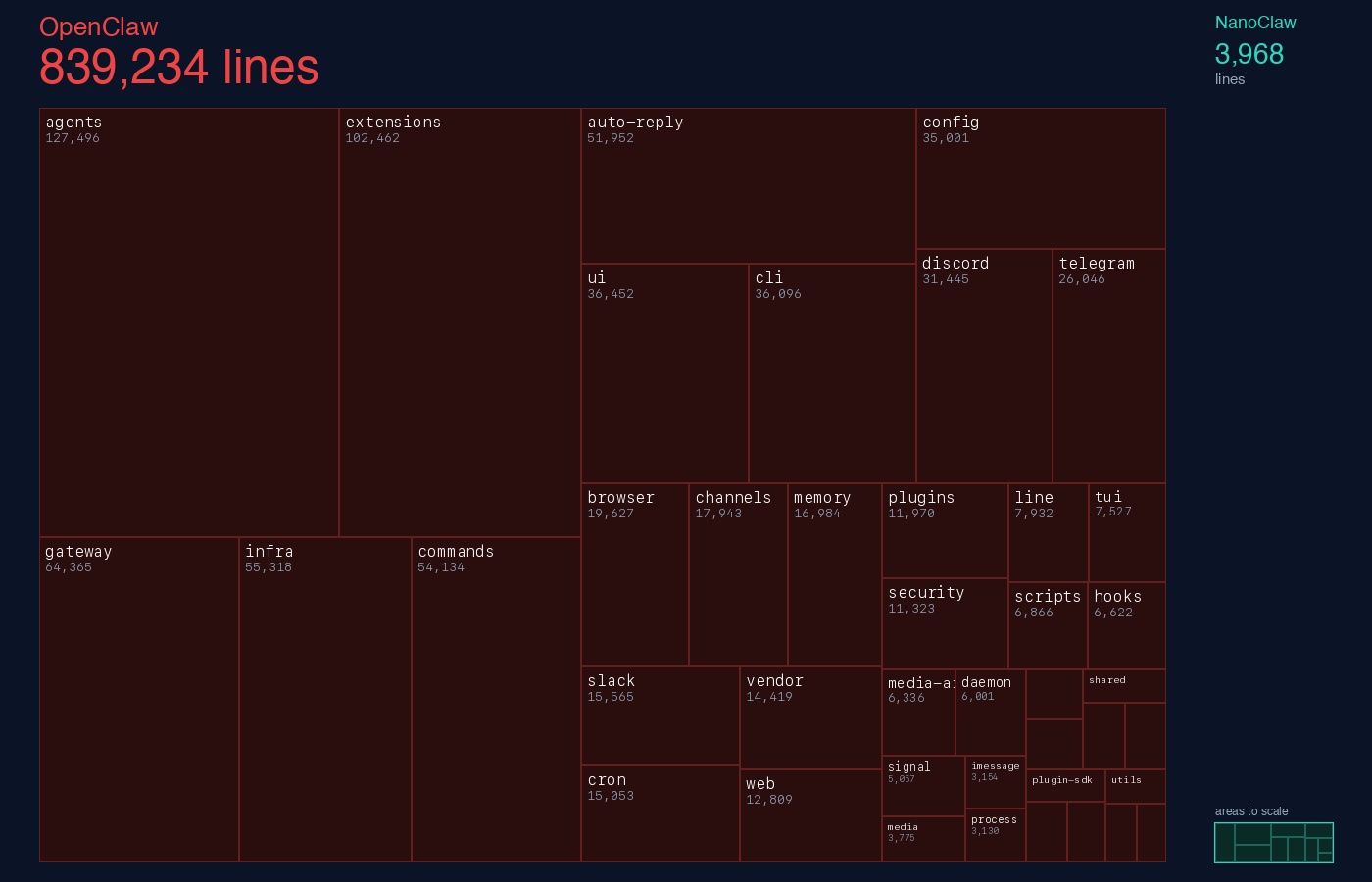
NanoClaw is one process and a handful of files. We rely heavily on Anthropic’s Agent SDK, the wrapper around Claude Code, for session management, memory compaction, and a lot more, instead of reinventing the wheel. A competent developer can review the entire codebase in an afternoon. This is a deliberate constraint, not a limitation. Our contribution guidelines accept bug fixes, security fixes, and simplifications only.
New functionality comes through skills: instructions with a full working reference implementation that a coding agent merges into your codebase. You review exactly what code will be added before it lands. And you only add the integrations you actually need. Every installation ends up as a few thousand lines of code tailored to the owner’s exact requirements.
This is the real difference. With a monolithic codebase of 400,000 lines, even if you only enable two integrations, the rest of the code is still there. It’s still loaded, still part of your attack surface, still reachable by prompt injections and rogue agents. You can’t disentangle what’s active from what’s dormant. You can’t audit it because you can’t even define the boundary of what “your code” is. With skills, the boundary is obvious: it’s a few thousand lines, it’s all code you chose to add, and you can read every line of it. The core is actually getting smaller over time: WhatsApp support, for example, is being pulled out and packaged as a skill.
If a hallucination or a misbehaving agent can cause a security issue, then the security model is broken. Security has to be enforced outside the agentic surface, not depend on the agent behaving correctly. Containers, mount restrictions, and filesystem isolation all exist so that even when an agent does something unexpected, the blast radius is contained.
None of this eliminates risk. An AI agent with access to your data is inherently a high-risk arrangement. But the right response is to make that trust as narrow and as verifiable as possible. Don’t trust the agent. Build walls around it.
You can read NanoClaw’s source code and full security model; they’re short enough to read in an afternoon.
Yes, they know how the feature they work on relates to other features, but actually implementing that feature is very often mostly involves fighting with technology, wrangling the entire stack into the shape you need.
In Brooks’s times the stack was paper-thin, almost nonexistent. In modern times it’s not, and adding someone who knows the technology, but doesn’t have the domain knowledge related to your feature still helps you. It doesn’t slow you down.
One may argue that I’m again pointing to the difference between accidental and incidental complexity, and my argument is essentially “accidental complexity takes over”, but accidental complexity actually does influence your feature too, by defining what’s possible and what’s not.
Some good thoughts (not mine) on the modern boundary between accidental and incidental complexity: https://danluu.com/essential-complexity/
Those extensions don't modify the core codepaths for what they integrate with, but still provide new capabilities for only what I want to use.
I guess I don't see extensibility, agentic capabilities, and more code safety (and fewer tokens burned on codemods) as mutually exclusive. Not saying you're saying that fwiw.