2University of Illinois Urbana-Champaign
Abstract
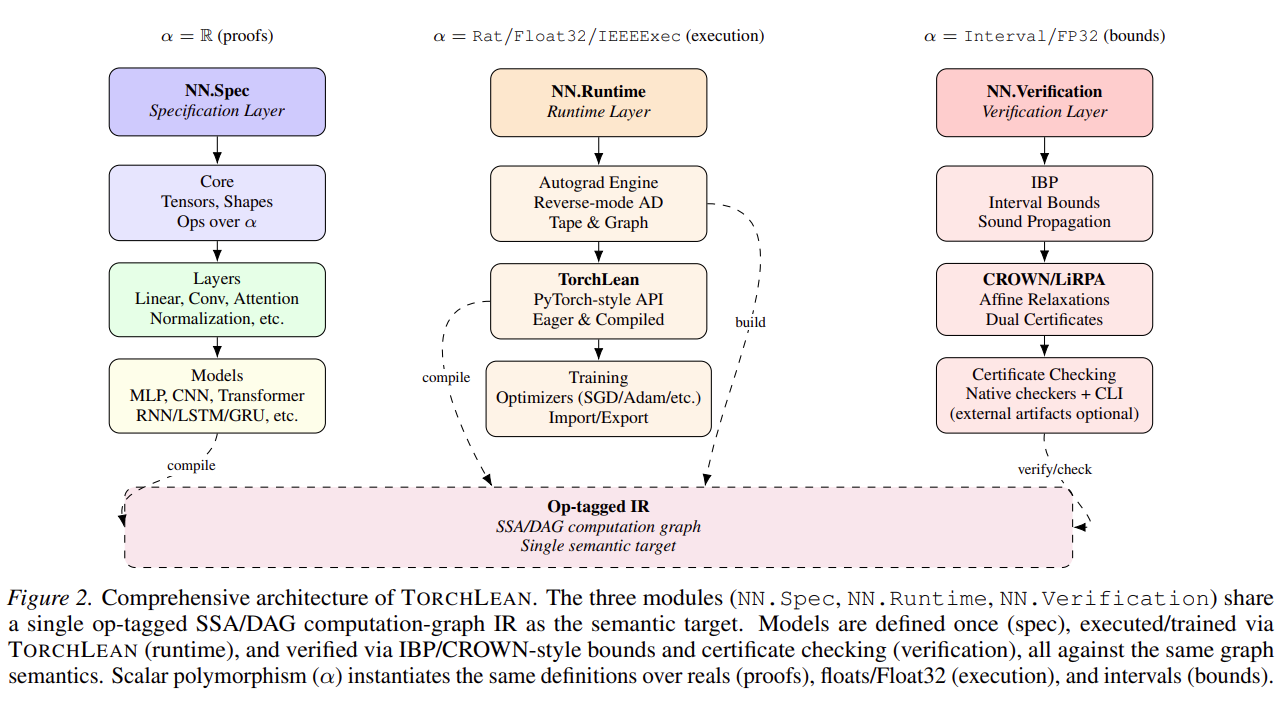
Neural networks are increasingly deployed in safety- and mission-critical pipelines, yet many verification and analysis results are produced outside the programming environment that defines and runs the model. This separation creates a semantic gap between the executed network and the analyzed artifact, so guarantees can hinge on implicit conventions such as operator semantics, tensor layouts, preprocessing, and floating-point corner cases. We introduce TorchLean, a framework in the Lean 4 theorem prover that treats learned models as first-class mathematical objects with a single, precise semantics shared by execution and verification. TorchLean unifies (1) a PyTorch-style verified API with eager and compiled modes that lower to a shared op-tagged SSA/DAG computation-graph IR, (2) explicit Float32 semantics via an executable IEEE-754 binary32 kernel and proof-relevant rounding models, and (3) verification via IBP and CROWN/LiRPA-style bound propagation with certificate checking. We validate TorchLean end-to-end on certified robustness, physics-informed residual bounds for PINNs, and Lyapunov-style neural controller verification, alongside mechanized theoretical results including a universal approximation theorem. These results demonstrate a semantics-first infrastructure for fully formal, end-to-end verification of learning-enabled systems.
Key Contributions
- PyTorch-style verified API in Lean 4 with eager and compiled modes that lower to an op-tagged SSA/DAG computation-graph IR.
- Explicit Float32 semantics via an executable IEEE-754 binary32 kernel and proof-relevant rounding models.
- Verification via IBP and CROWN/LiRPA-style bound propagation with certificate checking.
- End-to-end validation on certified robustness, PINN residual bounds, and Lyapunov-style neural controller verification, plus mechanized theory results (including a universal approximation theorem).
System Modules
TorchLean is organized around three tightly integrated modules that share a single formal semantics end-to-end:
TorchLean (Frontend)
- PyTorch-style API for defining models, layers, and training/inference code directly in Lean.
- Eager execution for rapid iteration plus a compiled mode that lowers to an op-tagged SSA/DAG graph IR.
- A single representation used by execution, analysis, and proof.
Runtime (Semantics)
- Executable Float32 semantics via an IEEE-754 binary32 kernel (
IEEE32Exec). - Proof-relevant rounding models to make numerical assumptions and trust boundaries explicit.
- Eliminates “semantic gap” between what runs and what gets verified.
Verification
- Native IBP and CROWN/LiRPA-style bound propagation over the shared graph IR.
- Certificate checking to validate computed bounds inside Lean.
- Supports robustness, PINN residual bounds, and control-oriented safety/stability (Lyapunov-style) verification.