Seriously, woo!
Do you have children?
In past HN threads, the preference largely comes down to whether you have children (and want more early morning light for safer trips to school) or not.
Now, 13 month calendar with each month 4 weeks, on the other hand..
Absolutely not. It was a compromise tempered by practical and political considerations.
The reason is that with standard time, solar noon coincides with local noon, so the day is approximately symmetric about noon, not regarding atmospheric refraction lengthening the day. It wasn't done on a whim.
But also, all the opinion polling (business and individual) was like over 90% in favour of year-round daylight time, so here we are.
Now, standard business hours (9-5 or whatever) were probably chosen for working well in the circumstances where they became standard, and it might be interesting to watch for whether tweaking the clocks leads to tweaking the nominal time of things...
The last time we went to year-round DST, we stopped almost immediately because people experienced what winter DST was actually like and went "wait, this sucks."
1 metre can be 100cm or 200cm depending on the season and your location
Most of the time people conflate longer summer days with DLS.
The situation with dark mornings is winter not standard time.
My children are already waking to school in daylight this time of year prior to the switch to DLS.
As others have said. I would rather permanent standard time but I’ll take permanent DLS. Moving the clocks twice a year is insanity.
Selfishly, I just want as much daylight as possible, which has very little to do with how a government selects a time range for legal reasons. The rotation of the globe has not been yet controlled, as far as I'm tracking.
Alas, I don't see my preferred method of changing the clock by 10 minutes every month taking hold. Basically ever. :D
I also don't think this is nearly as important for places that are not further away from the equator. If you are on the equator, you are almost certainly fine with no change throughout the year.
I always find it strange how particular people are about the numbers attached a purely astronomical phenomena(myself included, but I am pretty hard in the "let the sun figure it out camp"). If they want more "daylight" hours then get up at a time to enjoy them. But people would rather bend over backwards fiddling with the numbers as if that is going to change how long a day is.
(i.e. the time 12:00PM should be when the sun is overhead)
I'm not a "capitalism gives you brain worms" kind of person, but the idea that it is somehow better to literally change the location of the sun in the sky because the holy hours of 9-5 are sacrosanct is so strange to me.
Farmers have to wake up early because their animals wake up at sunrise and some tasks are best performed at that time. So they wake up before sunrise regardless of the clock time.
Human, like farm animals, are better off if they wake up at sunrise and go to sleep in full dark. At the equator that's easy, wake at 6, bed at 10PM. And standard work hours are 7-3 or 8-4.
The song is about a secretary who didn't get a lunch hour, so started an hour later than her boss.
Tech workers generally start at 9, but that started decades after the song came out.
I think this would make way more sense, when they say the Olympic Opening Ceremony start at 18:00, its 18:00 for everyone around the world. No one as to work out which TZ Italy is in or scheduling meetings with Tech Support in far flung locales does not require knowing IST is how far ahead or behind.
That's the perfect way to say it.
The other piece that a lot of people are missing is the whole larks (early risers) vs owls (late risers) divide. I think the best illustration of that is to ask, if you got your pick, which shift you'd take, based solely on your own body and habits: 8-4, 9-5, or 10-6 (or perhaps even further in one direction)? My guess is that the answer to that question predicts your desire for Standard or Daylight time pretty well.
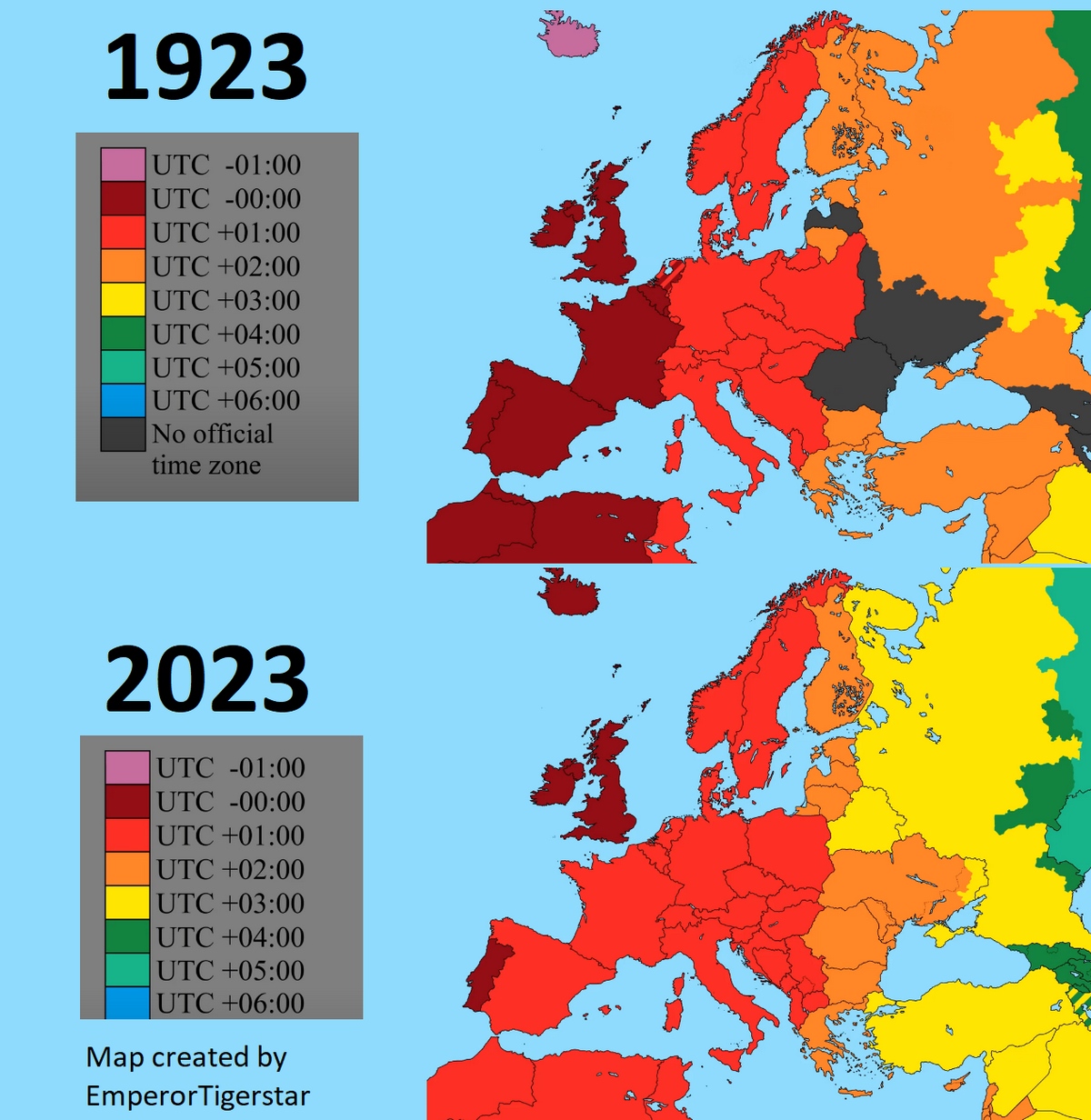
Why? because they decided to be on the same timezone as our eastern neighbors in Europe. The eastern part of Polonia is on the same timezone and probably have probably the opposite with much much earlier lunch and dinner than we do.
And yes, we could have all the schools and everything else open later in the winter than the rest of the year, but it turns out it's easier to change the clocks.
> He promoted worldwide standard time zones, a prime meridian, and use of the 24-hour clock as key elements to communicating the accurate time, all of which influenced the creation of Coordinated Universal Time.
The one bit where this would be problematic would be "what day is it?" When does today become tomorrow?
There are a lot of systems that we've built that depend on that distinction. Things like business days and running end of day so that everything that happens on March 2nd is logged as March 2nd. I've encountered fun with Black Friday sales where the store is open over the midnight boundary and the backend system really wants today to be today rather than yesterday (sometimes this has involved unplugging a register from the network so that it doesn't run end of day, running EOD on the store systems, and then plugging the register back in after it completes and then running a reconciliation.).
Other than that particular mess of banks and businesses... yea, running everything on UTC would be something nice in today's world.
---
This is also kind of what happens in China (with a complicated history). https://github.com/eggert/tz/blob/main/asia#L272
https://en.wikipedia.org/wiki/Time_in_China UTC+08:00 is observed throughout the country even though it spans about 60° of longitude.
---
Aside on the "changing clocks" and realizing my flexible schedule privilege at a company I worked at I switched my schedule from 8-4 to 9-5 with the change in daylight savings so that I maintained a consistent "this is the hour I wake up".
Yes.
> and that we should all just use UTC and ...
No. that does not follow. Abstraction is useful. Having commonly understood terms (in this case hours of the day) that share certain traits regardless of where you happen to be in the world facilitates communication.
My guess is that owls will say they prefer permanent daylight time and larks will say they prefer permanent standard time.
But their revealed preference is the opposite -- owls wake up well after sunrise and go to bed well after sunset. Yet permanent daylight time will shift it so they'll be waking up closer to sunrise and going to bed closer to sunset.
Larks revealed preference is more like permanent daylight time yet I think they're more likely to say they want permanent standard time.
-----
https://vividmaps.com/wp-content/uploads/2024/02/time-zones-...
The old borders aligned with the sun a lot more, so we can blame that on WW2 as well.