Yeah, just as I can "choose" to root my Android phone. I can do that, yes, but the result will be that Netflix, banking apps and most games refuse to even start.
TIL those exist (genuinely).
I’ve never met anyone who likes windows, just people who put up with it for work/gaming and people who doesn’t care about the whole thing enough to move from the default (which is totally understandable).
A long time ago, I used "7+ Taskbar Tweaker" that added a lot of nice things to Windows 7, like reordering the tasks in the taskbar. Now I'm remembering that the best feature was to ungroup the windows of the same task, that was super nice to edit two documents in Word
It used a lot of magic, probably overwriting dll calls in the kernel of Windows. It looks like it only partially support Windows 11 https://ramensoftware.com/7-taskbar-tweaker
- Slick Window Arrangement (better window snapping): https://windhawk.net/mods/slick-window-arrangement
- Better file sizes in Explorer details: https://windhawk.net/mods/explorer-details-better-file-sizes
I've completely disabled explorer.exe from running; among other things it disables the win11 openwith dialog from opening. Replacing with the win10 onew orks, but it'll regularly be replaced with the 11 one by Windows. Any solutions?
It's a corporate operating system, not a user operating system. If you want to customise your desktop experience and have a stable time of it - this is not your platform, sorry. There is really only one platform for customisation: linux. Because distros and software there have been _designed_ around user choice.
Hacks are cool, but inevitably open up vulnerability pathways, not to mention issues with stability and being able to receive security patches, rolled into windows update. It's fine if it's just a personal pc you can reload at any point, but it's pointless for a machine that you require to keep functioning (eg a work machine, or, my personal machine, which does stuff like organise media on a regular basis).
Back in the day you could use nLite and the like to replace W98's shell with the Windows 95 one, but keeping the compatibility. On GNU/Linux and BSD, you could use FVWM instead of bloated environments, or Fluxbox, IceWM... and still run things fast.
With current Windows tons of components are interleaved.
To give an example: I use AutoHotkey, it's a scripting language for Windows that allows you to do a bunch of things. You can customize the keyboard, mouse, you can create menus and toolboxes, you can target specific applications inside. It's a fantastic tool. But it isn't available for Linux for obvious reasons; Linux is much more fragmented. You need like 3 or 5 different programs to achieve the same result in some cases, depending on your given script.
In other words: debloating Windows and customizing it is considerably easier than installing Linux. Let alone some really good software you end up finding along the way: Everything, which is an amazing search program that allows you to create custom categories and the like. EmEditor, which is really good software to open and visualize really large text files, like it can open a 4GB txt with no problems.
About the last sentence:
>If customisability is important
People value both things: customisability but also they value their time (of not having to come up with a new workflow), they value the programs and workflow they already learned to use through the years, and so on and so forth.
But I rarely use Windows. I used to like it but for me XP was so ugly and bloated I switched to Linux and OS X full-time. I've never looked back.
I just play occasionally to keep my skills vaguely current. Sometimes I need to work with it.
Windows 11 is awful. Bloated, full of ads and nags, forcibly keeps your stuff in the crappy MS cloud drive for which there's no Linux GUI client.
You can't even put the taskbar on the left edge where it belongs.
Worse than Vista or Win ME or even Win 8.x.
I moved all my emergency Windows partitions to Win10 IoT LTSC. Quite unbloated, proper local accounts, no Store, no Onedrive, no Modern apps at all. It's what Win10 should have been.
And it's getting updates until 2032.
So, Windhawk looks fun but I don't need it.
Why is this not possible.
He was also really good at Microsoft Word, unironically - he made extensive use of custom styling and could format an assignment paper in like 30 seconds. He was super useful in group projects.
At least older versions of Windows were quite modifiable: not as radical as on GNU/Linux, but there were a lot of possibilities.
Rather with the arrival of smartphones and rising popularity of macOS (which all were rather about "enjoying" a prescribed user experience), Microsoft did a U-turn and started applying this (anti-(?))pattern to Windows, too.
You can also add shortcuts to folders in the taskbar and use Win+Digit to open them.
Way to make me feel old! I'm still using it!
> …to Windows 7
Aah that's better.
The tool still works on 10 btw, and offers some options not available otherwise - eg properly narrow taskbar when vertical (about small icon width wide).
So since every major Windows update functions as a core OS reinstall, your hacked setup will be restored to a clean slate.
You have two choices: Accept this limitation or move to another OS, there's no in-between.
If it's not for some specific games or programs, I don't see a single reason to still use Windows in 2026.
I used to laugh at the LaTeX masochists in college spending 15 minutes just to put a picture where they wanted the picture to be. They had to add like four 1-character modifiers to the "insert image" command, each of which meant "yes, really here", "no, don't move it to the next page" and "nono, really really here".
MS Word is properly great if you only use the custom style rules (basically CSS classes) at the paragraph level, and never directly apply styling (basically inline styles) except for super basic stuff like making a word italic. Has great referencing tools etc, fantastic formula editor and so on. And, well, you can use ultra modern human-machine interaction technology such as a mouse to choose where a picture goes and how big it is.
(They might've enshittified it since; the last paper I wrote was in 2010 and Word was pretty damn decent back then)
There is a difference between grouping and combining, and 7TT provided many more options.
This was a major concern for me when I first installed Windhawk, too.
Since I only use a couple mods for Explorer, I ended up simply excluding every process from injection and explicitly including explorer.exe only. This can be done by going to advanced settings, setting the process exclusion list to nothing but an asterisk, and then adding explorer.exe and any other specifically desired processes into the inclusion list.
I've done it before on Windows 7. Resized system clock, resized start menu button, removed "Terminate batch job (Y/N)?" warning in cmd, etc.
Most annoying is that VirtualBox stops working with the patched uxtheme.dll.
...
Life on Linux is great. My modifications stick for as long as I want. Permanently if I get my patches upstream.
That said, for work I've switched to Linux full-time years ago. Native containers are a killer feature for me, and the different UX and driver/dependency/repository issues aren't significant enough to make me want to go back to virtualization in Windows.
A huge chunk of the population can’t afford to make that jump, or don’t have the will to learn a new OS.
The article mentions ExplorerPatcher -- the changelog [1] of that project is informative. Every release involves fixing a bunch of things that Microsoft broke, intentionally or not. Some of this is understandable given how it (necessarily) messes with low level OS components, but there is still zero transparency and you just need to roll with whatever changes. I can't imagine doing that kind of work anymore.
These days whenever I use Windows I install bash and use a terminal so I don't really care about the window management, other than maximizing windows.
They're not like a car enthusiast who loves their MX5 out of its sheer beauty and feel, but rather they love their SUV because of it's big boot and because it gets them where they need to be, and thus are perfectly happy to tear out the old radio and uncomfortable seats.
The only difference is that car enthusiasts have many more options to choose from, while in OSes, if you're stuck with Windows, you're usually really stuck with it. Linux is certainly an option, but not one that is universally practical to apply.
I'm pretty much still on the same setup now, Win11 plus touchscreen. You'll pry my touchscreen out of my cold dead hands. How will I rage-close a "try chrome" popup without a touch screen? You ever try to rage click something with a touchpad? Total non starter.
MS word also has character styles (like a CSS style on a <span>). IMO you should use instead of bold or italic.
(There are three more types of styles: linked, table and List. See https://office-watch.com/2022/word-five-types-styles/)
For most people I'm sure computers are a tool not an identity.
And then I use my touchpad to switch between virtual desktops and the jerky animation reminds me why I prefer to run non-game Windows applications remotely from a Mac.
But yeah for layout, ie headings and the likes, only ever use the styles, never "bold, bigger bigger bigger". Don't touch the line spacing button, etc etc.
IMO Word could do with a mode where those buttons are simply hidden. Want a bigger, fatter heading? Edit the heading style. There's no other way.
Personally, I wouldn’t want to have it automatically, because sometimes you have really long file names, or other columns that can get arbitrarily wide. There would also have to be a configurable maximum column width.
Have you ever heard of Windhawk? It’s a cult-favorite Windows tweaking tool I’ve been dabbling with for years, and I’ve had readers ask me about it. If you dig through Windows enthusiast communities — on Reddit, in forums, and elsewhere — you’ll find lots of people chatting about Windhawk and sharing how they use it to customize their PCs.
In short: It’s a free tool that lets you install “mods” for Windows and the applications you run.
I’ve been thinking a lot about Windhawk as I contemplate why Microsoft is pursuing the Windows Baseline Security Mode, too. So let’s talk about Windhawk — and the future of Windows.
Imagine moving the taskbar, theming the Start menu, customizing the taskbar clock, making desktop windows translucent, and just generally changing the way Windows and the applications you use behave.
For example, I love making better use of my mouse wheel. With Windhawk, I can activate a mod that lets my switch between browser tabs by rolling my scroll wheel over my browser’s tab bar in Chrome, Brave, Edge. I can install mods that let me position my mouse wheel over the Windows taskbar and scroll to adjust the system volume, too. (You can view the full list of Windhawk mods here.)
Want to theme your taskbar or Start menu so they look totally different? In the screenshot below, I’ve turned Windows 11’s taskbar into a dock-style experience with a transparent background with a few clicks.
[
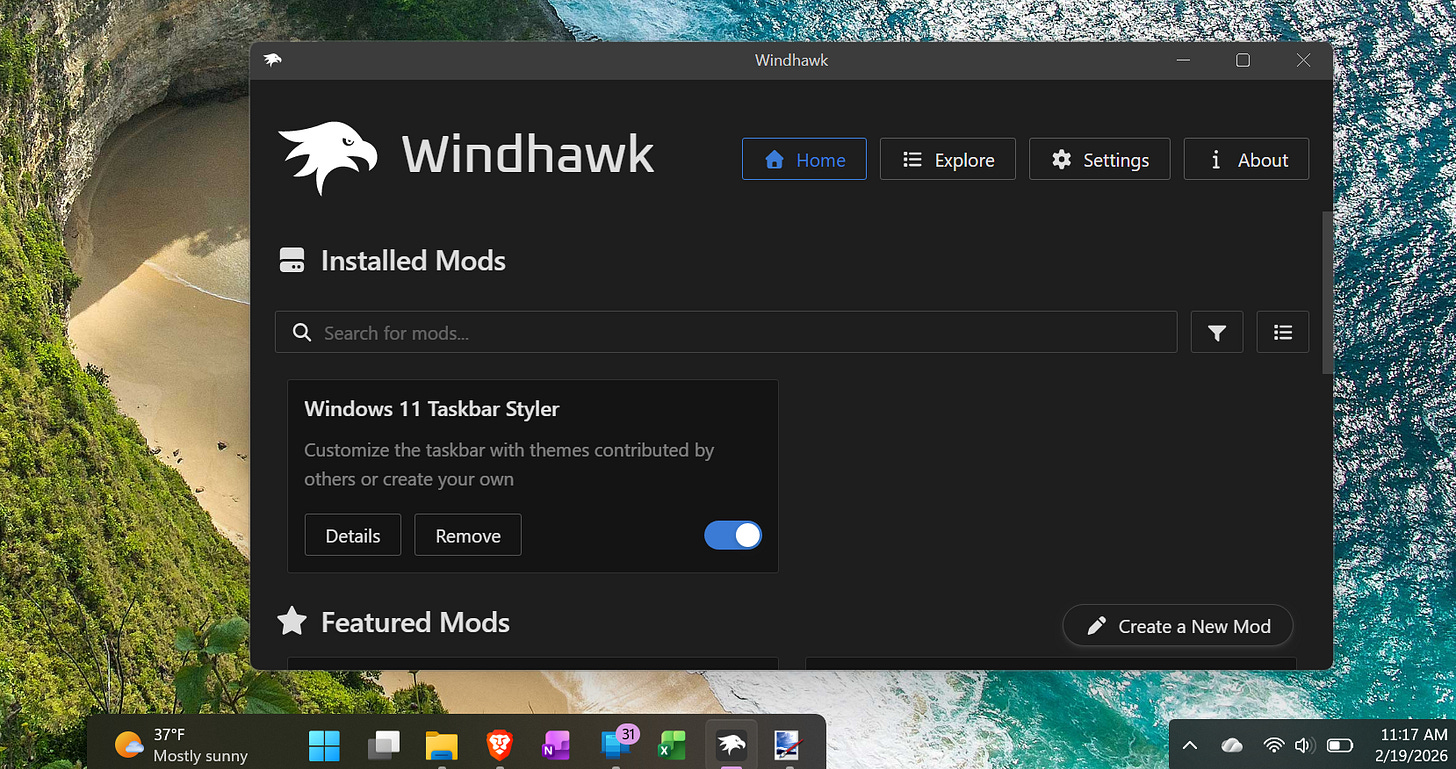
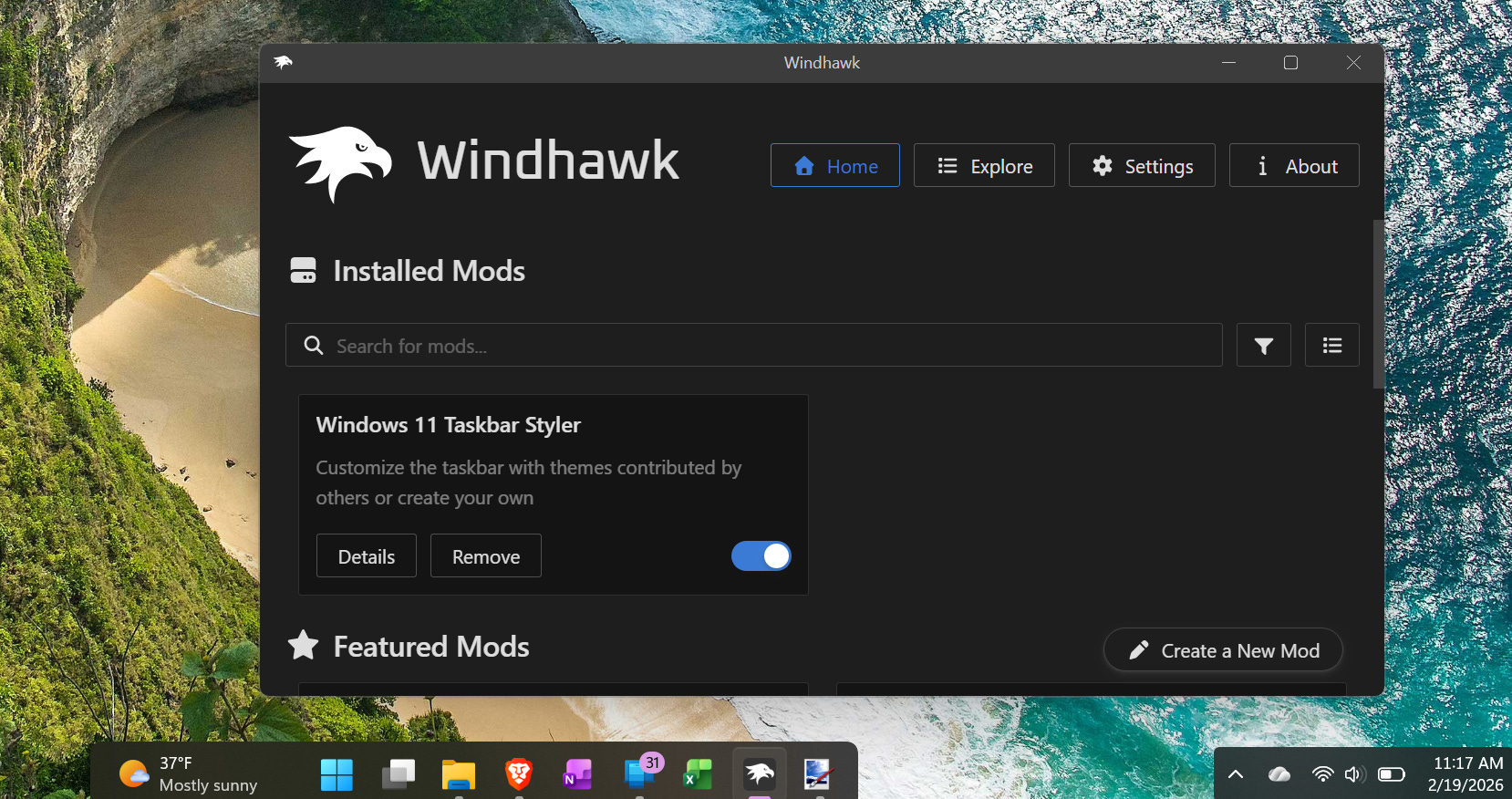
This is awesome. It’s the kind of power that, philosophically, should be available to all PC users out of the box. We should be able to deeply customize how our PCs work. Instead, we’re often fighting product decisions made by distant marketing departments.
Witness Windows 11’s taskbar, for example: While Microsoft will finally make the taskbar movable once again, it took 4-5 years of Windows users begging for this feature to come back before Microsoft decided to begrudgingly return it.
[
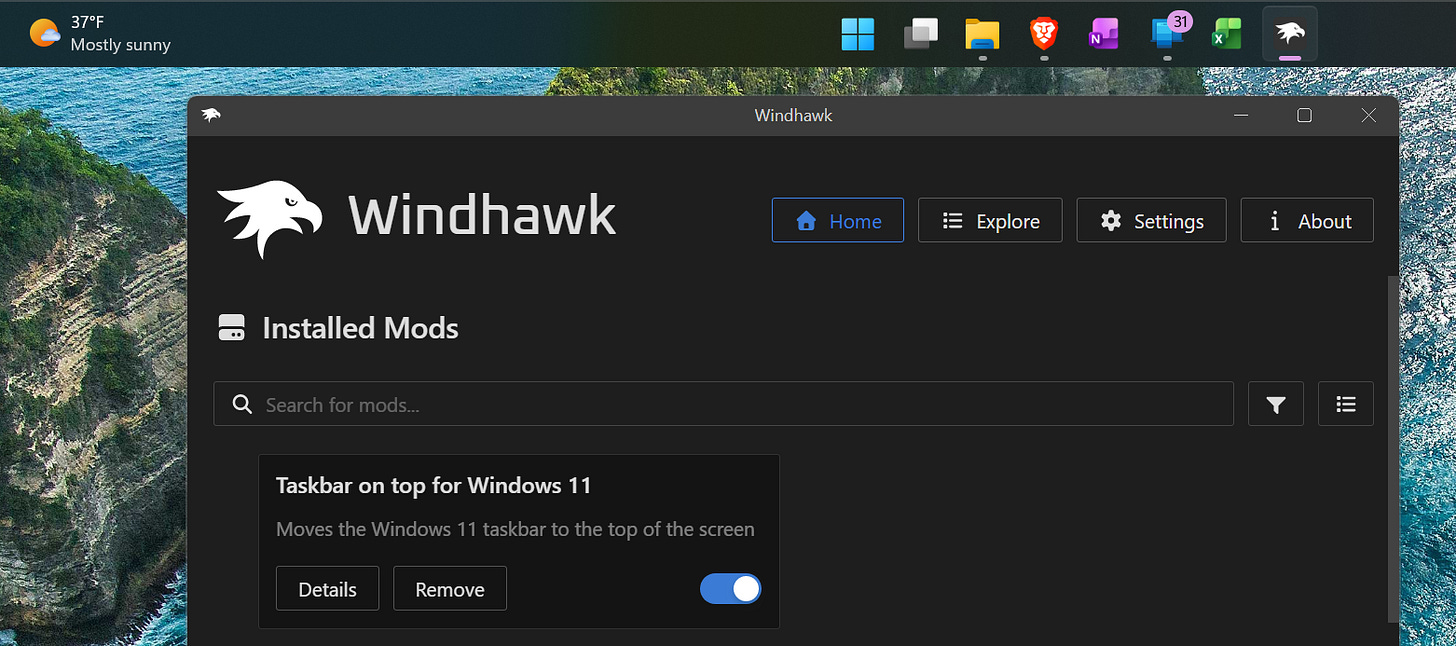
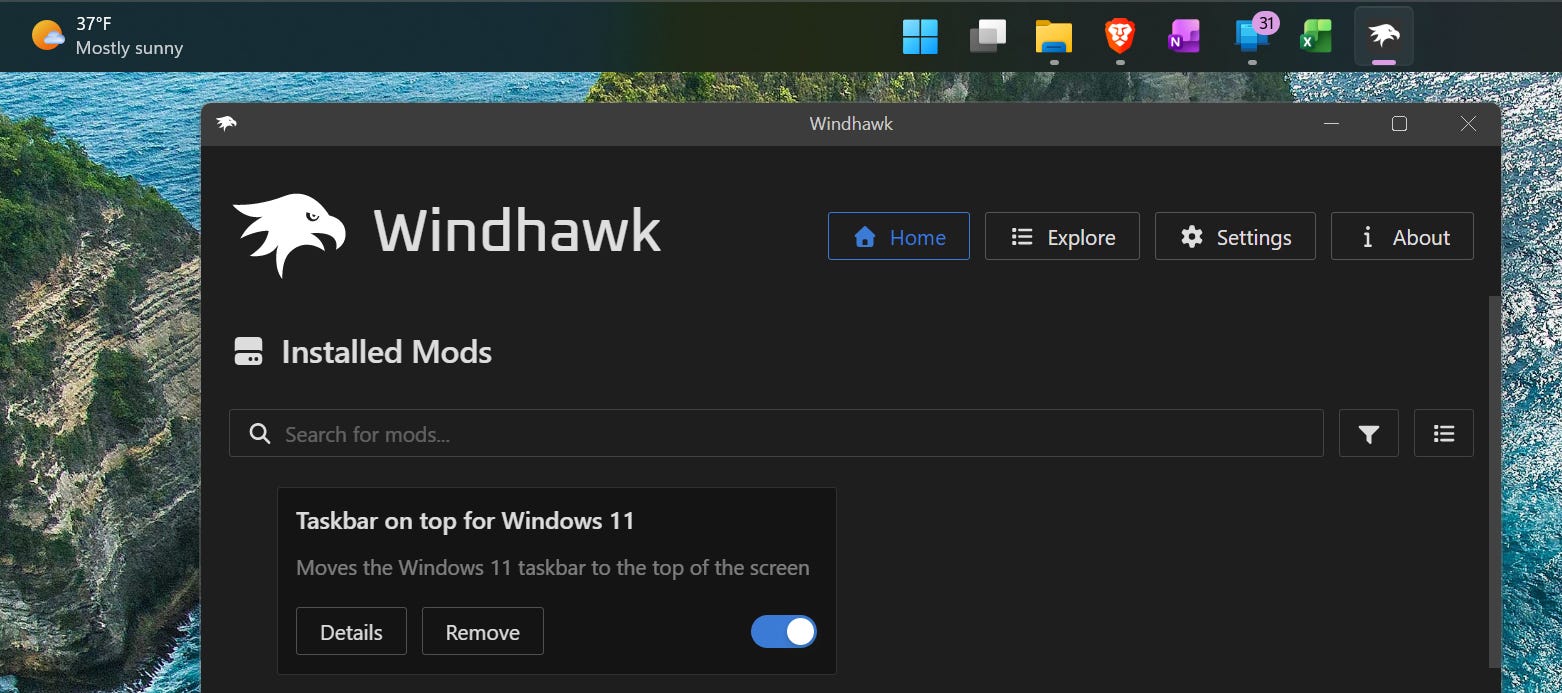
But, although it works, Windhawk isn’t perfect. In fact, as a tech journalist, I can’t “recommend” everyone download and use it. Instead, this piece isn’t a software recommendation: It’s an honest discussion of why Windhawk is awesome — and why you should be careful before using it, anyway.
It’s also a perfect example of the difficult spot Microsoft is in with Windows — trying to serve both people who want to run software like this on their PCs and people who wish their Windows PCs were locked down tight.
Windhawk functions by injecting its DLL into most processes running on your system. If you’re familiar with Windows, this is already enough to get you at least a little uncomfortable — what does that mean for stability and security? (Here’s the official technical look at how it works and what it does on your PC.)
You can customize that behavior, if you want. But, while the developer says most programs are compatible with Windhawk, it’s possible you may run into bugs and find yourself tweaking its settings to fix problems.
Windhawk may also cause serious problems with PC games that use anti-cheat software. On the project’s explanation page I just linked, there’s a description of how Windhawk hardcodes the default installation paths of many PC games. If you installed games to a different folder — perhaps your Steam folder is on your D: drive — Windhawk will load its DLL into those game processes. You’ll have to go out of your way to exclude that folder to stop it.
As Windhawk may look similar to a cheating program that injects itself into multiplayer games to tamper with gameplay, it could — conceivably — even get your account banned from online play in some games.
The good news is that Windhawk and its mods are both open-source. Windhawk is created by Michael Maltsev (Ramen Software), also known as m417z, who also created 7+ Taskbar Tweaker. Unlike many unknown developers with sketchy GitHub projects that may contain malware, Windhawk has as good a pedigree of trust as you’ll find with a tool like this.
The bad news is a usual open-source problem. Yes, Windhawk’s mods are all open-source, and you can view their source code yourself. But many of them aren’t written by the core developer. Do you trust them? Are you equipped to audit their security? Do you want to trust that these mods will behave as advertised and not cause problems? Are you sure they aren’t going to spy on you? I haven’t heard of a problem with Windhawk mods yet, but the potential risks here make me uncomfortable.
When you install a mod, Windhawk warns you that you should “install mods only from authors you trust.” Are you really equipped to make a decision like that? (If you stick with mods from the creator of Windhawk — m417z — at least you aren’t trusting an additional author.)
[
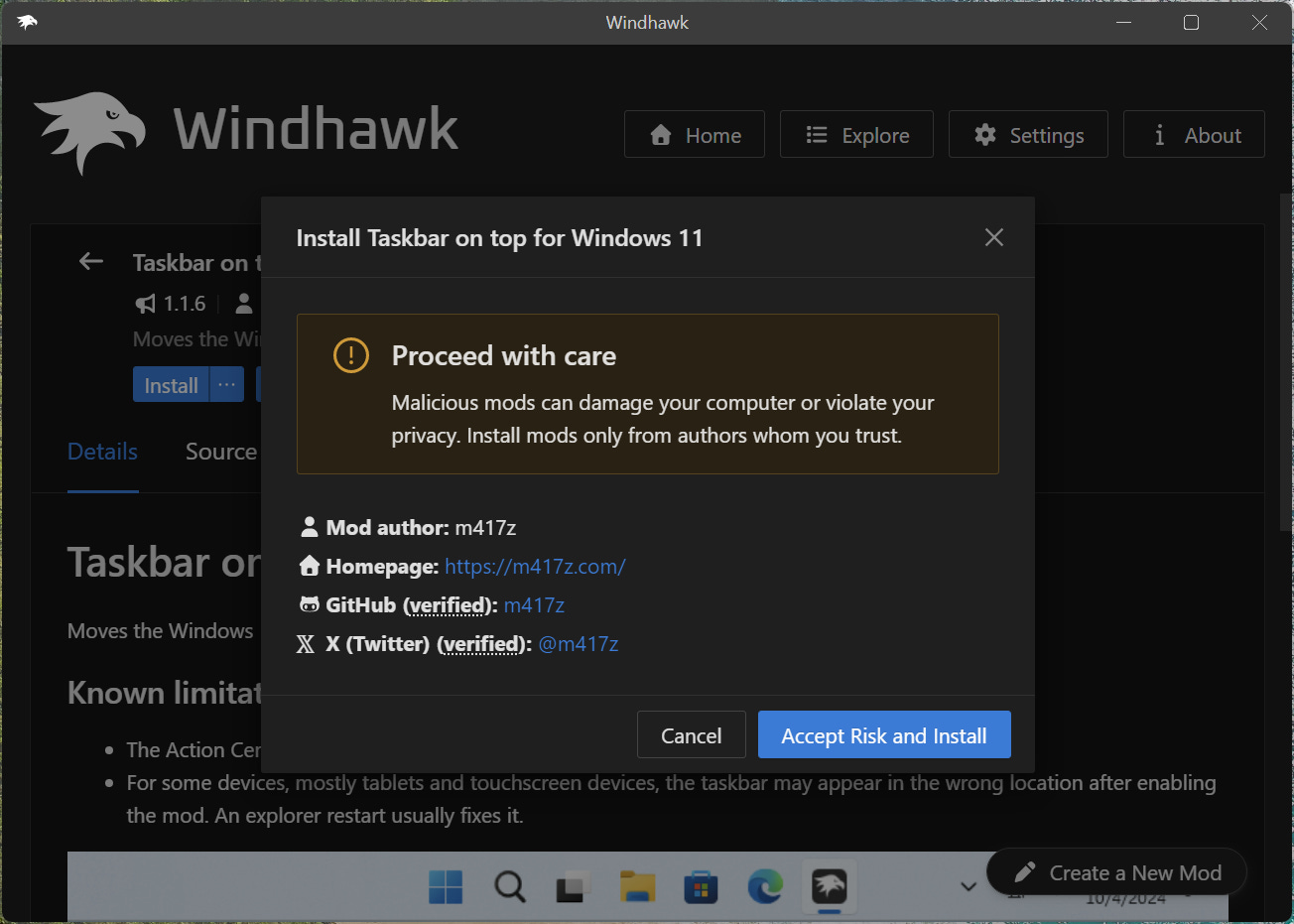
So where does that leave my recommendation? All of what I’ve written above is true and accurate to the best of my knowledge! It’s a mixed bag — a complicated picture — and you get to make up your own mind. If I was a Reddit commenter or dropping in on a forum, I might say “Windhawk is awesome. I haven’t had any problems with it.” And that would be enough.
But as a journalist writing for a broad audience, I have a responsibility to pause and say that I can’t exactly recommend you run this. I can’t tell you not to run it, either. Michael Maltsev has done a good job with this program, and it’s been around for a few years now. But it’s also not something I can vouch for — you proceed at your own risk if you use it.
Windhawk is a perfect example of the power of Windows — and how it can be dangerous.
A locked-down operating system — like Microsoft’s Windows RT — wouldn’t allow you to do anything like this. You’d have to use Windows and your applications as designed. No extra tweaking allowed! But there’d be no risk of instability or other security problems with tools like Windhawk.
In a sense, Microsoft has created the need for tools like this one by refusing to give Windows users the options they want. The taskbar is the perfect example: There’s a whole ecosystem of third-party tools for moving the taskbar — from Windhawk to ExplorerPatcher and Stardock’s Start11 — that are necessary because Microsoft has, for years on end, refused to offer this option. They can cause problems and other bugs. Thankfully, Microsoft is finally relenting on this point, and Windows 11 will soon let you move your taskbar without installing a third-party app.
But other customizations — like taskbar and Start menu themes — will still require third-party tools like Windhawk. Microsoft can never deliver every feature people want as part of the Windows operating system. It’s just not possible.
Windhawk makes me think about the future of Windows, too. Microsoft is talking about a “Windows Baseline Security Mode” that PCs will be in by default, only letting properly signed software run and forcing apps to ask for your permission when they access your files, webcam, microphone, and other resources. According to Microsoft, this will only be a default — you can choose to opt out.
Some people will want to install Windhawk and other tools, treating their PCs as a glorious customization sandbox — even if there’s a risk of breakage. And some people will want Windows locked down tight, ensuring their data is secure — even if their PCs become less customizable.
Going forward, I hope Microsoft will continue offering both options. Your PC should work how you want it to work. Everyone should be able to make their own choices.
As always, I’m sharing the latest links from Paul Thurrott’s website — I’m grateful to have his endorsement! And I recommend following his work if you want to understand Windows — and technology in general.
This week, there’s some Windows Insider Program news. Canary builds are getting extra confusing. And Beta and Release Preview builds delivered a few small new features.
But the big pieces this week are Paul’s guides to “de-enshittifying” your Windows 11 PC for Thurrott Premium subscribers. He’s written up guides to cleaning up a fresh install, purging an existing install, and making Windows 11 respect your privacy. These will also be part of a full book he’s releasing soon!
🦅 Anyway — that’s all for this week. Good luck with the Windows tweaking, whether or not you decide to experiment with tools like Windhawk!
No posts