Look at the parallel tracks. A VP is the same level as a distinguished engineer, roughly. To be a VP, you have to be a great manager and got lucky with a few big projects.
To be a DE, you basically have to be famous within the industry. And when I look at a large tech company, while there aren't a lot of VPs, usually the number of DEs is countable on one hand (or maybe two).
They are very different skill sets. You shouldn't choose your role based on money or career progression, you should choose based on what you love to do, because especially in this world of AI replacing all the "boring" work, the only people who will be left will be the ones passionate about what they are doing.
A lot of strong engineers move into EM roles expecting deeper technical impact, but end up spending most of their time on coordination, hiring, performance reviews, and cross-team alignment. That’s valuable work — just very different from building systems. More orgs should invest in strong IC tracks (Staff/Principal) so people can lead technically without managing people. Not everyone who’s good at engineering wants to optimize calendars and org charts.
- Don't move to Detroit
- Don't go into academia
- Don't use dating apps
- Don't buy Google stock
It's most obvious for the last one: you should buy Google (or any other) stock if you think it's underpriced and sell it if you think it's overpriced. But even for the other advice, a kind of Efficient Market Hypothesis holds. If there were a massive exodus of people from academia, causing universities to increase salaries and reduce administrative burdens, going into academia might be great for the right people. For many people Detroit is a terrible city, but I know a guy who worked for the Tigers, and bought a large house for a small amount of money, and did a lovely job renovating it, so Detroit worked well for him.
Life is all about finding underpriced value: options that you will appreciate more than others, for whatever reason.
I've been a staff engineer at Google and other companies, I have been an EM and a very senior IC at big and small companies.
If you're a very good IC, you can make a lot at a small number of good companies
If you're a relatively worse manager you can make a similar amount at many other companies
So the decision tree I would use is (focusing exclusively on compensation), if you're a very good IC, go somewhere willing to pay you >1M/year. If you can't get that you should be a manager
- if you transition from a technical role into this, beware your technical skills need regular usage to stay relevant. Not a show stopper for this role and I've had good non technical managers.
- Be ready for a lot of relatively short lived jobs as a CTO or VP Engineering. Many startups create engineering manager type roles around the time they start scaling struggling a bit. Maybe the founder CTO wasn't so good at management or whatever. You'll inherit a mess. And they might not like you after all. I've had a few friends facing a lot of churn in this role. Just one company after another, do ungrateful work, and then move on to the next. It can pay well but it's not stable work. And quite stressful. Some people get lucky of course.
- Make sure that this is really what you want to do the rest of your career and see the above two points.
If you find the right employer, then this can be a great role of course. I've had a few excellent engineering managers (some of them retired now) in my career. But I have heard of people burning out or getting a rough deal, repeatedly trying to do VP Engineering roles in messy startups/scaleups as well. I know a few more of those.
It seems smart at the time, and makes you more effective in the near term. But it might cause many of your skills to lose portability.
In my own team, I have seen ICs increasingly function like engineering managers, and even suffer some of the pitfalls of the role switch, as they change from reasoning about creating code to delegating to teams of software agents.
Increasingly, ICs are needing to understand the product roadmap more deeply, figure out how to spec a problem and constraints on a solution in the right way to get their subordinates to produce reasonable output, and be the communication bridge between other jobs functions and the entities actually producing the code.
I've also heard concerns of skill atrophy, as these team members spend less brain energy on language syntax, low level logic, etc, and more on interpreting abstract strategies to solving a problem and pattern matching those strategies against their software engineering wisdom.
If anything, ICs should consider that the skills that will make them successful managing agents might be the ones that have made first-level engineering managers successful: the ability to coordinate with other job functions, map implementation strategies to product and organization needs, and deliberately and carefully delegate and coordinate work of others writing the actual code.
This is the first time I've seriously considered swapping out of management. Not for any of the reasons the author says, but because:
- I don't feel as confident mentoring others through this period given how much the work is changing
- I find myself enjoying the work more
- EMs tend to have more difficulty justifying their existence at the best of times let alone a period of change like this
The AI world will still need EMs. It's just unclear what those EMs will be doing every day and how it will work.
Having been an IC for a long time usually enables me to support my team, or identify risks, lead projects and so on. However, since I never was an IC in the day and age of AI, I find that this experience is less and less applicable.
A significant part of what helps me increase impact of others is that I’ve „been there, done that“ and that’s going away right now.
I don’t mind - it’s exciting! But if I was an IC right now I would not switch tracks under any circumstances. There is so much more to learn directly in the trenches.
In fact that is the creator of claude code answering, not asking.
My technical skills served me very well in year 1/2, but once we started hiring enough people I could definitely feel my lack of experience.
Maybe big tech EM experience wouldn't have helped me a lot, the context is definitely very different, but at least it would have been some sort of baseline to draw from.
What tipped it for me is I spend most of my time managing agents now, why not manage some human agents too.
Also from my perspective, the article doesn't make any sense.
Working at big tech these days I see EMs and directors playing with AI, building tools, contributing to codebase through AI agents. Today when there's less hiring and building the org, becoming EM doesn't mean moving away from tech
> The ladder is very competitive
Just like on IC path. You think that being a great builder will move you from staff to principal role? Nope. It's about setting direction, aligning people, finding opportunities. A set of skills that's very close to what managers do.
> The pay is lower
When you compare EM against staff engineers. Is EM and staff the same level? In some companies, yes. In some companies, EM is at senior or between senior and staff. So yes, on average it will be lower than staff, but EM is not a promotion, it's a change of career path.
In any case, if someone's wondering whether they should try EM role given a chance, I still say: go for it. Going back has never been easier, a lot of companies now cuts manager roles and allows people to move back to IC, so if you have a chance to become EM and are curious about it, give it a try.
This is missing something... the friend wouldn't immediately become a staff engineer - that could take just as long, or longer, than a promotion to middle management.
At least where I am, the staff engineer equivalent (called Technical Fellow here) is considered Director or VP equivalent. In an engineering org of thousands, we have tens of these positions.
Or, if I've misjudged what "staff engineer" means, our next lower position would be principal engineer (typically 1 in 10-15 engineering ICs, roughly). And their salaries are in the ballpark of our engineering managers.
Anyway, all this sort of misses the point - it's two completely different jobs. I know plenty of people who don't want to manage people. Or tried and hated it. And plenty of people who are bored with coding and want a chance to put their management skills to work.
EDIT - grabbed this from another comment... - L1: Intern with undergrad degree - L2: Intern with graduate degree - L3: Junior - L4: Intermediate - L5: Senior - L6: Staff - L7: Senior Staff - L8: Principal - L9: Distinguished - L10: Fellow
We have fewer levels than that... - Engineering Intern - Engineer 1 - Engineer 2 - Senior Engineer - Lead Engineer - Principal - Senior Principal - Tech Fellow
So, staff is somewhere close to our Lead or Principal, who earn similar money as line managers. And only Principal+ are on a bonus plan (where all people managers are). For any of the lower ICs, a bonus is a rare thing (where for higher positions and managers, it's part of the comp package).
Perhaps the balance may tip one way or the others due to AI but something else will come along and tip it back again.
Do what you enjoy and are the most effective at.
I’ve barely gotten far enough to be drawn in by the article and then I get a giant popup (on mobile) to subscribe to read more posts like this.
Put it at the very end and I might. I’ve made it a habit to just exit the article whenever this happens. Nobody respects each other’s time in today’s internet, more intrusiveness = numbers go up.
Rant done
Although, I’m not disregarding his points. I’m just saying that this article feels less about the challenges of becoming an EM and more about the challenges of stepping down from EM to IC.
And, as you move up to Director and beyond, those higher often have much less to do with actual engineering than tasks that sort of surround the world of engineering - lots of organizing information and attending meetings.
I've seen too many developers who though they wanted to manage become victim to the Peter Principle [1].
There is nothing wrong with staying a developer, even if you're not "moving up" to some idealized title. If you like the work and you can tolerate the place you work, you're probably ahead of most people in our field.
The other part is that Engineering Manager is a terminal position, I've known a few people who were manager for 20 years without ever going to Director / Exec whatever, its just a competitive jump and mathematically most will never go up. This is ALSO true for Senior -> Staff and Principle though. But Engineering Manager positions often have more of an upside with bonuses / incentives than Engineers get.
Finally it is ultimately a career change, and that should be the primary factor to consider.
> But even if you don’t give in to the constant FOMO - it’s impossible to argue that the way we worked hasn’t changed. Almost every part of our work looks different, and will continue to evolve.
My experience is anecdotal, but this seems to be overblown. I'd say that almost every part of my work looks pretty identical to how it did a few years ago, and that the changes are relatively small in scope so far. Most of the arguments I've heard from those who advocate adopting AI tools are that the rate at which the tools are improving is exponential (or super-exponential, or whatever), which is a prediction about how it will change rather a claim that it has already reached a point that it's necessary. I don't pretend to have any expertise that lets me evaluate those predictions better than anyone else, but unless I happen to be a severe outlier, it seems like gross hyperbole to claim that every part of our work has already changed.
* It's a bad time to move away from tech
As a manager your role isn't to be the "best technical person" anyway. You still need to understand fast-changing capabilities of course. But you are managing people now, and the required skills are different. See below.
* The ladder is very competitive
It's always competitive, and in my experience it was the exact opposite - there were far fewer VP-level technical roles than VP people managers.
* The pay is lower (for senior managers vs. senior technical track)
Again, this is the opposite of my experience (besides at the first-line manager level, where pay was comparable.) Where I worked managers could quickly get paid more with more responsibility. I always thought it was because managing people is actually a lot less fun (at least for me it was.)
The biggest reason not to become a manager is because _it is a completely different job_. Although managers need to be technically competent, management skills are much more about people (and politics.) If that isn't your jam, then don't become a manager.
The real reason not to become an EM in 2026 is because AI makes our jobs 10x harder.
It continues to amaze me that becoming a manager of anything should mean moving away from it. The manager has to move away from the detail, but why should they move from the substance of the role. A legal partner has to stay up to date as much their staff, in fact a legal partner is often the only one who can answer complex questions. When I need complex advice on my statutory accounts I get referred to the Audit Partner, the most senior manager.
The manager at my structural engineers can still calculate a beam size, he is better at it than his staff.
So why in software should an engineering manager move away from tech? Isn't this just a sign of disfunction in those organisations rather than anything about the role. Is it this MBA idea that management itself is a profession, rather than being 'a higher level thinker than the others'?
And what do these managers even do if they have moved away from tech? Approve holidays and expenses? My personal theory is that in these kind of organisations a manager is the person who is better with PowerPoint than the other people!
EMs deal with friction and from my experience more output is more friction.
You have org leaders and businessy people putting their foot on the gas because AI is so productive and then programmers shipping 2-3x more code.
These two forces collide and you're stuck dealing with the friction so 10x the amount of initiatives you did before.
The friction is like sandpaper on sandpaper.
As we demand more productivity out of our devs, we’ll be demanding similar efficiency gains from our managers as well, and that means they’ll need to be doing more than just pushing paper and cheerleading.
So if you do go into management, keep in mind you can’t let your engineering skills atrophy… you now have to be good at both. There aren’t many people who can do both well, but companies will expect this moving forward.
You guys get time to play around? As lead/staff?
> You can be a great EM for years and find yourself stuck.
Better start now then, right?
Using OpenClaw as an example of exploding technology and why it's a bad time to move away from this (not sure how EM is a move away?) is ridiculous. And stating the career path is too competitive shows they don't really know what a true technical ladder looks like. Most organizations are going to have about as many staff developers as senior EMs and principal developers as senior directors. If it's stability you're after neither is particularly at risk in my experience, but I'd bet your CTO is looking to shake-up the domain of staff developers more than management with the AI hype train.
The critical piece here is the anecdotal (but true) insight that engineering orgs have been flattening over the last few years.
There are a lot of factors, but rarely discussed is the realization that senior engineers are completely capable and often willing of managing other engineers directly. The definitive text on this subject is literally called "Herding Cats" :facepalm:
In reality, senior engineers often have strong communication skills (albeit different than the styles of other management and leadership positions), very good time management, and likely can perform many of these 'soft skills' that engineering management is doing out-of-band from the teams directly responsible for shipping software.
The engineering manager role feels like it was borne out of a very west-coast ideology from another era responsible for removing agency from people based on dated stereotypes. There was a self-fulfilling prophecy wherein we said engineers aren't capable or willing to have agency to work across teams, manage resources, or communicate about career goals or blockers, and then plugged someone in the middle to take these activities away from engineers.
I'm exposed to a lot of teams with high-aptitude/techincal people that are not software engineers and almost never do you do see the equivalent of a traditional software engineering manager.
I wouldn't be surprised to see a continued and dramatic compression of these roles going forward.
Where do you work?!? If you are in Western Europe then the blogpost is irrelevant for you. The Western European market is weird.
This is true, but our job was getting kind of boring anyway. Time to lead, not manage. We should be having just as much fun as the ICs, and the best I know are having the time of their lives.
I don't think that you can take somebody with a finance background, take them straight out of their MBA, and drop them in an EM position. That's a bad fit. Good EMs need to come from software engineering backgrounds, mostly for the reasons you cite.
But management truly is a different profession with a different set of skills and a different set of challenges.
Even on the IC track, there's languages and frameworks that I touched early in my career (e.g. Java/Spring) and haven't touched in, I don't know, a decade, and I have not been keeping up with whatever is most recent best practice there. If I were to go into an IC role for one of those frameworks, I might as well be going into an IC role for a language I haven't learned before, ever. I expect someone who has been working with that language on a daily basis to really, really know it - having the standard library practically memorized, knowing common pitfalls, doing a lot of stuff from muscle memory, someone who you give them a PR that "looks OK" and they start reading and immediately can say "well that's just not even remotely idiomatic".
EMs are almost guaranteed to lose that touch because their day job is talking to people, not writing code. That's not to say that they couldn't go back to the IC track and start to sharpen those skills again, but EMs with FOMO who try to stay in the code are spending that time not talking to people. The lack of focus makes them bad EMs.
The technical decisions are made by the high-level SWEs. The product decision and customer-facing work is done by the PMs. The EM role only exists to hire, evaluate, promote, and fire SWEs. It's very light on the "engineering" and very heavy on the "manager". It's almost an HR-type role.
In my career, all my EMs who weren't recently internally promoted couldn't read the programming language that their team writes in. Some of them have good system design skills but they eventually atrophy from disuse. It's very much a role where you hang up the cleats.
The root cause is that other professions didn't bifurcate technical leadership and people management into separate streams. The partner lawyer or civil EM is the seniormost technical person on the team. Often the software EM is the least technical person on the team.
BTW there are countries (like China) that don't follow this model. Meaning, the only way to get promoted above a mid-level SWE is to become an EM. There is no parallel IC track, i.e. no "senior staff", "principal" or "distinguished" engineers. Just young ICs and older EMs.
That sounds insane to me. I want my manager to be good and managing. If they are writing code, it's a misuse of their time and skills. If they are good at writing code and bad at managing, they shouldn't be a manager.
Yes I believe so. At uni i see soooo many people who are in software to make a startup (before even knowing how to code) and make a quick buck instead of being good programmers
That never lasts. No one can do do both and do them effectively.
my job is basically self-directed. I'm expected to predict the future for what we as a business will need in 6 months to a year and become the expert in it now. lay the framework, prototype, sell to the larger org, integrate and move onto whatever else. This is in addition to the normal jira-driven feature/bugfix bullshit. I am looking at the problems we might run into then derisk them by figuring out what to build.
But I'm at a large org where timelines are about as flexible as jello. I think I'm also overqualified and underpaid so my boss just lets me do whatever.
Like I've been porting firmware from C to rust a day or two a week while I also am directing some more jr devs for our VP's latest product obsession.
Human societies have always rewarded and valued those who built hierarchies more than those who built things. If you focus on building a thing - you will forever be a cog in someone's big project. There's a reason that management ladder is more competitive.
Well that's a given, isn't it?
The contemporary CTO is looking for quantitative proof of productivity increases via Agentic AI adoption based on things like delivery cadence or SLAs. Management is a qualitative function, and guaranteed to be skilled in 'mapping' their role to the delivery of value and reporting such things upward anyway.
Engineering Management are there to make firm commitments and reasonable compromises around the ability to deliver features generally already committed to hard dates by either Sales or by virtue of external market forces. How this is achieved using social and political capital alongside Domain Knowledge is the distinguishing factor between an IC and a Technical Manager imo.
> Thanks Unblocked for supporting today’s article!
> AI coding tools are fast, capable, and completely context-blind. Even with rules, skills, and MCP connections, they generate code that misses your conventions, ignores past decisions, and breaks patterns. You end up paying for that gap in rework and tokens.
> Unblocked changes the economics.
Yeah I was reading through this going... huh? This is the same font and layout as the article. uBlock let this slip through. Maybe there's good content here, and maybe they need advertisements to pay the bills (as a well-paid Engineering Manager...) but I couldn't finish the article knowing that it was deceptively formatted.
I understand that some people take the manager path for the title/pay and never understands that the role is about handle people - not the tech. But they will not be very appreciated or it's a very small shop.
Some won’t ever take that position out of sheer self respect.
Many EMs are not ready to roll their sleeves up and do the full work, they are only ever riled up enough to roll their sleeves up and begin hiring like a maniac or going batshit crazy with micro management. You see, we all saw you too at work. Just know that. This is the LinkedIn comment you won’t see to your stupid fucking work achievement post - fuck you. Morning rant over.
But for my real EMs, much respect :)
This is entirely it. Titles should be consistently ordered within an organization, but they are not portable from one organization to another.
This is a lesson I’ve had to explain over and over to people at the beginning of their careers. I’ve been asked for advice about which offer to take from people thinking about leaving 10s of thousands of dollars on the table because another company will give them a Senior Engineer title and they think that’s important.
When hiring, titles are basically ignored unless the person is coming from a company like Microsoft or Google where their leveling system is publicly known.
I’ve interviewed so many “Prinicpal Staff Engineers” or even “CTO” people who would barely qualify as senior engineers at an average company. I’ve also interviewed “Senior Software Engineers” who had more experience than knowledge than anyone on our teams (and that’s saying a lot!)
Hiring managers know this, but it’s not obvious if you haven’t done a lot of hiring or worked at a lot of different companies.
- L1: Intern with undergrad degree
- L2: Intern with graduate degree
- L3: Junior
- L4: Intermediate
- L5: Senior
- L6: Staff
- L7: Senior Staff
- L8: Principal
- L9: Distinguished
- L10: Fellow
Each company has their own numbers and names but it generally progresses like that. Impact and scope scales as you head up the ladder.L5 or Senior is usually considered a “terminal” role. That means all engineers should be able to get to this role. And people without the headroom get managed out if they can’t get to L5.
Staff+ is usually “special”. It means that people count on you to drive initiatives and you have something special other than just writing code. You are able to make product and business impact.
Distinguished and Fellow are very rare. Large FAANG companies will only have a handful of these engineers. It means you’ve made industry-wide impact like inventing map-reduce or DynamoDB or Kubernetes.
For perf reviews your title dictates the rubric you get evaluated against, but in fact your manager is probably trying to fit a curve and then work backwards to the rubric. So they'll decide you're a 3/4 and then pick some boxes for your weakest areas to mark you down in. The realpolitik of it is that you can do the same work or more at a lower level but get paid less, depending on what you negotiate coming in, your experience, previous roles, etc.
Once you get into VP, Director, and C level they are comparable between orgs on their own kind of ladder. There's levels of responsibility for outcomes associated with being higher in the food chain. Not to say there also isn't a political aspect, but they are broadly comparable between bigger orgs.
I was a systems engineer for a while there.
But not a pure S/W one. Like an actual engineer with nuts and bolts and pneumatics and amps and bolts and the like. That was the title at many many companies, it was a pretty rigid one too, despite the job function being quite jack of all trades.
But then tech decided that they wanted to use Systems Engineer too. The reasons weren't bad, I guess.
But then trying to find a job in my version of the role was near impossible on any job site.
Unix this, Windows that. Sure, I used Unix systems for my job too, little servers for controlling some mechanical systems. Not like huge racks that served up billions of requests.
And then I'd get the job spam too, as I matched some keyword threshold for the S/W type systems engineer. Always a entry level role through.
Gah! Why couldn't S/W take the title of Unix Server Engineer, or Python Integration Engineer or something just a tad more specific and not bleeding all over my discipline?
Okay, whew, rant over
If you plan to stay at one place for a long time, it's much less important. You have a chance to figure out how things 'really' work in practice. I know a guy who is a senior architect, and everyone refers to him as that at his company, but his actual on-paper title is something like "project technical lead". It's just not very important if you are going to stay there for 20 or 30 years and chase deep breathing metis.
I don't have the same career outlook, so my job title is important to me. I actively negotiate for it. My own title is "senior DevSecOps engineer". Criticism of the acronym notwithstanding, this paints an instantly legible set of competencies around what I do best, what I do adequately, and what you probably would get better value for money paying someone else for. I'm probably pretty good at vulnerability management and securing CI/CD pipelines. Optimizing weights on our anti-spam logistic classifier is probably not the kind of thing I can do well. Etc., etc.
Because a manager at a structural engineering company is essentially acting as the equivalent of what a Product Manager or Forward Deployed Engineer is in the tech industry, because they are expected to be a technical domain expert and own delivery.
Meanwhile, for most software companies the underlying codebase isn't want generates revenue - it's the codification of business logic that does. Additionally, companies tend to have a separate Princiapl Eng to Distinguished Engineer/Architect track that outranks EMs and is in direct contact with leadership.
> Is it this MBA idea that management itself is a profession, rather than being 'a higher level thinker than the others'
Most Engineering Managers and Beancounters aren't MBAs - no company wants to sponsor an employee at a PTMBA which can cost upwards of $250K now.
Over drinks a few weeks ago, a friend told me he'd been offered a promotion, to an Engineering Manager role. He planned to decline it, but wanted to hear my take first.
Until recently, my answer in such conversations was always “100% go for it”. My logic was that it’s a super valuable experience, even if someone is not looking for the management career path. I told every engineer that a couple of years as an EM would teach them valuable skills, and they could always go back afterward.
This time, we had a long discussion about the tradeoffs, and I finally agreed with him that he should not take that step.
Here are the main arguments from our conversation:
Thanks Unblocked for supporting today’s article!
AI coding tools are fast, capable, and completely context-blind. Even with rules, skills, and MCP connections, they generate code that misses your conventions, ignores past decisions, and breaks patterns. You end up paying for that gap in rework and tokens.
Unblocked changes the economics.
It builds organizational context from your code, PR history, conversations, docs, and runtime signals. It maps relationships across systems, reconciles conflicting information, respects permissions, and surfaces what matters for the task at hand. Instead of guessing, agents operate with the same understanding as experienced engineers.
You can:
Generate plans, code, and reviews that reflect how your system actually works
Reduce costly retrieval loops and tool calls by providing better context up front
Spend less time correcting outputs for code that should have been right in the first place
WTF is OpenClaw? I’ve been on paternity leave for a few weeks, and another completely new project exploded…
The pace of change in the last year has been completely crazy, and it’s not stopping.
But even if you don’t give in to the constant FOMO - it’s impossible to argue that the way we worked hasn’t changed. Almost every part of our work looks different, and will continue to evolve.
You've probably seen this tweet - the creator of Claude Code asking why Anthropic still needs software engineers:
My friend was afraid that as a manager, he'd have less time to experiment and adapt. Especailly with a bigger team (he was offered to manage 6), you don’t have much time to play around.
I could definitely relate to his fear. There are so many ideas I want to work on, tech I want to play with, and so little time to actually do it.
The classic EM ladder used to look like: EM → Senior EM → Director → VP.
But companies have been flattening for two years now. Amazon increased its IC-to-manager ratio by 15%, and other companies followed.
This means there are fewer Director and VP roles to grow into (and much less Senior EM ones). You can be a great EM for years and find yourself stuck.
[
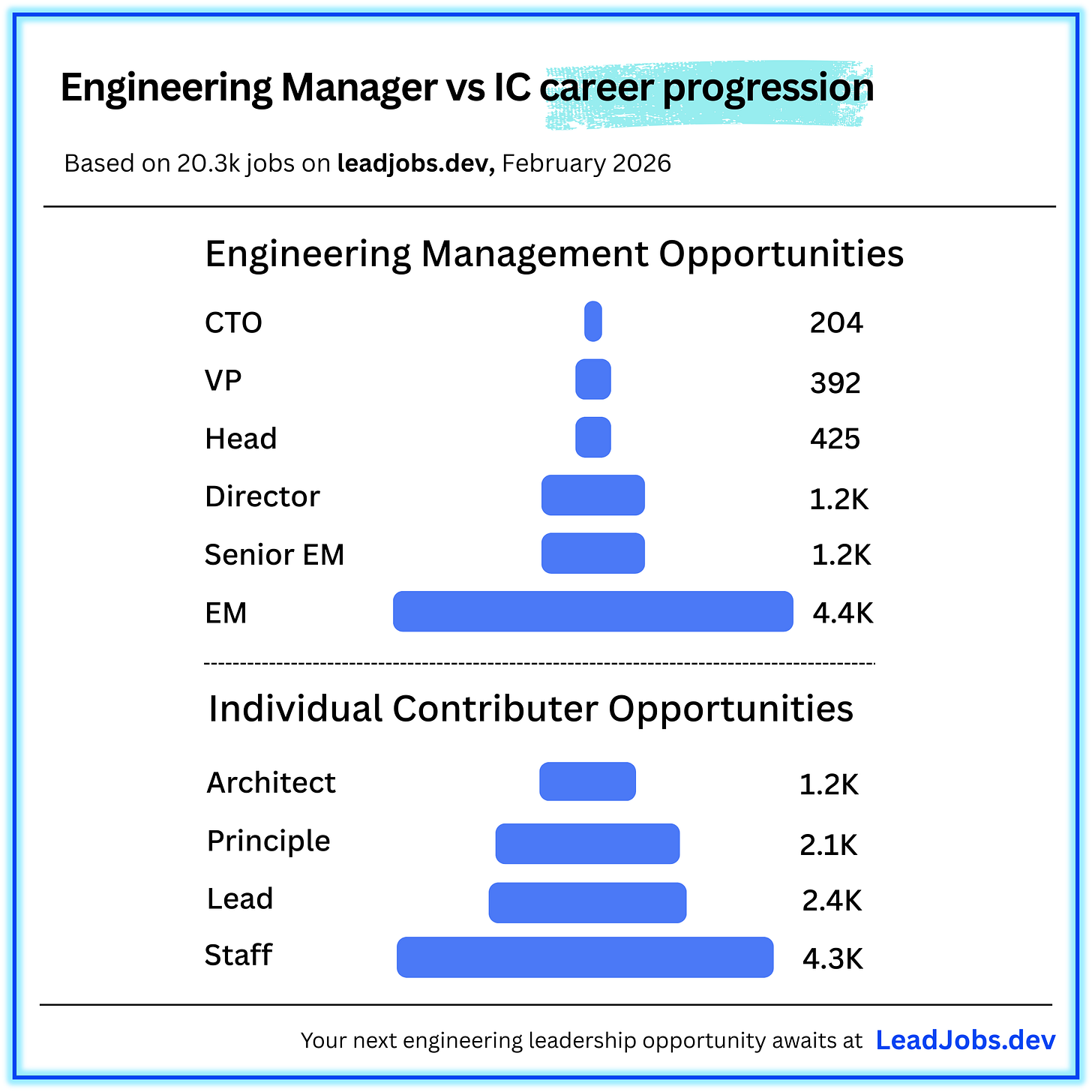
Note: leadjobs.dev is a side project I’m building with Piotr. I’ve been exploring the eng leadership job market in the last few months through the data we get.
Companies still need someone to run teams, but from Senior EM upward, it becomes much more competitive. You’re competing with experienced leaders who were laid off from those ‘flattened’ companies.
Also, there is less opportunity for internal growth. As an EM, to get promoted, you mostly need to start managing more engineers, which might not be possible right now. It’s more likely you’ll just get bigger scope with the same team - not a feat worthy of promotion.
As an IC, being excellent at building things can get you much further.
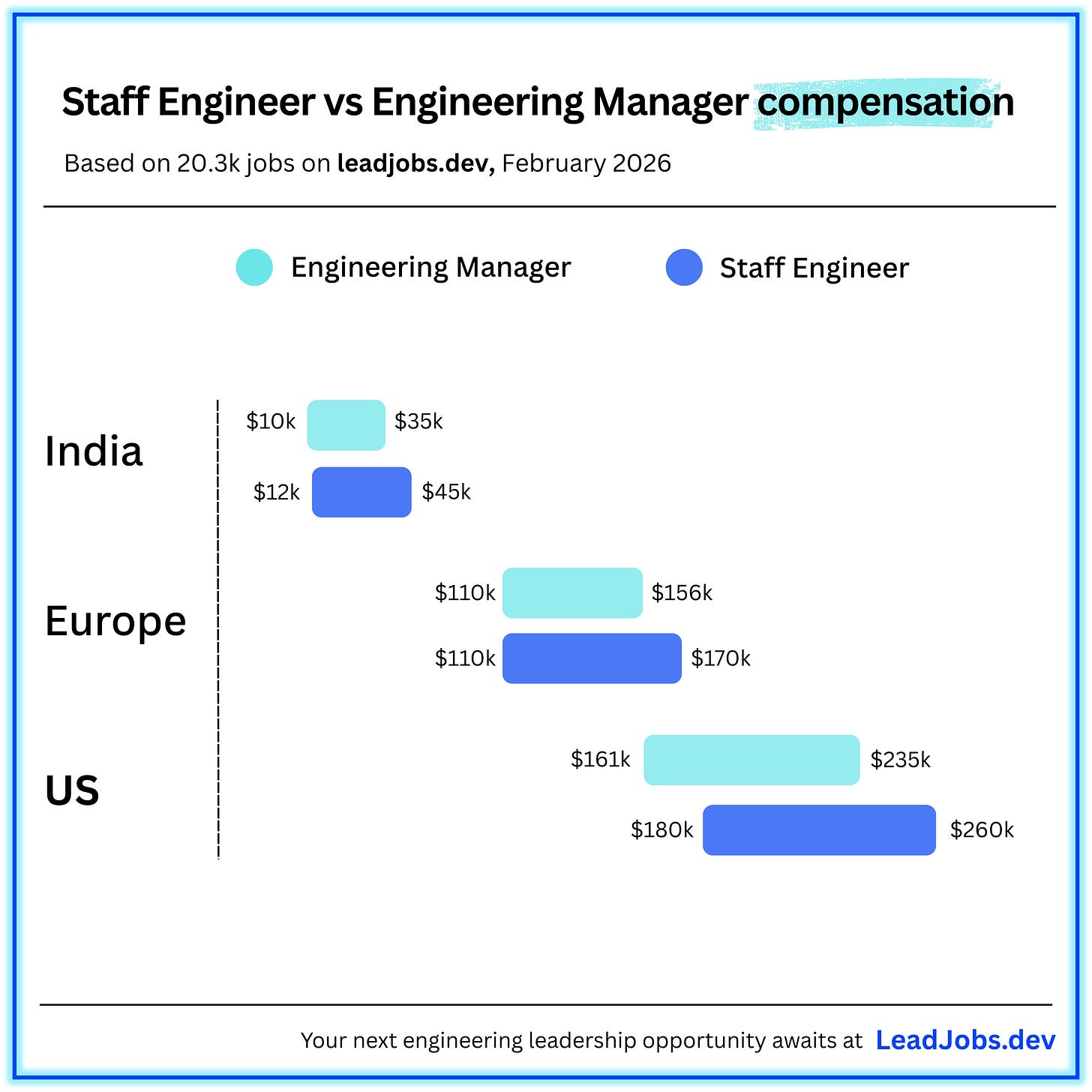
While my friend was offered a bump with the promotion to EM, the total compensation was less than the offers he received for Senior/Staff Engineer at other startups.
This surprised him. The assumption has always been that management pays more. It does, if you compare an EM to a Senior Engineer at the same company. But when you compare across the industry, being a Staff engineer is better paid. I believe it’s because those engineers are in huge demand (and will continue to be so).
For my friend specifically, staying on the IC track, becoming a Staff engineer and switching companies would have given him ~20-30% more than the EM promotion he was offered.
[
2 reasons:
First of all, I’m very optimistic about experienced Engineering Managers (who stayed hands-on), as I wrote in Engineering Management in the Age of Agents.
While we are probably less sharp tech-wise, there are tons of relevant skills the job taught us over the years, that will still be relevant.
And while it’s hard, I think I’ll manage to keep up.
But the main reason is that I enjoy my job.
While rationally I believe that being an IC is a smarter choice in 2026, I know I would enjoy it less.
James Stanier wrote a great article about what to do when the ladder disappears, to help you figure out where you should aim. I highly recommend the exercise there!
If you are a senior engineer, the bottom line is that I wouldn’t recommend the jump to management right now. I would wait a couple of years to see how things will look like.
BUT, and it’s a big but - if your gut tells you to do it (and not your brain), if it’s truly a path you want to pursue - then go for it!
Even fewer middle managers and more flexible teams? by Gergely Orosz. I love Gergely’s weekly Pulse (I’m a paid subscriber), this one was especially interesting.
Being an architect isn’t the sum of skills. It’s the product by Gregor Hohpe.
The Product Velocity Paradox: When Your Engineers Outrun Your Product Team? by Sahar Carmel. An interesting article on the current reality in many companies.
Yes, just like an Office Hierarchy there's an expectation that they respect the Rank - based on the caveat that the Officer/Manager doesn't confuse Rank with Authority.
Also, to clarify some previous assertions, VP title is often needed to empower a given member of staff to sign contracts on behalf of the company in certain jurisdictions or configurations.
It doesn't make a big difference to the company, but a lot of employees want these titles for ego / resume / status / recognition. And titles are free for startups to give away, so many do.
But the big difference, I believe, is that being at the top of a ladder in one company may be completely different from being at the top in another one.
It's easy to be the CTO of a company of 2, much harder for BigTech. Even if the company of 2 has the same levels.
I have met people being very very proud of their title of CTO, and when I asked, their company had a handful of developers.
You can be a “CTO” of your little 5 person company - you might be leveled as an mid level software engineer at BigTech
its entirely possible to go through the software engineer hiring pipeline, and end up in a situation where the organization and the new employee have a fundamental disagreement about the slate of work.
somehow in the giant waterfall of money, our ability to even talk meaningfully about our work to each other got lost
There’s far less age discrimination when you’re looking for management and strategy oriented roles. Those roles want experience, not the raw energy, output, and fresh skills of a younger IC.
I'm not saying that to be snide. When you come from a academic CS setting like university, there are so many new things to learn in industry that after 5 years you could still be completely unfamiliar with a lot of things.
AI produces code that people can understand and is easy to maintain if you ask it for that.
EM vs IC are totally different jobs though. The whole thing where you're a good IC, so you get "promoted" to being an EM is insane. There's some overlap, I guess, every job has pieces of managing other people even if it's not in the job description, but...
Just because EM offers higher positions in the hierarchy (and salaries etc to go with it) doesn't mean that accepting a "promotion" to being an EM is going to make your life better. Personally, I hated being an EM; I don't like the work, and I don't like that when I do a bad job, it directly impacts the careers of my reports.
I don't mind being a cog in someone's big project; but even if I did, I don't see how being an EM avoids it, unless you start your own thing, which I absolutely do not want to do.
I'm pretty sure I did well enough for myself in the IC track. I could have gotten bigger compensation as an EM, I suppose, but diminishing returns wouldn't have justified the additional stress. Obviously, that may depend on individual factors, everyone's path is their own and I got a lucky draw.
It is not a lie. It is true IF you live and work in the Bay Area, Seattle, and TLV - which represent the bulk of tech industry employment.
Companies where the underlying stack is a revenue generator and not a cost center are companies where these kinds of dual tracks exist, but these are only found in the major tech hubs and are not available if you are remote first.
They also require you to be both technically and socially adept.
As a hiring manager, this is completely accurate. I don't look at your title, I look at your scope. Tell me what you did, for whom, and what was the impact. That's all I care about.
We all know that Senior Principal Architect Engineer at 3-person startup is somewhere around junior to mid-level at a real company. Whereas some poor schmuck at a larger company with a title like "Senior Engineer I" probably owns and runs more impressive systems and works with more stakeholders than that 3-person startup will see in a year.
This is complicated during acquisitions… you have a new company coming in and leveling them is hard because it’s a mass title migration exercise, and nobody wants to be down-titled.
In the 2 examples I’ve seen gone wrong:
-the people at the parent company look at the acquisition’s team and think, “there’s no way this idiot should be a director.”
-the people at the startup think they’re geniuses because they got acquired but their tech is crap and they’re actually just 28 year olds running around without adult supervision
-the startup guys will all leave once they vest or be pushed out for being lousy
-the tech gets even more unstable because no one left knows how the code works
Titles are fungible, but your comp isn't. Don't let a company sell you on a better title for less comp, especially when the JD or role doesn't align with the title; the next place won't give a shit what your title was if all you did was Junior-level work because you bought into someone else's narrative rather than control your own.
Failed to design Quantum Lattice Bloom Cascade algorithm in 5 minutes?
EM is a terminal position that does not own the product roadmap (Product Management) nor the underlying implementation (Staff/Principal Engineers).
They primarily own delivery and execution because orgs can't be bothered to hire program managers anymore.
If you are great at managing upwards and ensuring delivery by hook or by crook, you will make a great EM. But the next jump after EM is extremely difficult because you are competing with Principal Engineers and technical-minded PMs making a lateral move and cofounders who are being managed out by the board; and dealing with micromanaging CTOs or CPTOs.
Not really.
Staff Eng and above will end up making similar to an EM including bonuses and has much more job mobility. You have to remember that most EM roles only open up once you hit Staff, so you are basically taking much more responsibility and longer hours for a marginal salary impact.
Engineering Manager jobs are hard to come by and your job security is actually less than an individual contributor, because even if an initiative was delivered late due to no fault of your own, if sales is braying for blood in order to protect themselves after failing to meet quota, it's the EM's head that is offered on a silver platter.
The reality is, there are very few EM and above jobs, and job security is tough - if I have to choose between firing an EM or a SWE, I'd fire the EM first because I can always find another replacement or split their responsibilities across multiple individual contributors and the PM.
If an EM is laid off or fired, it's extremely difficult to find another role, and it truly is a terminal position. Why would I hire a laid off or fired EM or Director when I can promote internally or hire someone from within my network?
Additionally, back when I was an SE, if we had a deal go bad in order to protect our ass we'd blame the EM so that we can have a head on the platter to hand our CRO, unlike a seasoned SWE who can push back and argue PM requirements were unclear and PM can argue that sales+product was aligned.
For a good interviewer these people are obvious even without any coding tests.
The idea is that command requires a separate set of skills and that experience needs to start early to have senior officers in their 50s.
In practice, junior officers are "advised" by senior enlisted on how to order people around and not taking that advice is a bad idea.
Kind of like how companies have managers and technical tracks where a line manager ignoring a senior technical person always blows up in their face.
Not really.
Above Staff and Staff+ companies are usually looking for expertise in domain, in addition to cross org leadership. Unless you want to get hired with Sr title.
Management is different though, you have highly transferrable skillset, managing people, up and down.
When does this choice ever come up?
My experience is that most engineers are seen as interchangeable while most EMs aren't.
Only time I've seen EMs fired for economic reasons is when a larger amount of engineers were also laid off.
My comment was more on the next levels - there seemed to be about as many high-level technical roles as managers (paid similarly) where I worked in biotech (that might be a different situation for software-only companies.) And there were more Directors/VP's than Principals/Fellows for sure. So at some point the "ladder width" crosses over.
And if you get laid off as a senior IC, good luck getting hired into another IC position. Age discrimination is real. The robust network is a must for anyone, manager or IC, in this case.
Is that actually true (the bulk of people in the tech industry are working in "big tech" or startups)?
I don't know if there's any hard data around this, but my understanding has been that people working for these types of companies are maybe a single digit percentage of all tech workers (if that).
People working for those companies are certainly the most vocal online, though, which maybe skews perception.
I remember that 10 years or so ago, an E5 in Google is considered a pretty prestigious position. In Amazon, L6 is such a high achievement that the entire India site had one L6 for more than 300 engineers. But somehow things started to change. Everyone expected herself to get promoted every couple of years. There was a joke in Amazon along the line of L8 is the new L7.
My guess is that two factors came to play. One is that Meta (and then the Facebook) started to promote people really fast, so other companies followed. Also managers gradually treated promotion as a tool to retain the people they need. Once that's the incentive, a long title ladder becomes a natural choice.
Product manager titles can have completely disjoint scopes of work between organizations - in one org they might be what was once systems designer role - getting requirements and writing specs, in another they might basically be doing UI or UX (even creating pages in figma), in others they are basically project managers.
I work in cloud consulting (specialize in app dev).
I worked at AWS ProServe (full blue badge RSU earning employee) before working for a much smaller company. I’ve seen the leveling guidelines for both.
An L5 (mid level) at AWS had to be a subject matter expert in at least one area (development, DevOps, security, etc) and be able to lead a “workstream” of a larger project including dealing with a customer or a smaller project by themselves. That maps to a “Senior Architect” at my current company.
A senior (L6) at AWS should be able to handle larger projects with multiple workstreams and deal with more ambiguity. That maps to a staff at my current company (current position)
An L7 is usually over a practice and/or handling multiple large implementations and more involved with strategy. Imagine someone (who hypothetically - they don’t need outside consultants) was working with Netflix.
That maps to a “Senior Staff” at our company.
You might ask what about lower levels in consulting? I never work with them. The bilingual cloud architects/senior cloud architects work with them. We don’t hire anything lower than that in the US.
I've worked at pretty much every size company imaginable.As the top post pointed out, these titles are meaningless across smaller companies. I've been at startups where nobody had titles at all, I've small companies where anyone remotely senior as a principal. I've also worked at large non-tech companies with only 3 levels for IC, after that you were expected to transition to management.
Large, tech companies have some degree they can be compared but what these titles mean from company to company is pretty meaningless.
Of course this also means the pool of people who can do your job or quickly learn it includes essentially every other EM.
And many of those people are looking for jobs now.
For an IC, no one can become an expert in Rust overnight.
Most tech companies are not hiring an EM without relevant domain experience. "People Management" is a table stakes skill in 2026 and Staff/Principal Engineers and Product Managers largely offer that as well as technical or product insight.
Additionally, it's something that can be cultivated in-house and is why internal promotions to EM tend to be preferred unless a director, principal engineer, or PM is getting their friend a job (which happens fairly often).
Fairly often, but we usually manage them out so that line-level engineers don't get paranoid and jump ship.
When an EM is suddenly shifted to work on another project, or all you ICs are suddenly talking to other managers or staffed on other projects, that's us as organizations managing out the malcontent and messaging to them that their time is up.
Yea. Biotech is different. The equivalent of a VP for a specific formulation at a Pfizer would be a Staff or Principal Product Manager at a Salesforce.
In software, Engineering Managers have increasingly become solely people+program managers with a bit of a technical component.
EMs aren't expected to own product - that's PMs. Additonally, EMs aren't expected to own architecture - that's Principal and Distinguished Engineers. All that leaves EMs is program management.
Maybe. That's why you need to put your scope on the resume :)
I had a CTO title 15 years ago. The complexity of what we were building was a joke compared to what I own now as a lowly "tech lead manager". And in fact back then I wouldn't even be able to comprehend how complex things can get.
As a hiring manager I'll look at progression of titles *within a company*. This shows a track record of upward mobility. But if they go from "senior" in one company to "principal" in another, I find it meaningless.
In my experience distribution of engineer quality is even across companies, countries, ages and any other dimension we can come up. Certain big scale skills can really only be practiced at honed at large tech companies, but it’s always a small minority that actually make those things happen. Resume alone can be an extremely misleading signal.
I can't know you ran a 30 person scale up unless you tell me. It doesn't have to be in those words exactly, usually it's tied to ARR or rounds raised or something you can easily talk about that translates across companies.
I've seen resumes with titles like "Lead Engineer" who under that title put something like "Hired 45+ people to run <huge systems> at <company you've heard of>". That person has more scope than the 30-people CTO in your example :)
PS: 30 people isn't even that many for a whole company. That's a Series A startup with early signs of product-market-fit. It's common to see a ratio of 10 employees for every 1 engineer in the company.
I've never heard of something like that. Usually the requirement for being director level manager of engineers is to at least have managed people as an EM for several years before.
No I mean
> Tell me what you did, for whom, what was the impact.
It's really that simple. Just tell me what you did at your job. What was it that you worked on. Why did it matter. Did you own a workstream (or 5), code monkey all day, own a critical service, play code janitor, ... what did you do?
Instead you become a generalist which is only really needed at tiny organizations.
Was it the devs fault for shipping code with a disastrous edge case, or the EMs fault for over- allocating work, resulting in less-refined code and a minimal review process that let the defect slip into production? Just as an example.
There's a lot of nuance but here's a simplistic overview: a manager tries to land a big project for their team, which lets the team stretch their abilities and grow, which over multiple successful deliveries results in promotions / raises for everyone involved AND the cachet to ask for bigger projects (and more headcount!)
The manager's role is the hustling and jockeying in landing the project, ensuring their team is executing and getting any mentorship needed (directly or indirectly) and protecting them from disruptions ("shit umbrella") -- which includes managing everything around the team including stakeholders and dependencies and escalations -- and then making the case for promotions / raises / PIPs based on their performance.
I've never been a manager, but having been involved in all these aspects, I can tell you none of this is easy. All of these can get very contentious, even in the best-run of companies; in the rest, a lot of pathologies spring up (like politics and empire-building) that cause even more nastiness.
So it may seem like they're taking credit for your work, but that's literally part of the arrangement, and it's only unfair if you're not seeing any upside. If you feel that way, this is 100% something you should bring up (very tactfully!) in a 1:1 or (even more tactfully!!!) a skip-level.
Isn't that what product/project managers and architects do though?
Other comments describe EMs as just HR mangers
> If you can't make that decision, are you really the EM?
You'd be served well as an EM by this part of the Serenity Prayer:
"God, grant me the serenity to accept the things I cannot change, the courage to change the things I can, and the wisdom to know the difference."
Depending on your organization, odds are high that AI use is one of the things you cannot change. Perhaps not even something you're ought to change. If your team is delivering x% more, "it makes my job x% more difficult so don't do that" won't fly neither upwards nor downwards.
> If AI produces code that no one knows and is hard to maintain
I think you're making an assumption here that the main problem with AI use is necessarily quality.
OP wasn't even talking about AI producing bad code, just that it creating more code, and enabling more things to happen. More things going on at the same time, means you'd have more friction points and more things that can go wrong. Whenever those happen, the EM is pulled in.
You attend meetings, negotiate deadlines, evaluate people, navigate project minefields, take decisions or force people to take them,... and the technical aspects are quite minimised.
Depending on the company this is not an upgrade, it's a lateral move. I have people under me who earn more than me, and I agree with that.
The job it's not easy, it's different. Spending 5 hours on meetings it's easy, but exhausting. Giving credit to your people but taking the blame (which is what should be done) it's easy, but demoralising. Not having a peer group of people with whom easily socialise makes the job feels lonely, when you talk with other managers it's 99% work related, and you can't make your people like you as a person.
Most days I'd love to have a clear objective.
One of the worst is the strange feeling that you have because you've studied for a long time some skills, and worked using them, and now those are hardly used. You need to use a set of skills that you haven't trained for, and haven't used as much (depending on your personality/skillset, of course).
Being a manager is not for everyone.
Sure, but now competitors are shipping like crazy (at their EM's sanity expense?). What to do?
> AI is voluntary
Until the company mandate. And also there 10 other EMs that I am competing with on my org tree alone, and their teams are all AI-heavy. Is that really a matter of choice?
The question really is why does American tech organise itself this way, a completely different way to other professions?
> The EM role only exists to hire, evaluate, promote, and fire SWEs
I can see why some people would find that unfulfilling. I work in one of those other professions and if I did just the hr bit I would be bored out of my mind! Do SWEs value the input of their EM? Does it really add value, or a bunch of busy work?
What does a manager even do in this world where they are non technical? I have never managed a large sw team tbf, but in smaller teams I did manage I had to do project management stuff. In my normal profession I manage a large team, but one of my big roles is being there to advise technically and make the big decisions. I can see why people find these EM jobs boring, you must have to invent things to do!
That's quite shallow for those who are 'Member of Technical Staff' which does not have this which is why titles are meaningless for experienced candidates.
Someone can give themselves that title, all because they know the founders; thus it can be exploited.
So instead, I get the candidate to exactly explain to me what did they actually build / do and how much money did they make / save the organization and it must be in the millions to qualify or did they build side-projects that contributed to this or not.
In this era, "titles" aren't enough and you need verifiable proof of work with monetary returns in the millions and I favour those who just build things that make money without asking permission from a manager.
Once you get to leadership you're giving credit where it's due and soaking up the loss.
Sometimes, it can look like management is doing very little because you only see the tail end of their outputs to the team.
I love engineers and I love tech. I still code daily but I'm not the guy that delivers at the pace of some of the amazing engineers that I had the privilege to work with. I love putting others ahead of myself wherever I can and it's never cost me anything, so I'm not afraid to do it again. I love telling the engineers how what they do actually matters because they're too focused on the work to sometimes see why changing goals doesn't mean their work and efforts were wasted and I also love shielding them from the corporate mess upstairs (that I somewhat masochistically don't even dread being part of)...
So, yeah, I really love my job and if one of my guys (or gals) wants that too, the more of a joy it is to me to mentor them into that process.
The massive shortage of software engineer talent over many decades has created a situation where any work that a SWE doesn't like to do is carved out into its own role so that the SWE's job description stays fun and attractive.
DE, DS, BI, SDET, SRE, QA, FDE, SE and to some extent even PM are all roles that emerged from the boring stuff that SWEs don't like doing.