There's a certain arrogance to believing the timing "simply wasn't right". It looks really bad if you try it with any recent controversy:
* "The timing wasn't right to charge people for heated car seats"
* "The timing wasn't right to make Photoshop a subscription service"
* "The timing wasn't right to increase fees"
It's a way of talking yourself away from the fact that what you are making may, inherently, be disliked. The cited survey even seems to have been read as favourably as possible:
> Surveys consistently showed that consumers believed artists deserved payment when AI generated content in their style.
This doesn't mean people want artists style to be generated by AI. It could mean they think it's horrible, but if it happens they should at least be compensated for it. In fact, the quotes survey even says 43% believe companies should ban copying artists styles. I could make the exact opposite argument with the same data:
"Many consumers believe companies should ban copying styles, and this may be a more common opinion than measured as most people have no experience with modern AI tools and therefore no chance to have made an opinion yet. What is known is that the majority believe that if artists were to be copied, they should at least be compensated"
edit: formatting, typo
It's interesting that "consumers" are generally for the expansion of IP laws. At at the moment, I'm fairly certain that "style" is not something protected by Copyright. I personally do not want this, and I'm sure there are likely many like me. Poorly thought out IP laws lead to chilling-effects, DRM, stupid and unnecessary litigation, and ultimately a loss of digital freedoms.
> What 325 Cold Emails to Artists Taught Us
I'm surprised 1% didn't respond with "EAT HOT FLAMING DEATH SPAMMER" for sending them unsolicited commercial email. ;)
> …fine-tune a Stable Diffusion base model.
So your entire business proposition was a lie, as you literally used a base model trained on billions of images by other artists too!
Then I tested out the image generation itself and I was unable to come up with prompts that achieved the kind of images I wanted. My only prior experience at the time was OpenAI API. With OpenAI I usually got what I wanted on the first or second try, but with Tess, I couldn’t get a usable result even after 20 tries.
So in addition to the limited number of artists, I think the quality of outputs vs. competing models was a huge factor. I needed to generate thousands of images, so I couldn’t afford to do dozens of attempts for each one.
Hopefully one day there will be a service that can match the quality of OpenAI Image API and Flux but with compensation for artists.
> A free Tess subscription to use their own model for brainstorming and scaling repetitive work (roughly 1 in 4 artists took advantage of this)
So based on the math I'm seeing... the 21 artists in the system, only 5 ("1 in 4") optioned to use the tool for their own productivity? That seems really low and makes me wonder what the user experience for creation feels like. I would assume if you decided to commit to this endeavor, you would want to see what derivative results will look like.
Startups are not for the weak but the process detailed here is how we've gotten some of the most transformative and innovative products in technology. Props on attempting this unique idea; very sad that it didn't work out, but sometimes the market just can't support certain ideas!
The demand to produce something in an artists style is low. The volume required to make it interesting to artist isn't present.
AI adoption and pushed back is greatest with artists you would be better off asking for money to shutdown AI.
The tech itself sounds interesting and would love that writeup.
Kapwing is specifically designed for artists to share IP with other people in an IP-friendly and financially profitable way. A 'consumer' on Kapwing is not the same as an ordinary person browsing for AI generated art, and the fact that people who make money from selling their IP on there are in favour of expanding IP law shouldn't be a surprise.
All this really tells us is that Kapwing's artist community believe protecting their individual art style is more valuable to them than any money they'd earn from licensing it on a per-image basis to Kapwing's AI tool. I'd be willing to bet that if Kapwing changed the offer to a flat-fee-of-$50,000-a-year-plus-per-image-fee they'd find 99% of artists on there changed their minds. As with most things, people feel strongly about their rights all the way up until the price is right.
Grammerly will tell us:
Despite being more popular than “lessons” in the corporate setting, “learnings” is still incorrect. It's an erroneous plural form of the colloquial term “learning.”
~ https://grammarist.com/usage/learnings/As a business-speak buzz-word it might fade, or it may end up with a greater global footprint outside of the Biz-speak Babel tower.
Don’t take this personally.
Even if you told this person to work constantly and they believed in you and the business, it’s not totally your fault that they burned out. I say this as someone that has burned out twice, is currently burned out, and blames those that I currently and formerly worked for. I know the problem is as much me as them. Yes, employers have a responsibility to their employees not to burn them out. But, if they do, even if the employer is in a power position where the employee felt they had no other choice, and I felt that both times, the employee can choose not to work that much or care that much for almost whatever that means- if you’re literally holding a gun it’s different of course.
I know of a developer that committed suicide and the toll that took on the employer. But the employer can’t take on all of that themselves.
I’m sorry that your business failed, but I hope that something good comes out of this.
Also- I’m not saying that any part of your responsibility in burning out this person was ok. Just that not all of it is your fault.
i generate hundreds of images weekly for video content and the honest truth is i never think "i want this specific artist's style." i think "i need a documentary still that looks like 1970s film grain" or "i need a character that matches my last 50 frames." consistency and speed matter way more than provenance. the few times i tried artist-specific fine tunes the quality was noticeably worse than just prompting a good base model well.
the 6.5% artist signup rate buried in there is actually the real story. they cold emailed 325 high end editorial artists and got 21. those artists didn't want passive income from AI - they wanted AI to not exist in their market at all. paying someone royalties to automate away their livelihood is a weird value prop no matter how you frame it.
What's more, their reasoning for abandoning the company was to build out another company with a suspiciously similar idea...
Don't forget how polling works. Change the wording of the question and you get a different answer.
Try asking them if they think Comcast or Sony should be able to sue individuals for posting memes that don't even contain any copyrighted material.
To a degree it is protected, but not by copyright. Design patents are a thing and companies have sued each other over them (Apple vs Samsung during the "smartphone wars" comes to mind)
It's not. This total depends on how you ask it.
Q: Do you think artists deserved payment?
A: YES.
Q: Will you pay for art?
A: MAYBE.
Q: Do you think people should go to jail not paying for art
A: NO.
Their solution basically just amounts of "Ethically sourced Styles" which still has all the red tape that a normal text2image model has because majority of the data is still unapproved for use in an AI model.
Businesses didn't want to get wrapped up in a pesudolegal model that really has no better legality than base SD.
I think a much more useful question is whether some arrogance is necessary to succeed. I personally think it is. But we are discussing a post mortem here, and the author is (in my opinion) clearly beating around the bush and using "the time wasn't right" to hide what may be uncomfortable truths.
Is a post mortem valuable if it doesn't address these face first? I am not the one with all the answers here, but what I am used to in mature tech teams is that the uncomfortable parts are usually the most important in any post mortem.
There are plenty of stories about companies that failed because the timing was wrong, and then see another company succeed in their place later on. That doesn't mean failure simply means "the timing was wrong" - you are putting a lot of weight on society adjusting to your belief. Consider that venture capital often invests in hundreds of founders like this, betting that at least one of them wasn't wrong. That's not statistically in your favor.
It is OK (in fact it is valuable) to fail and conclude that your signals may have been wrong. There's a reason some venture capital funds prefer investing in people who have failed before.
Since the didn't, they should go to jail. The same way I would have gone to jail if I built Sora in my basement and sold it to the public.
I'm staunchly against expansion of IP laws. But I personally think that when a corporate machine gobbles up an artist's works so that people like me who can't draw can generate silly memes for a few bucks a month, the artist should be compensated. The company is profiting off of other people's work! That's not right.
The mechanism by which compensation is calculated appears to be an unsolved problem currently though.
Would I pay extra to ensure that the artists that these models were trained on were compensated fairly? Absolutely! Would I pay extra for that but with degraded ergonomics? Given that this is just a silly hobby, probably not, if I'm being honest.
I think if that problem can be solved, and it's marketed to the correct group, a player in this space could certainly do well.
And I think same could happen to LLM. If it took all the fossil fuel on Earth just to barely able to drive a car to a car wash, there's more things wrong with the car than in the oil price.
That is the gap in the legal landscape.
Here, for example, any comment is open to read and respond to. On ArXiv any paper can be downloaded, read and cited. Wikipedia contains text from many thousands of editors, building on each other. We like collaboration more than asserting our exclusivity rights. That is why these places provide better quality than work for direct profit or, God forbid, ad revenue, that is where the slop starts flowing.
But including your art in the training data is fair use (or otherwise exempt) by most standards, as no reproduction occurs. You are advocating for a change to IP law to make it more restrictive.
What's wrong with it?
We live in an interconnected world. Every company or individual who profits off anything does so, in very large part, thanks to work left behind by others that they don't directly compensate each other for.
Stated differently, if we look at the other side of the coin, it's one thing to create value, and another thing to capture value. If you are a business (and artists seeking profit are businesses), you create value then try to capture that value. Creating value and trying to capture (in the form of profit) is the entire name of the game. But no business captures 100% the value they create. If you make a product/artwork/service/whatever and release it to the public, lots of people may use it, view it, be inspired by it, learn from it, and ultimately profit off it in their own way without you necessarily being able to capture some part of it. And what's wrong with that?
Do we really want the entire world to be endlessly full of cookie-licking rent seekers who demand profit every time anyone does anything? Because they failed to capture the value they created, and thus demand a piece of the pie from those who are better at capturing value?
I like the way Thomas Jefferson put it:
> If nature has made any one thing less susceptible than all others of exclusive property, it is the action of the thinking power called an idea, which an individual may exclusively possess as long as he keeps it to himself; but the moment it is divulged, it forces itself into the possession of every one, and the receiver cannot dispossess himself of it. Its peculiar character, too, is that no one possesses the less, because every other possesses the whole of it. He who receives an idea from me, receives instruction himself without lessening mine; as he who lights his taper at mine, receives light without darkening me. That ideas should freely spread from one to another over the globe, for the moral and mutual instruction of man, and improvement of his condition, seems to have been peculiarly and benevolently designed by nature, when she made them, like fire, expansible over all space, without lessening their density in any point, and like the air in which we breathe, move, and have our physical being, incapable of confinement or exclusive appropriation. Inventions then cannot, in nature, be a subject of property. Society may give an exclusive right to the profits arising from them, as an encouragement to men to pursue ideas which may produce utility, but this may or may not be done, according to the will and convenience of the society, without claim or complaint from anybody. Accordingly, it is a fact, as far as I am informed, that England was, until we copied her, the only country on earth which ever, by a general law, gave a legal right to the exclusive use of an idea.
It's not hard when someone inputs "create in style of studio ghibli" to say that studio Ghibli should get a cut. It's very different when you don't specify the source for the origin style.
And if you tried to identify the source material owner, the percentage of the output image that their work contributed to would be extremely - if not infinitely - small. You'd get minuscule payouts.
Where did you get that idea. Global economy is ~200T/year PPP. 0.1% of that split across every artist you want the training data from would be insanely difficult for the vast majority of them to turn down. Which makes sense as art isn’t that big a percentage of the global economy compared to say housing, food, medical care, infrastructure, military spending etc.
Obviously the incentive to take without compensation is far more appealing, but that doesn’t mean it was impossible to make a reasonable offer.
That's kind of an interesting concept: "since the scale of my transgression was so big, I should get away with it scot-free."
So if scan a book you are making a copy. In some copyright jurisdictions this is allowed for individuals under a private copying exception - a copyright opt out, if you like - but the important thing is private use. In some jurisdictions there is also a fair use exception, which allows you to exploit the rights protected by copyright under certain circumstances, but fair use is quite specific and one big issue with fair use is that the rights you are exploiting cannot result in something that competes with the original work.
Other acts restricted by copyright include distribution, adaptation, performance, communication and rental.
So if you copy a book, digitize it, and write a program to analyze the word frequencies it contains you may, in some jurisdictions but not all, be allowed to do this.
If you’re doing it locally on your own machine you are simply copying it. If you do it in the cloud you are copying it and communicating the copy. If you copy it, analyze it and train an AI model on it that could be considered fair use in certain jurisdictions. Whether the outputs are adaptations of the training data is a matter of debate in the copyright community.
But importantly if you commercialise that model and the resulting outputs compete with the copyright protected material you used to train, your fair use argument may fail.
So when you buy a book you are actually party to what is effectively a licence granted by the copyright holder, albeit it to the publisher. But as the end user of the book you are still restricted in what you can do with that copyright protected work, through a universal end user licence encoded in law.
It shouldn't be!
The starving artists I know would be extremely happy to get even one cookie to lick. I know an artist prodogy that paints on canvas and has work in a sizable gallery, at least one institution patron, and is constantly hosting paid workshop events. He architected and built his own custom 40ft ceiling pine art house covered in beautful stained wood and arches, with large metal cuttings and engravings of wild horses on the railings. This artistic prodigy is still starving and works as a handyman/construction worker part-time. He is strongly opposed to AI, by the way.
Most artists are "starving artists"; there are extremely few artists that can support themselves by their creations alone. Many artists make no money at all, and many artists seem to work or create alone as individuals, meaning that they almost always lack the funds or community resources to protect their creative work.
No, far better that we have four rent-seekers who gobble up everything that anyone is naive enough to share with the world, then turn around to demand profit in order to keep up with the new pace of the world that they’ve created.
Music conglomerates have money and their lawsuits will probably settle the issue.(unless they settle) That will be applied for all copyrighted works, regardless of the medium.
I believe going against the big guys is the reason why the big ones don't yet have music generation LLMs.
Maybe they're wrong but I tend to agree. Or even if it is possible to do it ethically, it still never will be done that way because there's just too much money in behaving unethically
There is a reason why we call it styles, because it’s a recognizable pattern someone came up with maybe after decades of work.
If it all was non-profit - then no one would raise the ethical issue.
You don't even need to have a legally acquired source material to produce work in a certain style.
The new reality allows for original creators to actually track the chain, so we're in this situation.
In addition, the idea that you need to pay rent on *your observation* of someone else's work is absurd. No one pays Newton's descendants for making lifts or hosting bungee jump sport activities.
PS: I categorically disagree that AI developers are rent-seekers, unless they require rent for the products their models generate
A retrospective on Tess.Design, our attempt to make an ethical, artist-friendly AI marketplace. We launched Tess in May 2024 and shut it down in January 2026.
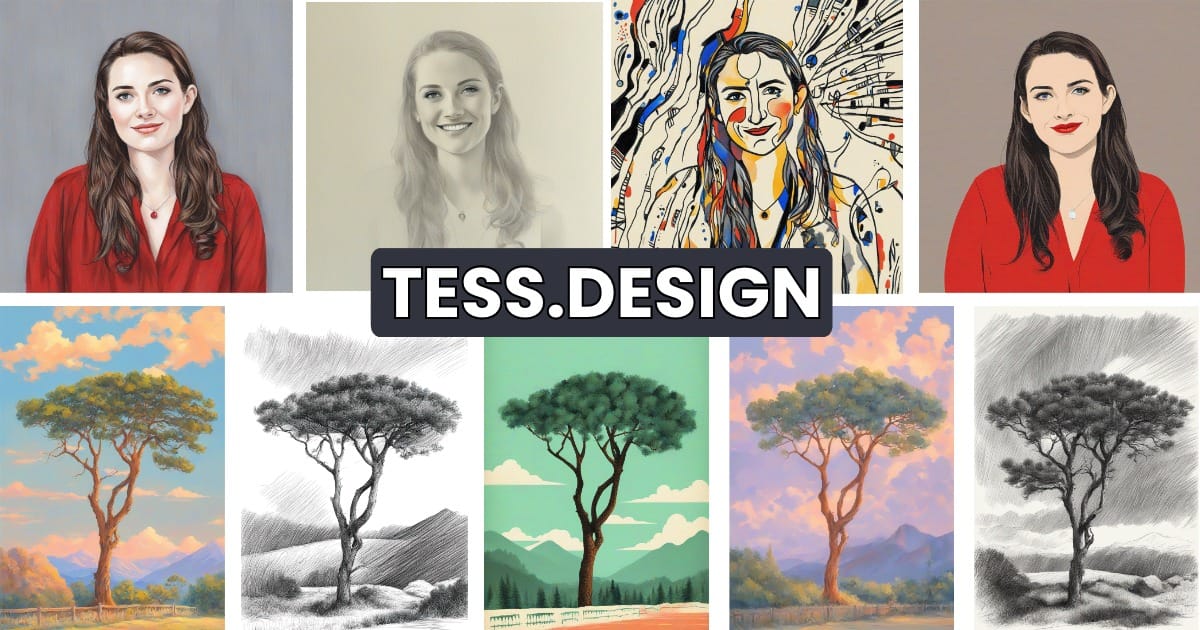
In May 2024, we launched Tess.Design, a marketplace of fine-tuned AI image models where artists got paid a 50% royalty every time someone used their style. Two years later, in January 2026, we shut it down. This post is a candid account of what we built, what the data showed, and what any entrepreneur should know before trying to build an AI licensing business on top of creative talent.
By 2023, AI image generation had become mainstream—and deeply controversial. Tools like DALL-E and Midjourney trained on billions of scraped images, often without artist consent or compensation. Surveys consistently showed that consumers believed artists deserved payment when AI generated content in their style. Yet no business model existed to make that happen.
Media companies were in a stalemate. Outlets like Rolling Stones and Fortune wanted AI-generated imagery for blogs, thumbnails, websites, and graphics. But their legal teams were nervous about copyright exposure, given the numerous ongoing lawsuits. So the publishers either banned AI tools entirely or turned a blind eye to their use, hoping for the best.
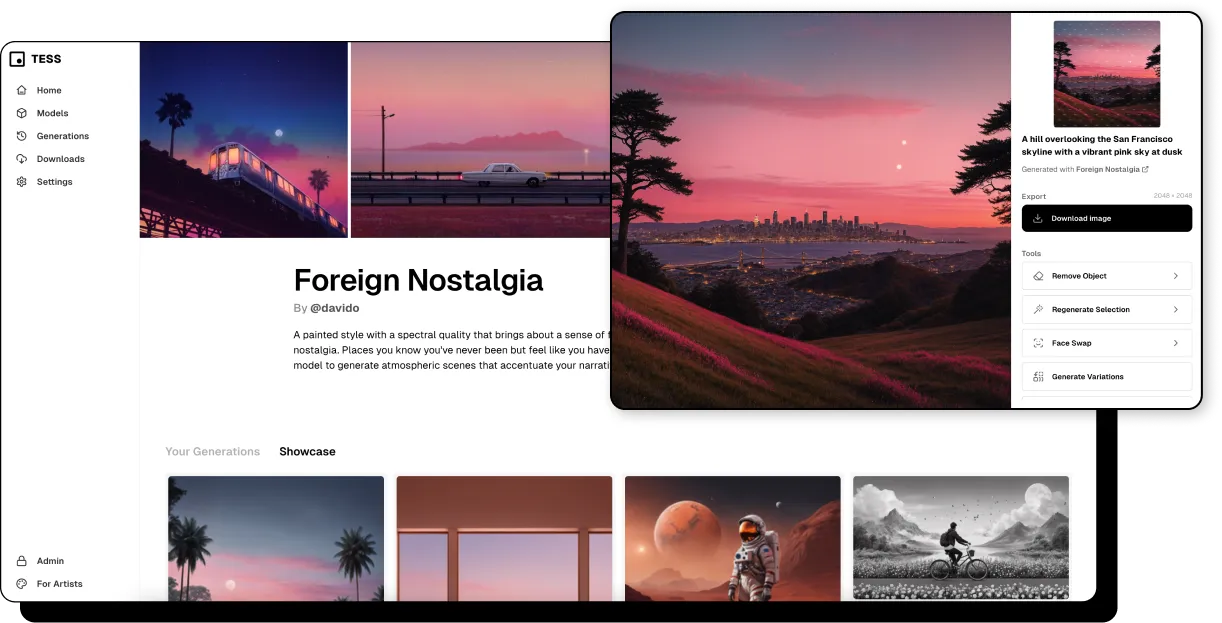
Tess was our answer to this problem: an AI image generation platform where every image was traceable to a single consenting artist, who earned a royalty in its production. In this way, we argued that Tess was the first “properly-licensed” image generator that produced the same quality images as Midjourney and other leading models.
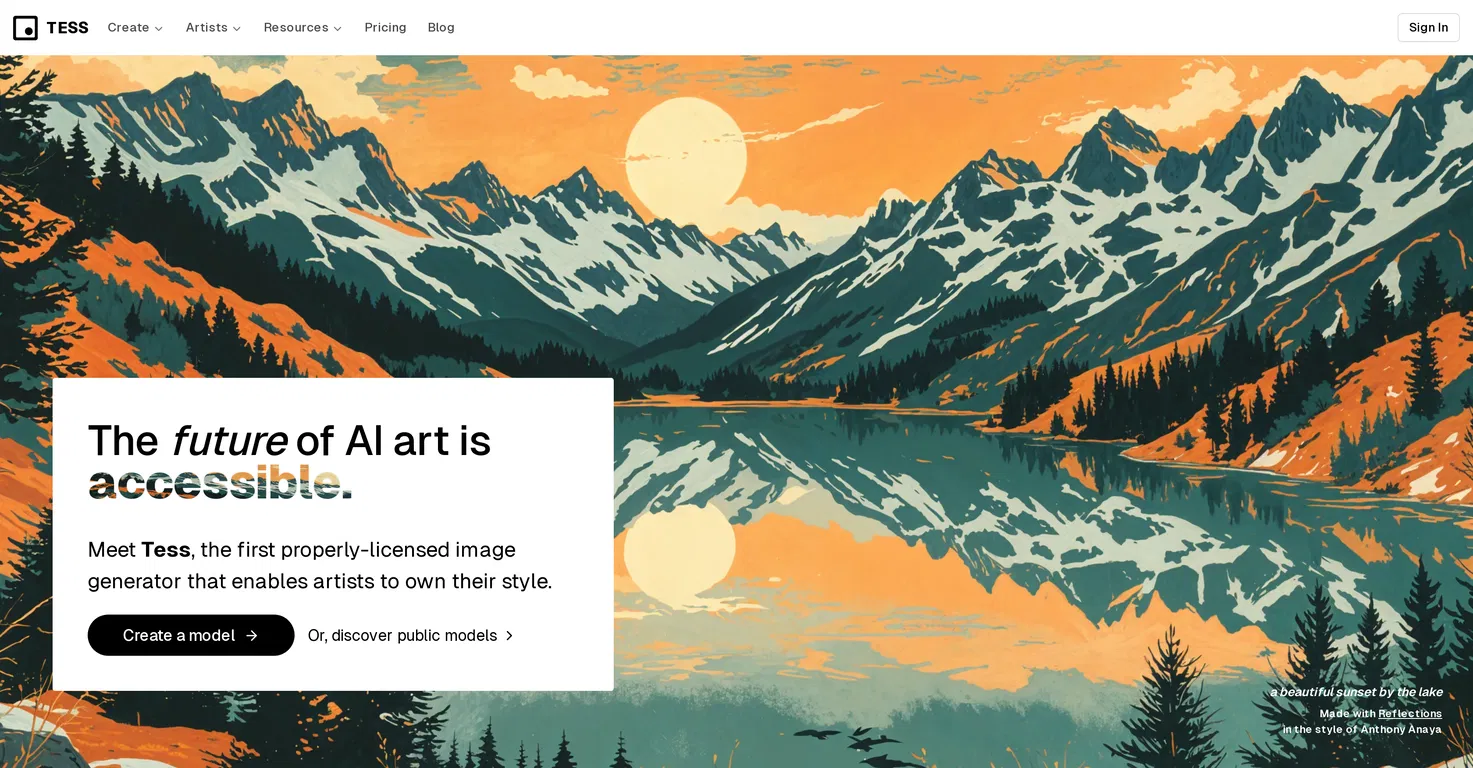
Tess Artists submitted a set of their work to fine-tune a Stable Diffusion base model. The resulting model, linked to that artist's aesthetic, was listed on a public marketplace at tess.design/models. Subscribers paid for access; the artist earned 50% of the revenue when subscribers used their model.
The legal architecture mattered as much as the product. Working with Fenwick, we constructed a contributor agreement and Enterprise Service Agreement built on a novel copyright argument. We posited that because all outputs were stylistically transformed into the contributing artist's aesthetic, the artist held copyright over the derivative works and could license them downstream to customers. This created a clean chain of copyright ownership, something no other AI image generator at the time offered.
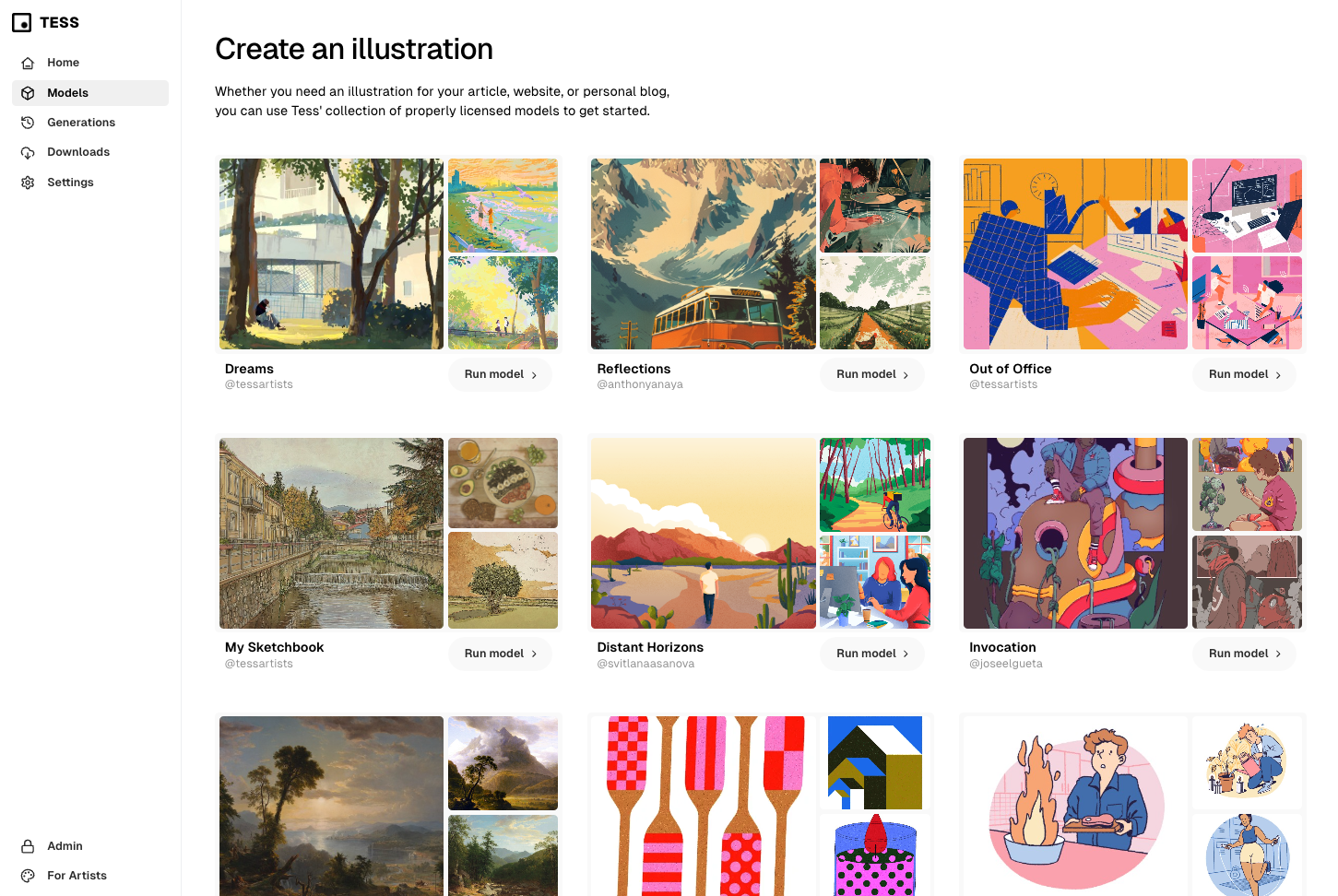
To seed the marketplace, we offered 25 founding artists an advance royalty of $300–$4,000 based on their portfolio quality and audience reach. In addition to income, we pitched artists on these value propositions:
In building Tess, we learned a lot from the growth path of Spotify, which took two years to develop its partnerships with record labels. Unlike the music industry, however, illustration and digital art is fragmented. We reached out to 11 illustration agencies about getting their artists on Tess. 0 said yes. So we went artist by artist—sourcing contacts from Instagram, LinkedIn, agency websites, and the bylines of editorial publications we admired.
We reached out to 325 artists over about 6 weeks. The leads were high-end editorial artists who make illustrations for magazines like the New Yorker, take custom commissions, and maintain distinctive styles for studio work.
The response rate was striking:
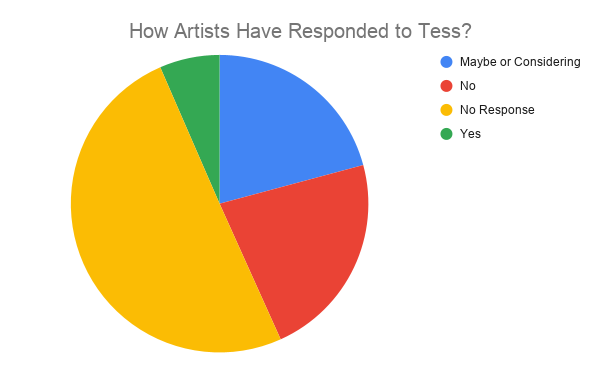
For artists who said no, their objections fell into four categories:
1) Ideological opposition to AI: Many artists saw AI as categorically exploitative, regardless of the revenue model.
“There is no such thing as ethical AI, full stop.”
2) Brand dilution. High-end artists worried that enabling anyone to generate in their style would cheapen it.
“ I don’t want it used by a cigarette brand”
3) On principle: Some believed art should be made by hand, regardless of the compensation structure.
“As an artist, I hold certain values regarding the creative process, and I personally feel that AI-generated art goes against those principles. While I acknowledge the technological advancements in this field, I prefer to maintain a hands-on approach to my work”
4) Reputation risk of being associated with generative AI, which the industry generally sees as terrible.The artist community was hostile to AI in 2024. Joining Tess meant risking cancellation. One artist put it plainly: "I've seen how other artists get fried when they say they're interested in AI." Social punishment was a real deterrent.
The artists who said yes were motivated by passive income, curiosity about AI, and a pragmatic desire to offload repetitive commission work—wedding placards, gift tags, wine labels—so they could focus on more meaningful projects.
“I’ve always been passionate about staying at the forefront of technology and embracing the innovations it offers,” one participating artist wrote. “I see AI as increasingly essential in every aspect of our lives, and joining Tess seemed like the ideal way to integrate AI into my profession.
Tess ran for 20 months and generated $12,172.33 in gross revenue. We paid out $18,000 in advanced royalties to artists and spent roughly $100/month on infrastructure (subsidized initially by Azure credits). So, Tess was a net loss: approximately $7,000 in direct costs—not counting the engineering, design, marketing, and product time invested.
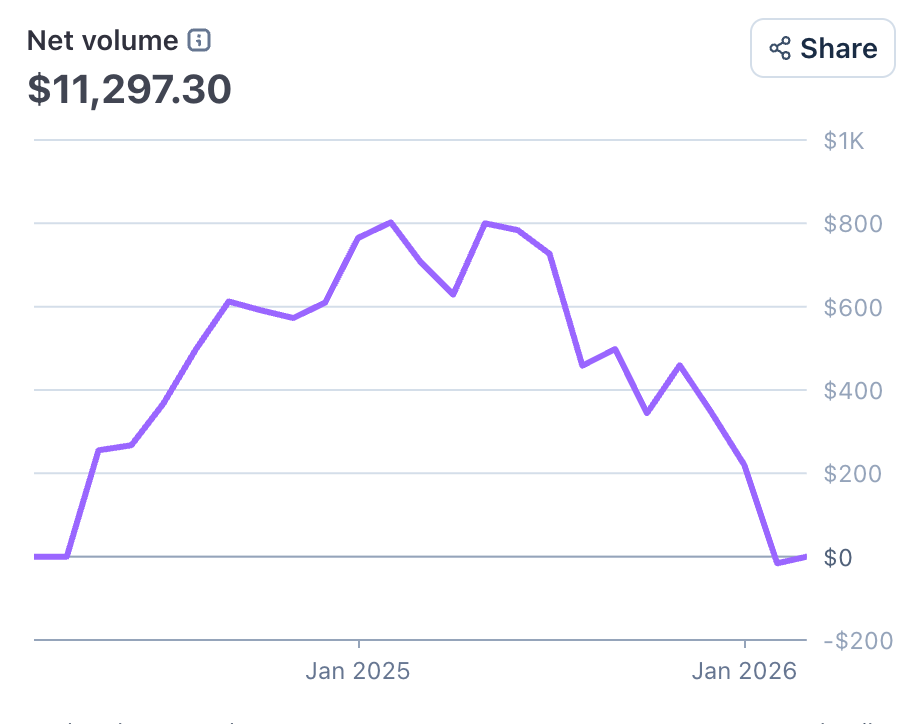
No artists earned enough from usage to receive additional royalties beyond their advance. The pre-generation economics never reached a meaningful scale.
We came close to an Enterprise contract. A major US media outlet evaluated Tess as a compliant alternative to banning AI generation outright. Ultimately, however, their legal team blocked the CTO from moving forward with Tess as the unresolved court cases around AI copyright made any AI licensing product too risky to touch.
Finally, we lost some trust from our team as well, which always happens when you invest in a product that doesn't work out. One engineer who left Kapwing in fall of 2025 said that the short-lived Tess investment contributed to burnout.
Three factors converged, leading us to shut down Tess:

The underlying model—paying human creators a royalty to license their style, voice, likeness, or training data to fine-tune AI—is not dead. It's early. Here's what I'd tell founders exploring this space:
I’m proud of Tess and what we built. We genuinely attempted to move the industry toward a more equitable AI licensing model where human creators get a cut of the value that they generate, and where brand/publishers have an easier time defining the output they want. If Tess had succeeded, it would have created a more beautiful world with more accessible art for all.
When I got married in 2025, I used Tess to generate all of the artwork: the invitation, the table placards, and the textures for the table chart. We also put up art made by our artist friends like Baffour Kyerematen, Gloria Ford, and Abby Cali. Tess will always remind me of my wedding day and the beautiful coexistence of AI art and human-made art.
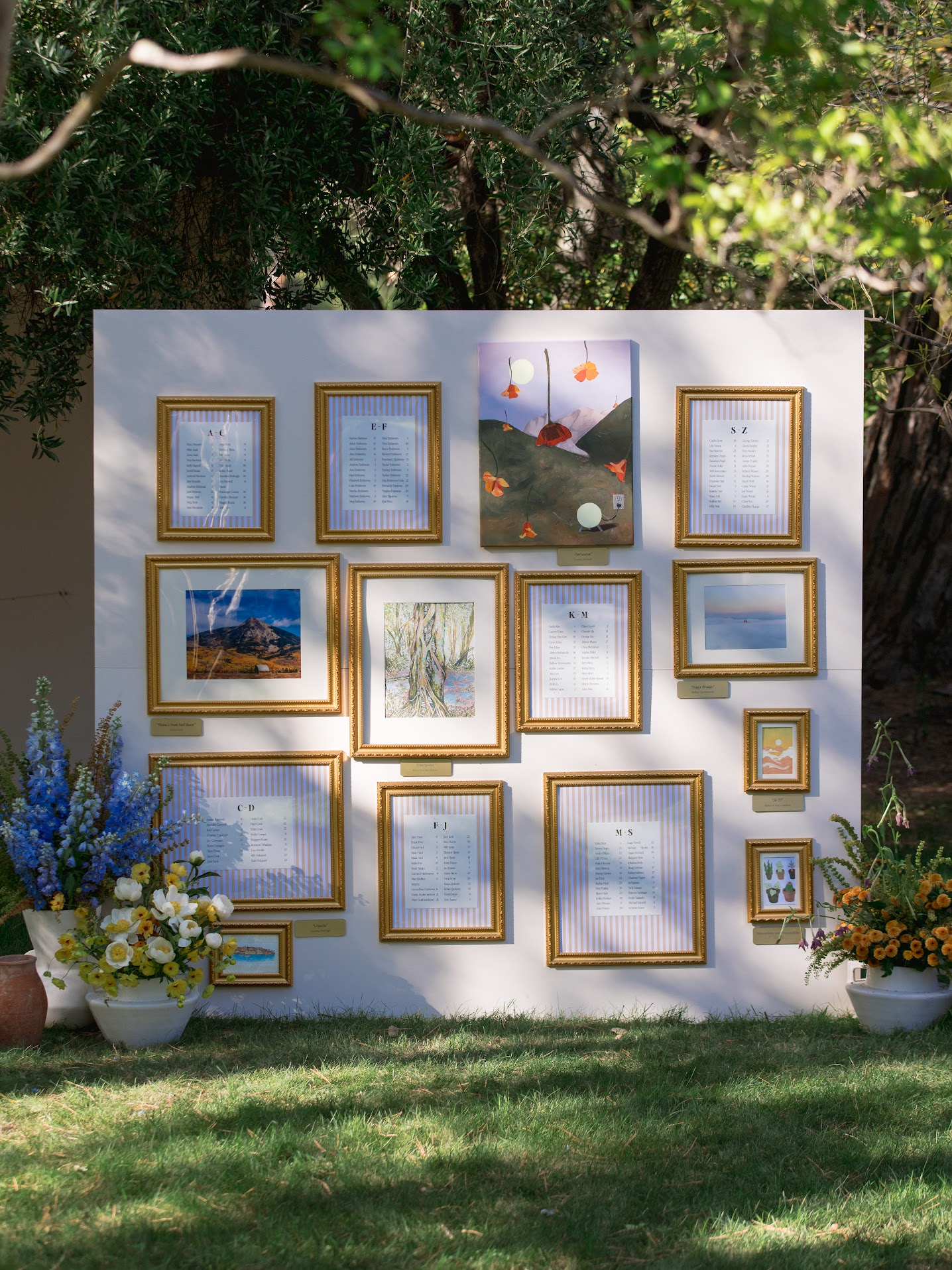
Thank you to each of the 142 customers who took a bet on Tess and to the artists who trusted us with their work. We’re sorry we couldn't build the thing large enough to sustain it. I hope that an entrepreneur takes another shot at this in the future.
If you’re building in this space, reach out. I’m happy to share more of what we learned. We'd also be open to selling the Tess.Design domain and concept so that the idea can live on.
Edit: haven't followed the law in a while, but you could definitely copy, digitalize and scan documents for yourself and your friends (copia privada).