- They don't need charging. Charging may seem like a minor inconvenience, and we're used to charging a lot of devices. However, even a minor inconvenience is still an inconvenience.
- They're harder to lose. When Apple almost immediately started selling accessories to connect their airpods together (i.e. Cables), it was pretty obvious that going completely cordless was not entirely superior.
- For an equivalent price point, wired headphones produce higher quality audio, and the top-end is a lot deeper.
- Wired cans don't need to pair, don't glitch out, don't become laggy, pair with the wrong device, etc.. Bluetooth was never really meant for use as an audio connection, and it's never really become 100% foolproof. With Apple's proclivity for proprietary standards, I'm amazed they (or others) haven't rolled their own wireless audio standard by now.
Too many android phones copied Apple and ditched the venerable audio jack, but a few kept it, and I've always insisted on it when buying phones. It's old but far from obsolete.
"Wearing wireless 24/7 tells me you don't own any land."
I wonder how much is being driven by such lead following.
Gee, is that the kind of stuff that makes people want this, rather than actual usefulness related reasons?
I want it because I don't want yet another thing to have to charge, and because I'd want to be able to throw some cheap headphones in my backpack that I can use the one time in a month that I actually need them in combination with a phone (which of course isn't possible anymore today)
Also, why are ANC headphones today worse for gaming than in the year 2018 when they supported aptx that had less lag? Technology is going backwards?
And you're correct that wired phones have a lot of advantages.
Tack on that they don't have latency, though I've never really tried to track vocals on wireless cans. I have a pretty nice collection of what I consider to be quality mid-tier stuff for my studio (hd280, dt770, mdr7506, k240), and I think they mostly sound better and I can use them longer than I can use the various wireless stuff I use.
And the "real" UHF wireless audio I use professionally (well, to collect rather than listen to audio) is very reliable and good sounding but also, like, $1000/ch once it's cased and cabled and properly accessorized.
However, for almost all of my day to day listening I use either airpods or a some bluetooth'd 3M ear muffs. I even went back to airpods after going through both wired and other wireless solutions.
I don't enjoy having my in-ears ripped out along with my pocket. And universally the cord ends and the physical connector on my phone are the weak spots that have had me replace stuff- I haven't bought a phone in the 5 years since I got one that could charge wirelessly and never has phones plugged into it, and I don't intend to get another one any time soon (knock on wood that my case keeps the screen from breaking and needing me to repair it).
I have a bluetooth receiver with an analog out that I keep in my workbox, which I used for program music at a show tonight. It's nice to start my truck and my podcast just starts playing, too, without having to get out my phone and plug it in.
You're right that wired stuff is better for some things. I still find wireless stuff to be superior in a lot of situations.
I've had to ally myself with a brand I've once sworn off just to get a flagship model Android with a headphone jack. Killing Reader is a greedy betrayal (they were pushing us onto Plus, the whole social web thing) but removing headphone jacks from Pixels is a cowardly betrayal! Eyeing you too there, Samsung. You and Google both have made it extremely difficult to maintain a modicum of principle in today's consumer landscape! You made me justify my purchase with a utilitarian "Better the jacked devil than the blue-toothed one".
(And before you ask, I only generally buy flagships because I upgrade my phone like, every five years, and in my experience flagships are just more bang for buck. YMMV tho.)
Anyway, honestly, wired is not perfect. Wired and wireless each have their inconveniences it's just that I'm more willing to put up with the inconveniences of wired. Wired connections have known failure modes, something which I really value in tech. I have a Sony WH-1000XM3 which can work both as wired and wireless and I love it for that.
Long live wired connections! Here's to a future with cheaper flagship models with a headphone jack!
I charged my wireless headphone for 5 mins and took the call and it went out of juice mid way through the call. I had to run to find a free conference room in the office which was present since it was friday.
I also often connect my wireless headphone through the weekend and not know that it is still connected since friday with my work mac. Wired solves all of this.
Thanks to this article, I just ordered a Apple Earpods USB-C 5 mins ago in Blinkit. It is going to be delivered in another 5-10mins. Good bye wireless. I will use it for work with my Mac and my personal Samsung phone.
Edit after 4 mins: Earpods Delivered!
The microphone and communication protocols on Bluetooth is shit. Everyone that talks alot on the phone knows that the microphone one a wired headset is sooo much better than Bluetooth, simple as that. You hear better and they hear you better. That is it
Obviously with wired headphones, because tape players don’t do bluetooth.
When I'm wearing wired earbuds, the feeling of getting the cord caught on something and having the earbuds violently yanked from my ears is one of the most annoying things, like a slap in the face.
Plus I like being able to put my phone wherever I want, when I'm listening to podcasts while doing yard work. The phone stays in the house, or on a patio table, not in my pocket where pruning shears or dirt will get to it.
There are various other situations where having wires going to my ears is annoying or impossible.
If someone made a cable with a mic on it for them I'd probably buy 10--it's pretty annoying to switch to Apple earbuds for calls, but whatever.
In the pro audio, wireless was never a thing with an exception of live shows where you’d might want to be free on stage but avoid stage monitors.
Notice that while Apple made everyone ditch the lovely 3.5”, on the MacBook Pros they’ve actually kept it and *improved* it.
As this is HN, I’ll focus on technical aspects I didn’t notice in the article.
- Active Noise reduction
While the article suggested the battery free magic of analog headsets. Flights are where the active noise reduction headsets shines. Active cancellation isn’t needed for studio environment but on the go it can certainly make your listening more pleasant.
- Hybrid devices There are several manufacturers with classical headset designs that also includes wired support with all modern features. This is a good balance in my opinion for benefiting from both worlds.
- Latency
Especially Bluetooth, our current consumer wireless is buffered and this latency is too much for creating music. Products such as GarageBand, Logic or FL Studio won’t be that useful for tracking with Bluetooth.
- Quality
Indeed, analog 3.5” audio is uncompressed vs Bluetooth. But it doesn’t mean the audio is superior for listening just because of that transition. Our modern devices are still mostly digital those days so there is DAC that takes those bits and converts them to analog (most of it today is done well as those chips are common) and the other step is the analog amplification. Audiophiles usually invest a lot in the headphones amplifier. Most android devices in the past were mediocre in that sense.
So while wired is a trend, the “dongle” of USB-C to convert the audio is still a major part of the quality we end with.
- Sharing is caring (my personal take)
The biggest frustration I feel with Bluetooth is that it’s now nearly impossible to use multiple headphones for listening. In the old days, you had a simple splitter and as long as both headsets were the same impedance, you can even have 4 people listening to the same content easily.
With Bluetooth, only Apple addresses this in a very limited manner with a lock in to specific models and up to 2 devices and no video calls or live audio support.
It happens so often I even wrote a script to switch to the MacBook internal speakers then back to the headphones.
I've used wired headphones before (and the Sony even has a wired option), but I didn't like how the cord was constantly getting the the way of my arms.
edit: Another big gripe is with the Bluetooth codec itself, and how the quality changes depending on if the mic is active.
>"Bluetooth does not work," Kravitz said in a recent interview, and it's not just headphones, but Bluetooth connections in general. "It's ruining important moments. Imagine the amount of times that you're with someone on a date, you're trying to set a vibe, and then you have to forget the network. On a date!"
TikTok is a big reason wired headphones are popular. AirPod microphone quality is spotty and improving the quality is non-deterministic. With wired earpods, people put the mic next to their mouth and get above-average audio quality.
Like the article says, wired headphones have also become a fashion statement akin to vinyl culture.
The truth is that the OS usually hides the latency of wireless heapdhones, e.g. airpods, by delaying video to keep it in sync. The real latency is somewhere around 100-400ms if the RF environment is crowded. Even worse is that the latency isn't actually constant, but drifts all the time.
At many IT conferences organized by hackspaces, everything is done by volunteers, including broadcast and video/audio postproduction. And that is actually one of the most common issues: our volunteers use wireless headphones even if we ask them repeatedly not to.
We cut talks in postproduction primarily based on audio, e.g., when does the applause start/end, when does the speaker's introduction start/end, etc. Obviously, that doesn't work reliably if the audio latency is nondeterministic.
Even worse, as different venues have different audio setups, there are sometimes real audio/video sync issues that need to be fixed. But if our volunteers are using wireless headphones, they won't just set the wrong offset, but they end up trying to fix issues that don't even exist.
And then you get complaints from viewers that e.g. the livestream audio/video is out of sync, even though it's not. The issue turns out to be caused by the viewer's laptop and wireless headphones not supporting the latency compensation technique I explained earlier. And there's nothing we can do about that.
Wireless headphones tried to fix something that wasn't broken, and made it worse. In German, we'd call that "verschlimmbessern".
How do you rate those?
I made my own, but they sucked balls. I have some Plantronic cans which have ~10db nrr, but they are falling apart now, and I'm looking for alternatives with decent NRR
When wireless headphones came out, I looked at my wired ones and asked the simple question: is a tangling cable worse than bluetoth pairing and having to keep yet another thing charged? My answer was no, so I kept using cheap wired ones.
A few years later, now that makes me look rich. Or something.
There are some models but none really explore their possible advantages (battery, ux, single signal source).
I lost single wireless earpiece multiple times making the rest useless. This won't happen with wire. With wire its also so much easier and quicker to take them off they will just hang around your neck. There is reason why many workers in loud environments prefer earplugs wired together.
My impression is that apple hyped the airpods so well that people forgot about other possibilities. And when Google included cool headphones with cables people thought they have to cut them… that was when industry decided its dead segment.
I don't think many people thought their expensive Airpods/Bose/Sony were not capable of handling lossless and may feel left out or missing something.
I spend a lot of time at the gym or walking with headphones in and music, podcasts, or audiobooks on. It’s so much better not having any wires when you’re moving. I can’t imagine doing these actives anymore with wired headphones.
Battery life, pairing, charging, audio quality, and other complains are all non issues for me, but I’m also no audiophile. They work incredibly seamlessly inside the Apple ecosystem.
* Having to charge them is a PITA
* Having to pair them is a PITA
* Having more points of failure is a PITA
* Paying more is a PITA
On the other hand:
* Wires are fine
I have a nice high-end set of Sennheisers that cost ~ $150, and they're much better than my old wired set (both in-ear, both noise isolating, similar prices).
The bluetooth ones win because they eliminate cable noise. I can actually jog with them. In quiet rooms, they're very comparable, except the bluetooth set has a built in EQ, which works around the fact that iOS / Android still inexplicably do not let you adjust treble and bass.
The bluetooth headset market has been stuck in this weird spot where fashion mostly dictates. I guess I shouldn't be surprised that fashion now dictates wired headsets.
Like, I have opinions about high-end headphones based on how easy the cords are to replace. That shouldn't be the case.
I was a discrete headphone amp guy, just to situate myself in this market. I didn't expect to get good wireless headphones and think "I'm never going back", but that's precisely what happened.
It seemed cool, people bought it, and then eventually many realized they didn't care about the fancy feature(s).
The convenience of being able to get up and walk around the house, or got out with the phone without wires getting caught makes it worthwhile though. On the other hand for stationary peripherals like mice I would never go wireless. I hate that feeling of complete helplessness to the pairing/connection lottery and the time waste of it.
The phones will always have to have DACs in them, to drive their speakers if nothing else. Denying customers a physical connection to them is just a dick move.
Actually, they're so good, they're still making and selling the exact same model.
They also project a clear message of “don’t bother me” when worn in public.
It's just much harder to get good sound quality when the mikes are by your ear rather than on a wire near your mouth
Not to mention that it completely removes the risk of running low on headphone battery mid-call
So it seems to me like the problem isn't Bluetooth, it's shitty implementations of it.
And it's not just cheap devices. My TV is a fancy LG OLED. For the price I paid it should handle Bluetooth just fine.
It's a real shame. When Bluetooth works, it's awesome, but a lot of people have had their opinions tainted by bad devices.
Also, I enjoy not having another device to charge. I recently have been wearing a traditional Casio watch more often instead of my smartwatch.
I've been on cheap Android phones and just moved from Samsung to Motorola and both have headphones sockets.
I have a pair of Airpod Pros that I use solely for audiobooks and podcasts when I'm doing chores or shopping, but the audio quality is so garbage that's all they're really good for.
* They are harder to lose, but the ones with non-detachable cords need repairing the cord if it rips, which happens frequently. Never happened with BT headsets I own.
* For BT headphones with detachable cord I agree, that BT channel reduces quality slightly, compared to cord on the same device. It's not as bad as vinyl/tape, though. You have a chance to notice it on lossless. but not regular MP3s.
* Wired don't need to pair, but need your awareness of the current relation between the cord and your body and surroundings, otherwise you will be constantly re-attaching them, or ripping cords. They don't glitch or lag, but pick static and RF.
Wireless is really convenient, if you can afford headphones that last a full day, or a pair of them to switch between and don't have many sources of sound to play to the same headset, even at different times. There are own standards that skip BT and use analog RF to skip the lag and drops (with a dongle), but they too have the issue with RF interference. You either can have digital with lag and rare drops, or instantaneous analog with frequent noise without drops.
They sound worse, if clarity is your goal. And they are huge and wear out. I agree with you 99%, I just wanted to point out that across some dimensions they are the superior technology.
- cannot overstate lack of lag and simplicity. You plug in and it works, perfectly, every time, forever.
- easily switch devices. I use my headphone on my phone, tablet, laptop, Synthesizer, Groovebox etc without a blink. And my phone never stops playing music and connects to our car my wife just started the way bluetooth ones do :-)
- to me, it's like email. Icq, aim, msn messenger come and go, yet email is old and boring but survives.
There's absolutely a time and place for wireless headphones and I probably use them more at this point. But killing 3.5mm from phones has been a Massive annoyance.
This is it. I have a lot of wireless headphones and every time I need to use one, it isn't charged. It's very exhausting and I don't want to deal with that. So I use them as wired headphone if possible, or dump them in the discard pile if not.
"Half of Vinyl Buyers in the US Don’t Have a Record Player, New Study Shows":
* https://consequence.net/2023/04/half-vinyl-buyers-record-pla...
Seems that people are buying records not to listen to, but to use an 'art object', or other type of artefact to publicly show their like and support of the artist(s) in question.
The Bose mobile app also allows me to use two pairs of Bose headphones on a single device, but still only 2 devices and AFAICT only for media consumption.
Now I'm down to my Shure IEMs (via an Apple lighting-to-3.5mm dongle) and a borrowed pair of old Galaxy buds - wanted to give wireless buds a try, since it's been so long. I don't like them.
1: emitting an earsplitting screech as they did so - the cable must have gone.
Right, but that only works when you control both. I love my Sony and Shure Bluetooth headphones and have 0 issues watching videos with them; they work great even on Linux.
But when people figure they're gonna use BT headsets for conferencing, it just turns into a shitshow of people waiting for the other to speak, then starting to speak at the same time.
I have an old Jabra headset for my video call needs, and it uses DECT. That thing has so little latency that I can use it to play FPS games without issues (I'm by no means a competitve player, so YMMV). At the same time, its range is huuuge. For the life of me, I cannot understand why nobody makes such headsets anymore: they've all switched to BT for some reason. The only models that seem to still use some form of low-latency transmission are some "gamer" models, but I've never tried one.
3 days ago
Thomas Germain

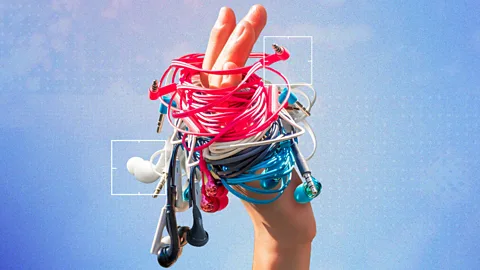
Serenity Strull/ Getty Images
Wired headphones were supposed to die with the headphone jack. Instead, they're making a comeback as consumers seek out better sound quality and technology from a simpler time.
When Apple ditched the headphone jacks on iPhones in 2016, I went into exile. I wasn't about to let a giant company dictate my listening habits, so I bought an Android and plugged in for dear life. But eventually, my phone took its last breath in the same exact month that Google – one of the last holdouts – said it was getting rid of headphone jacks on its phones too. It felt like a cosmic sign of defeat. So I went back to iPhone, tossed my wired earbuds in a drawer and joined the Bluetooth hordes.
Maybe I gave up too easily. Recently, a quiet movement has grown in the shadows based on a controversial truth: wired headphones are better than Bluetooth. Sales are through the roof in recent months. You can often get better sound for the money with a wired pair, but it's not just audio snobs either. Wired headphones are a full-blown cultural trend – a resurgence some tie to a broader anti-tech backlash. Whether it's practical, political or aesthetic, one thing is clear. Wired headphones are back.
"I'm converted," says Aryn Grusin, a wired-headphone-loving social worker from Portland, Oregon in the US. A few months ago, she borrowed her fiancé's old-fashioned wired earbuds and never looked back. "I just think it feels comforting. I like that it signifies to the world that I'm listening to something."

Serenity Strull/ Getty Images
You get better sound for your money with wired headphones than Bluetooth, but there are other reasons for the recent resurgence of cables (Credit Serenity Strull/Getty Images)
Grusin isn't alone. After five straight years of declining sales, wired headphone purchases exploded in the second half of 2025, according to the analytics firm Circana, and revenue from wired headphones was up 20% in the first six weeks of 2026.
"It feels like a lot of people are almost turning on technology because it's becoming so advanced," Grusin says. "I think there's a general group mindset where we're like, 'I don't like how this feels' and we're all kind of returning to the last place we were comfortable."
Sound quality can be a big advantage to the wired life, says Chris Thomas, editor at large at the headphone review site SoundGuys. "This is the drum I've been beating for many years now," he says.
Wireless headphones have improved dramatically, according to Thomas, but the best often come from niche brands made for audiophiles. When it comes to mainstream products you'd find in an electronics store, he says you'll still get better sound for the money if you chose the best wired option. Plus, even the finest Bluetooth headphones may not deliver their top audio performance because of bad connections or compatibility issues with your device. "With a wire, you just plug in and it works," he says.
But sound isn't enough to explain the trend. Somehow, it seems Bluetooth has turned deeply unsexy. Don't take my word for it. Ask actor Zoë Kravitz.
"Bluetooth does not work," Kravitz said in a recent interview, and it's not just headphones, but Bluetooth connections in general. "It's ruining important moments. Imagine the amount of times that you're with someone on a date, you're trying to set a vibe, and then you have to forget the network. On a date!"
In fact, wired headphones are now a must-have fashion accessory in some circles. There's a popular Instagram account on the subject called Wired It Girls, dedicated to women looking chic and unbothered with cables dangling from their ears, from regular people to celebrities like Ariana Grande and Charli XCX.
Keeping Tabs
Thomas Germain is a senior technology journalist at the BBC. He writes the column Keeping Tabs and co-hosts the podcast The Interface. His work uncovers the hidden systems that run your digital life, and how you can live better inside them.
Wired headphones have become so ubiquitous among the rich and famous that some see these tangles of plastic and wire as a cultural symbol. One social media user posted a viral tweet with photos of actors Robert Pattinson and Lily-Rose Depp sporting wired earbuds. "It's becoming a class thing," they said. "Wearing wireless 24/7 tells me you don't own any land."
Of course, there's something freeing about untethered, wireless listening. But batteries die at the most inopportune moment. Tiny earbuds get lost. Devices won't pair.
"People say it's easier, but it never feels easier to me," says Ailene Doloboff, a dialogue editor in the film business in Los Angeles. "With Bluetooth it's always one extra step."
Wired headphones join a list of seemingly obsolete technologies that have roared back in recent years, just we tumble into the next digital era. People young and old are adopting retro products such as DVDs, cassettes, ancient tube TVs and even typewriters. At a recent concert, I saw a guy in the audience recording the show not with a phone, but a 16mm film camera from the 1970s.
"I don't know why, but we all collectively had this switch. I think the presence of AI is making people more on edge," Grusin says. "Which is ironic, in a way. I'm uncomfortable with technology so I want to use a different piece of technology. But maybe plug-in headphones feel as close to analogue as we can get."
If you go wired, the question is how you'll plug the things in. But you can now buy wired headphones with a built-in USB or Lightning cable connection. Or you can use headphones with the traditional 3.5mm jack via an adaptor for the charging port, often called a "dongle", a word so undignified I spent years refusing to try one.

Getty Images
The dangling cables of wired headphones are a must-have fashion accessory in 2026 (Credit: Getty Images)
Apple removed the headphone jack on its phones in 2016 with the launch of the iPhone 7, which many saw as the end of wired listening. But even Apple still hasn't given up on wired headphones. "Oh, we still sell those," the company's chief executive Tim Cook – the man who killed the headphone jack on phones – told my BBC colleague Zoe Kleinman a few years ago. "People still buy them."
I stopped by an Apple store on my way home from the office to grab a cheap pair with a USB connection for myself. An employee told me he's been selling more wired earbuds than ever before. I spent a few days with the wires. I liked the feeling. Being tied to my device made me feel a little more present with my listening, and they also sat more comfortably in my ears than the heavy buds of my Bluetooth set.
But our relationship was short. I've never managed to never lose a pair of Bluetooth earbuds. The case for my AirPods is bulky enough that I can always tell if they're not with me. Not so for the featherlight wired earbuds. They slipped out of my pocket somewhere on the streets of my neighbourhood. I hope they found a more loving home.
Determined, I thought an upgrade might make me more careful. So I visited a specialty headphones store in New York called Audio 46, tucked away in a narrow storefront. Delaney Czernikowski, who reviews headphones for the company's website, greeted me at the counter.
"A lot of people are jumping on the trend. They come in saying 'I think wired is better, I want to try them'," Czernikowski says. "But sometimes they're worried about losing the Bluetooth convenience. I tell them Bluetooth can be very good, you don't have to lose out."
More like this:
• It might be time to ditch your phone case
• Not on TikTok? They're tracking you anyway
• People are selling your home address online. This privacy tool will help
Czernikowski let me try some of the fancier Bluetooth headphones in the store, with incredible sound quality and incredible price tags to match. They were enough to make even the most religious audiophiles drool. "But to be fair, the wired headphones, a lot of them are better and there's a lot more to choose from," she says. "And they do have nicer qualities that aren't weighed down by the need for Bluetooth technology inside."
I planned on grabbing something cheap. With about a minute of convincing, Czernikowski convinced me to try on a pair of $130 (£98) earbuds from a specialty Chinese brand with a thick, gorgeous, braided cable. "Don't compromise," she says. They sound superb for the money, but the BBC doesn't recommend products as part of our commitment to impartiality. So, you'll have to do your own research.
I handed over my credit card, bought a godforsaken USB dongle to go with the headphones and walked outside to plug them in.
--
For more technology news and insights, sign up to our Tech Decoded newsletter, while The Essential List delivers a handpicked selection of features and insights to your inbox twice a week.
For more science, technology, environment and health stories from the BBC, follow us on Facebook and Instagram.
Yeah, charging is a bit annoying, but the added comfort is worth it to me and I can't tell that the audio quality is any different.
I've had headphones where a slight change in the environment around me while walking would disconnect audio. Or IEMs not syncing properly the L and R channels.
Even in the best of cases using headphones with multiple devices is just terrible. Also syncing audio to picture rarely works as it should.
Yep, but this is a problem that is present everywhere. For example, electric cars are supposed to be simpler, because its one moving part. In reality, you get essentially vertical integration of all the components like battery management, motor controllers, infotainment, gauge cluster and the software that connects all of that, and when bugs are present you can't even get into your car.
Perhaps, but it kinda seems to me that there must be some inherent limitation of the standard which make it particular hard to create a high-quality experience?
The latency for instance - in my (somewhat limited) experience audio over BT does not sync perfectly with video.
The channels/codecs is/was so limited in bandwidth that until recently (few years back IIRC) headsets couldn't even send and receive decent quality audio at the same time. Even recent headsets like the Shokz Openrun Pro 2 has this limitation. (Which you could argue is an instance of "shitty implementation" since it was released after the availability of necessary tech (LE/LC3))
What do you mean? There are tons of wired headphones that don't do noise cancelling at multiple price points.
I can still pick up a new pair of headphones that I started using 10 years ago (AudioTechnica m50x if you want the recommendation).
I've experienced the opposite. The microwave will knock out my bluetooth completely, but the wired headphones are solid but in a decade of using both wired and wireless headphones I've never heard anything weird or staticy through the wired ones. My wired headphones were the Shure SE215, and now after a decade of using those they broke, so I have the Kiwi Ears Belle.
I've had a pair of Sony MD-7506s ever since I assisted in an analog recording studio, years ago. 7506s were the standard then, not sure about now. I am on my 5th set of cushion replacements.
A few years ago I bought a high-ish quality bluetooth adapter I can put in my pocket and walk around. The one I bought is the Boltune BT-BA001. Looks like they are only $30 on eBay now, but there may be better ones out there. That little box is probably my most used piece of inexpensive electronics.
I think you are going to far here.
Do wireless headphones have problems? Sure. Did they fix some problems wired headphones had? Yes. Yes, they did.
Simply the ability of moving around without having to worry about the cable getting tangled or dragging the headphones or the phone is phenomenal. My wireless headphones are a lot more reliable than my previous wired ones. Somehow the cable and the connector was always the source of failures.
Do you not like wireless headphones? Don’t buy them. I will keep buying wireless headphones because they have clear benefits to me in my usage.
I find it insulting that you represent your preference as some universal truth.
Sadly have to disagree. I use Beyerdynamic though where you can order parts to repair em yourself, which i already did.
[edit] cannot recommend their wireless stuff produced in China, the worst i ever had. The big corded cans are still manufactured in Germany.
Not "audiophiles" standard though from a sound engineer pov, it is very decent (especially compared to my other laptops)
Of course, the company disappeared, and now in 2026, we have lesser tech than we had back in 2017.
If you're wondering "Well, how did a company disappear?!", feel free to take the most corpo/capitalist-dystopian guess.
If you guessed "They got bought out by Google - presumably for IP - with the founders joining Big G, and Google of course promptly shelved it and did absolutely diddly squat with it", congratulations, you win... frustration and disappointment, I suppose!
1 - https://www.cnet.com/tech/tech-industry/the-most-exciting-th...
wireless headphones externalize the cost of latency to other conference participants. if you think your airbuds are "perfectly fine" it's because you're not the one paying the cost.
Shokz had a black friday deal on Open-Run Pros and those are my goto. Admittedly, they are not as convenient as my Airpods were, but my ears appreciate not being bombarded with noise canceling.
e.g. https://www.soundguys.com/apple-airpods-pro-3-review-close-t...
That’s an implementation problem, not a technology problem. iPhone with AirPods here - your scenario just does not happen. There’s even an option for “yes be stupid and connect to my car even when I’m in the middle of a phone call” if you really want to use it…
I’m not sure how, its an aesthetic choice but an inferior technology by every metric that counts.
Candles still have a place, we still buy them, but we can’t reasonably call them superior either- even if, candles actually would have a real advantage of not requiring power. Vinyl doesn’t even have that.
Many decades ago, those who bought vinyl and desired adequate audio quality never listened to vinyl discs, but they copied them immediately to magnetic tapes and always listened only to the tapes, keeping the vinyl discs only as a master source, to avoid wearing them out.
Sennheiser provides replacements should you need them. The effect they have on the sound is much bigger than you might think.
Until my cat finds them.
Any serious set of wired headphones better have replaceable wires because apparently they are delicious
The article prominently highlights mobile usage, in which case wireless headphones easily win on longevity.
To be clear, these are for noise protection and are heavy. They are big enough that I have another pair of muffs for shooting rifles and some ($$) molded westone earplugs for working on loud stages.
I mostly use the 3m when I am running a chainsaw or driving vehicles with the windows down (I find that too damn loud for my tastes). For a while I'd track drums with them over my shure se215, but I've started playing quieter and have found that something like an HD280 cuts stuff down enough to track drums while feeling more comfortable.
On one hand, they are kind of expensive, bulky, and the mic isn't great. Also their "ambient sound" is not anywhere near as loud or controllable as the muffs I use for shooting. On the other hand, they pair well, sound okay, have a lot of noise reduction, and they seem pretty rugged. They run on AAs and Battery life is pretty good, too.
RIP I'm sure it was a noble device. My Pixel 3a is currently my wireless router for very German reasons. I worry this will kill off the still-decent battery life, as has happened with my OG Pixel.
I have since allied myself with what I personally consider the devil of consumer electronics just to stay on this boat.
Afaik that's one big reason why BT is such a mess. Many different use-cases are dictated by different protocols, many of which are outdated, and two paired devices can only use a protocol supported by both. So the headphone can't just reuse the same nice connection and add a mic, it has to start pretending like it's some Bluetooth 2.0 device from 2005 or something.
Multipoint is also cool too. I like listening to music, taking a call, going to the toilet, and coming back to music all without doing anything.
If there's a silver lining to the last 15 years, it's that replaceable cables became a standard feature and that there are IEMs with direct USB C cables now. If/when Moondrop/KZ/Linsoul release IEMs that can be used like wireless earbuds with ANC, and can also connect and recharge via USB C, they can just take my money.
There are a couple of minor annoyances for sure, like the car grabbing my phone when it turns on, but that's not a huge deal. And the annoyance of having a cord dangle around while I'm walking the dog or doing dishes or whatever the hell I'm doing far outweighs it.
All of that said, if I wanted audio quality to sit and actively listen to music, I'd go wired no question. But I don't really care when 95% of my listening is audiobooks and podcasts.
The equivalent PTIA for wired would be having to untangle them everytime you want to use them.
>* Having to pair them is a PITA
How many devices do you have that this is an issue? This is an issue that pops up a few times a year, at most.
>* Having more points of failure is a PITA
It's unclear which has more PoF. Wires can break, not to mention randomly catch on stuff and sending your phone flying.
Even in the extreme case where you're replacing them every other year you could buy a handful of spares right away so you have them on hand when you need them and your headphones will outlast the batteries in your airpods
It's true that humans are not particularly sensitive to audio quality, but they are very sensitive to audio latency. If all you do is listen to buffered audio sources then latency is not important but the moment you need to use your headphones in an input loop then wired is the superior technology as it offers close to zero variance in latency.
Wired is for when you want to listen to music you really like and it's too late to use the speakers.
You can also go for moderately priced cans and just feel your ears tingling the first time you listen to something through them.
I can use them while charging my phone or working out. Can play a video while cooking and moving around the kitchen. Or while watching TV/playing a game in the TV where a cable can’t reach.
However when static I used wired. That’s mostly when on the computer, but like many people here I am assuming that’s a good part of the day.
The dongle is tiny and seems to be of good mechanical quality.
If you are lucky and have a good ear shape, then airpods sound good. Still not as good as IEM because IEMs have more space for better drivers without needing a battery or bluetooth hardware.
But if you are a person like me who has very hard time with any earbud staying in, then its gonna sound like garbage because you are never going to get a perfect seal.
My Airpod Pros are the most convenient personal audio device I have ever used. Sound wise they pale in comparison to my Sony MDR-ZX100 which I bought on sale for $9.99 at Best Buy...unfortunately the new model is about $15 regular price and maybe not as good (but I doubt it).
Sure the Airpod Pros sound better than ordinary Airpods or the wired Airbuds, but that's a really low bar for an audio device.
I have two iPhones and a MBP. I have to keep Bluetooth disabled on the MacBook otherwise it randomly triggers while I'm between podcasts or whatever and squeeze the AirPods to resume, instead it launches Apple Music, or some browser tab starts playing audio.
This is far from solved if you have more than one Apple device.
There is no option for me to say: never use AirPods for anything but podcasts, and absolutely never automatically select them as an audio source for zoom/teams. AirPods microphones just don't work for my vocal range, they sound horrible and underwater. The microphone on my MBP works great, the mic on my iPhones works great.
AirPods are fine if you only ever use one device at a time. If you use more than one at the same time, it becomes extremely annoying.
Let's not even get into the annoying ways which it becomes hard to manage when you have multiple AirPods, multiple iPhones, and multiple MacBooks.
Airpods Pro have great audio quality considering they are wireless bluetooth earbuds. Remove that qualifier, and if you're sitting at a desk all day and wired becomes an option, you can get far better sound quality/longevity for a fraction of the price.
Probably need to start shopping again soon cause updates stop in June.
I'm not well versed in the world of port design, but what comes to mind is a little shallow magnetic nub with a couple of contacts on it. Easy to clean, impossible to break by accidental torquing, not deep enough to get stuff stuck in it.
The cool thing is that whatever the new design is, making adapters for 1.44mm to the new thing is dirt cheap since it's still just an analog connection.
Would you share more? I've never had an issue with a USB-C cable. Helps to buy well constructed ones with legit specs.
I went looking for the state of the art in headphones and bought (1) a set of AirPod Pros and (2) a recent Sony headset.
My feelings about the AirPods are terribly mixed.
10 years ago I think the best reason to spend $250 instead of $25 on a set of Bluetooth headphones was that the $250 device would pair properly with multiple devices whereas it might take you 15 minutes of screwing around to unpair and repair the $25 headphones every time you need them. But hey they are so cheap maybe you can pack one for each device you have and not worry about it.
Today it is the other way around, somehow $25 headphones "just work" with Windows, Mac, iOS, Android, Steam Deck, whatever. After I disabled the microphone and switched to the microphone on my camera, the AirPods got reliable with Windows. Inside Apple's ecosystem it tries really hard and almost works, yet the $25 headphones "just work" and don't seem to be trying so hard. I don't get messages warning me that somebody else's $25 headphones are following me around but my iPhone tells me that about my AirPods all the time but I think it is a KPI for somebody in Cupertino that I see the word "AirPods" as much as possible.
Now the sound quality of the AirPods is just great, I'll grant that, but I'm not going to be one of those annoying youngsters who is as hard as hearing as the oldest oldsters because I have some genetic polymorphism that makes me produce copious amount of earwax that eject the AirPods from my ears if I move too much. My doc says one of these days my ears are going to plug up and I shouldn't get so excited about it.
I have a pair of IEM with the usb-c converter attached most of the time for use with phones.
Give Truthear Hexa a try.
I haven't bought headphones in years, and my current set support it.
Different strokes I guess.
Every pair of cheaper earphones or earbuds I’ve had fail have failed due to the cable.
We switched my oldest to a pair of BT headphones because he seems incapable of keeping track of the cord. It gets caught, he pulls, and something has to give. Longest lasting set he had in 2025 was BT.
Wired headphones at least if they fall out are still connected to a rope to get them back!
I just wonder if wired fans just never skip forward a song, or adjust the volume. Or even use active noise canceling.
Do you mean real time like games? “Wireless” headsets are perfectly fine and usable. Real time audio? Wireless transmitters and receivers exist and are used (granted with wireless in-ears but IMO that’s mostly so the don’t fall out) at the absolute highest level of audio production and live events.
You definitely can’t just say wireless isn’t used for real time.
You can with wireless charging!
Can't lie flat due to camera bulge. No headphone jack. Fingerprint sensor on the front that screen protectors interfere with. No sim slot. Ai bullshit triggers if i keep my thumb to close to where you touch to switch apps. Ai bullshit also replaces the old power menu, which now requires a combo button press.
Such a let down.
Wireless headphones take up much less space. I can put them in my pocket trivially.
Wireless headphones can tell me where they are and if I've left them behind.
Wireless headphones don't have a piece of plastic that dangles on my neck, shoulders, and face. As someone with sensory issues, this is genuinely important.
I've never had to spend five minutes untangling the cords for my wireless headphones.
I've never accidentally snagged the cable on my wireless headphones, causing them to snap off.
I can put my phone in a waterproof case in my backpack and protect it while walking. I don't have to do cable management to route the wire.
It's fine to prefer the wired headphones. I fully endorse that for you. Maybe drop the hyperbole about how wired headphones are strictly better?
If you still want to make the old headphones work these welders are a godsend, and with some small amount of diy work of cleaning, sanding and buffing you can easily hide these welds.
I personally like to leave them though since they accent that something that was once broken is whole again, and that it has a long history!
Right now, since I buy audio files anyways, I've mostly been relying on a tiny audio player that can also act as a Bluetooth receiver for my phone.
Sony experia, Asus zenphone, Motorola Moto G, and a few others
They're rare nowadays, but they're inherently superior when it comes to audio just working
Compared to 3.5mm where the frustrations I remember were usually limited to sometimes getting a bit of a crackle or one of the audio channels dropping out and worst case scenario you just unplugged it and put it back in and it usually worked. With USBC you have to wait to see.
Wireless can't get caught on doorknobs or other protrusions.
I don't have to plug them in. I put them in my ears and they work.
They automatically work with multiple devices. I put them in and make a phone call. I put them in and take a video meeting on my computer.
There certainly are advantages to wired headphones and more power to you if you prefer those tradeoffs. But it's bizarre to call wireless "strictly inferior." It should not be difficult to find at least one thing about them that someone might find to be superior.
For example if I have my phone and laptop running, and I’m listening to something on my phone, I pause with my AirPods, and then I unpause with my AirPods, instead of what was playing on my phone resuming through my AirPods, a video that I’ll have forgotten about will instead play through my laptop speakers, and pressing pause on my AirPods will do nothing and I have to interrupt whatever I’m doing to pause on the laptop. Possible they’ve fixed this specific issue though since I’ve learned to not have anything that has media controls open on my laptop.
The cross platform control stuff is probably very hard and usually works though.
Incidentally the same goes for bluetooth mice.
I also have to say i haven't checked this for two years but there seem to be some new models now (under banner of neckband earbuds). So maybe there is something nicer now.
For phones, I think it's just the Sony and Asus and Chinese brands that support it. Pixels and Samsungs generally don't since they use Tensor/Exynos instead of Qualcomm/Snapdragon SoCs, and definitely not Apple.
Story is even more bleak on the headphones side, Sony prefers their own LDAC codec so they support that instead of AptX Lossless, a pattern shared by many Asian headphones manufactuers. Many western brands only support up to AptX HD and AAC because Apple/Samsung devices have the majority marketshare. Qualcomm's own site only shows 12 headphones that support AptX Lossless.
Now my opinion is LDAC is close enough to lossless that it's probably good enough for Sony and most people (the 1411kbps for uncompressed 16/44.1 CD quality generally compresses to under 900kbps which is below the 990kbps max of LDAC). Bose does have a headphone that supports AptX Lossless. It's just the Airpods that are far behind the competition.
Wires suck.
Not anymore for my old 380 pro. Had to settle for aftermarket versions that feel a little softer but also sound a bit different.
with my bluetooth headphones, every time I use them in my house it's a hunt. First find my phone and disconnect them on it since thats what connected automatically. Then, go to the tv and disable bluetooth since that was the second thing it connected to. Then put the headphones in the case and back since they won't pair for some reason. Then go to settings in my PC. Realize my PC connected to my speakers, disconnect them, then connect to the headphones.
Someone then calls me on the phone, I pick up and their voice comes booming from the speakers.
Bluetooth would be infinitely better if it didn't connect automatically. Just press a button on the device you want to use. Instead it connects to everything but the thing I want to use.
Recently I bought some cheap $10 wired Sony earbuds. I was surprised they sound much better than my $150 bluetooth earbuds.
I personally prefer wired headphones... they're always charged and ready, even if I only use them with my phone once in a while.
- sorry just kidding. I couldn‘t resist.
Plus, the more high end ones come with repleceable cables.
I LOVED my Grado headphones but destroyed three pairs of them and was soldering my own ends on the cables over and over.
I use wired at home, where I'm not cycling the connection very much.
And I hate it: latency, glitches, randomly just deciding not to connect anymore, deciding to connect in the lower-quality headset mode when I want to listen to music, and refusing to switch to the high-quality mode, battery running out at inconvenient times, the cat knocking them off my nightstand and under the bed where I cant reach them. So many reasons to be annoyed by them!
But I hardly ever take out my wired headphones anymore, and I'm not sure why. Back when I got my first phone without a 3.5mm jack, I just kept a little USB-C adapter in the little pouch/case that held my wired IEMs, and it was fine. But at some point I bought a new phone, and there was a deal on cheap (or free?) wireless earbuds with it, and I really just stopped using wired headphones for the most part since then, even though the wireless ones really annoy me for so many reasons.
And when usb-c phones disconnect just a little, usually the phone will pause the music completely and disconnect, whereas the aux headphones will just keep playing. So if the connection isn't perfect, the usb-c cable becomes unlistenable because I can't walk 20 steps without it pausing.
edit: I've tried many cables and dongles, so if you don't have this problem, it might be just that I move around more? Biggest problem for me is commutes and walking around.
A wire sitting on a table does not suck. 2 people can gather around that table and still, the wire does not suck. As soon as 1 person picks up the wire and starts doing something with it....now an interaction with a wire sucks.
But that's not the wire's fault.
Your soldering skill (and sense of adventure) would have to be far better than mine to even consider doing that for wireless earbuds.
It happens to us all of the time.
My partner is on a conference call, I hop in the car to go run an errand. Suddenly I'm on a conference call.
My partner is in the kitchen listening to a podcast, I hop in our other car and suddenly I'm listening to a podcast.
My partner is sitting in the car having a driveway moment, I arrive home with the other car and now I'm having her driveway moment.
My partner is on a conference call at her desk and picks up her phone to respond to a message and then you hear "shit shit shit, hold on a moment!" and then frantic typing and clicking.
I had candles at my dinner table last Thursday, and am likely to do so date night tonight... but the bulbs I turn off to give the candles reign are LED...
well actually...
Using constrained mediums on purpose is often how the best artistic expression is achieved. For example, if the artist knows their channel is noisy and band-limited they can get a lot more liberal with the kinds of samples they use throughout. CD/SACD is kind of like 4K for television. The medium becomes so transparent that it causes upstream shocks in every other part of the process. You can no longer rely on the camera or audio chain to cover it up (unless you hobble yourself intentionally).
Candles/Vinyl can be superior if you clarify the metric you're optimizing for.
You can get rid of a surprising amount of surface noise with a static gun and a line contact stylus (where shape is close to that of a cutting head so you get the biggest contact patch).
I think most people only copied to cassette if they want to use a Walkman, play it in the car or give a copy to a friend. It generally wasn’t for sound quality.
But, another example: when I was growing up (dating myself here), cassette tapes were superior to CDs in the only way that mattered (to me): they didn't skip in my portable music player (walkman) when I took them running.
I'm the same way as your oldest, if I'm up and moving around while wearing earbuds/IEMs I run the cable through my shirt.
But also, I don't think it's either/or for most people. I use both wired and wireless headphones all the time depending on the use case. Wired sounds far better and is more reliable, wireless is more mobile. Different use cases.
I can point to the shelf with my Sony wired ANC ear buds, which I bought years ago specifically for ANC during air travel, in the era when I would use my iPod and later an iPod Nano. The ones I have are the second pair, bought after the first was accidentally left on a plane. I think they were different product generations, a few years apart. These are so old, they are purely stereo headphones. Microphones for duplex audio hadn't become pervasive yet.
These stick in my ear with little silicon flanges and have a part that sits outside with the microphone. Then there is a small control module sitting at the junction of left and right ear wires, which holds a AAA battery and has a power switch and a pass-through audio button (which always seemed more gimmick than utility to me). In their active mode, they also don't demand much of the source device.
For convenience and casual on the go listening, or to not annoy anybody, I'll use earbuds or light headphones.
If I really want to enjoy music I'll take the big ol' cans (circimaural open-back), lie back, and enjoy the music fully. Etc.
(And I'm extremely not an audiophile! But big roomy headphones are super comfy and sound super nice to me :).
If I'm on zoom calls all day I want something lightweight but with a boom microphone (massive Grrrr! To everybody joining meetings with airpods).
etc. I'm an extreme example but I have a few different boom-mic headsets in my home office for work, gaming headphones, running around headphones, and listening to music headphones. All of that at a teeny fraction of price people used to spend on basic entry level home hifi setup.
Though I've been working with writing software for esp32 and so that might change in the next month or so.
They're awful in several other ways too, which is sad for what should be their flagship model
even some of the cheapest in-line remotes that only have a single button will let you change the track by double tapping it
if you dont have an in-line remote then theres also the option of using a key remapper app (probably not on iphone) to let you change track by long pressing the volume buttons
So I guess it actually makes sense.
Real time audio exists for sure. But it doesn't use Bluetooth, and nobody here cares about it, not to mention the amount of investment needed for equipment.
This is just being pedantic.
(I actually don’t like 3.5mm jacks as much as some people do, though, as my experience has been the ports get janky over time if they’re under any strain at all, which they will be on a mobile device and which is always a back-of-my-mind source of stress when using them, but quarter-inch jacks are awesome)
I’ve been using Bluetooth wireless headphones exclusively when I’m portable since 2006 (Sony Ericsson HBH-DS970 represent), with only wired use at a desk and I’ve never looked back.
Hopefully more Bluetooth headphone companies follow suit. Maybe we can even get a standardized battery.
This has been a thing in wired headphones since at least 2007 lol
>But that's not the wire's fault.
So... "it's not the fall that kills you, it's the sudden deceleration"?
What is a "Sony g shock" if you don't mind? I know Casio's G-Shock and Sony's Sports series... did you mix them by chance as I suppose or is there a Sony range I'm not aware of?
Cables do fail though, completely. They become unusable.
In my entire life time of using headphones/earbuds since school with the PSP, ALL wired options have failed after 1-2 years for purely mechanical cable reasons. Not a single wireless failed for electronic reasons. The did fail for me dropping them and stepping on them reasons, though.
I prefer other technologies over noise cancelling in my ordinary use anyway. And my ears feel healthier. But that’s me, not you.
In theory. In practice most stuff is distorted and compressed to death and might as well be 12-bit ;)
Rather less-succinctly: I never got into vinyl and have never owned a turntable that wasn't built down to a price. I do still have my shelves of CDs, and it keeps slowly expanding. I usually listen to Spotify because it is convenient and portable and -- these days -- lossless.
But my sister and her old man have put together a quite decent stereo system with a mix of vintage and modern gear in recent years, and also started a a rather serious vinyl collection. While there's certainly no romance there on my end, it's a lovely and deeply-involving experience to hang out with them in their tiny little city-dweller living room and spin records into the wee hours; sometimes for just one track, and sometimes for entire albums.
I definitely prefer the way my own stereo, which I've built over the course of decades, sounds. It's detailed and big and it does all the things; it is by all technical measures very superior. But we have a lot more fun listening to vinyl at their place than we have playing CDs and Spotify at my place. The process -- and indeed, the inconvenience -- of playing vinyl makes it all much more visceral.
However, the noise cancelling gap is real. I'd kill for wired IEMs with an inline battery + buttons, and noise cancelling mic & circuit in the earpieces.
Closest is the Sony cans, which have wired mode (ie: they have a tiny jack, so you can use them passively) but I don't think they cancel noise when using them that way
Artistic expression is not technology. Vinyl is strictly inferior as technology. That doesn't imply that it cannot have any advantages at all, but that wasn't the point being made.
RAM prices are such an infinitesimally small component cost of digital audio equipment that I can’t take you seriously here.
The advantages of vinyl are basically making up for lack of self-discipline in humans. (I much prefer vinyl for that precise reason!)
a) Since putting it on becomes more of a ritual - handling the album carefully, brushing off lint, placing the needle &c - I find I make more of an effort to actually _listen_ to the music I put on. I could listen as intently to Spotify or Tidal, too - but, alas, I most often don't.
b) Seeing as you'll get some 20-odd minutes of music before having to make another choice - be it playing the other side or another album entirely - it enforces having to decide on what you'd like to listen to, rather than just letting your streaming service of choice play things it thinks you may like. (That being said, streaming services are a great way to explore new music!)
c) Given the economics of streaming, buying physical media helps both the record stores - a good one is like an excellent library, in which the librarians give you all sorts of curated recommendations for things you may like, in addition to being great social meeting places with like-minded folk - and performing artists alive; I've no idea how many hours I would have to listen to an artist on Spotify before the payout is equal to their takeout from a single vinyl sale...
d) Besides, it is cosy.
That being said, you could easily DSP CDs or streaming to sound like vinyl if that's your idea of fun - just about any playback format is superior sonically to vinyl. However, to many, it is the whole ritual of putting on a record which basically makes it worth the sonic tradeoffs... (Call me a luddite if you like!)
Gaming headsets are usually 2.4GHz wireless, and pro audio stuff is ~500-800MHz and the proper stuff requires a wireless license to use.
My assertion is that an inanimate object becomes a problem when a human interacts with it.
Your attempted logical argument is that a law of nature is the same as an inanimate object.
I am not contesting that an inanimate object is the same as gravity.
I'm saying that humans make bad decisions with simple things and whine about inanimate objects and that's a very real first world problem.
You’ll need to solder it to the contacts inside the can, but that’s quite straightforward.
In case the internal cable that goes from one can to the other breaks, you can replace it with any bit of audio cable so you can use one that’s easy to solder.
The trick is to gently scrape the stranded wire with a blade for the solder to stick and to make a good connection.
I also exaggerated the year a bit. After looking it up, I think this cd player came out in 2004!
But you could maybe argue that there are advantages to dirt (at least a hypothetical dirt which can be used as a musical medium somehow) which you lose by going to CD or vinyl. If this hypothetical dirt managed to be constraining in such a way that it produces kinds of musical works which would not have been produced for CD, is that not an advantage?
Technology is sometimes used by artists to express themselves. Sometimes that means lo-fi recordings of your music on a shit tape recorder when better tools ate around. Sometimes it means pressing vinyls.
I imagine any large about of RAM in audio equipment would strictly be for devices/functions that buffer large amounts of data as opposed to just decoding it.
An old Akai S1000 sampler I had a long time ago had slots for memory modules (some weird proprietary slot IIRC), but that was a musical instrument, not really a player of any kind.
Or are you suggesting that I buy the record, a blank CD, and all of the high quality recording playback equipment I need to write it to that CD?
I would stand by recording to reel to reel tape for quality being even less common recording to cassette tape.
Quality domestic reel to reel decks were just not that widely owned here. Maybe it was different where you lived.
The model I have, BT2, is "semi-wired", meaning that the Bluetooth and battery are common to the two earbuds, linked by a cable. And, outside the big heavy cables some big heavy headphones have, this one is the one that has held up best – I'm pretty sure I got it before Covid. They now have a newer model with no wires, which houses the BT and battery in some over-ear clips [0]. I have no experience with these. In any case, I expect other manufacturers to have similar options.
Before this, I would have to change the (old-school) wire on these IEMs seemingly every other year. But at least it was changeable, as opposed to other cheaper IEMs which would require to break out the soldering iron at best, or end up in the trash at worst if they were a glue fest.
[0] https://www.shure.com/en-US/products/accessories/rmce-tw2?va...
As a musician myself I can assure you that the high stakes releases for any musician are vinyl releases. They also happen to be the ones with which most musicians earn the most money.
Now technologically vinyl isn't superior (and anybody who claims it is is an idiot in the sense of the word), but technology isn't everything. A noisy casette tape can evoke the same (and sometimes more) feelings than the digital recording. A vinyl record with a big cover, an inlay with band info, that you specifically chose to put on the record player while reading the liner notes and examining the design is in a ritualistic sense a thousand times more gratifying than having spotify select a song for you without knowing why, in the background of the daily life. That is like the difference between a candle light bath and getting wet in a rainshower.
Now that doesn't mean people will be binary either 100% vinyl or 100% digital. Vinyl is for the special occasion or for DJ sets, digital is for everything else.
It would be the same surface noise each time, not getting worse.
I listen to most of my music on phones or computers and when I do, I like to pick out a track at a time or put together a playlist or just shuffle the whole damn thing.
When I purchase or put on a record, it's because I think the album is a cohesive work and I want to listen to it as a piece; the constrained format created the concept of an album, and using it enforces listening to the music as an album.
The utility has dropped tremendously though, now that headphone jacks have disappeared.
Would love to have a pair of "direct-USB-C" Etymotics.
> It would be the same surface noise each time, not getting worse.
Interestingly, not always getting "worse".
A large portion of vinyl surface noise comes from static rather than groove wear.
So you can zap it with a little petzo-electric gun and it goes away again. At least for a little while.
The parent comment basically argued vinyl is superior because when artists used vinyl the resulting music was creatively better (because of whatever process). Sure, but then you can't selectively ignore the great music that has been made with other recording technologies. I can point to a lot of good music recorded on tape or digital. Unless we are arguing that music back in the vinyl days was broadly better than now? (Different argument then...)
As for artistic choices, I totally agree that vinyl can be a valid choice! Then it's silly to say one thing is "better" than another.
But in terms of raw technology, I say it's just copium to claim vinyl is in any way superior to digital. Digital's recording capabilities are a superset of vinyl's. There is no magic sauce killer feature unique to vinyl.
I don't see how this is different between a record and a CD.
Old-school DJing! Imagine carefully positioning the laser on a CD...
Music may have been a bigger culturual force during the heights of vinyl record sales. Whether that translated to better music or whether it is some form of survivorship bias: I don't know. In fact I doubt it. But there is something to the music that happened when it was new, e.g. Punk music was better when everybody was still trying to figure out what is punk and what isn't, while today it feels like most bands just copy was has been made in the past. You can extrapolate the same idea to many other genres that developed. So was the music better on average? Probably not. Was it more exiting and had more impact on society, fashion, culture? For sure.
As for vinyl: I agree that digital is superior in terms of sound quality. Nearly every vinyl record is pressed from a digital master nowadays after all. Even those who want "vinyl warmth" could have that easily emulated in digital nowadays. Digital is endlessly flexible, you could theoretically envision (and some have done) a vinyl experience that is purely digital under the hood – or you could do whatever netflix is doing.
But in practise vinyl comes with the experience, forces you to do the ritual, to listen to the whole album, is immensly direct (just the waveform pressed into the material) etc. This is a limitation if vinyl is all you have, but in times where you could listen to 10 nameless streams of sounds at once for the whole day that limitation has become a popular feature. I have friends with pressing plants and all of them have more job offers than they could realistically fulfill for years now.
I'd advice against too easily dismissing the value of the ritual a technological dispositif forces onto the people interacting with said technology. Listening to a vinyl record in a time where people rarely ever sit down and just listen to music in a concentrated way is a thing people look for. Those who say it is because vinyl is technically superior are wrong, but the limitations and the listening habits a technology enforces are unseparably a part of the technology itself. And if you are looking for what vinyl gives you, vinyl is the thing that gives it to you best.
Heck, it used to be all the rage to get a three or five CD changer and shuffle the whole thing, comfortable unpredictability, forty or fifty songs you like but never knowing which is next.
You could likewise just listen to an album on your phone, in order, but it's too easy to let your distraction kick in and switch it halfway through.
Unless an artist is very disciplined, that means what would be a decent album at 40 minutes worth of music in LP days would be half an album today.
Again, this is a shortcoming in people, not in the medium itself - after all, a stellar 40-minute album can be released on CD, too.
I have heard expressed many times, though, the expectation that a CD should be 'full' in order to be a proper product - or, for that matter, the artist can be less severe in the cutting room, seeing as 'Oh, we've got room for that one, too ...'
I'd much rather have a condensed album which is mostly great than the same songs mixed with as many tunes which ought have been left in the archives pending a 'Collector's edition', 'Complete outtakes' or similar.
Then again (again!), at least a CD lets you skip the filler and listen only to the good stuff - at the risk of losing some of the recording artist's vision. Which, again, is a matter of (lacking) self-discipline. The LP raises the bar for skipping songs, hence forcing us weak souls (I count myself among them!) to listen to the full work, as the artist intended.
Or, at least as the artist intended before 'new release' meant uploading a new song to streaming services, making the album - as a somewhat cohesive collection of songs - a niche product.
Apropos nothing, the latest album I bought is a CD which arrived in the mail today, and it clocks in at 55 minutes and 20 seconds. Picked up a handful of LPs last week, though.
It saddens me a little that, in spite of all the technology, actual Hi-Fi listening seems to have become less accessible or prevalent. I'm still not sure how much this is really for the commonly stated reason of convenience, and how much that is really cope and denial of a bigger socio-economic decline. I.e. it simply isn't as realistic for regular people to have a Hi-Fi listening space...
Not really. Analog electronic instruments are based on non-linear feedbacks loops. Those are pretty much impossible to emulate digitally without emulating actual electric circuits and current flow.
(Yes, I know, irrelevant to the vinyl discussion.)
Especially if you get into synths. A digital sine wave oscillator is doing sin(time*frequency)*gain. An analogue one is designed to produce a close to perfect sine wave at a certain set point, but you make it able to be varied around that set point by replacing some of the components with adjustable ones in somewhat ad-hoc ways, and see what it sounds like. The frequency may be set by a 3-stage RC circuit, you replace all the Rs with vactrols and see what happens, now the impedance changes as well as the frequency and it might affect other parts of the circuit. You may one-point calibrate it to 1 volt per octave but it won't be linear.
Jim Lill's video on guitar amp tone is an interesting demonstration. Hear how close he gets to the original with an even simpler combination of EQ and distortion: