Why? Seems like basically the same paradigm to me, I can just do it without going anywhere.
Nowadays, I must visit a bank once or twice a year tops. My manager frequently sends me messages, but invariably he is trying to sell me something.
I've noticed that branches have really cut down on tellers and in my latest visit the branch didn't even have a teller, just someone helping people use the ATM and lots of desks (most were empty) for you to handle more complicated business with your account manager.
Is an app really that much easier to use?
What I noticed however is a noticeable decrease in service quality in bank branches while online (desktop browser) options became better. Banks pushed customers out of their branches progressively. In the early 2010s tellers couldn't do anything you couldn't do online by yourself. For services like dealing with large quantities of cash, or coins, they made it so that you couldn't do more than what the ATMs allowed you to do, limiting the amount of cash the branch had access to and increasing how much you could withdrew from ATMs.
They didn't get the idea to fire all their tellers when Steve Jobs announced the iPhone. It was a decision at least a decade in the making. It is just that people tend to resist change so it happens slowly, especially for big, serious business like banking. And I don't think it is a bad thing.
> the number of tellers per branch fell by more than a third between 1988 and 2004, but the number of urban bank branches (also encouraged by a wave of bank deregulation allowing more branches) rose by more than 40 percent
So, ATMs did impact bank teller jobs by a significant amount. A third of them were made redundant. It's just that the decrease at individual bank branches was offset by the increase in the total number of branches, because of deregulation and a booming economy and whatever else.
A lot of AI predictions are based on the same premise. That AI will impact the economy in certain sectors, but the productivity gains will create new jobs and grow the size of the pie and we will all benefit.
But will it?
First: Most people believe it was Netflix that killed Blockbuster, but that's not strictly correct. It was the combination of Netflix and Redbox that really sealed the deal for Blockbuster (and video rental generally). It normally takes not one, but at least two things to really fill the full functionality of a old paradigm. Also it's human nature to focus heavily on one thing (Blockbuster was aware of Netflix) but lose sight of getting flanked by something else.
Second: Not listed here is how banks themselves have changed to be almost entirely online, which in many cases is more of a outsourcing play than a labor destruction play. My favorite example of this is Capital One, where the vast majority of their credit card operations literally cannot be solved in a branch. You must call them to say, resolve a fraud dispute. Note that this still requires staffing and is (not yet) fully automated, just not branch staffing. It doesn't make sense to staff branches to do that.
I mean, there is definitely a turndown period in labour force when a new tech is introduced, but it will defintely produce more jobs tho, as an evolution of human history. <3
Lies, damn lies...
AI is more iPhone than ATM IMO.
Even now, the mobile deposit limit seems sufficiently low that I still go to the bank with more frequency than I’d like. Luckily, the ATM at the bank has a check scanner now that doesn’t have a limit so that’s usually easier and faster. It’s the daily $5000 limit I hit the most, a single check and put me over it and require a trip to bank. I think the monthly limit is $30000 and that doesn’t get in my way often. I think $5000 is too low of a daily limit. It’s common enough that I have to make a $5k+ settlement with friends/family that usually always has to be done by check. (For curious, This is usually travel that I pay for and we settle up later.)
Less common, but sometimes I need to get a bank check (guaranteed funds) or a money order. Way less frequent is need to get/give cash funds. Usually can use ATM for this unless it’s a larger withdrawal or if I need some particular denomination. This whole paragraph accounts for about 1-4 annual trips in any given year though.
Any time I needed anything advanced, I get shuffled to someone else.
First, ATMs increased the demand for bank branches, which more than made up for the decrease in tellers per branch.
Second, mobile banking decreased the demand for physical branches.
I think the idea raised about "Automated Firms" is a bit off in the picture painted in that linked article. I think the David Oks intention is to paint a picture of a fully automated company, but the linked article gives this impression:
> Future AI firms won’t be constrained by what's scarce or abundant in human skill distributions – they can optimize for whatever abilities are most valuable. Want Jeff Dean-level engineering talent? Cool: once you’ve got one, the marginal copy costs pennies. Need a thousand world-class researchers? Just spin them up. The limiting factor isn't finding or training rare talent – it's just compute.
In that above paragraph the author is saying to the reader that a human will be able to spin up and get these armies of intelligent workers, but at the end of the day their output is given to a human who presumably needs to take ownership of the result. Intelligent workers make bad choices or bad bets, but those AI machines cannot "own" an outcome. The responsibility must fall on a person.
To this end, I think the fully autonomous firm is kind of a fallacy. There needs to be someone who can be sued if anything goes wrong. You're not suing the AI.
why do so many writers claim this as a matter of fact? are we losing (or did we never have) a shared definition of the word "think"? can an LLM, at this time, function with zero human input whatsoever?
edit to add: these are genuine questions, not meant to be rhetorical :)
it's hard for me to gauge a broader understanding of AI/LLMs since most of the conversations i experience around them are here, or in negative contexts with people i know. and i'll admit i'm one of those negative people, but my general aversion to AI mostly has to do with my own anxiety around my mental health and cognitive ability in a use-it-or-lose-it sense, along with a disdain for its use in traditionally-creative fields.
There is no clear link to the iPhone causing lower teller employment.
This article does have a glaring omission: The 2008 financial crisis effects on the banking industry in general. When there are fewer local banks there are naturally fewer tellers employed. Bank failures peaked in 2010 in the aftershocks of the crises, which lines up nicely with the articles timeline.
Paying billed is easier on the phone in the sense that bills in Denmark have a three part number, e.g. +71 1234567890 1234678 where the first is a type number, second is the receiver and the last is a customer number with the receiver. The phone allows to just use the camera to scan the number.
Transferring money is terrible on both platforms, because it's designed to be doable on the phone, meaning having three or four screen, but it gives you no overview. There's plenty of space on a computer for a proper overview giving you the feeling of safety, but it's not used. Same for account overview. Designed to the phone, but doesn't adapt to the bigger screen and provide you with more details, so you need to click every single expense to see what is is exactly.
I use both. In the beginning I used to prefer the web version. I can use my large monitor to see more data and use a full keyboard and mouse. But I have started to use the mobile version more. For Wells Fargo at least, the mobile version is faster to log into because of face ID support. The website requires a lot more clicks and keystrokes. Also, the mobile app makes it easy and possible to deposit checks if and when I get them.
On the premium end of banking, where users generally aren't stressed about money, offering an app is more about catering to however the user prefers to interact.
That’s not a bank teller’s job, at least not in the U. S. You’re confusing that job with something else.
Getting rid of them isn't a good thing.
Entry-level jobs are important.
This idea of an automated firm relies on the premise that AI will become more capable and reliable than people.
It’s strictly an attempt to shoehorn the new tech into an existing paradigm, just because right now the system prompt makes an “agent” behave differently than the one with a different prompt.
It’s unimaginative to say the least.
I have refused to install the bank app on my phone because I see no point in it and just downsides in case I get mugged (bad experience in my teenage years)
The 1 check I get a year takes about a minute to deposit at the ATM on my way to work.
This is not so helpful if AI is boosting productivity while a sector is slowing down, because companies will cut in an overabundant market where deflationary pressure exists.
Did it? This sounds like describing a company opening a new campus as laying off a third of their employees, partly offset by most of them still having the same job in the same company but at a new desk.
If I'm reading this correctly, the interpretation should be that a third of them were transferred to new branches.
0.66 (two thirds retention) * 1.4 (40% more branches) = 0.84, so we only expect ~16% were made redundant.
Since I refuse to implement their "security" "feature," I just walk into their office every time I need a simple balance inquiry/transfer. They probably hate that I have just enough money deposited to consider my inconveniencing them profitable.
Worth the $1.00 monthly "in-person banking fee"
That huge job loss also means no hiring. If you were a bank teller you would seriously need to consider a job switch
I think Android and iOS are safer platforms than PCs and that's why banks want you to use your phone.
However, the number of software companies being started is booming which should result in net neutral or net positive in software developer employment.
Today: 100 software companies employ 1,000 developers each[0]
Tomorrow: 10,000 software companies employ 10 developers each[1]
The net is the same.
[0]https://x.com/jack/status/2027129697092731343
[1]https://www.linkedin.com/news/story/entrepreneurial-spirit-s...
My prediction is no, because productivity gains must benefit the lower classes to see a multiplier in the economy.
For example, ATMs being automated did cause a negative drop in teller jobs, but fast money any time does increase the velocity of money in the economy. It decreases savings rate and encourages spending among the class of people whose money imparts the highest multiplier.
AI does not. All the spending on AI goes to a very small minority, who have a high savings rate. Junior employees that would have productively joined the labor force at good wages, must now compete to join the labor force at lower wages, depressing their purchasing power and reducing the flow of money.
Look at all the most used things for AI: cutting out menial decisions such as customer service. There are no "productivity" gains for the economy here. Each person in the US hired to do that job would spend their entire paycheck. Now instead, that money goes to a mega-corp and the savings is passed on to execs. The price of the service provided is not dropping (yet). Thus, no technology savings is occurring, either.
In my mind, the outcomes are:
* Lower quality services
* Higher savings rate
* K-shaped economy catering to the high earners
* Sticky prices
* Concentration of compute in AI companies
* Increased price of compute prevents new entrants from utilizing AI without paying rent-seekers, the AI companies
* Cycle continues all previous steps
We may reach a point where the only ones able to afford compute are AI companies and those that can pay AI companies. Where is the innovation then? It is a unique failure outcome I have yet to see anyone talk about, even though the supply and demand issues are present right now.
I can see AI making things more productive but it requires humans to be very expert and do more work. That might mean fewer developers but they are all more skilled. It will take a while for people to level up so to speak. It's hard to predict but I think there could be a rough transition period because people haven't caught on that they can't rely on AI so either they will have to get a new career or ironically study harder.
People have been saying, “the computer is thinking,” while webpages are loading or software is running for as long as I’ve been consciously aware. I agree there’s something new about describing AI as, “literally a machine that can think,” but language has always had fuzzy borders
They are the only way to get non-20 cash in many areas; the ATMs that can dispense other bills are quite rare. And if you want $100 in ones you're going inside.
It doesn't matter what used to be, we're discussing what is now. We now have mobile devices that are much cheaper for people to obtain than a computer. For most, that device is more powerful than a computer they could afford. Arguing the fact that a vast number of people's only compute device is their mobile is just arguing with a fence post. It serves no purpose.
Nah. I think "good enough AI for 95% of people" will be able to run locally within 3-5 years on consumer-accessible devices. There will be concentration of the best compute in AI companies for training, but inference will always become cheaper over time. Decommissioned training chips will also become inference chips, adding even more compute capacity to inference.
This is like computing once again. In 1990 only the upper class could afford computers, as of 2000 only the upper class owned mobile phones, as of now more or less everyone and their kid has these things.
Checks could be deposited in the deposit drop, or later at an ATM. My payroll went to direct deposit as soon as that was possible.
But to get cash, before ATMs, you went into the bank, unless you had check-cashing privilges somewhere else (supermarkets used to offer this). To deposit cash, you went into the bank so the teller could count it in front of you and agree on the amount. It was risker to deposit cash in a deposit drop or ATM.
The move to cashless transactions for almost everything, and the resultant rare need to carry cash, is IMO the main reason why we don't need very many bank tellers anymore.
How? Across multiple browsers?
> I think Android and iOS are safer platforms than PCs and that's why banks want you to use your phone.
This statement fills me with revulsion and rage lol. The only real "safety" involved here is the removal of user agency. I have a lot more trust in a machine I can actually control, secure, and monitor than the black box walled-garden of phoneland.
How silly of me to rely on reality when it’s so obvious that AI is benefiting us all.
Long-term, they will need none. I believe that software will be made obsolete by AI.
Why use AI to build software for automating specific tasks, when you can just have the AI automate those tasks directly?
Why have AI build a Microsoft Excel clone, when you can just wave your receipts at the AI and say "manage my expenses"?
Enjoy your "AI-boosted productivity" while it lasts.
A lot of people recognize this pattern even if they can't articulate it, and that's why they hate AI so much. To them, it doesn't matter if AI lives up to the hype or not. Either it does and we're staring down a future of 20%+ unemployment, or it doesn't and the economy crashes because we put all our eggs in this basket.
No matter what happens, the middle class is likely fucked, and anyone pushing AI as "the future" will be despised for it whether or not they're right.
Personally, I think the solution here might be to artificially constrain the supply of productivity. If AI makes the average middle-class worker twice as productive, then maybe we should cut the number of work hours expected from them in a given week.
The complete unwillingness of people in power to even acknowledge this problem is disheartening, and is highly reminiscent of the rampant corruption and wealth inequality of the Gilded Age.
Technological progress that hurts more people than it helps isn't progress, it's class warfare.
Baumol's cost disease hurts the lower classes by restricting their access to services like health care and education, and LLMs/agents make it possible to increase productivity in these areas in ways which were once unimaginable. The problem with services is that they're typically resistant to productivity growth, and that's finally changing.
If you can get high quality medical advice for effectively nothing, if you can get high quality individualized tutoring for free, that's a pretty big game changer for a lot of people. Prices on these services have been rising to the stratosphere over the past few decades because it's so difficult to increase the productivity of individual medical practitioners and educators. We're entering an era that could finally break this logjam.
by this logic, the invention of mechanized farm equipment, which displaced farm labor, didnt increase productivity
They are the first line of human-to-human contact with customers. They are able to sell new services or upsell existing services to customers, especially with the customer's data right in front of them. A new pleasant conversation plus "Oh by the way, did you know that you could get service ABC that would help you?" is something that an LLM or ATM can't do reliably.
There's a tremendous amount of opportunity available with well-trained tellers.
It’s free, it’s transparent, you can read the profile… And it takes two minutes.
A recent example, Mitchell Hashimoto was pointing out that he wasn't "first to market" with his product(s), he was (at least) SEVENTH
Previously, software devs were just way too expensive for small businesses to employ. You can't do much with just 1 dev in the past anyway. No point in hiring one. Better go with an agency or use off the shelf software that probably doesn't fill all your needs.
I think this is right. The historical analogue I keep drifting toward is Enclosure. LLM tech is like Enclosure for knowledge work. A small class of capital-holding winners will benefit. Everyone else will mostly get more desperate and dependent on those few winners for the means of subsistence. Productivity may eventually rise, but almost nobody alive today will benefit from it since either our livelihood will be decimated (knowledge workers, for now) or we will be forced into AI slop hell-world where our children are taught by right-wing robo-propagandists, we are surveilled to within an inch of our lives, and our doctor is replaced by an iPad (everyone who isn't fabulously wealthy). Maybe we can eek out a living being the meat arms of the World Mind, or maybe we'll turned into hamburger by robotic concentration camp guards.
By selling those services at a cost of “free”, hyperscalers eliminate competition by forcing market entrants to compete against a unit price of 0. They have to have a secondary business to subsidize the losses from servicing the “free” users, which of course is usually targeted advertising to capitalize on the resources paid by users for access. Or simply selling to data brokers.
With the importance of training data and network effects, “free” services even further concentrate market power. Everyone talks about how AI is going to take away jobs, but no one wants to confront how badly the anticompetitive practices in big tech are hurting the economy. Less competition means less opportunity for everyone else, regardless of consumer benefit.
The only way it works if the “free” service for tutoring or healthcare is through government subsidies or an actual non-profit. Otherwise it’s just going to concentrate market power with the megacorps.
Plenty of businesses need very custom software but couldn't realistically build it before.
Anyways, this is the start. Companies are adjusting. You hear a lot about layoffs but unemployments. But we're in a high interest environment with disruptions left and right. Companies are trying to figure out what their strategy is going forward.
I don't expect to see a boom in software developer hiring. I think it'll just be flat or small growth.
IE. If a top tier dev make $1m today, they'll make $5m in the future. If the average makes $100k today, they'll maybe make $60k.
AI likely enables the best of the best to be much more productive while your average dev will see more productivity but less overall.
I think this is a bit hyperbolic. Someone still needs to review and test the code, and if the code is for embedded systems I find it unlikely.
For SaaS platforms you’ll see a dramatic reduction, maybe like 80% but it’ll still have a handful of devs.
Factories didn’t completely eliminate assembly line workers, you just need a far fewer number to make sure the cogs turn the way it should.
Speed, cost, security, job/task management
Next question
You've expressed very clearly what LLMs would have to do in order to be economically transformative.
"If you can get high quality medical advice for effectively nothing, if you can get high quality individualized tutoring for free, that's a pretty big game changer for a lot of people. Prices on these services have been rising to the stratosphere over the past few decades because it's so difficult to increase the productivity of individual medical practitioners and educators. We're entering an era that could finally break this logjam."
It's not that process innovations are lacking, it's that product innovations are perceived as an indignity by most people. Why should one child get an LLM teacher or doctor while others get individualized attention by a skilled human being?
We have a massively distorted economy driven by debt financialization and legalised banking cartels. It leads to weird inversions. For example as long as housing gets increasingly expensive at a predictable rate the housing becomes more affordable instead of less as banks are more able to lend money. The inverse is also true, if housing were to drop at a predictable rate fewer people would be able to get a mortgage on the house so fewer people could afford to buy one. Housing won't drop below cost of materials and labor (ignoring people dumping housing to get rid of tax debts as I would include such obligations in the cost of acquisition). Long term it's not sustainable but long term is multi-generational.
It's also easier to scan payments via app than go to the bank, something that is only possible via native like apps
though i'm not by any means an AI booster, my question wasn't really meant to be taken as a gotcha - more a general taking stock of where we're at in terms of broader understanding of these technologies outside of the professional AI/hobbyist world.
If goods aren't being sold, then the price will increase.
Of course, it could also be argued that some day we may decide that it's no longer necessary at all for code to be written for a human mind to understand. It's the optimistic scenario where you simply explain the misbehavior of the software and trust the AI to automatically fix everything, without breaking new stuff in the process. For some reason, I'm not that optimistic.
So newer bank branches look like car dealership offices. There are many little glass rooms where you sit down with a bank employee and discuss loans and other financial products. That's where the money is made.
There's a small area in back with traditional tellers. It's not where the money is made.
The only solution here is to stop tying people's value to their productivity. That makes a lot of sense in the 1900s but it makes a lot less sense when the primary faucet of productivity is automation. If you insist on tying a person's fundamental right to a decent and secure life to their productivity and then take away their ability to be productive you're left with a permenant and growing underclass of undesirables and an increasingly slim pantheon of demigods at the top.
We have written like, an ocean of scifi about this very subject and somehow we still fail to properly consider this as a likely outcome.
We have a K shaped economy. Top earners take the majority. The top 20% make up 63% of all spending, and the top 10% accounted for more than 49%. The highest on record. Businesses adapt to reality and target the best market, in this case the top 10 to 20%, and the rest just get ignored, like in many countries around the world.
All that unlocked money? In a K shaped economy it mostly goes to those at the top, who look to new places to park/invest it, raising housing prices, moving the squeeze of excess capital looking for gains to places like nursing homes and veterinary offices. That doesn't result in prices going down, but in them going up.
The benefit to the average American will be more capital in the top earners' hands looking for more ways to do VC style squeezes in markets previously not as ruthless but worth moving to now as there are less and less 'untapped' areas to squeeze (because the top 10-20% need more places to park more capital). The US now has more VC funds than McDonalds.
My subjective assessment is that agents like Copilot got better because of better harnesses and fine tuning of models to use those harnesses. But they are not improving in the direction of labor substitution, but rather in the direction of significant, but not earth-shaking, complementarity. That complementarity is stronger for more experienced developers.
Just like with a lot of things. Sure you could do a thing better, faster, more efficiently on a PC, but some people just don't care when 80% is good enough.
[

A few months ago, J. D. Vance, sitting vice president of the United States, gave an interview to Ross Douthat of the New York Times. During that interview, Vance and Douthat had an interesting exchange:
Douthat: How much do you worry about the potential downsides of AI? Not even on the apocalyptic scale, but on the scale of the way human beings respond to a sense of their own obsolescence? These kinds of things.
Vance: So, one, on the obsolescence point, I think the history of tech and innovation is that while it does cause job disruptions, it more often facilitates human productivity as opposed to replacing human workers. And the example I always give is the bank teller in the 1970s. There were very stark predictions of thousands, hundreds of thousands of bank tellers going out of a job. Poverty and commiseration.
What actually happens is we have more bank tellers today than we did when the ATM was created, but they’re doing slightly different work. More productive. They have pretty good wages relative to other folks in the economy.
I tend to think that is how this innovation happens.
There are two interesting things about what Vance said, both relating to the example that he chose about bank tellers and ATMs.
The first thing is what it tells us about who J. D. Vance is. The bank teller story—how ATMs were predicted to increase bank teller unemployment, but in fact did not—isn’t a story you’ll hear from politicians; in fact, for a long time, Barack Obama would claim, incorrectly, that ATMs had decreased the number of bank tellers, in order to suggest that the elevated unemployment rate during his presidency was due to productivity gains from technology. I’ve never heard a politician cite the bank teller story before: but I have seen the bank teller story cited in a lot of blogs. I’ve seen it cited, for example, by Scott Alexander and Matt Yglesias and Freddie deBoer; and I’ve heard it, upstream of the humble bloggers, from such fine economists as Daron Acemoglu and David Autor. The story of how ATMs didn’t automate bank tellers is, indeed, something of a minor parable of the economics profession. You can see it encapsulated in this wonderful graph from the economist James Bessen:
[
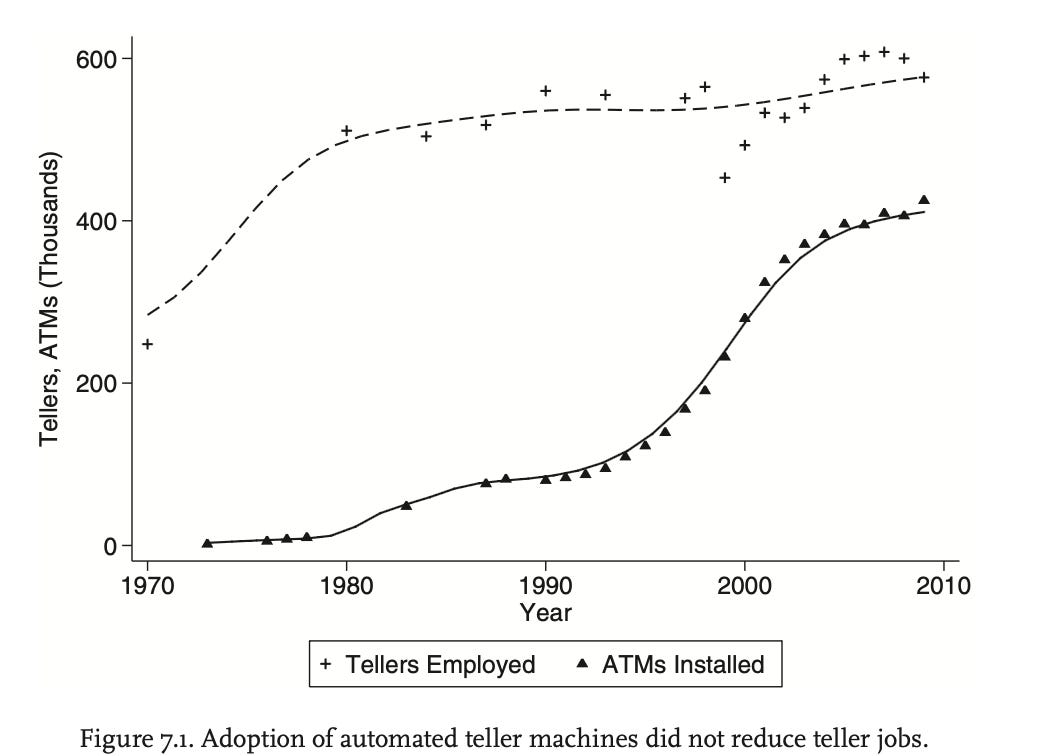
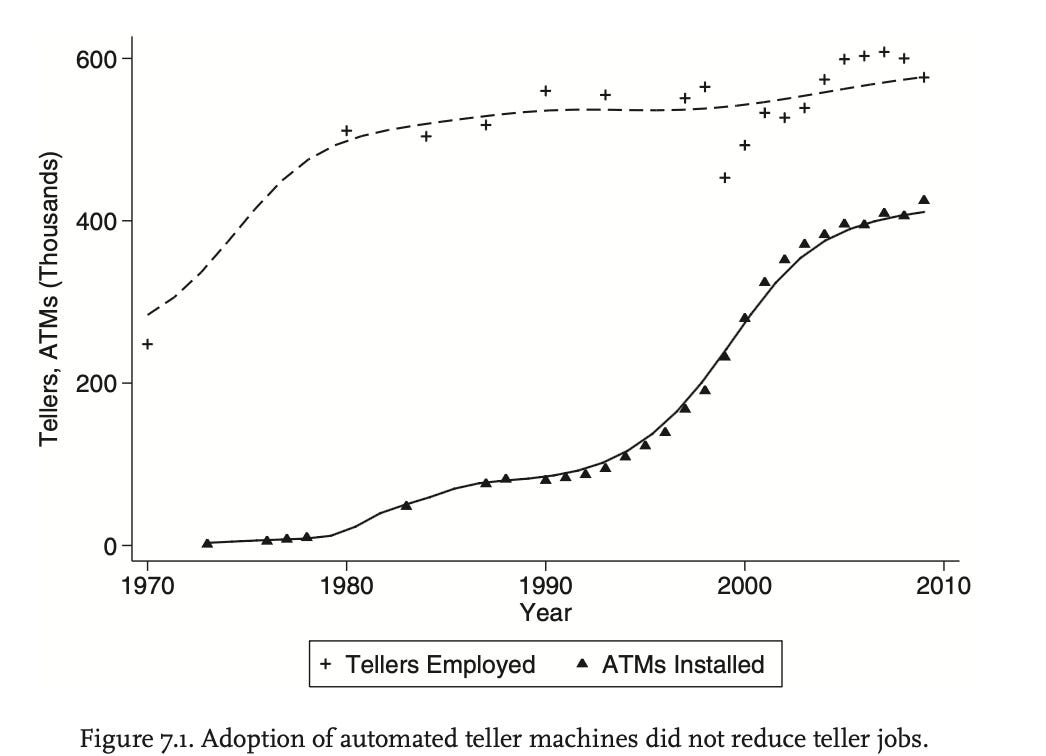
From James Bessen, Learning by Doing (2015)
So Vance’s choice of example tells us the same thing that his appearance on the Joe Rogan Experience did, which is that J. D. Vance—however much he might like to hide it—really, really loves reading blogs.
But the other thing about the bank teller story that Vance cites is that it’s wrong. We do not, contrary to what Vance claims, have “more bank tellers today than we did when the ATM was created”: we in fact have far fewer. The story he tells Douthat might have been true in 2000 or 2005, but it hasn’t been true for years. Bank teller employment has fallen off a cliff. Here is a graph of bank teller employment since 2000:
[
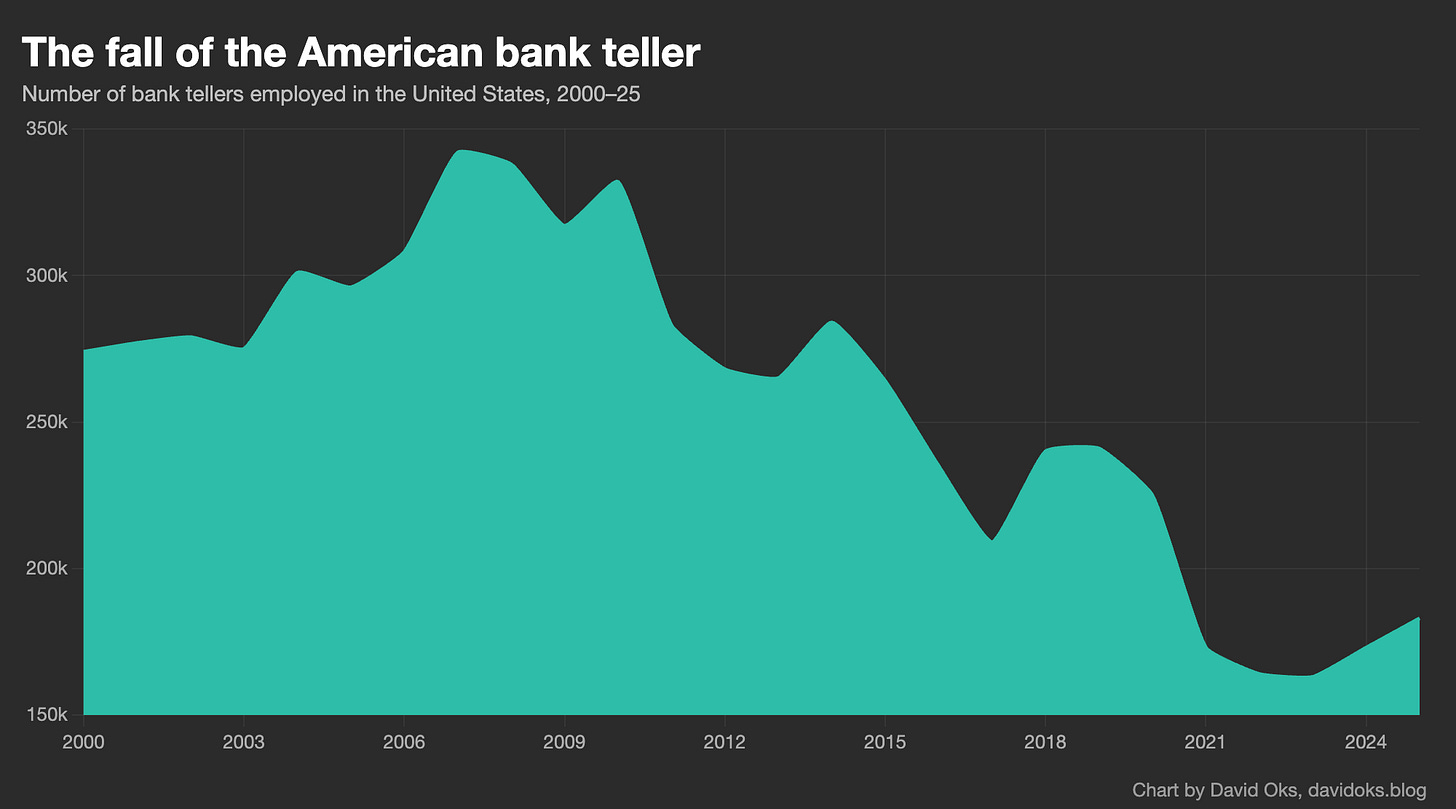
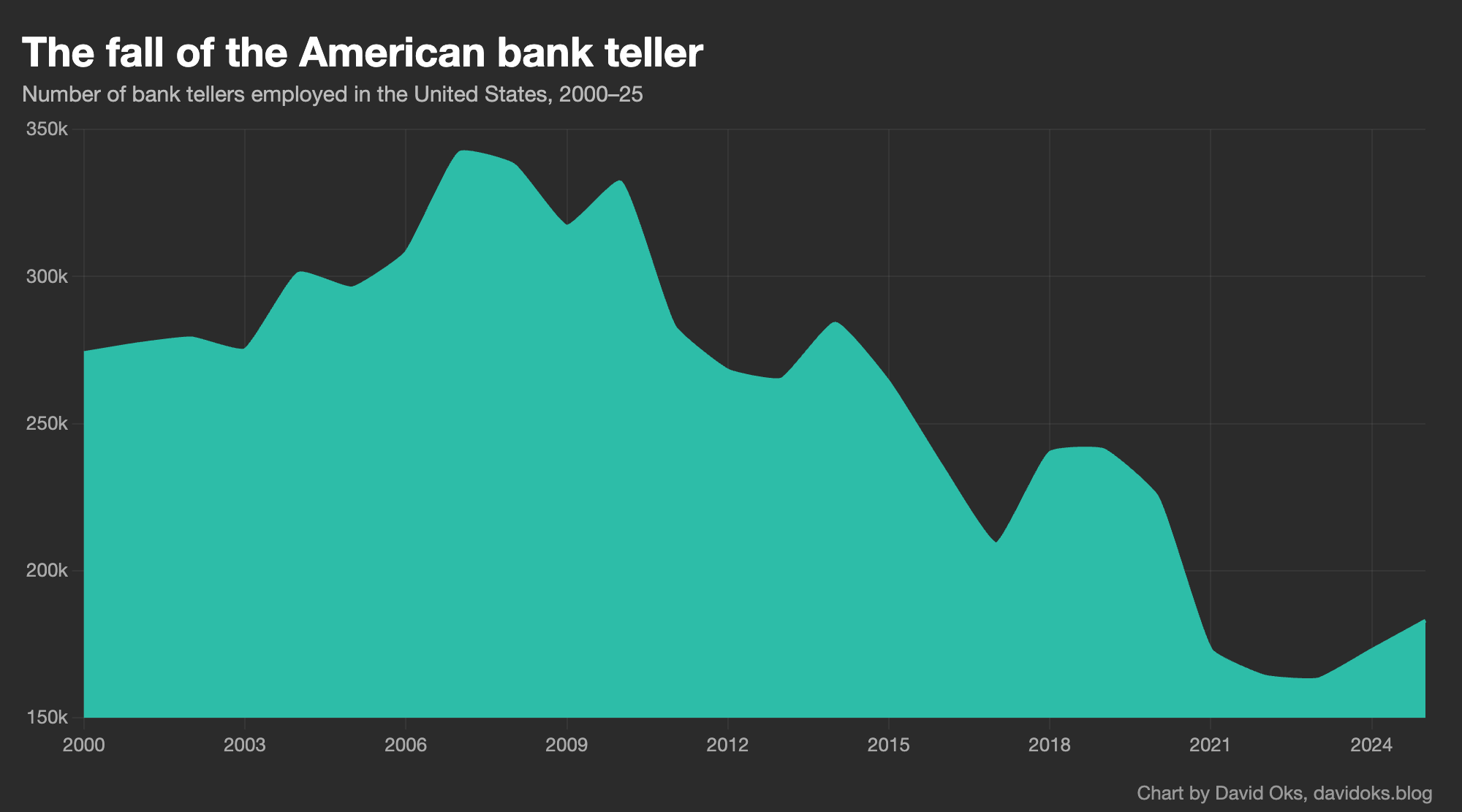
So what happened to bank tellers? Autor, Bessen, Vance, and the like are right to point out that ATMs did not reduce bank teller employment. But they miss the second half of the story, which is that another technology did. And that technology was the iPhone. The huge decline in bank teller employment that we’ve seen over the last 15-odd years is mainly a story about iPhones and what they made possible.
But why? Why did the ATM, literally called the automated teller machine, not automate the teller, while an entirely orthogonal technology—the iPhone—actually did?
The answer, I think, is complementarity.
In my last piece, on why I don’t think imminent mass job loss from AI is likely, I talked a lot about complementarity. The core point I made was that labor substitution is about comparative advantage, not absolute advantage: the relevant question for labor impacts is not whether AI can do the tasks that humans can do, but rather whether the aggregate output of humans working with AI is inferior to what AI can produce alone. And I suggested that given the vast number of frictions and bottlenecks that exist in any human domain—domains that are, after all, defined around human labor in all its warts and eccentricities, with workflows designed around humans in mind—we should expect to see a serious gap between the incredible power of the technology and its impacts on economic life.
That gap will probably close faster than previous gaps did: AI is not “like” electricity or the steam engine; an AI system is literally a machine that can think and do things itself. But the gap exists, and will exist even as the technology continues to amaze us with what it can now accomplish.
But by talking about why ATMs didn’t displace bank tellers but iPhones did, I want to highlight an important corollary, which is that the true force of a technology is felt not with the substitution of tasks, but the invention of new paradigms. This is the famous lesson of electricity and productivity growth, which I’ll return to in a future piece. When a technology automates some of what a human does within an existing paradigm, even the vast majority of what a human does within it, it’s quite rare for it to actually get rid of the human, because the definition of the paradigm around human-shaped roles creates all sorts of bottlenecks and frictions that demand human involvement. It’s only when we see the construction of entirely new paradigms that the full power of a technology can be realized. The ATM substituted tasks; but the iPhone made them irrelevant.
Let’s start with the actual story of how the ATM affected bank tellers.
[
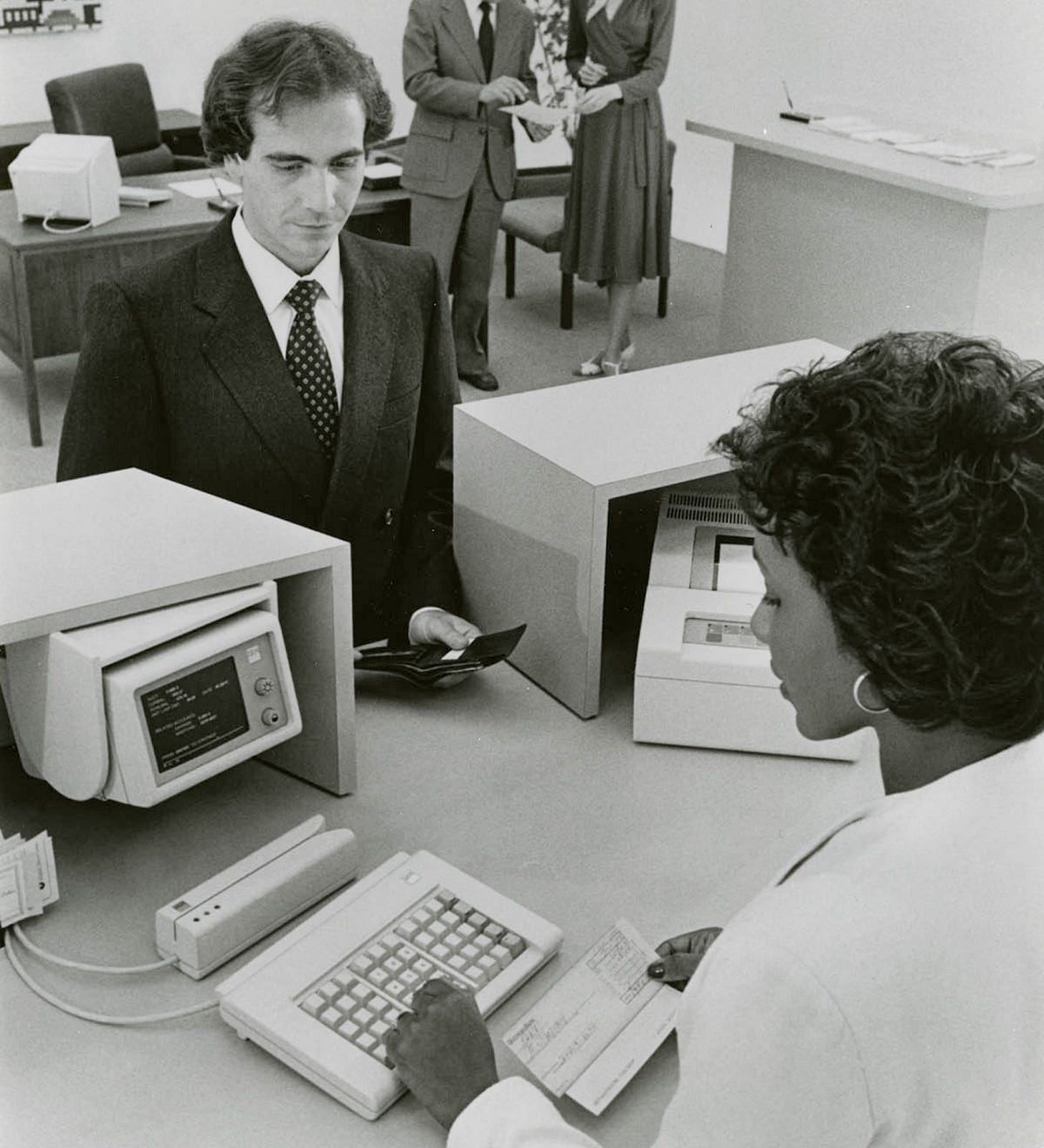
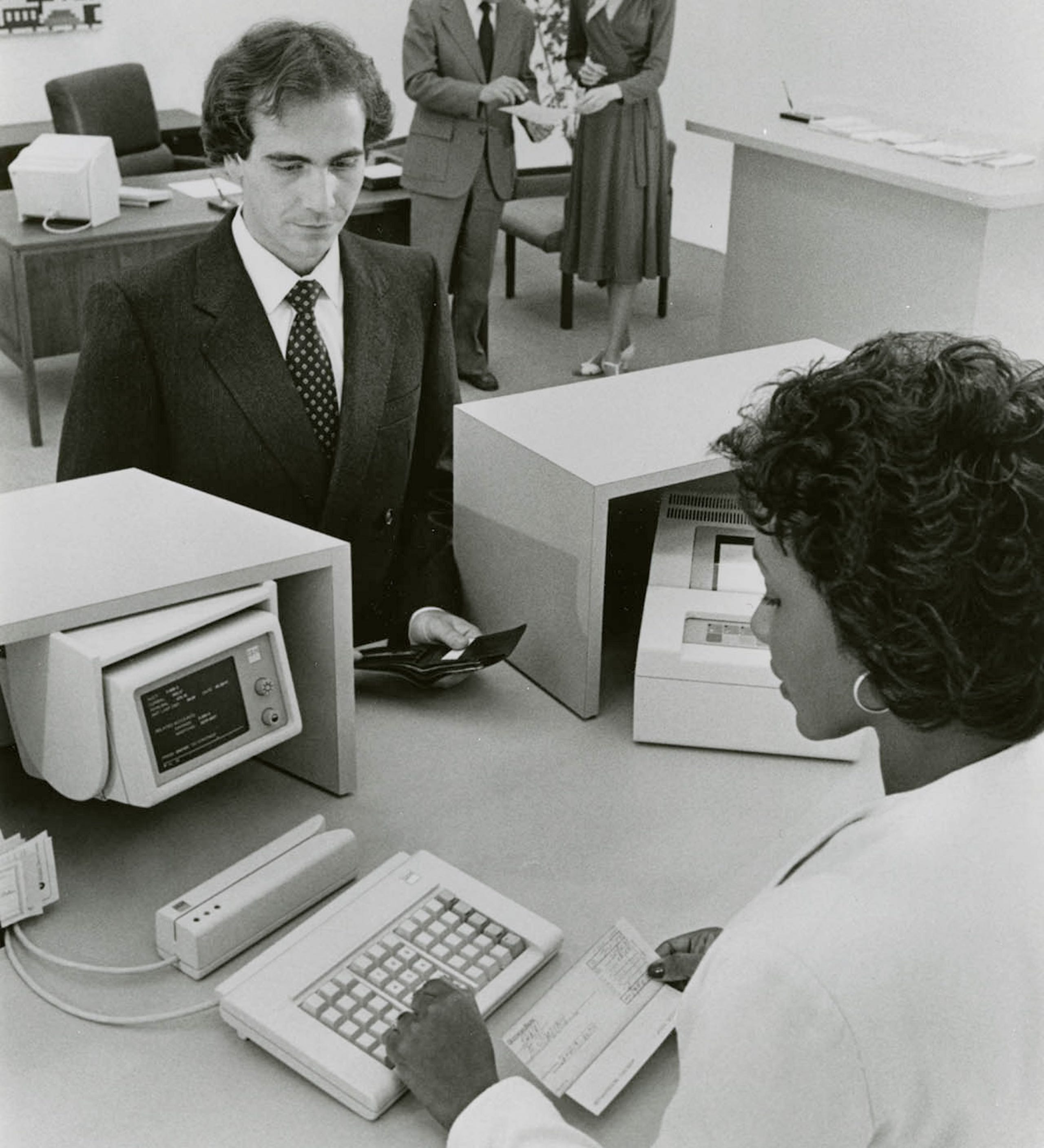
In the 1940s or ‘50s, if you owned a bank, you needed physical locations—these were your “branches”—and you needed people to staff those branches. You’d have your bank managers, your loan officers, and you’d have your bank tellers. When a customer wanted to deposit a check or check their balance or make a withdrawal, they’d talk to one of the tellers; and because this was the highest-volume type of interaction that people would have with your bank, you’d have to hire tellers in huge numbers.
The bank teller thus became a classic “mid-skill” occupation. It required a high school diploma and about a month of on-the-job training around counting cash and processing checks and settling accounts at the end of each day, but it didn’t require a college degree. And because they handled such a core part of the banking workflow, banks required a huge number of tellers: the average bank branch in an urban area might employ about two dozen people as tellers.
But in the 1950s and ‘60s, as Western economies were booming and enjoying their magnificent postwar economic expansions, labor was getting much more expensive. This was a good thing—it was simply the other side of rising wages—but it was also painful for enterprises that relied on lots of manual labor. And so we find that all the fashionable business concepts of the 1950s and ‘60s revolved around reducing labor costs to the maximum extent possible. It’s no coincidence that it was in the 1950s that the word “automation” entered the English language.
It used to be, for instance, that when you went shopping you’d have your stuff retrieved for you by a small army of clerks running around the shop; indeed that’s still how it’s done in places like India with an abundance of cheap labor. But humans were getting expensive in the 1950s and ‘60s, so everyone wanted to reduce the human component, and so in that period you saw the rise of supermarkets and discount stores, where the whole innovation is getting the stuff yourself. (Sam Walton’s Made in America is a good record of what that revolution was like from the inside; consumers tended to be quite happy with the whole thing, since corporate savings could be passed on in the form of cheaper goods.) And it’s the same reason why in the ‘50s and ‘60s you saw the rise of laundromats, vending machines, self-service gas stations, and “fast food” restaurants like McDonald’s.
So in the 1950s and ‘60s, the goal of every single business that employed humans was to find ways to replace humans with machines: in economic terms, to substitute capital for labor. And even though they were a relatively labor-light business to start with, this was true of banks as well. This was the case in the United States, but it was actually particularly true in Europe, where labor unrest among bank employees was an ongoing headache. (Financial sector employees were actually some of the most militant of all white-collar workers during this period: because of prolonged strikes by bank employees, Irish banks were closed 10 percent of the time between 1966 and 1976.)
Enter the computer. In the 1960s, to the great relief of bank management teams, it became possible to imagine that computers could be used to reduce the role of human labor in the banking process.
There were two key innovations that made this possible. The first was IBM’s invention of the magnetic stripe card in the 1960s: this was a thin strip of magnetized tape, bonded to a plastic card, that could encode and store data like account numbers, and which could be read by a machine when swiped through a card reader. And the second was Digital Equipment Corporation’s pioneering minicomputer, which dramatically reduced the price and size of general-purpose computing.
And so, bringing those two innovations together, you could finally imagine a machine that could do, programmatically, what a human teller might do: that could identify a customer automatically, via the magnetic stripe; that could communicate with the central servers of a bank to verify the customer’s account balance; and that could dispense cash or accept deposits accordingly.
And so in the 1960s, teams working concurrently in Sweden and the United Kingdom pioneered the earliest versions of what would eventually become known as the automated teller machine. These were primitive devices—they had the tendency to “eat” payment cards and to dispense incorrect amounts of money, and they didn’t see much uptake—but by the late 1960s it was clear where things were going. IBM, at that point the largest technology company in the world, soon took interest in the technology, and for the next few years groups of IBM engineers refined the technological and infrastructural layer to make the ATM functional.
And by the mid-1970s, after years of technical investment, the ATM was finally ready for prime time. By that point IBM, then enjoying its peak of influence, had decided the market wasn’t worth the investment, and so it ceded the nascent ATM industry to a company called Diebold.1
And in 1977 the ATM finally got its big break. Citibank, then the second-largest deposit bank in the United States, decided to make ATMs the subject of a large push: they spent a large sum installing the machines across its deposit branches. The New York Times reported it as “a $50 million gamble that the consumer can be wooed and won with electronic services.” But the response was tepid. In the same New York Times article, we encounter a scene from a bank branch in Queens where one of Citibank’s ATMs was installed: “most of the customers,” the article reports, “preferred to wait in line a few moments and deal with the teller rather than test the new machines.”
But Citibank’s gamble paid off. Consumer wariness toward ATMs turned out to be temporary: the advantages of the ATM over the human teller were obvious. Running an ATM was cheaper than paying a human—each ATM transaction cost the bank just 27 cents, compared to $1.07 for a human teller—and this could either be passed to the consumer in the form of lower fees or simply kept as profit. And ATMs were also just more convenient. An ATM could do in 30 seconds what would take a human teller at least a few minutes; and while a human teller was only available during business hours, ATMs could be used at any time of day.
And the benefits for the bank were even greater. ATMs were expensive to install, but once they were installed they were wonderfully lucrative and had low maintenance costs. The fee opportunities were wonderful, since banks could charge fees on out-of-network transactions. And since ATMs were not legally considered to be branches, banks could deploy ATMs without running afoul of banking laws that restricted interstate bank branching.
All of this meant that banks had a really strong incentive to put ATMs everywhere. And so they did. In 1975 there were about 31 ATMs per one million Americans; by the year 2000, that number had grown to 1,135, a 37-fold increase in just 25 years.
And what did this do to the bank tellers?
The natural expectation is that ATMs would make human bank tellers obsolete, or at least strongly reduce demand for bank teller jobs. And indeed the number of bank tellers per branch declined significantly: from 21 tellers per branch to about 13 per branch once ATMs had hit saturation. But this decline in teller intensity corresponded with an increase in aggregate teller employment. The number of ATMs per capita grew dramatically after 1975; but the number of bank tellers increased along with it. Bank tellers did become a smaller share of total employment, since the increase in bank teller employment was smaller than the increase in other occupations; but at no point in the period between 1970 and 2010 did the number of bank tellers actually enter a prolonged decline.
Why is that? Why did ATMs, which automated the bulk of the teller’s job, not lead to a decrease in teller employment?
We find the most elegant explanation in a paper from David Autor:
First, by reducing the cost of operating a bank branch, ATMs indirectly increased the demand for tellers: the number of tellers per branch fell by more than a third between 1988 and 2004, but the number of urban bank branches (also encouraged by a wave of bank deregulation allowing more branches) rose by more than 40 percent. Second, as the routine cash-handling tasks of bank tellers receded, information technology also enabled a broader range of bank personnel to become involved in “relationship banking.” Increasingly, banks recognized the value of tellers enabled by information technology, not primarily as checkout clerks, but as salespersons, forging relationships with customers and introducing them to additional bank services like credit cards, loans, and investment products.
We thus have a classic case of the Jevons effect. Teller labor was an input into an output that we can call “financial services.” ATMs allowed us to produce that output more efficiently and economize on the use of the labor input. But demand for the output was sufficiently elastic that more efficient production meant more demand: and demand increased to the point that there was actually greater demand for the labor input as well. And—this part is not quite the classic Jevons effect—the greater demand suggested to banks that there had been certain functions that were previously considered incidental to the teller job, like “relationship banking,” which were actually quite useful. And so ATMs were a truly complementary technology for the bank teller.
By the 2010s, people had begun to notice that there had been no mass unemployment of bank tellers. In 2015, James Bessen published a book called Learning by Doing, using the non-automation of bank tellers as a central example; soon it became a sort of load-bearing parable about what Matt Yglesias called “the myth of technological unemployment.” From Bessen the story diffused to Autor and Acemoglu; then to the economics bloggers; then to people like Eric Schmidt, who cited the ATM story in 2017 as one reason why he was a “denier” on the question of technological job loss. And they were right: ATMs really didn’t reduce bank teller employment.
But there was an ironic element to all of this: at the exact moment that people started talking about how technology had not displaced bank tellers, it stopped being true.
[


In the 2010s, bank teller employment entered a period of prolonged decline. This was not a product of the financial crisis that peaked in 2008: bank teller employment was roughly the same in 2010 as it had been in 2007. And the decline was not rapid but gradual. It continued even as banks returned to full health as the Great Recession abated. First there was a severe decline that started after 2010; then a slight recovery at the end of the decade; and then a collapse during the COVID years from which bank teller employment has never recovered. In 2010, there were 332,000 full-time bank tellers in the United States; by 2016, there were 235,000; by 2022, there were just 164,000.
This was not a long-delayed ATM shock: the ATM had reached full saturation long before. It was, rather, the effect of another technology, one that had nothing to do with banking. It was a product of the iPhone.
Apple first introduced the iPhone in 2007. By 2010, it was clear that the iPhone-style smartphone, with a touchscreen and an app store, was going to be the defining technological paradigm of the years to come: people were going to conduct huge portions of their life through the prism of the smartphone, which soon became simply “the phone.” And just as more forward-thinking institutions like Citibank knew in the 1970s that ATMs were the future, the smarter banks knew by the early 2010s that the future lay in what they called mobile banking.
The mobile banking vision was simple: the banking customers of the future would do all their banking via their banks’ mobile apps. They would buy things via payment cards or, later, via Apple Pay; they would check their balance or make deposits through the banking app; the customer’s relationship with the bank would be mediated entirely via the app. In this new world, there was no reason for the physical bank location to exist. Indeed there were new entrants, like Revolut or Klarna, that existed entirely as mobile apps. The branch was a thing of the past.
Mobile banking succeeded much more rapidly than the ATM did—which is remarkable, considering that mobile banking was a much bigger change than the ATM. I remember, as a kid, opening my first bank account at the Chase branch in my hometown, and the excitement of occasionally visiting there to deposit any checks I might have. I’m still a Chase customer, and I interact frequently with my Chase account for all sorts of reasons. But it’s been many years since I visited a physical Chase location. My relationship with Chase has transcended any need for the branch. I don’t think I’m alone in this: the Chase branch in my hometown, where I would once deposit checks, closed in 2023. The building now houses a doctor’s office.
And so the rise of mobile banking removed any real reason to have bank branches. Visits to bank branches declined dramatically throughout the 2010s, and banks aggressively redesigned the banking experience around the digital interface. The number of commercial bank branches per capita peaked in 2009 and has fallen by nearly 30 percent since, with most of the decline occurring in wealthier areas that were more likely to adopt digital banking first. Between 2008 and 2025, Bank of America, which at some point surpassed Citibank as the second-largest deposit bank in the United States after Chase, closed about 40 percent of its branches. Online banking had been around since the 1990s, Bank of America’s CEO said, but the iPhone was a “game changer” that “effectively allowed customers to carry a bank branch in their pockets.”
And as the branch disappeared, so did the teller. ATM had been an innovation within the existing world of physical banking, and thus its replacement of the bank teller could inevitably only be partial; as long as people were still visiting the bank branch, it was useful to repurpose tellers as “relationship bankers.” But when branch visits declined that stopped making sense. The iPhone represented a wholly different way of banking, and within it there was no real need for the bank teller: and so a large institution like Bank of America was able to reduce its headcount from 288,000 in 2010 to 204,000 in 2018.
Of course, the transition to mobile banking also created jobs: banks now needed software developers to build and maintain the digital interface, and they needed customer service representatives to handle any problems that might emerge. And so a “mid-skill” job was replaced by a thin stratum of “high-skill” jobs and a vast army of “low-skill” ones. The term for this in labor economics is “job polarization.”
So that’s the irony of the parable of the bank teller. Technology did kill the bank teller job. It wasn’t the ATM that did it, but the iPhone.
I think the story of the ATM and the iPhone offers us an important lesson about technology and its impacts on labor markets. Because Vance, of course, wasn’t really talking about ATMs when he talked about ATMs; he was talking about AI.
The lesson is worth stating plainly. The ATM tried to do the teller’s job better, faster, cheaper; it tried to fit capital into a labor-shaped hole; but the iPhone made the teller’s job irrelevant. One automated tasks within an existing paradigm, and the other created a new paradigm in which those tasks simply didn’t need to exist at all. And it is paradigm replacement, not task automation, that actually displaces workers—and, conversely, unlocks the latent productivity within any technology. That’s because as long as the old paradigm persists, there will be labor-shaped holes in which capital substitution will encounter constant frictions and bottlenecks.
This has, I think, serious implications for how we’re thinking about AI.
People in AI frequently talk about the vision of AI being a “drop-in remote worker”: AI systems that can be inserted into a workflow, learn it, and eventually do it on the level of a competent human. And they see that as the point where you’ll start to see serious productivity gains and labor displacement.
I am not a “denier” on the question of technological job loss; Vance’s blithe optimism is not mine. But I’m skeptical that simply slotting AI into human-shaped jobs will have the results people seem to expect. The history of technology, even exceptionally powerful general-purpose technology, tells us that as long as you are trying to fit capital into labor-shaped holes you will find yourself confronted by endless frictions: just as with electricity, the productivity inherent in any technology is unleashed only when you figure out how to organize work around it, rather than slotting it into what already exists. We are still very much in the regime of slotting it in. And as long as we are in that regime, I expect disappointing productivity gains and relatively little real displacement.
The real productivity gains from AI—and the real threat of labor displacement—will come not from the “drop-in remote worker,” but from something like Dwarkesh Patel’s vision of the fully-automated firm. At some point in the life of every technology, old workflows are replaced by new ones, and we discover the paradigms in which the full productive force of a technology can best be expressed. In the past this has simply been a fact of managerial turnover or depreciation cycles. But with AI it will likely be the sheer power of the technology itself, which really is wholly unlike anything that has come before, and unlike electricity or the steam engine will eventually be able to build the structures that harness its powers by itself.
I don’t think we’ve really yet learned what those new structures will look like. But, at the limit, I don’t quite know why humans have to be involved in those: though I suspect that by the time we’re dealing with the fully-automated organizations of the future, our current set of concerns will have been largely outmoded by new and quite foreign ones, as has always been the case with human progress.
But, however optimistic I might be about the human future, I don’t think it’s worth leaning on the history of past technologies for comfort. The ATM parable is a comforting story; and in times of uncertainty and fear we search naturally for solace and comfort wherever it may come. But even when it comes to bank tellers, it’s only the first half of the story.
Diebold’s history is a fascinating case study in the rise and fall of American industry—from its humble origins in 1859 as a manufacturer of safe and bank vaults, to its enormous success in the second half of the twentieth century as the world’s leading manufacturer of ATMs, to a period of debt-fueled hubris in the 1990s and 2000s that culminated in its filing for bankruptcy in 2023. You may remember the name Diebold from the controversies around the 2004 election, after the company had diversified into the field of voting machines: there was a popular conspiracy theory that claimed that rigged Diebold voting machines had stolen the state of Ohio for George W. Bush. We find in the course of its ill-starred life every doleful corporate trend of the twentieth century.
No posts
We are in negative growth, and the current leadership class keeps talking about all the people they can get rid of.
Look at the Atlassian layoff notice yesterday for example where they lied to our faces by saying they were laying off people to invest more in AI but they totally aren’t replacing people with AI.
Only if every person born needs to have a brand new house constructed for them.
Not if - you know - people die and don't need a house to live in anymore.
But considering how it's been the past 20 years, I'm starting to expect that a lot of the current elder generation will opt to have their houses burnt down to the ground when they die. Or maybe the banker owned politicians will make that decision for them with a new policy to burn all property at death to "combat injustice". Who knows what great ideas they have?
I feel like you didn't understand my comment. I am predicting that there is no code to review. You simply ask the AI to do stuff and it does it.
Today, for example, you can ask ChatGPT to play chess with you, and it will. You don't need a "chess program," all the rules are built in to the LLM.
Same goes for SaaS. You don't need HR software; you just need an LLM that remembers who is working for the company. Like what a "secretary" used to be.
All of that will inevitably be solved.
50 years ago, using a personal computer was an extravagant luxury. Until it wasn't.
30 years ago, carrying a powerful computer in your pocket was unthinkable. Until it wasn't.
Right now, it's cheaper to run your accounting math on dedicated adder hardware. But Llms will only get cheaper. When you can run massive LLMs locally on your phone, it's hard to justify not using it for everything.
Is the value in the outcome of receiving medical advice and care, and becoming educated, or is the value just in the co-opting of another human being's attention?
If the value is in the outcome, the means to achieving that aren't of much consequence.
Disconnecting value from productivity sounds good if you don't examine any of the consequences.
Can you build a society from scratch using that principle? If you can't then why would it work on an already built society?
Like if we're in an airplane flying, what you're saying is the equivalent getting rid of the wings because they're blocking your view. We're so high in the sky we'd have a lot of altitude to work with, right?
There's also the deeper philosophical question of what is the meaning of life, and if there's inherent value in learning outside of what remunerative advantages you reap from it.
Many low cost areas have bad crime problems, there is another little phenomenon where the wealthy by doing a poor job in governance can increase the price of their assets by making alternative assets (lower cost housing) less desirable due to the increase in crime.
I didn’t, and thanks for clarifying for me.
This doesn’t pass the sniff test for me though - someone needs to train the models, which requires code. If AI can do everything for you, then what’s the differentiator as a business? Everything can be in chatGPT but that’s not the only business in existence. If something goes wrong, who is gonna debug it? Instead of API requests you would debug prompt requests maybe.
We already hate talking to a robot for waiting on calls, automated support agents, etc. I don’t think a paying customer would accept that - they want a direct line to a person.
I can buy the argument that the backend will be entirely AI and you won’t need to be managing instances of servers and databases but the front end will absolutely need to be coded. That will need some software engineering - we might get a role that is a weird blend of product + design + coding but that transformation is already happening.
Honestly the biggest change I see is that the chat interface will be on equal footing with the browser. You might have some app that can connect to a bunch of chat interfaces that is good at something, and specializations are going to matter even more.
It was a bit of a word vomit so thanks for coming to my TED Talk.
But Baumol's argument, which you introduced to the conversation, is that outcome and process cannot actually be distinguished, even if a distinction in thought is possible among economic theorists.
How many of us have a reminiscence that starts “looking back, the most life-changing part of my primary or secondary education was ________,” where the blank is a person, not a curriculum module? How many doctors operate, at least in part, on hunches—on totalities of perception-filtered-through-experience that they can’t fully put into words?
I’m reminded of the recent account of homebound elderly Japanese people relying on the Yakult delivery lady partly for tiny yoghurt drinks, but mainly for a glimmer of human contact [0]. Although I guess that cuts to your point: the value in that example really is just co-opting another human’s attention.
In most of these caring professions, some of the value is in the measurable outcome (bacterial infection? Antibiotic!), but different means really do create different collections of value that don’t fully overlap (fine, I’ll actually lay off the wine because the doctor put the fear of the lord in me).
I guess the optimistic case is, with the rote mechanical aspects automated away, maybe humans have more time to give each other the residual human element…
In this society there is literally nothing for anyone else to do. Do you think they deserve to be cut out of sharing the value generated by The Engineer and the machine, leaving them to starve? Do you think starving people tend to obey rules or are desperate people likely to smash the evil machine and kill The Engineer if The Engineer cuts them off? Or do you think in a society where work hours mean nothing for an average person a different economic system is required?
For education, if you know as much as the average Harvard grad, can you give yourself a Harvard degree that will be as readily accepted in a job application or raising funds for a new business?
This is extremely hand-wavy.
Can you be more concrete in what you think this looks like?
The way I see it, we're only 5-10 years away from having general purpose robots and AI that can basically do anything. If the prices for that automation is low enough, there will be massive layoffs as workers are replaced.
There's no way to "naturally" solve the problem of skyrocketing unemployment without government involvement.
If I can run 50,000 fixed tasks that cost me $0.834/hr but OpenAI is costing $37/hr and the automation takes 40x as long and can make TERRIBLE errors why the fuck would I not move to the deterministic system?
Also, battery life of mobile devices.
But now, we not only have laptops, we run horribly inefficient GUIs in horribly inefficient VMs on them.
The dollar-per-compute trend goes ever downward.