
Like a much prettier version of Mermaid.
Kudos, Anthropic. Geez, this is so nice.
Now I'm going to ask it to draw a diagram of a pelican riding a bicycle, why not?
Great for summarizing a multi-step process and quick to render with simple tools.
I'm finding more and more often the limiting factor isn't the LLM, it's my intuition. This goes a way towards helping with that.
P.S. Credit to the poster, she posted a correction note when someone caught the issue: https://www.linkedin.com/posts/mariamartin1728_correction-on...
If there's humans involved, "I took this data and made a really fancy interactive chart" means that you put a lot more work into it, and you can probably somewhat assume that this means some more effort was also put into the accuracy of the data.
But with the LLM it's not really very much more work to get the fancy chart. So the thing that was a signifier of effort is now misleading us into trusting data that got no extra effort.
(Humans have been exploiting this tendency to trust fancy graphics forever, of course.)
https://www.reddit.com/r/dataisugly/comments/1mk5wdb/this_ch...
I usually use a lot of other tools for data analysis or write code with Claude code or another LLM to do data analysis and visualization.
article about the ChatGPT charts and graphs https://www.zdnet.com/article/how-to-use-chatgpt-to-make-cha...
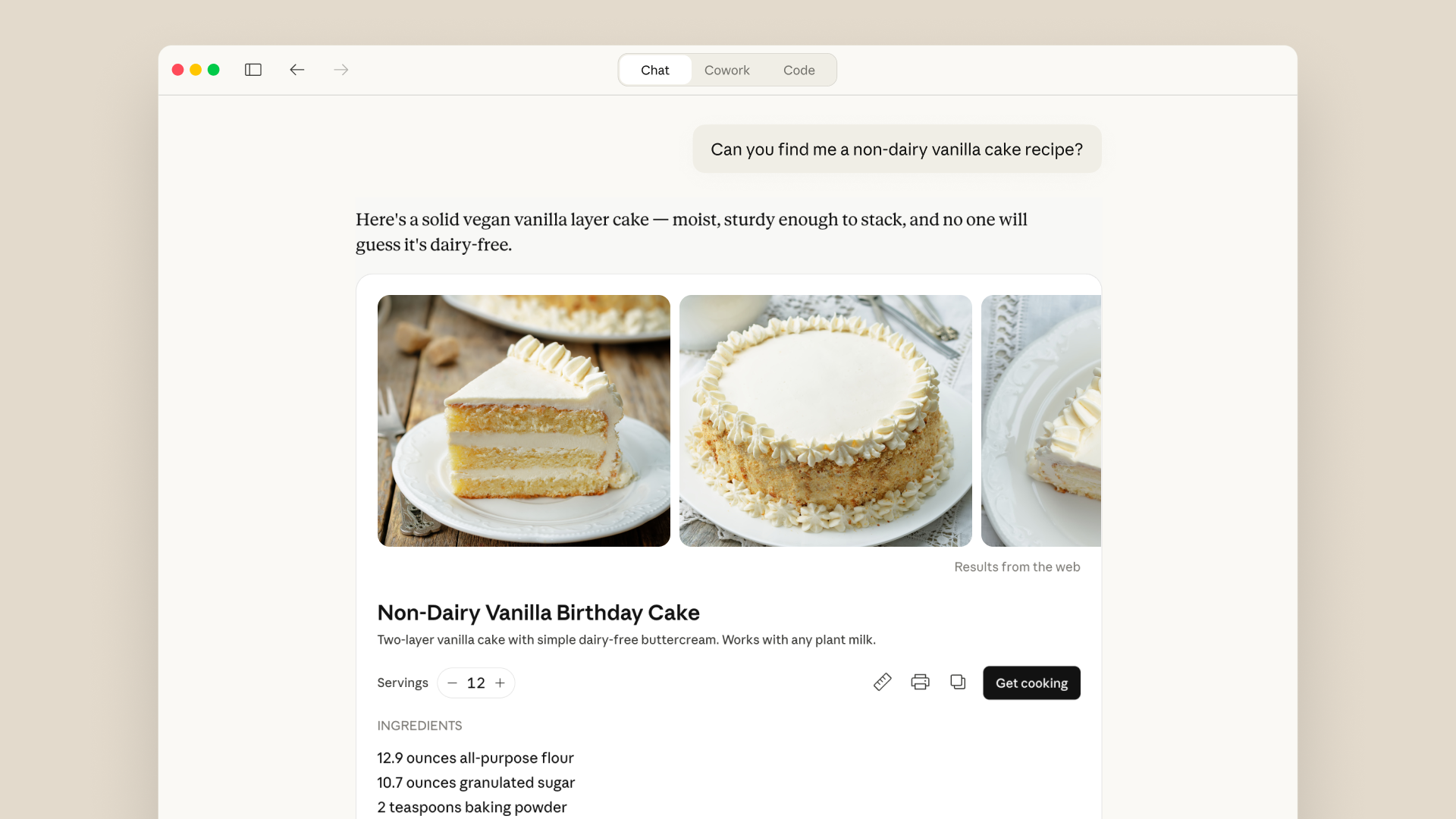
(Literally nobody needs an image of a cake when asking for a cake recipe)
I mean is it really that shocking that you can have an LLM generate structured data and shove that into a visualizer? The concern is if is reliable, which we know it isnt.
It responds with the statistically most probable text based on its training data, which happens to be different with the errors vs without. I suspect high-fidelity diagramming requires a different attention architecture from the common ones used in sentence-optimized models.
What instance of ChatGPT are you doing that with? (Reasoning?)
It's pretty bad (for me). I have to use extremely prescriptive language to tell ChatGPT what to create. Even down to the colours in the chart, because otherwise it puts black font on black background (for example). Then I have to specifically tell it to put it in a canvas, and make it interactive, and make it executable in the canvas. Then if I'm lucky I have to hit a "preview" button in the top right and hope it works (it doesn't). I could write several paragraphs telling it to do something like what Claude just demo'd and it wouldn't come close. I'm trying Claude now for financial insights and it's effortless with beautiful UX.
For posterity, Gemini is pretty good with these interactive canvases. Not nearly as good, but FAR better than ChatGPT.
Passive questions generate passive responses.
People find them quite easy to check - easier than the raw document. My angle with teams is use these to check your processes. If the flow is wrong it’s either because the LLM has screwed up, or because the policy is wrong/badly written. It’s usually the latter. It’s a good way to fix SOPs
They write 100% of their code with Claude. Some of their engineers apparently burn over 100k worth of tokens per month.
It’s not surprising they ship fast at all when the product is actually falling apart at the seams and they just vibe code everything.
But you can Sign in with Google.
If you signed up with your Apple on the iOS Claude app, to access your account on the computer, you have to open the passwords app and copy your random email address and paste it into the Claude website login.
Also if you try to copy-paste a prompt from Notes etc into the Claude chat, it gets added as an attachment, so you can't edit the prompt. If you do the four-finger shortcut to paste it as text, it mangles newlines etc.
Why are they so dumb about such basic UX for so long?
"If brute force doesn't work, you aren't using enough of it." - Isaac Arthur
Apple forces developers to offer Sign in with Apple on iOS devices if any other sign in service is used. Apple can't force them to do it on non-Apple platforms.
Isn't this basically Apple's fault? When you signed up, Apple provided a fake email address in leu of your real one. This is great for privacy but means the service has the wrong email.
I'm sure they didn't want to provide an Apple sign in option at all, but it's required by App Store rules.
In the meantime I can’t even continue a Claude Code session I started on desktop on my phone. What’s the point of shipping a billion features of they are all half baked?
But they wanted to provide a Google Sign In? wth?
> This is great for privacy but means the service has the wrong email.
So harm the users to benefit the service? wtf?
I don't want to give my real email or anything to random services, specially not one like Claude where they don't even let you remove your payment info.
Apple should not have had to require developers to have options other than Google for authentication, but clearly some companies have to be dragged kicking and screaming.
So clearly they support it, and there is no reason it should not work on the web also.
My original thinking was that Apple makes it too easy for a general audience to hide their email without considering the implications (the service won't know your email). But of course there's a tension here, since you also want the option to be easy and accessible.
The party I do not consider at fault in this case is Anthropic.
The original complaint was:
>> If you signed up with your Apple on the iOS Claude app, to access your account on the computer, you have to open the passwords app and copy your random email address and paste it into the Claude website login.
Either you use your original email or you use a per-service email. Apple helps you do the latter, but this does come with UX tradeoffs.
Using a per-service email, then complaining that the service does not have your real email, strikes me as misguided.
Always best to sign in with your own email address.
Using a randomly generated email per service is a huge improvement over always using the same email.
They don't have to bend for another, but they made a choice to put an app on iOS. They added support for apple signin, and then for some reason did not put it on their website.
You can criticize Apple for requiring that all you want, but they clearly have support for it and are choosing to not put it on their website which is causing a worse user experience.
IF apple did not support website loggin than sure, but they do. So the ability to fix this is on Anthropic (and many other websites).
If you are already going to support third party login you should not limit it to only Google accounts and there is no reason to support Apple on iOS and not the web.
Also for the record, Apple only requires sign in with apple if you already support third party authentication. So if you are already going to support that, giving the user more choice (and making it so we are all a bit less dependent on google) is a good thing.
Third party logins are an extension and a massive risk to any website that doesn't include email hosting.
We have see identity providers dissapear, and people may change their mind.
Easiest way is to register you rown domain and use it with an identity provider of your choice and be able to move it anywhere.
Otherwise we are a faceless citizen of a corporation that can handle access to our identity and everything attached to it without recourse or access to anyone.
Category
Product
Claude apps
Date
March 12, 2026
Reading time
5
min
Share
Last fall, we previewed Imagine with Claude: a new way for Claude to build visuals in real time, without any code. We’re now bringing a version of this feature, in beta, to Claude’s chat conversations. Claude can create custom charts, diagrams and other visualizations in-line in its responses—and then tweak and modify its creations as the conversation develops.
Claude’s conversations already include artifacts: permanent tools and documents created by Claude, designed to be shared or downloaded as more polished work. By contrast, these charts, diagrams and visualizations serve a different purpose: Claude builds them to aid users’ understanding as it’s discussing the topic at hand. They appear in-line, rather than in a side panel, and they’re temporary—they change or disappear as the conversation evolves.
Here are a couple of examples. You can ask Claude how compound interest works, and it’ll give you a curve to play around with. Or you can ask about the periodic table, and it’ll build an interactive visualization in which you can click around for more details, as in the example below:
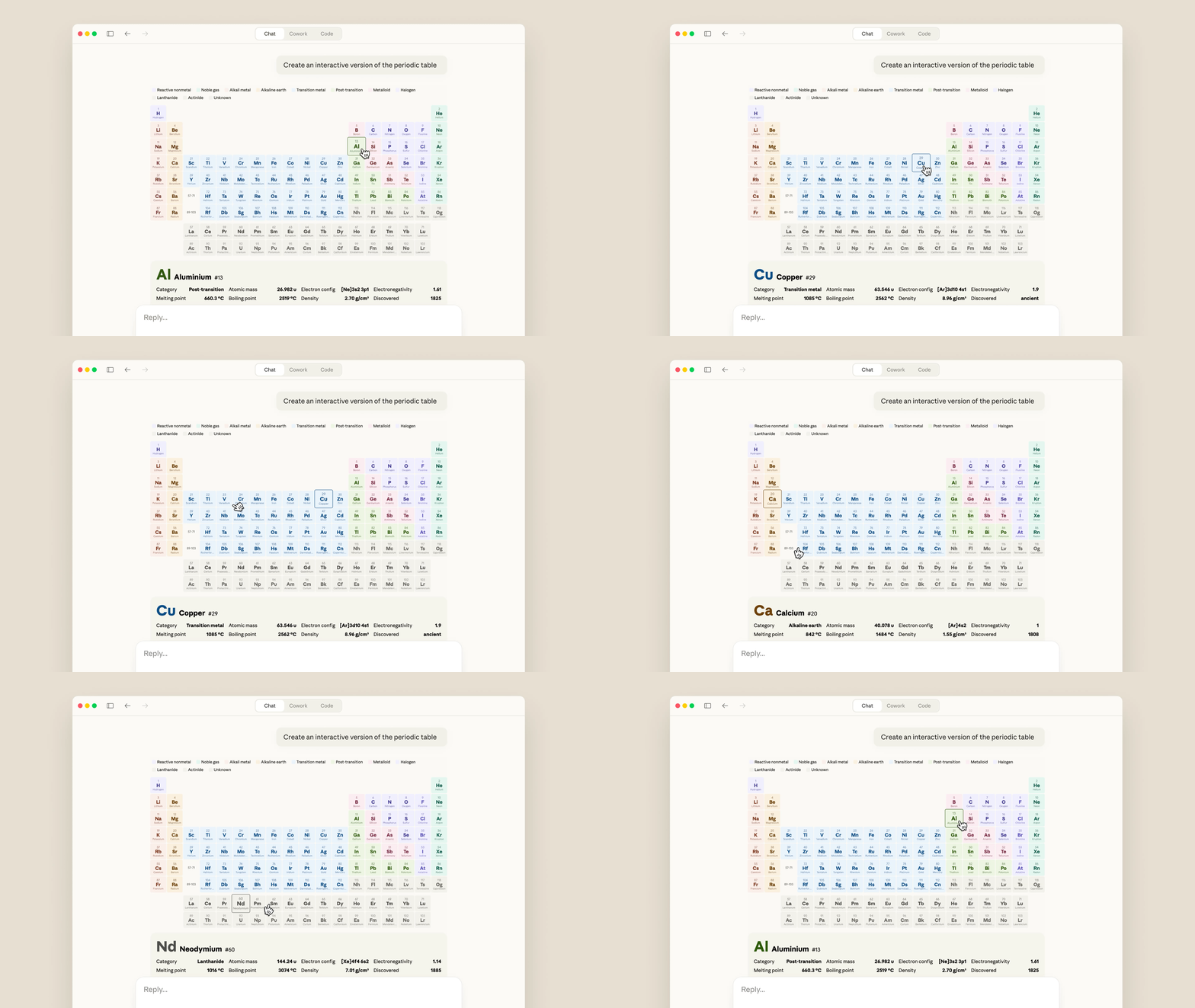
This feature will be on by default. Claude will decide when to build a visual for something, or you can ask it to do so directly (with a query like “draw this as a diagram” or “visualize how this might change over time”). Once Claude has created something, you can ask for adjustments or to dig in deeper.
These visuals are part of a broader set of improvements we’ve made to Claude’s responses recently. Earlier this year, Claude began using purpose-designed formats for some topics: recipes, for example, now appear with ingredients and steps, and Claude provides a visual when you ask it for the weather. You can also interact directly with apps like Figma, Canva, and Slack within your discussions.
Try it today. This feature is available on all plan types.
No items found.
0/5
eBook

No items found.
Get the developer newsletter
Product updates, how-tos, community spotlights, and more. Delivered monthly to your inbox.
Please provide your email address if you'd like to receive our monthly developer newsletter. You can unsubscribe at any time.
Thank you! You’re subscribed.
Sorry, there was a problem with your submission, please try again later.