> Unlike Tor Browser, Ceno Browser is not a tool for anonymity, which is Tor's primary purpose. In the Tor network, network traffic is encrypted and routed through a network of relays run by volunteers, and appears to originate from the IP address of an exit node. Tor is an excellent option for privacy from Internet surveillance and website operators. If it works in your network environment, we recommend it, provided that you've also read their support documentation.
> Ceno's primary distinction from a VPN is that it does attempt to route all of your website requests through the decentralized network. When a website is available without restriction, Ceno will simply connect to it like a normal web browser. Also, Ceno users cache and share content with each other. This reduces the strain on censorship circumvention nodes and improves deliverability.
source: https://ceno.app/en/faq.html
I thought this sounded like Freenet. Searching for "ceno" and "freenet" together led to this repository, which said "CENO uses the Freenet censorship resistant platform for communications and storage":
https://github.com/censorship-no-archive/ceno1
Looks like they have since archived everything on github and moved to gitlab.
This is why Ceno scrapes, caches then announces hundreds of media websites on BT https://schedule.ceno.app/
If the cache is inside your network (e.g. Iran) then that website is available through Ceno browser
edit: I try to read the paper and it's just referencing some RFC, which is not making me smart at all.
Again, how am I sure that when I am reading something from the cache, it's really serving what the site was serving somewhere else, and the person saving it there didn't modify it? Is it signed by the original page SSL cert?
edit2: ahh the "injector server", which is run by Ceno, retrieves the page and signs it. So you are moving the trust to Ceno and the central Ceno server actually does the browsing...? So the injectors can just see all the traffic? But that's inevitable I guess, someone needs to see the traffic
Better executive summary: "A browser that lets you bypass censorship via BitTorrent-based residential proxies and Ceno-owned proxies"
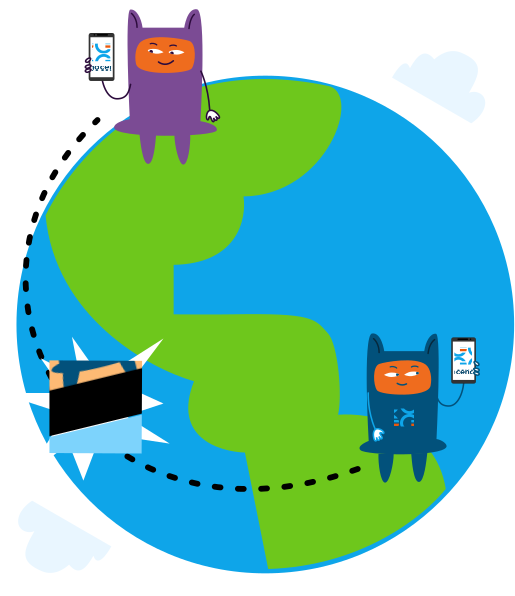
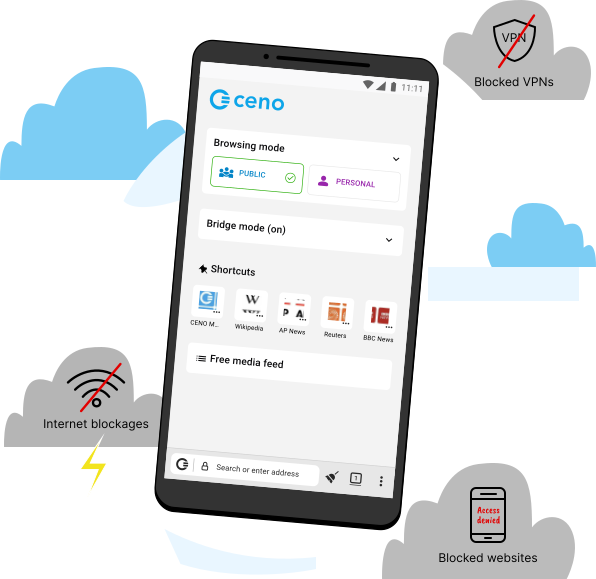
In Public mode, Ceno will look into the BitTorrent network to see if another Ceno user has recently shared the requested page. If the service can identify the requested page, it will retrieve that page from another user's device. If the content is not available, Ceno will contact several Injectors to request that website and have it delivered to you.
In Personal mode, you will only contact the Injectors to have that website fetched and delivered to you. The search will not connect to the BitTorrent network and will not attempt to locate the content on other users' devices.
To ensure that your Ceno client can always contact an Injector, we have also created Bridges. If the Injectors are blocked on your network, the Ceno app will look for available Bridges, who will forward your request to the Injectors. The Ceno network currently features around 6,000 Bridges. Their number is always growing.
So on the one side it's some kind of shared cache of website resources, and on the other some kind of distributed tor-like edge network?Quite clever! I wonder if it works well though, and if there is a risk of content injection by adversaries.
If it's based on BitTorrent, then surely that means that anybody who has the content that you want to see (or who advertises that they have the content you want to see...) will be able to see your IP address? Like how the movie industry can catch people who are sharing movies on BitTorrent?
Obviously, an attacker wwould probably need to use a separate BitTorrent client to do this, because I'm sure the IP addresses won't be displayed in the app itself, but that seems like it could potentially be possible.
I really hope I'm wrong on this, because other than that seemingly-big privacy flaw, this seems pretty great otherwise.
If I understand correctly the Internet Archive provides torrents for everything they archive.
I've seen such users ask about ways to prepare storing outside data in the event it becomes permanent. Some have suggested mesh networks, others downloading Wikipedia and torrenting things.
So it seems that this is useful where internet is still available but is restricted at say the ISP level. It seems to be a browser that when a page is unavailable it checks for Ceno torrents of the page from other users and serves that instead.
Another Crypto AG.
EU: Digital Services Act Article 5: Caching https://www.eu-digital-services-act.com/Digital_Services_Act...
"personal mode" is (extremely briefly) described:
"Information requested and retrieved in a Personal tab is not shared with anyone else. No record of your activity is recorded on BitTorrent. Use Personal tabs for logging into social media and other accounts. Also use them if you do not want to be associated on BitTorrent with any of your browsing activity in Ceno."
i wish the faq had even the tiniest bit of information on how this works, but it does not. they probably use their "injectors" to proxy the data or something. i am guessing it is discussed in more detail somewhere in the whitepaper (https://gitlab.com/equalitie/ouinet/-/blob/main/doc/ouinet-n...) but i dont have the time at the moment to read through it.
That mismatch is likely what is causing the confusion. The HN title probably should be updated to reflect the current title used on the site.
Another possibility is that the original title actually was “browse the web without internet access” and the developers later changed the site headline after the post was submitted to HN.
The hope/promise is that the handful of people with internet access in a blackedout country can spread content around in a way that is seemless to the end user.
I'd prefer mesh networks running spam resistant, private&anonymous protocols.
https://www.ietf.org/archive/id/draft-yasskin-http-origin-si...
I think the user raises valid concerns that should be discussed.
Freenet (~2000) did something similar. They distributed and cached content across all participating nodes. Users were storing encrypted fragments of other's data. It was notorious for distributing illegal content.
I recall that at the time, users were concerned about illegal content winding up on their computers - even if they weren't directly - knowingly - downloading those resources.
As I looked a little deeper just now, I'm discovering that courts have generally been lenient on unknowing participants - that intent and knowledge do matter. It's still a legal grey area (from some basic research I just did - maybe someone else can add to this).
I would still be concerned about a corrupt agency (in some fascist environment) pressing charges or insinuating illegal activity regardless of intent.
"Browse the web without internet access" is either purposely misleading or written by someone who doesn't understand the tech they're marketing.
Share the web!
Ceno is a free mobile browser that enables you to access and share web information, even when your internet access has been interrupted or cut off. With the help of other users, Ceno helps you sidestep internet censorship.
Join 566,565 other users
Ceno is the world's first browser that allows people to access blocked content with the help of other Ceno users.
Websites are shared by a global network of peers, and stored in a distributed cache for availability when traditional networks are blocked or go down.

You pay lower data cost because Ceno Browser routes user traffic through peer-to-peer networks, while still providing you with circumvention capability.

Ceno Browser is powered by an open source library called Ouinet that enables third party developers to incorporate the Ceno network into their apps for peer-to-peer connectivity.
Don't wait until the next time the internet is blocked to find a solution. Download Ceno now.
Help yourself and others. Keep Ceno installed and use it frequently.

Share websites you access to help build resilience against internet blockages.
Ceno is designed by eQualitie, a not-for-profit organization creating free & open source tools to protect freedom of speech, facilitate information exchange, & promote self-expression on the internet.

"Extremely important program. and not only for totalitarian countries, I think people of the free world should also use it more often to create a cache of pages. loads faster than other browsers."

Yuriy Karetin
"Awesome technology, it's free and works fine in Russia where a lot of sites are blocked. The whole image hosting of huge music platform Bandcamp is blocked here for more than a year now because of a single picture, so great to see album covers there again - and without VPN!"

Tim Six