A million dollars for a single bet is extremely high stakes.
https://www.972mag.com/israel-media-censorship-iran-war/
This could definitely affect key polymarket bets in the near term. I expect over the long term the truth will come out, but in the near term, it could be obscured.
* https://www.npr.org/2025/11/13/nx-s1-5605561/college-athlete...
... and many, many other stories.
>More emails arrived in my inbox.
>“When will you update the article?” one was titled. The email had no text content, only an image — a screenshot of my initial interaction with Daniel.
>Except it did not show my actual response to Daniel, but a fabricated message that I had not written.
>“Hi Daniel, Thank you for noticing, I checked with the IDF Spokesperson and it was indeed intercepted. I sent it now for editing, it will be fixed shortly,” I supposedly wrote. (To be clear, I wrote no such thing.)
this seems to be a main issue.
Would it help journalists if emails were quotable by default and the first party email providers could verify specific quotations? This way this class of fraud, market manipulation, and fake news would disappear.
I don't see why people wouldn't leave their responses as quotable when responding to journalists, for example, and journalists could also set their responses as quotable by default.
What do you think, could this help this issue?
We've all been looking around for the trigger for the market-crash-we-all-know-is-coming. Seems like "too much betting on a stupid war of choice" is just dumb enough to fit the timeline we've been trapped in. Very on-brand.
In other news: I'm almost entirely out of volatiles in my own portfolio right now. Cash and bonds until this pops. Frankly the chances are that today will be the day[1] are about as high as they've ever been.
[1] Trump, sigh, basically went on camera and capitulated, telling the world that there is no plan, the US doesn't have the capability to ensure trade through Hormuz and that Iran will deny access until Iran decides otherwise. Markets don't like uncertainty, but they really, really hate losing wars.
Could work in some crime procedural.
Here's the actual headline:
> Gamblers trying to win a bet on Polymarket are vowing to kill me if I don’t rewrite an Iran missile story
The issue at hand is that Israel has made itself one of the most hated countries in its region and in the world.
Trying to be an honest fact-based journalist for Times of Israel is like trying to be an honest journalist for Fox News. Even if you have the best intentions, don’t be surprised when nobody believes you or respects you.
In my opinion, Israel has largely made its own bed due to their own actions against their neighbors. If I were an Israeli citizen I would be rip-roaring mad at my government for endangering me by being positively moronic for the last half century.
Netanyahu’s extremist rule has been normalized so much. It wasn’t that long ago that, like Trump, he was seen as a dangerous threat to the region if he won election. Now that those men are in power the situation has been massively sanewashed.
We in the West have spent decades dehumanizing innocent civilians on the other side of our resource wars as “insurgents” and “terrorist affiliates” and yet here we are with a journalist “affiliated” with the obvious terrorist aggressor in the last two conflicts being upset that people on the Internet are doing just that. A trained, educated journalist should understand exactly what’s going on. Like, hello, wake up, look up satellite/drone photos/videos of Gaza. Your country did that!
Can I really get mad if someone on the internet is upset with me as an American for my country’s sins? They may send me empty death threats but my country bombed an elementary school just this year, as a part of an illegal unauthorized war that my country’s leaders can’t even explain coherently.
Downvoters of my comment seem like they’re ready and suited up to fight the AIPAC War and Operation Epstein Fury! I’m doing my part!
I suspect the gambler probably would have won on the basis of what happened but lost on the basis of what the times reported.
- the emails
- the whatsapp messages
- the discord messages
- the X messages
Mind you, I'm not stating the journalist is lying or overblowing, in fact I suspect this is all more widespread than we think, but it's odd that the journalist puts emphasis on the sources of his information in the case of the missile, yet it's not about his direct threats, some of those public like X replies.
Not to mention, they all prey on people. When I was younger, I worked in a gas station, and people would come in regularly and drop everything they had on scratch-offs. And a lot of these people clearly did not have the money to spare. It's gross.
Are you saying that the gamblers were actually the censors or that the reality was that the missile was indeed intercepted and somehow the censors forced the journalist to say it wasn't?
The author is being pressured (IMO) because the degens feel like they can threaten him (physical proximity)
There was a decision made by the security establishment not to allow reporting on Iranian missile hits in order to make it harder for the Iranians to do BDA.
These people believed that no Iranian missiles could possibly get through and instead of accepting they were misled they're shooting the messenger
The entertainment value of betting does not meet that standard, in my opinion.
But what evidence do you have that only over-leveraged gamblers resort to criminal behavior? Why do you think that some rich person who bet, say, $1 million they can actually afford will not still seek to recoup their investment, especially if it only takes some bribes and threats?
bet that someone will die by certain date
Downvoters:
I really doubt that you actually successfully 100% banned anything in the history of technology.
Prediction markets have value for people as a source of reliable information because they tend to be very accurate compared to any other human mechanism for creating forecasts.
https://marginalrevolution.com/marginalrevolution/2025/10/pr...
On a side note, I find it incredible crypto trading/day trading/meme stock trading etc is not recognised as a bigger societal problem. It is 100% gambling and has the same negative externalities associated with it. But none of the tools gambling companies need to abide by (blocklists, warnings, limits, etc) apply to trading.
I see you’ve decided to use the strategy of an ad hominem attack. This is a really great classic one! I applaud your efforts. Since it’s too hard to refute the substance of my comment you can just point out how I’m some crazy person.
If you’re open to it I invite you to pick just one point I made and see if you can find some kind of logical flaw in my reasoning.
And how could it be otherwise? You aren't the customer. Ads, or worse, billionaire political patronage, is what pays the bills for media companies. Their authority - the blind trust people have in them - is what makes them valuable for their actual customers. They're not doing science, the last thing they want is to make it easy to check their work (although, maybe I'm too charitable to scientists too here, if they make it easier to check their work it's often the bare minimum, but I digress).
One of the original points of WikiLeaks was to make a kind of journalism where claims were easy to check from the sources. But you can see how controversial that was.
Prediction markets on terrorist attacks and wars are one step back from that, but similar negative side effects are possible. And, regardless of what people are betting on, the corruption incentive appears where it did not previously, resulting in things like this.
(I don't think there's literally an Iranian missile operator opening Polymarket, taking out a position for "missile lands on Israel", and then pressing the launch button, but ultimately that's what uncensored markets with uncensored movement of money would enable)
Imagine the conversation went like this:
A: "Maybe we shouldn't sacrifice 500 virgins to the Aztec God to predict the harvest next hear?"
B "Why not? Killing virgins to predict the harvest are well calibrated (ie accurate).."
Because "only bribes and threats" are crimes for which people go to jail, and most "rich people" in the west, even in our authoritarian corruption hellhole timeline, are unwilling to engage in that nonsense because the benefits don't outweigh the risks.
Do I get to demand you cite evidence here, too? Has a wealthy person ever been caught in criminal extortion trying to goose a losing position that they could cover? I don't think that's ever happened, honestly.
I mean, yeah, it's my opinion. My gut says that the "bro" markets are all overleveraged right now, there aren't any easy winning positions at the moment (even AI stock valuations seem to have topped), and now the loans are coming due. Something's going to pop, and we're all looking for proxy measurements. This is one.
But even so, you're missing my point: even compulsive gamblers don't as a general rule resort to criminal extortion to cover their losses. The interpretation here isn't about the psychology of the criminals, that's sort of speciously true.
It's that the fact that "regular bettors" become "criminals", and are doing so at scale, is a proxy measurement for the amount of leverage in the system.
But it's fairly close to a tontine. But those are banned in the USA. But in those cases, rewards are split regularly between survivors. People who die with a tontine lose their share.
https://en.wikipedia.org/wiki/Tontine
I could see a movie about that, with living tontine holders sending out hitmen to remove other tontine holders, so they can get more money.
What is the reader assumed to do about an article that does not bring any proof?
The video of the missile exploding is also easy to fake, but it's an important element behind the reporting.
Are you gonna tell me residents in Tel Aviv will be able to hedge their chances of surviving tomorrow?
Nor there's evidence that providing information about the fact that US will strike Venezuela does it either.
What value any of that has? None, especially considering the perverse incentives on the other side of acting on the outcome probability for financial gain which has already happened. US executive insiders have definitely bet on US attacking Venezuela on Polymarket.
You see this as "information discovery", I see it as the fact that I can lobby for dangerous events to happen just for financial gain.
Future markets have some value in some scenarios where you can hedge the outcome.
E.g. a farmer hedging crop prices can de risk his operations.
There is a hedging and the hedge works as insurance.
What's exactly the value of betting on elections or military strikes? What's being hedged?
How can you not see the financial incentives?
We have a long history of regulating both futures, derivatives and betting for very specific reasons.
But now we've relabeled it all as information gathering and price discovery.
How can you not see how the financial incentives here are speedrunning terrible events to happen?
I'm gonna rephrase it like that: would you like for a contract to exist on whether you'll be sent to hospital tomorrow in a crash accident?
Are you gonna tell me: "well, it's information discovery and it's valuable that I can wake up knowing the odds have increased!" while ignoring that there are now people out there financially motivated to make this happen?
2. The author mentions X replies, those are public, where are they?
I'm gonna stand by my opinion: you deliver information, you provide all the evidence that is sensible to share. That's what journalism, especially investigative journalism does, and OSint can go a long way in helping.
2. The reason it is illegal it is beyond obvious: basic economics and game theory explain you how dangerous it is tying real world events with financial incentives.
There's a very long list.
https://gizmodo.com/kalshi-ceo-says-he-wants-to-monetize-any...
Polymarket accounts are more-or-less just a crypto address.
Whatsapp accounts are somewhat easier to link to a real identity, but still not hard to at least obscure a bit.
The arm of the law struggles to reach across borders, and on the internet, it's quite plausible all those involved are in different jurisdictions.
Not foreseeing the amount of sports betting that would take place, is kind of a failure of rationality in the first place, and I say this as someone who absolutely respects the community in general.
So it's common and hard to prosecute because the person threatening is most likely in another country.
1) “I believe in what we’re doing as a mostly positive force in the world”
2) “Eh, the money is good”
Probably the same way FB people feel, probably the same way Palantir people feel, etc etc
Just a pedantic, nit pick: you said "should be removed from civil society" but I think you just mean "removed from society" as in prosecuted and imprisoned.
"Civil society" has a specific meaning: https://en.wikipedia.org/wiki/Civil_society
Today they are bribing journalists to report on a bomb.
Tomorrow they will be bribing armies to bomb.
This needs to be banned.
There's nothing wrong with a prediction market. There are a lot of reasons why they're helpful in judging the probability of future events more accurately than any single analyst, and are therefore a net benefit to society, no different from newspapers and stock markets.
These are just individuals making criminal threats. They're the bad guys here. They don't work for Polymarket or anything. Your comment is like saying you can't imagine how anyone could go to work at the Olympics after Nancy Kerrigan got struck by Tonya Harding's ex-husband. Something criminal happened, but the Olypmics are not the one responsible.
Some death threats are pretty harmless compared to that, assuming that nothing actually happens (which is pretty likely in my opinion).
Cryptocurrency (although I hate it) you don't have to participate, so no harm done.
Prediction Markets you don't have to participate, so no harm done.
With AI, you're participating whether you like it or not. Layoffs, Job displacement, etc. There is no opt out here.
Once you're replaced with AI, that is it.
At least with cryptocurrency and prediction markets you can make money but it's obviously risky.
Ultimately with AI it would just push people to cryptocurrencies and prediction markets.
But we're in an era of less and less responsible government oversight, so the whole thing naturally gets ruined if there's no guardrails to prevent peoeple without souls or the accompanying morals from participating in ugly, greedy ways.
Though I'm also likely to adopt the idea that the absenece of competent government is an effect, not a cause, of some societies having had to mortgage their souls.
Edit: I mean, yeah, if you're stuck being fixated on pessimism and greed, of course there's a lot of ways this can be exploited. I just think that in its more pure, good faith form, the idea of letting the market tell you odds of things happening is pretty fascinating. I'm sure there's a whole body of economics on this idea, that it might be a better predictor of events than other models. I had fun betting $5 here and there on video game announcements/awards. (though for me betting is a game, not a financial strategy)
echo -en 'Gamblers trying to win a bet on Polymarket are vowing to kill me if I don’t rewrite an Iran missile story' | wc -c
107
HN also forces editorializing to less than 81 characters. I too sometimes struggle to editorialize the title to something that fits and ideally does not lose context.And polymarket isn’t even the wisdom of crowds lol. At its greatest possible adoption it’s still the wisdom of internet-connected (mostly) white men with time and money to spend on gambling.
https://www.usatoday.com/story/sports/mlb/columnist/bob-nigh...
On Tuesday, March 10, a massive explosion shook the city of Beit Shemesh, just outside Jerusalem, in yet another Iranian ballistic missile attack during the ongoing war.
Rescue services scrambled to the scene in search of possible casualties, though as it turned out, the projectile had struck a forested area just outside the city, around 500 meters from homes.
On The Times of Israel’s liveblog that day, I reported that the missile had hit an open area and no injuries were caused, citing the rescue services, as well as footage that emerged showing the massive explosion caused by the missile’s warhead.
But what I thought was a seemingly minor incident during the war has turned into days of harassment and death threats against me.
Later Tuesday, I received an unusual email, in Hebrew, from someone named Aviv.
Get The Times of Israel's Daily Edition by email and never miss our top stories
By signing up, you agree to the terms
“Regarding your Times of Israel report that described today’s launch as an ‘impact’ — Beit Shemesh Municipality and MDA (Magen David Adom) later corrected their reports to clarify that what fell was an interceptor fragment, not a full missile,” he claimed.

An Iranian ballistic missile that struck an open area near Beit Shemesh, March 10, 2026. (Screenshot: X; used in accordance with Clause 27a of the Copyright Law)
“I’d appreciate it if you could update your article, as in its current form it does not reflect reality. Alternatively, if you have information that it was indeed a full missile that was not intercepted, I would be glad to be corrected.”
I told Aviv that, from what I know from the Israeli military, the impact outside Beit Shemesh was indeed a missile warhead and not just fragments.
I added: “The footage also shows a massive explosion of hundreds of kilograms of explosives from the warhead. Normally, a fragment does not produce such an explosion.”
No injuries are reported in Iran's latest ballistic missile attack on Israel, the fourth today.
One missile struck an open area just outside Beit Shemesh, first responders say and footage shows.
Sirens had sounded across the Jerusalem area, the West Bank, and parts of southern… pic.twitter.com/j6sovAsDwz
— Emanuel (Mannie) Fabian (@manniefabian) March 10, 2026
A day later, on Wednesday, I received another email, also in Hebrew, regarding the impact just outside Beit Shemesh, from someone identifying themselves as Daniel.
“Sorry for reaching out without a prior introduction, but I assume we will get to know each other well,” he wrote, in a somewhat threatening manner.
“I have an urgent request regarding the accuracy of your report on the missile attack on March 10. I would really appreciate a response if possible. There is an inaccurate report from you about the missile attack on March 10, and it’s causing a chain of errors,” Daniel’s email continued.
“If you could reply to me tonight… you would be helping me, many others, and, of course, the State of Israel. And along the way, you would gain a good source.”
It was indeed a little strange to receive the same question, about something relatively inconsequential, from two different people within a day.
But I responded, naively: “Hi Daniel, can you elaborate on what the problem is?”
He replied: “In the article and in your tweet you wrote, ‘One missile struck an open area just outside Beit Shemesh.’”
“However, it appears that this was a missile that was intercepted, and its debris and interceptor fragments fell at the scene. No security authority so far has confirmed that it was a missile that was not intercepted and fell in an open area,” he claimed.
“If you could correct this tonight, you would be doing me and many others a great favor,” Daniel added.
Why does such an inconsequential detail matter to these people, I wondered.
Half an hour later, Daniel sent me another email: “If one of you could change everything to interceptor debris, or missile fragments even tonight, it would help a lot,” he persisted.
I went to sleep without answering.
By Thursday morning, Daniel had sent me another email.
“I would appreciate an update from you as soon as possible, because in the meantime you are already being quoted in The Economist, saying that the IDF confirmed that most of the missiles on Tuesday were intercepted except for one that fell in the Beit Shemesh area,” he said, attaching a screenshot from The Economic Times, an Indian English-language business-focused news site, and not The Economist.
“I ask again, if you could handle this as soon as possible, it would help us a lot. It’s really important, if possible, still this morning,” Daniel demanded.
As I read through Daniel’s veiled threats, I received another email from an anonymous user: “Is the article about March 10 interception gonna get updated?”
Moments later, I received a message on the Discord online platform: “In regards to March 10th. Some sources are saying all the missiles were intercepted on March 10th per IDF. Is that true?”
Meanwhile, on X, I saw a user reply to a recent tweet of mine: “There are people saying that they have received word from you that the missile strike in Beit Shemesh on March 10th was in fact intercepted, is this true or did no such interaction occur?”
Another X user responded to my post with the video showing the Iranian ballistic missile impact in Beit Shemesh with: “was there any video of the actual impact.” (Clearly, he didn’t watch the video.)
Checking those X accounts, both appeared to be involved in gambling on the Polymarket betting site.
As far as I now understand, the emails I received were intended to confirm whether or not a missile had hit Israel on March 10 in order to resolve a prediction on Polymarket.

This photo taken on March 16, 2026, shows a bet on the Polymarket site titled ‘Iran strikes Israel on…?’ (Emanuel Fabian/Times of Israel)
Polymarket is one of the largest prediction markets in the world, where users can wager their money on the likelihood of future events, using cryptocurrency, debit or credit cards, and bank transfers. However, there are accusations that the site has been plagued by manipulation and insider trading.
The event that these people had bet on was “Iran strikes Israel on…?” More than 14 million dollars had been wagered on March 10.
The rules of the bet state: “This market will resolve to ‘Yes’ if Iran initiates a drone, missile, or air strike on Israel’s soil on the listed date in Israel Time (GMT+2). Otherwise, this market will resolve to ‘No’.”
However, there is a clause: “Missiles or drones that are intercepted… will not be sufficient for a ‘Yes’ resolution, regardless of whether they land on Israeli territory or cause damage.”
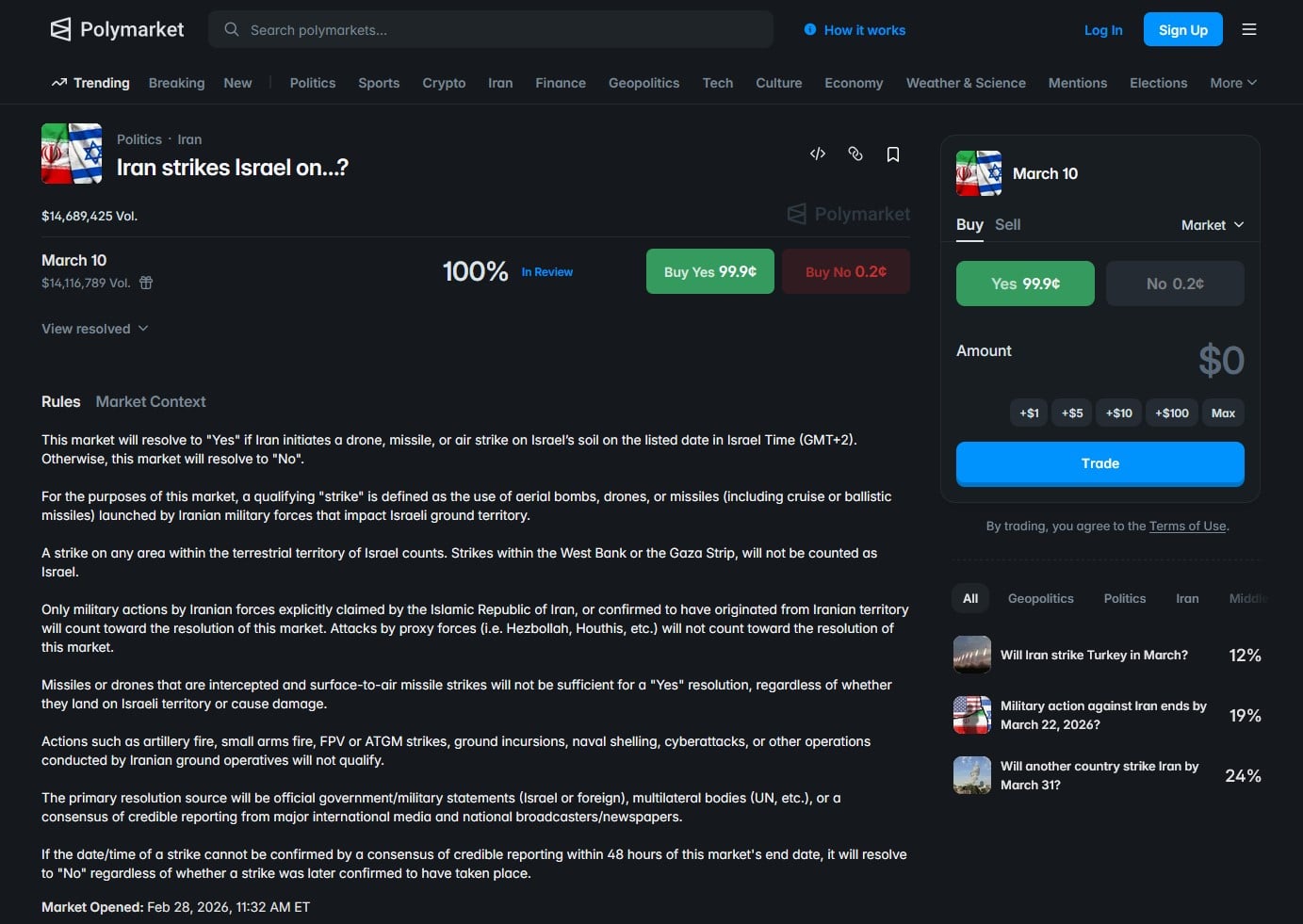
This screenshot taken on March 16, 2026, shows a bet on the Polymarket site titled ‘Iran strikes Israel on…?’ (Screenshot: Polymarket)
My minor report on a missile striking an open area was now in the middle of a betting war, with those who had bet “No” on an Iranian strike on Israel on March 10 demanding I change my article to ensure they would win big.
More emails arrived in my inbox.
“When will you update the article?” one was titled. The email had no text content, only an image — a screenshot of my initial interaction with Daniel.
Except it did not show my actual response to Daniel, but a fabricated message that I had not written.
“Hi Daniel, Thank you for noticing, I checked with the IDF Spokesperson and it was indeed intercepted. I sent it now for editing, it will be fixed shortly,” I supposedly wrote. (To be clear, I wrote no such thing.)
I then received a WhatsApp message from someone named Shaked: “Can I ask one question about the impact in Beit Shemesh on the 10th?”
Meanwhile, I saw a reply on X to a recent post of mine, with the same fake screenshot of my email exchange with Daniel: “There’s someone quoting that you replied to their email about making corrections to the below news article about all missile attacks being intercepted by Israel on March 10th. Is this actually true? Are we going to make this correction?”
By this point, it was clear to me why these people were asking about the missile impact, and I took to X and told the gamblers to get a better hobby.
This did not stop them.
A few hours later, a colleague from another media outlet messaged me. He said that someone he knew asked him to ask me to change the report on the missile impact in Beit Shemesh, and that it would be “negligible” for me if I did make the change.
The journalist had no idea why his acquaintance was demanding the change to the article until I told him what I understood was going on. He then confronted the acquaintance, who admitted to placing bets on Polymarket and confirmed my theory.
Going further, the acquaintance even offered the journalist compensation, from his winnings, if he managed to convince me to change my report.
After a quiet weekend, things escalated further.
Shortly after midnight between Saturday and Sunday, I started to receive threatening messages in Hebrew on WhatsApp from someone called Haim.
“You have exactly half an hour to correct your attempt at influence,” he wrote.
“Despite the fact that you received countless inquiries — you insist on leaving it that way.”
“If you do not correct this by 01:00 Israel time today, March 15, you are bringing upon yourself damage you have never imagined you would suffer,” he threatened, in a very lengthy message.
Haim also attempted to call me via WhatsApp multiple times during the night, before sending me more messages.
After you make us lose $900,000 we will invest no less than that to finish you
“You have no idea how much you’ve put yourself at risk. Today is the most significant day of your career. You have two choices: either believe that we have the capabilities, and after you make us lose $900,000 we will invest no less than that to finish you. Or end this with money in your pocket, and also earn back the life you had until now.”
After I didn’t respond, as I was asleep, Haim sent me another series of messages: “You are choosing to go to war knowing that you will lose your life as you’ve grown accustomed to it — for nothing.”
On Sunday morning, he messaged me again: “You have exactly a few hours left to fix your attempt at influencing [the market]. It would be stupid of you to ignore this.”
Hours later, more messages: “I am requesting a response from you in the next 10 minutes. We offered you to end this quietly with a profit in your pocket and everything disappears. But it seems you think you can stall for time.”
“You made a fatal mistake and you’d better respond to us.”
“I expect a response from you within 9 minutes from now.”
“We will not give up on sums [of money] like these.”
“One minute remains…”

The scene of an Iranian ballistic missile that struck an open area near Beit Shemesh, March 10, 2026. (Courtesy)
I then received a WhatsApp message from another number, someone posing as a lawyer called Vered. I ignored the message. Then they called me, though the person on the other end sounded awfully like a young man, and not a middle-aged female lawyer.
On the phone, the “lawyer” told me that they were contacted by a company in the United States to look into my supposed manipulation on Polymarket.
I hung up and contacted the police.
Later in the afternoon, Haim messaged me again, this time with the most explicit threat yet.
“You have 90 minutes left to update the lie. If you do this — you solve in a minute the most serious problem you have caused yourself in life. And you won’t remember me anymore in a week.”
“If you decide not to correct it, and leave the lie intact, you will discover enemies who will be willing to pay anything to make your life miserable — within the framework of the law.”
“And as far as I know, there are also some people who don’t really care about the law, and you’re going to make them lose about 50 times what you’ll ever make.”
“86 minutes left. You are the only one responsible for your life.”

The Times of Israel’s military correspondent, Emanuel Fabian, in southern Lebanon on November 21, 2024. (Chaim Goldberg/Flash90)
My time ran out shortly before I headed to the police station to give testimony and provide evidence. The police are now investigating.
In the early hours of Monday, as I ran to a bomb shelter amid yet another Iranian missile attack, Haim sent me another series of messages.
“You will pay the full price for your irresponsible act.”
“You have 9 more minutes to save your career. But not a stupid and disturbed child like you will take advantage of it.”
“I wish you not to fall asleep tonight and not any night. In any case, it’s not going to be too easy for you in the coming months.”
I did not respond.
The attempt by these gamblers to pressure me to change my reporting so that they would win their bet did not and will not succeed. But I do worry that other journalists may not be as ethical if they are promised some of the winnings
The attempt by these gamblers to pressure me to change my reporting so that they would win their bet did not and will not succeed. But I do worry that other journalists may not be as ethical if they are promised some of the winnings.
An Israeli military reservist and a civilian were indicted last month for using classified information to place bets ahead of Israel’s war with Iran in June 2025. Similarly, journalists could easily exploit their knowledge for insider trading on the platform. I dearly hope that’s not been happening, and won’t happen, in this unnerving new arena, where reality, journalism, gambling and criminality intertwine.
[0] Edit: Originally wrote "currently", but then I remembered the current White House, whose various crimes are being studiously ignored by the Republican congress.
Regarding meme stocks: I do not see how this should work compared to the "real market", as on the real market you have clear signals when it is useful to enter a position (e.g. institutional attention), but on the meme "stock" market lacking those features it is much much harder to make any money - unfortunately, a lot of young people are trying their fortuna
How? If I get two phone numbers and send myself a message and make a screenshot, how are you going to debunk that? It’s a legit screenshot, you have no way of verifying anything.
And I can also just import self written emails into thunderbird and take a screenshot. There’s nothing to analyze.
I agree that he could have linked the Public stuff though.
So any argument that starts from the assumption that rich people don't commit crimes for relatively low gains, and/or that they would be caught and put in jail if they did commit crimes, is obviously false.
I think the Epstein files even have specific examples of blackmail among said rich people (e.g. Epstein's letter draft to Bill Gates).
and where did I say I liked it?
Yes, of course! If you had some advance warning your home town was likely to be struck with missiles soon, are you seriously saying you can't think of a single thing you could do to prepare? I would, at a minimum, make sure I was stocked up on first aid supplies, water, and food that I could eat without needing power or gas to cook it.
You'll just push it underground and it will get even worse.
The cat is out of the bag.
A sane system would just throw him in jail until his illegal betting market implements KYC.
Subpoena Meta for all of the IPs of the account. Subpoena the ISPs for data who was using the IP. Bring in the likely people who were sending the message for questioning.
It's important to remember that for a brief time, people argued that gatekeeping was generally and usually a bad thing.
https://www.espn.com/mlb/story/_/id/46906636/guardians-emman...
Basically, a fake "Cricket league" was setup up in rural India, complete with online streaming, play by play commentary, etc. just to fool gamblers in Russia. Worth the read.
What makes you think that driving betting underground (which means far fewer people will participate) would be worse than the status quo?
Why do you (obviously) think betting markets are good?
If your argument is "people are going to bet and influence world events on the dark web", the argument ignores economics.
The whole point is that the wrong financial incentives exist, the dark web does not provide them, it's hard to access and liquidity is small.
E.g. Trump insiders are unlikely to "tor their iran/venezuela predictions in Monero" and try to influence the events at the same time, let alone how complex would such a system be.
Cool! Since you know who the involved persons are (as you agreed with it being an "open and shut case"), why don't you let the rest of us know, too? And while you're at it, tell the police as well. I'm sure it will help their investigation!
On their page "Quincy Institute’s Position on Russia-Ukraine" they say at the very beginning:
> We categorically condemn Russia’s illegal invasion of Ukraine, and support U.S. assistance for Ukraine’s self-defense.
https://quincyinst.org/2022/07/12/quincy-institutes-position...
But I think we can all agree there are a lot of negative effects of the new world where online gaming is without limits and government intervention is needed to some extent.
When this existed, it was quite literally done using the prediction market model. It was an early prototype for all this insanity.
Yes, humans can be bad. But humans can change. Let's not start accepting bad stuff as not so bad, simply because it is "just human behavior".
The question is whether they deem this case important enough, this is a journalist so there is a higher chance but I don't think this specific journalist carry a lot of weight locally
What if there's a prediction market on your life? Would you say you're still "not participating, so no harm done" ?
Did you read the article? It is about a journalist getting death threats from members of a prediction market.
If you’re in that telegram channel, though, I imagine the threats on your life are a lot more credible than the ones discussed in TFA.
Just because you might agree with the actions and behaviour of your current government enough, that you don't mind them being able to have a hand in your currency, doesn't mean that can't change.
E.g. a Chancellor on brink of second bailout for banks?
But yes, something used to work around bad governments, will also be used against good governments. Every legit tool can be also abused.
-- Cyborg Upton Sinclair
I routinely read the news, and I've been taught in school that critical reading involves doubting and focusing on facts, sources and proofs. No sources and verifiable proofs? No facts.
Which is why the journalist put emphasis on his sources behind the missile attack: he knows how much sources and proofs are important.
If you can fake screenshots, why not fake them, which is something that can be at least analyzed for tampering?
Even more: the author mentions X public replies, where are the links?
Actually what I really said is that no one does this, because it's insane. So I therefore infer that the people doing this are looking at losses that are not routine, they're faced with bets they can't cover.
That there are economical incentives to make it happen just to make money?
Such events have little-to-no "wisdom of the crowds" those events decided by a handful of people. And their consequences catastrophic.
What if there was a derivative for whether you will be hit by a car tomorrow?
What would you say if there was a contract on whether your county will burst in flames this month?
Are you happy because you can hedge this event, or don't you realize the obvious peril?
"Pushing it underground" discourages the majority of bettors from using it, and that is a good thing.
https://marginalrevolution.com/marginalrevolution/2025/10/pr...
It's always a honeypot, no one besides local junkies and people with personal beefs will do a murder for hire that a working person can afford.
There are people who are dumb enough to go to prison after paying like $1k-$10k for a "murder", like after a flight and hotel how much are you expecting your would-be assassin to make?
Answer this and I think you'll discover that "no different" is actually quite different.
Regarding the stock market: nobody sane uses the stock market as an indicator for the future. People predict the stock market, not the other way around.
Why "can look", "but", "just"?
I'd argue that prediction markets are more like stock markets. Very useful, but they also create opportunities for abuse which will need to be addressed. If they are eliminated later because the current administration refuses to regulate them, that would be a huge shame.
> Prediction Markets you don't have to participate, so no harm done.
Harm: https://www.npr.org/2025/11/13/nx-s1-5605561/college-athlete...
Harm: https://militarnyi.com/en/news/in-november-an-isw-analyst-ma...
Harm: https://www.cnbc.com/2026/03/05/prediction-markets-merkley-b...
Like, you pay him a little (<= $20 ?) and he'll announce your game of NBA-2K26 on twitch. He does have a good radio voice. A good way to make a little in the off hours.
So, he got a gig to announce the opening of loot boxes at some show. I think it was Fortnite loot boxes. I guess it gives you the total value of the loot box spree you opened. So, 2 people buy a bunch of loot boxes, then open them up, then whoever has the higher value wins and takes both of the people's total haul.
Sounds like a strange thing to have to announce, but sure the guy says you pay and I'll say.
No, it was gambling for the watchers on polymarket [0]. People were betting on who would have the higher value. 'Like a lot of people' he said.
That's High Card. "A lot of" people were betting on games of High Card, essentially.
You know, shuffle a deck, draw 2 cards, whoever has the higher value one wins. Repeat.
It is the most Degenerate form of gambling out there. There is no skill, no human factor, no nothing. Just pure random numbers.
My lord, what a plague we have unleashed. We'll be dealing with this for decades.
[0] no idea if polymarket and the like do things this quickly, but he said they were gambling somehow with another site off of Twitch and then waved his phone, implying you can access it that easily.
The more anonymous the winner is relative to the action taken, the more that bad behavior is incentivized. Back when this was dreamed up, the idea was crypto. But now we have prediction markets that encourage insiders to bet. And an administration that chooses to not prosecute corruption: https://www.wsgr.com/print/v2/content/49042620/Executive-Ord...
The result is a market that incentivizes manipulating wars for private gambling profit. With no need for anonymity, because the investigators have been fired. :-(
You went from a situation where the intent was for coaches to develop young men, teach them about hard work, overcoming obstacles, getting an education and become a part of an alumni base for the rest of your life.
And now it's leaving at the slightest difficulty, constant money dangling to encourage transfers because even if the guy doesn't play for you at least he's not playing for your opponent, followed by a million voices online just telling kids to follow the money. There's no telling how much gambling is playing a part.
It's taken one of the best institutions in our country for developing youth and corrupted it while people go out of their way to not report on the stories of people being hurt by the process.
I am curious - how do you even begin to police such a thing like polymarket? Wouldn't it take enormous resources to do it? Is it even worth it at that scale? They let you bet on anything and everything, right?
I had fun betting $5 here and there
Maybe this is the solution - don't let people bet more than $5. That is small enough for everyone to have some fun and not worth it for insider trading, threatening journalists etc?
I'd trim the bit about Polymarket to get under the cap.
> Gamblers [...] are vowing to kill me if I don’t rewrite an Iran missile story
You'll lose a little topical/karma sizzle (with no "Polymarket" keyword), but it's higher fidelity.
Kalshi is worse in a sense that it also accepts fiat payments.
I don't see how there is. The liquidity in a prediction market is not high enough to compensate for the expense of going to war.
The war was going to happen irregardless of the prediction market. The prediction market only let us know when it was going to happen with some hours to spare.
People routinely commit crimes for money, rich and poor alike, often for relatively irrelevant sums - and very often for money they don't even have yet. The incentive to commit crimes to prevent losses is even higher, given the well established loss aversion bias in all people.
And we don't even have to discuss losses. Many people commit crimes to get money quickly, from murder to insider trading to insurance fraud. If you agree that many people would be willing to kill for a few thousand or million dollars, you have to admit they'd be willing to threaten and blackmail a newspaper editor or production crew to try to fix a bet - especially when the internet brings them anonimity, and even if they bet a small sum that they wouldn't even care to lose.
If you don't believe this, try to go to a betting place in a poorer area and offer 1000:1 odds that no one punches you in the face hard enough to break your nose (a crime which could easily land whoever does this in prison). According to you, as long as you don't allow anyone to bet more than, say, $1 on this, it should be a very safe bet for you, surely no one would be insane to risk prison time for losing just $1, right?
As the comments on that article rightfully point out, restricting the data analysed to 12 hours before the resolution feels like cherry picking.
https://nexteventhorizon.substack.com/p/the-chaos-of-khamene...
There's nothing sane about KYC, it's a fundamental assault on the right to financial privacy. And the people with power can always bypass it; only the little people suffer.
Whether or not it should work that way is a separate question. But claiming that raw sources not being included is cause for suspicion is incorrect.
1. As pointed out in the comments, you can inflate your prediction success rate by predicting things that are 100% to happen. There are plenty of 99.9% bets on Polymarket with degens betting on some 0.01% lottery event trying to strike a jackpot against the odds, and those will inflate the perceived accuracy.
2. All you're really doing is paying insiders to leak information a few hours ahead of time. Insofar as Polymarket is unusually accurate on things that aren't ~100% to happen, it's likely because in the 12-hour-window that post measures is when all of the insiders place their last-minute bets telling you what will happen. This is extremely bad for society. It's wealth redistribution from stupid people to unethical people[1], and it could completely compromise national security when eg. an insider tells you 12 hours ahead of time that the US is about to launch an invasion of Venezuela. There is no societal benefit to this.
[1] Even if you have no sympathy for idiots who bet their life savings on markets without having insider information, gambling addiction has extremely detrimental effects on society and directly results in increased crime rates, divorce rates, etc. as people lose all of their money and do bad things in desperation, so it is a problem that becomes everyone else's problem.
But don't you think that will be the "good" majority? And the "bad" minority will continue using the underground version?
For sporting events, for example, the alternative to prediction markets 5-10 years ago was to use a website where you bet against the house directly, and they'd usually take around a 15-20% spread, and they'd ban you and keep your account funds if they decided you're winning too much. Now you can bet on the same events on prediction market sites, with around a 1-5% spread, and the house doesn't care how much you win (so there's actually an argument that you're playing a game of skill, compared to the old format where you definitely weren't, since you'd be banned for being too skilled).
Wouldn’t the good old-fashioned fraud laws present in basically every jurisdiction apply?
I have a bridge to sell you in Brooklyn if you believe that when you bet on the stock market or on the sports market for each and every particular bet involving millions of people the maximum profit is not reaped by a half a dozen of insiders who trade on inside informations and their only problem is not being too obvious about it.
Also even if they get caught the millions of people wagering are still getting fucked because there is not a redo or making people whole when the insider traders get caught (which is a tiny percentage of the time)
Actually, there's another perverse incentive operating on a higher level, when it comes for the people running things: "How is my prediction-market startup supposed to IPO for a bajillion dollars if we're not first-in-line for having sometimes-corrupt insider data? Nobody's going to pay me that much for a company that's just a spicier form of polling."
Polymarket US is starting to roll out in the US and other countries where Polymarket cannot operate, but that's a separate company and they do abide by KYC laws similar to Kalshi.
why do all NBA players seem so tall?
The lunacy of the mysticism of money.
That's not how I read GP; "Why would you want to do an end-run around the government when using currency?" is different to, well, whatever it is you are saying (I'm not sure I can decipher it well enough - seems to be "using currency is bad when it goes against laws", but I think that's fine too, so not really sure what your message is - maybe you can clarify?)
Using legal tender is not a problem. Using barter (which is what using crypocurrencies boils down to) is also not a problem. Lack of reporting your income to the tax authorities is a problem. Most bartering systems are too small to warrant the attention of tax authorities, but cryptocurrencies facilitate bartering at scale, which does warrant interest.
I don't have the slightest idea what point you're trying to make with this. Journalists make lots of people unhappy with their reporting, if you're referring to risks to journalists? Indeed that's part of the job of being a truth teller.
> nobody sane uses the stock market as an indicator for the future
I don't think you understand. If you think you can do a better job of predicting the future than the stock market, you will become extremely wealthy. So how exactly do you think it isn't basically the best publicly available indicator of the future, specifically the net present value of future expected profits?
Sophisticated analysts absolutely use current stock prices/market value for modeling the future.
What you're showing me is a death threat, which has existed for time in humans.
Betting markets of all kinds have existed for a long time and haven't been banned.
Banning on particular betting market prediction markets altogether and pushing it underground would make things far worse.
I don't think so. At least you have a 50% chance of winning. Unlike say a lottery or a slot machine.
Never go to Nevada.
How is this any more degenerate than slot machines? At least it is truly random, rather than rigged.
While I wouldn't use the word "degenerate", in terms of gambling, this isn't anywhere close to as bad as it gets.
At least this form is (psuedo)random, and the odds are statistically fair and published (by law).
Contrast to slot machines, which are not random, but are in fact preprogrammed to provide payouts in ways which maximize the earnings for the house and the addictive value for the player.
The house always wins, but there is no form of gambling where that is more guaranteed and manipulated than slot machine games (which includes the video arcade-style slot games).
And in the US prediction markets are regulated like commodities which have much more lax insider rules, because again, insider trading is the point.
we would actually have had to have been delivering on the whole "..develop young men, teach them about hard work, overcoming obstacles, getting an education and become a part of an alumni base for the rest of your life.." story.
Unfortunately, for the vast majority of student athletes in money sports, we never really delivered on all of those promises in the past.
These younger generations (GenZ) of student athletes are just wayyy smarter than the older generations of student athletes. Consequently, we can't take advantage the way we did in the past. Even women's volleyball and basketball athletes are choosing to take their money up front, and then transfer because they're pretty sure they won't need the "value" of the "alumni base".
Heck no, that's removing the important part of the news! Specifically, that a new kind of unregulated anonymous bet-making is leading to new kind of violence against journalists.
In contrast, the piece isn't really about Iran, or about Missiles, although those underscore the gravity or perversion of what's going on.
_____________
Such a cut isn't necessary either, compare the original versus this 79-character version:
Gamblers trying to win a bet on Polymarket are vowing to kill me if I don’t rewrite an Iran missile story
Gamblers on Polymarket vow to kill me if I don’t rewrite an Iran missile story
The assumption that Gamblers care about winning a bet should be obvious and implicit, so that's an obvious thing to omit. The ongoing nature of the vowing is also unnecessary when simply having past cases is bad enough.loads of banks all over the world now demands to know what you plan to spend the money on just to withdraw a bit cash. Some will even deny you saying "well.. you shouldnt buy a new car anyway". all the KYC shit. how about just no?
<facepalm>
A capricious system that interprets based on whim, politics and influence is a large part of how we got here.
People like this and their less than moral path in which they further their endeavors succeed specifically because of this environment.
Polymarket is basically a platform to monetize petty stuff while also being able to monetize bad stuff. There is soooo much pressure to monetize bad stuff that once you poke a hole it's an uncontrolled leak. Polymarket recognized this, used it to scale, and then wisely used that money to get the legitimization and buy in that they needed to make the system (capriciously) say "this is fine for now you can keep going".
They basically pulled a "actually Mr. Banker, I owe you so much money that it's your problem" but for insider information. The other metaphor you could use if people with a steady supply of prescription opioids don't turn to street drugs.
A weird synthesis of the goofy, the immature, the delusional, and the grandiose shot through with mental illness.
In such cases, the journalist likely will publish raw data/screenshots, since they're functioning both as the source and the reporter.
…which they already did before this market was made mainstream.
https://calibration.city/introduction
https://manifold.markets/calibration
2. That is just obviously not all these markets are doing. They're aligning incentives and aggregating information in the same way other markets do.
> I don't think you understand. [...]
I don't think you understand. Let's imagine a scenario: the market valuation of NVIDIA is high and has been trending up YTD, with some sizeable dips every couple of weeks. What does that tell you about the future?
Let's imagine another scenario. The odds on Polymarket of GPT-5.5 releasing in April just jumped from 40% to 95%. What does that tell you about the future?
You can try to derive information out of a stock market price, but it is not a prediction tool. The newspaper and Polymarket are more directly comparable in the context of prediction tools, because they both tell you exactly what they predict.
The risks of the stock market are closer to the risks of Polymarket (and the former has tons of regulations for obvious reasons, as demonstrated in the article), but the function is completely different.
> We categorically condemn Russia’s illegal invasion of Ukraine, and support U.S. assistance for Ukraine’s self-defense.
https://quincyinst.org/2022/07/12/quincy-institutes-position...
Also, having nuance and historical context does not mean they are "pro-Russia". We should be celebrating institutions that challenge propaganda narratives with context not hunting down anyone that doesn't fall in line with a narrative that requires you to believe history started last year
Stock markets also incentivize murder. Short a company, then kill the CEO. Boom, profit.
Given that the article is discussing some of the bad behavior typically associated with dark markets (death threats, extortion, fixing) happening in the light, what makes you think that banning them would make things worse?
If you have a 50% chance of losing $2 or gaining $1, you have a negative expected value and that's bad.
If you have a 10% chance of gaining 100$ and 90% chance of losing $1, that's an expected value of $9 and it's a great deal.
You don't have Nevada 24/7 in your pocket. Or you shouldn't.
If your buddy is somewhat famous, then get on the socials and network with the players in the files already, they all seem really open as it's still a big and unaddressed market. Payouts are gonna be small at first, think beer leagues and largeish friends groups. And from what I can tell the competition for big gigs is tougher as you go up in the field.
Honestly give it a try, seems like a great side hustle.
Edit: be a great idea for AI in the low end, but it's the human touch that really makes it. The guy I know is pretty funny and I assume his wisecracks help him
this isn't correct. slot machines are random. my first job out of school was, in part, making sure slot machines were random.
people think the machines are rigged because they don't understand the rules. the machines are fair, it's the pay tables that are rigged.
Have business cards ready to go and have them laying out.
My game of choice is the big state lottery and it’s simply for the fun mental space of the possibility of winning, actually checking your ticket is kind of depressing because the odds are so low. But look at it as paying for the experience of the possibility of a jackpot and realize when you buy one ticket or multiple so just buy one and it becomes a cheap thrill.
Only fair until the manufacturer of said lootboxes gets in on the action. This is why gambling is so highly regulated in all jurisdictions.
See also the list of prominent people and companies that benefitted from executive action after investing in the Trump Presidential Library. You know like Amazon, Coinbase, Lockheed Martin, and Comcast. One wonders what exactly Qatar has gotten for deciding that the library needs a jumbo jet.
As I said, when the investigators have been fired, this kind of stuff can just happen in the open...
(To be fair, this happens on both sides. Granted, Trump has moved the Overton Window on corruption. But there is no guarantee that his successor, even if a Democrat, will want to move it back.)
https://clemsontigers.com/pj-what-is-paw-journey
He's obviously not the only coach who wants to carry his program that way, just the most high profile to recently do it while competing at the highest level.
Another notable legend was John Wooden from UCLA who famously won 10 championships while teaching his players his Pyramid of Success that's been written about in books and even hung on Ted Lasso's office wall in the TV show.
We hear about the negative examples. What you're not hearing about as much today is the number of players entering the transfer portal seeking better deals who don't get one and end up as college dropouts. It's a huge percentage.
You're also assuming Ethereum-clone chains work the same way as Bitcoin. They do not. An Ethereum wallet has a single long-term identity.
The argument is that prediction markets incentivize insider trading and backroom power brokership. The “potential energy” behind surprise upsets is most profitably exploited when the outcome sharply differs from the public calibrated consensus, so these two incentives - calibration vs potential for exploitation - are in fundamental tension. I think this tension undermines the whole purpose of prediction markets IMO.
This is a hackneyed neoliberal fundamentalist myth.
If power is concentrated anywhere, it should only ever be in government - where it's answerable to the public electorally.
Governments become corrupt when they are weak, and turn to serving private interests rather than the public they represent.
Corruption in general is far more prolific and fruitful where government is weak (the neoliberal ideal) - which is one of the reasons corrupt private actors look to weaken government - for instance by undermining public trust in it or lobbying for its parasitization by private entities. Or by stuffing their acolytes minds with foolish neoliberal fundamentalist myths.
There is a fundamental architectural problem here with no easy band-aid fix, and the companies involved are desperate to deny it because their founders have personal fortunes riding on it.
And like any other gambling (see 1919 Black Sox), they can also incentivize behavior for actors who can influence the outcome of what’s being gambled upon.
Personally, that’s a significant enough negative externality for me to not want to live in a society where “prediction markets” are popular.
A world in which these people bet on heinous things while insider trading/influencing those very things.
Privacy in gambling or insider trading is not a constitutional right.
If CISOs can be held criminally liable for data breaches, the rest of C-suite can be held criminally liable for their own decisions as well.
In this case, the guy knowingly operates a betting market that illegally does not require KYC.
If CISOs can have personal liability for data breaches, CEOs can have personal liability for intentionally creating an illegal platform.
Instead we reward these people with billions for degrading the fabric of society.
Do you seriously think fraudulent Xbox live transactions are on the same level of the heinous insider trading going on in betting markets?
Or do you just think C-suite should be legally immune from accountability overall?
Polymarket's decentralized and anonymous nature was an intentional choice by its creator precisely because it enables illegal, anonymous transactions.
It would make more sense to campaign for better background checks on WhatsApp. A case can be made that a chat system with discoverable identities should have better safeguards. If the incentive to make a threat is financial gain rather than a pure desire to kill, restricting the means in which a threat can even be made (or identifying the participants) would help silence the noise and give actionable insights to law enforcment.
I’m generally opposed to KYC and similar measures, but if a platform is already collecting massive amounts of user data, it should at least use that data to help protect the people who become vulnerable because of it.
2 points - 1) “credible” is carrying a lot of water in that statement, and 2) your implication is that any activity which could eventually or conceivably involve a lunatic making a death threat is not compatible with any level of privacy.
The second is incredibly disturbing - people have made death threats over E2E encrypted chat channels, therefore we must remove any privacy built in to such a model?
But, an alternative goal is to maximize your probability of qualitative changes up, and minimize the probability of qualitative changes down, for your living conditions. If somebody is in a situation where they can spend a qualitatively inconsequential amount of money on lotteries, then playing the lottery is a rational way of maximizing this metric, right?
Of course, it does add the hard-to-quantify risk that they’ll become addicted to gambling and start spending a qualitatively meaningful amount of money gambling!
OTOH if we as a society all started putting a small percentage of our wealth toward the lottery we’re essentially misallocating whatever that percentage was. So it produces a somehow less efficient economy I guess. So maybe there’s a social bias against it.
If you spend $50 at the arcade you usually develop a little more skill at the game. Depending on the game and player.
$50 at a slot machine develops no skill. At best you’ve broke even or made a little money. At worst, it just feeds an addiction. But there’s no skill here; the odds of any outcome are fixed regardless of what the player does.
The Eudaemonic Pie is a non-fiction book about gambling by American author Thomas A. Bass. The book was initially published in April 1985 by Houghton Mifflin.
https://en.wikipedia.org/wiki/The_Eudaemonic_Pie
The book focuses on a group of University of California, Santa Cruz, physics graduate students (known as the Eudaemons) who in the late 1970s and early 1980s designed and employed miniaturized computers, hidden in specially modified platform soled shoes, to help predict the outcome of casino roulette games. The players knew, presumably from the earlier work of Shannon and Thorp, that by capturing the state of the ball and wheel and taking into account peculiarities of the particular wheels being played they could increase their odds of selecting a winning number to gain a 44 percent advantage over the casinos.
GP did not claim it was associated with Russia or that it had made specific claims about the invasion.
> They have simply written critically about the role NATO has played in making this conflict inevitable and the history of NATO sabotage of peace negotiations.
That seems aligned with the original claims.
You know you’re going to lose.
You know the money is wasted.
You do it anyway — and knowingly just pretend those first two facts aren’t true.
Then you lose your money. Which you knew was going to happen.
And I didn't have a response.
But if you are going to allow them at all, you want as much expertise as possible in them. Sharks eating minnows is what that looks like.
"Lack of regulation clarity on your part does not constitute a crime on mine". Why is that not a valid defence?
It's not illegal where he is. You can't go around arresting people in other countries just because they don't follow your country's law.
So if a war with Iran is going to happen, and so a general bets that it will, the odds will jump and go very high.
Now at least theoretically, people in the Middle East can see the high odds, and travel elsewhere.
After seeing how many people got trapped in the UAE, I might check these prediction markets in the future for similar things.
> “The point of these markets is to get information, so the only reason you should ever be trading on them is if you think you have some information,” said Hanson, a professor of economics at George Mason University whose academic work inspired the founders of prediction markets Polymarket and Kalshi. “People with more information should trade more and get more money because that's how they get paid for the information they contribute.”
https://www.forbes.com/sites/aliciapark/2026/01/09/why-predi...
Seems like you should read more about these markets.
Though I think where things start to get a bit more insidious is when the "insiders" have access not merely to inside information, but the ability to change the outcome. That type of insider trading should be banned IMO because it works against the purpose of prediction markets as a tool. (Though the extent to which banning that is possible is debatable.)
If I work at the company and count the inputs and outputs, and trade on it, I am a morally bankrupt scumbag and I have hurt society and all of the traders in the market.
Hmmmmmmm
Where’s this, now?
Anybody can send anonymous threats, that has nothing to do with any betting company, unless they are sent through that platform.
It's the responsibility of the lawmakers to make them illegal or force them to do kyc.
If you fantasize about China or Russia way of doing things you should move there.
When there's a crisis, it's still worth checking in to see what the LessWrongers are saying about it, because it might be very useful, and it's pretty easy to tell: you just check whether it looks like they're doing science, or Rationalism™®, and only investigate further in the rare cases where it's the former.
> We categorically condemn Russia’s illegal invasion of Ukraine, and support U.S. assistance for Ukraine’s self-defense.
How is that possibly aligned with GP's blatant lies?
If you happen to be at a casino, make exactly one bet in your lifetime and there’s a significant chance you’ll end up ahead. On average you’ll be out money but we don’t live out every possibility and average them. It’s just one event and you could easily end up ahead, it’s only as you repeat it with minimal gains and negative returns that things quickly become a near certainty.
With Powerball the odds are low but not astronomical that you buy 1 or 1000 tickets and end up ahead. It’s the most likely outcome by a massive margin but due to non jackpot prizes a long way from zero.
However again the odds of breakeven just reduce the cost of play they aren’t the only thing people get for their money.
Take the lottery: The classic "math objection" is to explain to the person that the expectation[1] of buying tickets in a lottery is negative so over time they will (on average) lose money.
Most people who gamble know this. The thing is they are not trying to maximise expectation. They are trying to maximise "expected marginal utility"[2]. They know that the dollar they spend on the ticket affects their life far less than the payoff would in the unlikely event they get it. Because the marginal utility of -$1 is basically nothing (it wouldn't change their life much at all to lose a dollar) versus winning say $10mil would completely change the life of most people and therefore the marginal utility of +10mil is much more than 10mil times greater than the marginal utility lost by spending a dollar on the ticket.
It is fundamentally this difference that the gambling companies are arbitraging. And for people who become addicted to gambling it is like any other addiction. The companies are just exploiting people who have a disease and are ruining their lives for profit. There are studies which show that addicted gamblers don't actually get the dopamine hit from winning, they get it from anticipating the win (ie the spin). So actually winning or losing just keeps them wanting to come back for another hit.
[1] Ie the average payoff weighted by probability
[2] Ie the average difference in utility weighted by probability. This could be seen as how much of a difference the payoff would make to their life.
They have some disposable income, and spend it at the casino for a bit of fun. Sometimes, they come out richer, and they are happy, sometimes, they lose, they come out a bit disappointed, but that's the cost of of entertainment.
Simultaneously: Insiders have power to coerce an outcome, the market creates a corrupt payoff for them to abuse that power.
If you hold a position of fiduciary responsibility within the company (or gain information from someone who does) that's a different matter. But the analogy there would be hacking into the company to read internal records, not just looking over a fence. in both cases, it's a crime.
The reason insider trading is illegal is because it undermines confidence in the markets by establishing a pattern by which insiders with privileged, secret information leverage it to profit off people who cannot access this information.
It also incentivizes insiders to leverage their position within a company to manipulate the business in order to profit. This also undermines integrity of markets.
Your second example, setting aside all your troll bait inflammatory verbiage about moral bankruptcy, is an illustration of this risk. I don't care if it rises to the level of moral bankruptcy, it is harmful to a capitalist society in a serious way.
Your first example is a depiction of someone leveraging information that anyone can gather. It does not undermine the integrity of markets because it is just an investor acting on publicly-accessible information.
For that very reason, insider knowledge, and especially the ability to influence future outcomes, become the subject of heavy regulation. And, the lack of such regulation for congressional members is also why their net worth tends to skyrocket once entering office.
If they have built a thing they can't maintain that isn't bully for them and we should feel sorry that their best efforts aren't working well enough - it's proof that that thing (or at least the way they built that thing) isn't feasible.
Surely you aren’t saying that because prediction markets can’t save every single life, that it’s somehow useless to save a few.
Another example, if odds jump on a missile strike on a particular city, you might have the chance to move out of the way.
2. If it’s only banned in the US, yes it pays out, you just need to get a VPN or go to another country.
Also even it’s banned everywhere, the markets are blockchain contracts so you should be able to access it without the website, which is just the frontend. (this is where my technical expertise breaks down, someone who knows blockchain is a better expert)
With prediction markets, the "purpose" is information discovery, and "insider trading" actually helps (=> via information from insiders).
Disclaimer: I'm somewhat playing devils advocate here, I personally think that prediction markets are for now mostly an ineffective zero-sum game (and legalized gambling with all the drawbacks that brings).
Edit: Personally I think betting on war is immoral and should be condemned by all sane people, but saying that everything needs 100% safety and 100% no harm is very naive.
But you don't usually buy the stocks from the company itself, do you? Unless there is some shenanigans with buyouts going on...