I also wouldn't say 'unknowingly trained', it's pretty obvious what it does, and I think the game even tells you that they want to understands how the POI looks like in 3D.
Do we have to think? Apparently they amassed 30B images. :)
PUSH your code to fit to find out more.
They have then fed that data into a more modern version of colmap (https://github.com/colmap/colmap) to create a point cloud. Then the engineering to make sure that point cloud is aligned accurately and automatically.
Once you have that point cloud aligned to the world, all you need is another image with some overlapping feature. Using simple trigonometry you can work out where the camera is from one picture
This is largely trivial to do for a few 100 sqaure meters. the hard part is doing it fast in at the city scale. Extracting a few thousand features from an image and then matching them against >billion other points is hard to do quickly, without some optimisations.
The thing that is not mentioned here is that data freshness is actually more important. Building change (advertising hoardings, paint jobs, logo changes, building remodelled etc) so the data goes stale. Its actually not that expensive anymore to just send your own people to scan areas. (A number of startups pre 2020 did it, mapillary provides a platform for it, although now owned by facebook)
The robots will be feeding that data back in to the map. the special sauce is updating the map without infringing patents, and doing it efficiently.
I'm more split on my feelings towards it these days given our current political/social climate but part of me still thinks the idea of mapping the real world in great detail is a worthy endeavor if it can be done "right". I'd probably be more inclined to support it if they would release the data or make it publicly accessible for others to use but it being tied to the whims of a corporation (even one that's been less shitty than most) makes it hard to get behind.
Huh? Does popsci not have copy editors?
Niantic builds massive geospatial models that can localize and reconstruct views: https://www.nianticspatial.com/
Extremely detailed mappings of CONUS with spatial intelligence already built around it, and we let the company get sold to Saudi government last year.
What people dislike is noticing the strings attached so distastefully. I can't think of any fads or pastimes where there aren't any, but the benefits of the activity offered should outweigh the cost.
In that sense, Pokémon Go was a bad deal. I still don't get what was ever in it for the player.
https://www.reddit.com/r/TheSilphRoad/comments/8i7byi/pokemo...
And for me it is not just the lack of transparency. It is the power balance. I should not need to work for free, give my data, and god knows what to play a game. I should not be living knowing that I am being exploited at each interaction with software. Transparency is good, but not enough. "Click here to accept" and thousands of lines of legalese do not create a fair society.
> Whether players knew it or not, those scans were creating 3D models of the real world
Kind of shitty reporting. Did users know about this data collection or not? Was it not disclosed?
It's useful to map the world, this is what Google / Baidu / Yandex Maps are doing too.
I don’t know if there’s much substance to the delivery robot story. This could be a journalist trying to make the story relatable.
Or is Ingress even still around?
You could argue that "of course it must be for AR", but that isn't clear at all. The camera shows a live image before I take a photo, and I wouldn't expect a photo to be captured and sent if I didn't press the (virtual) shutter.
There are probably some cheap phones that do precisely that, and I'd be just as annoyed at them and raise the same concerns.
i remember this being available in google maps in 2008 or so. fun technology!
The game is free, with doing so being the price. If you don't like that price, you can always pay $80 for a traditional Pokemon game.
As such, I don't get the handwringing. There is no such thing as a free lunch and never will be.
Technically, lawyers will argue that users had to opportunity to inform themselves.
Practically, nobody knew.
It is interesting that the 'non-gaming' division of the split kept Ingress.
looks back down at phone
HAH! Deep dreams.
Not obvious if they're successfully selling any of their collected data yet, but they must at least have plans to try.
Not a lot of big companies in the dashcam market, there are a lot of alphabet companies and some small players like Vantrue. The only company with broader recognition is Garmin and it feels like a weird side gig for them.
The question is how one stands on the monopolistic collection by a commercial entity.
I personally don't mind to share GPS traces and other data with i.e. open streetmap, as I directly benefit from the data as well and it's more or less equal between different entities.
I try not to give too much to Google and similar companies as this increases their competitive advantage, while my benefit is small.
The lack of transparency is about how Niantic is using the data, selling it to third parties for purposes unrelated to the game. And I agree with the parent that this is a fair trade for a free game, especially since that part is optional, but more transparency would be better.
PIs need to live in the future too.
Swipe left/right if you want to take the job.
I would be motivated to collect free data if it meant I was helping save lives, with that help not being behind a paywall.
I would be motivated to play a free game with ads just for the fun of it.
I would not be motivated to play a free game just for the fun of it if my playing of the game was furthering some faceless corporation's profit motives.
In fact, in that last scenario, I would feel tricked, and it would take a non-trivial amount of money for me to not feel that way.
LOL: Remember when they literally said the Pope wasn't Christian enough.
Tesla has explicitly ruled out using "HD maps" for autonomous vehicles. This means that all the data they have is going to not building maps, but building scenarios for testing its self driving models.
If you look at Wayve, they are building nerf maps to allow them to create scenarios for edge cases. all of that comes from the gathered data.
If you want to build visual navigation systems, you need lots of fresh data from all over. Seeding it with the data that naintic has is useful, but a lot of that data is out of date so not that useful anymore.
Before: "Freeeeeeddommm of Speech".
Now: "News outlets must follow admin talking points or be hung for treason" We'll solve that buy just buying them out.
Niantic was much more upfront about this with Ingress, so people who know the company's history will likely guess that Pokemon Go is serving the same purpose, but for someone coming into the game without that background, there is nothing in the game itself that indicates that data is being collected for other commercial purpose.
The other point from article. I took this as experimental, so maybe we'll find out later that they really couldn't get much usable data.

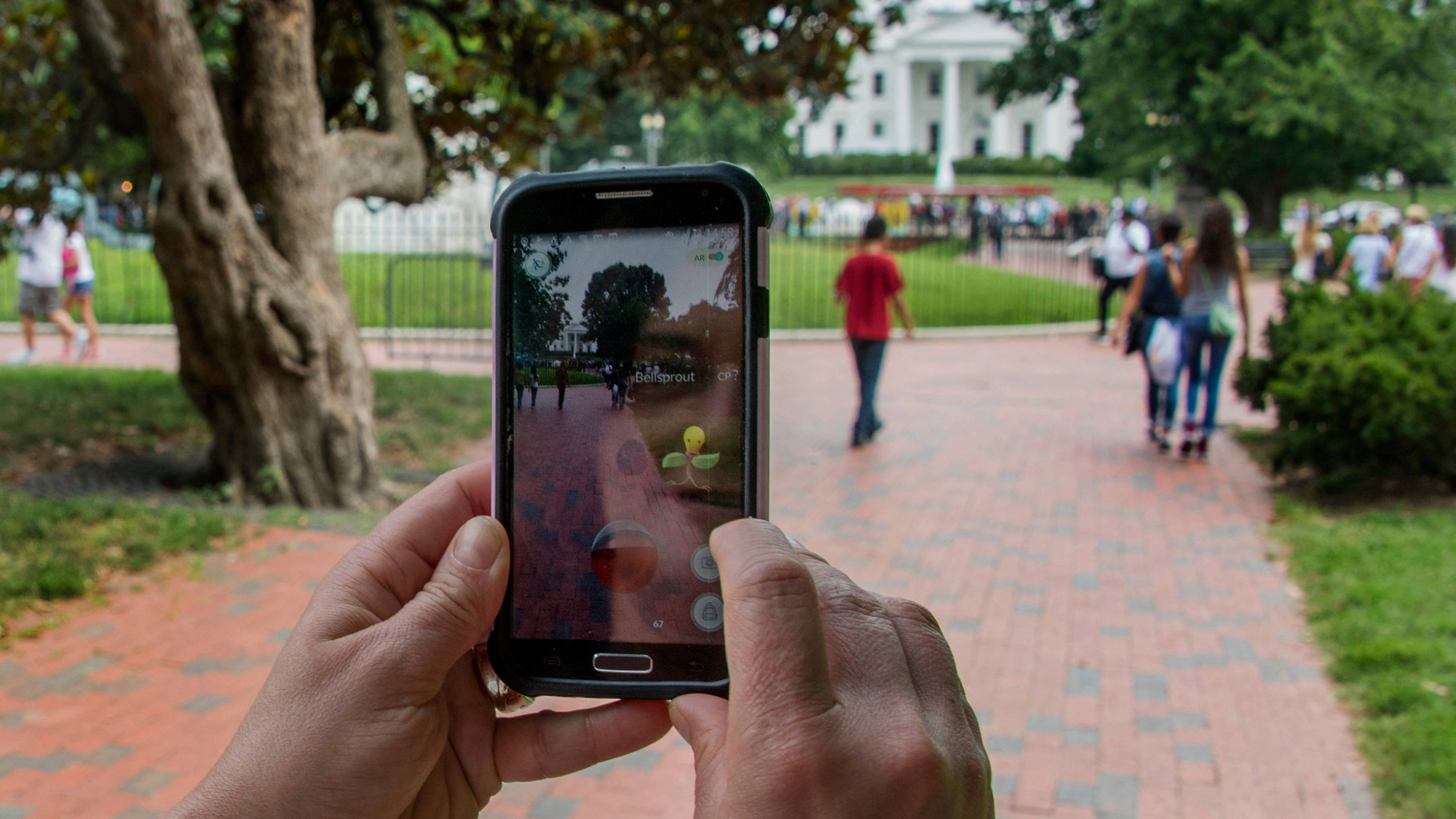
A woman holds up her cell phone as she plays the Pokémon Go game in Lafayette Park in front of the White House in Washington, DC on July 12, 2016. Jim Watson/AFP via Getty Images
Get the Popular Science daily newsletter💡
Breakthroughs, discoveries, and DIY tips sent six days a week.
Nearly a decade ago, Pokémon Go turned the real world into a digital scavenger hunt, with virtual creatures hiding in plain sight. The early augmented reality smartphone app prompted hundreds of millions of players to wander into parks, parking lots, and even dimly lit alleyways, peering through their phone cameras in search of Pikachus and Charizards that the app superimposed onto their surroundings. It was a major hit. But 10 years on from the app’s peak, it turns out that digital creature catching may now help that piping hot pizza you ordered find you.
This week, Niantic Spatial, part of the team behind Pokémon Go, announced a partnership with Coco Robotics, a company that makes short-distance delivery robots for food and groceries. Soon, those robot couriers will scoot around sidewalks using Niantic’s Visual Positioning System (VPS)—a navigation tool that can reportedly pinpoint location down to a few centimeters just by looking at nearby buildings and landmarks. Niantic trained that VPS model on more than 30 billion images captured by Pokémon Go users, and claims it will help robots operate in areas where GPS falls short.
In other words, all that time users spent wandering around playing Pokémon Go will now help determine how well a courier robot can deliver your take out. It’s a stark example of how crowdsourced data, seemingly collected for one purpose, can be quietly repurposed years later for something quite different.
“It turns out that getting Pikachu to realistically run around and getting Coco’s robot to safely and accurately move through the world is actually the same problem,” Niantic Spatial CEO John Hanke said in a recent interview with MIT Technology Review.
Instead of helping users navigate the way that GPS does, VPS determines where someone is based on their surroundings. That makes Pokémon Go particularly useful as a data source, because players had to physically travel to specific locations and point their phones at various angles. That mapping effort got a significant boost in 2020, when the app added what it called “Field Research,” a feature prompting players to scan real-world statues and landmarks with their cameras in exchange for in-game rewards. A portion of the data also reportedly came from areas known as “Pokémon battle arenas.”
Whether players knew it or not, those scans were creating 3D models of the real world that would eventually power the Niantic model. More data means better accuracy, and because Niantic was collecting images of the same locations from many different users, it could capture the same spots across varying weather conditions, lighting, angles, and heights. There’s no shortage of raw material to draw from either. At its peak in 2016, Pokémon Go had around 230 million monthly active players. Though less culturally relevant in 2026, the game still hovers around 50 million active users by some estimates.
Niantic and Coco are betting that Pokémon Go data will help delivery robots understand precisely where they are simply by looking at landmarks around them. Though most autonomous robots currently use some form of GPS for navigation, it isn’t always reliable. Other delivery robots tested on college campuses have been known to get lost or struggle to cross streets. That confusion can lead to delays. As any diner who has waited too long for a hot meal from a delivery app can attest, it’s crucial these couriers arrive on time. After all, time is money.
“The promise of last-mile robotics is immense, but the reality of navigating chaotic city streets is one of the hardest engineering challenges,” Hanke said in a statement.
And while most people associate spotty GPS with state parks or remote rural areas, reliability is also often compromised in the tall, densely packed buildings of a concrete jungle. All of those structures can interfere with signals, causing the location dot on a map to drift. The idea is that Coco’s robots can use VPS and four cameras mounted around the machine to get a far more precise read on their surroundings. In turn, the well-equipped robot will deliver food on time.
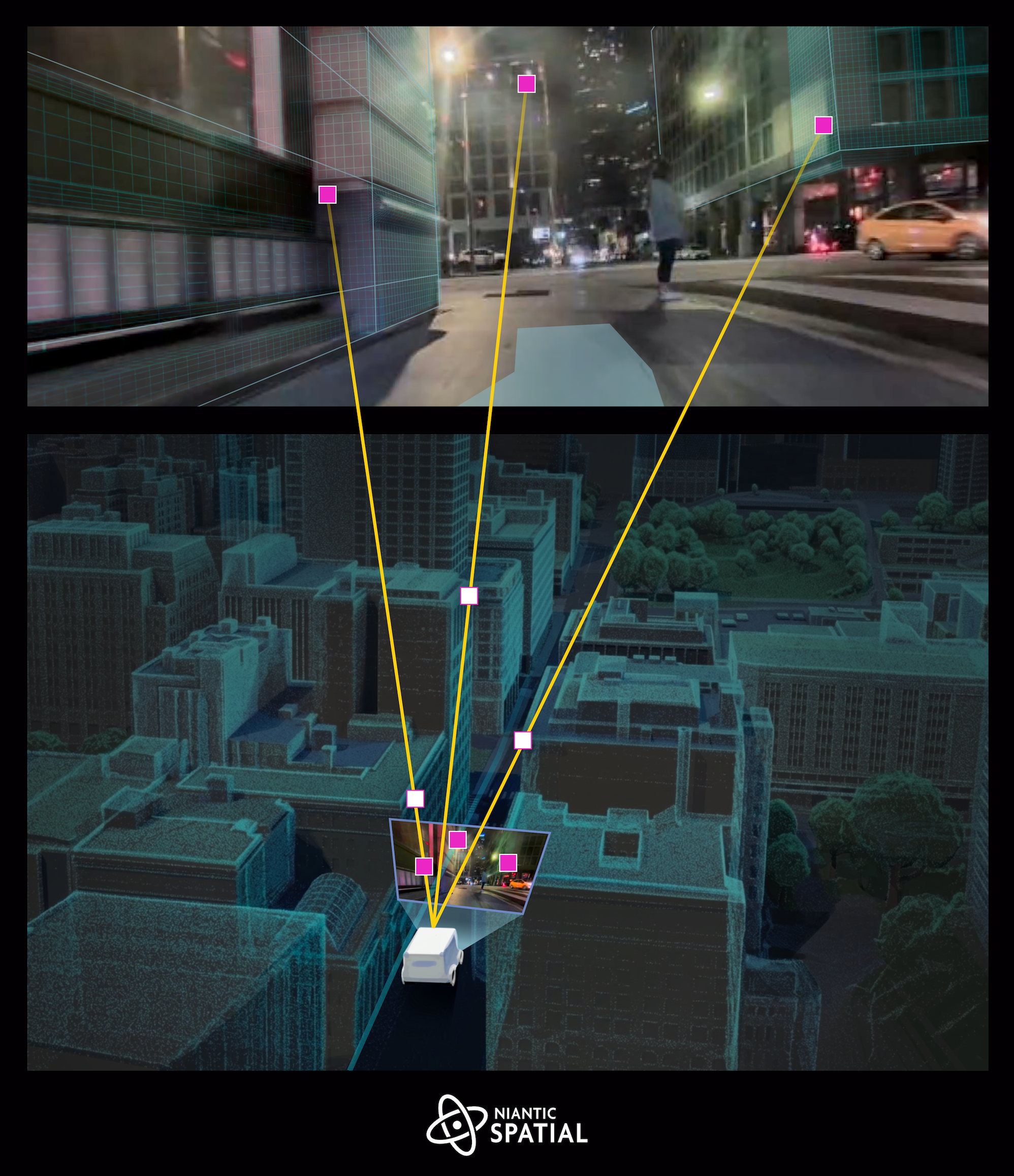
VPS uses four cameras to get a more precise reading of its surroundings. Image: Coco Robotics.
This also wouldn’t be the first time data freely scavenged by internet users for one purpose ended up powering something else entirely. Most famously, Google’s CAPTCHA tests, which ask users to click on images of bicycles or traffic lights to verify they are human, have come under scrutiny. Computer scientists have long speculated that the CAPTCHA tests have been used to help train AI vision models. More recently, law enforcement has allegedly accessed or purchased user-generated content from the consumer mapping tool Waze to assist police investigations. And while Niantic hasn’t suggested any plans to provide its VPS data to authorities, it’s not hard to see how a tool that can accurately pinpoint a location based on landmarks in a photograph could look enticing to law enforcement.
On a broader level, Niantic says its partnership with Coco Robotics is part of a longer-term effort to build a “living map” of the world that updates as new data becomes available. Once VPS-equipped delivery robots hit the streets, they will collect even more info that can be fed back into the model to bolster its accuracy further. This kind of continuous, real-world data collection is already central to how self-driving vehicle companies like Waymo and Tesla operate, and is a large part of why that technology has improved so significantly in recent years.
So, next time you see someone in a park trying to “catch ‘em all,” it’s quite possible the data gleaned from that scavenger hunt could play a key role in determining whether the pizzas of the future make it to their destinations on time.

2025 PopSci Best of What’s New
The 50 most important innovations of the year