Irl noop and forced execution control flow to effectively return true.
B e a utiful
I wonder if, assuming they continue making Xbox, they find a way to mitigate this in the next generation.
https://github.com/exploits-forsale/collateral-damage
What's new here is that this compromises the entire system security giving access to the highest privilege level.
Has anyone heard of notable earlier examples?
It sounds like that's the plan:
https://news.xbox.com/en-us/2026/03/11/project-helix-buildin...
Eventually Fort Knox will succumb to the unrelenting arrow of time and some future visitors will simply step over the crumbling wall and into the supposedly "secure" area.
a) this was a security win. millions and millions of people had physical access to the device for over a decade
b) as others have said, security is not all-or-nothing. the xbox one is extremely secure, despite not being perfectly secure.
c) just because something eventually gets hacked does not mean security was pointless. delaying access is a perfectly reasonable security goal. delaying access until the product is retired and the successor is already out on the market is a huge win.
This talk https://www.youtube.com/watch?v=BBXKhrHi2eY indicates that others have had success doing this on Intel microcode as well - only in the past few months. Going to be some really exciting exploits coming out here!
And if you predict the next dozen bizarre things someone might try, you both miss the thirteenth thing that's going to work and you make a console so over-engineered Sony can kick your ass just by mentioning the purchase price of their next console. ("$299", the number that echoed across E3.)
This talk about some of what went into it is fascinating: https://youtu.be/quLa6kzzra0
Obviously nothing is ever unhackable, not even Fort Knox, given infinite time and resources, and Microsoft never made such claims, this is just media editorializing for clicks and HN eating the bait, but Xbox One was definitely the most unhackable console of its generation. Case in point, it took 13 years of constant community effort to hack a 499$ consumer device from 2013. PS4 and iPhones of 2013 have also been jailbroken long ago.
Therefore, even the click-bait statement with context in relative terms is 100% correct, it truly was unhackable during the time it was sold and relative to its peers of the time.
I didn't ask but Emma -- who wrote the kernel-mode exploit -- and I would probably agree that Collat is not really what we would consider a proper hack of the console since it didn't compromise HostOS. Neither of us really expected game plaintext to be accessible from SRA mode though.
In many cases the truth is simply that its not worth the time/effort to hack it, so only the most dedicated perverts(with a positive connotation) keep trying.
Literally unhackable? XD
Can you attempt to quantify this effort in comparison to other game consoles? I'm not very familiar with the Xbox scene, but I would assume that there was a lot less drive to achieve this given that Xbox has never really had many big exclusive titles and remains the least popular major console (with an abysmally tiny market presence outside of the US).
As an aside, I wonder if Microsoft's extra effort into securing the platform comes from their tighter partnership with media distributors/streaming platforms and their off-and-on demonstrated desire to position the Xbox as a home media center more than just a gaming console.
The person who hacked the original Xbox wrote a book on the topic, which they've since made free: https://bunniefoo.com/nostarch/HackingTheXbox_Free.pdf
TF are you on about? The xbox one of 2013(competitor of the PS4 who got hacked long before) had a ~46% market share in the US and ~35% globally. Hardly insignificant. And any Microsoft Product, even those with much lower market share, attracts significant attention from hackers since it's worth a lot in street-cred, plus the case of reusing cheap consoles as general PCs for compute since HW used to be subsidized. And of course for piracy, game preservation and homebrew reasons.
I again tap the sign of my previous comment, of uring people to stop jumping the gun to talk out of their ass, without knowing and considering the full context.
Pedantic: I'm sure somebody would have snickered about "unsinkable" if the Titanic sank after 10 years. Pragmatic: if the "unsinkable" Titanic lasted 10 years (or at least to profitability) before being sunk by people intending to sink it, that might certainly count as being "unsinkable" for the time it hadn't sunk.
Hubris: Titanic was claimed to be unsinkable before it was launched.
A groundbreaking hack for Microsoft’s ‘unhackable’ Xbox One was revealed at the recent RE//verse 2026 conference. This console has remained a fortress since its launch in 2013, but now Markus ‘Doom’ Gaasedelen has showcased the ‘Bliss’ double glitch. Just as the Xbox 360 famously fell to the Reset Glitch Hack (RGH), the Xbox One has now fallen to Voltage Glitch Hacking (VGH).
RE//verse 2026: Hacking the Xbox One - YouTube 
Go deeper with TH Premium: CPU
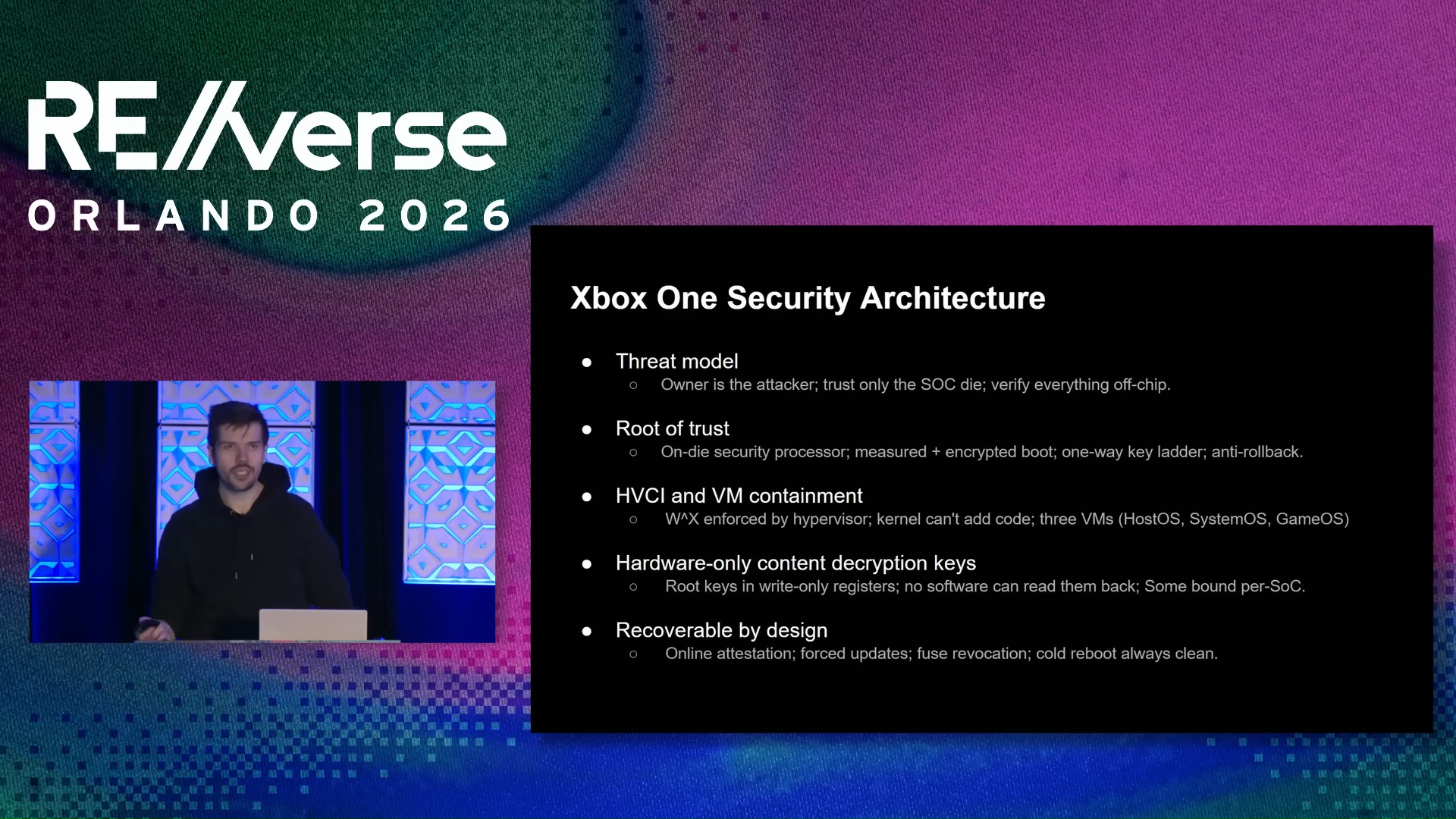
“In 2013 some kind of iron curtain came down on security, of the Xbox ecosystem, and the Xbox One never got hacked,” noted Gaasedelen in his introduction. The same is true of the Xbox One’s successors, and Microsoft was rightly proud. Seven years after its launch, Microsoft engineers would still assert that the Xbox One was “the most secure product Microsoft has ever produced.”
(Image credit: Markus ‘Doom’ Gaasedelen video presentation)
What made the Xbox One so secure, so special? Gaasedelen referenced prior work and presentations to convey this information. I’ve shared a summary slide about this, too, but let’s fast forward to the demo of the new Bliss hack, which takes place from about 46 minutes into the presentation.
Article continues below
Since reset glitching wasn’t possible, Gaasedelen thought some voltage glitching could do the trick. So, instead of tinkering with the system rest pin(s) the hacker targeted the momentary collapse of the CPU voltage rail. This was quite a feat, as Gaasedelen couldn’t ‘see’ into the Xbox One, so had to develop new hardware introspection tools.
Eventually, the Bliss exploit was formulated, where two precise voltage glitches were made to land in succession. One skipped the loop where the ARM Cortex memory protection was setup. Then the Memcpy operation was targeted during the header read, allowing him to jump to the attacker-controlled data.
Image
1
of
3
As a hardware attack against the boot ROM in silicon, Gaasedelen says the attack in unpatchable. Thus it is a complete compromise of the console allowing for loading unsigned code at every level, including the Hypervisor and OS. Moreover, Bliss allows access to the security processor so games, firmware, and so on can be decrypted.
What happens next with this technique remains to be seen. Digital archivists should enjoy new levels of access to Xbox One firmware, OS, games. There could be subsequent emulation breakthroughs thanks to this effort. We also now have a route to making a Bliss-a-like mod chip to automate the precise electrical glitching required.
Get Tom's Hardware's best news and in-depth reviews, straight to your inbox.
Whether PC users, our core readership, will be interested in actually emulating Xbox One, looks unlikely. The 2013 system’s game library is largely overlapped in better quality on the PC platform.

Follow Tom's Hardware on Google News, or add us as a preferred source, to get our latest news, analysis, & reviews in your feeds.
Mark Tyson is a news editor at Tom's Hardware. He enjoys covering the full breadth of PC tech; from business and semiconductor design to products approaching the edge of reason.