I also built an extension to redirect the article to this website, so that before these actions annoy me, I could read the article in peace.
Computers were invented, and initially used for calculations, punch cards, databases, spreadsheets, automating warehouses and running airlines and stuff. Computers are really good for that stuff, like many orders of magnitude better than analog alternatives.
Later, computers became a mass market consumer product, and we had the web and internet, and moving everything online became a fad, much like AI is a fad now. This pushed computers into some fairly marginal use cases, like "social media", publishing, messaging, e-commerce, and CRUD apps to manage workflows like JIRA and friends. Computers are kind of ok for this stuff... but, frankly, not that much better than the original thing. Like, a telephone, fax, etc. already allowed instant communication, email is maybe a bit better than fax, but it's not 1000x better. JIRA is a bit better than a whiteboard and post-it notes, but, also probably not 1000x better.
It's these recent, marginal-ish use cases that are getting destroyed by enshittification, AI, etc... because they were just never that good an application for computers and UIs in the first place. I think, if one wants to work on, or use an application that doesn't get filled with ads or have a copilot gratuitously inserted or whatever, it's probably more likely to happen in software for fluid dynamics or some natural fit for using a computer. Conversely, anything like facebook or jira or whatever that never really needed to be a computer app apart from because it was fashionable... is now unfashionable.
The 49MB web page
No, "No print publication on the planet can do this"
But looking back on magazines, newspapers, etc; they have ALWAYS used a tremendous amount of advertisements. Newspapers sold classified space to sell stuff. It was always passive, and no way to have the newspaper or magazine to watch the user back to track eyeballs.
Now with tech, we can do precisely this, or with close proxies.
And with FB marketplace and Craigslist eating what was left of classifieds, yeah being in media is a very bad place.
And thats not even discussing using LLMs to make slop. Even Are Technica was generating hallucinated articles, and the editor accepted it for months until being called out.
Nor the development practices that are hoisted as "the way to do things now" that people frantically race to adopt so they are not pushed out of the industry and a fruitful career as "obsolete".
Nor the technology companies that thought they served as a suitable replacement for news and advertising and community boards and used their massive investments to undercut the ability of traditional news outlets to survive, nevermind upstarts to have any hope of competing.
And the haranguing continues as if it was the design of these organizations in the first place.
There's no love lost for the media companies owned by billionaires, but maybe it should be more clear in these discussions exactly who started this particular mess.
Not really the point of the article, but almost all major news sites are significantly better if you block javascript. You sometimes lose pictures and just get text, but often the pictures are irrelevant anyhow. (a story about a world leader, and some public / stock photo is used and is not truly relevant to the story)
News sites are almost like lyric sites or recipe sites in this regard. The seem to presume that many visitors will not be regular visitors, and so they try to maximize value from every single visit.
Which is very surprising to me. I only read The Guardian within the Tor browser, and when the website is loaded over their onion urls I do not see the same large obnoxious ads. A rare Tor win? Maybe adnetworks block Tor IP addresses and the reason why ads don't show up?
The onion url https://www.guardian2zotagl6tmjucg3lrhxdk4dw3lhbqnkvvkywawy3...
QVC exists. That channel is ONLY ads.
Not to detract from the point, which seems to be "yes what this other guy said."
Because you have to pay for the print version. They have plenty of ads, too, but they're not the sole revenue stream.
Publishers could create efficient fast-loading web pages if they prioritized it (and a rare few do) but its just not a priority for most even though its in their best interest.
You can have ads loading on a web page, even with header bidders, if you structure it correctly. In fact you can implement an ad solution that allows for fast loading pages and better optimize your ad revenue - whether you're doing pragmatic or direct.
I know this because I've done this before. At a past employer we cleaned up their mobile version (they used the "m.example.com" format, so we could push this as a separate rogue experiment) and saw ad revenue grow by over 30% while giving readers a better, faster overall UX.
I actively monitor top publisher article pages and you can see how bad (and good) it is:
TL;DR Keep using an ad blocker
- https://www.youtube.com/watch?v=iYpl0QVCr6U
- https://idlewords.com/talks/website_obesity.htm
Some say that you should not use ad blocker, because that kills ad revenue, but I did not forced anybody to rely with their lives on ad revenue. Many of things were 'free' because we were all just using ad blocks, and then it all became commodified, simplified, so simpletons without ad blocks became a thing. Now they shame people for using ad blocks, even though it stops spreading malware and viruses.
I plan to use ad block, and use as many extensions that protect me. If there is some form of goods, be it streaming movies, audio, books I will happily pay for it. I will not accept a web with ads. I prefer touch grass. There is a clear line for me.
Also there is no line ad publisher will not cross. The goal posts are shifted, so you will never satisfy shareholder greed. The only pushback is trough ads and probably sometimes piracy. Not that I advocate it, but in reality if companies push too hard, there are consequences.
Yes because they don't give the print editions away for free.
You go to these sites as a free user, you get exactly what you paid for.
The only reason you're confronted with articles from these legacy publications in the first place is because they've lobbied governments to get google to force them into their carousels and recommendations.
> “A lot of websites actively interfere the reader from accessing them by pestering them with their ‘apps’ these days. I don’t know where this fascination with getting everyone to download your app comes from.” It comes from people who literally do not understand, and do not enjoy, the web, but yet find themselves running large websites.
I don't entirely agree. I think these people entirely understand the web. This comes from publications trying to steer you towards their app so you can't block their tracking/profiling requests. The screens are cluttered because we've defined acceptable metrics as more clicks and views. The easiest way to generate more clicks to put a few popups on your site. Who cares what the clicks are actually for, no one is tracking user flows and user retention anymore, it's all "get them caught in the swamp" and maybe the slow page loading, janky ui, and increased clicks will land them on one of the advertisements.
This stuff comes from "here is the latest pattern people are using to get people to click on stuff" then the team implements the pattern 100 more times as a bandaid/movement of the way to get people to click on things. Those people rotate out and it's only another 5 years before some dev says "hey can you clean up your Google Tag Manager script tags?" to whoever is in charge then.
This also stems from the thousands and thousands of marketing companies/"startups" that do one thing. "Put our script on your page to track and improve customer retention". Of course whatever the marketing company is selling is perfectly quantifiable inside the analytics suite, but no one gets promoted for implementing a new analytics report. You get promoted for implementing "Click Tagger" or whatever.
This mentality runs deep through modern American culture. Where it's more flashy and newsworthy to strike a deal with a sales rep of some AI startup than implement the tech yourself. Look at the US CENTCOM implementing Israeli tech or even the report yesterday about the committee approving Microslop garbage for federal use.[0] All of that comes out of some sales contract as our leadership teams only know how to copy script tags, not understand systems and flows.
[0] https://www.propublica.org/article/microsoft-cloud-fedramp-c...
The reader is not respected by the software because the reader themselves does not respect the software or the article. If the reader paid for a subscription to the website they would get an ad-free version. Don't pay and then this is what you get. The money has to come from somewhere. The issue is that a large portion of the population seems to think that if a product is digital then it should be free which is maybe fine if we are going to live in a world with Universal Basic Income but in our existing system is absolutely ludicrous.
We used to pay for things - including the news. The clear issue is that the working class have (since 1970s but especially since the financial crisis) tolerated having their inflation adjusted incomes degraded so there is no longer the money to pay. Outside of governments who have failed to take the necessary action against corporations and promote a power balance between investors, business and workers, the main cause of this is the lack of courage in middle management.
The executive suite have not tolerated this degradation and their salaries have risen accordingly. In contrast, middle management attain a level of safety/comfort and then coast - they don't want the hassle of looking for another job so they don't risk pushing for a pay rise. They just accept whatever meagre rise is offered because they think "well at least I'm still better off than the guys lower down the chain". This then filters down as the ceiling for the lower ranks can never be higher than the management. Over time this becomes a gigantic issue, particularly in countries with a strong minimum wage that rises every year as the gap between the worker and management closes every year. Management then start blaming the government rather than actually looking at themselves and the fact that they are not pushing for bigger wages out of fear of rocking the boat.
I literally saw this play out at a billion dollar revenue international non-tech company where I used to work a few years back. Directors were on £125k. Department heads on £75k. Tech leads on £55-65k. Seniors on £40-50k. Intermediates £27-35k. Juniors £25k. Devs who had developed features worth millions to the company would get offered pathetic pay rises of £2-5k because offering any more would then mean they'd be treading on the next rung.
That makes it sound like no one of The Guardian has a brain, it's not the intention, it's my most trusted news source, but maybe someone on the IT department thought a little bit further.
Advertising is when you're baited into watching some fun "content" and then they interrupt it to shove ads in your face. Nobody asked for this.
One note: the Property link, that links to the actual news source, is broken.
Also, the test link you're using for Nautilus (the top scoring site) is 404 (https://nautil.us/issue/48/chaos/the-multiverse-as-muse)
A lot of print magazines, like Vogue or even Field & Stream, are like 60% or more full page ads. But if you’re reading something like New Bride magazine you’re probably actively shopping for wedding dresses and flowers and such, so the advertising ideally works as part of what makes the magazine valuable for the reader and the advertiser.
The real problem is that the finance and business folks are addicted to performance metrics and they preferentially put their money towards things that can be represented as graphs because it’s hard to argue with a graph. Jon Gruber has a vague sense for what sort of audience he has and what they’re into, so he can pitch advertisers on the idea that by advertising with him they’re going to reach an audience of Apple enthusiast technologists who presumably care about design and UI/UX and whatever other intuitions he has about his readership. But none of that is a quantitative metric, so only a small market is open to putting money into it.
Yeah? How about when I go to the site as a paid subscriber and get the exact same experience? Did the number or obnoxiousness of ads go down when I gave NYT money? Nope.
He does this to amplify things, and look: it worked! The original post made the HN homepage a couple days ago, and now Gruber’s post about it has made the HN homepage again.
It's a link blog.
I grew up in a household where several newspapers were bought daily (dad was a journalist himself). I would struggle doing the same though, even if I can very much afford it, because it is very clear to current press that even paying, I'm the product.
There's all sorts of articles that are actually ads, attempts to move me in an ideological direction, information that is in the owner's interest to spread.
Press double dips. If the interest is on distributing ideology, have the parties/lobbies pay.
This isn’t true of the US:
https://fred.stlouisfed.org/series/LES1252881600Q
With fits and starts, real median wages have been on a solid upward trend since the mid-1990’s.
Have newspapers or magazines ever been financially sustainable on sale revenue alone? They've always carried ads, and I suspect that's always been a bigger income stream than the cost of buying the paper itself.
? Where is this true?
I pay for the NY Times. Logged in to my subscriber account, the front page is 68MB and has a giant Hume band ad filling 1/3 of the screen. Loading an article that contains about 9 paragraphs of text and I have a huge BestBuy banner ad filling the top, and then smaller banner ads interspersed between every paragraph.
That maybe 10KB of text is surrounded by 10MB of extraneous filler downloaded for just this page (not even including the cached content).
Some companies are like this, but they generally lose their best people to better salaried jobs elsewhere. They exist because not everything needs to be done by top people.
Free newspapers and alt-weeklies are the same. How are they supposed to function if people don't pay for them?
Most certainly not. The hollowing out of classifies by Craigslist in 2000s is what killed most local newspapers.
People used to all pay for their newspapers. So newspapers had an actual budget apart from ad revenue.
This has largely dried up and nearly all 'newspapers' today need to get their money from ads. Sure, some people subscribe, but it's hardly ever the main income for news organizations (some exceptions notwithstanding, I'm talking about the average news organization here).
On top of that the ad revenue is extremely 'diluted'. Putting an ad in a print newspaper was expensive!.
For an organization who get their main income from ads, tailoring their pages for the few subscribers is hardly worth it.
On the one end we've got Google Ads, which spies on your users everywhere they go. (I think most ad networks are in the same category, unfortunately.)
On the other end, you've got "someone emailed me to negotiate a sponsorship / affiliate thing and I added the banner/link manually, with no tracking code."
I only really see those two options.
Maybe the manual one is not so bad? I mean people don't want to see an ad either way, but if there's one, and you hand-approved it, and it doesn't spy on you... then we've eliminated most of the ethical and respect issues, right?
There's a temptation to "set it and forget it", but if you have even an atom of respect for your readers or customers, it only seems right that you'd put in a few minutes of work per month instead of deploying spyware on their machines.
(Just making it <a><img> also seems to solve all 49MB of ass.)
They want to look good in front of their bosses. They want to bring nice charts with nice performance metrics and they want to be up to date with the latest developments in the market of marketing tools, so they use every tool that is out there.
"IT" has no choice but to do what marketing demands, because IT is a cost center, while marketing is closer to revenues.
And so, over time, you end up with 49MB web pages with hundreds of trackers.
Yes, I tried YouTube iOS app recently, without an ad blocker. It pretty much describes the experience.
The printed version does _look_ better, but can org that serves Taboola ever be taken seriously anymore? Sanctity is miles away from "6 simple steps to $1 Million" ads. We can be sad in general about their passing. But let's not think it's isolated to issue surrounding online/ads. WaPo isn't the same either.
It has nothing to do with "understand[ing] or enjoy[ing] the web". It comes from people at organisations running websites that know where the money is, probably because some cretinous nerds encouraged them. Generally, the amount of potential data collection, surveillance, ad serving and _money-making_ is greater with an "app" than with a website
"Ad blockers" are popular but "app blockers"^1 are not. The "smartphone" is a remotely-controlled "entire surveillance device" (recent HN title: "Your phone is an entire computer")
1. Application firewalls like Netguard. And even this does not solve the problem entirely because the design of the "entire computer" includes extensive surveillance capabilities
lol, they're doing for the money. Not because they're "held hostage". More time on site means more money. They know this. They know it's a shitty experience. Look, I get it, they have to make money somehow, but some of these sites try to squeeze every last drop of money out of users. It's a fine line to walk between "I'll stay because this content is interesting" and "F this man, I'm leaving", and some push that line hard.
Youtube is just about the worst that I've put up with for it. Every single second it's trying desperately to inject more ads, which the blocker swiftly removes. After watching for a few minutes the block count can be in the several hundred...
And others feel they are entitled to passive income by hastily throwing together IP they did not create and do not own, apparently.
Everything has to be a side hustle and everyone has to take their cut as a middleman these days.
Ehh... I cancelled my SF Chronicle subscription a year ago. Since then I've received a dozen predatory phone calls and just add many letters. Plus when you do have the subscription they alter prices on you like a cable TV provider. So in some ways print is better than web but in other ways it's worse.
The NYT makes about $2B per year from subscriber revenue. They make about $450M from digital ads over all properties. Obviously not all news orgs are the same, but the lead example of a shitty experience is the NYT, so weird that all of the rationalizations work so hard to diverge.
>tailoring their pages for the few subscribers is hardly worth it
"Tailoring" a digital page to not include ads for subscribers is so laughably trivial that this is a farcical claim. They aren't hand-laying out the content and removing ad upsets it or something. But they don't remove the ads because, gollum style, why shouldn't they force ads on me?
What we're talking about is classic enshittification, and every justification people make up is just cope. Indeed, the fact that I'm a subscriber makes me even more lucrative to advertisers, in a classic catch-22 that completely undoes all of the "just pay and you don't get ads in my invented scenario".
(e.g. as maligned as it is, the Microsoft account really is one account you can use to log into your computer, your XBOX, and all sorts of things. The Apple account is the center of your digital life on iOS but on MacOS it's kinda... tacked on)
but the crazy thing we discovered is that the people who run news websites mostly don’t know where their ads are coming from, have forgotten how the ad system was installed in the first place, and cannot turn them off if they try
we actually shipped a server-side ad blocker, for a parter who had so completely lost control of their own platform that it was the only way to make the ads stop
At least in India, most popular newspapers actually do this nowadays. Several full page ads including on the front page have become the norm.
It is mostly a function of how little the reader is willing to pay for content. When the price point is too low (which for online content is too low), publishers make their money by other means. It is not rocket science.
I watched someone getting a livestream of an important (to them) soccer game going via the sort of thing usually reserved for "adult" content - that any given click, be it "play" or "fullscreen" or whatever, has a 9/10 chance of triggering a junk popup rather than the intended action, so you play whack-a-mole until you finally get it playing, whack-a-mole again until you get fullscreen, and then for heaven's sake don't touch it any more. Whereas with the adblocker, typically it looks completely clean, with no junk popups, and every click doing exactly what it should on the first try.
Anyway so could it be that the web having turned into such ad-overloaded garbage, that even its designers have adblockers running and don't even fully realize what a mess they're publishing?
Just as I need an ad blocker to browse the modern web, I need Reader mode to read Gruber’s rant about it.
I recently was in a 45 minutes Uber ride where the driver had the stereo set to the Sirius XM self-advertising channel - the one you get if you haven't subscribed. For 45 minutes, all he listened to was an ad for XM.
Most people just don't care.
If I loved King Crimson, I might create a site expressing that love and also host lyrics to their songs. Not to generate ad revenue. Not with any expectation of being reimbursed for hosting costs. I did it because it was fun and because sharing knowledge felt like the point.
I would actually flip your statement around. Today, many people feel entitled to be paid for sharing things on the Internet. In that sense, they are the newcomers. The original ethos was about sharing information simply because it mattered to someone else, and a few of us still believe that value has not gone away.
Wikipedia only exsists because they refuse to sell out. Do you know how much money they could make turning every wiki reader into a product for ads?
I would presume that this fascination with pushing viewers to the app is because they make better money off of you reading stuff in the app.
Shubham Bose, “The 49MB Web Page”:
I went to the New York Times to glimpse at four headlines and was greeted with 422 network requests and 49 megabytes of data. It took two minutes before the page settled. And then you wonder why every sane tech person has an adblocker installed on systems of all their loved ones.
It is the same story across top publishers today.
This is an absolutely devastating deconstruction of the current web landscape. I implore you to pause here, and read Bose’s entire amply illustrated essay. I’ll wait.
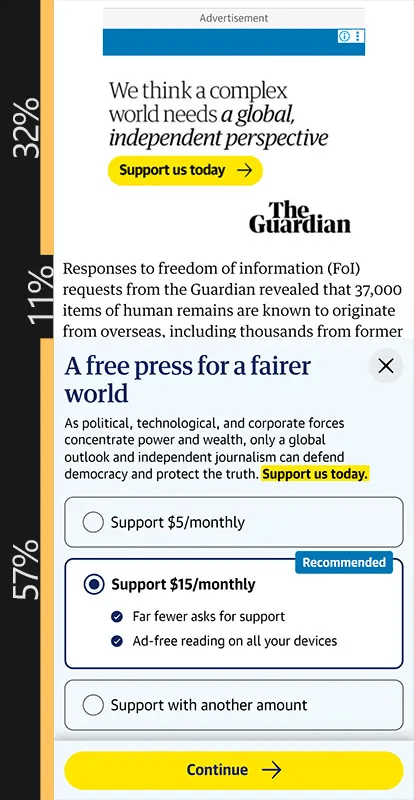
Even websites from publishers who care about quality are doing things on the web that they would never do with their print editions. Bose starts with The New York Times, but also mentions The Guardian, whose web pages are so laden with ads and modals that their default layout, on a mobile device, sometimes leaves just 11 percent of the screen for article content. That’s four lines of article text.
Bose writes:
Viewability and time-on-page are very important metrics these days. Every hostile UX decision originates from this single fact. The longer you’re trapped on the page, the higher the CPM the publisher can charge. Your frustration is the product. No wonder engineers and designers make every UX decision that optimizes for that. And you, the reader, are forced to interact, wait, click, scroll multiple times because of this optimization. Not only is it a step in the wrong direction, it is adversarial by design.
The reader is not respected enough by the software. The publisher is held hostage by incentives from an auction system that not only encourages but also rewards dark patterns.
I disagree only insofar as the reader isn’t respected at all. Part of my ongoing testing of the MacBook Neo is that I’ve been using it in as default a state as possible, only changing default settings, and only adding third-party software, as necessary. So I’ve been browsing the web without content-blocking extensions on the Neo. It’s been a while since I’ve done that for an extended period of time. Most of the advertising-bearing websites I read have gotten so bad that it’s almost beyond parody.
And even with content blockers installed (of late, I’ve been using and enjoying uBlock Origin Lite in Safari), many of these news websites intersperse bullshit like requests to subscribe to their newsletters, or links to other articles on their site — often totally unrelated to the one you’re trying to read — every few paragraphs. And the fucking autoplay videos, jesus. You read two paragraphs and there’s a box that interrupts you. You read another two paragraphs and there’s another interruption. All the way until the end of the article. We’re visiting their website to read a fucking article. If we wanted to watch videos, we’d be on YouTube. It’s like going to a restaurant, ordering a cheeseburger, and they send a marching band to your table to play trumpets right in your ear and squirt you with a water pistol while trying to sell you towels.
No print publication on the planet does this. The print editions of the very same publications — The New York Times, The Guardian, The Wall Street Journal, The Atlantic, The New Yorker — don’t do anything like this. The print edition of The New Yorker could not possibly be more respectful of both the reader’s attention and the sanctity of the prose they publish. But read an article on their website and you get autoplaying videos interspersed between random paragraphs. And the videos have nothing to do with the article you’re reading. I mean, we should be so lucky if every website were as respectfully designed as The New Yorker’s, but even their website — comparatively speaking, one of the “good ones” — shows only a fraction of the respect for the reader that their print edition does.
Without an ad-blocking content blocker running, one of the most crazy-making design patterns today is repeating the exact same ad within the same article, every few paragraphs. It’s hard to find a single article on Apple News — a sort of ersatz pidgin version of the web — that does not do this. The exact same ad — 6, 7, 8 times within the same article. How many 30-something blonde white women need hearing aids? It’s insane.
People are spending less and less time on the web because websites are becoming worse and worse experiences, but the publishers of websites are almost literally trying to dig their way out of that hole by adding more and more of the reader-hostile shit that is driving people away. The Guardian screenshot Bose captured, where only 11 percent of the entire screen shows text from the article, is the equivalent of a broadcast TV channel that only showed 7 minutes of actual TV content per hour, devoting the other 53 minutes to paid commercials and promotions for other shows on the same channel. Almost no one would watch such a channel. But somehow this strategy is deemed sustainable for websites.
The web is the only medium the world has ever seen where its highest-profile decision makers are people who despise the medium and are trying to drive people away from it. As Bose notes, “A lot of websites actively interfere the reader from accessing them by pestering them with their ‘apps’ these days. I don’t know where this fascination with getting everyone to download your app comes from.” It comes from people who literally do not understand, and do not enjoy, the web, but yet find themselves running large websites.
The people making these decisions for these websites are like ocean liner captains who are trying to hit icebergs.
Unfortunately the industry is so large with so much money now that choosing a different business model is almost always leaving money on the table. And I don't have any ideas on how to fix that.
Depends how you use it, I guess? The close and zero-effort integration and syncing with iOS is pretty key to my desktop (well, laptop) still having enough utility-to-effort to be worth having around at all. Probably still won't save it when my M1 Air gets a bit dodgy in a year or two and I start thinking about an upgrade (I'll likely upgrade my aging, last-pre-M-series-model iPad Pro instead) but if not for that it'd already have become inconvenient enough that I'd likely have forgotten about it in a storage bin somewhere.
Also, (1) the image is dithered, ha ha, and (2) The image on the page https://daringfireball.net/2020/05/dithering is an 863K PNG. (Which I bet we could still get down to a smaller size, granted.) It took me a bit to figure out what you're looking at -- the Dithering site on passport.online, where the cover art is inexplicably 3000x3000 pixels. I'm too tired to come up with a good crack about how that explains what I don't like about Ben Thompson, but I bet it's there.
Right before the web became a thing, Usenet was starting to become inundated with spam
Unfortunately, music lyrics are protected by copyrights so your site of King Crimson lyrics would not be authorized unless you paid for a license. The music publisher may not expend the effort to have a lawyer send you a "Cease & Desist" letter to make you take it down because your personal website is small fish but they wouldn't ignore a popular website that tried to show all lyrics for free with no ads.
The legitimate ongoing licensing costs from Gracenote/Lyricfind for their catalogs of millions of song lyrics will cost significantly more than the hosting bill. The cost is beyond the resources of typical hobbyists who like to share information for free.
EDIT: I have no idea what the downvotes are about. If you think my information about lyrics licensing is incorrect, explain why. Several decades ago, volunteers were sharing guitar tabs for free on the internet and that also got shut down by the music publishers because of copyright violations. Previous comment about that: https://news.ycombinator.com/item?id=24598821
Anyone can still do this today (I don’t know the legalities of publishing copyrighted lyrics though). Of course, the proportion of people who wanted to do that was much higher in previous decades.
But we also spend much more time and bandwidth today than decades ago, so maybe it just wasn’t feasible to expect that much quality content from volunteers to keep flowing.
No tracking. No cookies. No behavioral targeting (targeting based on stuff you've previously done). Every website where our ads appear AND every advertiser is hand approved. No JS from advertisers: just a plain JPG/PNG and text.
We're small but on track to pay out $500k to publishers this year.
And as a bonus (for the website owner), they're also much harder to automatically block!
You can’t do MITM on HTTPS anyway, so I can’t imagine they would do anything more than a $20 Pi Zero and PiHole, except for the fact that somebody else is managing it.
this is batshit insane, yet I believe it
At some point I just lost interest in the whole thing and cancelled my plugin subscription.
I got an email from the developer, which was kind enough, asking me why I was cancelling and if there was any feedback I wanted to share.
I mentioned how complicated ad inventory, ad placement, and online ordering for hands-off customer self-service was.
His question back was, "What's hard about it?"
I couldn't even muster a reply.
But that's never the option and apparently it never will be. Sorry, I'm just never getting yearly subscriptions to 30 different content websites. That would probably 10x my spam email intake, I'd have to worry about them jacking up prices and playing games after the initial subscription ran out, and I'd have yet another subscription floating out there in the ether for me to forget about.
Ads do break the internet, or let's say, fundamentally change the model of how it works to the detriment of most people
I think this might be selection bias in your customer base. I've had some friends who worked at a local news outlet. The ads on their website were a big deal and they had a full-time position dedicated to managing internet advertising.
It's only when I jump back into the ads management page where I'm able to get a better idea. Even then, the specific trackers are hidden behind a variety of menu items that can change every time. This post made me realize that I need a better strategy as things are getting ridiculous with ads.
I used to be someone who didn't use ad blockers because some of them are botnets. It's just not the same anymore, as I would trust the botnets with my data over the advertisers.
Print magazines make most of their money from ad sales, not subscriptions. A typical ratio is 60:40 ads vs editorial. Magazines like Vogue go >70% ads, and I'm fairly sure old issues of Byte and other computer magazines were in that ballpark.
The difference in print is that the ads are targeted, and even welcome. Many of the ads in old computer magazines were price lists and mini-brochures, and pre-web that was the only way to get that information to customers.
To be fair to your point though, the pirate sports streams are AWFUL in terms of link landmines.
I am so convinced that this is the case. They're using their own product using some max-level sub that removes all the annoyances, and don't realise how unbearable the default experience is.
Speaking of the NYT: previously, I used to bypass the paywall, and I simply got the article with no nonsense. Now I subscribe, and every single day I get an obnoxious pop-up ad to upgrade my subscription to some higher family tier. Giving the NYT money has made my day a tiny bit more annoying than not giving them money. Lesson learnt.
The median age in the US in 39, which means at least half of all Americans would have been in elementary school during that supposed era of the internet.
Now, whose job was it to remove the previous 200 Tag Manager scripts? Obviously the last guy's, because those were his experiments and he was in charge at the time so new guy was clearly not responsible for it. And at the end of the year, 250 Tag Manager injections would now exist and we would turn the page to reveal a new CMO.
And thus ends the parable of how I put a wrapping feature flag on the code that added Google Tag Manager to the site so that I could display the effects of the insanity and demonstrate why the PageSpeed metrics were ass and why engineering couldn't fix it (in a way they would permit, anyways).
"At some point I just lost interest in the whole thing and cancelled my plugin subscription."
This is called "Tuesday", for me.
> How the hell did they end up not knowing how to manage the content on their site?
The knowledge atrophied. To me the harder problem is keeping knowledge off the bus… it gets on of its own accord and then boom: knowledge lost. People leave the company, and with them, lessons. People are in constant crunch time, and don't have time for the last 2% of the work that takes 98% of the time, like adequately documenting the weird bits of the system. Half the time the corp site is an afterthought to main engineering, relegated to some CMS that marketing can have, and trust me marketing is not writing docs.
Company leadership at nigh every job I have worked on encourages the company, collectively, to forget. Dev turnovers at most places I've worked average around 2y… that's knowledge, just walking out the door.
Often, that tag manager isn’t managed by the technology department, and well-meaning marketing people continue to sign contracts and jam JavaScript into the front end. If there’s also not a good content security policy in place, ad networks quickly become unregulated, all sorts of strange ads come in, and it’s very difficult to control them.
There are a lot of “MarTech” consultants out there that help clients essentially burn their tag manager to the ground, then build it from the ground up to work properly.
Pornsites and pirating websites have always been amongst the most egregious UX/UI designed to make you accidentally click or open ads.
The only way I can explain your differing experience is that you only visit pornhub.com which is indeed the one well behaved beast in a pack of rabid possums.
(I'm sure there would have also been countless ways to make the thing play actual music, but turning it off is the most obvious course of action.)
What could a game notify you about? Nothing, probably spam. Deny.
What could a social app notify you about? Interactions with your content and profile. These are useful, allow.
What could an instant messaging app notify you about? Messages, obviously. Allow.
What could a fast food establishment app notify your about? Probably your order status if you order from the app. But it might also spam you. Allow but be prepared to turn off categories that are spammy if spam does arrive.
and the answer is: not much money at all. we ran the numbers and a typical user’s browsing was worth something like $20/month total across every site and every app combined
but no one can figure out the logistics, so we’re stuck with ads
The entire industry is run by actual journalists, it's one of the few industries where people who know how to do the job still rise to the top. Unlike most other industries, where the top brass are MBAs who don't actually know how to do things like build airplanes or write software or what have you. Which is honestly great except when it's not.
The web has never found a way to make journalism as profitable as it was back in the print days, so they mostly see technologists as people who get in their way, as disposable or replaceable.
So imagine the state of their tech stack — CMS's integrated with the front end, if not Wordpress then something like that, nothing headless. “Hey you should remove this plugin" what's a plugin? "look… this Bonzai Buddy, who installed it?" Some guy who left twenty years ago. And it's not in a template, it's in the articles and executed by an eval().
They have no motivation to fix any of it, because again, web sites for newspapers aren't profitable. Subscriptions are profitable. I think the real reason why Substack is successful is not that email is a good format for journalism — in fact it’s terrible — but because you generally cannot inject javascript into it. Which comes back to Gruber’s point — javascript was a disaster for the web as a document standard.
(personally, I haven't read news on the web in something like twenty years — RSS ftw)
(And of course you’ll get no argument from me that it’s insane that such things need to exist at all, but such is the world we live in.)
For big players, ad revenue is a big part of their business. Not a forgotten corner of their website.
Anyway, this is something you can have if you actually want it.
Which is a great idea and a great site, but why is it even necessary. The sheer dumb that means there are 12312 Netflix 'class' stream services is beyond ridiculous. I used to love one-stop shopping, now it's so fragmented I just went back to piracy. I don't have time to monkey with 10 sub services.
My point? As soon as such a service existed, there'd actually be 50 of them, and the stuff you wanted would be on 8 separate services.
- If it's a niche product, you can just "buy out" the ad space on the website. But if the phone becomes popular enough that the majority of a website's ad revenue comes through this route, there starts to be a bit of an extortion-like opportunity for the website owners. The website has an incentive to show _even more annoying ads_, with the knowledge that most users actually won't see the ads, but they'll still get paid as if they did. They can say "oh, we're adding 5 more banners, so you'll need to pay us 5x the amount you used to"
- I also see problems from the other direction (from the companies purchasing the ad space). By paying a website _not_ to show ads, you're essentially buying ad space. But the other purchasers-of-ad-space will still exist, and will now be competing for a more limited amount of space. So prices should rise, as demand rises. And as prices rise, you'll have to pay the websites more to keep them ad free. This should converge to a new equilibrium eventually, but I wonder if you accounted for that? If you get significant market share, the new equilibrium would be really expensive, because you're essentially trying to out-purchase everyone.
My only overriding and most prominent concern is that given how every other webservice has been, that once they have sufficient ownership of the space they will increase the cost, likely significantly, and then they will likely add in their own ads on top of everything else.
It will take a literal once in a century genius to make something like this that actually works and that companies will latch onto.
Why in the hell would they not just sell it to me at cost for $2. Heck, I'll even say I'll be a customer for the REST OF TIME if they did that. I understand why Netflix and other vendors charge $12 - $20 because it has to pay for the copyright. But Youtube does NOT. It's a fucking scam to make us pay a premium.
I refuse to buy Youtube ad free until they drop the price to something $3 or below...
Communication is hard. Even harder in writing. A usually working approach is to assume friendliness.
Every popular / beloved service is a target for these giant piles of cash. The fact that lots of people like it is de facto proof that it's underpriced, or over-resourced, or coddles its users with too much content. According to the finance industry, a stable business relationship should have the userbase reluctantly concluding that they have no other option, gritting their teeth and opening their wallet - and that's the sort of maximally profitable entity that a giant pile of cash will leave alone, letting it just exist, as a business.
I'm hesitant about a lot of this stuff because it's very easy to get to a place where we let net neutrality degrade even more than it already has. Part of the way that platforms indoctrinate us to accept that paying extra for quality of service or "fast lanes" for specific content types are "necessary" is to degrade the existing experience so much that it seems inevitable.
You would be correct, but...and I say this as a subscriber to Apple's "all-in-one" package...Apple News+ is in many ways garbage. Low-rent articles from publications whose time has long passed (looking at you, Popular Mechanics), with Taboola-grade ads interspersed (as Gruber said recently, how many 30-something blonde women need hearing aids?).
That said, stay away from the front page and go straight to your selected publications, and it's a good deal with access to WSJ, LA Times, and what have you. You still get crappy ads (which I can't seem to find a way to block with PiHole), but the content is there. For all my bitching, I'd still recommend it.
> I refuse to buy Youtube ad free until they drop the price to something $3 or below...
There in lies the problem. Your eye balls (assuming well employed with $$$ disposable income) is another 10x worth to advertisers.
If I were to make a guess, Youtube for sure will lose money at $14/month on your specific browser.
You are literally subsidizing internet for, let us say for arguments sake, some zip code in rural america or <sub any rural part of the world> 's Youtube streaming needs.
Users complaied about the price to go ad-free (something like $25 per year).
The commenter revealed that the actual revenue from ads was much more than $25 per year. Every person who purchased the ad-free option actually cost them money.
----- The lesson I took away is that ads pay more than we expect, though i didn't know the specifics of YouTube.
By providing an ad-free option, they are really allowing the user to out-bid the advertiser.
I think for most people, they would not be willing to pay more to avoid the ad than the ad seller is willing to pay to show it. It's a weird conundrum--but people are very cheap.
IANAL but I suspect bankruptcy law is a subtle and chronic bad influence here.
If a well-behaved company has financial trouble, formerly-binding promises around privacy or ethics may get voided in the name of somehow turning the whole mess into money for creditors. Then the new ownership may be able to do whatever they want with the data.
If the prior management deleted everything before the sale, they could get into legal trouble for destroying "valuable assets" and wrongly prioritizing customers over creditors.
I agree that Apple News+ is bad, but I think this is an example of why these plans always fail:
Someone says "I would pay good money for a service that does..." and then the service that does the thing appears and the goalposts keep moving as people realize their threshold for wanting to pay for something is higher than they originally thought.
It should be a public utility. It should be as ad free as reasonable. It should not track you.
The internet should be a lot of things that it currently isn't all because rent-seeking money and power grubbing bastards have too many of the strings and love pulling them like they're pulling their puds.
Youtube claims "we’ve reached 125 million YouTube Music and Premium subscribers globally, including trials"
And I bet most of that is trials and it's probably cumulative rather than right now. I bet that 500m people paying $50 /year would actually make them real money that is dependable - since most people would pay for it again next year to avoid ads. And the lower price would skyrocket subscriptions.
TIL.