The Soul of a Pedicab Driver
 |
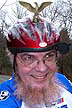

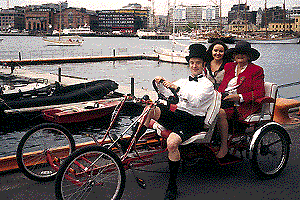
Pedicabbing doesn't make me a better person. By trying to become a better person, however, I am becoming a better pedicab chauffeur. This is the story of a little spiritual journey I've taken over the last year, stimulated in part by my pedicabbing.
I am by hobby a pedicab chauffeur in Oslo. Last year I drove a Chinese cycle rickshaw with 7 gears, while dressed in a tuxedo top and black cycling shorts or tights. This year I bought a Quadracycle (from Indiana, USA), a bright red four-wheeled vehicle that looks a lot like a pedal-powered dune buggy or Model -T, depending on whether the roof canopy is on or not. Though I'm originally from the U.S., I put on a pseudo-British accent when I cycle and go by the nom de velocipede "Charles Armstrong."
When I started pedicabbing, I found it both lucrative and personally rewarding. My friends characterize me as a happy, cheerful person. When I drive a pedicab, that attitude becomes quite infectious. The experience of riding in a pedicab is so exotic and fun that passengers often start laughing the moment we start moving, and sometimes laugh all the way to the destination. Passersby share in the pleasure, smiling with amusement at the sight of a tuxedoed man furiously pedaling a human-powered "car." Even car and bus drivers grin and yell encouraging remarks. Friends who I have taken on pleasure rides comment on how happy everyone in Oslo seems, when seen from the seat of a pedicab.
At the same time, I found that pedicabbing could be very stressful. Dressed in a funny costume, driving a funny vehicle, I am vulnerable, an inviting target for everyone who feels a need to vent some frustration or just get some attention. Since I am mostly out on Friday and Saturday nights, and this is Norway, there is no shortage of drunks who fll that bill. Pedicabbing was full of everything from small annoyances--like people who grab on to the vehicle to stop it while I'm struggling up a hill, or deliberately jump out in front of it--to threatened and, once, actual violence. Nothing terribly serious, but it did not increase my joy in life when a drunk giant shook the whole vehicle while bellowing threats, or I got a hard rap in the head from a member of a gang of kids who had just run away from the fare.
These everyday stresses took their toll on me, and I found quickly that the problems compounded themselves. After particularly unpleasant encounters, I didn't have the reserves of cheerfulness left to play the good-spirited chauffeur that Charles should be. Even very small things--like the sort of people I meet twenty times a night, who yell out "can you take me to Bergen?" or some other place tens or hundreds of kilometers away, and then laugh uproariously at their own wit--got under my skin. I found myself needing to quit for the evening more often from psychical fatigue than physical exhaustion.
As I recognized this pattern, I began to plan ways to conserve my psychical energy, both directly and indirectly. Since body and soul are intimately connected, I made sure to take short breaks for food and drink every hour and a half or so, whether I felt a need for it or not. When stress was high, I'd disappear to some quiet spot I knew, preferably by the water, and spend a few minutes in quite meditation, trying to find my center again. Before long, I was also scheduling "preventive" meditation together with my food and water breaks.
These measures worked, as far as they went. I realized one night this last summer, however, that I needed more than that. I had dropped off some passengers at the bar Barock, and was about to head back to my usual "taxi stand" when a couple women in their early 20s climbed aboard and wanted a ride, for free. It's not unusual for women of that age to try to mooch a free ride while fluttering their eyelashes, but these were more insistent than flirtatious. I told them my minimum was 20 crowns (US$2.70) per person. They objected strenuously, yet they wouldn't get out.

Demand here is high enough that I normally turn down fares rather than go under my minimum, because of the opportunity cost--taking two people for a total of 30 crowns means that I can't take the group of four for 100 crowns that I meet a couple minutes later. These women refused to get out, however, so we compromised on 20 crowns total for a very short ride to the National Theater, maybe 100 meters away.
When we got there, they demanded to be taken to the Lipp, baranother 200 or so meters away and a little uphill, for the same fare. I have no patience for people who first refuse to get out of my vehicle when I tell them we can't make a deal, and then try to take 300 meters and a hill when I give them 100 meters. I told them it would be 20 per person to Lipp or the ride would end where we were. When they accepted neither, I tried a tactic that usually works with undesired passengers--I sped away in the opposite direction to that they wished to go in. After 100 meters of that, they still weren't prepared to get out, and it was starting to get uphill in that direction, also.
After braking as suddenly as I could, I simply ordered them to get out. When they still sat contemptuously, I took away the cigarette from one of them and threw it on the ground under the pedicab, once more telling them to get out. They said that they would get out, but first I had to crouch under the vehicle and retrieve the cigarette. I would have none of that, of course, so finally I took each of them by the arm and, gently but firmly, removed them from the pedicab, as the expletives hailed over me. It could have been a lot worse if they had physically resisted, but I was still shaken by the whole thing. I cycled over to a quiet corner by a fountain and took many minutes to regain my calm. It took a lot longer time to calm down after the confrontation than it would have to drive the women to Lipp.
There's got to be a better way to handle things like this, I thought. I recalled my big, jolly friend Ole Jan, who had pedicabbed with me last fall, when we both were on rented rickshaws. As we were getting ready, a disheveled, unwashed street woman, flying high with the glue she reeked of, tried to force her way into my apartment building after us. Repelled from the door, she sat herself in Ole Jan's pedicab and was still there when we returned. I would have removed her with persuasion or some sort of firmness before pedalling away, but Ole Jan let her sit there as he followed me up to our taxi stand. Halfway there, I looked back and Ole Jan was gone. When he caught up to me later, he explained that he had taken her on a detour to the railway station, announced that they had arrived, and courteously given his hand to help her out of the pedicab. She accepted the help and proudly alighted on the sidewalk, just as if that was where she had intended to go all along. What a way to handle the problem!
What would Ole Jan have done with the two insolent young moochers?
I haven't seen him since this summer to ask him, but I've got a better idea now of what I would do. My friend Knut Einar, who got me started in pedicabbing by renting me his rickshaws last year, told me that he would have taken the women to Lipp and told them that if they don't want to pay the standard fare there, he'd rather they pay nothing at all and just live with the shame of having cheated him.
Knut Einar says that he expects 19 of 20 trips to go well, and someone will attempt to cheat him or something on the twentieth. If and when that happens, then he just shrugs it off as part of the cost of doing business.
I read recently that burn-out in work is a function of expectations. Some people in very trying jobs, like working with addicts and street people, can work for decades without burnout, because they have no illusions about human nature. They don't let themselves be disappointed by setbacks, don't expect everything to go well. Knut Einar is a deacon in the Lutheran church and has spent much of his professional time caring for the poorer aged and other hard-off people in Oslo. Hmm. I was seeing some connections.
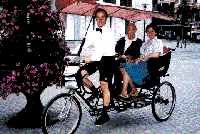 By the time Knut Einar and I talked, I had already begun modifying my _modus operand_i as a pedicab chauffeur. It had been pretty good from the beginning, but needed some fine-tuning. From the start I had had a Robin Hood philosophy, often taking lower fares from students and young people and giving free rides to kids in the neighborhood. I had tried to make myself a part of the street life of Oslo, taking the time to talk to the Kurds selling roses, the bouncers at some bars, and others, and visiting with people who just wanted to talk about the vehicle. I even struck up a light relationship with a single mother and heroin addict who panhandles regularly, giving her a free ride sometimes and keeping up with her progress in trying to overcome her addiction and put her life back together.
I also tried to make Charles quite civil. When some of my passengers rudely shouted or swore at pedestrians to get out of the way, I politely but firmly told them to keep quiet and let me clear the way with a little ringing of the bell and shouts of "Taxi! Coming through, please! Thank you!"
Still, I was also quite concerned about making the time on the street pay. When I quoted a fare to a place, I was thinking about the time as well as the effort. If people wanted to stop to talk to friends or--much worse--to stand in line for a hot dog or automatic teller machine, I soon became impatient. When people wanted to ride for free or almost nothing, I waved them off summarily. I didn't ignore them, as I did the people who shouted from across the street that they wanted to go to Trondheim, but I didn't exactly suffer them gladly, either.
I decided to let go a little, to sacrifice some income per hour for the sake of giving people a more fun ride and myself peace of mind. After all, for almost all my passengers, it is their first time ever in a pedicab. They should have a completely fun experience, not feel that they are in conflict with the chauffeur.
At the same time, I was realizing that pedestrians don't understand how much control I have over my wheels. I've always been pretty careful, and have disappointed some passengers who have wanted me to zoom wildly through the crowds. Still, I saw some pedestrians shrinking back at my passage, when I knew I was leaving plenty of room to clear them, as long as they maintained course and speed. Ross Lowell commented, after visiting here and riding with me in the Quadracycle, that we were missing pedestrians by at least 5 mm. This was an exaggeration, of course, but it could perhaps reflect how the pedestrians themselves felt. So I decided to become more cautious, slower in my movement through crowds. By pushing a little less, I felt I could also make life easier for those around me and myself.
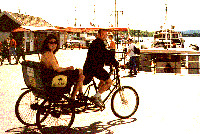 These thoughts, along with some other things that were happening in my life, contributed to the birth of a new, even more mild-mannered Charles: a mellower chauffeur who would push less and prioritize others' wishes more, giving up some control of the situation. I would still make the decisions about traffic safety--e.g. refusing to go the wrong way on one-way streets, and firmly quashing any passenger's encroachment on the steering wheel or brake--but within bounds of reasonableness and safety, I would make an extra effort to make passengers, potential passengers, and pedestrians alike comfortable with the pedicab. Regular breaks for rest, food, and meditation are still an important part of my routine, but how I act in between the rests is now changed.
Once I identified the changes that needed to take place and decided to make them, it was relatively easy actually to carry them out. The first night out after my Big Decision, two teenage guys wanted a ride down to the Bozos bar. On the way there, they shout-flirted with some women they didn't know. We sped past the women, and the guys insisted we stop and back up. Before, I might have refused, or said I'd charge extra. This time, I meekly stopped, turned around, and drove back 50 m to let the flirting continue. It could have gone on for some time, so I invited the women to hop in, a suggestion which everyone liked. When we got to Bozos, I announced that the women rode for free and it was 35 crowns apiece for the guys. (Fortunately, they had not asked the fare before, so they didn't know it was usually a 25 crown trip.) Everyone was extremely pleased.
.
Later that evening, a group of 15-year-olds stopped me as I was cycling back to my main taxi stand. They wanted a short ride, but balked when they learned of the 20 crown minimum per person. Their destination was normally at least a 25 crown fare from where we were, and too far away and uphill for me to want to give them as much Robin Hood discount as they needed. Before, I might have just said "Sorry!" and continued on, leaving them disappointed. But they were going the same direction as I was headed, so I offered to let them ride for a block for free, as long as one of them helped pedal. They had a ball, leaving all of us laughing. Sure, I might have been flagged down by four-five people for a 25-30 crown fare apiece on that block if I'd been empty, but letting the kids ride spread the fun around more. Besides, a cab filled with happy passengers is good advertising.
When pedestrians stop in front of me now to give me a hard time, refusing to move, I just give them a disappointed look and wait, not edging towards them as I sometimes did before. Occasionally I'll make gentle fun of them in comments to my passengers. It doesn't take long for them to get bored and move off, or for their friends to grab them in embarrassment and drag them out of the way.
I'm just trying to strike a better balance between maintaining my own integrity, self-respect, and wishes, and looking out for those of others. Mind you, I'm still firm on many things, even beyond those that directly affect safety. For example, the courtesy and respect I try to show my passengers means that those who show little respect for me or others sometimes don't get what they want at all. It frequently happens that two groups will approach me at nearly the same time, and one will hop aboard and shout out a destination, while the other group talks to me first. The group who talks to me first gets to ride, and I tell those who just grabbed the seats that the cab is already taken. But I also encourage them in a friendly way to catch me again some other time.
In the time since my Big Decision, I have had no serious incidents, and minor incidents have remained minor. I have never had to go home early because of psychological pressure. I understand this to mean that I had been a significant part of the dynamic of the problems before. By changing my behavior, I avoided many of the problems that previously had plagued me.
I'm trying to apply the lessons to other parts of my life, and that is not as easy. Changing the behavior of Charles, a character whose narrowly defined role I play for some hours at a time, several times a month, is easier than changing the behavior of this Carl figure I live with every minute. But I'm starting to catch on and, with a little help from my friends, am finding ways to, as well as the advantages of giving up some more control and accepting life more as it comes.
Because Charles can pedicab longer with less psychological pressure, I may even be making more money since adjusting my behavior. I don't know. The more important thing is the effect on me and those around me. This is not impenetrable armor--the new, mellower Charles is not immune to hassles, and it's not impossible that I'll get shoved next week by some drunk who just hates tuxedos. But the shove is a lot less likely than before, and, if it happens, it will bother me less than it would have before. Every night I leave people feeling better inside than I did before. This makes me feel better, too.
Why put this on a cycling page? If cycling can lead to enlightenment, then that's worth talking about, too. Also, the lessons I've learned apply to some degree to cycling in other circumstances. Someone posted on the HPV mailing list a few months ago that his accidents and close calls were always the other guy's fault. Yet when he started pushing the limits of the safety envelope less--a kinder, gentler cycling style--he found that his mishaps and near-misses practically disappeared. Same principle.
For more about Pedicabs, visit the Pedicab Forum
Carl Etnier wrote this while living in Oslo in the 1990s; he has lived full-time in Vermont since 2001 -- see bio here. This essay originally appeared on the IHPVA e-mail list, now discontinued. The IHPVA now has a Facebook group, though.
Sheldon Brown converted this essay to HTML and added the links.
Back to Fiction and Essays
Articles by Sheldon Brown and Others
- What's New
- Beginners
- Bicycle Glossary
- Brakes
- Commuting
- Cyclecomputers
- Do-It-Yourself
- Essays and Fiction
- Family Cycling
- Fixed-Gear
- Frames
- Gears and Drivetrains
- Humor
- Old Bikes
- Repair Tips
- Singlespeed
- Tandems
- Touring
- Video
- Wheels
- Translations
- Sheldon - the man
Copyright © 1997, 2007 Carl Etnier
Harris Cyclery Home Page
If you would like to make a link or bookmark to this page, the URL is:
https://www.sheldonbrown.com/pedicab.html
Last Updated: by Harriet Fell