What’s helpful is donating to people who you already know are going to win so that they do you favors later on.
I read that as them having mistakenly sent the cryptos to the "opposing candidate"
It's far more accurate to say that pro-Zionist groups spent big in the Illinois primary and got mixed results. Crypto just went along for the ride.
There is a war in the Democratic Party between anti-genocide candidates, who enjoy 90% support in the base, and the establishment who is doing everything to defeat them, up to and including intentionally losing the 2024 presidential election [3].
Nobody cares about crypto.
[1]: https://www.politico.com/news/2026/03/18/aipac-israel-illino...
[2]: https://news.gallup.com/poll/702440/israelis-no-longer-ahead...
[3]: https://www.thenation.com/article/politics/dnc-autopsy-gaza-...
They're concerned about regulation, as always.
Note that this election has no impact over the current congress. Senators and Reps won't be seated until January.
In the Illinois 9th, AIPAC supported candidate seemingly at random in an attempt to split the progressive vote and clear a path for Laura Fine. Didn't work there either.
It may very well be the case that Israel is disfavored by a strong majority of Illinois Democrats (I'd certainly understand why). What your analysis misses is salience: people care about lots of things they don't vote about. Poll primary voters here; you will find a small group of them that think Israel is the most important issue in the district (they will be almost uniformly white PMC voters and they'll be disproportionately online). Mostly you're going to find voters that (a) hate Trump and (b) are concerned about the economy.
It's clearly not the case that "anti-genocide candidates" enjoy a 90% share of the Illinois Democratic primary electorate, because they didn't win.
Campaign spending does have an effect for unknown candidates, but once the voters know who you are and what you stand for, further spending doesn't move the needle.
It's true that the campaign with most money usually wins, but that does not the money caused the win!
One way to think about it is that the most popular candidate naturally gets the most donations, just like they get the most votes. It can also be a good investment to be on good terms with the future winner.
Having a Fox Mulder moment, because I too, want to believe. However, it makes me think, if it didn't work to some degree, whatever that may be, it wouldn't be common.
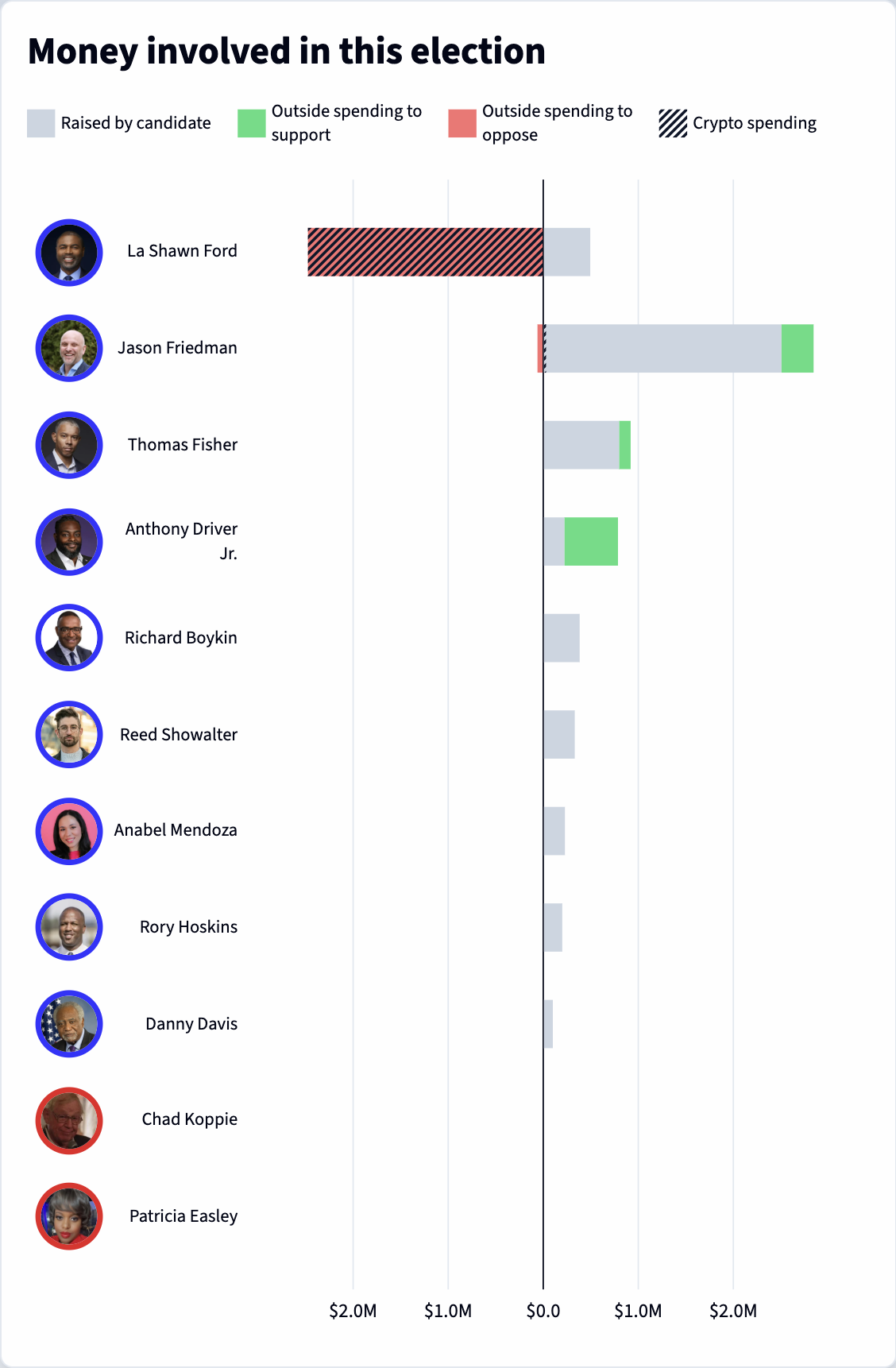
The cryptocurrency industry super PACs dumped $14.2 million into the Illinois primaries. 90% of that – $12.8 million – was wasted, in that it went to opposing Democratic candidates who won their primaries (Stratton in the Senate race, Ford in H-07) or supporting their opponents.
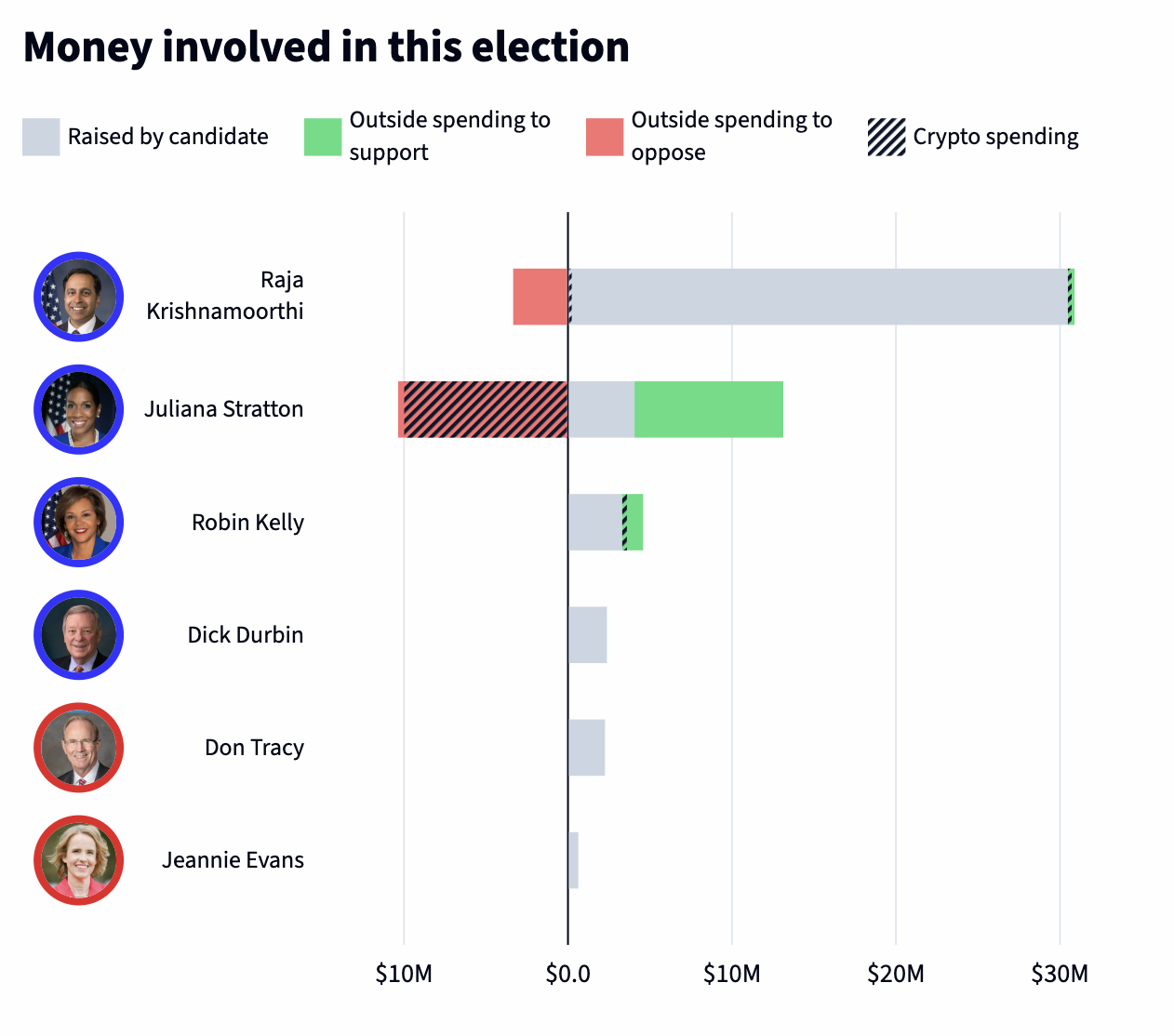
The Fairshake pro-crypto super PAC network spent $10 million to oppose Senate candidate Juliana Stratton and $2.5 million to oppose H-07 candidate La Shawn Ford, both of whom won their primaries
The PACs' only victories in the state were where they contributed money towards outcomes that were already highly likely. They opposed Robert Peters (H-02), who had been polling in third place and ultimately received 12% of the vote. They supported Bean (who was leading the polls in H-08) and incumbent Budzinski (H-13).
Sadly this early spending in Illinois used up less than 6% of what the super PACs have on hand, so buckle up for a looong eight months.