Not if. When. You never 'win' in the UK, not in the long term
That figure is highly misleading. Yes, 48% of new vehicle sales in Thailand are now EVs, but their share of total vehicles on the road is much smaller: I can't find recent figures, but it'll be far less than 10%. (Share of new sales was under 20% until late last year.)
The Philippines is even further behind, with share of new sales under 10%.
Of course total fleet composition will eventually converge on new sales, but given that the lifespans of cars are measured in decades, it takes longer than you'd think.
BYD was already selling a ton of cars when the oil prices were "low", of course there's some very creative accounting business moves you would expect from a Chinese company like BYD ( companies from other places have their own peculiarities too ).
Gas prices have been "sky high" for a week and people who are under financial stress just decided to ditch their cars and buy a brand new BYD? Are we children now? listening bedtime stories?
The concept of electric vehicle is technically superior to support the context and lifestyle a large majority of people have. It will "win" over time. There is no need to this bullshit simplistic feel-good articles.
Btw, the the market movements of people trying to get rid of their gas-guzzling SUVs when prices are high and trade them for a smaller and more economical car ( what they should have been doing in the first place.. ) already happened in the past many times, there is no news here. But these movements don't happen in a time span of a week or a couple weeks.
Sorry for the rant, but between AI's "Absolutely, you're entirely right!" and these bullshit articles.. I don't know.
To be clear: EV's will "win" and BYD has been selling a ton of cars because they are cheap and not terrible right out of the gate, also people don't have much disposable income.
Even if they tripled their sales for the last two weeks, it wouldn't be relavent to if their bet will ultimately pay off.
https://www.byd.com/us/news-list/DENZA-Z9GT-to-start-Europes...
I know EV purists will complain about the complexity of maintaining the gas engine, but this hits the perfect sweet spot for me - it doesn't weigh a million tons, it cost under 40k new, and the one weekend a month when I need to I can drive 300 miles each way on a single tank of gas.
One country is disincentivizing or even blocking renewable energy production, rolling back climate protection measures, trying to revitalize the coal industry, slashing investment in scientific research of all kinds, demonizing higher education, and spending vast and rapidly increasing amounts of public funds to create direct, physical conflicts.
Another country is increasing their renewable energy generation capabilities dramatically each year, encouraging EV adoption, investing very heavily in scientific research, and also investing in military (although without initiating direct physical conflicts).
One of these two countries is riding on momentum, but the drag from waste and mismanagement of resources is increasingly slowing it. The other country is building momentum while reducing drag.
The difference in these approaches will be obvious in a decade, and in two decades one of the two countries will be just another chapter in a book about the rise and fall of empires.
In reality, most working class Filipinos travel via public transit or ICE scooter.
I know they write this stuff to generate clicks but at least pretend to try.
What we really need are incentives for companies to build more affordable EVs. California could play a role here, but given the strong opinions we have about Elon Musk, nothing will be done.
When we bought are last car, I would've bought one of those if there had been a Toyota or Honda minivan. We ended up going for a regular hybrid instead. Hopefully this category gets adopted by more car makers
Ember Energy: ASEAN emerges as a new leader in global EV adoption - https://ember-energy.org/latest-updates/asean-emerges-as-a-n... - December 16th, 2025
You can see how this looks over a longer term using Norway's data as they transitioned to ~100% EV sales: https://robbieandrew.github.io/EV/
Have you actually seen the news and the situation? Gas prices will continue to rise and will stay high for at least 3-5 years, given the damaged infrastructure and how long it will take to rebuild. And that's if nothing else happens, so the situation could get a lot worse
This means 2 things: 1) it might be a better alternative to drive electric (depends on the numbers), and 2) if enough people start preferring EVs, prices for EVs might spike in the next 1-2 years. So buying now could be a good move depending on how things turn out
The battery of a PHEV is relatively small and will be strained much more (as compared to an EV), especially if you drive a lot in EV modus. PHEV batteries tend to wear out faster for this reason. This drives up cost of ownership.
Then you still have the maintenance / cost of the ICE drivetrain. It does not make sense to me.
I feel that a lot of people buy vehicles because of the long-distance trips they make a few times a year. Long-distance trips are not a big deal anymore with the current status of the fast-charging stations.
Yes you may still do 600 miles on a single tank of gas with a ICE or PHEV, but you have to stop and rest, use the bathroom, drink something. Everytime you stop is a charging opportunity.
Anno 2026 there is so much choice for 'pure' EVs for the budget you stated, especially second-hand.
And then you may be able to charge at home, with solar, it's a no-brainer to me. This is possible with an PHEV too, but well, we discussed that here.
Would be incredible for US auto consumers.
But might put some of our automakers out of business.
https://driveauthority.com/cheapest-ev-car-in-china/
All you really need is a political snap of the fingers to remove tariffs, so they can start selling them in the US.
Of course, there is absolutely no way this will happen with the current administration.
Now that I'm comfy with "oh, install yet-another charging phone app" (a handful offer a website too) and the prevalence and backwards-compatibility of modern DC chargers and learning how to check which standards are supported by where, I'd be comfy with a full-EV, but I could understand being intimidated by that without the practice of driving a PHEV.
But to be blunt: It's a hump you'd get over, as long as you had access to an overnight charger of any kind (even just 110V mains) at home.
The port war is basically over here in North America - CHADEMO and CCS2 aren't a thing here and any charge station that offers those is just an old station that was hedging their bets. The only real standards you'll see are
- J1772 (the old AC power system),
- CCS1 (DC upgrade to J1772, backwards-compatible with J1772 chargers, looks like a J1772 with extra bits on the bottom)
- NACS (the Tesla port).
And unless you've got an old J1772 AC-powered car (like my Prius Prime), you can get adapters. So basically if you get a CCS1 car you need 1 adapter, and if you get a NACS car you need 2 (both CCS1 and J1772) if you want to be able to charge literally anywhere. The only wrinkle then is how fast you need to charge, and AFAIK NACS standard has more options for crazy-fast charging.
Tradeoffs everywhere, so "perfect" is very much not the word I'd apply.
I wouldn't bother with a PHEV for a vehicle I buy as I'm always going to buy EVs from now on, but for rentals a PHEV makes a lot of sense.
(And the larger gas vehicle can still be a non-plug-in hybrid.)
I will first point out that for DC fast charging, there are only two connectors to think about. It is not really more complicated than that. It's a learning curve, but not much different than learning the difference between gasoline, diesel, and which octane to put in your car.
You would have your charging station at your house. That removes a whole lot of the burden.
Then, there’s just the sheer size of the expansion and reliability in charging networks over the past year or two. Where I live, there is no direction where I can travel on an interstate where there aren't chargers on premier networks at normal rest stops/truck stops (rather than in odd parking lots behind Walmarts or what have you).
You've also got newer non-Tesla EVs that have NACS compatibility or NACS built-in, doubling the size of the charging network for those vehicles.
You wouldn't have the problem of lacking the right adapter if you owned the car.
With long trips, we are talking about multiple hours of driving before needing to charge, so I think we need to rethink the amount of burden it really is to plan your route ahead of time. It’s gotta be less of a burden than getting multiple oil changes per year or visiting a gas station every week or two to cover your daily commuting.
I think the only people for whom EVs don’t work are people who take long road trips with a frequency that far exceeds the national average (e.g like a monthly 600+ mile trip).
Of headlines? Always. Of the content of the article? Not without you providing counterevidence.
Speaking of the content:
* BYD has seen an uptick in demand for EVs
* "At one [BYD] dealership in Manila, the capital of the Philippines, demand is so high that it booked a month’s worth of orders in just the past two weeks"
* another dealership nearby had to hire more salespeople
* small uptick from Edmunds for people researching EVs in relevant period[1]
1: https://www.edmunds.com/car-news/electrified-vehicle-researc...
The situation is something that makes people pause for a second.
Like everyone knows that EVs are the future, but when gas is fine, status quo fine, that future can be a fuzzy thing in the distance and it's really easy to shut off your brain, live in the present, and not really do any thinking and just go through the motions.
A sudden oil shock puts the issue of EVs on the front burner and gives people reason to think about things for a moment.
electrek.co is a renewables (biased) blog.
I think you're missing something. This war is an inflection point. Consumer behavior is likely to change after it.
So yes, this is just a transient thing...but I think the effects will be permanent.
With appropriate battery management, this doesn't really drive up the cost, it just moves the depreciation curve around.
Think of it from the other side - with an EV, you're paying up front for a bunch of battery value in a consumable good that you'll never depreciate.
> ...
> The difference in these approaches will be obvious in a decade, and in two decades one of the two countries will be just another chapter in a book about the rise and fall of empires.
The interesting question is: why. I'd say the US ultimately will be judged to be another victim of the "shock doctrine" (in its case, the China Shock). In other words (at least in a democracy): letting the economists and libertarians run wild with the economy will create a backlash that will ultimately weaken it.
The supposedly smart people in charge needed to pay less attention to their pet theories, and way more attention to the common people. They didn't, and this is the result.
Mind you I am living in a Tier 4 “city”.
https://ourworldindata.org/data-insights/one-third-of-cars-o...
And Norway is a "best case" as a wealthy country where people turn over their cars pretty quickly. The Philippines is at the opposite end of the spectrum.
Plug-in hybrids use three times more fuel than manufacturers claim, analysis finds - https://www.theguardian.com/environment/2026/feb/18/plug-in-... - February 18th, 2026
Smoke screen: the growing PHEV emissions scandal - https://www.transportenvironment.org/articles/smoke-screen-t... - October 16th, 2025
Drones with 100-150kg just not capable of inflicting hard to recover damage. What they are good is striking repeatedly. But judging by numbers Iran is not capable any longer of sustained stacks with hundreds of drones per day.
Gas could be free, and I'd still have no regrets. Because an EV is simply the better vehicle. And I think after over a decade of mass-produced EVs that maybe it's time to get away from "saves on gas" or "good for the environment", and maybe start marketing as "full every time you pull out of the garage", or something. Kind of like Mazda's old commercials for their Wankel engine cars: "piston engine goes 'boing', but the Mazda goes 'hmmmmm'".
Have you seen what's happened to wholesale power market prices? Have you seen that BYD's care sales in 2026 are down y/y?
Trusting anecdotal hype from BYD salesmen and a renewables blog isn't sensible.
While I agree with your overall point, I'm reminded of "the market can stay irrational longer than you can stay solvent" here. The US is a huge economy with a massive military infrastructure. I don't think it's fading to fallen empire status that quickly.
Metros and light-rail systems tend to use electricity. Manila has both.
> ICE scooter
You know EVs are allowed to be scooters too, right?
It'll never go below $100 a barrel.
It went bellow $100 a barrel for the last few years because as US shale processing came online, opec decided to also keep production high which cut oil prices from $100/barrel to ~$50/barrel where it's roughly stayed for the last decade.
There's not another "new way to extract oil for cheap" technique on the horizon. Israel and Iran are both destroying oil extraction and processing facilities in the gulf region, it'll take years and a huge amount of money just to rebuild those. By the time that's finished, assuming it finishes, inflation will have firmly caused the price of oil to stay above $100.
This is basically a permanent increase. We are sort of at global warming catastrophes now. It's not a question of if it will be bad, it's a question of how long and how intense. The longer this war/military operation/regime change/whatever we are doing goes forward, the worse it will be. And, unfortunately, I don't think there's any specific goal the trump admin is trying to achieve. This is such an obvious F-up and Trump will only pull out if he can somehow make a claim that it isn't.
But BYD is pushing forward, and though there's some infrastructure to build it'll get there eventually.
The west coast is the only part that relies on middle eastern oil. And a spike in prices will just get them in line and connected to the rest of the shale powered system.
I don’t like any of this, but I think the doom and gloom lies elsewhere.
For example, what about:
- no sales taxes on new EV sales
- free registration for 5 years
- free bridge tolls for 5 years
That might convince some of these companies to start making EVs again.
The parking spot may or may not be an issue. If you can charge an EV at home, you likely have a garage or driveway. If not, then sure this doesn't apply.
The bonus: with 2 vehicles you can use exactly as much car as needed for each trip.
The EV can be a smallish hatchback or sedan with low-to-medium range. You aren't going too far and won't carry much stuff. It's enough for 90% of your miles driven.
The ICE can be a minivan or SUV, since you'll likely need more space for road trips. You aren't pointlessly driving that hulking PHEV SUV on milk runs.
It all depends on what you want the car for and how you use it. It will also depend on the very specific car and manufacturer. In my case, even though I love the concept of PHEV, I'd still wouldn't buy a Chrysler, so, to your point, I prefer to get a different brand that is not a PHEV, than get that specific make

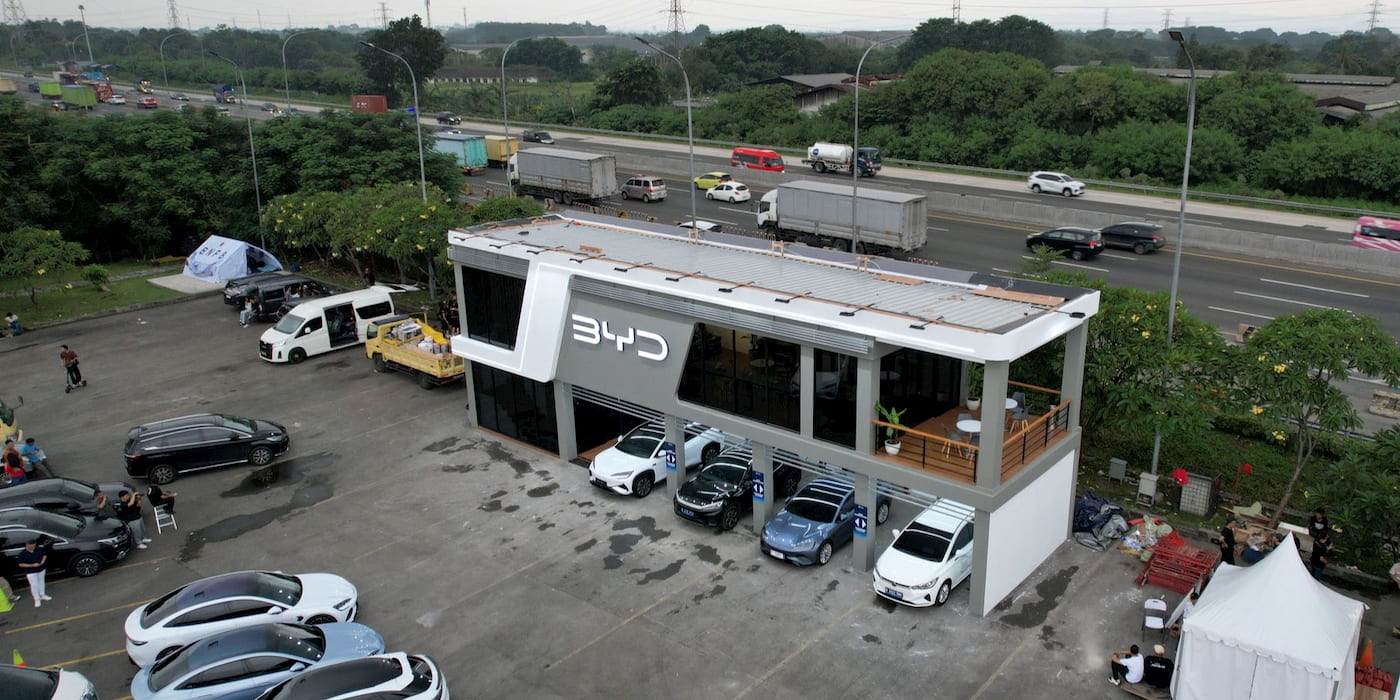
BYD is already seeing a flood of new EV buyers as gas and oil prices surge amid rising tensions in the Middle East.
Since it stopped building vehicles powered solely by internal combustion engines (ICEs) in 2022, BYD has become the world’s largest EV maker.
The Chinese automaker ranked sixth in global sales in 2025, surpassing Ford for the first time, with over 4.6 million electric and plug-in hybrid vehicles sold.
While sales growth has slowed over the past few months amid new competition and shifting policies, BYD is seeing an uptick in EV demand as buyers seek alternatives amid rising oil and gas prices.
At one dealership in Manila, the capital of the Philippines, demand is so high that it booked a month’s worth of orders in just the past two weeks. “Clients are replacing units in favor of EVs because of the oil price hikes,” Dominique Poh, a salesman at the dealership, told Bloomberg. And it’s not just BYD that’s seeing more traffic in its showrooms.
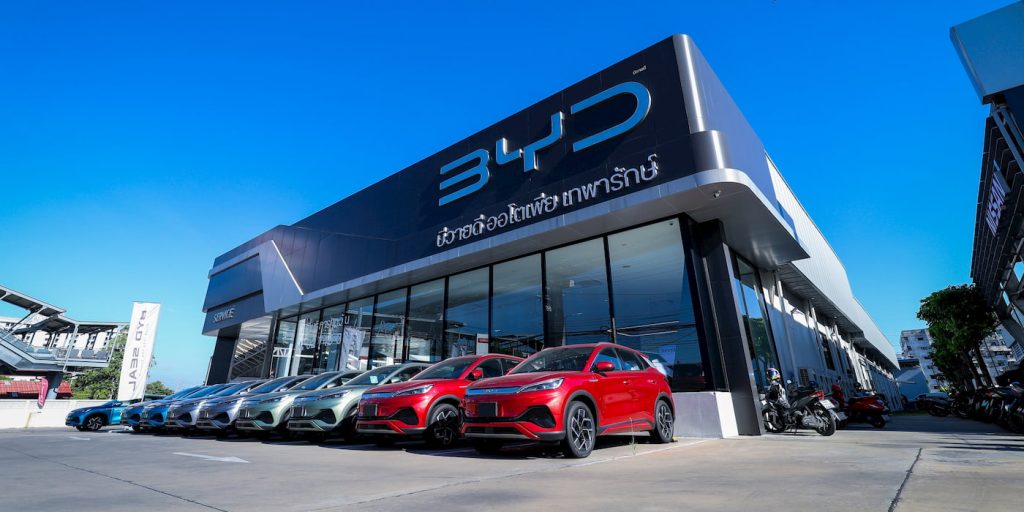
BYD dealership in Thailand (Source: BYD)
A VinFast dealership about 1,100 miles away had to hire a few more sales workers after showroom visits quadrupled since the start of the war.
Switching to EV will help us significantly save money,” Lai The Manh Linh, who traded in his gas-powered Toyota Vios for a new VinFast 5 as his new daily driver.
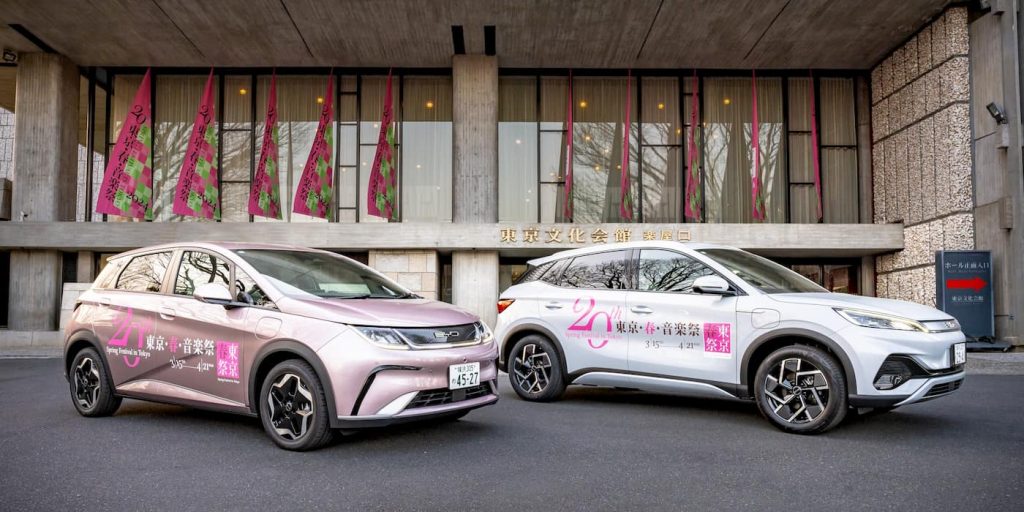
BYD Dolphin (left) and Atto 3 (right) at the 2024 Tokyo Spring Festival (Source BYD Japan)
A recent analysis from UK-based Ember found that the global EV adoption helped avoid 1.7 million barrels per day of oil consumption last year, or about 70% of the roughly 2.4 million barrels Iran exports through the Strait of Hormuz.
While Asia, particularly Southeast Asian countries like Thailand and the Philippines, has higher EV adoption rates than those of the US and Europe, at around 40%, they are still hit hard by rising oil prices.

BYD’s first EV manufacturing plant in Thailand (Source: BYD)
About 40% of oil imported to Asia passes through the Strait of Hormuz. As a result, some countries, like Laos, are slashing EV registration and service fees, while raising them on comparable gas-powered cars.
Surapong Paisitpatnapong, spokesman for the Federation of Thai Industries’ automobile industry group, said that “We were previously less upbeat about EV demand in 2026, as the government’s lower subsidy made EV prices less attractive compared with conventional fuel-powered vehicles.”
“If oil prices stay at current levels or rise further, we expect a significant increase in EV demand,” he added. And Thailand isn’t the only country.

BYD “Xi’an” car carrier loading Dolphin Surf EVs for Europe (Source: BYD)
China is set to see the largest demand uptick as it produces more EVs than any other country, but other major markets, like the US and Europe, are also seeing buyers shift toward electric alternatives.
Shopping data from Edmunds showed that in the first week of March, consideration for electrified vehicles rose by more than 20% from the prior week. Most of the interest was in battery electric vehicles, and that was just the first week of March. Interest is likely much higher currently, with national gas prices closing in on $4.00 a gallon in the US.
In China, BYD aims to deliver the final blow to the gas and oil industry by offering free EV charging for 18 months on select EVs.
Learn more about how EVs are the best bet for energy independence: A reminder as oil prices spike: EVs are the #1 route to energy independence

FTC: We use income earning auto affiliate links. More.
But the day of the PHEV has come and gone. The massive price gap between PHEV and BEV is now negligible, and the charging experience is so much better now.
Without time travel or CCCP circa 1955 property controls, a 100% EV ownership benchmark is unreasonable.
> Globally, over 1-in-5 (22%) of new cars sold were electric in 2024. This share was 92% in Norway, and in China, it was almost 50%.
In 2025, it was 1-in-4 (25%). What will expensive oil do? It will pull these trajectories more vertical.
Global oil price stuck in triple digits. Goldman Sachs says it may stay there for years - https://www.cnn.com/2026/03/20/energy/oil-gas-prices-intl-hn... - March 20th, 2026
Our World In Data: Tracking global data on electric vehicles - https://ourworldindata.org/electric-car-sales
Ember Energy: China Cleantech Exports Data Explorer - https://ember-energy.org/data/china-cleantech-exports-data-e...
The World Hit ‘Peak’ Gas-Powered Vehicle Sales — in 2017 - https://www.bloomberg.com/news/articles/2024-01-30/world-hit... | https://archive.today/p2hl1 - January 30th, 2024
Electric Cars Pass a Crucial Tipping Point in 23 Countries - https://www.bloomberg.com/news/articles/2023-08-28/electric-... | https://archive.today/e8XSt - August 27th, 2023
Because otherwise we just get things like the Hummer EV which is literally over 9000 lbs.
Well it depends on your specific configuration/workflow.
I just get oil changes when I have my vehicle in for seasonal tires changes anyway - I drop it off in the morning on my way to my office and pick it up after work. The experience would be identical with an EV.
They’re always the cheapest option and they’re often nicer than the cheapest gas ICE options. I’d rather be in a Genesis G80 Electrified than a Camry.
I just got a $100 charger for my relatives garage, which almost immediately paid for itself.
(Though I’ll admit, I’m lucky that they installed a 220v outlet decades ago for appliances in their garage).
I guess there's a lot up in the air right now, so I personally wouldn't bet on things getting better that quickly
Yeah, because famously neither Rome nor Spain nor England had massive military infrastructures for their times.
I’m saying this as a non European. I’m an American who is making plans to split my time between the US and Costa Rica (here now) and maybe Panama and would love to see them become close to Europe politically.
'Two ways. Gradually, then suddenly.'
But in the article:
> Porsche hybrids consumed more fuel – around seven litres per 100km – than other PHEVs when the electric motor kicks in, and significantly more than non-PHEVs in combustion engine mode. The lowest fuel consumption levels were found in the cheaper end of the PHEV market, in Kia, Toyota, Ford and Renault vehicles, which often used under one litre per 100km, or as much as 85% less fuel than the Porsche.
So it seems like they are putting all cars in the same bucket based on the worst performing one: Porsche. Pretty misleading
Also, even if the claim applied to all cars, for a Chrysler Pacifica PHEV for example, instead of 82 MPGe (32 mi electric-only range), you'd get ~39.2 mpg (using 6 L/100 km, the figure from the article), which is still better than a Toyota Sienna hybrid at 36 mpg, and way better than a Honda Odyssey at 22 mpg (gas only)
It truly is a great strategy if you want to make a quick buck now before you become irrelevant in five years.
That range is a significant caveat. If your round trip commute (or one way commute, if you can charge at work) is outside the electric range, then you'll be relying on gas every day. In my situation it's worked out extremely well. I charge at home and only need to fill the gas tank about three or four times a year.
I wonder if they are just being miss-sold. They clearly make no sense if you don’t have somewhere to plug them in.
On the other hand it is clearly working for the GP.
Not so much in the US, where our braindead political culture is intent on ignoring the obvious economic advantage of renewables, but definitely everywhere else in the world.
I don't want a door handle that can't open in an emergency. I don't want my vehicle constantly phoning home to the mothership (sadly I have to deal with that today, I really need to go disable that functionality). I certainly don't want a touchscreen through which all controls are routed.
I have a 20-year-old Jeep with significant mechanical problems; I should really convert it to a BEV.
Feel free to expand on the wholesale power market prices you are referring to though, not sure what your take is
You are rebutting a completely different statement which was not said, and arguing in bad faith.
The biggest hindrance to EV adoption are EV people and their religious fervor to win at all costs.
In practice I bet 5-minute charging will mainly be used to show off for your golf buddies. Co-locate it with the megawatt-scale chargers we'll be building for trucks next to major highways anyways, and it can be offered as a very profitable luxury product without too much extra effort.
> Israel and Iran are both destroying oil extraction and processing facilities in the gulf region
This isn't like Katrina where oil infrastructure was being temporarily evacuated, shut down, and taking some water and wind damage.
The oil infrastructure is being blown to smithereens. And not just pumps that are sucking oil out of a hole in the ground. Refineries. Big expensive factories that process oil. Stuff we don't even bother to build in progressive parts of the world because the combination of environmental regulations and concerns about climate change mean it's possible they'll never pay off their massive construction costs.
…Porsche hybrids consumed more fuel – around seven litres per 100km – than other PHEVs when the electric motor kicks in, and significantly more than non-PHEVs in combustion engine mode. The lowest fuel consumption levels were found in the cheaper end of the PHEV market, in Kia, Toyota, Ford and Renault vehicles, which often used under one litre per 100km, or as much as 85% less fuel than the Porsche.
If I am buying a PHEV, I am not getting a Porsche or BMW.With an EV, it's 0, unless you are doing a long road trip.
This will all get easier as the chargers become more prevalent.
Californian here. There is no discussion or any desire to build an oil pipeline from TX/LA across NM and AZ to deliver oil to refineries here. Ha, if you think the Keystone XL pipeline was controversial... it'll never happen.
Calif produces about 20% from its own but tired wells. Some oil is imported from the Middle East but larger volumes come by ship from South America and Alaska.
However, the more radical wing of Democrats still have some anti-globalism in them (eg Bernie). But still, imho: Unusual outcomes are on the table for Democratic party leadership at this point.
Only in the USA. In the rest of the world, taxes and parking fees are also significant. Americans are really spoiled when it comes to low car ownership costs.
Depends how much you drive. If you don't drive much to start, and then having two vehicles cuts that in half, your effectively-fixed costs go up - e.g. you start having to replace your tires because the rubber is getting too old long before the tread wears out, insurance doesn't scale down linearly for low-mileage drivers, etc.
Anything Trump supported will continue to be seen as hot garbage after he is removed from office. There is no appetite for protectionism when it has hurt rather than benefitted the American economy.
Fuel is very much use dependent. I drive very little so having one large nicer (3 years old off a lease return) made the most sense to me when I had to watch the bottom line. Both financially and quality of life.
I filled up the tank on that thing once every 2-3mo at most. Tires cost more due to simply aging out and the rubber compounds not being as spry as they once were. Other than that it was an oil change once a year. It was a Honda so I think the only repair work I did was a $20 relay that failed I was able to self diagnose, over the 13 years I owned it.
Yeah that’s the extreme end - but there is a lot of middle ground before you get into it being cheaper to have a second vehicle. I do now, but that’s due to owning a ridiculous dream weekend car. Maintaining two cars, insuring them, dealing with less space in the garage for other stuff, etc. really is a giant expensive hassle even if both were cheap(ish) used vehicles.
The math switches once you get to “beater” level cars - but I am far removed from the time of my life where I want to deal with actual car repairs due to things breaking unexpectedly. The used car market also isn’t like it was when I was 22 and broke either. Deals are much harder to come by. I value my time and mental energy far more these days as well.
Different strokes for different folks!
If I went back to a single car I’d likely be looking at a PHEV Lexus or similar class vehicle for a bit of luxury plus reliability. I still rarely drive though so it’s a silly expense either way.
I think Toyota might be the only company with a good PHEV drive-train. A Prius or Rav4 PHEV can do highway speeds on battery. And they have a heat pump so the gas engine doesn't kick in unless it gets very cold.
Another factor is home charging availability. The Canadian government gives a rebate for PHEV vehicles, but they took away the subsidy to install L2 chargers. It's very attractive right now to buy a PHEV and never charge it just to get the purchase rebate.
The west coast is adopting EVs at a faster pace than the rest of the country. You could just as well see accelerated adoption of EVs in personal and freight transportation, Chinese manufacturers opening up US EV production, and so on.
The answer isn't necessarily drawing shale from Alberta that we can't really process anyways (without mixing it with light crude from Texas anyways).
yes
> has the potential to be good for parts of the us energy sector.
No way this is good for anyone other than oil producers. The only potential positive it'll have on the US energy and shipping sectors is this is going to put even more pressure on adopting renewables as fossil fuel cost spikes.
I think storage is great and solar has a place, but this is not true unless you discard reliability and other features, which should be in the price. Solar plus storage for baseload power matching requires huge overbuilds. Even in the last few years, before the AI hype, installed utility scale renewables costs went up in the US. It's not just the hardware or national politics.
And if you can't get renewables interconnected in a couple years, then the install rate won't lower the carbon of the existing grid mix charging your car.
You quoted the parent's mention of BYD.
But one thing 5 minute charging would improve is throughput. We're in the middle of a house remodel, and no room in the garage at the moment for the car to get near the charger. So we've been charging at public chargers a lot, and in the three or four times I've hit a public charger recently, I've had to wait on another car to unplug about half the time. Granted, this is the Seattle area where you can't swing a golf club without hitting an EV, but I've had the same problem on road trips, too.
Ignoring pollution and externalities for the sake of argument this is what is very interesting to me. It’s not clear that the capital markets if left to their own devices would even invest in rebuilding these to begin with due to concerns about being paid back.
The oil industry has went from growth based investments to capturing returns on current deployed infrastructure over the past decade or so. Only very limited and calculated capital is being deployed in this sector these days.
It will certainly be interesting to watch. I’m certain those countries will rebuild via government funds, but I’m wondering how profitable that will end up actually being given how expensive that’s become to build, the insane construct lead times these days, and the overall trend in oil demand. Natural gas is even more interesting since it’s firmly directly linked to renewable energy deployment. Gas usage goes up as we deploy more solar worldwide, at least in the short term.
You're going to be really disappointed when you go to look at new ICE vehicles. This "EVs are a privacy nightmare!" trope needs to die, all cars do that now.
I don't want a door handle that can't open in an emergency.
Only one car manufacturer to my knowledge has that problem, just don't buy one of those. Again, nothing to do with electric cars.
I certainly don't want a touchscreen through which all controls are routed.
So far, other than the poorly-designed door handles of one manufacturer, nothing you've listed is unique to EVs. All you've done is describe "most new cars".
I've lost track a bit, but Ford has a pretty comparable drivetrain (e.g. in the Escape PHEV), and Toyota is sharing their drivetrain with Mazda (e.g. the CX-50 has same drivetrain as RAV4) and Subaru has Toyota-derived drivetrains in the new Crosstrek/Forester hybrids. (Mazda/Subaru don't currently have PHEVs available for their Toyota-sourced hybrids, but that could presumably easily change.)
Availability of various models is wonky now due to US tariffs.
Raise taxes on gas? Put extra taxes on sell ICE vehicles? Increase registration fees for ICE vehicles? (In short - ICE sales will paying for money lost via EV sales)
I’m not saying it will be easy. I’m saying that if we really want EVs to succeed we can do it.
It’s amazing how much grift and subsidy leveraging the US renewables market has engaged in compared to pragmatic deployments elsewhere like China. Utterly insane and it shows how difficult it’s going to be to fix since it’s an endemic problem with American society at its core.
It’s going to be a multi-polar world. The US will continue to be among the top powers for decades to come. We’re simply exiting an unusual period where China isn’t leading/among the leading pack of countries.
The rate of US relative decline will be set by our policy decisions and cohesion. As we are apparently electing malicious narcissists with dementia to our highest office, a more precipitous decline seems reasonable
But, by definition, most EVs are modern. That's not true of ICE vehicles, hence the tradeoffs.
It’s the silly regulatory games played by manufacturers and regulators that cause stuff like a hybrid cayenne or 6000lb BMW M5 Touring to exist when neither the buyers or manufacturers want them to exist to begin with.
These things are not remotely in the same actual category even though on paper they might be. They exist for entirely different reasons, one is market based and one is regulatory workarounds and gamesmanship.
It’s not the knowledge and tech, but manufacturing-of and at-scale-use of renewables that matters here.
We can’t just-in-time install infrastructure a across the entire country in a matter of weeks or months.
