Sorry Microsoft, some people already transfer to a different train because you offered a crazy ride.
Personal computing is a rare niche these days thanks to the majority who have chosen to give over the personal aspect to the privacy hostile duopoly of MS and Apple (while celebrating doing so) who hold the leash.
I am doing my part - I managed to get 6 people in my family and friend group off Windows onto Debian last year.
All positive feedback so far :).
Sure it's only a small victory - but a meaningful one to me.
How about, turn it off by default?
Only a public statement of "deepest possible rethink in attitude" from Satya Nadella would mean a different future for Windows.
Whatever this is - which is mostly weasel words - will fizzle and fade.
They may say they're backing off now, but it's hard to trust them. Will they just do the same thing with whatever the next tech trend is?
Microsoft Copilot 365 Operating System App is just trash, plain and simple.
I gave up a long time ago hoping Windows would get better. At this point, I just hope it does not get worse.
I don't think Microsoft can pull this off, I think as mindshare is shifting it will continue to do so and its going to take Microsoft a long time to row back and right now its only talking about doing some minor things. Now Nvidia is developing the drivers on Linux seriously there is every chance this transition snowballs and nothing Microsoft does will be enough.
> Enhancing Search: [...] Clearer and more trustworthy results, with results from content on your device easy to understand and clearly distinct from web results
So yeah, you still get web results in your search bar, a feature absolutely zero people want and which is just there to fake Bing success, just with a little divider now next to the applications the search failed to find.
My next laptop will be a MacBook Pro.
My Surface Laptop 5 will be collecting dust in case I need it, but that’s highly unlikely.
Fixing long-standing complaints, removing Copilot from obnoxious places, improvements to Windows Update and Windows Explorer stability/microstutter/lag, etc.
I congratulate them on seeing sense, and I congratulate Apple on another victory with the Neo. Kind of frustrating that's what it took for Microsoft to finally listen to their userbase.
That said, this business model has historically proven effective for companies such as IBM. Microsoft allocates its resources toward segments that offer meaningful revenue growth.
No automatic restarts! I understand that in our security patching world that patching and restarting automatically is the default, fine, but there absolutely should be a dead simple way of disabling auto restarts in settings. I'm fine if it pesters me to restart or whatever, perhaps with growing alarm the longer I wait, but it should always be optional in the end. There are just no words for how bad it can be for mission critical workloads when your computer restarts without your consent. Please make disabling this simple.
> all while reducing update noise with fewer automatic restarts and notifications.
Pause for longer.. why not just stop. And resume when wanted.
Fewer automatic restart. What about no automatic restart.
I couldn't read any further. Mind bended leadership to think this sort of wording after the obvious fiasco would make users hopeful.
I stopped using windows personally 15 years ago. My mental health improved right away. Forced to use Windows at work, I finally got liberated 4 years ago and my mental health got even better. I refuse since then employment forcing me to use this OS. It's a health hazard, always has been.
MMC snapins haven't been touched in years and still can't even sort those columns properly, search and filtering is terrible
Control panel is still not migrated over to settings after 12 years nor you can open two settings apps.
Error messages in modern apps are just the worst, how about printing valuable error messages than "something is wrong"?
Fixing dark patterns like taking over your screen with popups and taking over the application header so you can't close windows unless you go to the task manager. First time opening edge shows a really annoying splash screen + home page is filled with ads.
Also where are 5 second boot times on NVMe SSDs? Anything more is just sloppy.
Just to list a few pet peeves
But let's see if they can even fix things they've mentioned in the post, though that's like 1/4 of the issues that should be fixed.
I think this is good, because they're talking about removing (hideously inappropriate) react and other web technologies from core OS components, and using proper native OS calls instead. But I'm not familiar with WinUI3. I only know Win32. Is WinUI3 a flash-in-the-pan system like their other UI attempts, or is it decent and stable?
I wonder if this will include being able to put it on the non-primary display once again. It's not mentioned, but that was one of the biggest frustrations with Windows 11. It seems their focus is exclusively on single display devices.
It also ruined my flow for my flight sim until I found a workaround. The fullscreen window wishes to launch to the primary display, which means losing the useful bits of the taskbar.
I love what they're saying, but my faith in them is very, very is low.
Great!
Switched to Linux on my personal devices 2 years ago and using Ubuntu and PopOS! on two different laptops. I've had very small number of issues. Can't understand people moving to Mac - it is the same messed half backed OS as both Windows and Linux (flavors). With the llms these days, any linux issue is fixable within minutes.
With Linux at least I don't have to worry about privacy.
Just this past January I implemented something on my workstation I should've done a long time ago: outbound filtering all network traffic via so-called 'Windows Defender Firewall with Advanced Security'. I've also skipped more Insider builds in the past two months than I have in the past 11 years.
The only thing keeping me around at this point is the migration overhead and (at least I tell myself) window 'snapping'.
- MS doing what they say here. (Uphill battle given the perverse incentives others have mentioned) My gut says Windows is going to be *worse* vs better, and I am willing to settle for stagnating...
- Linux desktop makers taking UX, ABI/linking compatibility, and "just works" seriously.
It's like you could take the good from both and discard the bad, but it hasn't happened yet.They won't actually move back to a user-focused OS at all. It's nice for them to declare they will, but their culture and business pressures will prevent any kind of sustained effort. (Their users aren't their customers.)
And it really comes down to $MSFT. If the stock keeps dropping, how long do you think any real commitment to “quality” for a boring, low(no?) revenue product will last? Very little when the ad/partner revenue really starts flowing for “ai focused metrics” that can directly tie to windows surveillance (ie recall).
Gen AI has even more power at task generation than at content generation. Imagine running Photoshop or Final Cut Pro via prompts. People seem squeamish because so far the Copilot entrypoints have been encouraging tacky text & image content generation, like Clippy. But imo that’s the weakest and most sensitive application.
V1 is often not very good, for any new application.
Spoken like a true AI.
If you make it possible to defer updates indefinitely, users will. Guaranteed. Doesn't matter how urgent or critical the update is, how bad the bug or vulnerability it patches is, how disastrous the consequences may be: they'll never, ever voluntarily apply them.
If you're running a server, and willing to accept the risk of deferral because 1) you're in a better position to assess the risk and apply compensating controls than a regular user is, and 2) you're OK accepting the personal risk of having to explain to your boss why you kept deferring the urgent patch until after it blew up in your face, then yes, you should have a control to delay or disable it.
But end users? No. I use to believe otherwise, but now I've seen far, far too many cases where people train themselves to click "Delay 1 day" without even consciously seeing the dialog.
Because most regular people will never choose to turn them back on, that’s why. We already know what the world looks like when millions of computers run an unsecured OS. Last I heard, a stock Windows 98 machine lasted 30 seconds online before being compromised. Automatic updates are good, and they’re here to stay.
Average computer owners don't really care about their machines, let alone understand them. Computers are appliances to them like their washing machines and microwaves.
> More direct control over updates, including the ability to pause updates for as long as you need
So it does sound like you'll be able to pause updates forever and also therefore not automatically reboot.
I was forced to work on windows for years too, it's like working with a tool that's broken and repaired with duct tape. You can't stop thinking it's amateurish and this product should have perished a long time ago.
Switching everything to apple was like a breath of air, sadly it's starting to become bad. Every updates brought stuff that felt out of place but last one is complete nonsense..
And it's not like there is much competition, it's either'duct tape' windows, macos or 'broken' Linux.
Control panel is still not migrated over to settings after 12 years nor you can open two settings apps.
I wish they'd migrate back to the old Control Panel...
Error messages in modern apps are just the worst
...as the new one is a "modern app" and about as horrible as they come.
They have a bunch of replacements, all of which are slow as molasses and not feature complete.
1. Server Manager.
2. Windows Admin Centre.
3. Settings App (same as desktop).
4. PowerShell
5. DSC
6. Azure Arc
There's also Active Directory Administrative Center which never replaced dsa.msc for me or anyone I've ever worked with.
Similarly, there's like half a dozen performance monitor tools for Windows Server, and they're all terrible and are missing critical features.
And when all is good and everybody's too busy to pay attention we'll force feed you an update that will revert all changes to what we want.
Don’t listen to the smooth talk. Plan an exit strategy now, before you need it later.
If you stay in the happy path, it's decent, better than it used to be. Microsoft does seem committed to it, they're slowly converting Windows apps to WinUI 3.
That said, the team is clearly understaffed; there are long-standing unresolved bugs, just search for "memory leak" on their GitHub issue tracker. Also, native, non-.NET support is definitely an afterthought, it's barely documented and the tooling is super awkward. But at least, unlike WPF, it exists.
There's nothing wrong with Win32 (and everything wrong with the newer stuff); "interaction latency" was just fine on a single-core 33MHz 486 running Windows 95.
I had to dig around because I could not remember since when I take this stuff - putting as many toolbars as you'd like anywhere on multiple monitors you feel like as granted and yes, 14 years ago xfce 4.10 was released. Time flies, I guess.
At the very least, don't forget my font setting on the update.
> With the llms these days, any linux issue is fixable within minutes. I think this point is really it. What in the past needed a 40min google search to fix something, llms now fix it in seconds.
I went back to windows, using WSL in 2017. In 2023 I got sick of how everything was getting progressively worse and switched to linux (which has window snapping). I'm never looking back.
Also, why couldn't they make this announcement as they release the taskbar change. Taking away the most basic features and bringing a few back doesn't mean things are improving, it means things are getting petty.
There is no reason for the start menu to take 2 seconds to show up on a computer with 8 CPUs running at 4GHz. We all know that they're completely half-assing everything now.
Would you settle for 2 out of 3? UX is improving, and things get more polished every year, but we've mostly settled on shoving things into some sort of package (container, flatpak, snap) alongside all its dependencies specifically so we don't have to actually stabilize any sort of ABI
Which just tells me what I already know - Windows is actively hostile to power users, and they should be on Linux. Leave Windows for the less technically confident who need that stuff hidden away.
I think this all stemmed everyone wanting to be Apple except no one actually achieved it and now we have 3 different versions of the audio control panel in Windows, the start button is somehow in the middle of the screen, and windows search no longer searches your PC.
Deleting "Product" might save windows, short of that, I am doubtful.
This is about the MacBook Neo coming for the budget laptop market. At 500$ it's an easy choice.
> dangerously close on performance
sometimes more performant.
Reports seem to be of system crashes and degraded performance. I imagine there are lots of 'it works for me' stories, but think: for Linux to eat into Windows user market share (which I would greatly support), critical things like Zoom have to work at least as reliably as on Windows. For nontechnical users who would never figure out which incantations to type into the terminal to fix it -- because they have their next meeting in 15 minutes.
I think this is in response to slightly abnormal people trying Steam OS and other user-friendly Linux distros as they grow increasingly annoyed with Windows 11 antics.
The problem is that I do not want to mess around to make things work. This is the power of Windows. Everything is built around it and it does not need or want you to keep hacking it.
Don't get me wrong I am working on Mac and my personal dev laptop is a Linux Mint, but sometimes it physically hurt to find something that sends me down a rabbit hole yet again on Linux. I just think the whole "you have to hack it because you can and otherwise you don't really own it" thing is a big hurdle on Linux that keeps mainstream peeps to stay away
Not sure if I made sense, but yeah basically in order to challenge Windows Linux would need to "just work" which is not the case right now (or ever was)
Having said that, I don't begrudge people from using Windows or Mac. As much as I'd like to believe otherwise, Linux has rough edges that most people really don't want to deal with. I'm willing to give Linux some grace because I believe in open source and want to support that world with my actions. But when someone complains about why their fingerprint reader doesn't work, all I can say is "yep, that can happen". I think the little niggles in Linux are worth it for having a free (as in freedom) OS, but as it turns out, most people don't value that.
It's the easiest route. On non-Apple computers, Windows is already installed. (It takes a bit of effort to buy a computer without an OS.) Microsoft makes it easy for a user to get Microsoft 365. With that, users have the computer they have at the office and are familiar with. Most are just surfing the web and writing an occasional letter, anyway. That doesn't include people who are perfectly fine with a Chromebook or just their phone.
Finding a Linux distribution, downloading it, putting it on a USB stick (or burning a disc), then installing it is not simple for most people. (Don't even ask them to verify the checksum.)
Funnily enough, there's a bug that's affecting all MacBook users in my company (does not wake after lid down overnight). Apparently the culprit is windows defender installed in the MacBooks. Corporate, you know...
No, I don't need you to summarize a two sentence email. How about I move emails to folders and you start to learn the patterns? Or which alert emails I want to ignore? Or who asked me something last week and I forgot to respond? Or which emails I should look at first after a vacation? Etc.
Sure both have their quirks, but it's just wild how much Windows goes out of its way to be annoying. From a billion startup notifications to basic UI stuff to copilot and the list goes on.
No. "Commitment" in corporate speak is a synonym for "absolute lack of intention". That's why corps 'commit' to reducing emissions, treating employees fairly, etc, ie. to all the things they will not do. But no suit 'commits' to making money. They just make money. It's just a superficial linguistic gesture. Shakespeare got it.
Saying and doing are very different. They have passed through the "fuck around" phase, and are entering the "find out" phase of this AI journey. Lots of companies are, suddenly.
My employer trained us all on the Gartner hype cycle, tested us on how to remain level-headed before and during the peak of unreasonable expectations and now every single manager in the company is drooling over AI, saying that "this is the future, join us or find another job" and I cannot wait for the curve to come back down to a sane level where intelligence rules behavior as much as it used to. We'll see.
We’ve certainly done the “fucking around” and now we'll see if we "find out" enough to regain our sanity and our humanity.
The continual recall/ai push from Microsoft has not helped at all and is pretty gross. There is a way to do a “recall” style thing that some folks will really want if they can trust it. The msft approach has been the opposite of that.
Windows used to be built for the user. Now, Microsoft builds it for themselves, as a way to help hardware partners sell hardware which includes a windows license.
So if Microsoft makes Windows for their own benefit, and not for the users benefit, I see no reason to use it at all. I don’t like games that much.
MacOS has gone downhill in a hurry but it’s still very good. Far better than Windows for me in every way.
Yet it was the end users that forced enterprise to embrace the iPhone, not the other way around.
If her vision was the only driver, we'd still be rocking Blackberries.
… this was a feature in Windows 95. I didn't even realize they'd removed it! Is the author too young to remember a time when the start bar was positionable…?
… to then follow "we listed to your feedback" with "more AI everywhere" … it's satire … right? Right?!
Microsoft will continue to move in that direction in various overt and covert manners, and any so-called responding to what users wants is just a charade.
* We're going to keep shoving AI and copilot in your face in every corner of the system whether you want it or not. It's what we want after all. Please subscribe to copilot now or 3 days later.
* We're going to continue vibe coding core system components and interface elements in JavaScript to minimize our developer costs. Just get over it already.
It is not that everything should stay the same, that is one choice, but there needs to be a steward that says, hey our right click menu on the desktop has an SLA of 100ms to open, it doesn't matter which features you put in there, if something causes it to be slow, kill it.
Can I access basic apps that are table stakes for an OS, an editor, screenshots etc without popups for unrelated nonsense. If you fail at that, then as a user I get confused. I am used to just being able to note down some text, why am I asked to transcribe with Copilot or login to microsoft.
It is clear that the adoption of Copilot was measured in activations, and as such was pushed in as many places as possible, simply because they needed all that exposure to meet their targets. Windows was not just a product but a funnel to other offerings and that cannibalized windows even more than it was previously.
I've got a slight bias, as I haven't had windows installed in about 10 years, but when I've helped my family with their issues, it is clear how much of a shitshow it actually is.
This already existed. You took it away. If anything, you are back peddling and re-introducing it. But I don't care anymore. Made the switch to Linux and don't look back.
Most security-only updates have a low risk of interfering with with the user or causing instability. Most feature updates have a high risk of doing so.
(1) Although I think there should be some way of disabling even those, even if that way is hard to find and/or cumbersome to keep the regular users away.
No one should be able to have control over his computer.
1. deprecated lol
2. i think it can't be run on things like AD, so for very small companies this is annoying
3. ... that's not really an admin app?
4. sure, but then i might as well switch to linux if i have to stick to cli (and i did)
5. last time i checked there were two versions, incompatible with one another, not great alternative to ansible
6. if you have hybrid and are in azure already, maybe? haven't used
I mean it's not like there are not 5 alternatives in azure/intune for every thing as well that are half baked. And 365 and azure is worse with terrible migration guides, ms graph with a combination of commands and json inputs and defaults from 2016.
It's really time for microsoft to fully commit to one thing, make it good, finish it and deprecate everything else.
The idea that we'll all be forced off of Windows one day sounds like a dream, but so far we continue to be in a state where myself and many other are long past the point of wanting to leave, but we can't for some reason or another.
Microsoft knows that, which is why they've been able to do whatever they want and not worry about the consequences.
To remain compatible with Android and iPhones they removed or simplified a bunch of features, ironically stripping out HDR support just when practically all phones got wide gamut and HDR, OLED screens, etc.
In the era when mobile phones are getting amazing, Microsoft is still racing towards the bottom along with every laptop maker other than Apple.
On the other hand, Microsoft is famous for killing something good (like OneNote) but spamming the UI with numerous entry points that will make you think "this is some piece of crap that Microsoft is spamming because nobody in their right mind would want it." That they are getting some self-awareness of this is a good sign.
[1] I'd say Google's AI Mode gives consistently better answers (like use "vite-ignore" instead of writing a Vite plugin that doesn't work) than copilot with the reservation that if Google seems to get uncomfortable about a conversation it will end the conversation with a ten pack of search results whereas Copilot tries to simulate a person with healthy boundaries (e.g. "I will help you write a romance story but I won't help you write a sex scene")
Starting with Windows 11 26H2, the Start Menu will be removed and replaced with Copilot. In order to use a locally hosted app, an externally hosted LLM will need to be instructed to launch it. The reliability is phenomenal: our testing has shown it can launch the right app with 95% accuracy.
https://www.macrumors.com/2024/06/12/macos-sequoia-window-ti...
I was coincidentally just updating old softare I wrote, and I just ripped out the snap, RPM and Debs because I can't be bothered to maintain all of them.
Although, surprisingly, built on top of absolutely incredible silicon.
And yet somehow none of them are as nice as https://eartrumpet.app/ lol
My uncle runs one in Bradford on Avon and they are slapping on an OS for you whilst you supp tea and chat. Often, the user-agent is set to something Microsoftie in the browser. If necessary Edge is installed but that is frowned on 8)
I have not heard of this MacBook Neo thing ... Why would ? I only own a little IT company and hang around on HN.
Some reasons: Even as a low-level programmer fully capable of resolving problems, I want to spend my time working on my programs, not working on making my OS work, and Linux frequently demands that I spend hours chasing down issues. Windows does a better job of managing memory/swaps, at least out of the box. Windows has a stable userland with 30 years of backwards compatibility. Windows makes good use of both GUIs and CLIs, letting you choose whichever is faster for the task, while Linux distros and devs have some kind of bizarre ideological purity culture and generally refuse to make good GUIs. Windows has a built-in tool for easily making full system images while the system is running, without requiring the image destination be larger than the system drive including unused space. Windows developers are not so in love with dynamically linked system libraries that dependency management becomes a pain in the ass. Windows generally has a polished UX with a lot fewer papercuts.
So the only superiority is that it runs the apps most people want to run?
And this is why geeks are always the “Less space than Nomad. No Wireless. Lame” types or the HN equivalent when talking about DropBox:
“For a Linux user, you can already build such a system yourself quite trivially by getting an FTP account, mounting it locally with curlftpfs, and then using SVN or CVS on the mounted filesystem. From Windows or Mac, this FTP account could be accessed through built-in software.”
Every time my swap is full the entire system freezes for a good second, sometimes it stays stuck, no way out besides rebooting, I've never experienced that in any other OS ever
It's impossible to get more than a few days of uptimes, it's like the ram is never ever freed, last time I had to reboot my mac I had close to one year of uptime.
A friend sent me a png to print, every time I open it with the image viewer it uses 100% of my memory instantly (10+gb), causing the system to freeze. The image is 700kb and opens fine on gimp
I completely understand why people stick to the alternatives, it's way too easy to "hold it wrong" with Linux
99% of people buy a desktop and don't even consider what the operating system is let alone think about changing it to something else. I would imagine they don't even know that a difference exists between operating systems.
I think that the market (though it is certainly irrational) is moving away from windows. It's very likely the reason why this post was written and they're now (4+ years after the release windows 11) addressing even the most basic complaints (like the taskbar). I have zero faith that the attitudes driving the fundamental problems that brought us to the point where MS has to be genuinely worried about the future of Window's market share have changed.
Microsoft still sees your computer as belonging to them. They still feel entitled to all of your data and the contents of your hard drive. They still want to use their OS as an ad platform. They're still deeply envious of Apple and want an app store with similar control over what you can and can't install on your computer.
Like you, they've lost me. The moment any meaningful amount of gaming was viable on linux they lost the only thing that could have kept me using Windows in any capacity (and even then my gaming PC would have been treated like a console. Almost zero personal info and mostly offline).
They fucked up badly and promises like "you can move your taskbar" or "we'll be less obnoxious with updates" is not going to being me back.
I think OS level integrations that are opt-in, not opt-out, may even be popular. But they have to be done carefully and tastefully.
In fact, basically any feature added since Windows 10 is probably unwanted.
The author of this commitment is the same person (Pavan Davuluri) spearheading move of Windows into an Agentic OS: https://www.windowscentral.com/microsoft/windows-11/windows-...
I see nothing about privacy, spying, forced microsoft accounts and continued locking down of windows that they've been doing.
I see that they're bringing back _some_ of the taskbar options you had in windows 10 (termed it as "introducing"), they promise to make Explorer faster, great. But they also say they're bringing more AI into windows and something about widgets that I don't think anyone cares about.
And lastly they're promising to revamp the place where you go to rant at microsoft, but they're not promising to actually listen to feedback.
How is it even possible to spend 4-5 seconds to show a list of files in a local freaking folder?
(that's an overstatement, early OS X were buggy too, but they just switched to Unix after OS9, so, understandable.)
it's just better than Windows, which is just aggressively bad. (and I guess Linux is eating their gamers market with Proton? but I am not a gamer)
They are not saying "we will remove the mandate to use a Microsoft Account." By itself, that shows their "care" is purely corporate, likely driven to calm down furious OEMs who will happily remind them Apple doesn't need an Apple Account to use a now-cheap Mac.
Also, because Nadella can't stand the word, I'll say it right here: Microslop is still making Winslop to help people make Officeslop to then upload to Slopdrive.
Windows 11 is finally catching up to MATE desktop (which is maintained possibly by a single guy from their basement), what a time to be alive!
This is basically: we’re doing the absolute minimum possible to claim we’re listening to users while still pursuing exactly what we were doing before. We realized we just need to boil the frog a little slower.
If they were hoping this would help shake microslop, they’re in trouble.
It's not only steered me off of Windows, but Azure, Office, and anything else with the Microsoft name on it. I'll do my best to steer family and business customers off likewise.
Trust is earned over years, and whoever the execs are that pushed all these shitty short-term squeezes on their customers, the company now gets to pay the reputational price.
The feedback/forum tool, has been a thing for years. Submited many bugs that I wanted fixed, and always been ignored.
Thanks, but Im not looking back.
My game controller worked, my BT headset, the media keys on my keyboard even worked.
Lots of stuff was mildly broken but no more so than it was on Windows. It is just differently broken.
How many hours have they put into the Linux client?
My guess is the answer to these questions indicate more of how it got there than anything the distros or upstream components can do.
It's just that we accept windows issues as "that's how computers are". While Linux is expected to work
1) Somehow both GNOME and KDE got much better in the last 2 years. It's very smooth and polished experience that I now prefer to both MacOS and Windows. I only need to install 1 or 2 extensions and it's good to go for me.
2) AI! It's orders of magnitudes easier to fix any Linux issue now compared to 3 years ago. The issues that would take a whole afternoon of fighting are now just a couple back-and-forths with the LLM like ChatGPT or Gemini.
3) Valve and SteamOS. The large and mostly successful push by Valve to make Linux be the platform for gaming has cleared many Linux issues and hurdles on the way. I think this will have ripple effects in the industry. My prediction is that thanks to Valve and SteamOS we will see a viable, widely used Linux based phone in the next 3 years.
I don't know what it is, but UI on Linux always feels too disjoint from the rest of the system.
It's a bit like how Windows 3.11 was just UI-on-DOS. I get the same feeling.
Don't get me wrong - I love Linux for all its CLI use but for some reason I've never been able to primary drive it without going insane after a week.
Windows just seems to feel more put-together and I guess that's because the kernel probably has hacks to support Office, and Explorer probably has hacks to support the kernel, etc.
The only other system I've felt this level of unity in is FreeBSD with its userland+kernel harmony.
Maybe I need to try a Linux desktop again as I haven't done it in ~10y but the other comment here about Fedora not feeling production ready doesn't inspire much hope...
Any ideas?
I installed Linux instead, Fedora specifically, and everything just worked. It actually cleared up some weird hardware issues I had on Windows that I could never manage to track down. I'm pretty sure I didn't need to do any CLI or config file tinkering for anything that wasn't getting an actual CLI app I wanted to use running. Beats the dozens of different registry hacks and powershell scripts downloaded off random Github repos people kept telling me I needed to do to make Windows 11 work and not be too annoying.
I want to have a computer with stable vendor supported OS so _I can do my stuff_ not tweak some os level configs.
I _don’t_ want to spend my time playing an os systems programmer.
OS is a _component_. Like the wifi driver. I think it’s great some people love developing wifi drivers but personally I just want network that-just-works because there are billion other cool things you can do with a computer.
Similarly I want an OS that just works! Without asking me to do a anything! Because _i don’t really care_. (I mean i care it works but i expect the engineers actually developing an os offering to have a far better idea than myself what is a good stable default config for the system)
Even Microsofts esteemed moat (office) is “Web only” on the lowest tier.
And of course when I look up the problem, the threads I land on don't point me to a thing to toggle in the UI. No, instead one of them directs me to create a config file for pipewire while another says the remove a specific package entirely. And they're not presented as a set of clear steps to follow, so good luck to your average person trying to fix the problem for themselves.
The OS is definitely stable and perfectly fine to use.
It was extremely common to get Q/A like:
Me: Who is your internet serviced provider?
Them: I just click the 'e'.
Translation: They were telling me they use internet explorer.
Me: OK, bring in your computer and I can look at it.
Them: (arrives some time later, plops their CRT monitor on the table).
It was always like that. It took me a while to figure out how to ask the right questions to get the information I needed from them. TBH, this was most of the job.
This is just absolutely beautiful. My grandmother would often identify stitching on my slacks. I was, quite literally, blind to it!
Especially considering you could move the taskbar until Windows 11 when they inexplicably killed it. It only took them 5 goddamn years to put it back.
To be fair, this does indeed demonstrate their "commitment to quality", just as they intended.
Of course this might change in future. And Mac OS has other popups where there is no “skip” and only “remind me later”.
Maybe it's doing stuff that doesn't rise to my level of attention, but it isn't actively annoying me.
My reasoning is from bitter experience. I saw too many these honest talks/commitments - it always this pattern when product/company starts to decline. Suddenly somebody with technical background shows up talks about past mistakes and what need to fix. Even sometimes holds discussion, which is usually very reasonable. But as time goes there only cosmetic changes with excuses like lack of resources, market wind changed this time, too hard make changes due politics and etc.
The only thing I'd add is that not only did he tweet the infamous tweet that caused the backlash, Pavan ridiculed those in the backlash (since deleted). Also, Satya still spews the same "agentic OS" narrative as recent as last week.
So, I hope for the best, but I don't plan on taking them at their word.
Look where we are now.
Unless you really think we've reached the pinnacle of user interface with repetitive clicking around and menus.
The problem is with shoving AI down user's throats. Make it an option, not the only option.
Yep. That stuff makes money (via upsells) so it will never be removed.
Online accounts are fine when optional, but unacceptable when forced.
Now all folders with media files open immediately. Also if you want no wait for video files folders, right click in the folder and select 'View -> Details or View -> List or some other option where it doesn't create thumbnails and it'll load even quicker.
And, yes, I am aware that Pro/Enterprise don't suffer from this, but a LOT of computers sold are Windows Home/OEM licenses. It impacts a ton of people.
1. That's not how businesses work - the 10-year-old will be 28 when he becomes an IT manager, and their 40yo boss will say "LOL no, learn to use Active Directory, we're not switching the entire company to Chromebooks/MacBook Neos because you 'grew up with' them." They will then adapt and learn to use what the business has.
2. Even assuming charitably that our 10yo will be founding a company one day and making all purchasing decisions for themselves, it's worth pointing out that neither Google nor especially Apple has shown even slight interest in delivering "Enterprise" anything. Even MDM Apple farms out to third parties, likewise they have no realistic counterpart for Active Directory, nor business email or collaboration (at least Google has that though). A startup may be all-Mac. Eventually if it's successful though, it'll be too big to use 'consumer' tools only.
The MacBook Neo is a cute PC for a student or a grandma or indeed any casual user. But despite it giving Apple (for the first time in Apple's existence) a price point for an entire computer that's under the amount where you'd be embarrassed to propose adopting it for your whole fleet... the hardware is but one part of a larger ecosystem, and Apple has demonstrated that they have no interest into selling into "The Enterprise" except for tiny niches (relative to the whole PC market) such as "web and mobile" software engineers, video editors, VFX shops etc.
As a result, I do not currently think that Microsoft is consumer-oriented. They have reinforced my opinion by doing anti-consumer changes in XBOX and then saying that they were pro-gamer. Seems like a pattern.
Maybe they will prove me wrong; I am sun-setting my final host that's running their software soon.
That's usually due to:
1. Converting directX into Vulkan (potentially very large performance gains)
2. Less OS overhead (usually minor gains)
> options when to update
> less horrible and slow file explorer
Finally, a desktop with feature parity of an OS from the year 2000.
Good on them for hearing complaints after 4+ years and addressing some of them.. maybe. They say they will at least.
This is one of the points where people have vastly different experiences. I'm one of those that has fewer issues with Linux, and I definitely don't spend hours fixing problems. And this despite the fact that I use Arch, which is supposed to be an unstable distro. Why is that different users report so different experiences I don't know. I think that this might be partly due to perception: we tend to forgive more the OS we like. But your case doesn't seem to be just about perception. So I wonder how much the hardware could play a role here. I think Linux has quite good hardware support nowadays, but maybe I was just lucky so far.
You can really sense the SF-centric bubble HN lives in.
Hello Windows Insiders,
I want to speak to you directly, as an engineer who has spent his career building technology that people depend on every day. Windows touches more people’s lives than almost any technology on Earth. Every day, we hear from the community about how you experience Windows. And over the past several months, the team and I have spent a great deal of time analyzing your feedback. What came through was the voice of people who care deeply about Windows and want it to be better.
Today, I’m sharing what we are doing in response. Here are some of the initial changes we will preview in builds with Windows Insiders this month and throughout April.
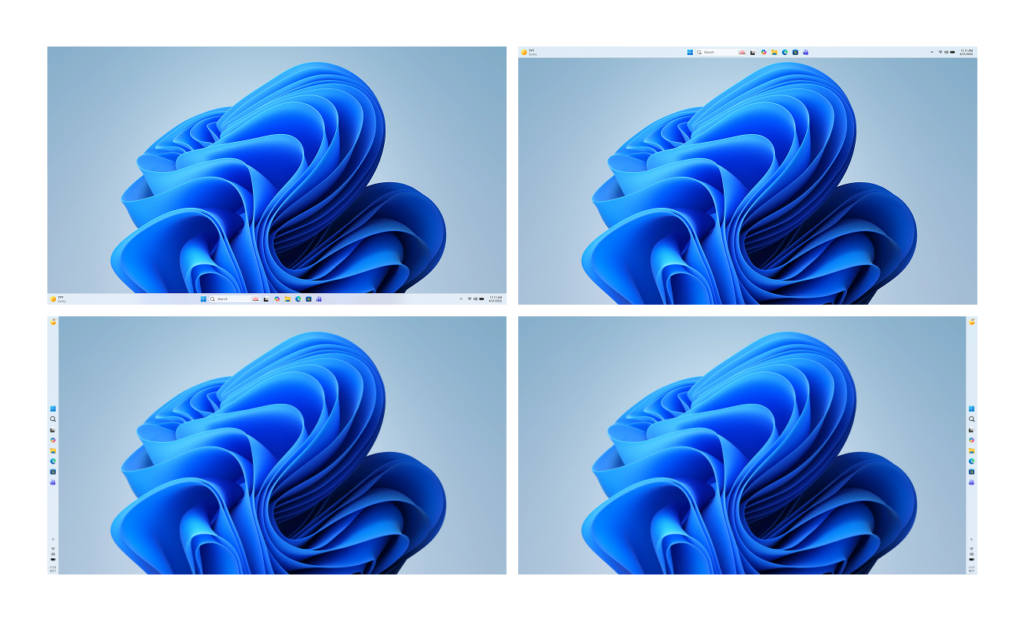
Desktops showing the taskbar positioned on the bottom, top, left and right side of the screen
More taskbar customization, including vertical and top positions: Repositioning the taskbar is one of the top asks we’ve heard from you. We are introducing the ability to reposition it to the top or sides of your screen, making it easier to personalize your workspace.
Integrating AI where it’s most meaningful, with craft and focus: You will see us be more intentional about how and where Copilot integrates across Windows, focusing on experiences that are genuinely useful and well‑crafted. As part of this, we are reducing unnecessary Copilot entry points, starting with apps like Snipping Tool, Photos, Widgets and Notepad.
Reducing disruption from Windows Updates: Receiving updates should be predictable and easy to plan around, so we’re giving you more control. This includes the ability to skip updates during device setup to get to the desktop faster, restart or shut down without installing updates and pause updates for longer when needed, all while reducing update noise with fewer automatic restarts and notifications.
Faster and more dependable File Explorer: File Explorer is one of the most used surfaces in Windows. Our first round of improvements will focus on a quicker launch experience, reduced flicker, smoother navigation and more reliable performance for everyday file tasks.
More control over widgets and feed experiences: Widgets should feel helpful and relevant, not distracting or overwhelming. We’re introducing quieter defaults, more control over when and how widgets appear, and improved personalization for the Discover feed.
A simpler, more transparent Windows Insider Program: The Windows Insider Program is how you help shape the future of Windows, and it should be easy to understand what to expect and how to participate. We are implementing changes to make it easier for you to navigate with clearer channel definitions, easier access to new features, higher quality builds, better visibility into how your feedback shapes Windows, and more opportunities to engage directly with us.
Improved Feedback Hub, available starting today: Your feedback is essential to improving Windows, and it should be easy to share and see what others are saying. Today, we’re rolling out the largest update to Feedback Hub yet to our Insiders, with a redesigned experience that makes it faster and easier to submit feedback and engage with the community.
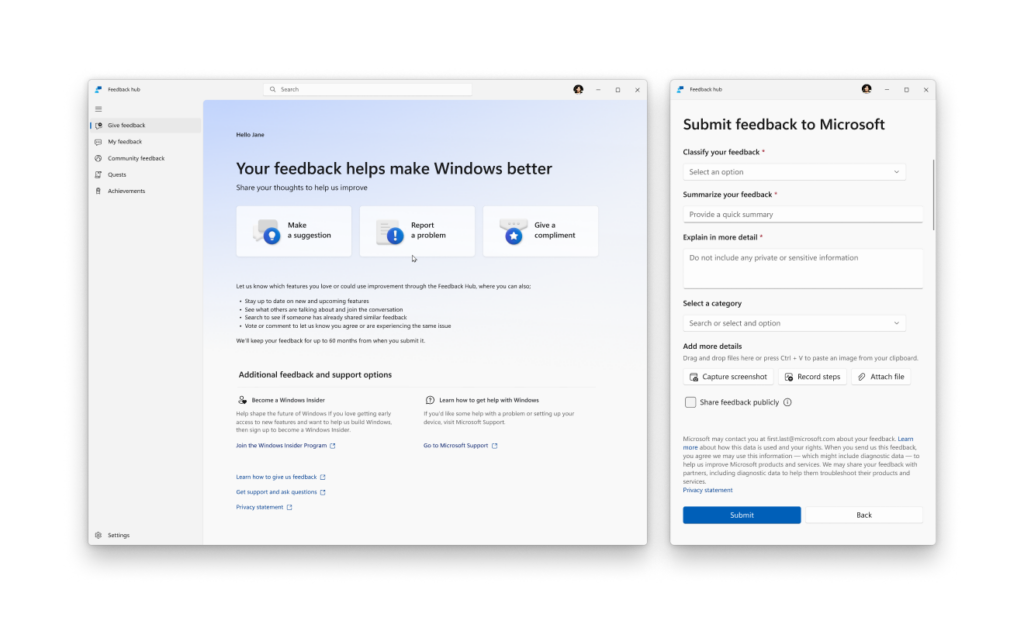
The new Feedback Hub app showing the redesigned home screen and feedback form
Building on these changes, what follows below is our broader plan and areas of focus for the year to raise the bar on Windows 11 quality. The work is underway. You can expect to see tangible progress that you’ll be able to feel as you preview builds from us throughout the rest of the year.
Last night I had the chance to sit down with a small group of Windows Insiders here in Seattle to listen, to answer questions, and to share more about where we’re headed. The Seattle meetup was the first of several stops our team will be making to engage in person, in more cities around the world, to connect with the Windows community.
Thank you for holding us to a high standard. Windows is as much yours as it is ours. We’re committed to strengthening its foundation and delivering innovation where it matters, for you.
Please keep the feedback coming, to help us shape the future of Windows together.
Best,

Pavan
EVP, Windows + Devices
_______
What follows is our plan to raise the bar on Windows 11 quality this year, with a focus on performance, reliability and well-crafted experiences. These areas have meaningful impact on how you experience Windows: how fast it starts and responds, how stable it is under real workloads, and how consistent and thoughtful the experience feels.
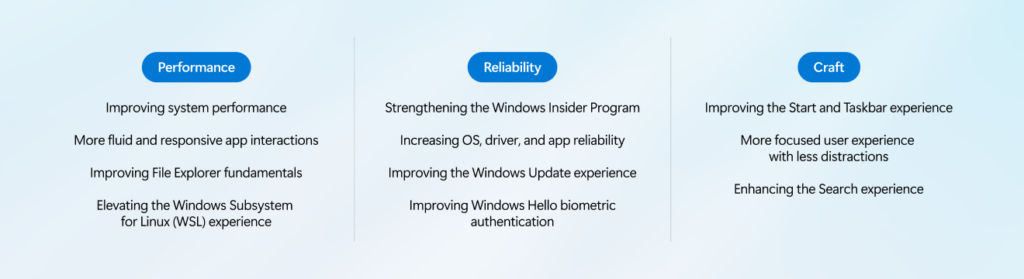
We are focusing on making Windows 11 more responsive and consistent, so performance feels smooth and reliable.
Over the course of the year, we’re improving system performance, app responsiveness, File Explorer, and the Windows Subsystem for Linux, helping Windows stay fast as you move between apps and workloads.
Improving system performance: Reducing resource usage by Windows to free up more performance for what you’re doing.
More fluid and responsive app interactions: Reducing interaction latency by moving core Windows experiences to the WinUI3 framework.
Improving File Explorer fundamentals: Reducing latency and improving reliability across search, navigation and file operations.
Elevating the Windows Subsystem for Linux (WSL) experience: Improving performance, reliability and integration for developers using Linux tools and environments on Windows.
Reliability is the bedrock of trust. You should trust that your PC is going to be there and function when you need it most.
Across the operating system, we will focus on improving the baseline reliability of areas such as the Windows Insider Program, drivers and apps, updates and Windows Hello.
Strengthening reliability and quality of the Windows Insider Program: Making it clearer what to expect from each Insider channel, raising the quality bar for builds and strengthening feedback signals to improve build quality before broad release.
Increasing OS, driver and app reliability: Delivering a smoother, more dependable Windows 11 experience by strengthening system stability, driver quality and app reliability across our vibrant ecosystem of silicon, ISV and OEM partners. Our priorities include:
Improving the Windows Update experience: Faster, more predictable updates with clearer control over restarts and timing.
Improving Windows Hello biometric authentication: We’re strengthening Windows Hello sign‑in so it feels reliable, effortless and secure, reducing friction while increasing confidence that your device recognizes you correctly.
To us, craft is the discipline that turns functional products into loved ones through usability, polish, coherence and refinement.
This year, you will see us invest in raising the bar on the overall usability of the experience, with more opportunities for personalization, less noise, less distraction and more control across the OS. That includes being thoughtful about how and where we bring AI into Windows, leading with transparency, choice and control, so that new capabilities enhance the experience rather than complicate it.
Improving the Start and Taskbar experience: Making these core Windows surfaces more reliable, flexible and personalized so you can navigate your PC in the way that works best for you.
More focused user experience with less distractions: Making the Windows experience quieter, to help you stay focused, minimize distractions and stay in your flow.
Enhancing Search: Delivering faster, more accurate results with consistent search experience across Windows surfaces.
As part of this effort, we are evolving how Windows is built behind the scenes to raise the quality bar and deliver innovation where it matters most, shaped by the feedback we are hearing from you.
This includes deeper validation and broader testing across real-world hardware and usage scenarios before new experiences reach Windows Insiders, and a more intentional approach to where and how new capabilities are introduced. The result will be higher quality builds, more meaningful innovation and greater flexibility in choosing what you want to try. This is how we will continue to build and ship Windows 11, so we can deliver better experiences with greater confidence, month after month.
In line with Microsoft’s Secure Future Initiative, we will continue to make Windows more secure with every release, building in new capabilities and strengthening security by default to help protect users, devices and data.
As we improve and innovate, we look forward to your continued feedback on where we can keep making Windows better.
The first is coercion. Installing without a Microsoft (Outlook) account is more and more difficult. An attentive steward of Windows would allow older gui themes (xp, Win7 Aero, etc.) to be applied for the nostalgic. And there would be an easy control to disable all Copilot integration. Microsoft is coercive towards their customers with these and other actions.
The second is incompetence. The Windows update process is intrusive, lengthy, and prone to repeatedly bricking unlucky PCs. Linux updates are far more pleasant.
These are big problems, and I agree, it will take great institutional change to curb these abusive tendencies. I don't know if they can.
I hadn’t tried Fedora until late last year, and was very impressed. Came across as highly polished and complete.
Hadn’t tried Pupply Linux until a couple months ago, and it’s now my new favourite. I’m now running it on a small form factor desktop HP with no internal drive.
That's not at all how that works. DirectX12 isn't slow by any stretch of the imagination. In my personal and professional experience Vulkan is about on par depending on the driver. The main differences are in CPU cost, the GPU ultimately runs basically the same code.
There's no magic Vulkan can pull out of thin air to be faster than DX12, they're both doing basically the same thing and they're not far off the "speed of light" for driving the GPU hardware.
Isn't there already a viable, widely used Linux based phone OS called Android?
Many Linux users seem to like upgrading (if you can call it that) to the latest eye candy every time Gnome or KDE or whoever puts out a new release. I'm the opposite. I do think much of the UI work in Linux has done more harm than good. But that's the nice thing about Linux: I don't have to care, precisely because of the lack of such close coupling between the GUI and the underlying OS. I can't stand the GUI that comes by default with Ubuntu, but I just don't use it; I use something else instead.
I felt the same as you, up until quite recently, although I was using Xbuntu which uses a very barebones desktop environment. Since changed to CachyOS + KDE Plasma late last year and haven't booted up Windows for 3 months other than to extract a few files. I"m a MacOS laptop user, Windows desktop user, but these days I much prefer CachyOS for speed, responsiveness, easy customisation. You may still find you prefer Windows but it's worth a revisit I think and easy to try via a USB Boot as you know (although running it off USB is way more sluggish I find).
I can’t place my finger on it, but Bazzite feels more “coherent” despite using the exact same GUI.
I had the misfortune of using a Windows 11 machine the other day and I didn’t even recognise it. They’ve taken a huge misstep with the Copilot rollout.
You really should, yeah. I've given up Linux as a daily driver in favor of a MacBook but I do have a work mandated Windows machine and I hate that thing with a passion. I cannot think of a single thing that's better on it than on my MacBook or any Linux distro I've ran as a daily driver.
In fact, most of the time I want to do any tasks which are not directly Teams or MS office related I find it easier to just use WSL.
Right up until you try to access any settings menus.
This is exactly why modern Windows is problematic. MacOS is better. A right Linux distro (e.g. Fedora Silverblue) on right hardware (e.g. Thinkpad T series) also just works™; this basically the same kind of limitation as with MacOS.
I wish they issued a Windows Rock Stable edition. Ancient as rocks (Win7 look, or maybe even WinXP look), every known bug fixed, every feature either supported fully, or explicitly not supported. No new features added. Security updates issued regularly. It could be highly popular.
You don't have problems with Arch presumably because you've avoided building your system into a neutron star of corporate shitware, while that's the default state for most distributions.
But even if all most people want is browser, why go through the hassle of running Linux?
I usually recommended a Windows PC to most people because on the low end, they are cheap, disposable, and if the one odd program they might want to run isn’t available, I didn’t have to hear about it.
If they know what they want, I didn’t have a problem recommending an Air and now for a lot of use cases, a Neo.
If you've ever used it before, you'd quickly come to the conclusion that web only Office is only useful for someone writing essays for school.
The moment you need to do anything more complex than that, the document renders completely differently on web vs app-- not to mention there are tons of critical features that aren't even available on the web version.
It’s true that most stuff is in the browser, but basically every user has a couple things that are native apps which don’t work on Linux.
Wine has come a long way for gaming, but my experience is for regular programs, most stuff doesn’t work. Even the simple apps are usually critically broken.
I feel like people dramatically overestimate their impact on "the world" by way of making niche software choices or consumer products or whatever.
I think the reason Windows is so successful is because it's stable, bulletproof and easy. You don't have to burn an ISO to a USB and boot from it, partition a disk and install it. You don't have to grep grub at any time. You rarely have to use PowerShell for much of anything at all, including device management, managing services and even tweaking the registry.
The "desktop environment" is the operating system, not a seperate abstraction around it. There's no research required on what distro works best for you, what package manager is ideal, what file system to use, what window manager to use, what desktop environment to use. There's no messing with repositories either. No issues with drivers that require compiling from source, no marking an executable as "executable" through chmod.
I like Linux, but the Linux community overestimate how usable it is outside of their meta, and underappreciate their own mental model of what a computer is and how it differs from the layman. Most people want to open their laptop, double click a browser and watch Family Guy funny moments on facebook.com without having to troubleshoot PulseAudio because it's suddenly gone super quiet.
Today, people don't love the iPod or Dropbox. Both products became completely commoditized once consumers realized that there is actually nothing special about using MP3 files or hosted NFS. Windows is a commoditized OS, it's unapologetic post-desktop slopware. And it sells.
I install Gimp one time. I like to casual draw on autopilot, usually while doing something else, talking, watching a movie, listening to a podcast etc. For some reason half the icons were missing and the existing set was replaced with the hipster horrifying flat single color monstrosities. This would have been a waste of their time if it was only an option for no one who wants this some place buried deep in the settings where it would only clutter the nesaserily complex options.
With MS it feels more like intentionally trolling the user
The best spot for the applications sub menu is to not make it a sub menu. The second best is to leave it wherever the fuck it was before. I want to struggle remembering what an application was called and wonder why they are organized so poorly. (Not by file Association) In stead they have me wonder where they even are???
1. The usage statistics don't reflect your anecdotal Linux usage; Linux desktop/laptop usage share has not grown that significantly in 20 years and Windows remains quite dominant.
2. MacBook Neo was widely discussed on HN not very long ago, and I'd think if anything an owner of an IT company would be more aware of it than an average HN user. It's definitely going to shake up the market for lower-end laptops.
That's a problem right there.
Even the Server Core edition, which has a much smaller "surface area" needs reboots almost every month.
Even if you're not leaving the ecosystem anytime soon, you should always know where those lines are and what the landscape looks like on the other side of things.
I also have set the classic right-click menus.
There are some things about Windows 11 I like but a lot of it seems to be designed by people who use Mac OS (graphic designers).
And I could tell that. In one instance where I asked it to write a script that does a bunch of things, it provided a series of steps to do in the terminal. This is very off my typical experience with other chatbots. I immediately went to Claude which gave me a complete script that does exactly what I need.
s/2000/1995/But also, why wouldn't UI changes be possible if the source was open? I remember WindowBlinds and patched uxTheme.dll in the XP days, and that was /without/ source being available. So in this hypothetical, what's stopping hackers from backporting the things they like about 7 to 10 or adding more rounded translucency?
This article is so disconnected and uninterested in the actual needs of users who despise windows in its current form today.
Just like the dialog that searched for a solution to why my program just crashed. Of all the times I saw that (maybe every other day), it found something precisely 0 times, but wasted my time every time.
Did it work for anyone or am I alone?
BUT
I don't actually understand your sentences for the most part. I really had to work to glean what you were talking about.
I'm not trying to be insulting here; sometimes I write in inscrutable ways too. But - could you reword a few things so I know what you're trying to say?
There are open UI shells from KDE and GNOME, multitouch gesture support, Android emulation... it's all there.
But every Linux distro has its own UI, and pretty much every distro makes it easy to configure it to look how you want, with tens of thousands of themes out there developed over the past 20 years by people wanting their os to look a certain way.
The most glaring inconsistencies are going to be user-inflicted. If I spend a weekend tweaking defaults to look just right I need to be ok with possibly tweaking any new software I download to fit my theme.
But even from a non-power-user perspective, if my mom runs into problems with her computer it's much easier to walk her through a fix over the phone if she's on Windows or a Mac.
My dad, who is very tech-literate, once tried Linux and all the trouble shooting guides required him to open a command prompt (because there isn't a consistent GUI you can use to fix things across distros). He never forgave it.
proxomitron is a rewriting proxy, which I always thought was a very nice approach to webpage filtering. again, I remember it having very good UI/UX as well as being fast and capable.
There is a new game with no support? So sorry. Can't be done
I meant that Microsoft is intentionally removing their own moat.
That the tools are awful is just the standard microsoft affair. (with some notable exceptions, which ironically include Excel).
Android “won” as pyrrhic of a victory as it is since Android manufacturers besides Samsung make very little profit and every one who has money (again to a first approximation) buys iPhones. It won because Google gave it away, shared ad revenue with OEMs and it bent over backwards to the carriers and Apple wouldn’t.
And yes Linux would save OEMs maybe $30 on licensing Windows. But OEMs make mire than that on bundleware.
None of this has anything to do with the quality of the desktop of Linux or windows. If Linux had 75% market share I promise you all those things above would quickly become true for Linux as well.
On the Mac side, either way I spent all of my day in VSCode and the browser - we use GSuite - Zoom and Slack. It wouldn’t make that much of a different either way.
The only integrations I use between my work Mac and my personal Apple life are my iPad for a second screen, shared subset of passwords. I have a separate Apple Account for my work computer and I share work related passwords.
I don’t know that i’d expect windows to be much better either, but that’s my experience.
What is the benefit of 'GUI native' if things are broken and people cannot fix them?
Time for some Internet researching...
Anyone with any illusions about this name quickly the top vendor for the third item in the materials itinerary of the first thing with a materials itinerary you get your hands on (for me it’s usually food. Who is the main vendor for citric acid? Or sugar. Or that red dye that causes adhd. I have no clue)
General consumers could not care less about open source.
It’s component.
Not a product.
I don't care about the hem on my pants. My pants either work, or I get a new pair. This is most people's relationship with their computer.
I'm telling myself that this is an intentional "blind hem" joke.
I don’t use it often, but occasionally use the proofread option. Other than that, it stays out of my way.
However if your interests lie in indie games or games that require a keyboard and mouse interface (precision shooters, grand strategy games, RTS games, etc) then having a PC that can play games is completely necessary. (I say this as someone who runs linux btw, not a windows defender).
Edit: but I am somewhat surprised that it’s qt and not the typical react electron bloat that Microsoft is slopping out. I’m sure it’s only a matter of time.
What stands out to me is the organization needs to be accept that change is needed and 'walk the walk', and also that those efforts take time. I've no idea what things are in motion in MS, but I wonder how quickly they can turn the ship, how much momentum is in their current direction and how much force is in turning. Moving the taskbar seems like addressing a loud persistent talking point, but it's one among many. What's the timeline (even though windows version timing seems like 'when they need branding')? Win12? Win13?
[0] https://web.archive.org/web/20020204233701/http://www.comput...
I think you and I have very different meanings of "intelligent", "understands" and "gets it done"
See how that sounds a bit silly? It's because it presents a false dichotomy. That our choice is between either the current state of interfaces or an agentic system which strips away your autonomy and does it for you.
There's everything wrong when "agentic" means that the regular bread-and-butter functionality of the OS becomes unusable.
Communicating and predicting desires, preferences, thoughts, feelings from one mind to another is difficult.
Fundamentally the easiest way of getting what you want is to be able to do it yourself.
Introduce an agent, and now you get the same utility issues of trying to guess what gifts to buy someone for their birthday. Sure every now and then you get the marketers "surprise and delight", but the main experience is relatively middling, often frustrating and confusing, and if you have any skill or knowledge in The area or ability to do it yourself, ultimately frustrating.
When that completely didn't work, we thought that augmented reality was the future of the computer, which also didn't work out.
You need a screen to be able to verify what you're doing (try shopping on Amazon without a screen), which means you also need a UI around it, which then means voice (and by extension agents which also function by conversation) is slower and dumber than the UI, every time.
Meanwhile I have yet to see any brand excited to be integrated with ChatGPT and Claude. Unlike a consumer; being a purely "reasoning-based" agent, they're most likely to ignore everything aesthetic and pick the bottom of the barrel cheapest option for any category. How do you convince an AI to show your specific product to a customer? You don't.
I'm sorry, this is very funny to me in the context of the person upthread arguing about how great "agentic OSes" are. Some people seem to believe that we're living in the future, but I'm pretty sure we're still stuck in Windows '95.
Surely you don't mean remove all columns, and if you did you wouldn't have to also specify removing media metadata columns?
When such basic tasks are failing spectacularly, nobody can have any confidence that complex things can be achieved reliably. Instead of spying on their users and trying to squeeze more and more money from them, they should first focus on making a great product and work on making it better, not researching ways to enshitify things.
- The OS is getting buggier, with every large update getting press coverage on scary bugs.
- The OS is getting overbearing; constant nagging for upsells on Microsoft products with terrible attach rates.
- The OS is getting focused on hype; the latest trend is AI?Let's force a new button on people that will break decades-old workflows. Let's put AI everywhere.
- The OS is getting slow; there's no focus on speed and the place where 85% of the market resides (laptops) is getting completely trounced by Apple Silicon.
- The OS is getting squeezed; under 300$ it's all terrible e-waste in six months Chromebooks. Over 500$ Apple is aggressively entering the market with the Neo. Over 1,000$ Apple has owned a commanding share of the profits there for decades.
There are 994 more problems with Windows but I've made my point; there's just no end in sight to the problems with Windows. I haven't mentioned it's become a minor part of Microsoft's profits!
source: been there.
2. Missed it or perhaps blanked it. It really will not shake up the lower end because anyone wanting a lower end laptop (whatever that is) will insist on it running Windows and not Apples.
There is a really good reason why car manufacturers run multiple marques - the budget, standard and premium ones. Attempting to put the Apple "premium shine" on a budget effort may backfire spectacularly (and devalue the entire brand) or maybe they will somehow manage to re-invent marketing.
Imagine a plumber talking about how much better his toilet is than everyone else's - bc everyone believes only a plumber can install it (which was truth for most of Linux history and general PC users).
Nobody took it seriously bc they took it as mostly an odd humblebrag for niche Windows haters.
As a separate point, it seems quite feasible to run Android apps in VM on Linux based phone and make the experience fairly seamless. Something like what Waydroid provides.
You can run KDE but depending on the app and containerization you open you'll get a Qt environment, a Qt environment that doesn't respect the system theme, random GTK apps that don't follow the system theme, random GTK apps that only follow a light/dark mode toggle. The GTK apps render their own window decorations too. Sometimes the cursor will change size and theme depending on the window it's on top of.
That is an unforgivable sin in my eyes.
Chicken and egg problem.
Valve is making enough headway that game makers take Linux seriously. We’ll likely see a lot more native releases over time. (once the worry about anticheat subsides).
But this is kind of like the 'great man' theory of history where you can also argue that the markets would have converged on this outcome regardless of what the specific device was that we attribute to it.
There were so many things in previous versions of Windows that were done with thought and care. Probably the blogs helped make me appreciate it (especially Raymond Chen's The Old New Thing). Windows 11 feels like an insult created by people who hate Windows and never use it
I really wish we could keep the modern underpinnings with a prior shell
I don't really mind Windows that much for non-development use, once you disable all the bloat. But for development... It seems obviously a distant third behind Linux and Mac, and I don't think I've ever heard any developer say otherwise. And I say this as someone who is forced to use it at work, so it's not out of ignorance (thank god for WSL).
But that's why I ask what kind of development you do, because I suppose there are areas where Windows really is a good option.
Not sure I can buy that one
And do you mean hardware issue or hardware incompatibility?
The former would most likely manifest itself across many operating systems, but if you mean the latter... why would that matter in terms of a given person deciding whether to switch to Linux?
It's like asking why a non-mechanic would ever need to use a car.
Do you know what you'll be moving to to replace what Workspace provides (email/IdP/calendar/Chrome policy management?)
Maybe? For a couple of decades, we believed that computers you can talk to are the future of computing. Every sci-fi show worth a dime perpetuated that trope. And yet, even though the technology is here, we still usually prefer to read and type.
We might find out the same with some of the everyday uses of agentic tech: it may be less work to do something than to express your desires to an agent perfectly well. For example, agentic shopping is a use case some companies are focusing on, but I can't imagine it being easier to describe my sock taste preferences to an agent than click around for 5 minutes and find the stripe pattern I like.
And that's if we ignore that agents today are basically chaos monkeys that sometimes do what you want, sometimes rm -rf /, and sometimes spend all your money on a cryptocurrency scam. So for the foreseeable future, I most certainly don't want my OS to be "agentic". I want it to be deterministic until you figure out the chaos monkey stuff.
typing "open hackernews" into copilot instead of clicking the browser and typing hackernews?
99% of OS interactions already boil down to 2 clicks and a search phrase.
That's a why, but it raises more questions than it does answers.
Apple made a significant number of tradeoffs to reach $500, but for a budget user, they're reasonable tradeoffs.
The performance benefits of Vulkan and DX12 come from tighter control over the hardware by the engine. An engine written for older APIs needs to be adapted to gain anything.
The happy path has improved a lot. When Linux is working it's reasonably usable. But once something breaks it breaks HARD and recovery is still miserable.
For reference I've been using Linux since Red Hat 5.2 circa 2000. I cut my teeth debugging problems without internet access. I ran an LTSP lab at my high school. I remember the hell that was XF86Config (I was there, Gandalf, I was there 3000 years ago).
....and like the previous commenter I run Windows on my personal machines because I want to spend my free time using them, not debugging them.
My most memorable MS Word experiences are all the times I accidentally put my document into a weird state and didn't notice something was wrong until I've spent 3 more hours on it, at which point I was forced to re-create the document by copy pasting text into an earlier copy.
And the only reason I knew something was subtly wrong was because the weird VB extension I was required to use would stop working correctly. Basically this would happen when some random key element of the document had ended up with a very subtly different style. If I didn't have to worry about the VB extension breaking, I'd just have a document with some weird bug somewhere.
If I wanted a professional looking document, I would use some modern LaTeX variant maybe with Pandoc to generate most of it from something more restricted like Markdown.
If I wanted total control over the content of a page, I would use some kind of graphical publishing software with text and vector graphics.
I have zero idea what kind of Stockholm syndrome you must have to think that Microsoft Office (or any other similar WYSIWYG editor for that matter) is power user software.
It has lots of features, that's for sure. But the features form a Jenga tower. That makes it a toy.
Even the then CEO of Google used BlackBerry devices years after Android came out as opposed to SJ who used the iPhone before it was released and after it was announced, saw that the screen was easily scratched and publicly did a press release that they were going to change it to use Gorilla Glass from plastic.
The right click menu never once showed me “loading…” when I just want to click “properties”
A not too overly flashy UI that made efficient use of your screen space.
It didn’t used to by default shove “news and entertainment” bing suggestions. Nobody wants to open their browser after an update to be greeted by tabloid rags.
The search used to work. You could find files instead of bing results. You could grep text files with the explorer search bar (across the network too) and it just worked. Good luck doing that today.
VSCode with WSL and Docker Desktop was fine.
Yes the hardware you chose or is given will heavily influence your linux experience. I kinda wished the community was more proactive making lists of "certified" hardware that is likely to cause the least amount of problems...
The only computers they tend to own are phones, tablets, and maybe a game console.
Heck, my millennial sister in law got her first computer because of covid. Until that point the only computers she was using was her work computer and her phone.
I agree, a tablet isn't as capable as a laptop. However, a very large portion of the population doesn't need those capabilities. They just want something to watch netflix on.
And I think this is one reason why, for those of us who grew up with "computers" modern UI trends are, to quote https://idlewords.com/talks/website_obesity.htm, "like we woke up one day to find our Legos had been replaced with Duplos"
I know more and more people who are editing photos and videos on their phone/tablet - not movie producers, sure. But lots of YouTubers, influencers, etc.
The whole Gemini thing is just a massive embarrassment for Google I really can't follow their thinking, you'd think that after the Google '+' debacle that they would have learned their lesson not to cannibalize your old products to launch a new one.
The closest to useful it's been is in the GCP console, but it seems to decide at random to forget context, and it might just be Gemini Flash with minimal thinking, which tends to mean it's just repeating things it's already said.
I actually trust the Apple Intelligence, when off, doesn't exfiltrate my data.
Baked into the OS implies that it's integral to its operation in a way that the two are fundamentally inseparable. Having a global off switch implies that's not true.
There are other irritating baked in aspects of the newest macos and other recent versions that are arguably less avoidable, like Tahoe's entire UI design, or the Settings app.
Nobody can predict what Apple will do tomorrow, but as of today, they aren't really pushing Siri/Apple intelligence really hard particularly after initial setup. None of most of the above for example.
We've progressed an impressive lot since, say, the nineties when computers (and the internet) started to spread to the general consumer market but the last 10% or so of the way is what would really be the game changer. And if we believe Pareto, of course that is gonna be 90% of the work. We've barely scratched the surface.
As I use AI more and more to write code I find myself just implementing something myself more and more for this reason. By the time I have actually explained what I want in precise detail it's often faster to have just made the change myself.
Without enough detail SOTA models can often still get something working, but it's usually not the desired approach and causes problems later.
- "Plan my summer vacation with my family, suggest different options"
- "Look at my household budget and find ways to be more frugal."
There are thousands of things I can think of when it comes to how an agentic OS would work better than the current Screen Keyboard paradigm. I mean all these things I could now do with Claude or Codex and some of these things I already do with these tools.
https://www.youtube.com/watch?v=Bmz67ErIRa4
i feel like someone high up in microsoft probably has this pinned in a epic or something somewhere
We're reaching Microslop levels we never thought possible. I actually think Claude Code would have done a better job.
https://archive.org/details/bitsavers_microsoftwindows951994...
But why?
The premise of Waydroid seems to be to bring Android apps you want to your Linux desktop. But why would you want the phone in your pocket to run Desktop Linux so that you could then run Android apps on your Desktop Linux mobile phone instead of just running Android on your phone?
What desktop Linux features do you want on your phone that would justify this complexity?
When it comes to games, Linux has an OS/2 problem.
Excel is really The Thing. So many businesses and departments rely on it.
So what argument could you give Joe Normal about how Linux is better than Windows ?
"My favorite toilet is the Ultramax by TOTO." , "Its model number is "xxx-xx-etc" - that man definitely believes in Ultramax!
This was the same post he said he wouldn’t license Apple’s DRM. But if the music industry would license their music DRM free, the interoperability goals would be achieved an Apple would sell DRM free music.
One of the major record labels and some independent labels took him up on it immediately. It took two years for the rest to come onboard.
iMessage always supported SMS and now RCS. What more did you expect Apple to do?
I too would not want any unprompted access to my files.
At the end of the day this issue is that we don't trust the OS and we cannot easily validate how it is designed to behave.
I don't know what happens with Home Edition, but I though the pushback was mainly from Insider Preview?
> Plan my summer vacation with my family, suggest different options
What part of this does an agentic OS help with? My OS doesn't know my travel preferences, family size, work schedule, etc.
These are more appropriate tasks for a smart assistant.
What specifically does an agentic OS UX look like beyond giving claude access to local files and a browser?
huh? ... this reads to me like you don't need an "agentic" OS to do the things you'd want to use an "agentic" OS for..?
like... it seems you just don't want a keyboard to do the same things you've already been doing? ... is that the crux of it?
My hope is that installation of the Android apps on Linux phone could be made seamless.
If Steam Deck, the new Steam Machine etc take a significant part of market share, I think it will be more enticing for game developer to release a native version for Linux. Providing a native version should still be more robust and performant.
He doesn't really want to care but Microsoft's decisions have made their main product into an annoyance.
I’m sure Google would deny Google Play Services to any popular fork that didn’t follow their rules. But they would do the same to any Linux desktop or whatever that didn’t follow their rules, too, if it became popular.
Why? The only stable ABI on Linux is Win32.
I'm an older millennial with a ton of genz family (nieces and nephews, I have 50 total. Mormon family). Very few of them have or want computers. I see the same thing with my in-laws. They have family computers which the kids have no interest in. It's the Gen x and millennials, mostly, that are obsessed with it.
Edit: I've been looking for stats to back my claim and this is frustratingly hard to find. Perhaps because genz is just starting to fully mature. 14 to 29 is just a large gap in terms of life experience.
The best I can find is the vast majority of Gen z have phones and access to laptops/PCs. One study I saw absolutely backed up what you are saying that Gen z tends to own laptops.
You can't even select a cell on notepad without a freaking copilot button pooping up every single time. Same on word, that's maddening !
You could argue that windows isn't Microsoft copilot 365, but then, why do people even use windows ? It's always because of the office, my bad, copilot 365 suite.
I need that Drake meme here, where he's negative about the idea "Optimize the calculator layout to improve the UX" and very enthusiastic about the idea "Find ways to get incremental revenue from users of Calculator with ads or selling of data"