> Captain and first officer are reported to have died in the accident, two fire fighters on board of the truck received serious injuries, 13 passengers received injuries.
https://www.faa.gov/airports/airport_safety/certalerts/part_...
Per the ADSBx track the plane was at 101kts (115 mph / 185kph) just before crossing taxiway D, which would be where it hit the firetruck. It still had enough energy afterwards to reach taxiway E, 600ft away.
edit: Looking into this a bit more it looks like the plane came to a stop around crossing E while the emergency vehicle was crossing at D(based on ATC recordings). Using the following map as reference[2], the 58kts point was around E, while the previous recorded point which was just before D was 114kts.
[1] https://www.flightradar24.com/data/flights/ac8646#3ede6c39
[2] https://www.flightaware.com/resources/airport/LGA/APD/AIRPOR...
People into boats need to understand this. Even a boat that travels no more than 4mph can crush you easily. This is why you never get on to moving boat from the front. Many people have made a mistake because speed is not high.
(Though some of the major damage may have happened while deplaning the passengers)
https://www.reddit.com/r/aviation/comments/1s16x61/comment/o...
I'd bet a lot of money that however the system is implemented the police and fire get special treatment when it comes to process and that's what lead to this.
This is a good overview so far:
Let's get the important parts out of the way first: We in charge have taken care of optics, with regard to our offices.
Oh, and we're going to contact families eventually.
ATC audio is https://archive.liveatc.net/klga/KLGA-Twr-Mar-23-2026-0330Z....
The clearance for AC8646 to land on runway 4 is given in a sequence starting at 4:58. "Vehicle needs to cross the runway" at 6:43. Truck 1 and company asks for clearance to cross 4 at 6:53. Clearance is granted at 7:00. Then ATC asks both a Frontier and Truck 1 to stop, voice is hurried and it's confusing.
Also, did the pilots die in the collision or in some sort of aftermath? The cockpit looks absolutely smashed.
It wouldn't surprise me in the slightest if the truck has a single radio (airplanes always have two) and was constantly switching between ATC and fire house frequencies. The probably never heard the "stop, stop, stop stop.."
It would also not surprise me if airports previously had dedicated fire services, which have since been outsourced for cost reasons.
ATC audio
make a mistake, recognize it, and then have to continue on your job, knowing you likely just killed people, because if you don't others will die.
The weight of some jobs is immense, and our civilization relies upon workers to shoulder the burden everyday.
That ATC still takes place over radio just seems insane at this point. And there's pretty much no way to make ATC's job not stressful, its inherently stressful. Taking out how much of their job is held in the current operators mind versus being 'committed' seems like low hanging fruit 30 years ago.
The whole system's just begging for human error to occur. There's 1700+ runway incursions a year in the US alone, each one should be investigated as if an accident occurred and fixes proposed. Like when an accident occurs.
You should provide sources for a claim like that. For example, what in the BBC article is wrong?
An Oshkosh 1500 4x4 is 62000 lbs GVWR (wiki says kerb weight but it’s incorrect).
The plane was landing and the truck was heading to an intervention, so they were likely close to empty and to GVWR respectively.
And again, 25mph is the final ground speed, after the plane punted the truck and kept on going for 600ft.
The NYT gets all kinds of things factually wrong, but it’s still basically the most official newspaper of the American ruling class.
> Video footage on social media showed the aircraft, which is operated by Air Canada's regional partner Jazz aviation, coming to a rest with its nose upturned.
This just isn’t true. There’s no video of the plane coming to a rest with its nose upturned (which implies motion). The upturned nose happened only after passengers deplaned and the balance shifted.
Everyone can write a comment on Reddit / make a podcast / video / whatever claiming whatever they want. Unless you already know and trust them (which requires you to be able to cross-check their information), it's potentially as useful as a random LLM hallucination. Could be brilliantly spot on, or could be completely nonsense. No way of knowing unless you already know enough. (Because even cross-checking won't necessarily save you, if you cross-check multiple bullshit sources).
Media with standards (like the BBC, Guardian, Liberation, etc.) will do their best to report truthfully (even if sometimes with some bias), and will fix their mistakes if they're caught later on or the story evolves. Independent media checking organisations have shown time and time again that there is trustworthy media, you just need to know which it is, and always take a pinch of salt. It's wild to me that people will just dismiss rags such as Fox News and relatively quality media like Guardian in the same breath.
Our civilization? Nah. Just that one shithole country. Greatest country in the world and they schedule a single guy to work both tower and ground frequencies at a major airport, it's almost like they're asking for this shit to happen.
And before anyone mentions understaffing, this literally one of the plethora of problems that the rest of the world figured out while the U.S. continues to act special.
I'm gonna guess that code never went into production. The problem seems easy until you start looking under the hood.
My father works ATC and his schedule has him working overtime, 6 shifts a week, including overnight shifts, meaning that there is literally not a day of the week where he doesn't spend at least some time in the tower.
If that's the reality for even half of the controllers, it's no surprise that we've been seeing more and more traffic accidents lately.
I feel the same way about close calls on the road, especially ones involving a vehicle and a vulnerable road user like a pedestrian or cyclist. Way too many lives being saved by a person jumping out of the way at the last minute who shouldn't have had to do so, and then cops and bureaucrats shrugging with "well what do you want us to do, the numbers don't show enough fatalities here for it to be worth fixing" and later when someone actually does die it becomes "this is a horrible tragedy that no one could have seen coming, let's focus on thoughts and prayers rather than accountability that could lead to structural change."
It does, the Runway Status Lights System uses radar to identify when the runway is in use and shows a solid bright red bar at every entrance to the runway. I'm curious what the NTSB has to say about it for this incident. From the charts LGA does have RWSLs. I didn't check NOTAM to see if they were out of service though.
In the end the air traffic system is a highly complex but also a highly reliable system, especially when you compare accident rates.
I am sure the working conditions of ATC staff might be improved - but being both a pilot and a programmer, I know that there is no easy digitalization magic wand for aviation.
CPDLC is already being deployed domestically. It's currently available to all operators in en route segments.
All runway incursions at towered airports are reported, classified according to risk, and investigated.
I read elsewhere that the plane was only going 24mph when it hit the truck, and I didn't understand how the collision could have been that damaging, but I wasn't taking into account how much momentum a plane would have at that speed. From the video, it seems like a plane moving on the ground acts less like a car or truck and more like a very delicate freight train when it hits something.
4 hours ago
Olivia Irelandand
Sakshi Venkatraman,LaGuardia Airport
Video shows damaged Air Canada plane at LaGuardia airport after collision
Two pilots have died after an Air Canada plane carrying dozens of people collided with a firefighting vehicle responding to a separate incident at New York's LaGuardia Airport.
Forty-one people were taken to hospital, Port Authority executive director Kathryn Garcia confirmed. Thirty-two of them were later discharged but others had serious injuries, she said.
LaGuardia Airport would remain closed until at least 14:00 local time (18:00 GMT) on Monday, Garcia said.
New York City Mayor Zohran Mamdani described it as a "tragic collision" and said the National Transportation Safety Board was investigating Sunday's incident.
"I am grateful to our first responders, whose swift actions saved lives."
'Stop, stop, stop': Listen to LaGuardia control tower audio during collision
At about 23:40 local time on Sunday (03:40 GMT Monday), shortly after Air Canada Flight 8646 had landed from Montreal, it collided with a firefighting vehicle on the tarmac.
The fire engine from the Port Authority of New York and New Jersey was responding to a United Airlines aircraft that had "reported an issue with odour", Garcia said during a news briefing.
Video footage on social media showed the aircraft, which is operated by Air Canada's regional partner Jazz Aviation, coming to a rest with its nose upturned.
Eyewitness Leo Medina, 23, told the BBC: "We were literally like 100 meters away. It was like the plane got cut in half."
In audio from the air traffic control tower at LaGuardia, a staff member can be heard saying: "'Truck One, stop, stop, stop!" in the seconds before the crash.
The aircraft – a CRJ 900 model, carrying 72 passengers and four crew members – suffered significant damage.
All on board the plane have been accounted for, Garcia said, while adding that the sergeant and police officer who were inside the firefighting vehicle were in a stable condition in hospital "with no life-threatening injuries".
"I visited them both in the hospital, as has the chairman, and they were able to speak and we're notifying their families," said Garcia.

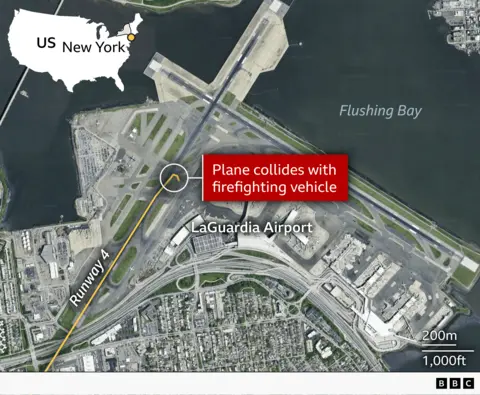
All arrivals and departures from the airport have been cancelled or delayed until further notice.
Hundreds of flights are affected, with carriers including American Airlines, Delta Air Lines, Southwest Airlines, United Airlines, and Air Canada.
As of 08:00 local time at Terminal B, from where Air Canada operates, a board showed every departing flight for Monday morning, bar one, had been cancelled. Confused passengers were huddled on benches or sleeping on the floor. Many had small children with them.
Some people were on their phones trying to sort out their travel plans. Others were waiting in the hope the airport opens again.

Reuters
Earlier, LaGuardia Airport authorities released a statement stating that "emergency response protocols were immediately activated" after the crash, with the agency's chairman and executive director on the scene with Port Authority police.
The New York City Police Department said people should "expect delays and avoid the area if possible".
"Due to an emergency incident at LaGuardia Airport, all streets and highway exits into the airport are closed until further notice."
The New York City Fire Department told people to "expect cancellations, road closures, traffic delays and emergency personnel near LaGuardia Airport".
"Use alternate routes," it posted on X.
There have been many attempts to change phraseology, teach pilots and controllers to always readback runways, etc. but nothing that actually prevents the issue from occurring entirely via automation.
If so, doesn't the understaffing (lower # of employees) result in each employee being overpaid (paid a higher hourly rate)?
EDIT: And it seems like air traffic controllers can retire after just 20 years and draw a defined benefit pension: https://www.faa.gov/nyc-atc
> In audio from the air traffic control tower at LaGuardia, a staff member can be heard saying: "'Truck One, stop, stop, stop!" in the seconds before the crash.
It sounds to me like either the Cop or the Firefighter (whichever was driving) wasn't listening to ATC and this whole incident was probably completely avoidable.
EDIT: a video of the crash seems to have warning lights that the emergency vehicle ignored.
I'm sure the NTSB report will cover why this didn't stop the accident. Presumably either the system wasn't working as-expected, or the fire truck proceeded despite the warning lights since they had clearance from the controller.
The system is only advisory at present, so if the truck did see a warning light and proceeded anyway, they were technically permitted to do so.
Ok, let's not try improving systems, how's that working out?
I'm not completely sure but it seems like the runway entry lights are red which very clearly indicates the runway is in use. They should have known better.
Software routinely solves database coordination problems with millions of users per second.
Traffic lights instead of mad max intersections are better.
Then there's subway Automatic Train Control.
I don't know that Air Traffic Control staff don't have computer systems for establishing which plane owns what airspace. They at least did do it manually already following specific processes, so it can be at least augmented and a computer can check for conflicts automatically (if it isn't already). And, sure, ATC could still use radio, but there could be a digital standard for ensuring everybody has access to all local airspace data. Or maybe that wouldn't help.
Your ground vehicle wanting to cross a runway could have the driver punch "cross runway 5" button (cross-referenced with GPS) and try to grab an immediate 30 second mutex on it. The computer can check that the runway is not allocated in that time (i.e. it could be allocated 2 minutes in the future, and that would be fine).
But, as pointed out elsewhere, obviously some of this is already present: stop lights are supposed to be present at this intersection.
1700 incursions a year, and other articles mentioning multiple near misses a week at a single airport [1]. It is safe in practice, likely largely due to the pilots here also being heavily trained and looking for mistakes, but it seems a lot like rolling the dice for a bad day.
>I am sure the working conditions of ATC staff might be improved - but being both a pilot and a programmer, I know that there is no easy digitalization magic wand for aviation.
I didn't say it'd be free. Just hard to believe radio voice communication is the best way to go.
[1] https://www.nytimes.com/interactive/2023/08/21/business/airl...
I wouldn't be so quick to rule out that there's some kind of relatively easy technological double check that could greatly reduce incidents. The fact that we've not gotten there despite years of effort to reduce runway incursions doesn't mean that it's not possible.
You can still do contract ATC work after 56.
One controller working tower duties, ground movement duties, coordinating with other ATC functions off the radio, an active emergency request, and giving clearance amendments all within 2 minutes. It's insane understaffing. On top of it, there was nobody there to take over after the crash. He worked the whole cleanup for the next 30 minutes.
This is an Olympian level elite Air Traffic Controller who was setup to fail.
I've visited towers, center facilities, and have flying (and some instructing) in the San Francisco airspace for 10 years. That kind of failure is systemic way above an individual.
My suggestion is to restrict the use of smaller jets like crj and turboprops. I know airports like LaGuardia can't handle the big jets either, but they could reduce the slots and require a jet that holds, say, 150 people or more. This would result in fewer flights per day to some airports, but reduce overall congestion while still serving the same number of passengers.
Digital comms is available in the US:
* https://www.faa.gov/air_traffic/technology/DataComm
The issue is that the final approach and landing (and taxiing?) environments are probably too dynamic for that: in this particular situation one of the vehicles was responding to an emergency (fire).
In addition to huge planes, there is baggage transportation, passenger buses (to mid-field terminals), fuel pumpers, emergency vehicles, snow plows, deicers, and general maintenance vehicles (clear debris off runways).
A naive view that confuses the map with the territory.
While in a database state you write a row and reality updates atomically....for aircraft they exist in a physical world where your model lives with lag, noise, and lossy sensors, and that world keeps moving whether your software is watching or not. Failed database transactions roll back, a landing clearance issued against stale state does not. The hard problem in ATC is not coordination logic but physical objects with momentum, human agency, and failure modes that do not respect your consistency model.
The money doesn't somehow make it sustainable for the people burning out their lives. Working 7 days a week, including overnight shifts, for 20 years to collect a pension seems like WELL earned compensation.
That's seems unrelated to "we have so few" and "we enmiserate the one's we do have".
You're left with a bunch of planes in the sky that can't stay there forever, and not enough humans on the ground to manually land them.
Now image the outage is also happening at all airports nearby, preventing planes from diverting.
How do you get the planes out of the sky? Not enough humans to do it manually.
Now imagine the system comes back online. Does it know how to handle a crisis scenario where you have dozens of planes overhead, each about to run out of fuel? Hopefully someone thought of that edge case.
Literally the crash here was caused by a fire truck entering the runway.
Which has always seemed a little nuts, like in case of hit and run it would definitely be possible to take action based on a plate alone, both for police and insurance purposes. Unless the registered owner can point to the not-them person who was driving their car at that time, then it was them. Or it was stolen, but either way there will be a clear paper trail.
> If an Air Traffic Control clearance is in conflict with the Runway Entrance Lights, do not cross over the red lights. Contact Air Traffic Control and advise that you are stopped due to red lights. (ex.: "Orlando Ground, Ops 2 is holding short of runway 36 Left at Echo due to red lights").
Airports are highly controlled environments unlike typical motor vehicle roadways and generally the same rules apply for aircraft, vehicles, and equipment on airport surface movement areas. From all sources I can find, if the RWSLs were working they should have been red and nobody should have entered the runway without further clarification from ATC.
In this case, from the available information, the drivers of the fire truck thought they were cleared, and proceeded to cross while a plane was cleared to land. I'm not familiar with ATC ground radio to know if they were actually cleared or not, but it seems clear that that the drivers thought they were cleared.
Investigation reports will give us more details.
This is a REALLY hard problem that the US cannot solve alone. It would require extensive global coordination.
Not insurmountable, but this is not something you can easily roll out piecemeal. If even a single aircraft lacks the compatible equipment you're back to the existing system.
It seems like less than 2 seconds from declaring intent to cross until they are told not to cross.
The runway entrance lights look red to me which is also a huge warning flag.
We can probably semi automate runway crossing. Someone mentioned red lights when you definitely cannot cross
Remember when all the Waymos were confused by a power outage? Now do that, but with airplanes that will fall thousands of feet and kill hundreds instead of park in the middle of the street.
I'm not saying we shouldn't automate things. We should. But, it's not easy. If it was, we would have done it already.
In the audio released by the BBC, the fire truck DID get permission from the tower to cross something, I can't tell if it was the runway in question. However, to cross the red runway lights if lit, you normally need that spelled out too something like "truck one, cross four delta, cross red lights". This did not happen on the BBC audio, which could mean one of many things.
But calling a replacement of major ATC functions with software a "simple fix" is a perfect illustration of why this is a bad idea. Nothing about human-rated safety-critical software is simple, and coming at it with the attitude that it is? In my view, as an experienced pilot, flight instructor, spacecraft operator, and software engineer, that thinking is utterly disqualifying.
Besides, there already are a lot of "simple" fixes in place for this problem, e.g. RWSL, which didn't prevent this accident.
Clearly human-run ATC results in situations like this, so the idea that automated ATC could result in a runway collision and should therefore never be implemented is bad.
This isn't a Kubernetes cluster where you can add VMs in 30 seconds.
All that creates a mountain of work and man hours that any police department in America would likely put on low priority.
Basically our legal system is too forgiving and the possibility that someone stole their car (even if it was a friend) and returned it 20 minutes later exists, and therefore it's on the police to prove it wasn't.
And the law is pretty hard to change since it would change it to 'guilty until proven innocent'.
No one here or anywhere is saying automation would solve or be able to handle everything that human operators handle, that's an argument you invented that no one is making.
People are saying automation could handle a significant portion of the routine things allowing humans to handle the more complex/finicky issues.
Even if automation could handle 10% of the most common situations it would be a huge boon. In reality its probably closer to 50%.
Even if most of the work is routine, you definitely still want a human in the loop.
Or to stick with the language of the analogy, every fruit tree has some fruit that is lower than the others. That doesn't mean all "low-hanging fruit" is within arm's reach of the ground, some fruit just doesn't require as big of a ladder as other fruit.
This comment isn't a judgment of this specific case. I don't know enough about ATC to have any confidence in my opinion on the viability of replacing humans with software.
Honestly, you can generally just blame Reagan for about anything. A presidency about weaking labor, strengthening Iran, and ballooning the deficit is uh never going to leave good traces.
See this article from 2017: https://www.govexec.com/oversight/2017/06/house-democrats-in...
> Besides, there already are a lot of "simple" fixes in place for this problem, e.g. RWSL
It'll be interesting to hear why RWSL didn't help, as it is supposedly deployed at LGA.
The guy was alone operating 2 frequencies, had an emergency of another aircraft going on… is not so easy as many commenters from the armchair are insinuating
Yes, I know it probably costs $300k, surely today you can have a $10k ground version.
You could also show every plane on a screen inside the vehicle and have some loud alarms if they are on a collision path.
You could even just display FlightRadar24, still better than nothing.
You would still get permission for the tower, this would not be an allow system, just a deny system.
The union pretty loudly and early on pointed out major problems with that job and the response of ignoring them for 4 decades is what's driven us to the current situation.
A union that isn't allowed to legally strike when needed isn't a useful union though. The state that ATC has been in for the decades after that suggests to me that they were correct to strike.
You obviously wouldn't authorize the bot to do everything, but you could allow it to autonomously call for stops or go-arounds in a situation like this where a matter of a few seconds almost certainly would have made the difference.
Imagine the human controller gives the truck clearance to cross and the bot immediately sees the problem and interrupts with "No, Truck 1 stop, no clearance. JZA 646 pull up and go around." If either message gets through then the collision is avoided, and in case of a false positive, it's a 30 second delay for the truck and a few minutes to circle the plane around and give it a new slot.
Multiple economic write ups have concluded that Reagan’s “stick it to the upstart guy” cost us tax payers way more than it would if they’d just acceded and maybe even thrown in a gracious bonus to say thanks.
Larger sociology say the intangible cost to labor balance laws actually were much more.
Reagan’s trickle down (great euphemism for “piss on”) movement was the beginning of the demise of the GOP IMO. Disclaimed: I voted both times for him and many GOP followers.
If the reason you have the human there is to handle the unusual cases, you run the real risk that they just aren't paying attention at critical moments when they need to pay attention.
It's pretty similar to the problem with L3 autonomous driving.
Probably the sweet spot is automation which makes clear the current set of instructions on the airport which also red flags when a dangerous scenario is created. I believe that already exists, but it's software that was last written in 1995 or so.
Regardless, before any sort of new automation could be deployed, we need slack for the ATC to be able to adopt a new system. That's the biggest pressing problem. We could create the perfect software for ATC, but if the current air traffic controllers are all working overtime and doing a job designed for 3 people rather than one, they simply won't have the time to explore and understand that new system. It'll get in the way rather than solve a problem. More money is part of the solution here, but we also need a revamped ATC training program which can help to fill the current hole.
We get it, @ExtraRoulette. You're big pimpin'.
Having grade-separate crossings for vehicles might, but that introduces new issues (plane skidding off runway could hit the incline and break up).
Very possibly. It will be interesting what comes from the investigation.
> No one here or anywhere is saying automation would solve or be able to handle everything that human operators handle, that's an argument you invented that no one is making.
I’m asking if it would have solved even the current situation. The truck presumably saw the red light, and was asking to cross. Would traffic control have said no if more had been automated and if so, what automation would fix this? Unless we are supposing the truck would be autonomously driven and refuse to proceed when planes are landing, in which case, maybe, though that’s not really ATC automation anymore.
But all private businesses have the same responsibilities and capabilities and therefore can be lumped together as one entity? The asymmetry in how you're critiquing the way this is discussed ends up revealing your bias.
....if they go around kilometer of the runway the fire will turn into bigger fire
(See my other comment below if you're tempted to say something about visibility.)
I'm not saying its easy, I'm actually specifically saying it's such a hard job we should have automated most of it away ages ago. If the only thing stopping an accident like this is an ATC employee, this _will_ happen in the future.
They came up with rail signals long before the idea of a computer even existed. It's hard to believe voice only communication of routes and runway access is the best path forward. Especially when passenger airliners are involved.
When cleared across a runway I'm still going to be looking in all directions, and proceed as fast as I can. I also look both ways at railway crossings even if the guards are up and silent.
TCAS on planes is disabled below 1000±100' (~300m) AGL (above ground level).
ADS-B on vehicles is already a thing (and FAA certified):
* https://uavionix.com/airports-and-atm/vtu-20/
There are three categories of runway incursion types: operator/ATC error, pilot error, pedestrian/vehicle. Even if someone 'knows' that they need to "hold short runway 12", they can still have a brain fart and go through the hold short line.
Unless you want to argue that all vehicles taxiing have to operate (SAE Level 4) autonomously?
https://news.ycombinator.com/item?id=46046401
But I don't think we should extrapolate from it.
That was my first comment in this thread, so there was no established goal to change. My sole goal was to clarify the meaning of an idiom that the comment I was replying to was misstating.
I even included a disclaimer that "This comment isn't a judgment of this specific case", so I don't know how you could have received it as such.
This is not obvious on its face, but also, paying taxes is not my only concern wrt the civil society in which I live.
Ridiculous to see people acting like LLMs are a silver bullet for every problem without putting any thought into what that would actually look like.
Every time i see an anti-union article, its usually about unions that do good union things...
But noone ever complains about the police union. It's always the public goods people like ATC or teachers.
Things are happening to the federal workforce right now that aren't even legal in the private sector.
Maybe this is the one evidence-driven case where you can be open minded about the value of a public employee union?
"”The truth of the matter is that my policies are so mainstream that if I had set the same policies that I had back in the 1980s, I would be considered a moderate Republican,” - Barack Obama [0]
[0] https://thehill.com/policy/finance/137156-obama-says-hed-be-...
Automation is fantastic. We use it extensively in aviation. However, the long tail of 9s in reliable requires constant vigilance and oversight because anything that can go wrong will.
There are so many failure modes with vehicles and planes using the same tarmac that I fail to see how anything would be worth developing here that doesn't eliminate that requirement altogether.
Obama was a very moderate Democrat for his time. If you go back in time a moderate Democrat and Republican were similar because the "center" was more reasonable. Now the "center" is just people that are ashamed that they vote Republican.
I also wonder if you're down to a "one controller" scenario if it would be better for there to be once frequency, not a ground/air split.
But sure, yeah you can seek redress through the courts.
And this admin doesn't simply stop an initiative when courts block them, they find a new "creative interpretation" to do the same thing, and carry on for however long it takes the next trial to happen.