It's remarkable that computer users are paying $139 to give data to Microsoft through an ad-supported "operating system"
Back in the day (generally) only OEMs paid
What is the $139 for
They absolutely can't help themselves but make their product more and more user hostile.
I will have to use Teams and Outlook at work because I don't have a choice. But that's it Microsoft.
Swarming, as in locusts, or else flies on shit.
I think the only way this gets better for consumers is if customer response more often insisted further roll backs than just the last straw if a company crosses the line. The risk of losing other gains at the expense of the user should discourage companies from trying to go full on maximum extraction.
Sadly the only recent cases to achieve that level of success were the reactions to Unity’s install pricing and wizards new OGL. Mostly companies get away with “oh my bad, this final step was just an experiment, we’ve rolled it back for now” to try again later, or just toughing out the negative reception and hoping their competitors come along for the ride too so users have no choice
But they hit an infinite gold mine with government adoption and for the last 30 years no amount of bad engineering was able to shake off government use.
Windows 11 is bad? Yes, but did you try Microsoft Teams? The only way to force Microsoft into "users matter" engineering is to get govvies off it. My 2c.
To add insult to injury, it always displays terrible gossip, sports or far right news.
If any developer that works in MS news service is reading this message, please know that I hate you.
1. An analysis of what allowed the situation to get out of control to begin with
2. Systematic changes to prevent it from happening again
Otherwise you will just be in the same situation again in 3 years. And neither is included in Microsoft's messaging here.
I know people run an operating system to run programs on so it isn't easy to switch but so many windows users make it sound like they have Stockholm Syndrome.
My advice as a Linux user of 32 years for normal people is to buy a Mac.
All because it has some AI stuff on it that I don’t want.
sorry, I have never seen these supposed ads in win11. the lock screen does display icons for things like local events and weather, but i consider them useful at best, and innocuous at worst - it's not like i spend much time in the lock screen. i have never seen an ad in the start menu or settings.
am i specially blessed, or is there a bit of (wrong) groupthink going on here?
as for microsoft accounts, i find having one (i have 365 subscription) more useful than not. day to day it doesn't irritate me at all, because i never see it.
mostly, i find win11 pretty good - its fast, smooth and the UI is about as good as UIs get.
X-Plane runs on Linux but my simulator devices do not work as well. So I keep Linux for work, Windows for flight.
Saying that here as someone that isn't fond of the Windows experience these days, but the two are not relatable.
1. Ship something user-hostile 2. Wait for backlash 3. Roll it back partially 4. Get credit for "listening"
I'd say the problem these days is not Ads, its Content. Firefox and Chrome (desktop and android) and Edge start with a tab of content - celebrity tat and sensationalistic world news. Windows taskbar was the same, weather and news gave me a load of tatty Content. You go and find the setting to turn it off and it goes away. But I hate Content much more than I hate Ads. Content is the problem and on that front Windows is about the same as everything else.
I am customer and I absolutely hate it that they have restricted the machine that Windows can run on.
If they don't fix this sort of anti customer garbage then all their words are pure horseshit.
I suspect it's going to hurt iPad sales though, as a real Mac running MacOS is vastly more capable than any iPad.
Copilot isn't in Visio (at least in the subscription my work pays for).
I used Copilot's chat interface instead, and it is unable to generate a diagram in the Visio .vsdx format; it tried, failed, tried to fix it, failed.
Sigh.
If anyone knows how to revert to non-AI version of the subscription let me know
It's a setting called "Get fun facts, tips, tricks, and more on your lock screen", and it's checked by default.
I pay for a 365/OneDrive subscription and it works well. I get the apps on desktop/laptop/phone and 1 TB storage for a decent yearly rate. I log into the PC and laptop on the same account and useful things sync.
I've done mild tweaking to turn a few things off, like the icons in the "search" bar, but nothing's been "hacked". On Macs you're pretty much have to make an Apple account too, but somehow that's not evil?
I have 10 Linux machines and 1 Mac at home. I never use windows for anything personal. At work we have windows laptops that I really only use for email /web and to connect to a remote Linux desktop where I do all my work. The windows enterprise version we have seems to have far less of the crap that people complain about.
It actually used to work well, and I think there are still some windows editions like this they are more strictly separated and not that good for daily en user usage.
I hate that/wish it weren't so, but I think the last ~15y of M$ decisionmaking makes a lot of sense in that context.
Either give a solid set of requirements that let a dev assume things about a windows 11 system (good hardware security, in particular), or fuck off entirely.
There was a rumour 1-2 months ago about Lenovo and Asus meeting Microsoft execs and warning them that if win11 issues continued to cost them support hours and devicw returns they would be forced to find an alternative.
Speaking only for my own small business in the UK we have never understood how it can be possible to comply with our legal and regulatory constraints on issues like privacy/confidentiality while using an operating system that is under the control of another company with a proven track record of forcing updates that are incompatible with those standards. Issues like pushing saving/uploading to OneDrive or the potential implications of Recall if they do push it out are very serious concerns if you're working with any kind of sensitive data.
For us the "last ever version" of Windows was Windows 7. We aren't confident that we could legally use Windows 10+ for a lot of our real work. We are too small to run the enterprise editions where they don't dare try to remove control from corporate IT departments in the way they have been forcing on everyone else. So apart from occasional testing for products where the users are likely to be running on Windows we exclusively use other platforms now. I don't see that ever changing back unless there is a root and branch reform of Microsoft starting with totally new senior leadership because it's no longer a technical decision or based on the capabilities of the products.
As it is now, buying a laptop in a store is a "pick your poison" situation.
this is in general how the market for pretty much everything works (sometimes 'users' are replaced by 'the regulator', but it doesn't matter too much).
lesson in there is 'majority of users don't care nearly as much as you think', usually.
Most standard users simply dont have an option. Mac Neo brought Apple into a lower price range, but requires a new device. Linux is there (and frankly fantastic at this point) but good luck getting the average person through the setup process.
We tried not using Office or Windows. Ended up needing a laptop with Windows and Office anyway.
Note to MS Product Manager: this should not be a success story. I was once your biggest cheerleader, now I am so desperate to get away from you that I am starting to look at Google as my savior.
an enterprising hardware manufacturer can take on the mantle, and be the trail blazer with a no-setup machine that works.
Personally, i would imagine something like framework laptop, and steam machine, are the best candidates.
AI is part of the problem with what MS has shoved in to things but it may be part of what can help with the underlying issue of this behavior by corporations.
The average user increasingly will not need to be walked through in certain ways, they’ll only have to be aware something, some way, is possible. Because we are most of usthe average, meaning outsider to knowledge and understanding of things their functioning on a computer. I can strip out tired windows behavior to some extent and certainly stand up a Linux desktop. But I didn’t know how to easily manage retrieval of data from an old disc image that refused to mount. But I knew it was there and not impossible so I asked Claude. A one shot prompt that a few minutes later had Claude reading raw bytes in someway and finding the location of a few files I needed.
So there is potential for AI to fill some gaps in this way and make some things easier and more in reach of average users. It’s potential only though, so continuing to work and ensure open models remain a thing, it’s important. Just like the Internet enabled a lot of things previously out of reach of people. And yeah, that was not an un mixed blessing with the rest, so all the more reason to move forward thoughtfully.
It already is.
> MacBook Neo Just Broke an Apple Sales Record, Shipping Delays Continue
> The laptop is a record-breaking release for sales to first-time Mac owners, according to Tim Cook.
https://www.pcmag.com/news/macbook-neo-just-broke-an-apple-s...
>Ask ChatGPT on your phone if ever any bugs come up.
This is a dealbreaker compared to never (or even rarely) having any “bugs”.
It generates a formatted response but cant edit the document. How stupid you have to be to integrate copilot and not allow it to update text in a text editor??!
Death by a thousand cuts. So many micro abuses by the OS that keeps reminding you who has the power.
Not trying to turn everything "woke", but phrasing of scenarios around this just takes away from the severity of what actual abuse is.
Look at the mobile YouTube client. The bottom navigation bar has the "+" create button stuffed right in the middle of it, larger than any other button. What % of users creates YouTube content? Probably <1%. What pp of those do it in the mobile YouTube client? Probably 0.1%. Yet the button is there, with no way to disable it.
In general, why don't apps have a "creator" toggle, off-by-default, that optimized the entire UI for viewing / consuming? Just how apps like Uber have either an entire separate app for 'partners', or toggle.
I know the reason this happens is because we aren't the real customers of an app. Nor are the creators / partners. The real customers are the shareholders. And YouTube has no competitor, so they can go buckwild with anything that synthetically increases KPIs.
I think the only app in recent memory that I have seen right the ship is Spotify. The past year they have introduced a lot of toggles for things like the shuffle algorithm, the dumb looping album art videos, audio loudness normalization being split out into normalization and compression ('volume'), etc; About the only thing that's missing is a toggle to disable podcasts, just like YouTube needs a toggle to completely disable shorts.
Any PMs reading this, be our hero. Fight the good fight.
This is capitalism's biggest flaw: it's based on the assumption that there will be competition, but competition eventually leads to winners that then consolidate their positions and we end up with no real choices.
You're telling me people would pick a worse OS because they don't care even if they had real options? I don't believe that for a second.
It’s easy to not understand the impact or meaning of referring to violence in a flip way when one has never had to have experienced it.
Where it lost its way however is Microsoft actually cared about Windows, it was their flagship product after all. It was terrible in some aspects, but also excellent in some others. I particular, they took compatibility very seriously, which is far from an easy task in the wild PC ecosystem. They were also quite good in the UI/UX department. The Office suite was unmatched too, I tried a few alternative, none of them came close.
Now, they completely broke their UI/UX, and that's not just the ads, forced Copilot stuff, etc... It is pure incompetence. They still have good compatibility, but it is not as impressive of a feat as it once was, as apps today are naturally more portable because of all the abstraction layers (performance be damned, but that's another story). The traditional Office suite is still good, but they are in the process of sabotaging it with web-based apps that remove tons of features without actually simplifying anything.
Microsoft being good to their customers is the anomaly, not the other way around.
A lot of companies are paying for office and teams comes bundled with it. Why pay extra when its included?
XP was good, Vista was bad, Win7 was good, Win8 was a disaster, Win10 was decent again. Now we're in a low part of the cycle with Win11.
Maybe there's another 'good Windows' on the way. But I'm sceptical this time, being in the era of enshittification and the AI slop bubble, where everything is user-hostile by design, where if something seems like a good deal, you know it's a bait+switch.
The ability to write in the meeting chat before and after a meeting for example. That is some serious quality of life function that all others are lacking.
Microsoft doesn't have any trust to lose, and they won't be gaining any by this move.
That is the one advantage they have in all of this. Their public image is as bad as it can get.
It wasn't too long ago that Microsoft went "all in" on Windows for developers and power users. WSL was drastically improved, developer tools were revamped and open sourced. The press adored the "new" Microsoft. Many developers moved over to Windows because they "got the best of both worlds".
And then, they just went back to the same old shit. The thing is, the shit phase of this cycle lasts longer than the non-shit phases.
This next phase is just words, so far. But, mind you, even if Microsoft does produce releases to back up those words, they'll be back to their same old shit within a year or two, once again.
And the whole process will repeat.
PS: And regardless of this supposed change of direction, if you listen to recent statements from Satya and other senior leadership, they are still spewing the same platitudes about agentic computing and software. So what's really going to change long-term?
[^1]: https://www.winehq.org/
Either way, it's too little too late for me. I'll be trying to get into Linux again after Windows 8 times cause I've had it with Win11.
This is not general. This is true only on markets which are full regarding available customers, and there is no foreseeable growth.
What we can see in IT in the past 10-15 years (especially after around 2015) is the slow progress towards this state from a rich and competitive (and personally I think a way more fun) one.
I worked for dying companies (e.g. Ericsson), for slowly moving ones (e.g. Santander), and for several now dead startups, and what happened with Google, Microsoft, etc is that they slowly moving from the "startup" market - there is still available non conquered market segments - to the dying, slowly moving one - where there are a few large players, and it's not possible to grow in any meaningful way with your own skills. The only difference now compared to the decades until the 90s is that antitrust checks and balances are dead, and they can artificially inflate their own power, which haven't happened in this scale for at least 100 years. And it caused world shattering problems back then, and it will now too.
I would leave this field happily, even when I'm exceptionally good in it, because it's more and more disgusting. Only if there would be any good alternatives, which wouldn't require me to loose at least a decade of my life. But unfortunately, the balance is way more fucked up to easily change my lifestyle at this point. And it will be just worse than this.
The problem is that I can't get one in a store. It's a product that is only available to those in the know.
In the ideal situation a lay-person would be in a store, and there would be two versions of the same machine, one with ads on the lock screen, one without.
I completely understand it being triggering but shying away from it because of that protects perpetrators. A lot of executive circles are filled with abusive freaks and their decision making reflects that.
I agree with you, but I feel like they've stopped caring about most of their software. Windows is just the most egregious, high-impact example.
SharePoint and Teams were the first ones I noticed. I used to run an enterprise SharePoint farm for a big company. Under the covers it was a Rube Goldberg machine. Microsoft has some of the best database-related developer knowledge in the world because of SQL Server, but SharePoint was storing its data in giant XML blobs instead of using proper, efficient table schemas.
That lazy "it works (most of the time), and it's cheaper for us to offload the cost onto our customers' devices" approach was even more pronounced in Teams, and now Office and Windows itself each spawn about a million Edge WebViews for the same reason.
I never thought I'd be nostalgic for the Microsoft of the mid-2000s.
I don't think so. The web version is mostly incompatible with the Windows or Mac desktop versions.
Have you compared the UI of Word/Powerpoint/Excel with alternatives like Apple Pages/Keynote/Numbers or Google Docs/Sheets? For me, the MS products are a complete mess with arbitrary collections of unrelated buttons, abysmal font rendering and insane defaults.
The situation has only just changed now that Apple and Valve are getting close to threatening the Windows monopoly.
Microsoft is often good to their customers. Generally in situations where badness has a poor RoI, or they're trying to lure you deeper into their clutches.
Regulators should be all over it. EU has tried, but unsuccesfully, since it was lawyers who came up with the mitigation.
Most of my team members are using different named chats for discussion instead of channels, which are used for more important notices. Somehow it works, and our channels on slack were also basically chats anyway.
My only gripe is that Linux does not have a “native” client anymore and the web client is full of bugs on Firefox. But it’s Microsoft, what can you expect. It’s not that bad except for memory consumption on other platforms.
Objectively.
And that doesn't even get into gaming.
A while ago, they introduced the Home page with algorithmic recommendations; okay, it sucks that you can't choose whether Home or Subscriptions is the default, but at least you can choose between the algorithmic recommendations and the chronological subscriptions feed.
Then they introduced Shorts. These are algorithmic ally recommended TikToks which you can't disable, they always litter both the Subscriptions page and the Home page. This sucks.
Then, recently, they added algorithmic recommendations to Subscriptions. So if you're on Home you see only algorithmic recommendations, and if you're on Subscriptions, a lot of your screen is still taken up by algorithmically recommended videos from channels you subscribe to.
Every one of these steps is in the direction of making sure you watch what YouTube wants you to watch instead of what you want to watch.
TV has it. Only TV program production companies can create shows. That literally undermine ... a lot of things. We don't need that.
The fact that governments allow Microsoft to abuse its position to force OEMs to install Windows is the biggest problem. This would never happen in a market where regulation ensures healthy competition.
A step on a thousand-mile journey, perhaps, but it's a step.
- Gaming: a problem being tackled by Valve mainly, and I getting better day by day;
- Printing Services: a lot of manufacturers, specially of high end business printers only work on windows.
- Photoshop: I think many of these will eventually just fully migrate to mac.
- Excel: the rest of microsoft office is used because its in the package. But is not necessarly irreplaceable.MOst people already exchanged Outlook by the webmail (damn, outlook itself is just the webmail in a electron wrap in the new version). Word is a pain, but there are suitable open source and paid replacements. But Excel is the big one. Tons of small and big business runs on Excel, and there's simply no alternative in the market for it, with 100% compatibility. And considering the ammount of stuff running on obscure excel formulas, and excel macros, it will take a lot of time before one arrives.
Its the curse of the power user.
Builders - let's build awesome stuff with great experience.
Execs - need to meet next earnings reports goals. Let's sneak a few features to help M$FT stock price at expense to our users.
Product suffers... Execs then allow builders to make the products better. Then execs step in again because they need some quick wins. Visual Studio and .NET really seemed to exemplify this a few years ago as Code was eating into Visual Studio's user base.
I for one hope ending quarterly earnings reduces patterns like this in companies.
Hopefully they stop but I recognize these steps from Windows slippery slope.
The taskbar in Windows 11 is a downgrade in every conceivable way. I can look past having the icons be centered and grouped by default, as that is an option that can be configured. I can't get past not being able to at least make a double height taskbar. But the biggest frustration is that Windows 11 refuses to make ungrouped items have a static width. Moreover, the width of a taskbar item will depend on the title of the window. So when I have a browser open with multiple windows the taskbar will animate the taskbar item expanding or contracting based on the title of the page I am looking at. I, personally, find this incredibly distracting, especially considering how often one visits a different page or tab while browsing. While Windows 10 also changed the size of taskbar items, it only did that when opening a new window and the taskbar was full. Even so, it would resize all existing items to the same dimension.
This became nigh intolerable for me, but thankfully, I was given permission to install a third-party taskbar and start menu replacement called Start11. I would say it gives me about 95% of the functionality I wanted back. At home, I'm still running Windows 10.
98 good
ME bad
XP good
Vista bad
7 good
8 bad
10 good
11 bad
When 12 comes windows will be tolerable again.
I think consumers have little power here. Our economic system fundamentally chooses to reward such behaviour. Until we change that, the power will always be with these kind of companies.
Perhaps governments could levy punative fines in such situations. But that seems like a bandaid (and ripe for corruption). Ideally we'd have structural change that prevents this behaviour in the first place. Perhaps worker representation on company boards. Or progressive corporation taxation that more strongly encourages smaller companies and more competition.
Also, who is paying for Windows in 2026?
I made a decision I didn't want to make: I bought the Macbook Pro. If I was retired or completely cashflow positive in my endeavors, I'd pick the machine I want.
That being said, there were so many ecosystem, hardware, power management, GPU throughput and compatibility advantages with the Macbook Pro at the moment, and given that I'm firmly in founder/launch mode, I went with the safety option. My biggest risk is Apple making another anti-consumer choice.. I don't see the ads they've started pumping into their product, but I do miss GNOME.
I made a work decision, not a technology decision. That said, Windows never entered the equation.
Recently, I decided to start making music again after a decade of hiatus. I got a nice audio interface and some hardware which can do nifty things. The catch?
None of the supporting software for my hardware runs on Linux. I either need to run a VM to configure these things, or use the macOS versions of the software. I chose the latter because it's not meaningful to passthrough all the devices to change some parameters and give device back to Linux. I also don't use Wine. I don't want to install something that big into my daily driver.
While Linux is great for many, many things, there are some things still sorely lacking in the ecosystem. Why can't I adjust monitoring/routing in a class-compliant audio device? Why my effect processors' USB protocol is not open so I can't play with it parameters from Linux?
We still have a long way to go in some areas.
Thus, the MacBook Neo. For the average user who only occasionally needs a general-purpose computer, it's powerful enough. As the geek in my friends-and-family circle, it's what I will be recommending to most of them if they ask.
Most of them only use phones or tablets anyway.
That program is so powerful when used in skilled hands, it saves me tons of time every day, easily 30-60 mins compared to other colleagues doing similar tasks. Editing files directly in archives (or archives in archives), quick file comparison, tabbed panes, dir sync, ftp client, etc.... and tons of customizations of behavior and visuals, plugins ecosystem, and its freakin' fast and stable.
Another one could be Notepad++, ie mass edit of lines as cells in spreadsheet is a powerful feature.
If you count "time to unobstructed desktop + working hardware drivers", Debian beats windows by a large margin. (10 minutes vs. 1-2 hours). Also, with windows, you need to type weird crap like this into a terminal:
& ([scriptblock]::Create((irm "https://debloat.raphi.re/")))
Debian mostly lets you avoid such stuff.Microsoft spent four years stuffing Windows 11 with ads, forced Copilot integrations, and bloatware, now they want applause for promising to remove it.

23 Mar 2026 — 25 min read

Microsoft just announced a 7-point plan to fix Windows 11, and the tech press is treating it like a redemption arc. Pavan Davuluri, the Windows president, admitted in January 2026 that "Windows 11 had gone off track" and said Microsoft was entering a mode called "swarming" where engineers would be pulled off new features to fix existing problems.
Listen to this article
0:00 --:--
Failed to load audio
I saw this headline and my first thought was: it's like being in an abusive relationship. They beat you, then show up with flowers saying they've changed. And everyone around you says "see, they're getting better." But the bruises are still there and the apology only covers the hits people noticed.
I want to walk through what Microsoft actually did to Windows 11 over the past four years, because this "fix" announcement only makes sense when you see the full damage list and realize that the worst offenses aren't even part of the repair plan.
click to replay
The Copilot invasion started September 26, 2023, when Microsoft pushed their AI chatbot into Windows 11 ahead of the formal 23H2 release. The icon appeared between your Start menu and system tray, you couldn't move it, you couldn't remove it through normal settings, and it hijacked the Win+C keyboard shortcut. Over the next two years, Copilot buttons metastasized into Snipping Tool, Photos, Notepad, Widgets, File Explorer context menus, Start menu search, and system Settings. Microsoft even planned to force-install the Microsoft 365 Copilot app directly onto Start menus of "eligible PCs." The new plan promises to remove all of that. They want credit for pulling their hand out of your pocket.
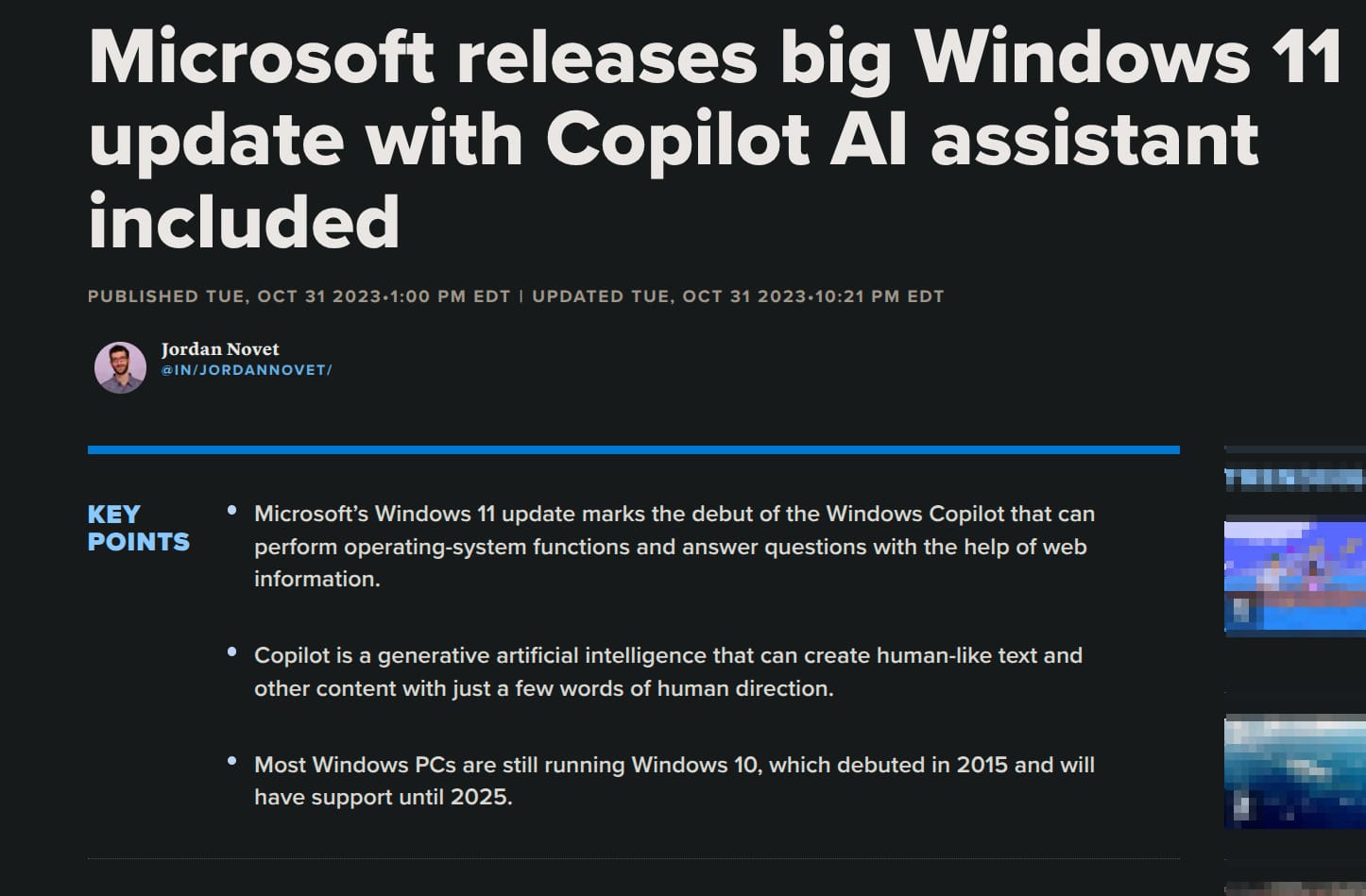
23H2 release
On April 24, 2024, Microsoft shipped update KB5036980, which injected advertisements into the Windows 11 Start menu's "Recommended" section. These showed up labeled "Promoted" and pushed apps like Opera browser and some password manager nobody asked for. And the Start menu was just one surface, they also placed ads on the lock screen, in the Settings homepage hawking Game Pass subscriptions, inside File Explorer pushing OneDrive, and through "tip" notifications that were thinly veiled product pitches. The "fix" promises "fewer ads." Fewer. The operating system you paid $139 for at retail should have exactly zero ads, and the fact that "fewer" is supposed to impress anyone shows how thoroughly Microsoft has lowered the bar.
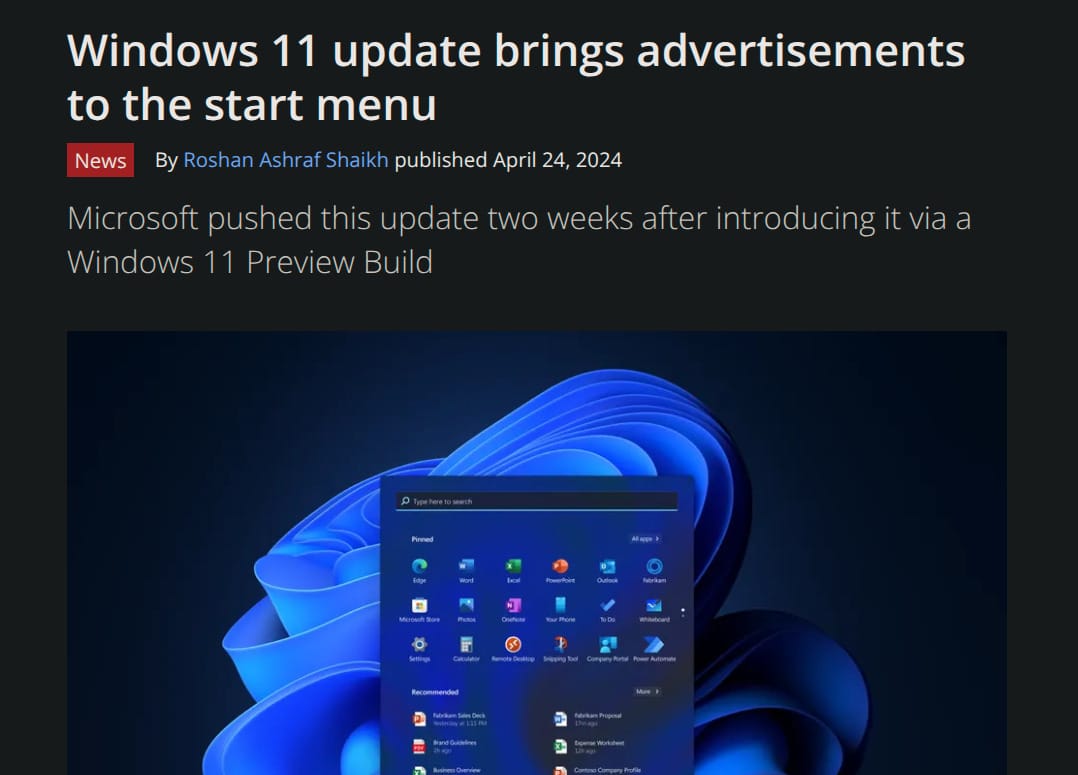
KB5036980
The privacy angle is where this gets dangerous. When Windows 11 launched in October 2021, Home edition required a Microsoft account during setup. By October 2025, Microsoft had systematically hunted down and killed every single workaround for creating a local account, the `oobe\bypassnro` command, the BypassNRO registry toggle, the `ms-cxh:localonly` trick, even the old fake email method. Amanda Langowski from Microsoft stated it plainly: they were "removing known mechanisms for creating a local account in the Windows Setup experience."

A Microsoft account means your identity is tied to your OS from first boot. Your activity, your app usage, your browsing through Edge, your files through OneDrive, all funneled into a profile Microsoft controls. And this particular abuse is nowhere in the 7-point fix plan.
OneDrive got the same treatment. Microsoft silently changed Windows 11 setup in 2024 so that OneDrive folder backup enables automatically with no consent dialog, syncing your Desktop, Documents, Pictures, Music, and Videos to Microsoft's cloud. When people discovered this and tried to turn it off, their files disappeared from their local machine because OneDrive had moved them, transferred ownership of your personal files to their cloud service without asking. Author Jason Pargin went viral describing how OneDrive activated itself, moved his files, then started deleting them when he hit the free 5GB storage limit. Microsoft's response to this was silence. Also not in the fix plan.
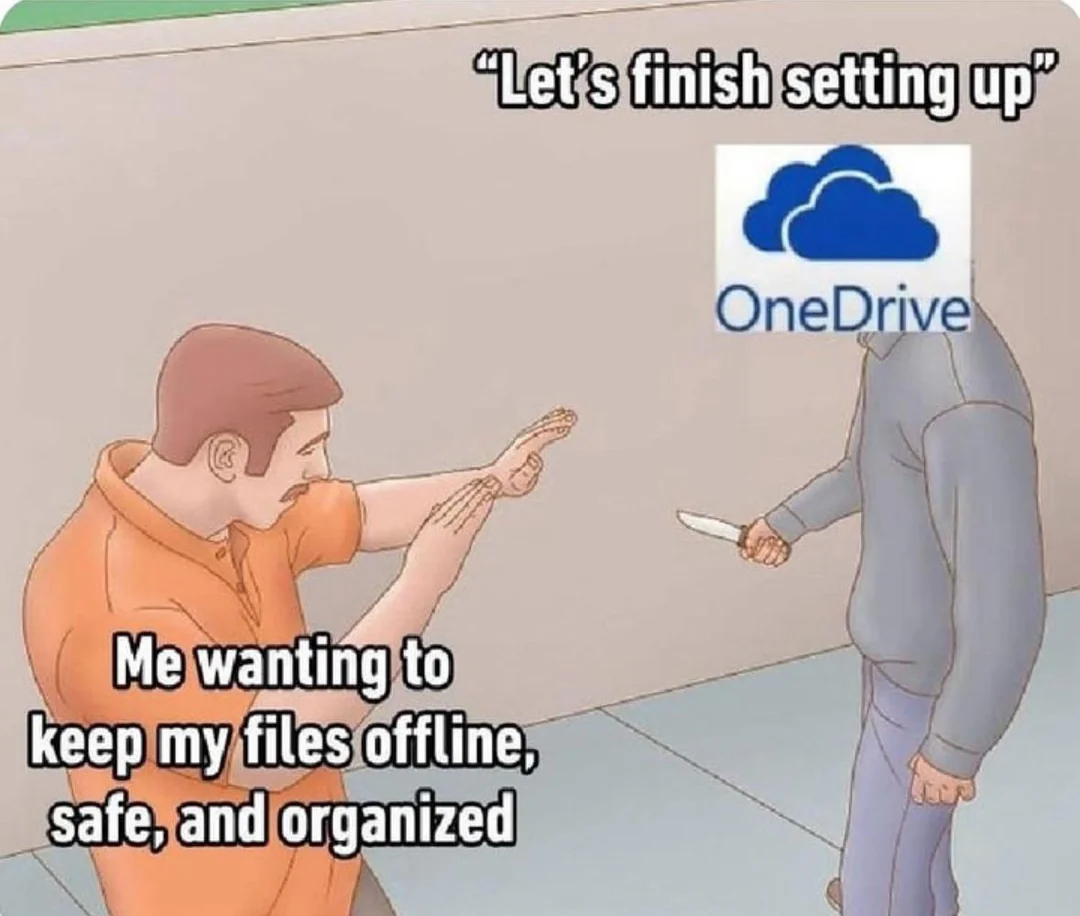
OneDrive
Windows Recall is worth lingering on. Announced May 2024, it's an AI feature that screenshots everything on your screen every few seconds and makes it searchable. Security researcher Kevin Beaumont demonstrated that the entire Recall database was stored in plaintext in an AppData folder where any malware could extract it. Bank numbers, Social Security numbers, passwords, all sitting in an unencrypted SQLite database.
The UK's Information Commissioner's Office got involved. Microsoft delayed it, made it opt-in, added encryption, and quietly relaunched it for Insiders in November 2024. They built a surveillance feature, shipped it broken, got caught, and called the patch "responding to feedback."
click to restart
But the abuse pattern goes back way further than Windows 11. In 2015 and 2016, Microsoft ran the GWX (Get Windows 10) campaign, full-screen nag dialogs that pushed Windows 10 upgrades on Windows 7 and 8 users. In May 2016, they changed the behavior of the red X button so that clicking it, which for decades had meant "close" or "cancel", instead scheduled the Windows 10 upgrade. Microsoft's own security advice told users to close suspicious dialogs using the X button, and they weaponized that trained behavior against their own customers. A woman named Teri Goldstein sued after the forced upgrade bricked her travel agency PC and won $10,000. Microsoft appealed, then dropped the appeal and paid. They eventually admitted they "went too far."
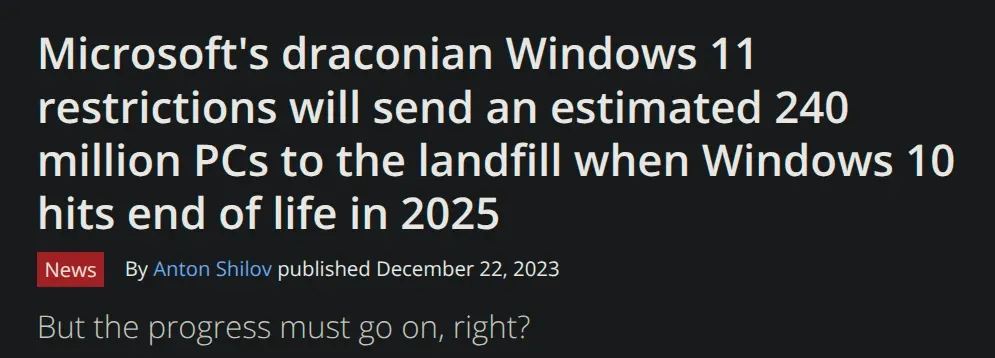
And right now, Microsoft is about to force 240 million PCs into the landfill. Windows 10 hit end of life on October 14, 2025, and Windows 11 requires TPM 2.0, specific CPU generations, UEFI Secure Boot, hardware requirements that excluded roughly 20% of all PCs worldwide. Perfectly functional machines, rendered "obsolete" by arbitrary software restrictions. If you want to keep getting security patches on Windows 10, Microsoft will charge you $30 per year, paying for patches to an operating system you already bought a license for. Enterprise customers pay $61 per device for Year 1, $122 for Year 2, and $244 for Year 3, with the price doubling each year.
Edge is its own disaster. Mozilla commissioned an independent report titled "Over the Edge" that documented specific dark patterns including confirmshaming (pop-ups implying you're "shopping in a dumb way" if you don't use Edge), disguised ads injected into Google.com and the Chrome Web Store, and default browser settings that hijack back to Edge without notification. Certain Windows web links still force-open in Edge regardless of your default browser setting. Despite all this manipulation, Edge holds just 5.35% global market share. Even with the full weight of an operating system monopoly forcing their browser on people, almost nobody chooses to use it.
And the telemetry question. On Windows 11 Home and Pro, you cannot fully disable telemetry. Setting `AllowTelemetry` to 0 in the registry on non-Enterprise editions gets silently overridden back to 1. Only Enterprise and Education editions can actually turn it off. The operating system you paid for reports data about you to Microsoft, and the setting to stop it is a lie on consumer editions. Also not in the fix plan.
| What They Broke | When | "Fixed" | Gap |
|---|---|---|---|
| Taskbar position (top/sides) | Oct 2021 | Mar 2026 | 4.5 years |
| Taskbar drag & drop | Oct 2021 | Sep 2022 | 11 months |
| Copilot forced on taskbar | Sep 2023 | Mar 2026 | 2.5 years |
| Start menu ads injected | Apr 2024 | Mar 2026 | 2 years |
| AI buttons in every app | 2024 | Mar 2026 | 2 years |
| Forced update restarts | Oct 2021 | Mar 2026 | 4.5 years |
| Local account blocked | 2021-2025 | Never | - |
| Telemetry on Home/Pro | Oct 2021 | Never | - |
| Bloatware installs | 2015+ | Never | - |
| OneDrive auto-sync | 2024 | Never | - |
I haven't even mentioned the EU fining Microsoft over 2.2 billion euros across multiple antitrust rulings, including 561 million euros specifically for breaking a browser ballot promise, a Windows 7 update silently removed the choice screen for 14 months, affecting 15 million users, and it was the first time the EU fined a company for violating a "commitment decision." Or the _NSAKEY controversy from 1999 where a second crypto key labeled literally `_NSAKEY` was found embedded in Windows NT. Or the time in August 2024 when a Microsoft update bricked Linux dual-boot systems across Ubuntu, Mint, and other distros, and it took 9 months to fully fix.
Ok so here's the table that tells the whole story:
click to replay
The bottom four rows are the ones that matter. The privacy-hostile changes, the forced Microsoft accounts, the telemetry that lies about being disabled, OneDrive hijacking your files, the pre-installed garbage, none of that is part of the fix plan. Microsoft's "swarming" effort targets the most visible UI annoyances, the ones that generate bad headlines. Data collection, vendor lock-in, forced accounts, those stay because those are the revenue model.
Microsoft spent four years deliberately degrading an operating system that people paid $139 or more for, and now they're announcing the removal of their own damage as if it's a gift. The "fix" is them taking their foot off your neck and expecting applause. The ads should have never been there, the Copilot buttons should have never been forced, and the taskbar should have never been crippled in the first place. And the things they're choosing to keep, the telemetry, the forced accounts, the data harvesting, those are the real product, because at this point, you are.
Progress 0/10 answered
Question 1
When did Microsoft first push Copilot into Windows 11?
March 2023
September 26, 2023
January 2024
October 2022
Question 2
Which Windows update injected advertisements into the Start menu?
KB5034441
KB5036980
KB5039212
KB5031354
Question 3
What happens when you set AllowTelemetry to 0 on Windows 11 Home?
Telemetry is fully disabled
Windows silently overrides it back to 1
The system prompts you to confirm
Windows Update stops working
Question 4
How many PCs are estimated to be scrapped due to Windows 11 hardware requirements?
50 million
120 million
240 million
500 million
Question 5
What did Microsoft change about the red X button during the GWX campaign in May 2016?
It minimized the dialog instead of closing it
Clicking it scheduled the Windows 10 upgrade
It reopened the dialog after 5 minutes
It was removed entirely
Question 6
What was the Windows Recall database originally stored as?
Encrypted binary blobs in System32
Plaintext in an AppData folder
Cloud-only on Azure servers
AES-256 encrypted SQLite database
Question 7
What is Edge's global browser market share despite Microsoft's dark patterns?
12.8%
5.35%
18.2%
8.7%
Question 8
How much did the EU fine Microsoft specifically for breaking the browser ballot promise?
€280 million
€899 million
€561 million
€1.2 billion
Question 9
How much does Microsoft charge Windows 10 consumers per year for extended security updates?
$10
$30
$50
$99
Question 10
How long did it take Microsoft to restore the ability to move the taskbar (top/sides) after removing it?
6 months
2 years
4.5 years
3 years
0/10
Your Score
0
Correct
0
Incorrect
0
Unanswered
In the case of Office I actually consider it a strength. Office has to take into account a large number of use cases, most people will use only a fraction of what is available, but not everyone use the same fraction. So that "unrelated button" may be someone else's essential feature. The "insane defaults" are what people are used to. I don't know about Apple, but I tend to get to the limits of Google Docs/Sheets rather quickly. It may cover 99% of my needs, but Office gives me the missing 1%.
That's for the traditional Office Microsoft are sabotaging, the web versions are only a shadow of it, and by most points worse than the Google suite, and that's the problem.
As for font rendering, I am sure that Apple is ahead, it has always been their strength. Microsoft may be the king of the office, but when it comes to art and creative work, Apple has always been on top.
;)
For low end laptops, if you can tolerate Apple's terrible window manager, rapidly declining stability, and creeping ads (they leaked expansion plans that are coming soon), then the Neo probably wins.
Typed on a macbook pro.
The cycle is more complicated:
* 2000: exceptional
* XP: bad (the original XP was indeed bad)
* XP SP2 (from a technological perspective basically a new OS): decent
* Vista: bad
* 7: good
* 8: awful (it was so bad that soon 8.1 was introduced)
* 8.1: bad
* 10: controversial (some say it's "decent"; some say it's "bad" because of the magnitude of telemetry (spying) that Windows 10 introduced)
* 11: awful
So, in my opinion it's rather a general downward trend with some overlaid cycle.
Gaming on Linux is a mostly solved issue for anyone that doesn't do competitive multiplayer gaming. If a game isn't using some root kit level anti-cheat or copyright protection, it is going to run just fine. Same with running most other software.
The only part where Linux is sucks is for certain creatives fields. If you need Adobe products you are out of luck. Video editing well you use Da Vinci or free software. There are some good DAWS but no Ableton.
Yes, you have to compromise but Linux is definitely getting there. Not everything runs on Mac either and people cope just fine.
Like domestic abusers, things only expand and escalate from here.
Maybe, but I somewhat doubt it, for a few reasons:
- Kids like iPads for gaming/video watching, and the overhead of computer interfaces for them might discourage laptopping (understandable for littler kids; regrettable loss of tech familiarity for older ones, but true regardless).
- Parents/rough users like iPads 'cuz there aren't moving parts or gaps to get hammered and damaged, though the screen is a risk.
- Cellular iPads/huge phone-alikes are pretty popular, and the vast majority of users are unfamiliar with the idea of hooking a computer-shaped device up to cellular internet.
- iPads are easier to MDM-manage/lock down. You can do that on MacOS too, of course, but a lot of folks find it easier to regulate kid/employee/etc. use of an iPad because the management system is familiar and simpler.
- iPads feel like a big phone. That's a pretty intuitive switch for a lot of folks who either don't have keyboarded computers at all, or associate them with non-fun (work/school) computing. Silly distinction to draw, to be sure, but very significant in the minds of many users. The single-brick/touch aspect of iPads is desirable enough that a fold-out laptop isn't going to overlap with a lot of those users.
Really? Isn't this only for App Store and other Apple services? You can still do your everyday basic things, including downloading and installing software from internet.
Exactly.
I am in an engineering design software developer organization bought by an investor from the founders approaching retirement (they worked 3 decades on this software helping construction engineers designing better homes). Ever since the lead up to the sell - changes were tuned to lure in investors, for the liking of investors - our organization is focusing on maximising revenue. Fast. That is THE focus. New marketing strategy, sales strategy, licensing strategy changes, reshape organization to have more informed decision making in sales (i.e. collecting and processing much more data on increasing number of contacts). Company meetings are about EBITDA, sales goals vs. actual, streamlining organization. Luncbreak discussions evolve around how to license existing features differently so it would trigger/force up/cross sales.
What is not on the agenda for maximising revenue: features and engineering. We are a "sales oriented organization", says our new CEO prodly - brought in during the sale. Addressing user needs and becoming more popular for the eventual income boost takes longer than the sales cycle of less than 5 years (the investor wants to sell the company in 5 years time). Engineering is in the way, accounting books need to look much much better much sooner for the eventual profit. Only sales tactics work here.
I see ralted pattern elsewhere, in tools I have the misfortune to use (SaaS and other subscription based products). Shameless self-promotions (cross-sale) distact your focus all the time, 'features' good for the assumed 'cutting-edge' image of the organization, privacy offensive practices (data for running sales campaigns), 'offerings' that help you with the ideas they force on you for some sizeable extra cost.
It will not end well. Takes long time to fail, but without valuable features and engineering there will be no value left for the users to buy eventually. No user wants top notch marketing, licensing, and sales strategy for the benefit of the organization.
Then why even do it?
It is completely impossible to comply with European privacy law if you are using up-to-date Windows for your business.
The US CLOUD Act compels companies to provide access to data on machines they have the technical ability to access.
Starting in Windows 8, Microsoft granted itself the ability to pull locally-stored documents out of (non-onedrive) folders on all machines for "debugging" purposes.
Since then, EU courts overturned the Privacy Shield deal with the US because our laws are in direct contradiction with their privacy protections, so no, there isn't some backstop that lets Microsoft be the good actor if they get a bogus warrant.
If the EU could ban Windows, I'm sure they would have done so already.
Source on "they can read your files": https://learn.microsoft.com/en-us/compliance/assurance/assur...
Note that this policy began in the Windows 8 days, and didn't originally have the Microsoft 365 branding attached to it. Now that Windows 11 mandates login, they changed the wording.
A lot of windows UI design decisions are pretty good. They mess it up now and then like windows 8 (tablet design mess) disaster, especially now with WSL 2.0, it delivers everything I need.
Do I still hate it , yes for the reasons explained in this article and other stupid designed features like search index, windows defender , mix of legacy and new dialogs, for the shitty design of powershell and then the mess of mixed shells, terminal etc.
List goes on, but comparatively I’ll pick windows desktop over anything out there at the moment. It’s a personal choice but I assume majority of windows user feel this way (or cannot afford macOS :))
Apple shipped 25.6 million Macs in 2025. Lenovo shipped 19.3 million PCs in the 4th quarter alone.
Phones got larger and more capable, tablets now seem somewhat redundant. But a laptop with a keyboard and 'real OS' can still do many things that aren't practical on a tablet or phone.
I don't see any of the other things you do. I use Edge as my default browser, with uBlock installed and it all seems to work. There is a Copilot icon, but I think I could remove it if it irritated me, which it doesn't. My Asus Zenbook has a Copilot key which irritates me much less than other aspects of the keyboard layout which have nothing to do with Microsoft.
All in all, I like Windows 11. I don't see how it has made things worse than any of the other NT versions.
https://www.reddit.com/r/SurfaceLinux/comments/nwr4kd/best_d...
It's imperfect. We have way more choices in domestic partners than we do with operating systems but I think there are a lot of similarities though too. User-hostile software like Windows is intentionally designed to develop dependence and learned helplessness in users. Windows will gaslight you. Microsoft will victim blame. Many shared tactics. It's a fair comparison to make.
I'm interested in where that estimate + number are coming from. And I'd like to point out that I don't nearly see as many people pushing back against say MacOS for "not being Windows", despite the fact that the same issue would be there. I wonder why Linux gets special treatment in that regards, when modern distros make usage very accessible.
> And that doesn't even get into gaming.
Gaming on Linux works very well. And if something doesn't, it's usually by choice (e.g. BattleEye customers not enabling it on Linux) or by sheer incompetence / malevolence (e.g. EA Games and their shitty EA App that breaks often even on Windows, and even worse on Linux in a Wine environment).
Hard disagree. Not that it has to be FOSS, but you have a product that is predatory towards you and you refuse to change your ways.
Leaving an abusive relationship is hard, but sometimes you have to do it.
I suspect that most people don't run much software at all outside of their web browser and wouldn't notice any difference between using chrome in windows and using chrome in linux. Gaming is not the barrier it used to be either.
It's not 2016 anymore, you don't have to switch to LibreOffice if you need an office suite of apps.
That obviously would be preferable, but if you're an avid Microsoft ecosystem user, just use WinApps. It's simple enough to the point that a child could use it.
It is getting tiring, I don't say Linux is perfect, but KDE has been better than Windows for years, Linux doesn't bit rot like an average Windows install and Linux is in practice surprisingly more stable, but no-no-no, Linux can't be this time again. Quick... ehm "there is a piece of software that only works on Windows". Have you ever thought the reverse holds too, but times 1000?
If you call yourself an IT-professional, you only run spyware.exe in a vm or in a box with all networking gear ripped out and you don't making stupid excuses.
Unfortunately this also allowed the USA to have companies so large that they basically control the government, changing this now will require massive political will and a political body untethered from corporate interests. I really don't see that happening in the USA, it's been thoroughly captured after so many years driving on that path.
Don't buy their products, and tell your friends
Consumers have the final say, our economic system fundamentally is consumer spending. (Ok, save for most recent year(s) of mag7 AI buildout. But generally that's the case for USA economy).
We have to stop taking out our wallet and just accepting things like sheep. (nearly) Every one of the "scrapped" computers could have run a *nix OS and been a middle finger to microsoft.
The only way that stops is by having enough people leave that they change their behavior, and it's not sufficient to switch to the competition that is operating under the same perverted incentives under the same system with the same failure modes. No Windows, no Mac, no Chromebooks, no enshittified corporate quagmire of awfulness and despair.
The solution is simple - use Linux. Set your family up with Linux.
It's the year of the Linux desktop; it's never been easier or better, and it's never been more important to make the leap.
Windows' biggest competitor is iOS, and many people have stopped using Windows entirely and just rely on their phones. Microsoft has had record profits since that started happening.
https://support.focusrite.com/hc/en-gb/articles/208530735-Is...
I haven't actually tested it, but it seems like it works for people, and it's solid enough to have the kernel component in the kernel. I found it while researching a possible move with my Vocaster One.
Public infrastructure should be built on open-source, period.
Buyers of PCs, laptops and other devices with Windows pre-installed. I guess that the cost of the Windows licence is included in the price of each device.
The distribution which left the root account without a password if you selected "Use sudo as default and disable root account"?
It actually is. It may not be the best solution, but it absolutely is one of available solutions. = Not being able to ( or wiling to ) learn ( and adjust ) as needed is part of the reason we are here.
I am not being nitpicky here. Reasonable people don't hope things will change; instead, they change things they can.
Perhaps ironically, Wine may be the best stable API on Linux. I'd like to see a concerted and well-funded effort to make Wine run certain Windows applications well. We might not be able to replace the Adobe Suite short-term by a FOSS alternative for most of its users, but we might be able to get Wine to run the Adobe Suite, Affinity Suite, and whatnot well enough to make it possible to switch and keep running these applications.
We crossed an all-time record recently.
We get a 2 rows x 3 column grid now. The upper left is an ad, the lower row are clipped in half to coach scrolling, bringing the total to 2 thumbnails.
I feel like a junkie whose dealer tripled their prices and cut the drugs with 80% filler; sobriety by cartoonish consumer exploitation
I was thinking about this compatibility problem the other day. Usually someone moving between office suites (MSFT Office, Google Drive, LibreOffice) complains stuff broke, then they give up / drop it / work around it. I was imagining an ideal path would be to document these cases of incompatibility as bugs/issues in LibreOffice. Describe the difference and how it should work, then LibreOffice fixes their software to better match. I don't know if this already happens. Personally I avoid all office software like the plague and try to work with plain text files and vim. I just hear about these issues enough that I'm mildly invested in the situation by now.
I tried to tell a friend about WYGIWYM stuff like LaTeX, groff, and Typst the other day. He seemed more interested in "figuring out" why stuff broke when changing between office software. I tried to tell him that MSFT doesn't follow their own spec and everyone else has to reverse engineer it, resulting in implementation differences. Plus MSFT's own implementation being proprietary so it can't be easily copied. I'm not sure the weight of the situation got across to him.
The biggest reason I don't just migrate is because gaming. Most steam games could work on Linux but then if you want to play one that doesn't you have a problem. I'd rather just use Windows and never have a problem, because the game was designed for my platform.
That being said, for work I use macOS.
https://americanhistory.si.edu/comphist/sj1.html#kids
My point is it's harder to switch from the system you know.
Prior to SharePoint 2013, Microsoft used sparse columns. It made for massive tables and was poor design.
Moving to XML blobs for user-defined schemas was the correct choice. The table schema became significantly smaller and user-defined schemas (for Lists/Libraries) could become much more complex.
I'm guessing the native client has been going downhill, based on frequency of issues people report. I hope they kind of forgot about the web client, and won't enshittify it as quickly.
And honestly it seems like you refuse to learn even the smallest bit about human nature.
Very, very few people want to "learn" how to use their computer. Walk into a room of 100 graphic designers who have spend the last 20 years using Photoshop exclusively and put GIMP in front of them and and at least 98 of them are going to say what the hell is wrong with you, they have work to do, take this uncanny valley garbage and get out of here.
I'm typing this on a System76 laptop right now but I understand expecting people to use Linux writ large is ridiculous.
In our office, we'd definitely need the enterprise version for compliance reasons, not because of the features. That's about 14/user/month.
At a workforce of roughly 2500, that's a 4million+ yearly cost for something that is comparable to something you can get without that pricetag. It's no competition at all at that point. Think about it, would you be willing to ask your boss to pay 4 million so you can have a different chat app? No matter how much more ergonomic and friendly and intuitive it is.
Make office work and people will happily leave in droves.
It is a solution. Once you do it, your problem is solved, that makes it the solution. If you aren't willing to go with that, you can stay with Windows and just accept the constant abuse.
As for gaming, I've been on Linux for two years now and I haven't had a single game not work.
Both installing Windows and installing Linux can be difficult for most people. I have done both professionally and when installing Windows I have encountered frequently more serious problems, which required much more time to solve than the problems encountered when installing Linux.
For those who have someone else to install and configure Linux, it is at least as easy to use as Windows.
My parents, more than 80-years old, have used for many years Linux without any problems and they have no idea what Linux is, they just know the applications that they are using for viewing and editing documents, e-mail, Internet browsing, music or movies listening or watching, TV watching or recording (with TV tuner) and so on.
Take an industry with healthy competition like restaurants. You can compete in price, quality, format, service and probably a lot more.
Now tell me how that competition enshittified eating at restaurants?
For me, nothing stands out. If a restaurant charges nonsense fees, under-staffs to increase profits, reduce portions with the same value, etc. I can simply go to another one. Restaurants that enshittify will almost inevitably close.
But if we look at a closely related industry like the food delivery apps, we see the same exact signs of enshittification we see on the tech world due to monopolies (or oligopolies to be more exact) like: - Increased/hidden fees
- Increased delivery times
- Crappy apps with ads everywhere
- Ineffective review systems
- Pay-to-win search
- Dynamic pricing
They can get away with it because realistically, you don't have any other options. The cost to entry might not be that high but the network effect all but prohibits competition.
* Windhawk - can tweak taskbar with extensions similiar to gnome tweaks imo (free)
* DisplayFusion - qol for multi monitor setups (paid)
I would give it a try if these two applications help you, honestly there's just so many settings to explore -- but afaik static width was something I needed and got done through Windhawk.
I imagine them presenting their design on a static PowerPoint slide, and upper-management says "beautiful", and they move on to CoPilot features, never looking back.
The real problem is more specific industry software - Revit, Solidworks and probably a thousand smaller ones.
Pretty much all their other stuff is stuff that either works fine on Linux or is just in the browser anyway, but the only thing that I don't really have a rebuttal to is when my dad points out that he uses the full-fat excel and a lot of the more modern features.
I would so rather they move to Linux, and just put Excel inside Winboat or something, but they won't have it. Annoying since I'm still expected to play tech support for them and Microsoft's recovery tools do not work, and as far as I can tell have literally never worked for anyone in human history, and I'm not entirely convinced that the people at Microsoft have ever tested them.
That said, I doubt the average person on a laptop even needs a general computing device, so your point does make sense. Though, is carrying around a screen and a keyboard and cable any better than carrying a laptop?
I could see an argument of it being cheaper, but that would take years, possibly decades, of multiple competitors in the space for the market to make that true.
Now, if we could have a decent folding keyboard and monitor that fit into the same case as your phone, that would be a game changer, but I don't think anyone is risking the investment to develop that.
Turns out, a lot of people do exactly that. Hundreds of millions of people play CoD, Fortnite, Battlefield, Apex and many many other games which won't work on Linux at all.
I think the state of gaming on Linux is absolutely incredible - what used to be a very esotheric and "roll of the dice" process 20 years ago now is extremely simple and it mostly just works. But when I play games with friends every week it's almost never a game that would work on Linux.
I think this post's usage is meant deliberately to be a bit edgy, to illustrate how badly Microsoft has behaved.
An encouragement to be mindful of language, and therefore discuss what shared context we're trying to build, shouldn't be so controversial in a self-professed 'thoughtful' [0] forum.
Personally, data point of 1, I think it's a bit distasteful, and would prefer to participate in a community that doesn't routinely use that kind of langauge.
Username checks out, but you might want to check with your mother about how she feels about this comparison.
TFA brings up abuse not stndef.
An analogy is "a thing which is comparable to something else in significant respects" and stndef is right to point out that microsoft behavior, while abusive, is not comparable to domestic abuse "in significant respects". Not even close.
The TFA title is sensational for effect and in very poor taste.
Linux is an important operating system, but anyone under the delusion that it is desktop ready right now needs to actually watch someone use it. I say this not because I hate linux, but because I love it. I want someone to make it usable for a desktop, and people claiming that it is usable right now are not helping that.
You’re actually giving that same venture capitalist $4m of their own money back, in a way that makes their investment more valuable.
I, living in Germany, rather wonder myself quite often why US-American tech startups don't act much more frugally: this would give them so much more leeway/runway to make their startups succeed.
Just as nobody is pushing back against Linux when it comes to server software, or pushing back against PlayStation when it comes to games.
Or users that have a very crappy Windows laptop and would like to improve to something good hardware wise?
Or what about Windows users that have other Apple devices and don't have strong hardware requirements?
Let's not forget about RAM and SSD prices increasing PC prices through the roof.
I'll be happy to correct myself if I said anything wrong, but downvotes without comments really don't tell me much.
Individual consumer action does not a monopoly break.
Too many markets are utterly dominated by one or two big players. I know it’s a tricky problem because market share is hard to define (Does Amazon have 80% share of e-commerce? Or 30% share of all retail?) but I think we would be better off if there were a more aggressive set of rules about anti-competitive behavior that automatically applied to these huge firms, which didn’t rely so much on subjective judgment.
The family computer is set up to boot into Ubuntu; booting into Windows 11 is the exception (games, iTunes).
Over Peak I had to update a shared Excel file on SharePoint each night - because as we all know, Excel is the finest multi-user database in existence. I had no problems doing that from my iPhone.
My “nice” mechanical keyboard is sitting on my old desktop, which is now a container store. It’s easier to not go back and forth.
To solve the chicken/egg problem, the GNU/Linux distributions should generate some very (in particular binary) stable interface for writing applications (including GUI applications) on GNU/Linux - like WinAPI on Windows. With "stable" I mean "stable for at least 20-25 years". This interface must, of course, work on all widespread GNU/Linux distributions.
Nearly 1 billion PCs have stayed on Windows 10, 42% of the global desktop marketshare is still on 10 despite EOL. Linux has been showing consistent growth on the steam hardware survey as well, and time will tell but I have a feeling the MacBook Neo is going to put another nail in Microsoft's consumer coffin.
The problem for us is that's such a tiny margin of Microsoft's customer base. They aren't a consumer company anymore. For Microsoft to feel the pain, we need the big legacy enterprises to start ripping out Windows (and by extension, rip out Windows Server, Azure, M365).
Us here on HN are in a unique position to help, with many of us having influence on or even the authority to make technical decisions for the companies we work for. Its not enough to stop buying Microsoft at home, we all need to stop buying Microsoft at work.
Only if consumers have viable alternatives to choose from. If they don't then what are they supposed to do?
Also quite a few inaccuracies - what the heck is 'bit rot' on windows? I had 1 same Windows 10 install running on desktop for 8 years as primary personal PC and installed tons of software and games, both official and... some other types. 0 issues.
On laptop whole lifetime with original install is the default for everybody I know, for me 6-7 years (simply the length of ownership). We don't talk about Windows 95 or ME era here where frequent installs were basically mandatory and a well-practiced chore.
For photography and graphic arts, Linux can handle many if not most of the work (I use Digikam and Darktable with great success, for example), yet when it comes to audio for example, it falls short due to a thousand papercuts.
Another instance where companies can have more leverage than consumers is gaming. Console exclusives are a thing because they work; not giving consumers the option to play Pokemon on anything but the Nintendo Switch drives switch sales. Microsoft is better off working with other gaming companies to ensure Windows keeps being dominant, than building an OS to gamer's preferences.
I think time has proven many times that consumers aren't always good regulators for the market. The market is best regulated by organized entities.
They fought the compiler wars with real engineering, giving Borland a run for the money. Different people have different opinions about Visual Studio. As a Linux user since 0.9 I did not like its architecture and focus on GUI at the expense of everything else, but I still saw it as a consistent framework done by excellent engineers. And so on.
Win98: bad
Win98 SE: good
Yes, and you correctly point out: On the average restaurant visit, nothing stands out. A good restaurant only needs to provide not-terrible food and not-terrible service to be almost indistinguishable from all others. Quality of a restaurant visit is hard to measure and compare. Price is easy to measure. Thus, the rational consumer will prefer the cheaper option (and even at the same price, a restaurant with lower costs will be more profitable, thus expand more easily).
The same thing happens on Amazon and other market places: When it is difficult to compare quality, price always wins out. Some products are interchangeable with well defined specs, like a 16GB RAM stick is obviously twice as good as 8GB RAM and so it can be twice as expensive and still sell. But when I'm looking for a new light for my bicycle there are no standardized specs to compare. All the product descriptions and pictures are exaggerated. I have no reliable information to tell if the lamp that is twice as expensive is really twice as good (and from personal experience: they never are), so I'm buying the cheapest one cause I expect all of the products to be equally crappy no matter the price.
It's not Amazon's fault. This happens everywhere.
You may have to spend extra work to get things running; but once it's done, it runs forever without a hitch.
I know, I use Slackware. It's regarded as a very technical distribution and some manual configuration is expected but once it's done, it's done. I have configs from > 20 years ago that I still use without a hiccup.
I guess you want a Mac. That's fine.
I value freedom and things not mysteriously breaking and functionality not disappearing, and am quite happy investing a the time and knowledge upfront, so I use Linux.
And then there are people who want to have a system which works out of the box initially and who don't want to learn anything and don't mind it breaking later, and they choose Windows.
To each their own.
Do you also have a problem with "killing" a process on a computer? A kill-fee on a contract? How about killing time?
They had a "last release in the series was best pattern" with Win 3.11 / NT, Win 98 SE / 2K and XP SP2 (which merged the consumer and business tracks).
After that, it's been strictly downhill. 7's additions vs XP are purely hostile to the end user, including escrowed disk encryption and DRM. 8 was the beginning of the pivot to mandatory cloud. 10 added mandatory telemetry and ads. 11 added nonsensical AI crapware, and turned the ads to 11.
The question is: "are staffers $14 / mo more productive with it, than the free version?"
The answer may also boil down to satisfaction, support calls, other things, aka 'total cost of ownership' as well.
Not 'But it costs $X million!'.
Companies will spend a fortune giving staff the right monitor, or chair, but literally don't think they're smart enough to know the dam tool they use all day?
Let them pick their chat software, like they pick their monitors.
That one's using PlayOnLinux.
Not tried it myself but that's been one of the blocks to me using linux as a day to day thing. Although I'm on mac and don't find it too bad.
Someone would send you a document and it took over the entire Teams window. You had to exit it in order to chat with the person about the document. The concept of having more than one 'thing' on screen at the time was completely missing. My only explanation was that the developers had never used a computer before.
Would have they bought such a configuration on a random computer store?
It's a shame too, I feel like the underlying OS has some really good engineering in it, but the layers of cruft and anti-features on top make for a poor overall product.
Hated 10, was forced to it basically only due to gaming, a common assholish trick MS uses whenever it can. But when looking from 11 perspective, 10 was fine compared to that heap of disorganized badly designed crap.
Yet again time to be ashamed to work for MS, this time its sticking around like tar spit on a white shirt.
Just curious, is it about different tools / workflow / the new thing to learn (and those are valid reasons!) or are there some technical issues with for example Winboat?
you interest me strangely - which one?
I see this point being missed over and over again in this thread. To people like you and I the computer is often the entire point. To normal people it's a tool. It exists to get the job done so they can move onto something else.
The solution that requires the least effort is objectively the best solution. Most of the time that still means Windows, and it won't change until the required level of effort changes.
If we had a giant influx of computing illiterate people, the platform would enshittify. They would move towards android-type lock downs and user hostile stuff. More and more binary-only proprietary software, they might fork systemd etc and make sure that the proprietary binaries only run under certain unmodified setups etc. Of course there would be escape routes to various other, nonpopular distros, so the skilled people would be fine again, but there would be a barrier again.
I think this is fundamental. Once the general public starts entering an arena, it won't stay the same. Eternal September etc.
All of these issues go away with Mac and Windows. I'm not giving up on Linux, I'm just a realist.
Your critique should be channelled into a productive direction and point the finger at the maintainers why this is not packaged yet. https://repology.org/projects/?search=winapps https://pkgs.org/search/?q=winapps
Moving forward, I'm sticking with hardware where everything works without setting the Linux 'taint' bit (i.e., zero proprietary code in the kernel). Most laptops made in the last few years with an AMD CPU + GPU meet that requirement.
I'd require that even if I was running windows, given how badly I've been burned on short hardware support lifespans in the past. For instance, I also have an Intel OEM reference motherboard that never had Linux video drivers. It no longer boots windows.
The tin foil hat interpretation of this is that it is all by design, by whatever cabal runs everything, to subjugate the masses and control them directly or indirectly. The generous interpretation is closer to an extreme version of Sturgeon's Law[0] where this is just a natural, even inevitable, byproduct of most things being garbage. Like most things the truth is almost certainly somewhere in the middle.
[0] "90% of everything is [crud/crap/shit]" https://en.wikipedia.org/wiki/Sturgeon's_law
The people doing the former use computers for ‘real work’. They are using a computer as an end in itself, care about operating systems and have strong opinions about systemd. The people doing the latter couldn’t give two shits about any of that and just want to get their presentation finished on time.
Problem is, both sets of people have to use the same machines. It’s also why software like GIMP will never become widely adopted in professional environments because it’s designed for a completely different userbase.
Better to go bust quick, than to eke out a tiny profit by being super frugal. The latter is a waste of everybody's time.
"Build musl libc statically, set up a toolchain to use it, build libc++ for that toolchain, get libwayland, link that statically (which their build scripts don't support, roll your own), get xcb,libxau,libxwhatever and build those statically as well, and implement TWO platform layers, dynamically checking for wayland support. There's like 5 different ways to set your window icon. Yes, you need to implement all of them. Now for loading the graphics API......."
On Windows it's a call to RegisterClassW followed by CreateWindowW.
It's a hard question to figure out what's the proper level of abstraction for this is. And while I strongly resisted it originally, I am becoming more open to the argument that many people don't need to "know" what a file is, to benefit from their computers - that as long as they can "save" their work, and "send" it from one app to another, they'd be able to get all the productivity that they are looking for.
The present: Nobody got fired for buying Microslop.
Microsoft has largely stopped asking consumers for money. The last paid upgrade was Windows 8, IIRC. Since then, Microsoft wants consumers to upgrade, so it's free, with full screen prompts at login, and sometimes the 'no thanks' button just does it anyway.
Microsoft sells consumer OSes to OEMs. I haven't been looking, but I assume they don't allow OEMs to install Windows 10 Home anymore; and maybe not even Windows 10 Pro. So when consumers buy a new PC, they're getting Windows 11. The only Linux option at most stores is Chrome OS, which Google is shutting down, and is just a browser for most users (it's a useful product! a lot of users just need a browser; but it's not a platform of empowerment)
I agree it's not as easy as pre-installed, but it definitely is viable.
Sure, but I also think that a lot of the issues with Windows 11 don't really matter much if its just used as a work OS. For example, I refuse to upgrade my home PC to 11, because I don't want Microsoft to spy on me; however, when I am using my work computer, I know that I am already being spied upon, so that's not a concern for me.
I actually have a desktop still running that got a launch party host Windows 7 Steve Ballmer edition install that's just been upgraded as time has gone on. Very much a Ship of Theseus machine but technically only ever migrated the OS image around, never reinstalled. That's 17 years of a Windows install so far, and its perfectly fine. That one install has made it through multiple motherboards and OS upgrades. It'll end up dying and being replaced once I get too uncomfortable with 10 EoL, this board is still useful to me but it doesn't have a TPM so Windows is dead to this machine.
Analyzed well here: https://yalelawjournal.org/pdf/e.710.Khan.805_zuvfyyeh.pdf
“Boy, I hate operating systems from evil gigantic corporations that constantly spy on us. I know the solution, let’s use a Google product!”
There is a whole ecosystem that needs to move before they can move.
In the past a good "registry cleaner" would help - but those are no longer reliable with newer versions of Windows - there are many virtual entries that get cleaned-up by overly aggressive utilities.
https://www.reddit.com/r/linux_gaming/comments/1qdgd73/i_mad...
Oh, and laptops are nasty. They are put together in ways that can easily confound you when you have plenty of experience. Lots of it revolves around little pieces of plastic that are marginal when new and that just want to break by the time the device needs service. It's a conspiracy!
Anyway, at least you know it can be done. The conditional still holds.
No, Win8 was all about the Metro/RT nonsense, the attempt to convert Windows into a touch-centric locked-down App Store platform.
While a fair bit of that lived on in 10, it was far less obnoxious. Although they still managed to break things like Sticky Notes in the process of converting them to 'store apps'
Don't worship Windows 8/8.1.
It also introduced WinRT, an API that gave the programmers a lot less freedom; the roadmap was clear: applications should from now on be developed for the WinRT API, and only be distributed via an app store (Windows Store). The old WinAPI shall be legacy, and will only be provided as long as Microsoft is willing to.
Windows 8's ARM version (Windows RT) was incredibly locked-down; here applications could only be installed via an app store (Windows Store). It was clear that Microsoft had similar plans for the x86 version.
Actually, because of programmers' and users outcry regarding this, Microsoft pedaled back in this regard with Windows 10 (but started introducing a lot more telemetry).
Also, Windows 8 was the Windows version that started the tight integration of the local user account and the Microsoft account. Windows 8 and 8.1 were the first versions of Windows for which the "How can I avoid setting up a Microsoft account when installing Windows?" tutorials started.
Play on Lennox is just non-free wine. And no offense to the wine people, but it seems like perhaps they have hit a wall on what would be Windows 10 translation.
Windows NT4 was also very stable (once you installed the Service Packs), but had a lot less convenience and modern features than Windows 2000.
The feeling of being able to work away from my desk and dont care about battery, is so goooooooood.
And I have to admit. Even if I dont like macos, my macbook with m1 and 16gb ram is probably the fastest laptop I ever own.
As I said in a sibling comment, I think they really just don't want to change and they are looking for excuses; I suspect even if I could prove that there's absolute feature parity between the two versions they'd just find another reason.
Honestly I think they really just don't want to change and they're trying to look for ways out because they know that "I don't want to!" isn't going to fly with me if I'm expected to be tech support.
Try not to blame the people working at the coal face. Developers lack influence in most companies, they are told what to do by product managers and the rot often gets worse further up the hierarchy chain. Developers mostly know what is wrong and don't like the shit they are doing. Imagine the anger of working on Server 2012 (Windows Server 8) with the default Metro UI - that idiocy had to go right to the top.
How independent are developers at Microsoft - are they in charge of product design decisions?
Also yes, volume licensees generally get massive discounts.
You're the only one saying that, not me.
They aren't looking and they aren't interested in looking. At this point they have no one else to blame.
If it's one of those and class compliant, you might be able to access all of it through alsamixer or one of the many frontends (maybe too many, maybe one for you): https://en.wikipedia.org/wiki/Alsamixer
The Audient situation appears to be a proper nightmare realm with non-class compliant stuff, but there is a tool with a list of caveats longer than you might want to deal with: https://github.com/TheOnlyJoey/MixiD
It's more best case scenario as an escape hatch and less problem solved, but it's something.
Most consumers are unwilling to take an option that they perceive as inconveniencing them more than getting screwed by the company inconveniences them.
They aren't a majority in any other market segment.
The person responsible for picking our work laptops asked me for advice selecting our new Macs since our old model was being replaced:
"Do we really need to spend an extra $1000 for 64GB of RAM instead of 24GB?"
"That'd save us $300 per year, or about a dollar a day, over the deprecation schedule, and it'd make our devs slower. We spend more than this to have lunch catered."
"You know... good point. 64GB it is, then."
And that's how we opted for beefy machines on this hardware cycle. The guy I talked to is extremely smart and competent, but just hadn't looked at it from that angle. Once he saw it, he instantly bought in. There are dumb ways to save money with massive negative ROI, and cheaping out on basic equipment and resources is one of them.
An operating system is a style of thinking about your work. WINE is a way to get Windows applications to run (by now run decently) under GNU/Linux. These Windows applications are nevertheless foreign bodies in the whole kind of thinking which GNU/Linux is built around.
I didn't expect Audient to work, actually.
The reality is that companies know they can get away with crap because they all get away with crap. And because they all do it, consumers are powerless.
This is why regulation isn’t a bad the thing that many HNers seem to recoil at. The real problem with regulation is when it’s defined by lobbyists rather than consumer groups. But even then, it’s really no different to the status quo where businesses are never held accountable.
I'll give you five guesses which OS I never booted into.
You don't have to be everything to everyone. You just have to satisfy a need.
I used to do a lot of document and Office work. If you had told me that 20 years in the future MS would still be around, automagic piracy enabled coding bots were a thing, and people were having problems because the buttons in Office don’t work, I would’ve flagged the third as unbelievable.
Yet, Darktable allows me to process my RAWs to a point which I like. Similarly, my audio equipment allows me to create some music which I like, too.
I didn't push Darktable to professional levels, but I believe it can match bigger tools for what I want to do with it. I don't do photo manipulation, for example. Just process RAWs. I expect the same from my audio equipment for my music endeavors.
It's sad because it's true.
On that note, I remember how absolutely ecstatic I was when I first set up Sublime Text and discovered that unsaved editor tabs always reliably survive restarts; it essentially flips the script, whereby I've lost multiple saved files by accidentally deleting them, but I've never accidentally lost work in unsaved tabs, and I've never actually had any interest in figuring out where and how these tabs get persisted - it just works.
Without the helpful abstraction of files and folders, all we'd have are bytes stored at various addresses or sectors of the hardware.
A disturbing proportion of my family spend more than half of their free time watching television (typically while doom scrolling tiktok). They don't "need" TVs - they need to find interests.
From personal experience, it really really is barely even an inconvenience. Especially in a world where YouTube exists and is accessible for free from a desktop computer. There's barely been anything good on TV for decades, and the older stuff probably only seemed good because of the difficulty of publishing any competition.
Are there some things I would struggle with if suddenly there were issues? Sure. I had to significantly increase my internet spend because of the (much) cheaper option going to complete shit. I require the internet for my career but unless the entire world collapses I doubt I'll run into any true blocker that would prevent me from using it for work.
Most people are just afraid to change their lives substantively. I am too, but I'm also willing to do it for causes I believe in.
I agree with most everything else you said, but would slightly push back on that. I actually quite like the idea of non-hierarchical blob storage searchable via arbitrary indexed metadata, as well as the idea of content-addressable storage (e.g. with magnet links). While folders are an elegant abstraction, I really feel that we shouldn't be beholden to it.
Besides, it’s not like TVs are the only industry where consumer choice is an illusion. You see the same problem in a lot of sports (I used to fence and there was a great deal of pressure to buy equipment from one specific manufacturer which charged literally 4x the price for their gear).
And it’s not just hobbies either. I need a car for family duties and there are plenty of parts on it that can only be replaced by an authorised dealer.
My point is that your list is one list which you are making, but someone else could look at your life and make a different list. Your argument only goes so far you can extend into your own life. If you really cared about something's place in your life, you wouldn't classify it as a convenience, so you are conveniently applying your own classifications to other people's lives, which you don't have a right to do.
This is why we have democratic institutions and authority -- to make these limits about what is tolerable and intolerable -- not what people's conveniences are.