Some franchising platforms (window cleaning is a good example) don't offer much beyond sales and marketing support and some nicely designed uniforms. There's not much to window cleaning other than basic equipment, so a person's route can easily be disrupted by a new entrant who doesn't have the franchise rake to contend with.
There's a model between employment, ownership and franchising that will probably emerge as sales, marketing, ops gets easier technically.
Godspeed bro.
> When I told my manager I was leaving, he said I should start my own company and give him a call when I do. So that's what I'm doing.
I love hearing stories like this, because it shows a way to be a builder without the "venture or nothing" narrative that has pervaded the tech space since the dotcom days.
It is very difficult to make a venture-backed services firm (providing services, not software) that can be immediately profitable, grow sustainably, and outperform competitors with in-house technology that's built for real on-the-ground stakeholders... at a speed that will satisfy venture investors.
But it is more possible than ever ([0]), to do this (in-house tech and all) on a bootstrapped basis - since AI reduces the engineering staff required to build, adapt, and maintain an agile best-in-class solution at single-tenant/single-customer scale. The outcome is at the least a lifestyle business, but with upside that can take the form of anything from franchising to licensing to full-fledged SaaS in the future.
I wish OOP the best of luck, and hope he's found a passion. He could go far with this approach if he ends up following through.
([0] This is not to say there are no barriers to entry. There's privilege in the word "founder," and this is no exception. And the K-shaped economy has left many brilliant would-be founders behind. But at least some barriers are lower than they once were, and that's worth appreciating.)
I think this falls in exactly that situation. You see how janky these national companies are doing things, plot out a disruptive course, then disrupt them in a particular region so that you can extrapolate how much that will hurt at national scale and force a buyout that's way beyond the multiple you bought those small operators for.
Consider being a platform coop with regional operators as members. See https://platform.coop/
Assuming everyone knows your acronyms is just not a good writing style.
Since I couldn't understand how s/w was going to get opossums out of anyone's basement, I think the correct decision was made: hands on!
You deserve accolades for making this choice. Good Job!
Like any physical trade, this is by it's nature a local only endeavor. So a web presence that is primarily visible to geographically local potential customers would be most effective.
Any aggregation is really just a way to skim some of the profits from the people actually doing the job. That is to say, GTM according to my definition above.
Personally, when I can't get an in-real-life personal referral to some trade, and I'm forced to do web search, I always spend extra time to try to find a web page that is put up by a local company, not an aggregator.
Things like plumers.com (this is a totally made up example, not referring to any real website) I find to be extremely irritating. Since they have absolutely nothing to do with whoever will eventually show up and do the work.
This form of aggregation through, is extremely common today, and a very large part of why the modern internet sucks.
craigslist.com (the actual website) used to be a good example of referring local services, until it was overrun with spammers and scammers.
Will this correct? Will we proceed to the dead internet? Who knows! What next weeks exciting episode to find out...
There are lots of antiquated operators not having newer technology for pest control, which makes this area lucrative for even $50K MRR.
Go for it!
I'd really love to read a dedicated article on this side project.
Apparently, Karpathy is into AI based education business with Eureka Labs [1].
[1] Introducing Eureka Labs:
My longterm vision is to be the agent platform for traditional industries, bridging the gap between knowledge work and physical work.
This is the exact process private equity tries to do at scale, right?
>when I was leaving my boss told me I should start my own company.
Genuinely or sarcastically?
You put in real work to understand the business landscape and typical pain points. With AI, implementing solutions has become much easier but knowing what the problems are and how to solve them hasn't.
Side note, is it just me or do these services seem designed to be a short term patch so I have to have a long term, every 6 month, sort of servicing from the pest control company?
The issue isn't the AI output quality — it's that most builders (myself included, initially) use AI reactively. Ask a question, accept the answer, move on. No structure for maintaining context between sessions or verifying that new additions stay coherent with the existing system.
The builders who get the best results seem to treat Claude/Cursor more like a junior dev: useful, but you review everything, and you explicitly maintain shared context about the state of the project.
Domain-specific SaaS is actually a great use case for this because the problem space is bounded — you can give the AI a really tight context. "We are building scheduling and invoicing for pest control companies. Current architecture is X. Today we are adding Y." That specificity makes the output dramatically better than generic prompting.
Good luck with the build — the insight to go learn the domain in person before building is genuinely rare and gives you a huge moat.
Sounded more like he likes he is passionate about building a business.
It will compound over time if the basics are done right (which is harder to do than I thought before this experiment)
In my previous company, we founded it with the outcome first - "take over the world" or bust. This time I think the base case is a good company, and the ceiling is the best in the industry.
Background checks, company phone, drug tests, exams, and a truck that wouldn't start on day one.
How it started
I'd been doing white-collar sales consulting work for companies selling into traditional industries, and noticed companies have become less likely to offer their time for ride-alongs and research calls.
They get too many requests, and vibe coding is drawing their attention to self-build.
I grew up helping out with our family plumbing business back home, so getting my hands dirty is second nature.
I was ready for a change from white-collar work.
I decided to go back to blue-collar for real.
Why pest control?
I was helping a renovation company with go-to market consulting. One of their projects was a beautiful home for a guy who sold his pest control company a few years back.
He built the company over 20 years and adopted the vertical SaaS of the day from the very beginning, while competitors didn't. He knew the software had played a big part in the success.
The more he told me, the more I liked the sound of it: recurring revenue, specialization, fragmented, regulated, $30B TAM in the US.
That night, I applied to every pest control company in the area.
Getting the job (and getting ignored)
Three days in, barely anyone had replied, so I started showing up in person. I got three ride-along offers on the first day. Two converted to job offers.
I accepted a role at a subsidiary of one of the biggest groups in the country doing $B's in revenue through a nationwide portfolio of local brands.
Over the next couple of months, I only heard back from half the companies I'd reached out to. Even in a tight labor market, companies drop the ball on recruitment.
It turned out that getting the job was the easier part.
13 days to licensed (company record)
Getting licensed isn't a formality. It involves book study, seminars, a proctored exam, and enough supervised truck time to handle controlled products independently.
Most companies take two to three months to ramp a new tech, paying them the whole time - a real sunk cost if they don't work out.
I built my own training GPT from books I’d bought, and passed in 13 days, which was a company record. The training manager knew I'd built the app but never showed an interest, which makes sense: it could replace about a quarter of his role.
Now I was ready to get in the truck.

My field rep pest control license
Getting in the truck (it broke)
Fleet ops took three weeks to source my truck, which had a flat battery on day one.
My fuel card took 5+ weeks and didn't work initially. I was paying out of pocket and claiming back through the expenses app that took 2–3 weeks to repay. Not great when most techs are working paycheck to paycheck.
The core system was built on Salesforce, modified so heavily that ripping it out felt unthinkable, even though it was clunky and techs complained. Onboarding required registering for 10+ apps on the company phone. I used maybe two of them.
The company monitored everything - truck idling, GPS, time per visit, phone activity and so on. The techs had workarounds for all of it, but everyone pulled their weight and the group wouldn’t tolerate slackers.
The techs started calling me "undercover boss" in the group chat.
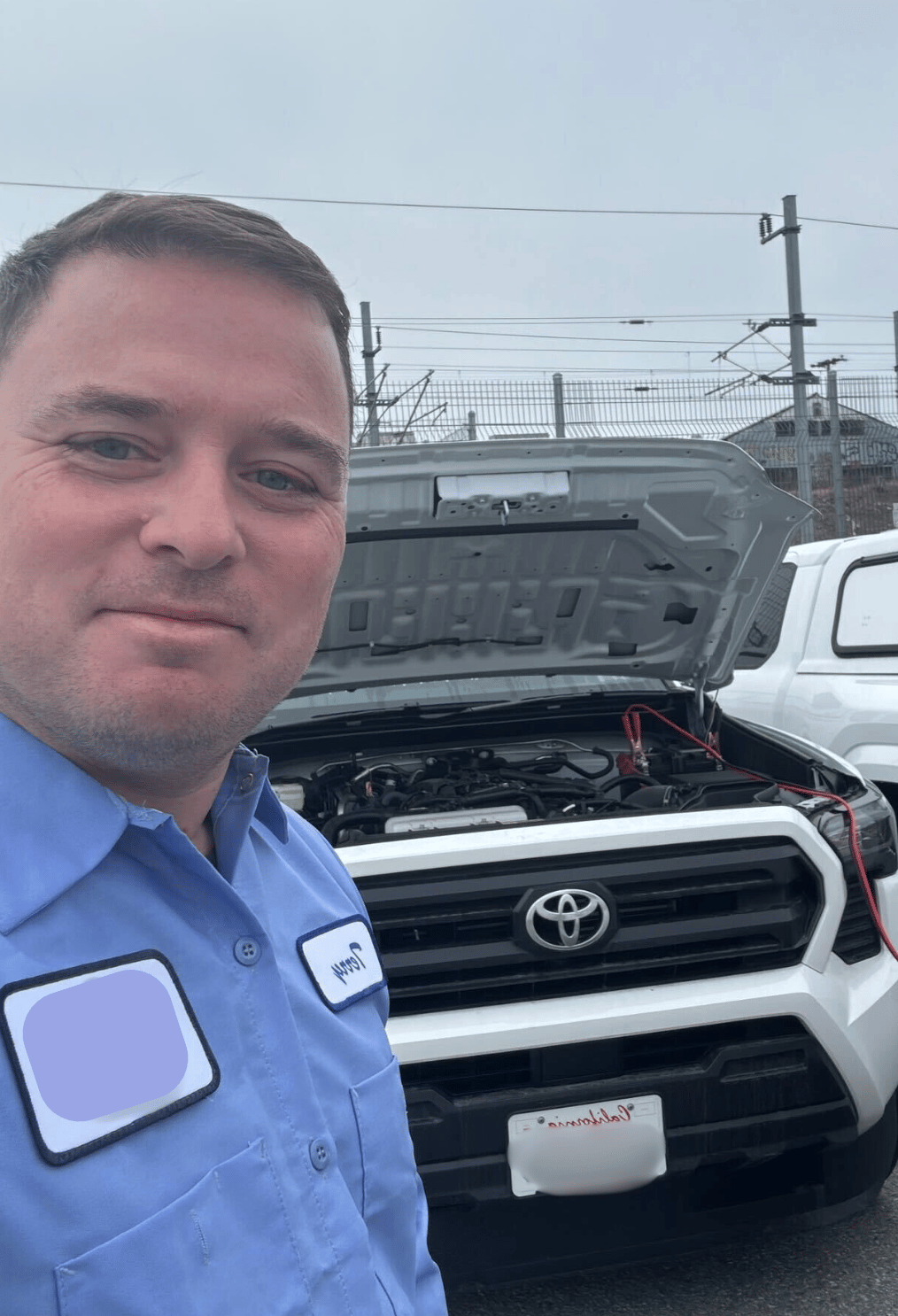
How I earned the nickname
While shadowing a senior tech, I got talking to the client and made a small upsell. There was no training for this, but it's a big opportunity while boots are on the ground.
They offered me a sales role shortly after, which I accepted.
That same evening, I mapped every prospect in my territory, built a workflow to reach out, and waited for the results to come in.
$30k ARR inside 21 days
I closed a $24k annual contract with a shopping center sourced from my outbound campaign, plus a few smaller upsells to existing clients.
The internal quoting process nearly lost me the $24k deal. It required multiple signatures and yet another account to be created by corporate.
Sales training was a Zoominfo webinar. Most reps drove around their territory in their company vehicle (free fuel) and visited in person. The top guys had 10+ years experience and were selling $800k to $1.2m ARR with very low churn - although nobody had the specific figure.
Their business is doing great, but it could be so much better.
Employees don’t want to rock the boat and there’s no incentive to push for improvements. It’s safer to stay in their lane.
That’s why selling SaaS or AI to this kind of company isn’t for me - I’d rather focus my energy on building a company from my own principles, and hire people who share them from the beginning.
Exit interview: “Why don’t you start your own company?”
When I told my manager I was leaving, he said I should start my own company and give him a call when I do.
So that's what I'm doing.
We have an acquisition of a small residential operator lined up, which we'll build the tooling for and grow a platform around once we’ve proven the model works and can scale.
If you've built, invested in, or rolled up a home services business, I'd love to chat.

Doesn't seem like it can be a tulip if it encompasses all productive endeavors.
Taming wild animals is bad for their long-term well-being around human populations, as rabies also initially causes uncharacteristically "friendly" behavior at first.
I agree people should leave nature alone whenever possible. =3
Think of Saudi Arabia, Iran, Putin's Russia, or Norway. I.e. risk for highly nepotic dictatorships, with the potential that it might end up well despite the odds (Norway).
Before, if you made a product that improved the lives of everyone, say you invented Google or Heinz ketchup, you could make a lot of money through that, and you did a good deed and became rich the same time. The masses of humans would reward you for delivering the benefits of your invention to them by giving you a piece of their work output.
As their work becomes less and less worth, why focus on those humans though? I am asking rhetorically of course.
An economy that thrives from innovation enriches the innovators, making them powerful. A brute in power causes the innovators to leave or in the worst case, he mass-executes them outright (think of what Stalin did in Russia). With AI, you can have a brute in power though, as an oil rig or datacenter can be protected by a bunch of machine guns.
An economy with AI everywhere will be, after a short and very innovative period, just be about who controls which resource, i.e. water for a datacenter, production lines for robots, mining rights, operational control of robot fleets, etc.
The working 95% will probably experience a sharp decrease in purchasing power, making a lot of products unaffordable to them, so consumption wise we'll have a further shift towards plutonomics. The owning top 10% will probably be affected by this major shift in consumption as well, E.g. a tower full of condos becomes worthless if the tenants can't pay rent because they got laid off, etc.
Need for robots and AI will further increase. Eventually most economic activity will revolve around those robots. It's a bit like paperclip optimizer here, whether those robots protect gay luxury space communism from counterrevolutionaries, or they project the will of the Davos council of Forbes 400, economically it will be quite similar.
There will still be human societies, humans will still talk to other humans. We won't be all exclusively conversing with LLMs, I doubt that. There will still be social mobility but it will revolve around nepotism, lying, and various escalation steps of war.
We might end up in different scenarios depending on the country, but some countries like Germany might lose relevance as most of their value lies in stuff that is going to be replaced by AI, i.e. they have less natural resources, or they have been depleted already.
We might also see companies that automate everything from end to end, from mining to producing and running weaponized robot fleets. Shareholders of those companies will do great too, if the leadership of the companies respects minority shareholder rights that is (why should they though, they will outgun any law enforcement).
Do I like this future? I don't think so. We will probably have solved cancer, communicable diseases, and aging in the next 30 years if AI continues its successful trajectory, but not sure if it will be accessible to 8 billion humans.
(http://upload.wikimedia.org/wikipedia/commons/f/f8/Baby_opos...)
Voice input that actually works to reduce screen time and distractions while driving or wearing gloves on site. Understanding and reacting to parking availability in cities, prompting the technician to upsell in the way the system knows he's most comfortable with (so he actually does it).
Incumbents will have to base this on Salesforce and adapt it which is expensive and a grind. Even if they have appetite for that, retraining the technicians who are used to the existing way will be horrendous.
I recently talked to a few companies in the AI space, from (smaller) frontier model labs to companies still looking to build "AI products" and my take away was that, if you're not working for one of the big players, the market hasn't really figured out if there is an "AI engineer" job yet.
I'm increasingly starting to believe that the future of work for people that have technical skills (more than just 'software') is likely going to be working in places that are less about "shipping software" and more about supporting teams doing something physical in the real world.
These companies are also the most ripe to truly leverage AI: they have tons of messy problems that need to be solved and iterated on extremely fast. Operations people tend to be "EoD" deadline people, not quarterly planners. Getting solutions solved in an actionable way on time often means really understanding the core business, the technical space surrounding it, and how to leverage AI to pull of some miracles. It can be stressful, but when you pull it off your stakeholder have sincere and real gratitude and you're actually moving the needle for the company.
I don't think the Bay area, even those sniffing the AI vapors the hardest, is really willing to accept what AI is going to do to software and software companies.
I was up front that I was exploring getting back into blue-collar, coming off the closure of my startup, and that I wanted to get into sales but wasn't sure if this would be a long term thing as it's a totally new industry for me.
We were aligned on giving the technician job a try before moving into sales, and it's common for people to take that path as you can't really sell the services if you've not done the job for a bit.
Important context - I am not a tech millionaire. The top guys regionally at these companies earn $500k+, and some are in the $Ms, so if there was a route to be top pest guy at BigCo, I was up for it!
The operating license holder is also on the hook for legal action if (when) things go wrong.
"Control" is interesting and I have found in all trades that people value their freedom. The good companies don't monitor employees too tightly, and are rewarded with loyalty and longer tenures generally. Of course you have to run a good recruitment and referral process to find the good people!
Does your software do anything fancy or is mostly for organization, good workflow, and being the central source of truth?
Did it require a lot of development after getting a few customers on boarded?
are you a 1 man show?
GTM is ubiquitous on the business side.
If you read his post, there's significant effort not "catching opossums" but waiting or churning through admin overhead - wasted time, which maybe he can translate into $. This much inefficiency is...common in many businesses.
Given this company is basically the best, they should really build their own revision / quiz tool. The most valuable part of training was a webinar which I took notes from, and turned into revision cards alongside info from the books and revised the way I know works for me. They could do this bespoke for each trainee in seconds now.
For residential / consumer markets, referrals are the gold standard and I agree to an extent about the local focus. A lot of PE (private equity) backed roll-ups result in a worse customer and worker experience as they try to force scale too fast.
Some PE companies will open a local market by initiating acquisition conversations with all local players, low ball everyone, buy some and for a short period dramatically reduce pricing to force the hold-out cohort to sell at an even lower price. Not good for communities.
The unlock to balancing scale and customer / worker experience is creating the right incentives for people to adopt the behaviors you're after. This is why bolting on SaaS or AI to established companies is tough, as the staff often don't want to change and will leave - which is bad in a tight labor market.
Searching for home services online is totally broken and is a tax on buyers and operators. HVAC contractors pay on average $600 for a closed lead from online ads, and close about one in four / one in five leads.
But this leaves an opportunity for anyone that cares to build a business that is higher quality (and even better if it’s possible to build it efficiently too).
I think with AI lowering the barrier to entry we should expect to see a lot of new small businesses appear, and perhaps if we are lucky this trend can drive a reversal in the enshittification.
> ...and noticed companies have become less likely to offer their time for ride-alongs and research calls. They get too many requests, and vibe coding is drawing their attention to self-build.
Is this ACTUALLY happening? Are entrepreneurs who get into vibe-coders really eating up time a bunch of time for trades people?
You want at least a year where you're systemising the owner out of the business without filling their shoes.
You'd also want some kind of break clause so you can back out if it turns out the business can’t run without the owner, or if the team won’t adapt and can’t be replaced.
When someone asks what the plan is for next week, the answer is normally, it needs to be written out, or I'll have to find this for you etc.
In general, there are a lot of serious rules around energy and fuel industries. Rockwell and Kongsberg technology still dominate for some very practical reasons. Seeing a few small firms fail hard in the area, I would still call it a fools errand for those looking at low hanging fruit. =3
I'm personally anti-AI. I checked out his app, and whether vibe-coded or not, it looks very well done. And the app actually has both offline mobile apps + web apps. And it's free? And FWIW, pestpro.app was registered ~1 month ago.
I would have thought the opposite because pest control is the easiest thing to DIY for most people. All the insecticides and traps and knowledge for what to use is available online, there is usually no emergency so research can be done, and no technical skills to learn most of the time.
Yes, PE enshittifies the experience. You can be a better human and win customers that way.
The headwinds are the usual david-v-goliath going up against scale/consolidation stories:
- consolidation gives more purchasing power. When all the PE-controlled pest control vendors in the state are negotiating as one, they get bigger cost breaks
- PE has a bigger war chest. They'll enshittify eventually, but they'll undercut you longer than you can stay solvent. At that point, they'll happily buy you for pennies.
- The end-game is always monopolization. A PE firm bought up something like all the concrete mills in Georgia or one of the southern state. Any building or municipal project in the state effectively buys from that one company, even though it looks like a bunch of different local concrete mills.
- Any AI you throw at the problem presumably PE can handle more efficiently at scale.
What's the strategy that outcompetes?
He used his funding to rent four apartments in San Francisco, which he then sublet, personally, through Airbnb.
It’s not that I don’t think anyone would choose to repair their vacuum. It’s more that I can’t imagine they get enough volume to pay the lease/rent/bills on whatever commercial property they’re on.
Let's be honest here, why did you generate this just now, are you hoping for work building mobile apps, or are you sincerely expecting to run a pest control SaaS business with AI generated blog posts and a download link that doesn't work?
You've done the incredibly easy bit (making a prototype), do you intend to do the hard work of building a business over 10+ years?
Also why is it free? Presumably the data is the product.
Spinning a web like that today is 30 minutes of Claude Code prompting.
But like it or not, the gatekeeping of Apple and Google means that pushing an app to their stores is days work and wait time.
So yeah, reeks of ai slop.
We got huge pushback from every angle with the local teams, people paying lip service to drag it out and delay. Eventually I got to the root cause... The capex had to come out of the business unit, and the payback would negatively affect their KPIs and bonus. Next time I came across this kind of issue, I asked to see the incentive structure before approaching anyone.
Also, I don't know where you live, but the more powerful substances used by licensed pest control are regulated and aren't (legally) available to the general public. If you're willing to run a business model based on unlicensed use of controlled substances, there are more profitable options than pest control lol
FWIW didn't mean to hurt/insult(?)
I’m guilty of this type of thinking and occasionally get reminded when I’m way out of my lane.
Also, don't knock it, a quality vacuum like a Kirby or Miele will go decades, are incredibly quiet, and just need maintenance on wear and tear, which these repair shops provide. I think we got used to thinks being terrible. Like my Dyson, does good work, it's also very loud compared to my financially secure friend's Miele.
There are also a lot of geniuses who might barely know how to read but can do incredible work and figure out some really difficult problems.
I consider myself blue collar even though I am a school teacher currently. It’s in my blood. I don’t especially like the work but I can do it and I am skilled at it.
My advice to anyone moving in to the blue collar world is to be respectful. If you are educated Don’t ever let on that your education makes you superior somehow. You will make a lot of enemies by being that person.
You will likely run in to people who really are quite unintelligent just be considerate and don’t get into debates with them. A lot of people come from poverty or really tough backgrounds and many are quite sensitive about it so don’t make a big deal about it.
On the other side there are many people who are quite intelligent and have the skills and knowledge of engineers even though they do not have any formal training or education.
Which is wild because a Dyson has a premium price tag.
I then nearly die of internal cringe.
Most blue collar jobs require this. A mechanic usually has to provide his own tools. This can be tens of thousands of dollars just for a basic set that lets you do standard jobs. Then you might have specialty tools for specific equipment.
Even a framer or roofer is bringing his own hammers, saws, PPE, and anything else that's required. You don't just roll up to a job and get handed everything you need like a software job.
In trades, the risk is usually not financial. I come home every day smelling of petrochemicals, with minor to moderate injuries, having been on my feet for 8 hours, sometimes up on ladders with greasy boots on, climbing on, into, and out of machines that could maul me without even making an unusual sound, and carrying 100lb sharp steel parts up stairs because it’s more efficient than waiting forces the shop hands to do it.
While the risks certainly have financial components, they’re more “get cancer, brain damage, lose a limb, or maybe even your life” risks. Risk averse is career death.
Fine. I'll say it: developers aren't smart enough to survive a blue collar environment.
My credentials? I worked in a factory in my youth. 12hr shifts, nightshift only, 7 days a week, on assembly lines.
Your average developer is definitely not risk averse enough to keep all their limbs. Where I worked, two people on two different lines lost limbs.
If you have ever used npm install on your daily driver without sand boxing it, you're too stupid to work in a factory.
Funding someone that knows how to run a restaurant and an engineer with food processing expertise, HAACP compliance and all that? Sure. But I was in that business in the Boston area and saw SO many tech geniuses blow through their funding before they even opened.
That's way too strong. I would say "if you've ever done it and had an issue and not learned from the mistake then you're too stupid".
The trades differ from software and that there's a lot more "learning on the job" and making rookie mistakes in terms of how the physical world works.
There is learning on the job with software, but it's a much smaller component and much of that is being replaced with AI skills.