Mirror: https://archive.ph/JkeMp
CERN can make/store the antiprotons, but not measure them as cleanly as they want because the facility itself introduces tiny magnetic fluctuations. So this is really a story about moving the sample to a quieter lab, not moving toward sci-fi antimatter batteries... for now
Gemini says a firecracker releases 150 J, so yeah not a lot.
Being able to transport it seems like an important piece of that puzzle.
Production and storage would need to be scaled by many orders of magnitude, but that's merely an engineering problem...right?
https://www.youtube.com/@pbsspacetime/search?query=antimatte...
Not necessarily because I want to use it, but because I have a vague idea of what it's capable of, and what that would mean in the hands of certain groups capable of producing it.
If you're ok with the looming threat of total annihilation.
I suppose at least it will kill you faster than your neurons can communicate so you wouldn't even notice.
> Following Fig. 9, beam core and plasma core configurations can produce direct thrust by directing the charged particles produced into an exhaust beam using a magnetic nozzle. Gas core systems use the energy released from the reaction to heat a gas that is exhausted for thrust. Finally, solid core configuration heats a metal core like Tungsten that acts as a heat exchanger to a propellant that is then exhausted from a regular nozzle.
Not the same paper, but goes into more detail.
https://www.sciencedirect.com/science/article/pii/S266620272...
The fact that we don't see these glowing boundaries in space is evidence that there are not antimatter regions and that the visible universe is almost entirely composed of matter.
More accurately: we aren't sure if antineutrinos are the same or different from neutrinos!
Antimatter production is so inefficient that they will be much more expensive per unit energy yield.
Don't you have that problem with any energy-dense fuel? It's just that it doesn get more dense than that, so you can be very space and weight efficient.
It's like everybody saying that a hydrogen car is a rolling bomb because of the energy stored in the hydrogen. Well, sure, but gasonline has just as much energy stored. Which is the whole point of fuel. To store energy. It's not like you are bringing 100x as much energy with you just because it's hydrogen. So that doesn't make an ICE car any less of a bomb...
The upshot was, it was likely that less than a mol of hydrogen had been run through the ring.

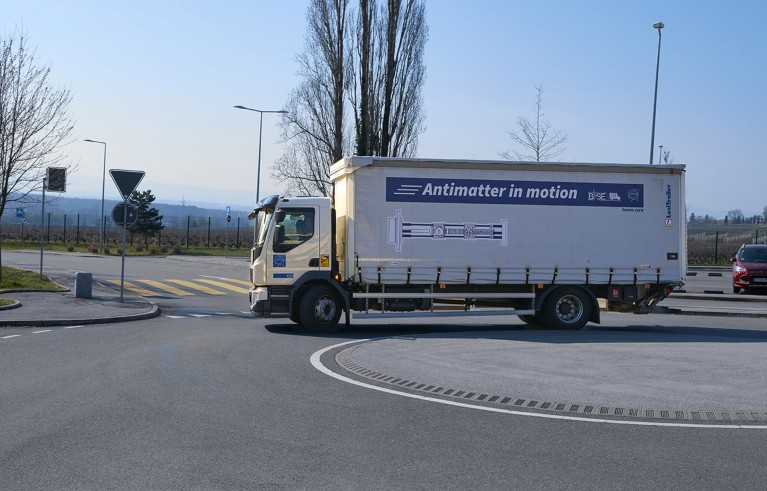
Scientists successfully transported 92 antiprotons in a truck around CERN, Europe’s particle physics laboratory, using specialized bottles which prevent contact with matter.Credit: CERN
Antimatter is matter’s equal and opposite. If the two meet, they annihilate each other, turning entirely into energy. This makes it incredibly difficult to store or move antimatter.
On 24 March, a team at CERN, the European particle-physics laboratory near Geneva, Switzerland, transported 92 antiprotons in a specially designed bottle that traps the particles using magnetic fields. The bottle travelled on the back of a truck, taking a 30-minute journey around the lab’s site.
The experiment’s ultimate goal is to take the antiparticles to a location free of experimental noise, where antiprotons can be studied with greater precision than is possible in the CERN ‘antimatter factory’ where they are created.
CERN is the only place in the world that produces usable quantities of antiprotons. Many staff members turned out with their mobile-phone cameras to capture the truck as it travelled more than 8 kilometres around the site, reaching a maximum speed of 42 kilometres per hour.
“It is something humanity has never done before, it is historic,” says team member Stefan Ulmer, a physicist at Heinrich Heine University Düsseldorf (HHU) in Germany. “We bought a lot of champagne, and we invited the entire antimatter community to celebrate with us today.”
[
LINK: How to transport antimatter — stick it on the back of a van
](https://www.nature.com/articles/d41586-025-01532-y)
Antimatter can be used to study other phenomena, such as the structure of radioactive nuclei, or researched itself to unravel some of the Universe’s deepest mysteries. Physicists who created the antimatter factory more than 30 years ago dreamed that someday it might be possible to transport the material, says Christian Smorra, a physicist at the HHU who led the project. “Now it’s finally possible.”
“This is a great technological achievement,” says Tara Shears, a physicist at the University of Liverpool, UK. Antimatter is the most fragile type of matter there is, so storing it, let alone driving it around CERN, is “a technological marvel”, she says.
“I love the idea of CERN becoming the Deliveroo [a food-delivery company] of antimatter,” she adds.
Antiparticles are like their ordinary counterparts, except with their charge and magnetic properties reversed. Although matter is abundant, antimatter occurs naturally only very rarely. No one knows why this disparity exists, when both should have been created in equal amounts during the Big Bang.
CERN makes antimatter by colliding beams of protons into a dense metal, then using electric and magnetic fields to slow and capture the antiprotons that emerge. Most particles are lost in the painstaking process.
[
Simulation of matter–antimatter creation on quantum platforms
](https://www.nature.com/articles/d41586-025-01581-3)
To develop a portable trap for the particles in which they never touch the matter-containing sides, scientists had to power a superconducting magnet system and use cryogenics to cool it to a chilly −269 °C. The bottle had to be kept in a high vacuum to stop antimatter from meeting any stray matter particles and being annihilated on the way; all the kit had to withstand the forces of the journey in a truck. The team installed a detector, which meant they could check on the antiprotons from the driving seat.
With antimatter the tiniest leak will annihilate your ship.
The difference is that antimatter annihilates with any normal matter that it comes into contact with. This means you can't just put it in a tank, the way you can with hydrogen. You can't e.g. combine it with some metal to make a metal hydride to make it safer to store, the way you can with hydrogen.
At an absolute minimum, you need extremely strong magnetic confinement and an extremely hard vacuum. And even then, you're going to get collisions with stray atoms and annihilation events which release gamma rays and other radiation products - although shielding is probably the least of your worries in this scenario.
A typical research lab at a university or large corporation can't make a vacuum strong enough to store even tiny quantities of antimatter for more than a few minutes, and they can't produce the magnetic confinement strength required to store macro quantities of it, either.
So the question with an antimatter-powered car is not if it's going to destroy the surrounding region and bathe it in hard radiation, but how many milliseconds (or less) it will take before that inevitably happens.
But probably luckily for us, this is all moot, because we have no way of producing enough antimatter for this to be an issue. If all the antimatter that's ever been created by humans annihilated simultaneously, only scientists monitoring their instruments closely enough would notice, because it's such a microscopic amount.
Edit: for perspective, you'd need about 7 billion times the 92 antiprotons transported in the truck in the story to produce the energy produced by a single grain of gunpowder.
Liquid gasoline does not spontaneously explode like an action movie. You can put a match in the fuel tank and (presuming infinite oxygen availability) it'd just start a small fire. Heck, may even just give a little puff and then put out the match.
Antimatter in any sufficient fuel quantity, the moment it breaks confinement, will completely annihilate and release ALL it's energy in a single moment, setting off a chain reaction to the remaining antimatter. It's like sitting on an armed nuclear bomb, where you rely on electrified, highly sophisticated containment equipment never failing a single time for months to years... In a radiation-heavy environment known for causing sophisticated electronics to have errors.
And, yes, hydrogen cars were looked at critically because of the perception they can Hindenburg (I'm unsure if it's true or not). Which is a good example because you don't particularly see any hydrogen blimps anymore - we made them illegal because they're dangerous.
According to, Michael Doser, a prominent particle physicist at CERN, "one 100th of a nanogram [of antimatter] costs as much as one kilogram of gold."
S: https://www.abc.net.au/news/science/2023-02-19/antimatter-fa...
Interstellar spaceflight will become (barely) feasible once spaceships can reach velocity between 0.02 to 0.1c are possible. Even assuming non-100% conversion efficiency, antimatter has enough energy density to provide this capability.
Those aren't comparable costs. The cost given for antimatter is the cost of producing it from nothing. The cost given for gold is the market price of buying gold that already exists.
Consider the cost of producing one kilogram of gold from nothing.
(Consider also the cost of ownership. Gold has a higher-than-average cost of ownership; you have to provide security or it will be stolen. Antimatter's cost of ownership is far, far beyond that.)
We can't afford to blow up ourselves that way.
There are plenty of other ways we can afford, so antimatter isn't top of anyone's worries.
The practical limit for nuclear energy is about 5 to 10 times less than that, because the theoretical limit corresponds to the transmutation of hydrogen into iron, coupled with the capture of the entire energy, which will not be achievable any time soon.
But there is an essential difference between nuclear energy and antimatter energy. Nuclear energy is stored in our environment and you just have to exploit it. Antimatter energy is a form of energy storage, so you need some other form of energy to make antimatter. The energy efficiency of making antimatter is many orders of magnitude worse than the factor of less than 100 that exists between nuclear energy and antimatter energy and the mass of the confinement device needed for storing antimatter is also orders of magnitude greater than the mass of the stored antimatter.
For now, there is absolutely no hope of ever using antimatter in practice for storing energy. Such a thing could be enabled only if some technologies that we cannot imagine would be invented.
Despite the great technological progress of the last couple of centuries, it is hard to say that there have been many inventions that have never been imagined before. After all, already 3 millennia ago the god Hephaestus did his metal smith work with the help of intelligent artificial robots.
Batteries have some of these same risks: they store a lot of energy and it can be released very quickly under the wrong circumstances.
It talks about symmetries, but has a nice story about this exact hypothetical scenario. (Someone else already replied why this probably isn't possible in our observable universe, but the episode is cool so I thought I'd share)
Maybe. Beamed propulsion makes a hell of a lot more sense in the solar system.
We're not going anywhere without a revolution in our understanding of the universe.
And, no, batteries can have outbursts but they're nowhere near as catastrophic as compressed, explosive gases or an antimatter bomb.
Also, now your tank is just fuel as well.