I also noticed dozens of tiny half centimeter diameter holes in the ground under that magnolia tree which I guessed were little bee burrows. This sent me down a rabbit hole of trying to identify what type of bee these were. Long story short, there are way too many types of bees (30,000+ according to my research) for a non specialist like me to be able to pinpoint a species. But whatever type of bee (miner/sweat) they are going to go absolutely nuts when that magnolia tree blooms in the next couple weeks.
[0] https://www.goodreads.com/author/show/323591.Dave_Goulson
There are several severe threats to honey bees which without human intervention would cause a significant number of hives to be lost.
There's the varroa mite and the things it carries like deformed wing virus, then there is the increasingly prevalent Asian hornet which European honey bees are unable to deal with, and colony collapse disorder where the bees literally disappear for reasons we current don't understand, and climate change is causing colonies to starve over the winter.
Honey bees are not going extinct tomorrow but they are not doing well.
Tangential, have a look at a Gaussian splat of a honeybee I recently captured: https://superspl.at/scene/3ae6a716
There is plenty of old fencing, a stack of logs, but they like my house.
https://www.bbc.co.uk/iplayer/episodes/m002t686/my-garden-of...
(Wildlife film-maker Martin Dohrn is bee obsessed. He has found over 60 species in his Bristol garden and sets out to film them, with mind-blowing results.)
[0]https://gardenbetty.com/carpenter-bees/
I have carpenter bees, mason bees, bumblebees, honeybees, wasps, etc including bees of every size. I also have planted my property in native plants and wildflowers to make sure these native insects have a place to hang out. I provide water for insects and wandering animals using washtubs with stacked rocks and solar powered fountains to discourage algae. I think that you could improve your chances of keeping the bees without them destroying your siding or trim if you follow the guidance about bee house placement.
You can make a bee house block or buy one that will attract multiple native bees and they will use it for years. Here is one option with additional info about carpenter bees.[1]
[1]https://www.thewallednursery.com/do-carpenter-bee-houses-wor...
The holes in the bee house need to be about 1/2" (12-13mm) if you are attracting carpenter bees. For mason or orchard bees they should be smaller, 3/16" to 5/16" (5-7mm).
However, the holes need to be deep enough for the bees to be safe from bee-eating birds. Otherwise, the log will instead function as a bee trap, allowing a bird to pick off one helpless bee after the other.
But at the risk of being patronising, I wanted to say that we should all try to resist the "the author lost me when" reaction. I catch myself doing this too, but I don't think it's useful.
Reading an article isn't a competition where you win if you don't get your mind changed. Someone might have valid thoughts and opinions even if there are details of the article you disagree with.
Especially in the current climate, I feel like we could benefit from being a little more charitable.
If course, if you're in Europe, honeybees are the native pollinators. At least around the Mediterranean.
In most places honeybees are raised they couldn't even survive in the wild. Just like cows and chickens and pigs. As with most livestock, without human intervention they would probably be wiped out.
> Promoting honeybee hives to save pollinators is roughly the equivalent to building more chicken farms to save bird biodiversity
The other problems you raise are important but are also a treat to others bee species and insects.
https://earth.org/data_visualization/bees-are-not-declining-...
Of course nobody cars about wild bees, our lives don't depend on them nearly as much.
For mason and leaf cutter bees, a box sheltered from rain and filled with Japanese knotweed tubes (don’t grow it yourself, it’s highly invasive) works well for “I like seeing solitary bees around, but want minimum efforts”. There are tons of videos you can find on the subject.
Drilling various sized holes in wood blocks also often works. The nice thing about “solitary” bees (which are often quite communal), is they don’t have much of a drive to defend a nest, and would much rather fly away than bite/poke you. I’ve walked alfalfa fields full of them, and while the loud buzzing was a bit disconcerting, they couldn’t care less about me. Leafcutter bees are used for alfalfa because they don’t mind how alfalfa flowers work mechanically. European Honeybees will just chew through the base of the flower to get the nectar, avoiding pollination.
For other bees, there is highly likely to be a native bee enthusiast group in your local area that can give guidance on native flower mixes and possible setups for habitat.
Here in western Oregon, the hazelnut orchards on the sandy soil near rivers have actually become a great nesting place for multiple species of beautiful green metallic “sweat” bees: https://blogs.oregonstate.edu/gardenecologylab/2017/11/13/po...
They like the semi-compacted neutral to slightly alkaline sandy soil that’s clear of weeds, hence a long term orchard is perfect, especially as we’ve moved to softer insecticide chemistries that generally preserve beneficial insects. Offhand I think I start seeing them filling the ground with little holes in may when I start monitoring for Filbertworm moths.
And don’t forget bumblebees. While it’s a hated introduced weed for growers, it turns out that Sharppoint Fluvellen in the fescue grass fields is loved by bumblebees because it happily continues to flower in the late summer/fall when everything else has dried up or run it’s course.
Bumblebees do just fine in most places, as they go after my geraniums like a fool with a hole-punch every year. We have several local variety, and they are an important part of the ecosystem.
The mite & foulbrood damage means most agriculture businesses euthanize hives when a problem becomes obvious. Hence why they also over-produce queens, as people know most colonies will not make it right now. The beekeeper community are some of the kindest folk you will ever meet, and people are doing their best given the situation. Have a wonderful day. =3
Bumblebees do produce a kind of honey, but it’s much thinner and less concentrated than proper honey (which has had most of the water evaporated off by the wing beats of the bees).
Hopefully you are now less lost.
You're correct about "breeding more" not being trivial, but they do it on an industrial scale. In really broad strokes: in late winter, in preparation for pollination season, they feed their hives intensively (with sugar syrup) and add extra brood boxes for the queens to fill with eggs. Then they split the hives, leaving the old queen in one box, and adding new queens to the box(es) they take off. Voila! Double (or more) the hives.
Pollination is where commercial beekeepers earn their living, by renting out hives of bees to farmers. Honey production is not necessarily an afterthought, even though it doesn't really turn a profit - it's worth doing because you'll be putting the bees on nectar flows for the summer, anyway, so you won't have to feed them, and extracting (some of) the honey covers transportation costs - but all the money's in pollination.
I could keep going and going - queen production and hive splitting are fascinating topics on their own - but I'll stop before I risk boring people with an over-long comment. I have commercial beekeepers in my family, and I've worked (summer / vacation jobs, when I was a kid) every part of the process.
(This is all in a USA-ag context. Beekeeping is - very! - different in other parts of the world.)
More dangerous in all these is the monoculture - a hundred years ago we would have a wide range of crops and livestock; now 90% of meat chickens are probably the same genetically; similar with cows and bananas and corn and rice and pigs, etc. That sets us up for a "wipe out 90% of chickens" risk.
And aggressive honeybees still rarely sting. They typically just charge at you (which is annoying/disruptive)
I wonder if it would be possible to experiment a bit - ban honeybee hives in a 10 mile square radius, or perhaps in that area that bans all radio transmitters. See what happens.
Mustard (Sinapis alba) is nice if you like pleasant smelling little yellow flowers, low-effort resilient plants, and spicy food. =3
That depends on how you draw the line. Most would consider buffalo[0] to be native to North America, but they arrived less than 200000 years ago. If you go far enough back, no life is native to anywhere except wherever abiogenesis occurred.
but then I've also been told by a local bee keeper that the whole plant flowers for the bees policy isn't a good idea since that's how mites and other nasties can be transferred between hives?
22 Mar, 2026

My neighbour keeps bees.
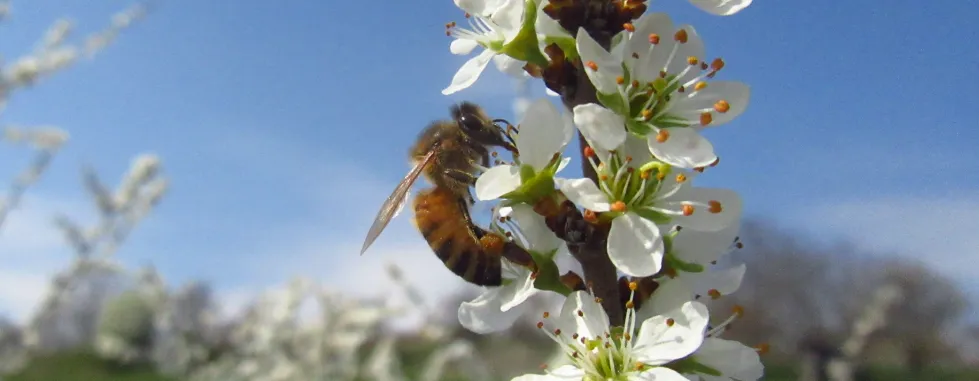
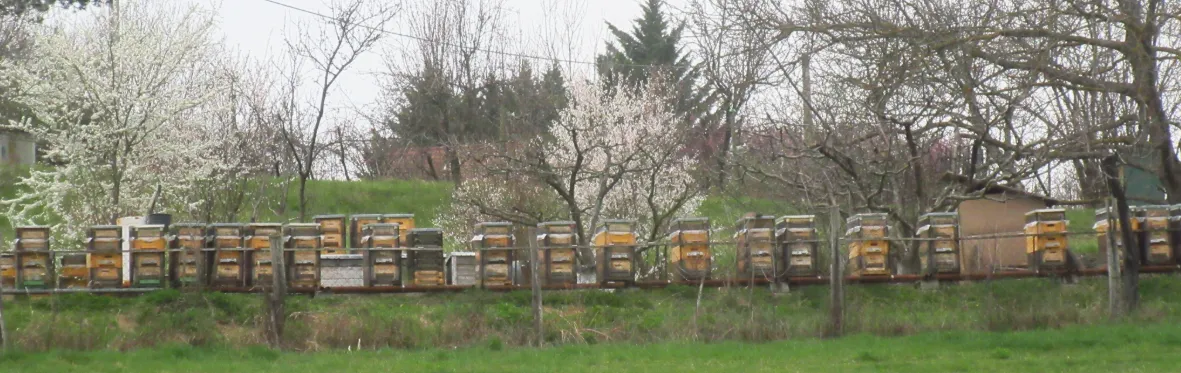
Fifty hives, all lined up neatly along the edge of his property. On warm spring days the air between our gardens hums with them. They work the plum blossom, the almond, the dandelions in the lawn. They are, by any measure, impressive.
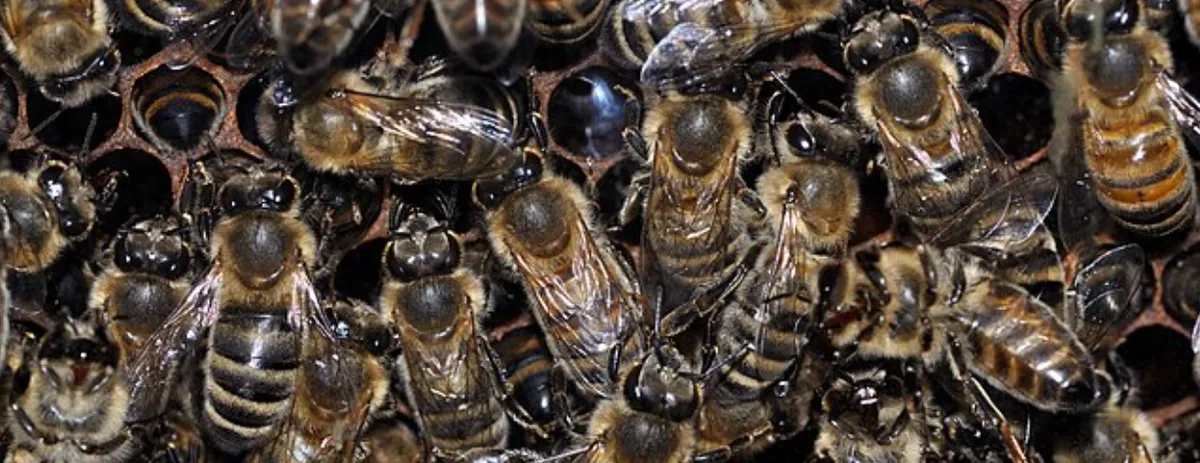
A beekeeper a little further down the road has another thirty hives. At a conservative estimate of fifty thousand bees per hive, that's four million honeybees within flying distance of this garden on a warm spring day! Yes, you read that right.
Four million individuals of a single species, none of which would be here without human intervention.
To put that in perspective: a healthy population of mining bees might have a few hundred nesting females in a good aggregation. A bumblebee queen starts a colony that will reach a few hundred individuals by midsummer at most. The numbers are not comparable.
And yet the honeybee is the one we worry about.

Apis mellifera, the Western Honeybee, is not a wild animal in any meaningful sense of the word. It has been kept, managed, moved, and selectively bred by people for at least six thousand years. It has been transported to every continent except Antarctica, introduced into ecosystems far outside its original range across Africa and the Middle East, and kept in densities that would never occur naturally anywhere on Earth.
By any reasonable definition, the honeybee is livestock.
It belongs in the same category as the sheep in my meadow. Domesticated, managed, dependent on human intervention to maintain population numbers and health, and kept in artificial concentrations for human benefit.
This is not a criticism. Beekeeping is a legitimate and often valuable practice. My neighbour's hives produce honey, and those bees do pollinate the fruit trees we both rely on.
The problem is not the bees.
The problem is the story we tell about them.

At some point in the last decade, the honeybee became the symbol of pollinator conservation.
Campaigns to save the bees almost always feature a honeybee. Urban beekeeping exploded in cities across Europe and North America, marketed as an environmental act, a way to help struggling pollinators. Rooftop hives appeared on office buildings. Companies installed hives as proof of their ecological credentials.
Meanwhile, the bees that actually need saving received very little attention.
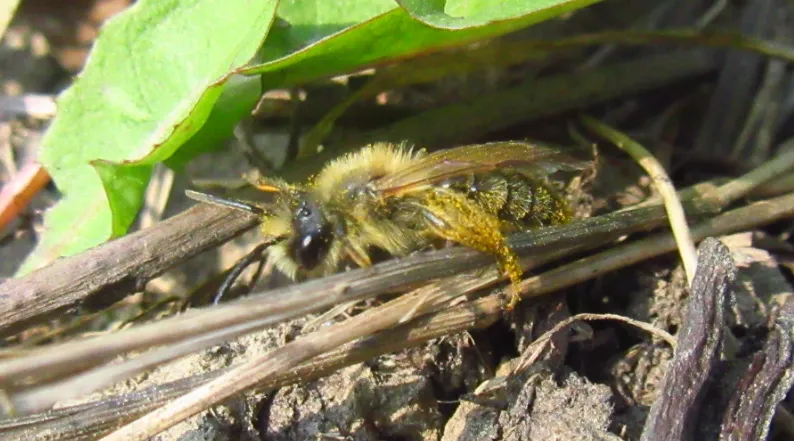
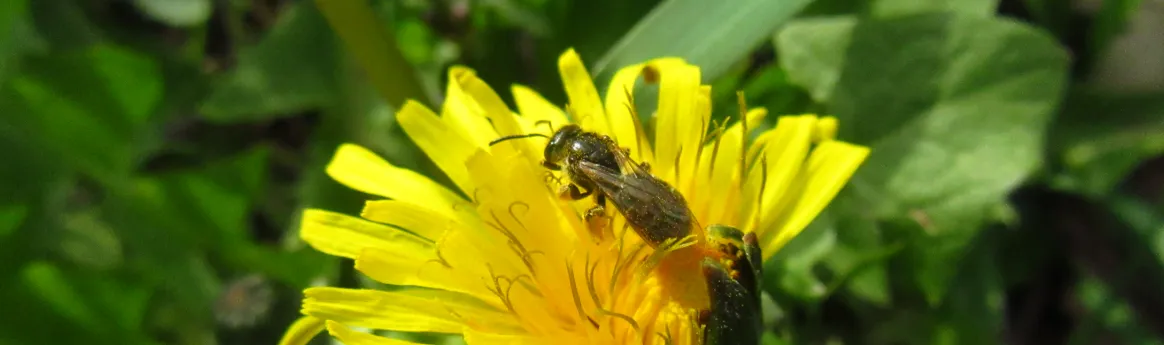
The Andrena mining bees nesting in the bare path between my sheep meadow and the vegetable garden. The Bombus queens starting colonies alone in early spring. The Halictus sweat bees working low flowers in the grass. The Violet Carpenter Bees looking for old wood to drill into.
None of these appear in campaigns. None of them produce honey. None of them can be kept in a box and managed.
Promoting honeybee hives to save pollinators is roughly the equivalent to building more chicken farms to save bird biodiversity. The honeybee is not endangered. It never was. The number of managed hives in Europe has been stable or increasing for decades. What is declining, quietly and with much less public attention, is everything else.

Four million honeybees don't just appear in a landscape without consequences.
Each colony sends out tens of thousands of foragers simultaneously, all working the same flowers as the wild bees trying to provision their nests. Research has shown that as honeybee abundance increases, nectar and pollen availability decreases and wild bee diets change as a result. A three-year field experiment found that high hive densities reduce the diversity of wild pollinators and disrupt pollination networks, with wild bees providing fewer pollination services overall in areas with heavy honeybee presence.
More recent work found that honeybee competition can reduce not just the quantity but the nutritional quality of wild bee diets, meaning that even the pollen wild bees do manage to collect may be less useful to them when honeybees have already taken the best of it.
The effect is not uniform. In a landscape with abundant and varied flowering plants, competition is less severe. In a landscape already simplified by agriculture or development, where flowering resources are already limited, adding eighty hives is a significant additional pressure on every wild bee trying to nest and raise offspring in the same area.
I look at the four million bees within flying distance of this garden, and then I look at the few hundred mining bee nest entrances in the path, and the numbers tell their own story.

There is another part of the story that gets less attention: honeybees are not actually the best pollinators for most plants.
They are generalists. They will visit almost any flower that offers a reward, which makes them useful across a wide range of crops. But many plants have evolved with specific pollinators in mind; particular body shapes, particular foraging behaviours, particular flight times and temperature tolerances.
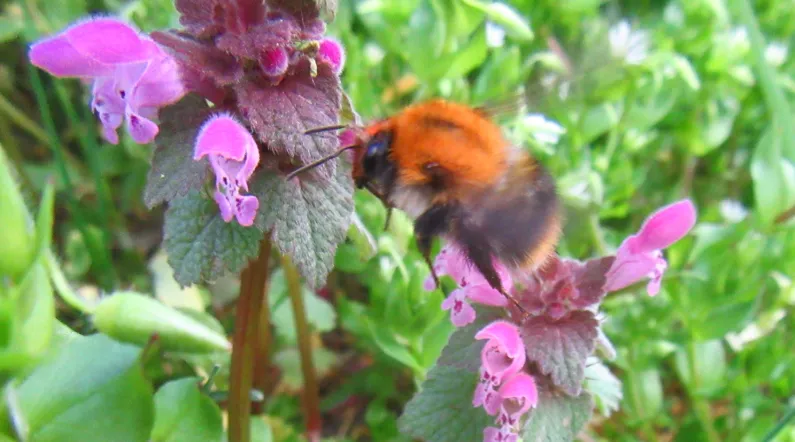
Bumblebees are capable of buzz pollination, vibrating their flight muscles at a specific frequency to shake pollen loose from flowers that don't release it any other way. Tomatoes, potatoes, and many other crops require this. A honeybee cannot do it. No matter how many hives you put in a field of tomatoes, you still need bumblebees.
Species like the Andrena mining bees nesting in my path are important early pollinators of fruit trees precisely because they fly at lower temperatures than honeybees. On a cold March morning when the honeybees stay home, the Andrena queens are already working.
Recent research found that losing wild pollinators is more damaging to plant reproduction than losing honeybees. The diversity of the pollinator communities matters more than the sheer number of any single species.
None of this means my neighbour is doing something wrong. Beekeeping at a reasonable scale in a landscape with sufficient floral diversity is a legitimate practice with genuine value. My neighbour clearly loves his bees and tends them carefully. And I'll admit that watching four million bees work the blossoms on a sunny March morning is not an unpleasant thing.
But if you want to help pollinators, the most useful thing you can do is not install a hive. It is to grow more flowers, stop using pesticides, leave patches of bare ground and dead wood, and stop pulling out the dandelions. Let the mining bees keep their path. Let the carpenter bee keep her old vine post. Let the bumblebee queen find a mouse hole in the unmown grass.
The honeybee will be fine. It has been fine for six thousand years of human management.
It is everything else that needs the help.
Valido et al. (2019), Scientific Reports — Honeybees disrupt the structure and functionality of plant-pollinator networks
Page et al. (2023), Journal of Animal Ecology — Evidence of exploitative competition between honey bees and native bees in two California landscapes
Magrach et al. (2017), Nature Ecology & Evolution — Honeybee spillover reshuffles pollinator diets and affects plant reproductive success
Garibaldi et al. (2013), Science — Wild Pollinators Enhance Fruit Set of Crops Regardless of Honey Bee Abundance
European Commission (2022) — Large-scale study indicates wild bees are just as effective as honey bees for commercial apple pollination