[0] https://www.theregister.com/2026/03/23/nato_air_defenses/
This is a powerful propaganda tool for Iran waiting to be used to full extent.
We may even need to revisit what air superiority means in the age of long range, relatively stealthy drones that are cheap to produce using widely available tech.
I also would expect Russian and Chinese Satellite intel being fed to Iran to locate these types of targets, again exactly like how the NATO powers have been providing intel to Ukraine.
https://www.nbcnews.com/politics/donald-trump/iran-negotiate...
I'm not sure what anyone can do about that but that to me is my biggest fear about the future of all this technology.
The box is shipped internationally and sent to a package delivery company that gets a job to deliver the box to an abandoned lot near an airforce base in bumfuck nowhere America.
Once the package is delivered the deployment device cuts the top of the box open and lets the drone out. The drone flies in the direction of the base and then kamikazes on the nearest helicopter or aircraft shaped object that it sees.
What’s the counter to that?
Or imagine a scenario where a country launches a weather balloon full of the same kinds of drones but equipped with solar panels.
The weather balloon explodes like a piñata and deploys all these drones over a vast area. The drones are programmed to make their way to different military or infrastructure targets and stop and recharge high places out of site of people and maybe only travel at night. They slowly make their way over days or weeks until they find their target. They’re designed to self destruct if they sense that they’re being handled by a human being.
What’s the counter to that?
Narcissism-speak is easy, once you have figured them out.
For example if they accuse others of something, that means they have done exactly what they are accusing others of.
DoD is trying to find US companies that can do drone detection and it isn't going well
China also views the US as a strategic rival and would love the opportunity to take us down a peg.
Don't think that America's strategic opponents -- Russia, North Korea, Iran, China, Algeria do not provide some mutual support, even if for purposes of survival, and view the US as threat. We have already taken out Venezuela, Lybia, Syria and flipped Armenia. Cuba, Iran are next on our radar, but we are active all over the world trying to flip pro-Russian/pro-Chinese governments to pro-US governments.
get real please.
Everything else is a half measure.
And then all drones tracked by satellite so any drone that doesnt show up gets shot down anywhere over a large geographic area.
Using cheaper drones to hunt down expensive drones.
Or of course, just eagles.
Iran has thrice the population of Ukraine and 1.5x (nominal) to 3x (PPP) the GDP. With Ukraine building 23560 drones for every F35 the US is building, it would be quite reasonable to expect Iran to be able to build a few thousand per F35 ass well. Iran already has a fairly mature drone industry supplying the Russian side of the UA-RU, after all.
In other words: If it were to come to a race of attrition, the US can't afford to lose a single one. Even ignoring the massive cost difference, F35s simply cannot be constructed fast enough.
Or this: https://www.epirusinc.com/electronic-warfare if you think the C-RAM would get saturated. Whether the weather balloon drones move at night is irrelevant if you stop the last move they need to make.
Militaries have been defending themselves against attacks for as long as they've been around. Drones will change the way they fight a little, but it isn't going to be some magic pill that modern militaries can't adapt to. Hiding an explosive and then blowing it up when your target is nearby? That's almost the same concept as assassinating someone with a car bomb. Putting it in an Amazon box and letting the drone go the final distance changes things a little, but militaries and governments were able to assassinate people remotely before drones.
Swarming attacks with cheap munitions? Saturating an enemy's defenses has been a thing at least since the time of the English Longbow. The longbow regiments would all shoot at the same time, and while you could dodge one arrow it was hard to dodge all of them.
Drones are new and will take some adapting to. If a military refuses to change then it probably will be disadvantaged. But the US military has been buying and testing drones for a while, and is already undergoing the adaptation. As it better understands cheap drones for offense, it necessarily gains a better understanding of what is needed for defense.
To be clear, I'm not advocating for the US attacking Iran. All I'm saying is that the US military is not about to lose the conflict because of this particular tactic.
And these are either autonomous drones (more expensive?), or fpv with the fiber optic line out the back - either way you have to get them in range without being detected somehow.
In short, i think this is an unrealistic scenario - fun to imagine as a horror-sci-fi idea but unlikely to be deployed. Just one opinion.
I bet you could do aiming and firing in less than 0.1 seconds with nearly 100% accuracy in the 50 meter range which would enable ~10 destroyed drones per unit if the drones are going 150 km/h.
Shotgun pellets are also basically entirely safe when shot into the air as they have low falling velocity enabling usage when shooting over populated areas.
It becomes defense in depth though, perimeter defense is no longer enough. Thats kinda new.
But why go through all that when you can just have someone in the country launch it, or drop it off?
In what way would that not immediately escalate tensions?
So realistically a laser drone weapon can eliminate just a couple of drones until a third or a fourth one comes through and destroys your turret.
How's that going to work when the drone hugs the ground, only rising a bit to hop over walls? Are you going to flatten everything a mile around every base, and shoot at head height with zero warning?
> Leonidas EWS
How's that going to work when the drone doesn't show up on radar and has fiber-optic controls?
If drones were this easy to counter, we wouldn't be seeing them play such a massive role in the Ukraine war. The whole problem is that drones massively change how a conflict works, and the entire US military is designed for pre-drone warfare. It remains to be seen whether they can adapt quickly enough fast enough for this conflict - the US doesn't exactly have a great track record when it comes to asymmetrical warfare...
China already has created a UAV that is designed to launch at least 100 drones. If they can make that 1000 drones and then fly out 1000 of these motherships at one time, that's already 1 million.
And yes the drones would be autonomous, there's no reason for any person to be controlling them in the age of AI.
Have you seen the price tag on some of the US jets? Are they not doing just this?
Then two drones approach from opposite sides at 200 MPH. Your emplacement costs more than $200 and can only fire in one direction at a time.
Or, as we've seen in Ukraine, once your disposable low-cost drones have precisely identified a high-value, high-effectiveness static emplacement, you send in a cruise missile to clear it out, and then the drones continue sweeping forward.
Can they be hacked, or duped into firing at friendly aircraft?
How will they deal with the enemy adapting their drones to have camoflage?
There's no way automatic turret mounted shotguns are the solution to this problem.
It simply isn't economical to produce, install and maintain all of these things, and now you've sunk a massive amount of resources into this infrastructure when the enemy doesn't even really have to launch a real attack.
Yeah, doable. I went to a clay pigeon range last week (company outing). These are targets that move quite fast. They don't spring out from the same spot and some roll over the ground. I had never handled a gun before. I am 50, with the attendant poor eyesight and lack of twitch reflexes.
And yet, I still nailed 20/25 moving targets. A turret with a shotgun is going to hit much more than that.
Credible sources claim it's very likely Iran is working with Chinese satellite data (that is also possibly available commercially but they would be unlikely allowed to obtain it without government approval). That of course in addition to Russian help that the US knows very well about and does, again, nothing at all.
The US has plenty of bases in the area, but considering the ease of an attack and the general anti-US sentiment of the region, projecting power into the Middle East is going to become an awful lot more difficult...
Yes. You've obviously never seen a C-RAM in action. They will put 20 mm rounds in any angle that isn't restricted. The rounds go far beyond a mile when fired into the air. Only a few hit the target, dozens/hundreds of rounds just sail off into the distance, and if it hits a village down the road, well that's just too bad. Shooting downward into the dirt is probably a better arrangement because ricochets won't go as far.
> How's that going to work when the drone doesn't show up on radar and has fiber-optic controls?
Tiny drones do show up on radar. Tiny birds show up on radar. Making a quadcopter or similar drone stealthy kills some of the value proposition on making them cheaply, and physically shrinking them lowers the amount of destructive payload they can carry. Fiber optics don't help against a directed energy weapon- the microwaves burn out the electronics; it's not a jammer, it's a heat ray. And if there was a fiber optic line, that means the attacker is close enough to be struck directly rather than some long-distance control or autonomous program.
Before you think you've solved warfare and that a modern military can't possibly defend against your brilliant tactics, learn about what warfare is actually like and how the systems work. A lot of your ideas have already been thought out. A loss of a single helicopter is not really an indictment of the US military's defense; the fact that there's only one of these stories vs. the many that have come out of Ukraine indicate that a US base isn't nearly as vulnerable as the Russians have been. While Ukraine is punching far above its weight, their adversary is hampered by (more) corrupt acquisition processes, poorly trained conscripts, and overall bad decision making.
But also, 1000 carrier drones is a lot easier to shoot down than 1mil drones.
The US spent $11.3b in the first six days of israel’s war with iran. So not an unprecedented amount of money, just a lot to put into a single attack that could fail, and that mostly kills humans, and that requires a shit ton of logistics to make happen.
We have these things called wheels. Or you could mount it on a drone.
> Meanwhile your guns shoot birds and once in a while - an occasional bystander
We are discussing protecting military bases or military assets.
> Some drones just drop grenades
That requires flying above the target. See counter-point 1.
Please put in the minimal effort needed to follow through at least a few steps of argument and counter-argument in your head. I assure you I am not putting in as little effort into my arguments as you did.
A drone that can go 300 km/h is way more than 100 $, you are in the thousands of dollar range at that point. Turret wins if it blows up one.
Also, it could probably blow up more than one since at 300 km/h you would get 0.5 seconds to respond and I was arguing 0.1 seconds per target anywhere in a full 360. 0.25 seconds for anywhere on a full 360 would be enough for 2 and that is within human capability.
> you send in a cruise missile to clear it out
Cool, you sent in a hundred thousand dollar cruise missile to blow up a thousand dollar turret. Turret wins. Also you can put wheels on the turret, so it might not even be there.
Now you are probably going to argue about a drone that goes 1000 km/h at which point what you have is a cruise missile which costs tens to hundreds of thousands of dollars. At that point the entire argument about drones being too cheap to cost-effectively stop is moot.
Or you might argue that the drones just go high. 50 m is a ludicrously low flight ceiling. But then your drone can not explode on contact. You could use a drone that drops explosives, but that still requires flying over the target. High flying drones are easier to detect, and you could counter that with flying shotgun drones or turret mounted machine guns which have ranges in the hundreds to thousands of meters and would still only cost a few dollars of ammo per kill.
My main point is that bullets can easily disable a cheap drone and are much cheaper than a cheap drone. You just need a cost-effective way of deploying mass bullets against mass drones. Logical answers are ground deployments around targets or drones with bullets that cost-effectively shoot down drones without bullets.
You will then likely get into a arms race of fighter drones to protect your bomber drones. And scale up your drones until they are not easily bullet-destroyable. But then your drone costs have likely increased to the point where anti-air cannons shooting 100 $ explosive shells are cost-effective. And so on and so forth.
Without writing an essay, I can definitely see automatic turtent mounted shotguns as an effective solution.
I'm responding to the assertion that they would choose this route specifically to avoid increasing tensions.
> That of course in addition to Russian help that the US knows very well about and does, again, nothing at all.
Isn't the US currently involved in a trade war and toppling various administrations around the world due to these tensions?
They are sometimes.
It's much more effective than a cruise missile because you can just blow up weak points on bridges, buildings, take out entire military bases, etc. Even 1000 of these drones would be extremely effective but 1 million would be devastating.
Nope. The calculus is not about individual components, but about overall cost of the entire system and all of its associated support. What was the material, labor, and opportunity cost to install the turret? What was it protecting (which is now presumably destroyed by drones, or captured by the enemy)? You're also still assuming that you're facing off against guerillas fighting an asymmetrical war on a shoestring budget, but that's not the case. Whatever force you're fighting can be trivially bankrolled by a peer power who is happy to bankroll them to make you bleed to death. China will be happy to build plenty of cruise missiles, and plenty more drones.
Now picture an American military base. They're pretty big, right?
Now imagine how many of these shotgun towers you need to secure the paremeter based on the firing range of these weapons, then imagine how many you shotgun towers you need to defend the interior of the base from drones that don't attack from the side but instead come in from the middle because they can fly.
How much ammunition can each of these shotgun towers hold? What happens when it runs out? Does a human have to go over there and refill it? What kind of equipment do they use to do that? How much time does this take and how much fuel does it consume? What is the opportunity cost of this?
Now that's just one military installation. How many does the US have? Are you going to put these shotgun towers outside the homes of high ranking military officers? The roads that they take to go to work?
What's stopping someone from doing this kind of drone attack on the highway to the military installation timed with the morning or evening commute? What's the counter to that?
Automated shotguns are not an economically viable defense to the threats that I described in my previous post.
> Isn't the US currently involved in a trade war and toppling various administrations around the world due to these tensions?
Which administrations? They are verbally attacking the UK, Germany, Spain, Denmark, Canada, raising and lowering tariffs randomly, if there is some grand plan in all of this it's hidden very well.
Of course I know about Venezuela and Cuba, but it's quite a stretch to claim that the US is aggressive towards them because of the tensions with Russia or China. If there was a coherent strategy, support for Ukraine would be a big part of that, but US support has ceased in the last year.
Because that’s an abhorrent thing to do. Because then you have to occupy people who don’t want to be occupied. Because the nation you just destroyed has allies who have the same weapons. Because that nation has the same weapons. Because killing “all the politicians and all the generals” will become impossible immediately after the first time this is used - assuming it’s not already impossible today.
And attacking civilian targets is a violation of the law of armed conflict. It would be a war crime if a country were to use drones (or any weapon) to intentionally attack civilians who are not participating in the fight.
I don't even know why people are still arguing. The US has been bombing Iran for nearly a month now. If drones and drone tactics were a particular weakness, why hasn't the US lost more equipment because of it? Out of 25 losses recorded for the US only one has been because of a drone. The US has lost more due to crashes and friendly fire than enemy drone action. Until drones are more effective than just someone not paying attention then it's hard to make an argument that there is a serious weakness. https://en.wikipedia.org/wiki/List_of_aviation_shootdowns_an...
You have presented no evidence as to the overall cost of this mystical unstoppable drone swarm. In contrast, we do know that shotguns, machine guns, and bullets are cheap, mass-produced, and mass-deployed by the tens of millions.
The key unknown of my proposal is the bulk cost and production of a small automated turret or fighter drone that can economically and flexibly deploy cheap bullet interceptors to asymmetrically defeat expensive drones. However, the operational requirements for such devices are simple and within the range of existing technology.
There is no clear evidence that cheap explosive drone swarms are magically cheaper than cheap fighter drone swarms or cheap ground drone swarms. It could easily go either way and without a rigorous actual analysis you and I are both unqualified to determine what is actually dominant.
Who said anything about that? I'm referring to https://en.wikipedia.org/wiki/China%E2%80%93United_States_tr...
> They are verbally attacking the UK, Germany, Spain, Denmark, Canada, raising and lowering tariffs randomly, if there is some grand plan in all of this it's hidden very well.
The tariffs are more than verbal attacks and the ostensible lack of a grand plan doesn't change the reality of what's happening.
> Of course I know about Venezuela and Cuba,
Yes, that's what I was referring to, and Iran obviously.
> it's quite a stretch to claim that the US is aggressive towards them because of the tensions with Russia or China
That claim hasn't been made. I'm just pointing out that they're not the passive spectators unable to take any action like was suggested above with questions like "Well what would they do?" and the suggestions they would do "nothing" like they had done before.
> If there was a coherent strategy,
Again, having a plan or a strategy isn't important for the question at hand.
The TWZ Newsletter
Weekly insights and analysis on the latest developments in military technology, strategy, and foreign policy.
Short-range kamikaze drones operated by an Iran-backed militia appear to have successfully targeted a U.S. military Black Hawk helicopter and a critical air defense radar at an American base in Iraq. This is the first known example of a successful attack of this kind on a U.S. military aircraft. It’s also not the first time we have seen evidence of these kinds of drones zipping over the same installation in recent weeks.
The incidents underscore the reality of the threat posed by small drones in the Middle East, where a wide variety of nefarious players have already employed these systems for surveillance and attacks against U.S. forces on multiple occasions, for years now. It is also a preview of what the U.S. could end up facing on its own homefront as it grapples with constant and sometimes highly perplexing drone incursions over sensitive bases and facilities. Even since the war began, there have been very alarming drone incursions over one of America’s most important bases that houses nuclear weapons and B-52 bombers that carry them. You can read all about these developments here.
One of the videos that began circulating yesterday, filmed from a first-person view (FPV) drone, shows a pair of Black Hawk helicopters sitting in a compound, protected only by a low blast wall. The video feed cuts out just before detonation, on or close to the main rotor, but the assumption is that one of these helicopters (at least) was struck.
An Iranian-backed militia carried out a successful FPV drone strike on Camp Victory in Iraq yesterday, successfully hitting multiple targets.
Seen here, one of the FPV attack munitions hits a parked UH-60 Black Hawk. pic.twitter.com/ngY8td9ONZ
— OSINTtechnical (@Osinttechnical) March 25, 2026
The location has been identified as the Victory Base Complex (VBC), a cluster of U.S. military installations surrounding Baghdad International Airport close to the Iraqi capital.
As for the helicopter, this appears to be a medical evacuation (medevac) configured HH-60M, emphasized by the video editing, in which it seems the prominent identification panels marked with red crosses have been obscured.
Noticing they blurred out a portion of their attack video (green). I think they were trying to hide the fact they attacked a medevac helo. Note white mark circled in orange.
DVIDS source pic of a CASEVAC/MEDEVAC UH-60 Black Hawk for comparison. https://t.co/4woNHofUL9 pic.twitter.com/qeeMWKDaip
— Evergreen Intel (@vcdgf555) March 25, 2026
These are actually US Army HH-60M CASEVAC helicopters. Not UH-60s. Assigned to Charlie Company, 2nd Battalion (General Support), 4th Regiment, 4th Infantry Division Combat Aviation Brigade. https://t.co/OIjvcxagz6
— Chris Komatsu (@chris_komatsu) March 25, 2026
Whether the helicopter was damaged or even destroyed by the drone is unclear at this point, but most significant is the fact that such a target was able to be engaged by a relatively simple, low-cost threat. The same goes for the second video, where the extent of the damage is much clearer.
The target in this case is a container-based AN/MPQ-64 Sentinel radar, a system used to alert and cue short-range air defense (SHORAD) weapons, including the National Advanced Surface-to-Air Missile System (NASAMS). The radar is in operating mode, its antenna clearly rotating.
A video showing a U.S. Army AN/MPQ-64 Sentinel radar in action with the 10th Combat Aviation Brigade:

Sentinel Radar
This footage includes the perspective from another drone, which confirms that the radar was hit, after which it is seen burning.
While it’s clear that more than one drone was in the vicinity of the radar during the attack, there have also been unconfirmed reports that the militia used some kind of swarming tactics, or at least multiple kamikaze drones to perpetrate this attack, with some degree of coordination.
Reportedly, the attacks on the Black Hawk and Sentinel radar occurred yesterday. In both cases, it is apparent that there is no degradation in the video feeds as they drop very low over the ground, even behind structures. This might be the result of the drones having been launched very close to their targets, or that they used fiber-optic control links. Both those scenarios are alarming, but a fiber-optic FPV drone would explain why passive sensor systems would not have detected them as they approached the base.
Wow, for the first time, fiber-optic drones have been spotted in use by the Azawad Liberation Front (FLA) in Mali, who are fighting against both the Malian Armed Forces and Russia’s Africa Corps/Wagner Group. The drones and training were likely provided by Ukraine, with previous… pic.twitter.com/OxemaEbWwO
— OSINTdefender (@sentdefender) July 28, 2025
The drone strikes are notable for a number of other reasons.
First, there is no sign of air defenses attempting to engage the incoming drones.
Of course, a response to the drones in the form of electronic warfare and cyber warfare, or other ‘soft-kill’ options, is a possibility. In regards to other counter-drone capabilities, there is no indication that the limited number of directed-energy weapons the U.S. has were deployed to this facility, while surface-to-air interceptors are not generally suitable for engaging such small drones. Other options would include gun-based systems, as well as drone-based systems, like the Coyote, and the laser-rocket-slinging VAMPIRE. On the other hand, we also know there is a chronic scarcity of many of these systems.
Video footage shows Block 2+ Coyote drones engaging drones in an undated demonstration:

Raytheon Missiles & Defense proves counter-UAS effectiveness against enemy drones
It should also be noted that, for all their relative simplicity and low cost, FPV drones are very hard to spot and target, especially when they are moving quickly at very low level. In many cases, they will evade detection by traditional radars, while even microwave radars, tailored for counter-drone work, can provide sporadic coverage at very low altitude.
The apparent vulnerability of the Victory Base Complex is all the more surprising since this is not the first time that the same installation has been targeted by FPV drones.
Earlier this month, videos emerged showing drones purportedly belonging to the Iran-backed Kataib Hezbollah group.
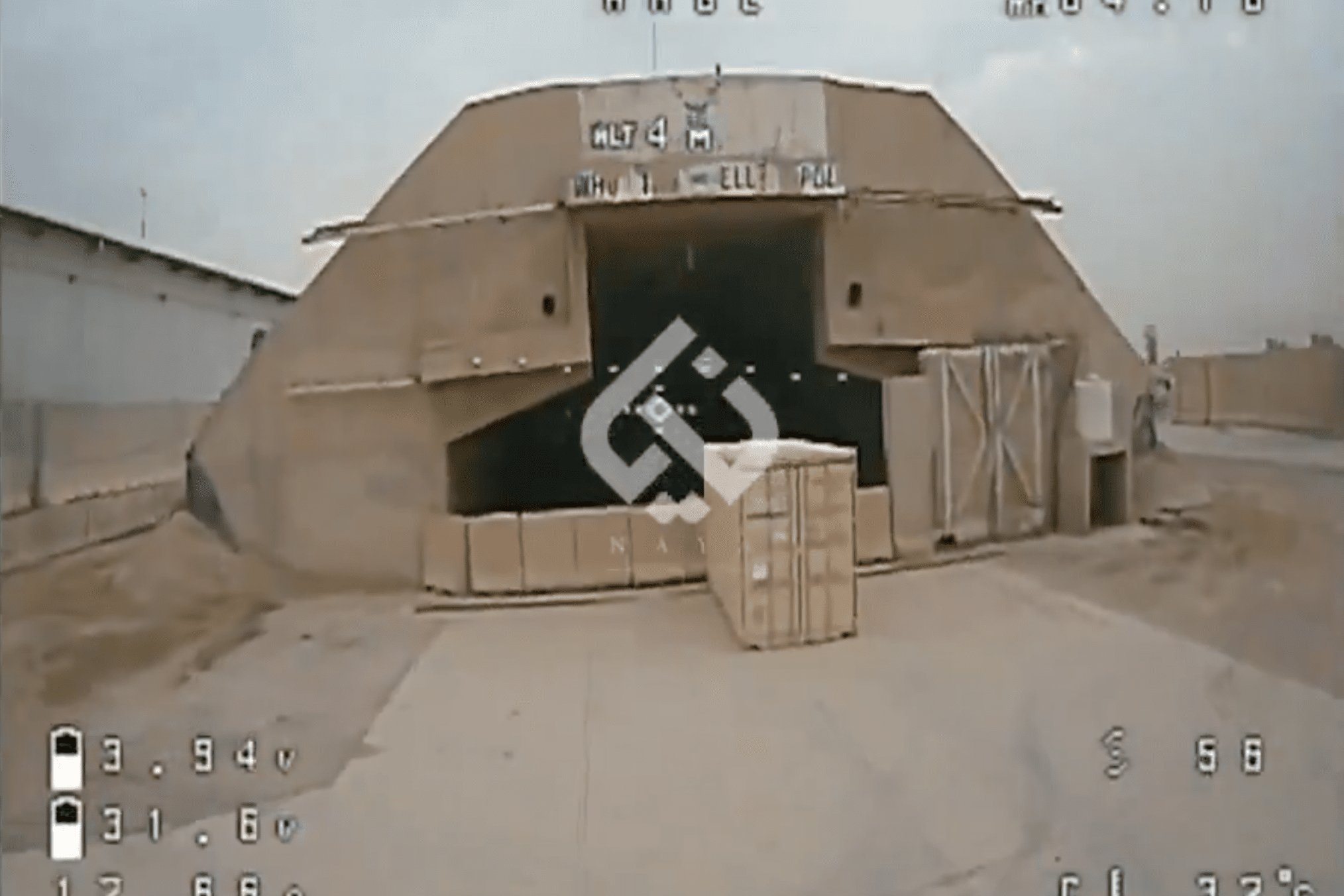
A screenshot from a video released by the Iran-backed Iraqi militia Kataib Hezbollah showing an FPV drone approaching a hardened shelter at the Victory Base Complex earlier this month. via X
There have been suggestions that all of these various videos may have been recorded during the same (complex) attack, although the latest footage appears to come from a separate attack on a different date.
Thirdly, the threat posed by drones of this kind, while proliferating significantly since the start of Russia’s full-scale invasion of Ukraine, has been recognized long before that.
Last year, we reported on how U.S. Defense Secretary Pete Hegseth had created a new task force specifically to counter the growing threats posed by small drones at home and abroad.
“There’s no doubt that the threats we face today from hostile drones grow by the day,” Hegseth stated at the time. “Emerging technologies — we see it in battlefields, in far-flung places, and we see it on our own border in small unmanned aerial systems. [These drones] target and bring harm on all warfighters, our people, our bases, and frankly, the sovereignty of our national airspace.”
Hegseth said the Pentagon “must focus on speed over process” when it came to new counter-drone efforts.
Clearly, the U.S. military desperately needs a more potent counter-drone plan after years of incidents in which its assets at home and overseas have faced small drone incursions, many of which were of publicly unknown origin. TWZ was the first to report about drones flying over Langley Air Force Base in December 2023, as well as incursions last year over Wright-Patterson Air Force Base, Picatinny Arsenal, and many others in the U.S., and four bases in England. And these are just the tip of the iceberg: drone swarms have also harassed U.S. Navy ships off the coast of California, and other drones have been detected flying over nuclear energy plants and other sensitive areas, such as military training areas and airports.
Once in a conflict zone, the threat posed by small drones is even more glaring.
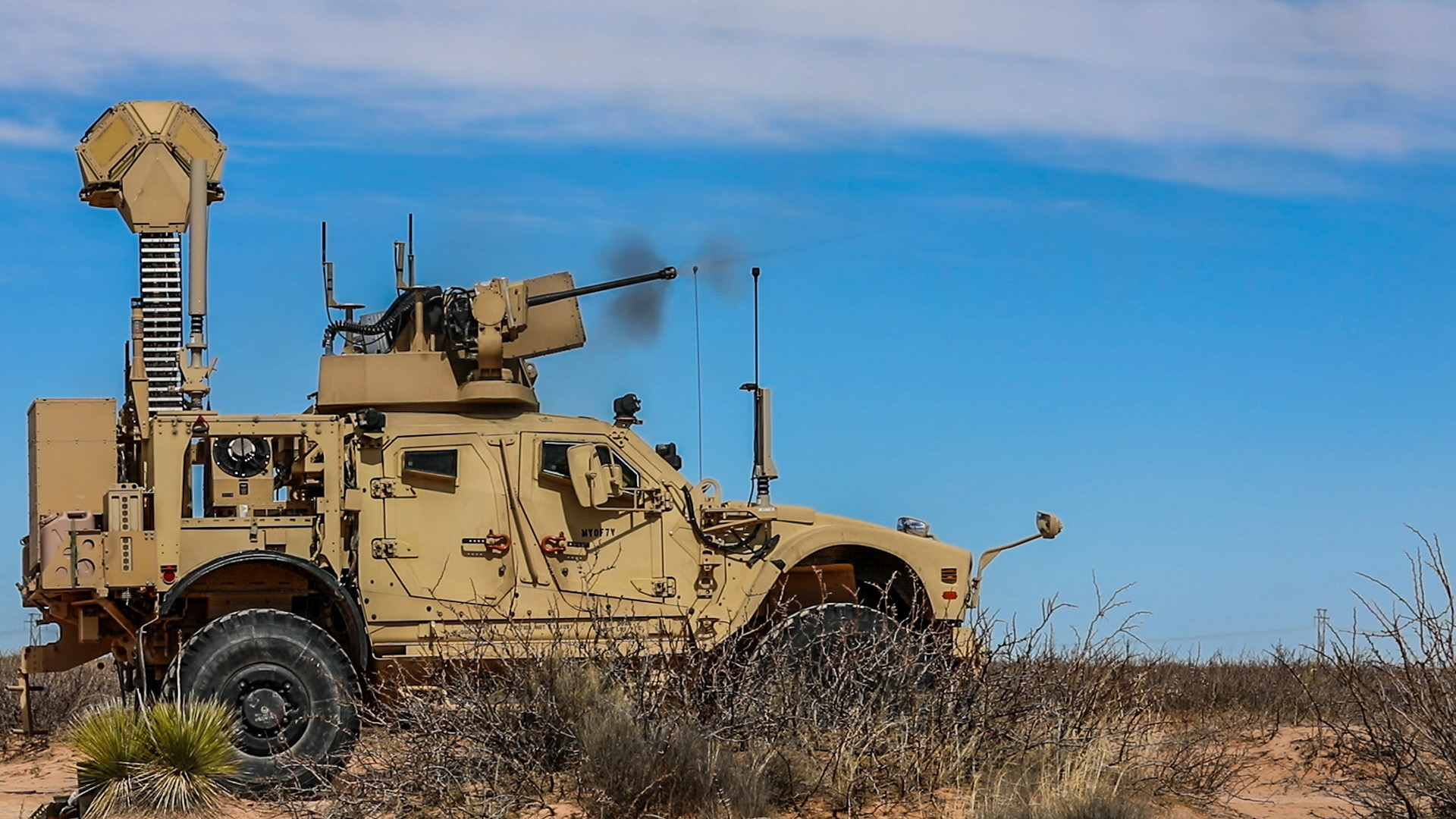
Soldiers from 2-130th Infantry Regiment hone their skills in a counter-drone training exercise at McGregor Range, New Mexico, last year. U.S. Army Staff Sgt. Raquel Birk
While there have been various regulatory barriers that have prevented the fielding of more robust drone defense of key installations and assets in the United States, this is not such a problem in Iraq, and especially in the course of a regional conflict.
It is notable, too, that there have been reports that some type of quadcopter-type drones may have been used for surveillance ahead of the Iranian strike on a U.S. logistics operations center in Kuwait on March 1. That attack led to the deaths of six U.S. service members, and more were wounded.
The incidents also underscore the very real risk faced by military infrastructure in the United States, a point that TWZ has repeatedly raised in the past. In particular, near-field attacks like these pose a huge threat and one that is hard to stop. Compared to a combat theater, something like this could be far more successful at home, where there are fewer defenses and more limited surveillance. As in Iraq, aircraft parked on the ground and radars are highly vulnerable, and the same threat even extends to traditional air defenses.
Operation Spiderweb, a Ukrainian drone attack that targeted multiple bomber bases deep in Russia, showed the world something that we had predicted for years.
On June 1, the Security Service of Ukraine carried out a brilliant operation— on enemy territory, targeting only military objectives, specifically the equipment used to strike Ukraine. Russia suffered significant losses.
In total, 117 drones were used in the operation – with a… pic.twitter.com/PeD1lTx9Nw
— Defense of Ukraine (@DefenceU) June 2, 2025
We have reached out to U.S. Central Command for more information about exactly what happened at the Victory Base Complex, and what kind of defensive measures are in place there.
As we wait for more details to emerge, to paint a fuller picture of these attacks on American assets in Iraq, it is clear that there are still questions to be asked about the resilience of the U.S. military in the face of kamikaze drones and similar threats.
Contact the author: thomas@thewarzone.com