
Given the presence of the wiring schematics and the mechanical dimensions, I'm surprised that the author did not try to 3D-print the mechanical parts of the connectors, givem that the electrical parts extracted from the BMW connectors did fit.
Completely unrelated. Would be interested if you figure out how to retrofit the new adaptive shocks on performance models to the older cars. Something I would love to do if I had hobby time. I'm pretty sure they fit physically, but needs to be connected to the main computer. I likely would never touch the main computer unless I got root access. In my brain I was thinking about a separate system made with raspberry pi's.
"To promote further security research, Tesla offers security researchers the opportunity to retain root access on their infotainment system even after their reported vulnerability has been patched. In order to qualify, a researcher must send in a valid report describing a novel way to gain root access on a Tesla infotainment system. Upon confirmation, Tesla will instruct the researcher on how to use their existing root access to enable the researcher SSH feature, along with an SSH certificate for the researcher's public key (tailored to their specific hardware ID). The certificate restricts SSH access to the local diagnostic ethernet link. Tesla may renew the certificate as long as the researcher continues reporting vulnerabilities."
Very neat.
> Tesla offers a “Root access program” on their bug bounty program. Researchers who find at least one valid “rooting” vulnerability will receive a permanent SSH certificate for their own car, allowing them to log in as root and continue their research further.
Pretty interesting. Sounds like Apple's Security Research Device Program[0], where you're loaned a rooted iPhone, but with a clear qualification criteria.
It strikes a nice balance, because to qualify you have to 1) show you have the skills to get root access anyway and 2) show you're willing to participate in the bug bounty program and get things patched.
I would of course love root on everything I own, but I can understand Tesla's motivation here since root for everyone would make vulnerability discovery easier for malicious actors. And if everyone had root on their Tesla, it'd be much easier to make naughty modifications that might catch the ire of regulators. (like disabling driver attentiveness checks in self-driving mode).
https://x.com/i/status/1722717318009041104
DM me if interested
Can't you just solder some extra wires onto the cut off bits, rather than having to try and find a compatible cable? They've left the connectors in, and that's the hard bit, the rest is just wires
Fwiw, mine costs $450 from Ford. Also in the US we call this a wiring harness, with the loom being the material that goes over the wires
Hey, I just remembered my school used to have ages ago some cool power supplies (I think from Agilent?) that were very idiot proof, they had current limit with a dial that I think didn’t went over 1A or perhaps even less, and they would instantly disarm on short circuit (and indicate it with a led), and also the voltage dial I think wouldn’t go over 25V. I remember it was very big and heavy, but it survived countless students that used the lab daily.
Nowadays, is there any power supply available that is that resistant or is the recommended approach to get an used old one? Does anyone have a power supply at home that is also used by kids with a brand/model they would recommend? Thanks!
> A REST-like API on :8080 which returned a history of “tasks”
I am curious to know what kind of historical tasks- since it's a media control unit; does it show what kind of media was being played in the last trip? does it reveal any other info about the driver?? There might be a privacy angle here that you could exploit and share it with Tesla.
What a waste.
I have a Model 3, but I can't say I follow the forums.. but I've never heard of screens failing -- I'm sure it happens but I think if it was common problem I'd have heard of it.
I was really surprised to read this at the end of the article -- how could someone be this deep into a project of this depth and not realize this?! Not only because all cars (...er... all vehicles) are wired this way, but also because the documentation they were referencing has plenty of detail to show this... there's even a whole picture of it (and to Tesla's credit they have amazing free docs): https://service.tesla.com/docs/Model3/ServiceManual/2024/en-...
They've also revoked certificates from researchers personal cars in the past
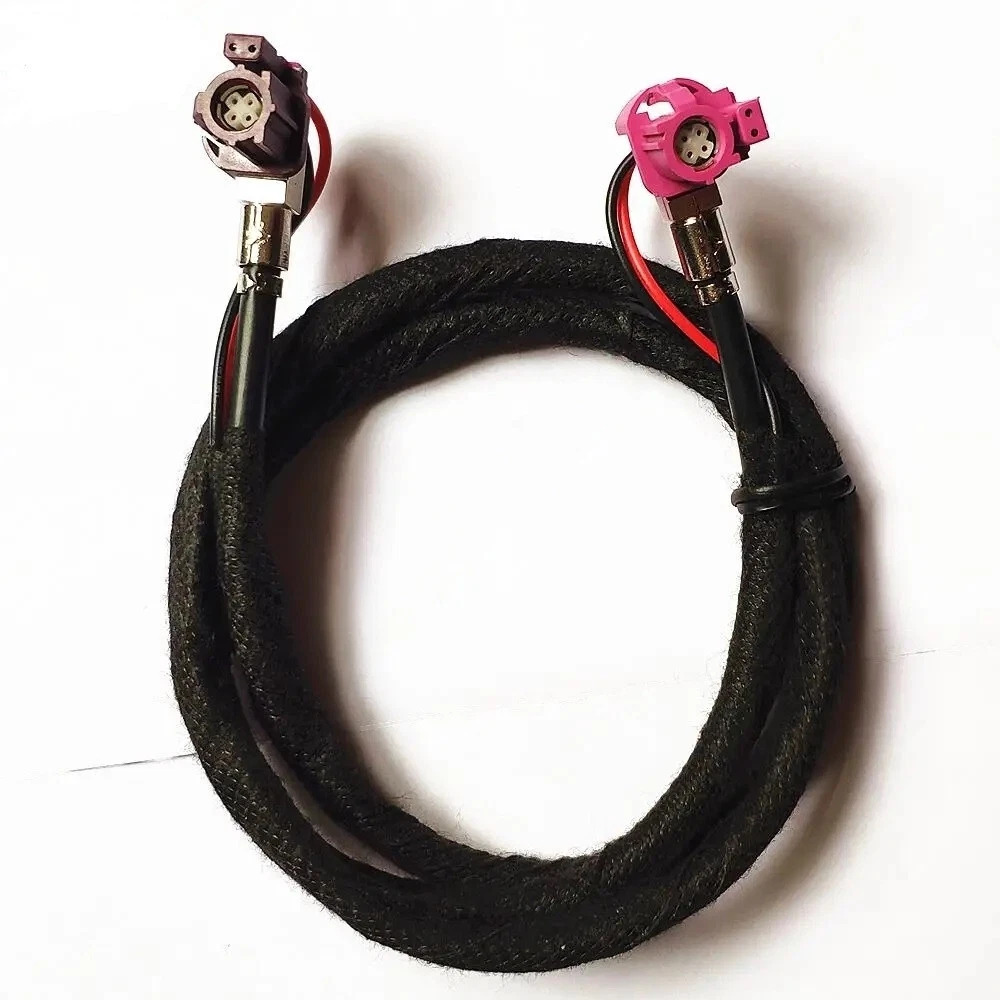
Violet HSD Code D 4+2 Pin Female to D Female Jack Connector 6 Pin HSD LVDS High Speed DataTransmission Harness Wire LVDS Cable https://a.aliexpress.com/_EuGOh9e
And a soldering robot with a specialist a few rooms away to beam down the latest errata into physical form, at times.
Tracy Kidder just died, and Soul of a New Machine was a favorite of my formative years as an engineer. Once I started in headunit ECU development it felt very familiar to me at times.
I'm a software guy, but the gear has a lot of allure.
https://www.mouser.com/c/power/power-supplies/power-supplies...
AT $5k it better make me breakfast, too.
If you want that sort of reliability it will probably go towards 100$.
In Tesla terms, the infotainment does much more than just playing music - it has full access to the rest of the car.
Turns out the early Model S vehicles used consumer grade LCD panels that weren’t designed for the prolonged high heat you get in a metal and glass box left outside in the sun all day.
Tesla since upgraded their vehicle screens to proper automotive-grade LCDs which are excellent.
My point is, automotive-grade hardware is higher spec than regular consumer computer hardware, hence the high prices.
As an aside, I upgraded my whole computer and screen from MCU1 to MCU2 and it was worth the upgrade.
Credit to Tesla for building a retrofit computer upgrade for old vehicles. Thats a non-trivial thing to engineer and I appreciate their effort. Other car manufacturers would prefer you were compelled to buy their latest vehicle instead.
I think this is a software guy who occasionally dips into hardware things (to hunt bugs).
Not to Tesla's credit, they had to be dragged kicking and screaming into it (primarily by Massachusetts) and their right to repair legislation through a solid chunk of malicious compliance:
1. When told that they had to have a site for people to order parts, Tesla put up a site that had every single item as "Call us", including the most simple of bolts. And when a few places called, "Sorry, that's not available to you".
2. The service manual was originally only available in a few locations in MA, and had strict conditions: you had to book in advance, there was a $100 fee per booking, and you could only view the manual on premises, and could not bring electronic devices into the room with you, just pen and paper.
The docs they have are great, and who knows how their attitude would have changed over time, but they absolutely didn't want you to have it, initially.
Usually, for most other vehicles, the connectors are either standardized (e.g. radios, ISO 10487 [1], high-current chargers by VG 96917) or the foundation plugs, sockets and re-pinning tools are readily available by the vehicle manufacturer or by aftermarket suppliers.
Tesla truly went out of their way to make the life of third parties (such as wire harness repair shops) more miserable here.
As an Australian. I often find myself saying things like “the wiring hardness, or loom, or cable, or whatever were calling it this week”.
Exasperated by living in a state other than the one I grew up in. South Australians are often easily spotted by their pronunciation of certain words.
It feels like this is something you should get by being owner of the car, and not have to do free speculative research for the manufacturer to get it.
So LVDS is more likely to linger in automotive displays, while in less obsolete devices it has been replaced by either eDP or by MIPI DSI (used e.g. in smartphones).
There's a list of them here: https://service.tesla.com/docs/Model3/ServiceManual/2024/en-...
Now they just have to take the next step and have everything in the vehicle running on PoE.
I have worked with a LOT of PHD's in recent years. Their code leaves much to be desired.
:O
It's pretty amazing what Claude + Ghidra + knowledgable coaching can accomplish. It was basically just setting direction, setting up an incremental workflow with the right kind of documentation, and questioning some of its theories and assumptions from time to time.
I'd love to release a lot of it but I'm torn between releasing artifacts created with expensive software I paid for and thinking that many of those things should really be freely available to anyone (specifically the things which definte the protocol to talk to the car and mapping of what various things are reported vs what they actually mean.
"Early on, the notebook computer and LCD vendors commonly used the term LVDS instead of FPD-Link when referring to their protocol, and the term LVDS has mistakenly become synonymous with Flat Panel Display Link in the video-display engineering vocabulary."
https://en.wikipedia.org/wiki/Low-voltage_differential_signa...
Put a voltmeter on the battery terminals of a regular car at 2000rpm and note the voltage. You'd be surpised (the alternator can produce as high as 15V on some cars).
Not understanding this sentence. Most running ICE vehicles product closer to that 14.4 than 12v. I think a standard controller would have worked fine?
Professionals overestimating their knowledge is a very common thing!
You should see what happens when someone involved in the sciences, e.g. Chemistry, gets their hands on Claude Code.
It’s just a phrase or sentence with spaces removed.
Knowhatimsayin.
Typical setup for cars (and lawn mowers). As a software guy my first instinct is, computing power is cheap enough, seems like a CAT5-like thing running between all components would do it. Speaking as a software guy - meaning I'm probably missing a lot of the big picture. On the other hand, it's a lot easier to safety-check a mechanical lockout that physically opens a circuit, than something running on software.
What is a "local PCB repair shop"? All the guys who used to fix TVs and radios are gone. Anyone else (not living in China) having trouble locating such an outfit in their neighborhood?
Right-to-repair legislation is chipping away at this but slowly. The EU's right-to-repair directive covers physical repair and doesn't really touch software access. The real test would be a regulator taking the position that restricting root access on hardware you own constitutes an anticompetitive tying arrangement, since you can't use the car's data for your own purposes without going through Tesla's APIs and paying their fees.
John Deere has been the main battleground for this argument so far. Farmers can't repair their own tractors without paying for dealer access to diagnostic software. Tesla is the same pattern applied to consumer vehicles, but the consumer advocacy pressure is weaker because fewer people feel the pain directly.
As a pedestrian I prefer for most people to not have root access to their multi-ton fast-moving killing machine.
Tesla runs a bug bounty program that invites researchers to find security vulnerabilities in their vehicles. To participate, I needed the actual hardware, so I started looking for Tesla Model 3 parts on eBay. My goal was to get a Tesla car computer and touchscreen running on my desk, booting the car’s operating system.
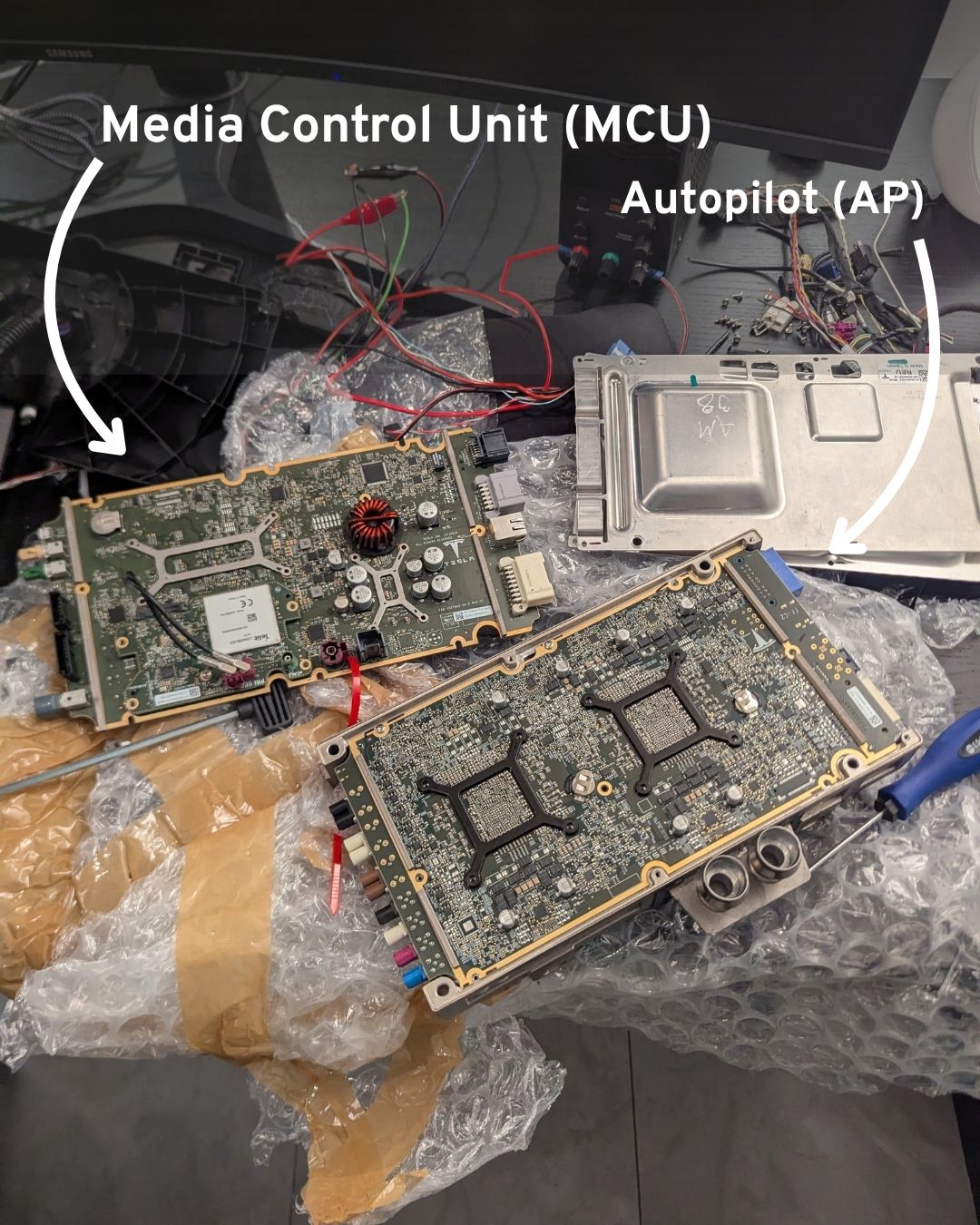
The car computer consists of two parts - the MCU (Media Control Unit) and the autopilot computer (AP) layered on top of each other. In the car, the computer is located in front of the passenger seat, roughly behind the glovebox. The part itself is the size of an iPad and the thickness of a ~500 page book and is covered in a water-cooled metal casing:
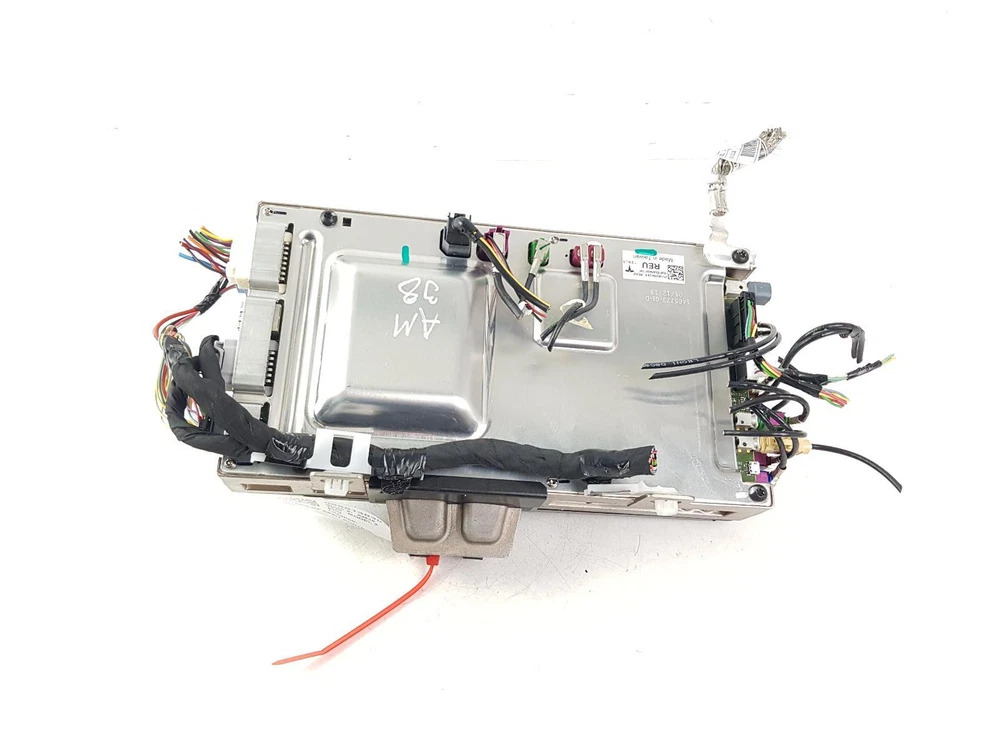
By searching for “Tesla Model 3 MCU” on Ebay, I found quite a lot of results in the $200 - $300 USD price range. Looking at the listings, I found that many of these sellers are “salvaging” companies who buy crashed cars, take them apart, and list all parts for sale individually. Sometimes, they even include a photo of the original crashed car and a way to filter their listings for parts extracted from the same vehicle.
To boot the car up and interact with it, I needed a few more things:
For the power supply, I went with an adjustable 0-30V model from Amazon. There was a 5 ampere and a 10A version available, at the time, I figured it’s safer to have some headroom and went with the 10A version – it was a very good decision, as it later turned out, the full setup could consume up to 8A at peak times. The Model 3 screens were surprisingly expensive on Ebay, I assume that is because it is a popular part to replace. I found a pretty good deal for 175 USD.
The last and most difficult part to order was the cable which connects the MCU to the screen. I needed this because both the computer and a screen were being sold with the cables cut a few centimeters after the connector (interestingly most sellers did that, instead of just unplugging the cables).
This is when I discovered that Tesla publishes the wiring “Electrical Reference” for all of its cars publicly. On their service website, you can look up a specific car model, search for a component (such as the display), and it will show you exactly how the part should be wired up, what cables/connectors are used, and even what the different pins are responsible for inside a single connector:
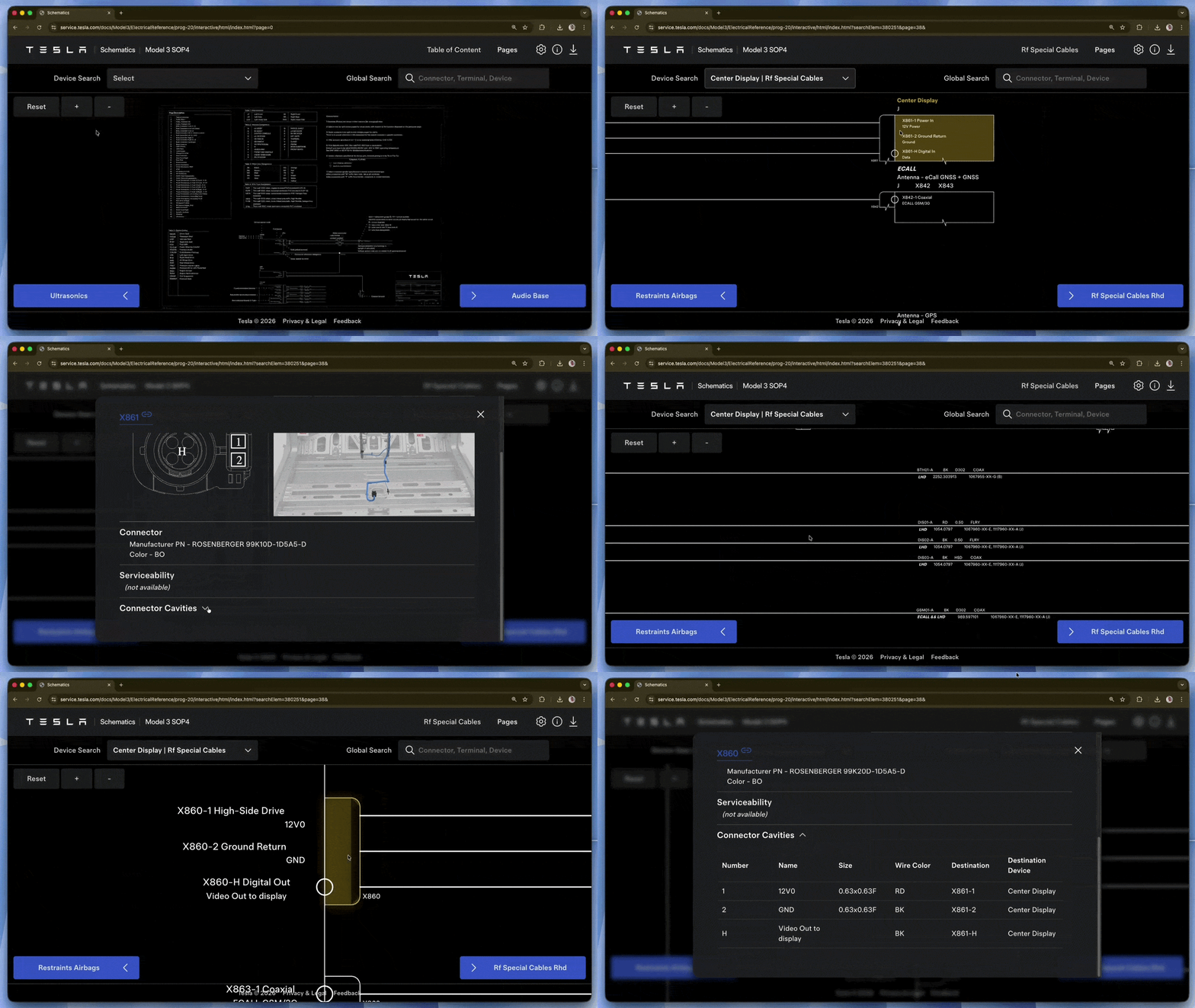
Turns out the display uses a 6-pin cable (2 for 12V and ground, 4 for data) with a special Rosenberger 99K10D-1D5A5-D connector. I soon discovered that unless you are a car manufacturer ordering in bulk, there is no way you are buying a single Rosenberger cable like this. No Ebay listings, nothing on Aliexpress, essentially no search results at all.
After digging around a bit, I found that this cable is very similar to a more widely used automotive cable called “LVDS”, which is used to transfer video in BMW cars. At first sight, the connectors looked like a perfect match to my Rosenberger, so I placed an order:
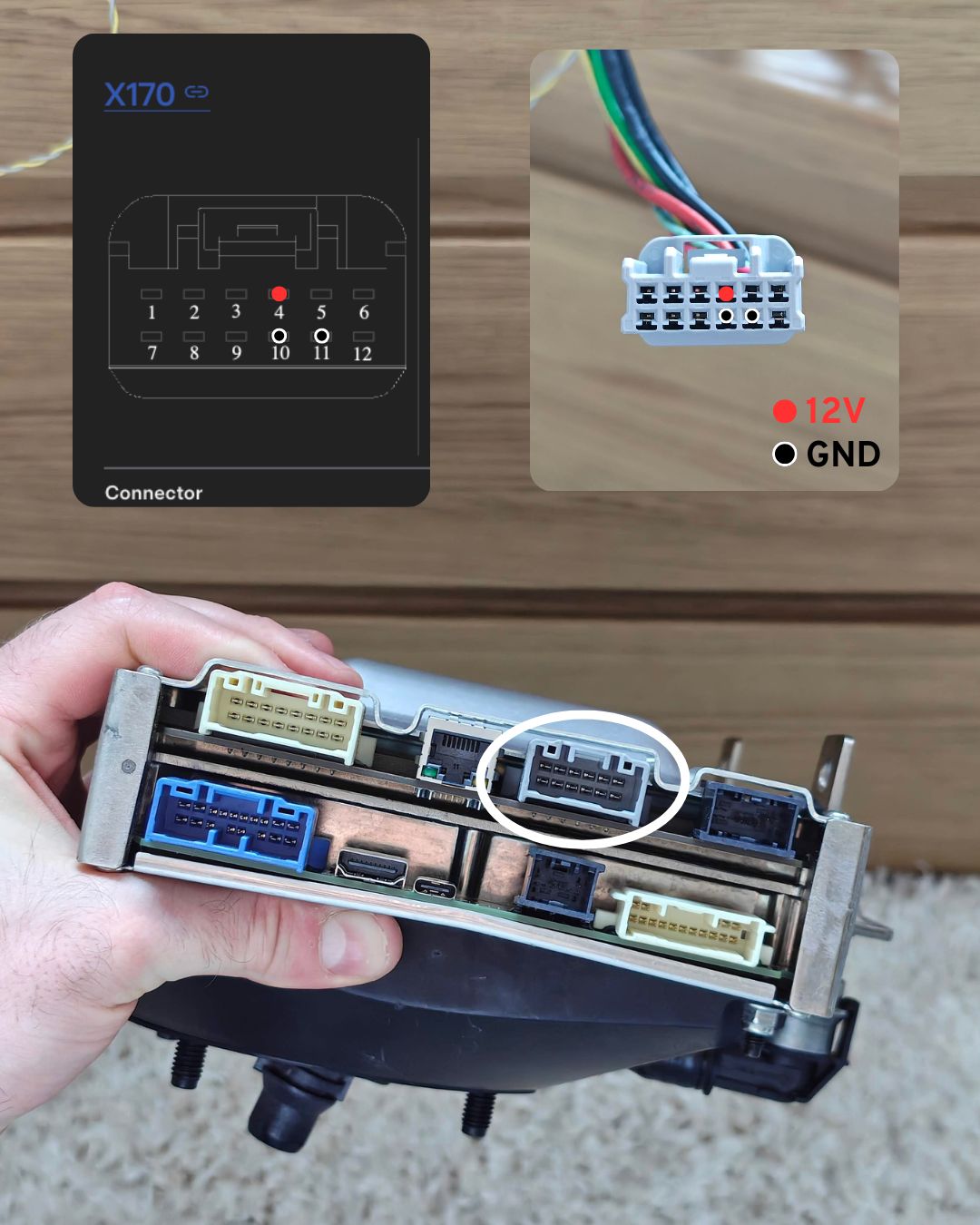
The computer arrived first. To attempt to power it on, I looked up which pin of which connector I needed to attach 12V and ground to using the Tesla schematics & the few pictures online of people doing the same desk-MCU setup. Since the computer included the shortly cut cables, I was able to strip the relevant wires and attach the power supply’s clips to the right ones:
I saw a couple of red LEDs start flashing, and the computer started up! Since I had no screen yet, there were not many ways to interact with the car. Reading @lewurm’s previous research on GitHub I knew that, at least in older car versions, there was a network inside the car, with some components having their own webserver. I connected an Ethernet cable to the port next to the power connector and to my laptop.
This network does not have DHCP, so you have to manually set your IP address. The IP you select has to be 192.168.90.X/24, and should be higher than 192.168.90.105 to not conflict with other hosts on the network. On Reddit, I found the contents of an older /etc/hosts file from a car which shows the hosts that are normally associated with specific IPs:
192.168.90.100 cid ice # mcu
192.168.90.100 ic # only in Model X/S | IC = instrument cluster
192.168.90.102 gw # gateway
192.168.90.103 ap ape # ap = autopilot
192.168.90.104 lb # no clue
192.168.90.105 ap-b ape-b # also autopilot
192.168.90.30 tuner # Also no clue
192.168.90.60 modem # this has the ftp server
@lewurm’s blog mentioned that SSH on port :22 and a webserver on :8080 was open on 192.168.90.100, the MCU. Was this still the case on newer models? Yes!
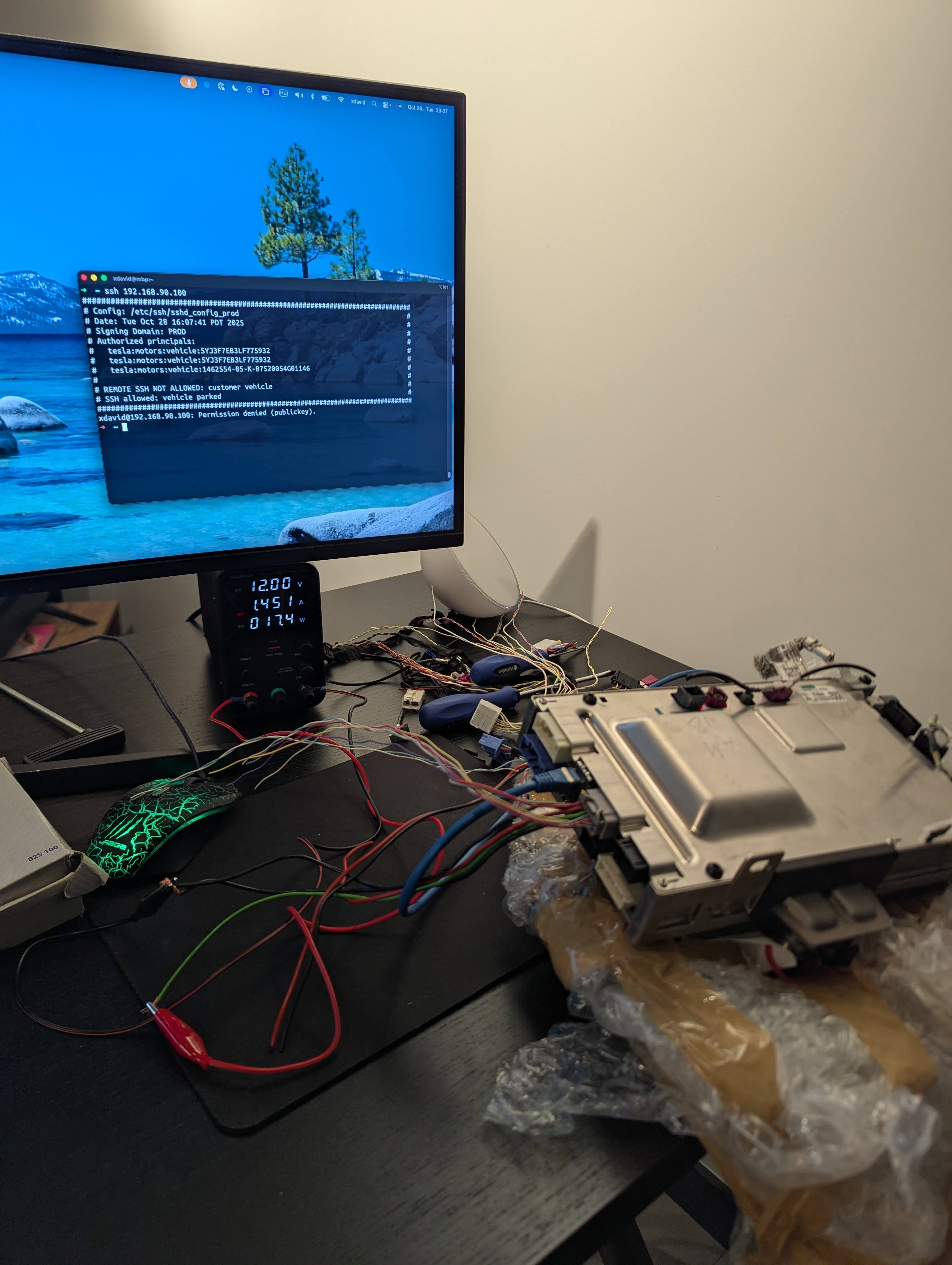
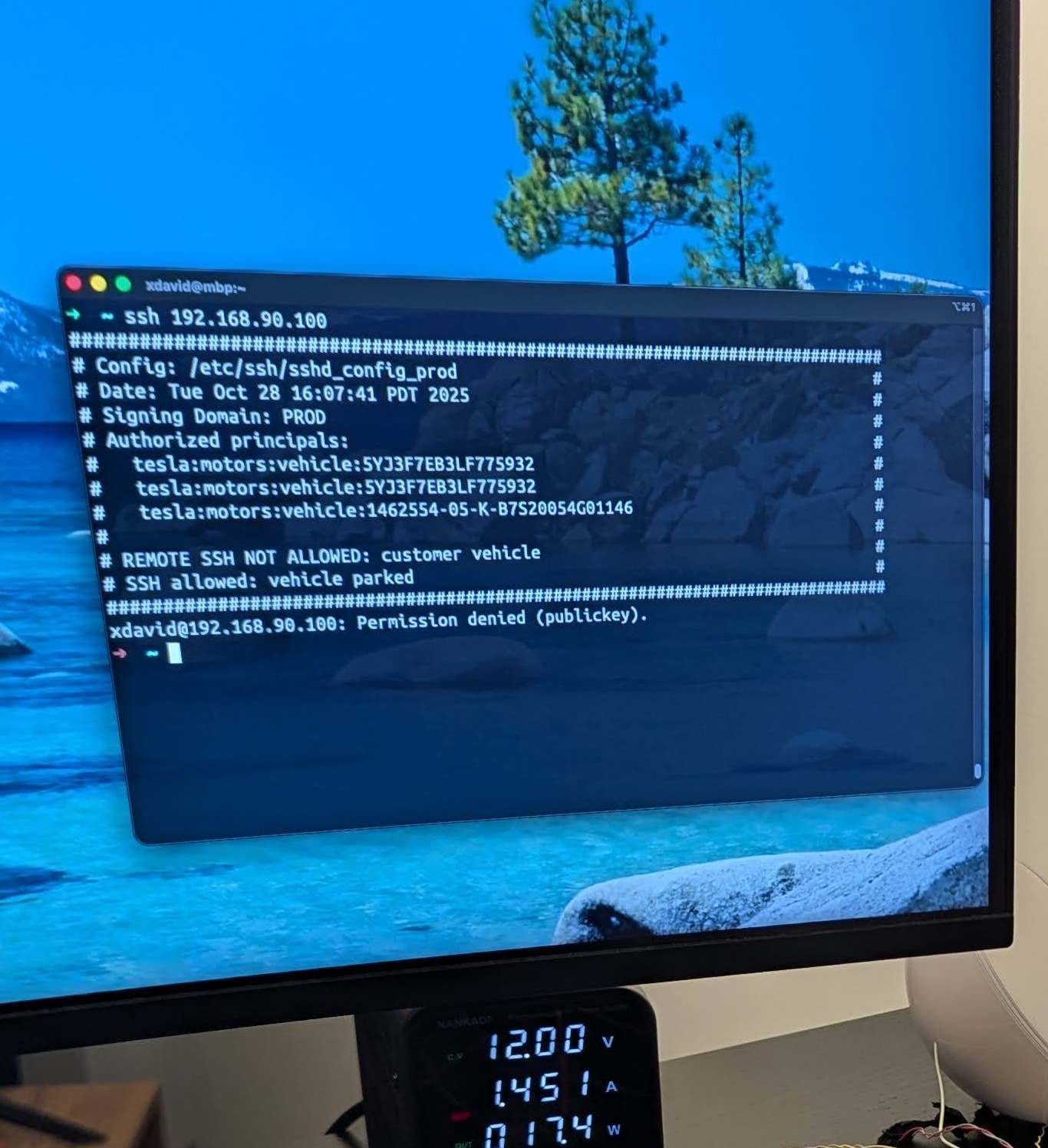
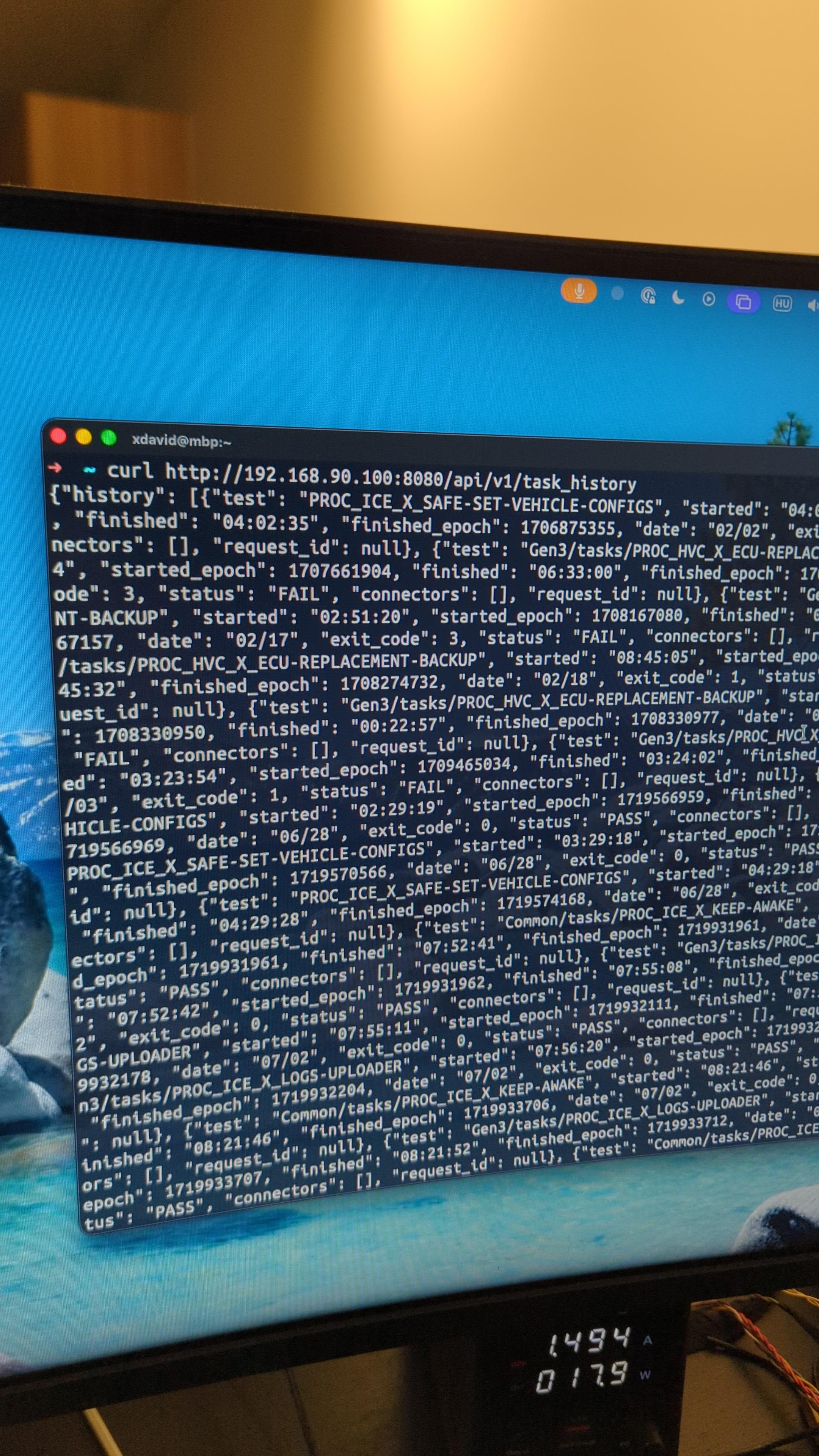
I had already found 2 services to explore on the MCU:
:8080 which returned a history of “tasks”Around this time, I also removed the metal shielding to see exactly what the boards look like inside. You can see the two different boards which were stacked on top of each other:
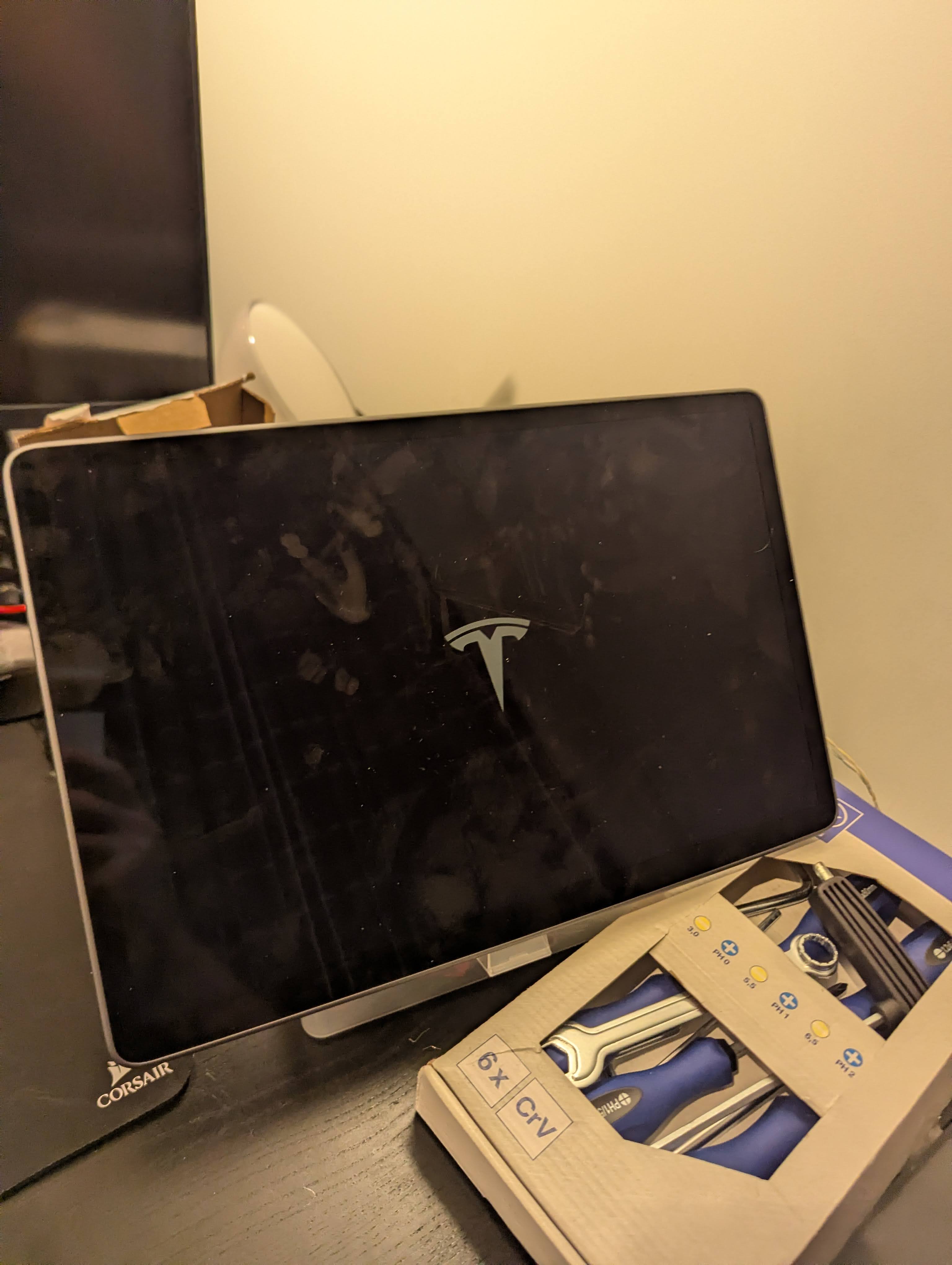
Once the screen and the BMW LVDS cable arrived, it unfortunately became clear that the connector is not going to fit. The BMW connector was much thicker on the sides and it was not possible to plug it into the screen. This led to some super sketchy improvised attempts to strip the two original “tail” cables from the MCU and the screen and connect the individual wires together. The wires were really sensitive and thin. The setup worked for a couple of seconds, but caused wire debris to fall on the PCB and short it, burning one of the power controller chips:
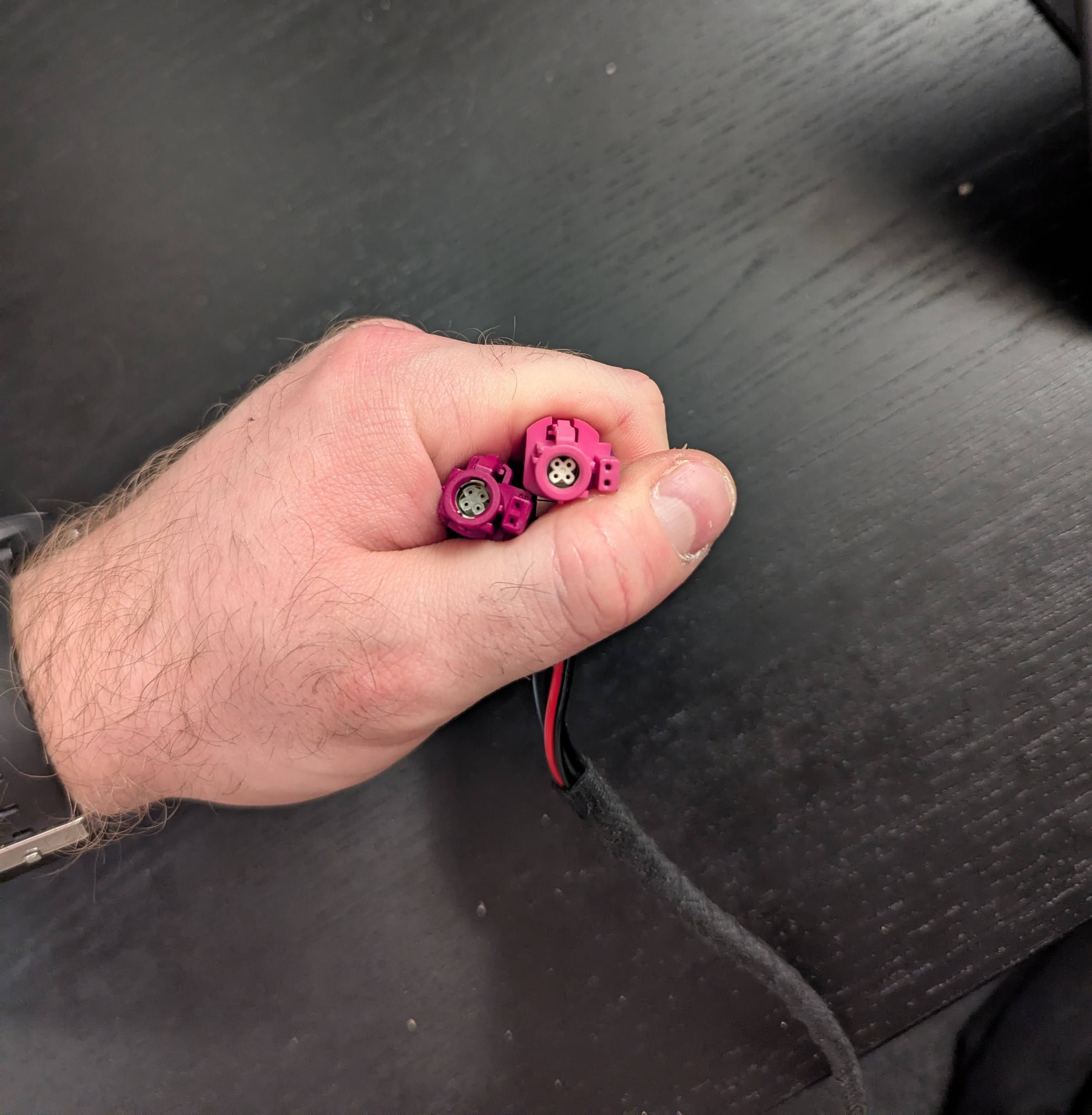
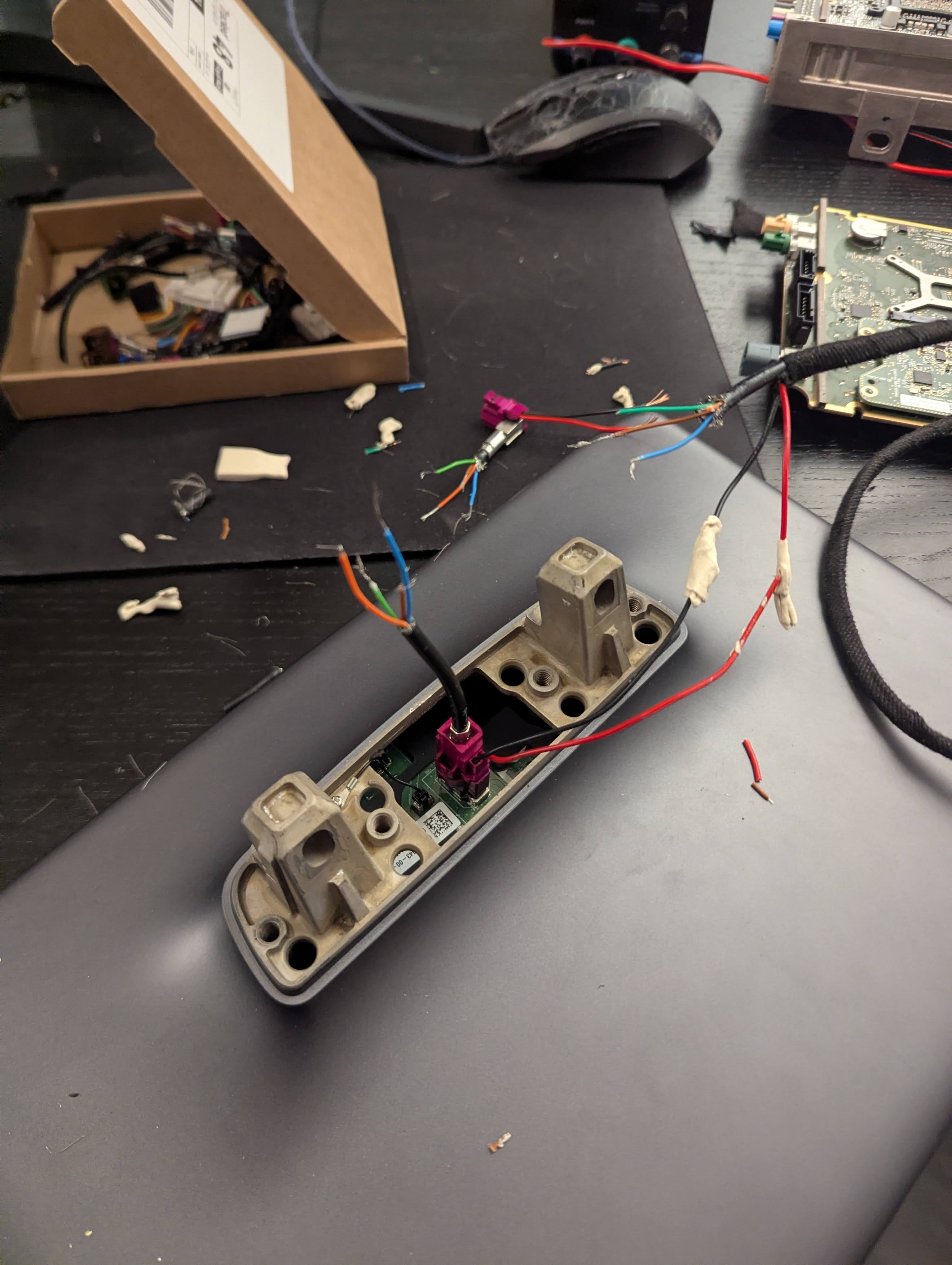
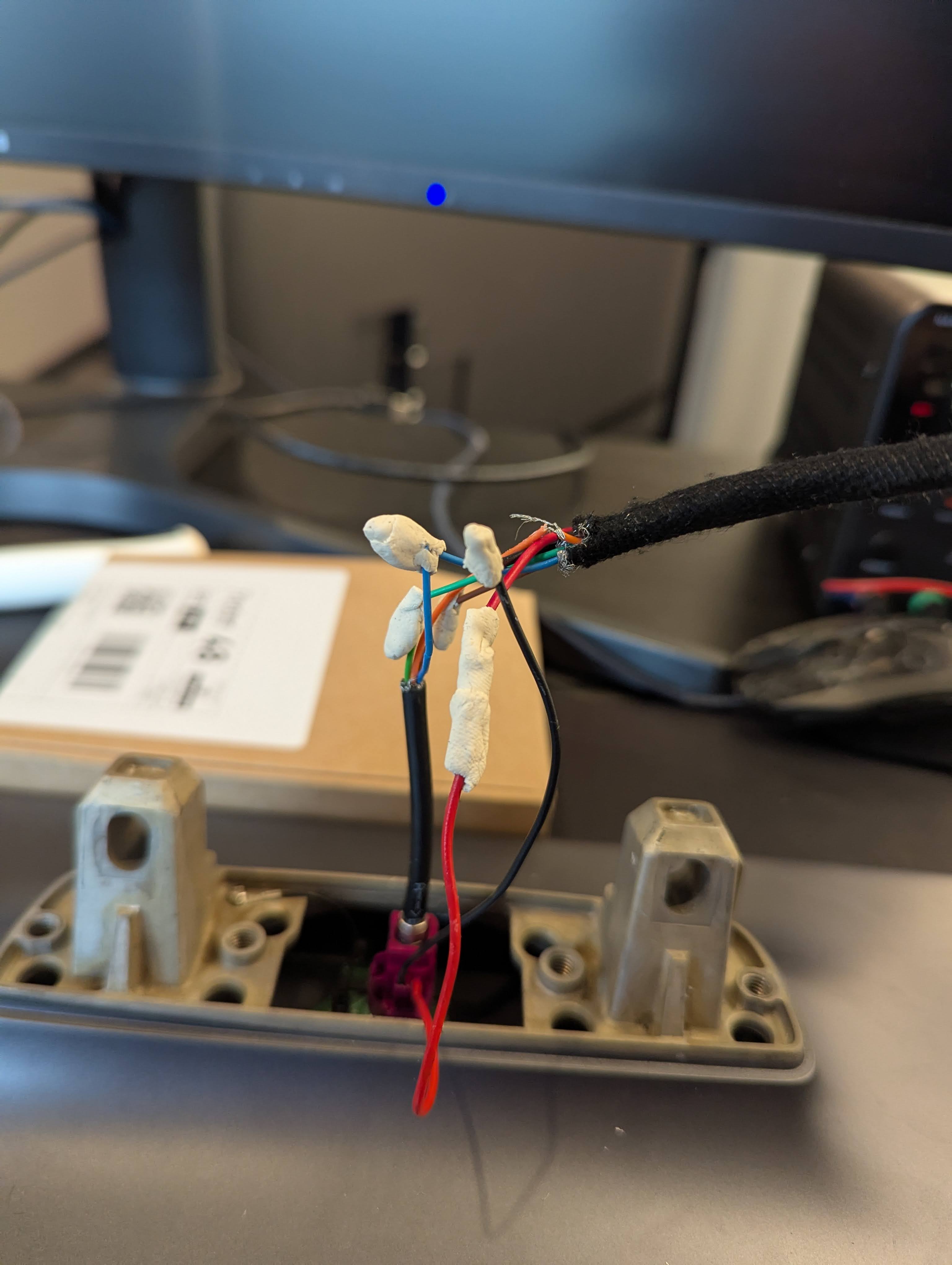
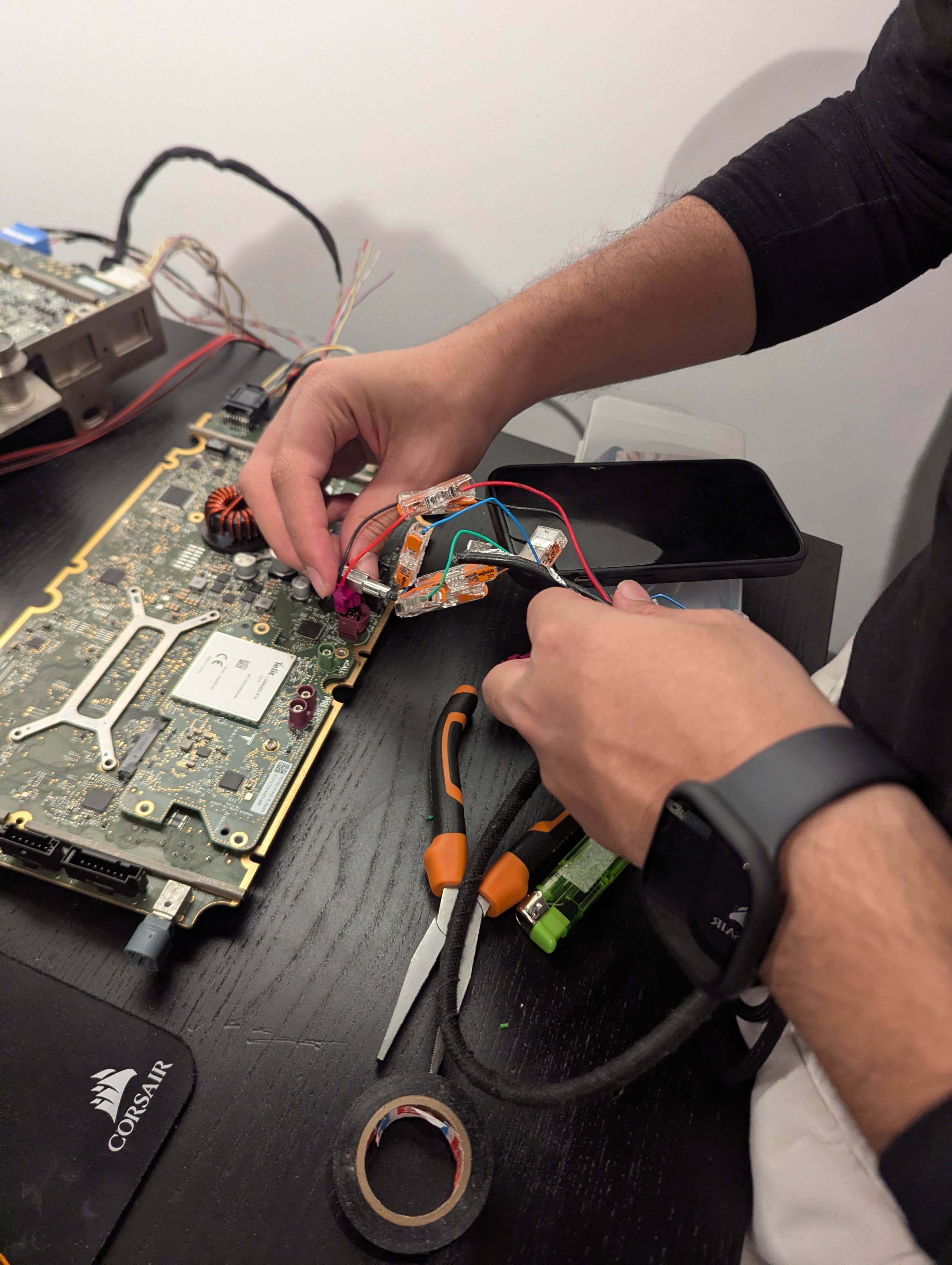
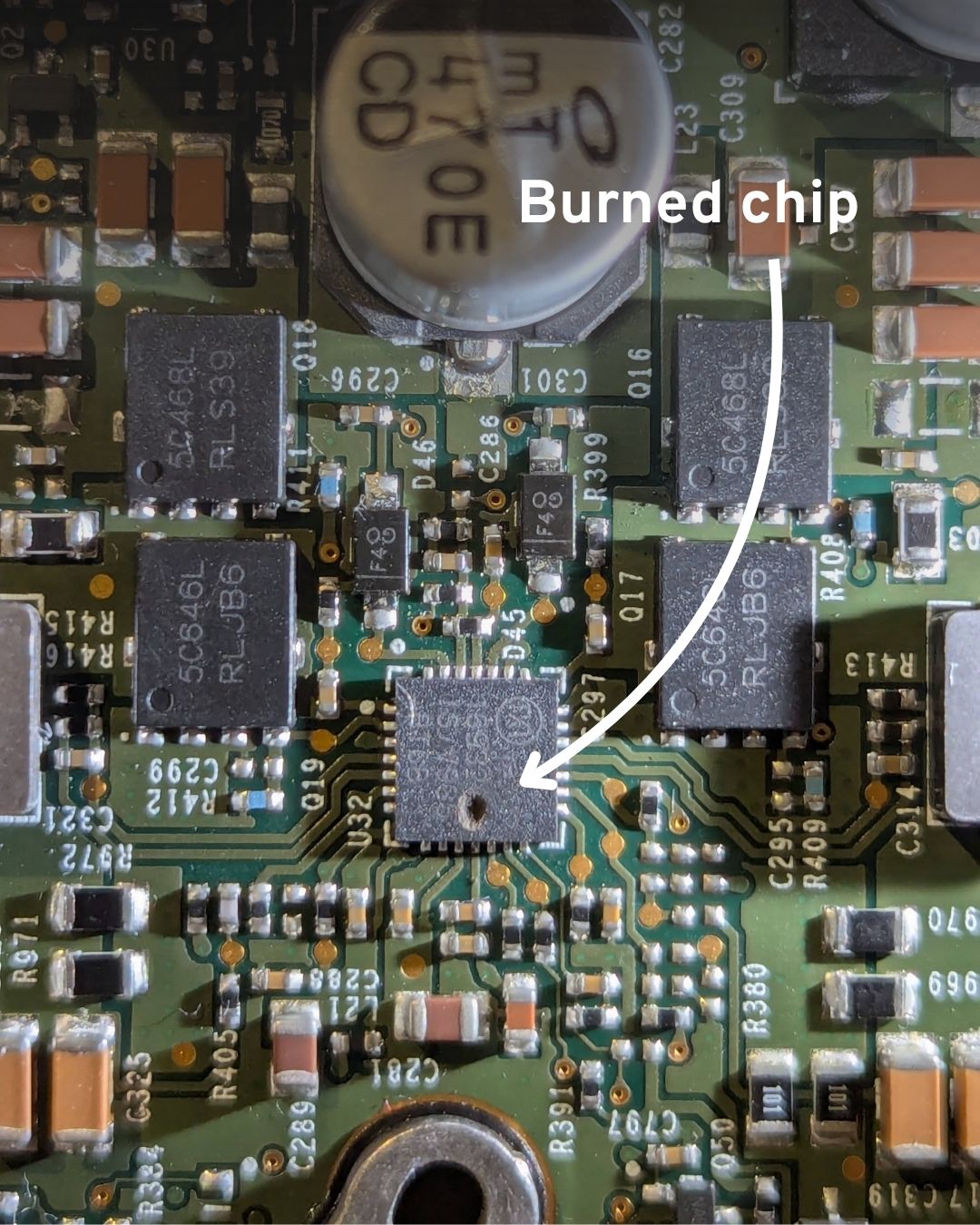
It was extremely hard to find the name/model of the chip that got burned, especially since part of the text printed on it had become unreadable due to the damage. To be able to continue with the project, I had to order a whole other car computer.
In the meantime, my friend Yasser (@n3r0li) somehow pulled off the impossible and identified it as the “MAX16932CATIS/V+T” step-down controller, responsible for converting power down to lower voltages. We ordered the chip and took the board to a local PCB repair shop, where they successfully replaced it and fixed the MCU. Now I had two computers to work with.
So I really did need that Rosenberger cable, there was no getting around it.
After having no luck finding it online and even visiting a Tesla service center in London (an odd encounter, to say the least), I had to accept what I had been trying to avoid: buying an entire Dashboard Wiring Harness.
Back in the Tesla Electrical Reference, in addition to the connectors, one can find every part number. Looking at the cable which connects the MCU to the screen, the number 1067960-XX-E shows. Searching for it on Ebay brings up this monstrosity:
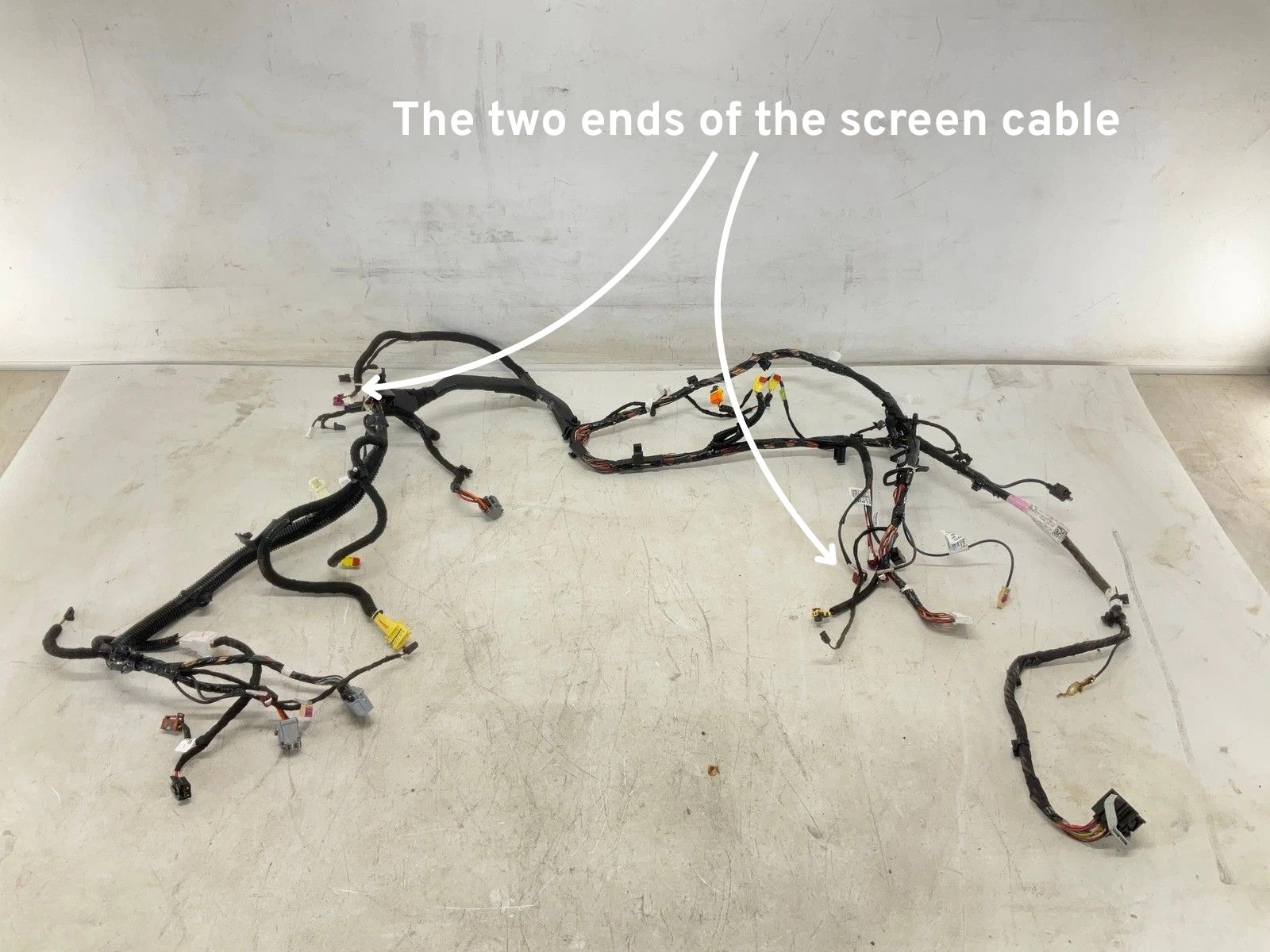
Turns out that actual cars don’t have individual cables. Instead they have these big “looms”, which bundle many cables from a nearby area into a single harness. This is the reason why I could not find the individual cable earlier. They simply don’t manufacture it. Unfortunately I had no other choice but to buy this entire loom for 80 USD.
Despite how bulky it was, the loom worked perfectly. The car booted, the touch screen started up, and I had a working car computer on my desk, running the car’s operating system!
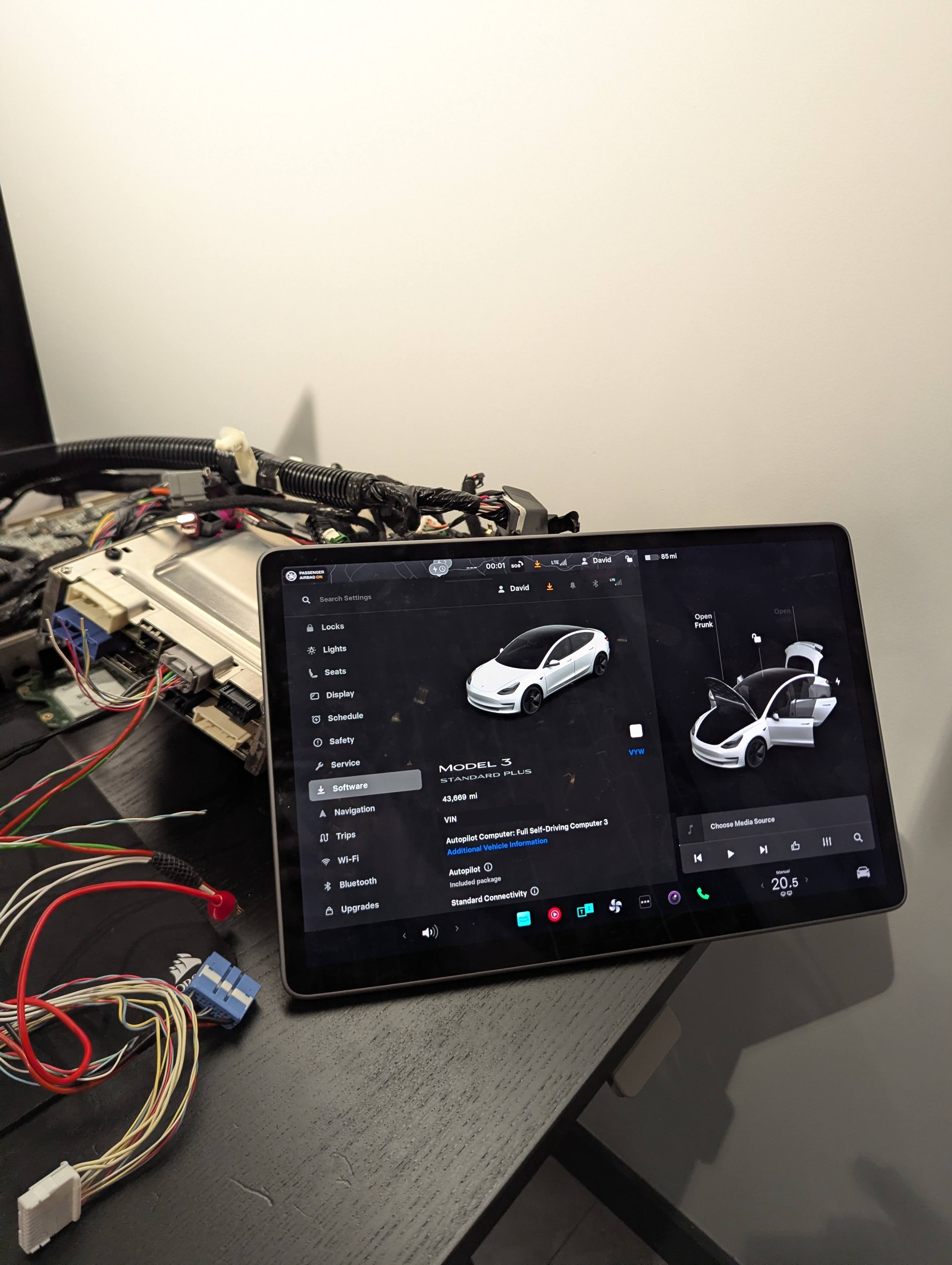
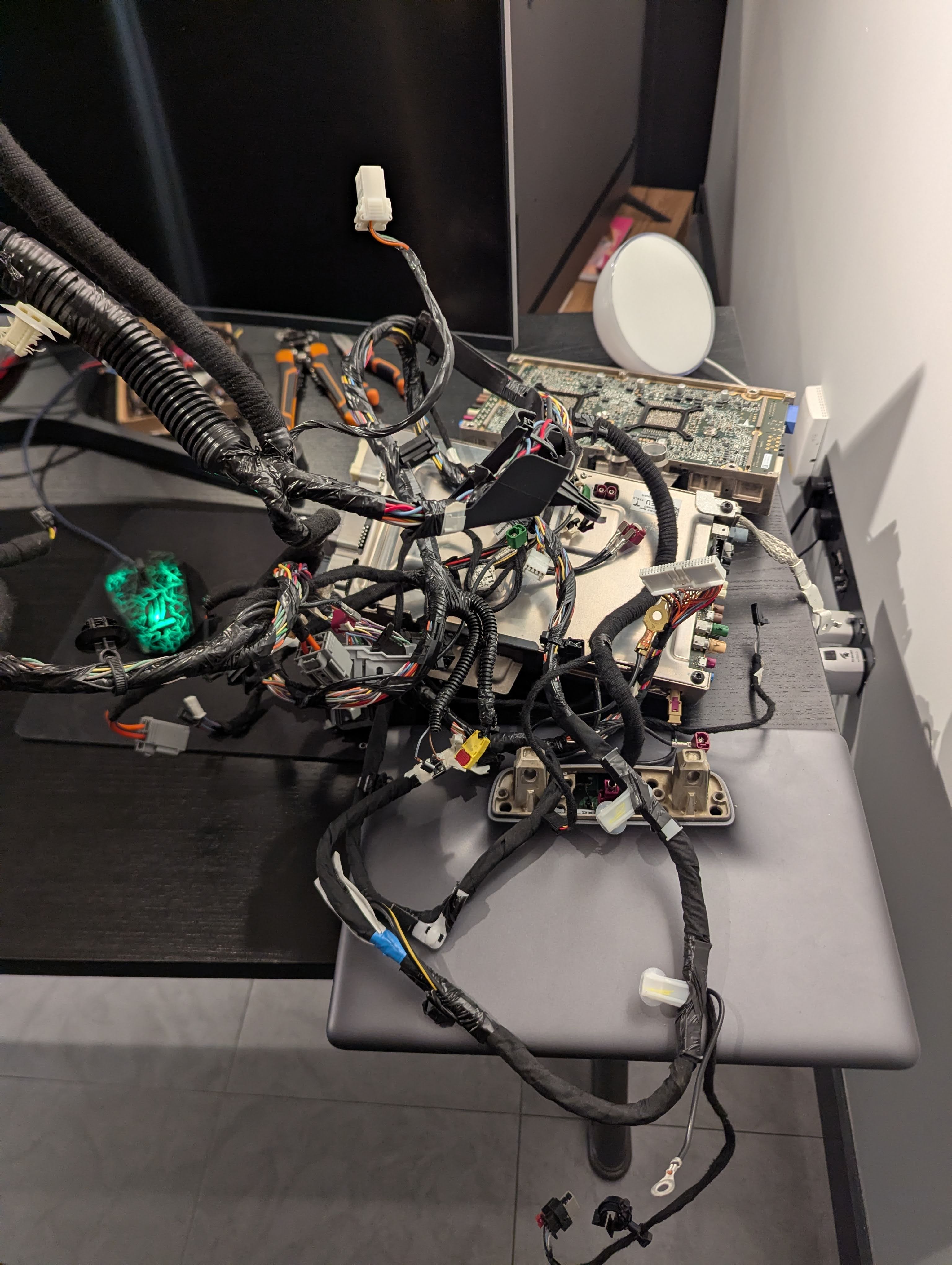
Having the system running, I can now start playing with the user interface, interacting with the exposed network interfaces, exploring the CAN buses, and perhaps even attempting to extract the firmware.
https://www.reddit.com/r/teslamotors/comments/utivlj/tesla_s...
> This used to cost $3187.50
https://driveteslacanada.ca/news/tesla-service-manuals-free-...
> The access story has been inconsistent over the years. Tesla has opened up free access to both the service manuals and diagnostic software in the past, but that was apparently a mistake, and loopholes were quickly closed.
https://www.teslaownersonline.com/threads/tesla-service-manu...
"Always ... all free to use". Not so much. And before that, even less available.
I will grant you for number 2, there seems to be some ambiguity - some people claimed it was only if you needed to actually use their diagnostic tools, because Tesla wouldn't sell them to anyone at the time (which is also in contradiction to your "everything you need, all free, always").
It's also notorious for having awful solder connections and failing outright.
https://evilution.co.uk/mod/sam-unit-solder-repair.htm (and Aging Wheels: https://www.youtube.com/watch?v=n8AAleKR33Q)
I was a developer for a decade before I went to school for design, so I’ve seen it from the other side. It’s not all bad: that overconfidence can lead people to tackle problems they’d abandon if they really understood the domain’s complexities. But often it presents like developers acting like their genius developer brain allows them to solve difficult problems in completely different fields with a few glib analogies and a few brief thought experiments.
13-14v is normal in all 12v automotive systems as the charging voltage
of course this is just a modern interpretation. older stuff runs at 6v and some weirdo offbeat cars have a 24v/48v rail sitting around somewhere. Cop cars often had alternators that put out weird voltage ranges for certain equipment, or dual 12v for high amperage output.
https://www.3m.com/3M/en_US/p/c/electrical/wire-cable/tubing...
That said, I'm sure there's gotta be a better way to solve it with less copper. And I think they did something like that with CyberTruck.
And eDP is a differential signal at 200 or 400 millivolts so I don't see how that's "quite incorrect". It's not "the" LVDS but it's still in the category.
If an athlete breaks a world record, they're likely to do it again. Even though it's incredibly hard to break a world record.
"12v" in reference to anything automotive is very much a nominal reference.
That means all computers etc will work at 6v.
Sounds alright until you realize after spilling a bunch of flower vases in the trunk (hatchback) that the computer has literally no case on it and immediately shorts out while driving. Or a passenger spills a drink in the rear seat cup holder.
There is now a recall notice to pull the back seat out to install a $5 plastic cover over the thing.
And yep, it’s the main computer for the car which controls the electronic transmission etc. Immediate full on engine-shuts-off at speed on the freeway and you require a flatbed to tow it away level of broken. I’m sure the engine ECU is in the engine bay, but holy hell what a surprise!
Some Mazdas put the metal-cased engine computer in a plastic air box that feeds cold air from the front, to help ensure the engine computer stays cool enough.
In general, I believe the cooling airflow from the frontal air and the cooling fans keeps engine bay in check.
For example, this is the board that’s used in Mazda CX-5 2017+ engine computers (mfr Denso), it lists max temperature range of +150C: https://www.renesas.com/en/document/mah/rh850e1l-users-manua...
It's like "software dude thinks he can do hardware", but on steroids. They don't know what they don't know and they think they have a panacea in their hands.
Don't you know? Software is beneath them and the fiddly bits are just standing in the way of them getting their BigImportantWork™ done.
[1]: https://www.holley.com/products/engine/engine_dress_up/hoses... [2]: https://www.oreillyauto.com/detail/c/dorman-conduct-tite/lig...
I know CAN is a thing for a while now, and in the aviation world they have ethernet-derived standards like AFDX etc. But for some reason cables abound.
Meh, even in the IT industry cables abound.
With this, the John Deere approach to gatekeeping vehicle repair would no longer be legally protected by the DMCA or by copyright law. All the other protections afforded by copyright law would still apply: you cannot rip the firmware off the hardware and distribute it, the manufacturer is under no obligation to help you modify it, etc.
However, tools which patch or circumvent antifeatures of the firmware would now be legal to use on hardware you own: it would be legal to patch out software locks, retune engine computers, etc.
No i'd push back on this because the entire workshop manual is available for free without even registration required. You can literally google and land in the relevant sections and it is of a far higher quality than ford, VAG or bmw as three examples i'm pretty familiar with. I haven't seen the John Deere stuff.
Tesla does have "special tools" for some repair procedures, a practice as old as the auto industry but they don't rely on them to the same extent as BMW for example. Anecdotally, the special tools i'm aware of are genuinely useful - for example, the tool for disconnecting seatbelt anchors saves time vs the traditional bolt - where special tools on other marques are often clearly to workaround a failure of packaging or engineering resulting in tight access for a regular tool.
Their online API access is a little bit annoying, or at least unfriendly to casual home user, specifically the workflow to register an OIDC client, but not insurmountable.
Almost invariably when that excuse is trotted out, there are are usually many things that are much more common that are also far more dangerous. For example, texting while driving or driving with bald tires in the wet are both 100x more dangerous than anything almost anybody would do by modifying the car's software.
I had a small crack in the rubber seal around my sunroof from parking outside in the elements. When it rained, water seeped in, made its way down the a-pillar, pooled under the seat, and fried the computer.
Expensive fix but I was able to drive it to the shop.
Their code is aways terrible, and they constantly think it's good.
The exercise is always the same: explain the math to me, like I'm 5, then we profile it and see what is faster.
Oddly Claude Code, integrated into their IDE's has made this situation happen much less.
I never want to work in a place again where the fun way to start the Monday meeting is a "math problem".
PS: Don't even get me started on their SQL.
This thread is interesting to me 'cause I'm also a software guy and recently took a job dealing with building fighter jets and the amount of engineering going into the wiring and computers on those things is insane. It's been a very interesting learning experience.
Manufacturers have increasingly restricted control over products as they've gradually been digitized. Prior to the digital era anyone could do anything to personal property (regulations notwithstanding ofc); more expensive items typically came with circuit diagrams for the purpose of repairing them.
If you can open it up and find the JTAG pads, it should be simple-ish to use a JTAG reader to dump the image and then you can figure out the update protocol from that. It's unlikely to be complicated.
each body model (nothing to do with year or style) was different so clearing dtc but nothing else is not a surprise.
i did get that working, but I last touched it in 2007 so I don't remember enough details to be helpful. good luck.
So the alternator has to put out at least something higher than if it’s planning on recharging the battery after 500 to 700 amps have been pulled from it for a few seconds to start the engine.
What does that mean? "The software" is a specific configuration of the hardware you own. How can you own the hardware and not the specific copy of whatever data is on it? Note that I'm not confusing the copy of the data with the IP rights to it.
It really isn't. Unlike John Deere, Tesla is actually pretty good on right-to-repair. All of their technical and repair manuals are available for free to anyone. The service/diagnostics software ("Toolbox") is also available to anyone, albeit for a (not entirely unreasonable) fee.
(There is also a service mode built in to the car which can do many basic diagnostics for free)
This would be okay if there's a way to reject the license and install my own firmware.
How is this different from the 2000s, or the 90s, or even before, when the normal thing to do with commercial software was to purchase a license to use said software and a physical medium containing a copy? You'd also then not "own the software", but you owned the right to install a copy on your own computer and use it. That worked without having to hand over the keys to your own computer.
Sure, the physical delivery medium is gone, but that's just a detail. Why do we now think that just because we license software for use, we can't be in ultimate charge of our own devices?
This is about selling tools and access. It's another profit pipeline for car OEMs.
> That means all computers etc will work at 6v.
Not necessarily all of them. Plenty of stuff will drop out while cranking; hopefully not the computers that run the fuel injection and ignition, though.
There's just so many computers and what-not in modern cars that this is a very tall ask. You'd need a project on-par with HomeAssistant to get anywhere.
It's a bit perplexing that those lead acid systems are referred to as "12V" systems when that figure is effectively the 0% voltage, whereas 3.7V for single Li-ion cell is the 50% voltage.
e: also, ICE transients can be in kV range, coming from ignition mechanisms. I've heard that you can literally measure engine RPM by selecting 1/dt on an oscilloscope and dividing that by cylinder count.
When you bought a DVD, you didn't "Own" the movie, but you had a legal right to do things with that data you didn't "own" anyway, like format shifting and selling that physical object on to another person. You could copy that data off and do things with it. I think technically it would be a copyright violation to then put that movie file into Movie Maker and cut up your own personal highlight reel, but good luck finding a judge willing to hear that case if you don't upload it to youtube.
Now, thanks to the DMCA and courts being absurdly credulous of bullshit arguments from corporate attorneys, you no longer have basic consumer rights. If you try to even inspect the code that runs to protect your literal life, that can be a crime. You own the literal hardware, but if you try to act like you own it, that's a crime. You technically still have the right to format shift a BluRay for example, but bypassing the math protecting that data overrides that "right" and you are guilty of a crime. A CEO's wet dream.
If the DMCA was older, IBM could have prevented the existence of the Clone PC market and ensured a locked up market. We would all be stuck on absurdly shit hardware because that's what was more profitable for IBM.
Pre-DMCA, Sega was told that their trademark rights were overridden by the innate market right to interoperate with their product. IP rights used to be fairly weak! Sony could not prevent a company from selling a software product that ran playstation games. To this day, Nintendo simply pretends these court cases didn't happen.
This is part of why China has so much success in manufacturing and product development IMO. They don't need to develop purposely worse versions of things just so some other company can sit on their hands for 20 years collecting rent. If you want a fast moving market, the ability to lock things down for 20 years is fundamentally unacceptable, only enriching a few owners, and outright harming our country. Basically every time in history that IP rights are weakened or nullified, you see a burst of development and advancement in products and solutions.
Enforcement is abysmal for stupid reasons. Courts are reluctant to remove the ability for people to drive because America purposely made itself dependent on cars, and cops are reluctant to actually arrest a lot of people for drunk driving because they tend to be buddies, or worse. You can find plentiful examples of off duty officers trying to get out of drunk driving simply by being a cop.
This is what you get when you can vote on the sheriff and judges who insist they are "Tough on crime" because they sentence a dude smoking a joint to years in the joint while ignoring real problems like, you know, murder and theft and violence and all the shit their buddies are doing. The "Tough on crime" people are the ones drunk driving often enough.
Disabling alertness sensors might worsen drunk driving actually.
It's not really feasible for a private owner, so I can see why it's not offered as an option.
That should be the bare minimum. Ford charges you 40 dollar an hour for it and unless you know exactly what you are looking for you will spend several hundreds on it.
Too bad ford killed their old site, the print form was unauthenticated and you could print the entire schematics to pdf if you knew the internal model number. Or do what I did and run a script to dump it to higher res PNGs.
These days unauthorized access tends to lose you effective use of the hardware you bought because the hardware requires software features to work and that software often unnecessarily phones home so if the OEM toggles a field in a DB somewhere you lose access to back up assist or whatever other fancy tech features that you a) paid for b) don't strictly need to have dependencies that phone home to work but do "because reasons".
That, or no company wants to assume liability. In which case, go whine to your local representative. That’ll be hilarious for all involved.
One minute you might be accelerating and the onboard voltage drops as the battery supplies most of electricity. Then, as you reach the crest of a hill and start engine-braking, the car frantically tries to convert all the available kinetic energy to electricity, raising the onboard voltage to quickly charge the battery.
But at least in my jurisdiction, I can mechanically modify the car in any way I please, as long as it still has seat belts, brake lights, and bumpers of a certain height. It doesn't even still require a steering wheel; that's not specified in the law as far as I've been able to find. (Now, if I removed the muffler and made it louder than proscribed by law, I could be cited for a noise violation, but only at such a time as I womped on the gas and actually made the noise. The car itself being _capable_ of the noise is not, inherently, illegal.)
This blew my coworkers' mind once as I unplugged the passenger-side airbag while mounting a bunch of new stuff there. Apparently in some places, it requires paperwork and certifications just to unplug a connector? Weird.
As it turns out though blatant irresponsibility is quite rare (depending on your definition anyway) since people have a strong self interest in not endangering their own lives or wallets. It's similar for homeowners - many states explicitly carve out a requirement that insurance companies cover DIY modifications that are within reason and this generally works out since you have a strong vested interest in not destroying your own house regardless of any insurance policy.
More legitimately, alldata.com has repair data, workshop manuals for most marques up to today and will sell you either single vehicle (called "DIY") or a package aimed at independent mechanics where you can access anything. Same manuals either way, but you pay per vehicle with DIY (and have to contact support to switch.)
I use alldata for my GM truck, it is fantastic.
I won't go into details but searching around with the "forum" keyword and etis might get you somewhere (at least that did the trick a few years ago, now with LLM slop I don't know, and what the other person posted).
Give me root access so i can install openclaw.
It is. Thousands of people have died because of aftermarket headlights. Harder to assess, but probably much larger, is the number of excess deaths from nitrous oxide etc. emitted by modified cars.
Maybe you think daytime running lights are stupid and want to disable them for instance.
Modified cars can release 1000x more polution, on streets with 800 daily cars that will have an affect.
This isn't complicated FFS.
The difficulty against this in the US is the unfortunate reality that the people coming to these shops to enable their stupid trucks to roll coal are the people who should technically be raiding and shutting down these companies. This can be fixed.
Physically, you can already modify your car to be controlled by a stupid program and that has been possible since at least the 90s. You can do the supposed harm by not being aware of damage to your exhaust system.
The solution to exhaust harms of ICE engines is electric cars, not a reduction in consumer rights.
The risk profile is very different and non-obvious to your average car owner.
It's the difference between trying to repair your leaky dishwasher vs. trying to repair the electrical panel in your basement.
I don't disagree that it's a bit different in certain ways but I feel like that's drifting off topic. It shouldn't be up to manufactures to determine these things unilaterally but rather the legislature. Particularly any justification to the contrary rings hollow in this case because there's a very strong conflict of interest.