Cohere is announcing Transcribe, a state-of-the-art automatic speech recognition (ASR) model that is open source and available today for download.
Speech is rapidly becoming a core modality for AI-enabled workloads and automations — from meeting transcription and speech analytics to real-time customer support agents.
Our objective was straightforward: push the frontier of dedicated ASR model accuracy under practical conditions. The model was trained from scratch with a deliberate focus on minimizing word error rate (WER), while keeping production readiness top-of-mind. In other words, not just a research artifact, but a system designed for everyday use.
Cohere Transcribe reflects that intent. It is available for open-source use with full infrastructure control, maintains a manageable inference footprint suitable for practical GPU and local utilization, delivers best-in-class serving efficiency, and is also available via Model Vault — Cohere’s secure, fully managed model inference platform.
Cohere Transcribe currently ranks #1 for accuracy on HuggingFace’s Open ASR Leaderboard, setting a new benchmark for real-world transcription performance.
This marks our zero-to-one in bringing high-performance speech recognition into enterprise AI workflows. Read on to learn more.
Model overview
| Name | cohere-transcribe-03-2026 |
|---|---|
| Architecture | conformer-based encoder-decoder |
| Input | audio waveform → log-Mel spectrogram |
| Output | transcribed text |
| Model size | 2B |
| Model | a large Conformer encoder extracts acoustic representations, followed by a lightweight Transformer decoder for token generation |
| Training objective | standard supervised cross-entropy on output tokens; trained from scratch |
| Languages | trained on 14 languages:
|
| License | Apache 2.0 |
Image 1: Cohere Transcribe is an open-weights Conformer ASR model converting speech audio into text across 14 supported languages.
Model performance
Accuracy
Cohere Transcribe is the latest standard for English speech recognition accuracy. It leads the HuggingFace Open ASR Leaderboard with an average word error rate of just 5.42%, outperforming all open- and closed-source dedicated ASR alternatives, including Whisper Large v3, ElevenLabs Scribe v2, and Qwen3-ASR-1.7B. This captures the model’s versatile capability across real-world speech tasks, such as robustness to multiple-speaker environments, boardroom-style acoustics (e.g. AMI dataset), and diverse accents (e.g. Voxpopuli dataset).
| Model | Average WER | AMI | Earnings 22 | Gigaspeech | LS clean | LS other | SPGISpeech | Tedlium | Voxpopuli |
|---|---|---|---|---|---|---|---|---|---|
| Cohere Transcribe | 5.42 | 8.13 | 10.86 | 9.34 | 1.25 | 2.37 | 3.08 | 2.49 | 5.87 |
| Zoom Scribe v1 | 5.47 | 10.03 | 9.53 | 9.61 | 1.63 | 2.81 | 1.59 | 3.22 | 5.37 |
| IBM Granite 4.0 1B Speech | 5.52 | 8.44 | 8.48 | 10.14 | 1.42 | 2.85 | 3.89 | 3.10 | 5.84 |
| NVIDIA Canary Qwen 2.5B | 5.63 | 10.19 | 10.45 | 9.43 | 1.61 | 3.10 | 1.90 | 2.71 | 5.66 |
| Qwen3-ASR-1.7B | 5.76 | 10.56 | 10.25 | 8.74 | 1.63 | 3.40 | 2.84 | 2.28 | 6.35 |
| ElevenLabs Scribe v2 | 5.83 | 11.86 | 9.43 | 9.11 | 1.54 | 2.83 | 2.68 | 2.37 | 6.80 |
| Kyutai STT 2.6B | 6.40 | 12.17 | 10.99 | 9.81 | 1.70 | 4.32 | 2.03 | 3.35 | 6.79 |
| OpenAI Whisper Large v3 | 7.44 | 15.95 | 11.29 | 10.02 | 2.01 | 3.91 | 2.94 | 3.86 | 9.54 |
| Voxtral Mini 4B Realtime 2602 | 7.68 | 17.07 | 11.84 | 10.38 | 2.08 | 5.52 | 2.42 | 3.79 | 8.34 |
Image 2: the Hugging Face Open ASR Leaderboard as of 03.26.2026. This is a widely used, standardized benchmark evaluating automatic speech recognition systems across curated datasets using word error rate (WER) as the primary metric, computed over normalized reference-hypothesis alignments, where lower WER indicates higher transcription fidelity. See the live leaderboard here.
Critically, these gains aren’t limited to benchmark datasets. We see the same state-of-the-art performance carried over into human evaluations, where trained reviewers assess transcription quality across real-world audio for accuracy, coherence, and usability. Consistency across both evaluation methods reinforces that Cohere Transcribe’s performance translates reliably from controlled tests to practical enterprise settings.
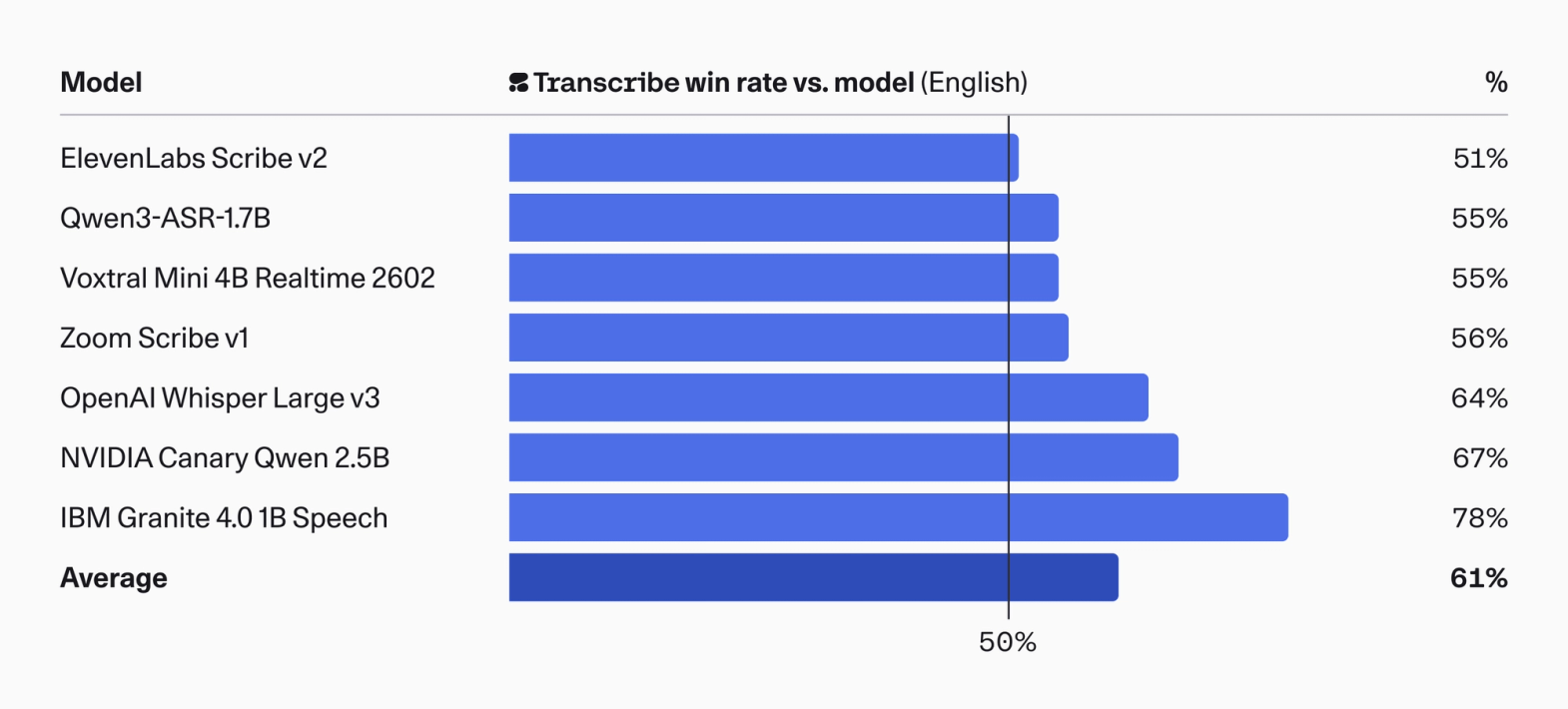
Image 3: human preference evaluation of model transcripts in English. In a pairwise comparison, annotators were asked to express preferences for generations which primarily preserved meaning - but also avoided hallucination, correctly identified named entities, and provided verbatim transcripts with appropriate formatting. A score of 50% or higher indicates that Cohere Transcribe was preferred on average in the head-to-head comparison.
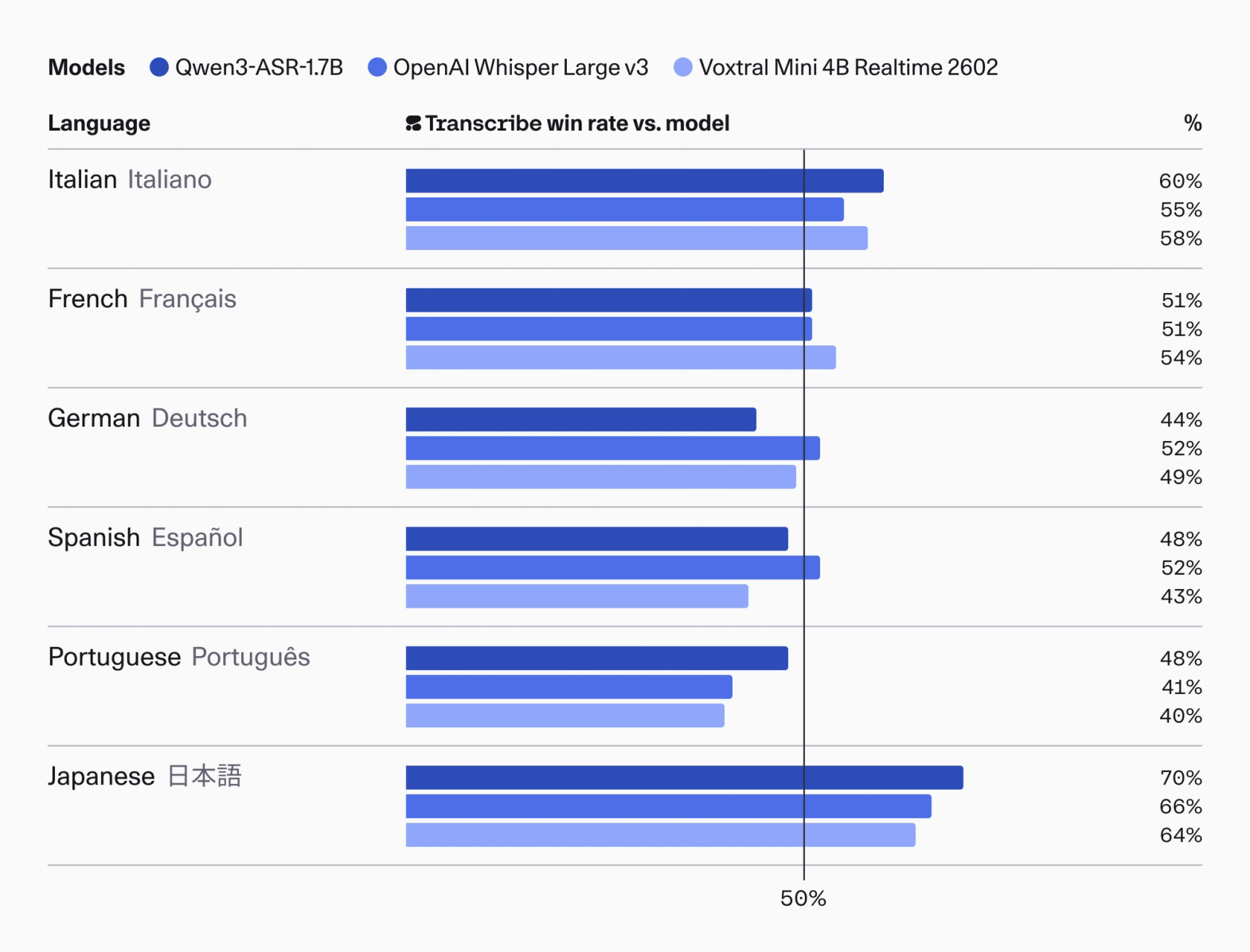
Image 4: human evaluation of ASR accuracy for a selection of supported languages. A score of 50% or higher indicates that Cohere Transcribe was preferred on average in the head-to-head comparison.
Throughput
In production settings, ASR systems must operate under strict latency and throughput constraints; even if accurate, slow or resource-intensive transcription can directly impact user experience, operational efficiency, and cost.
Transcribe extends the Pareto frontier, delivering state-of-the-art accuracy (low WER) while sustaining best-in-class throughput (high RTFx) within the 1B+ parameter model cohort.
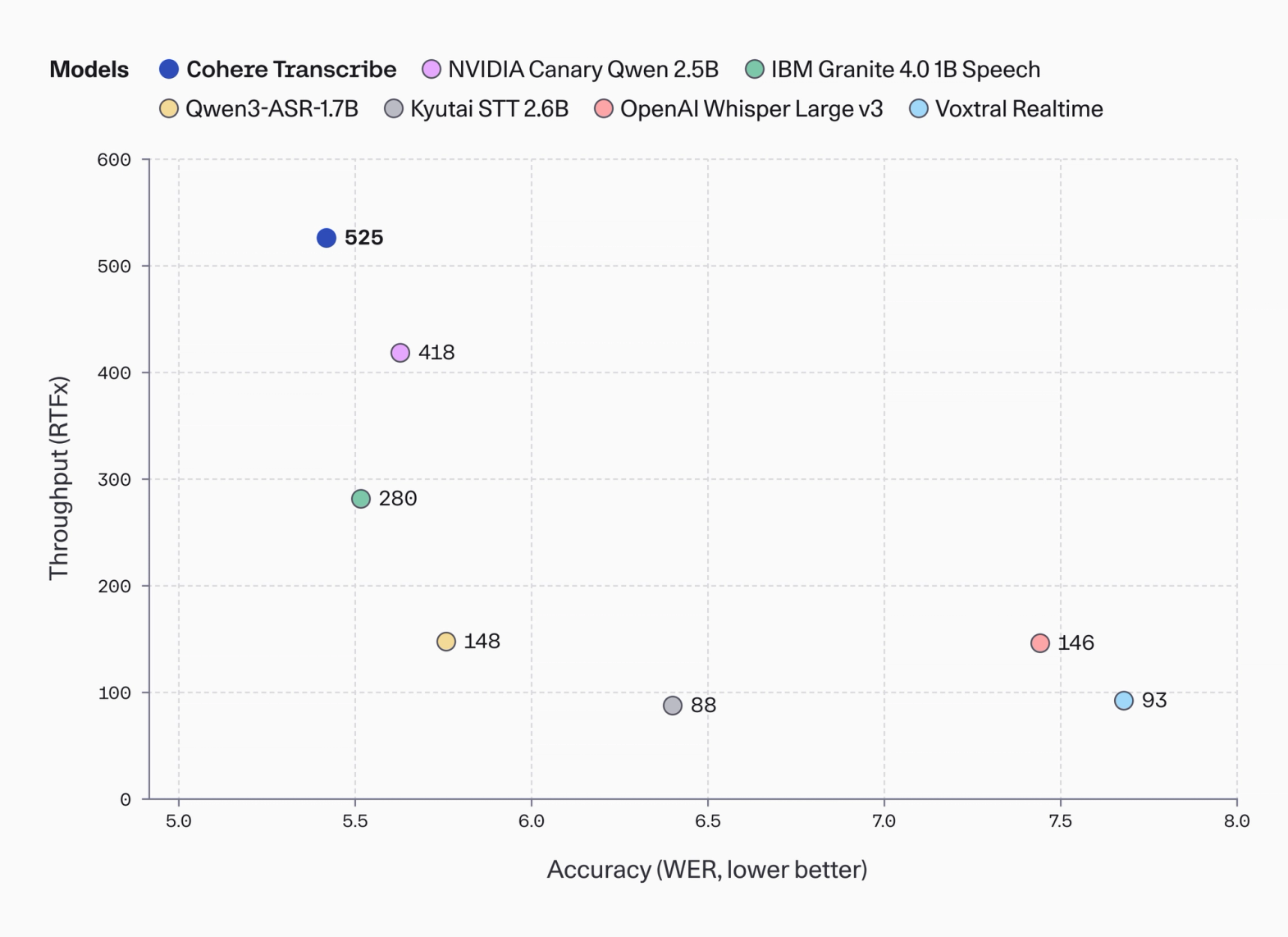
Image 5: throughput (RTFx) vs accuracy (WER) plot for leading models larger than 1B in size. RTFx (real-time factor multiple) measures how fast an audio model processes its input relative to real time.
“We’re genuinely impressed with what Cohere has built with Transcribe. The speed is exceptional — turning minutes of audio into usable transcripts in seconds — and it immediately unlocks new possibilities for real-time products and workflows.
In our testing, the model handled everyday speech very well and delivered strong, reliable transcription quality. The overall experience has been smooth and easy to work with. We’re excited to be partnering with Cohere and to continue exploring what we can build with this technology.”
Paige Dickie Vice-President Radical Ventures
Zero to one, and beyond.
We are working towards deeper integration of Cohere Transcribe with North, Cohere’s AI agent orchestration platform. With planned updates, Cohere Transcribe will evolve from a high-accuracy transcription model into a broader foundation for enterprise speech intelligence.
Getting started.
Cohere Transcribe is now available for download on Hugging Face. Follow the setup instructions to run the model locally, or even in edge environments.
You can also access Cohere Transcribe via our API for free, low-setup experimentation subject to rate limits. See the documentation for usage details and integration guidance.
For production deployment without rate limits, provision a dedicated Model Vault. This enables low-latency, private cloud inference without having to manage infrastructure. Pricing is calculated per hour-instance, with discounted plans for longer-term commitments. Contact our team to discuss your requirements.
Key contributors: Julian Mack (Member of Technical Staff), Ekagra Ranjan (Member of Technical Staff), Cassie Cao (Product Manager), Bharat Venkitesh (Manager of Technical Staff), Pierre Harvey Richemond (Manager of Technical Staff).