They stack, and I am lazy, and so I put the one I just pulled out from the middle of the stack back on top. So the ones on top are the ones I use. If they are at the bottom they don't get used much.
On the other hand, I don't care which ones I use a lot as I am not trying find candidates for eviction. I just care about not having to pull items out of the bottom of a stack of five shoeboxes. It happens, because frequency != importance.
If you are auditing the count you can see everything was counted. If you find an old dusty box you know why it is not in the system. If you are looking for slow moving stock, find the ones with lots of dots. Even with electronic systems it is not uncommon to find rotation (First In First Out) is not working.
Now I'm thinking about the boxes of electronic components in my own garage. Clear boxes, labelled on the front, bags inside, just like the article... and untouched year after year! It just feels so good when a psu breaks and you pull a capacitor and replace it with one you had already on hand...
This works well for deciding what stays nearby, but not necessarily what to get rid of.
Something like a toolbox or a charger you rarely use might only get a few dots, but when you need it, you really need it.
My bins are stacked like in the article's photos. When I am done with a bin, it goes on the top. Least recently accessed bin is on the bottom. I need to get better about cache eviction though.
This also works with clothing on a rack. Put clean clothes on the left. Choose what to wear from the right. Eventually, the things you don't like wearing will all be on the right. This also happens to sort clothes by season.
I like the dots, they are visual, you can see at a glance - standing in the lab. You could graph your digital data of box usage in the lab over time from home. I understand you've attained desired function and have no reason to do that.
I'm not picking on you - I'm seeing this type of content all over and I also understand why we are retreating from digital spaces... but,
This is a clever "life hack" - partly bc it isn't reliant on any technology and that is clearly stated -> very functional but almost anti-tech, being such a hit on HN is actually quite interesting.
I have some I don’t think I use. I’m going to adopt this idea. Instead of dots, however, I think I’ll just use a pen/pencil. Maybe I’ll print space for the marks on my labels.
I just purchased a cheap thermal sticker printer that I may use instead of my label maker. But handwriting labels would be fine too.
I also keep a pair of scissors in there since there's no reason to look in two places at once.
my collection isn't quite the same categories since it's a hash of craft, electronics, DIY and just general household stuff so my categories are more about size and actions vs likelihood of use. I have "very tiny things", "smart devices", "covers, cases and stands", "cables modern", "cables ancient", "adaptors & extenders".
the best two boxes we've ever implemented: "gribbins: known use" "gribbins: unknown use" for the leftover bits at the end of a project or the spares for something you bought online all labelled in the known box and thrown into three unknown box. if your looking for something in our house its in one of these two boxes!
sometimes things are sub-bagged and labelled in IKEA sandwich bags because free colour coding others it's a free for all because we use it often
I always considered I would do something similar if I owned a used book store. Each year would usher in a new colors. All books acquired that year get that colored dot on the inside page.
Some 5 years (or so) on I could easily go through each shelf of books and find the ones that were not moving. These get one last chance (a year?) in a bargain bin before then they go to Goodwill or wherever.
Otherwise a used bookstore can remain in a "picked over" and cluttered state.
I have found this same thing to be true. I even tell my family that if for some reason they need to access all our critical info on my computer, the most recent files in each directory are almost always the most interesting ones.
I don't know about the dots, though. These boxes are so flimsy that I immediately know which ones are used most often by how beat up they've become in less than a year. :)
In the UK I settled on Really Useful Boxes. Not their new cheaper range, the chunky straight-sided ones.
Transparent, they don't go brittle in a few years (I guess they will eventually), the front-opening ones are handy if you're racking them, and you've got some guarantee you can go back and buy more in a couple of years.
I wouldn't be surprised if I've spent £1k on RUBs over the years, but they really were worth it. The only problem I've found is that they don't have overhanging lips, so you can't build floating bin shelving (eg https://www.youtube.com/watch?v=gYX50-Vw9AQ) for them.
I like to write commentary in the margins, so the dots help me know which books are "devalued" and which are fine to donate or loan out to others.
Multiple dots are an indication I return to a book often. Each time I re-read I take notes in a different ink color and try to record the date in that ink color in the front matter.
- The value of the information: This is the purpose of the dots and, I think the stated reason for the dots.
- The value of the process: If you did this and didn't have the final dot information, would it still be valuable in some way? I suspect there is value here in creating friction that helps you consider your environment more.
- But clearly there is also a cost (so, three things came to mind. sue me!). The cost would be stickers on my junk. I generally don't like that.
So call the cost and the value of the process a wash and you are left with 'can I get the value of the information without the cost or at a substantially lower cost?' That is, I think, an argument for AR. I'd love a version of this where I could tag a lot of things and gather my own usage data without putting stickers on my stuff. How often did I wear x, or use y? Did I actually eat 4k calories in fried chicken two weeks ago? Of course the privacy concerns here are the main stopper for me but when local compute is cheap enough AR tagging, like these dots, is something I definitely would try.
(I would have appreciated less AI-assistance in the prose though FWIW, I'm sorry if that's annoying to say!)
Say you have only 5 colors: green, blue, orange, purple, red.
1st year: green
2nd year: replace the green dot with blue
3rd year: replace the blue dot with orange
4th year: replace the orange dot with purple
5th year: replace the purple dot with red
6th year: red + add green dot
7th year: red + replace the green dot with blue
Even if you use a box for 10 years, you will have max two dots. Sure, granularity is only yearly. An alternative refinement is to continue with the current system but collapse all the 1st year dots with a single next year's dot.I'm trying to get to a place where I think of all my purchases as rentals. That it's OK, if justified, that a tool served its purpose one time, and if it doesn't get used again or goes to the donation center, I have received the benefit. Something that can be reused is then just bonus. If not reused by me, then at least, someone else can benefit from the good.
Switching my mental thinking to "renting" instead of buying items has help me be able to get rid of items which I haven't used in some time, reducing my footprint. I have a long way to go, but I come from a family of clutterbugs and it's just kind of baked in.
Dots would be useful in my scenario just to capture utility of everyday things.
For small common components (diode, resistor, LED) though I prefer the traditional wall-mounted array of trays for sorting by values. Also, my commonly used tools and supplies (soldering, cutting...) live in other wall mounted open top bins (like the stereotypical "mechanic's shop" kind that hook on at the rear).
I have a rare brand loyalty for the brand of box I use - only the "Really Useful" stacking boxes. Clear, robust, and the different sizes have lips to stack and tile on each other. Who knew that a simple storage box could have an ecosystem.
Little systems like this are so useful. For example, I have a similar system for clothes hanging in my closet. Shirts hang on the left side of the bar, trousers on the right. Empty hangers go into the middle. Clean clothes are always placed into the middle on the appropriate side. Whenever I pull something out to wear, I choose from the ends, not the middle.
This does two things: First, I'm cycling my clothes a little more fairly instead of wearing the same stuff over and over (the DS&A nerds among you would call this an LRU cache, I guess). Second, clothes that I don't like so much or just don't use, for whatever reason, get pushed to the ends, and every year I pull out the stuff that's been stuck at the ends for a while and donate it to charity, without a moment's thought.
Also, the annoying thing about collecting dusty components is that you won’t need it most of the time… until you do.
> I was looking for something simple. Something right-sized for my scale.
> Clear boxes don't have this problem. They scale.
> That's not a failure. That's the system working.
I wonder if there's a simple regex that could detect these. Perhaps I should ask Claude
The entirety of this post could be explained in 20 tokens: 1) use transparent boxes and bags for organizing 2) track the usage with stickers 3) remove rarely accessed boxes
We need a sponsorblock-style crowdsourced solution against such slop. Meanwhile I'm just blocking offenders' domains on all of my networks
BTW: gonna take a lot of ideas from this article, thanks for sharing!
I feel like this adds a ton of visual noise. It would annoy me
I've switched to UTZ Rako/Euroboxes for longer term storage. I even bought a beat-up dolly so I could easily transport 60L boxes around. They stack, they're divisible (e.g. 2x30L on top of a 60L) and the smaller ones fit neatly into a KALLAX cubby. You can buy them used for cheap, if you're willing to spend an afternoon scrubbing factory dirt off them. But they're not significantly pricier than Really Useful.
There are other suppliers like Auer, who make all kinds of interesting variations like toolboxes and latching/lockable boxes, but can get really expensive. You can get insert containers for them, but same problem: no transparent lids, only generic gray unless you want to buy 100.
I've been lusting after some of the Sortimo boxes that Adam Savage recommends, but I can't justify 50-100 quid per compartment box.
As for the original article... I like the idea of dots, but I would try a gridded label with sharpie marks. Having worked in a lot of workshops and labs though, boxes are not efficient. You want a good rack/drawers for things you use all the time (tape). I do like one box per project for convenience, which is often more useful than a box with generic grouped parts. If you really need to, you can do things like cut SMD tapes for each project. This way is much easier to drop back into something you only have time for on the weekend, and it's also what we would do in hardware shops (single sorted organizer with the BOM items for a project).
I do agree about the hardware side being surprising. When I was working on electronics for work, having a 4 channel scope was indispensable. But most of the time, debugging on chip/breakpoints are enough. I switched to a 4 channel mixed signal Picoscope.
(Someone else mentioned kitchen containers. I spent some time in a professional kitchen which hooked me on Cambro-style containers, or whatever Nisbet's sell in the UK. Also standardized alu sheet pans and matching silicone mats for baking.)
I'd have maybe used different colored dots, e.g. N blue, then remove them and place 1 green etc. as a counter and so on.
Consider that it's just an ice cream maker. Few people need an ice cream maker. Few people need or even benefit from all the crap they buy in consumerist societies and pile into their houses.
You say you may want to make ice cream one day. So what? That's hardly a good basis for keeping something, especially in light of evidence to the contrary. So what if you one day want to make ice cream? So you don't make ice cream. So what Do you have to satisfy every impulse? The psycho-spiritual burden, distraction, and waste this thinking produces far outweighs some one-off use.
Maybe a friend has an ice cream maker, perhaps one he uses all the time. Ask to borrow it for those one-off cases. Or make it a social event.
Same here. I've been using them at home and work for years and they are absolutely fantastic; we've probably got well over 100 and it's rare for one a year to break and even then it's usually just the lid.
I think they've been very clever in how they manage their range. I generally use the 12L and 18L boxes, but I don't need to remember any dimensions because a different profile box would say be 11L or 19L. All you need to do is remember the capacity and it'll be the right matching box.
More like a FIFO buffer. But you probably don't strictly enforce the rotation - you might still pick a preferred garment over the one on the end, I am guessing. So kind of like a network queue that might prioritize some packets - er, garments - over others.
It's especially a problem for people with ADHD, because the "very sorted and hidden" mode of organizing is heavily socialized as the _only_ way to be organized, but it's also the exact opposite of how (some) ADHD brains want to operate. OTOH the very exposed and "emergent" organization that works for an ADHD brain probably is mild torture to an OCD brain :)
For myself, the sorting system in this post looks pretty ideal. All the stuff is right there where I can see it and scan for what I'm after, it explicitly allows for emergent organization where classification happens incrementally over time, and the dots thing has near zero activation energy but still gives me long-term information I can use. It's much better than an electronic or "clean" inventory system precisely because I'll never be able to consistently keep using those, whereas slapping a dot on a box, even on bad brain days I can manage that!
And I put them in the crawl space :)
It's such a shame too because the author clearly cares about sharing their system, they went to the lengths of taking nice photos etc. - but then it's this low quality, meandering, repetitive, predictable AI writing.
It's also surprising to see that most people in the comments here just do not seem to be affected one bit. Not sure if it's because it's become so standard now that everyone's completely accepted that this is what content is going to be from now on... or if most people just don't care about poor writing.
The second hypothesis seems less likely given how central to the ethos of this board pg's old essays about good writing seem to be, but maybe that's just a bygone era.
And seeing every day this kind of crap at the top of the front page of the websites I used to love, with hundreds of comments of intelligent people not even noticing all this useless AI slop... Very sad future ahead.
> It wasn't the specialized components. It wasn't the sensors I had so many of.
> These aren't the exciting parts. They're the infrastructure that every project shares.
And it's astounding. Because this is awful writing.
Author, one year ago: "you replied to an LLM generated comment. if you look at the posting history you can confirm it"
Now they can't be bothered to take an edit pass on the most rote slop.
One product many have at home (if they've got a wife or if they're a woman): nail polish remover. This is a magical tool for it's ubiquitous. Sure, you can go and buy the proper stuff: but this one many already have some at home.
It works also should sticky stuff fall from trees on your car's windshield (do not use it on the car paint). It's really miracle stuff.
I also "steal" my wife's nail polish itself: I love to put marks on components so I know where they should be plugged. Even on my guns: there are pins that go one side but the other (say the two pins to take apart the lower and upper receiver of many rifles), so I mark them with nail polish from different colors. Cables on motherboard? Color code with nail polish: both on the mobo and on the cable.
Now you don't it to attack the plastic of the box: quickly wipe the sticky gum then clean it with some water.
Besides that from TFA:
> The first thing I did was get rid of every opaque container I owned. Every toolbox, every parts organizer with little pockets, anything I couldn't see through.
I saw a friend of mine doing that 25 years ago and immediately adopted that technique.
I also track historical movements to see which items are never used.
Recently I've moved towards everything being stored in numbered bags, which are hung in order on a line for O(N) retrieval. For storage it tells you which bag to put it in, for retrieval it tells you where it is.
I'm thinking more and more the optimal system will have a physical as well as digital component.
Also, I feel this system would be great for shared workshops at work places and maker spaces etc. I was just rummaging through our lab at work today, there's so many parts in the lab no one would know about, if it was inventorised with a good integrated (AI?) search function the equipment could be much more useful/available.
Oh man, tangent into one of my favorite library book experiences. I checked out a sci-fi book at the library. It was good I was enjoying it. Then a few chapters in, I found a previous library patron had written nit-picky notes in the margin, poking holes in the author's fictional science tech explanations. And these weren't little one-word exclamations, they were whole sentences written in perfectly legible, almost impossibly-tiny pencil handwriting. Some of them even had little drawn diagrams! It went through the whole book, every hundred pages or so some little margin notes about how such-and-such sci-fi babble didn't reflect how space-time actually works or whatever. It was a hoot, a little bonus on top of the book itself.
And for small things, like cables you don't often use... You never know when you'll need them. I've been telling myself I'm just going to throw them away after all, but then within a month of deciding that, I end up using a cable that I hadn't even seen in 2 years, and I had to hunt pretty hard for it. And it's a $10+ cable.
The article sounds like it's going to address these issues with the dots, but then just doesn't. I'm actually not even sure what the point of the dots is other than to convince the author that they're doing something about their problem, when they're really just putting stickers on things and buying more bins.
This was a special treat because the book itself already uses copious footnotes and cross-references from fictional characters to create a maze. And now a real person added to the effect by trying to make sense of it themselves.
I simplified a lot of things when I was moving back in. I’m sure I threw out some things I should have kept. For cables specifically I need a better system than going through a large plastic box. Probably some garage reorganization thing.
if you're not going to use your ice cream maker every week, why have it on your kitchen counter, or kitchen shelf, put it away in a cupboard
An ice cream maker costs maybe $200? How would you feel if you disposed of the ice cream maker and then a week later realized you wanted it?
If you want to soften the blow, don’t throw things away: give them away to someone who will use them.
I hate owning things, owning an ice cream maker that I never use would weigh on me and I would much rather spend $200 on a new ice cream maker every 5 years (that I give away after a month) than have an unused ice cream maker for 5 years.
You have 10 containers, slap a marker on one every time you take something out of it.
12 months later you have 2 containers that haven't been touched (zero stickers). -> 80% reduction of the amount of stuff to comb through to find unused/useless cruft.
I regretted throwing out a thing like that maybe once.
Don't do it to "insurance" items like a fire extinguisher or a drain snake.
Now, what happened to me more often was: losing a thing, doing an extensive search for it, not finding it, buying a replacement, and then finding the original item the day after.
The unitasker advice is also a bit difficult for inexperienced people to follow, from what I've seen. A stand mixer is a great multitasker on paper, whereas a speed peeler does exactly one thing. Yet the latter will be used massively more often than the former in most kitchens. Probably the most used tool in my kitchen (after knives and cutting boards) is the kettle, another unitasker.
In some circles perhaps. I'm more of a fan of Adam Savage's First Order Retrievability - an overly fancy term for a pretty simple concept. There's certainly large swaths of folks that adopt that vs the everything-in-a-drawer approach, especially in workplaces where otherwise it would just cause entirely too much friction for common operations.
I give myself a lot of grief for a messy workshop, but it is nice once you realize there's a lot of ways to be organized and it's a very personal process. The important part is to devote a bit of time and energy to it, and to slowly pay down the organizational debt. And to let go of the perfectionism!
At the end of the day, if someone doesn't like my open workspace style, they probably don't value working the way I do, and I'm ok with that.
Acetone can damage and melt certain plastics. It can cause clear plastic to become cloudy. Using a hair dryer to soften the adhesive, or a bottle of Goo Gone, is often a better alternative for peeling off stickers.
That's a hell of a collection. Is there any risk of them degrading over time, as they're organic?
Dont justify after the fact just dumbly implement the rule.
The extreme form of this causes:
* https://en.wikipedia.org/wiki/Hoarding#Anxiety
For ice cream specifically, America's Test Kitchen has you covered with "How to Make Homemade Ice Cream Without A Machine":
* https://www.youtube.com/watch?v=72Ml3U39xqs
And their video on some of the science behind making good ice cream:
One example is a Picomotor piezo actuator. It's a really cool piece of technology. I want to believe so badly that I'll use it in a project someday.
but after four years and seeing zero dots on it, it's like having concrete evidence PROVING that I'm delusionally optimistic about how useful it is. I can't ignore the reality.
the Picomotor is my version of your ice cream maker. the lack of dots gives me the evidence I need to finally donate it to a better home
Things that are subject to a lot of wear and tear and handled a lot will not work well with dots as they will come off, but I don't find that to be a problem for the front of storage boxes so it works for me.
While I don't have an electronic system for tracking parts bins, the one exception is parts I place on PBCs. This is a small subset of my total parts and to track them I have an electronic database that's much more rigorous, tracking part numbers, data sheets, footprints, symbols, and it is much closer to the kind of part database that a site like digikey would use than the dot system.
I don't need dots to track parts I put on PCBs because I can do that all programmatically to scan the files and see what parts I place the most often.
I don't quite know what you mean with your question about whether it would be useful if I didn't have dot totals but still tracked them. I do find the dot totals to be useful, and comparing across years also helps me identify things that were used a lot, but maybe only two years ago. Stuff like glue and magnets seem timeless and are used constantly every year though.
For me it’s about getting into the mode of going through and parting with stuff.
So $20 fee to pay for getting rid of a bunch of other cables I didn't need years ago and saving ~500 cubic cm of space.
And I gave the printer cable away to a friend when I was done with it, happy to repurchase it in a few years in the increasingly unlikely scenario that I need it again.
Then we did the main move (a LOT less stuff to move) and kept the storage unit for a bit over a year, going there to grab stuff as needed.
After that we sold, donated and/or threw away pretty much everything in there. So much useless crap we were bringing along "just because".
Walk into my lab and the first thing you'll notice is the dots. The walls are lined with clear boxes, each one labeled, dated, and covered in dot stickers. Some boxes are buried in dots of every color. Others have a few. Others are bare. You don't know what they mean yet, but you can see the pattern. That's the system. It costs three dollars, has no software, and I've been using it for four years.
I've been collecting electronic components since university in 2011. Resistors, capacitors, microcontrollers, motors, drivers, DC-DC converters, displays, amplifiers, servos, LEDs, connectors. The usual trajectory of someone who keeps finding new projects. At first, my collection was small. A few toolboxes held everything. Then I graduated, kicked it into high gear, and by 2017 the collection had outgrown every container I owned.
I was stuck in an awkward middle ground. Too many parts for no system at all, but I was still one person. I didn't have the problems that DigiKey or Mouser have, where they need barcodes on everything and a vast computerized inventory. I was looking for something simple that made sense for the scale I was working at.
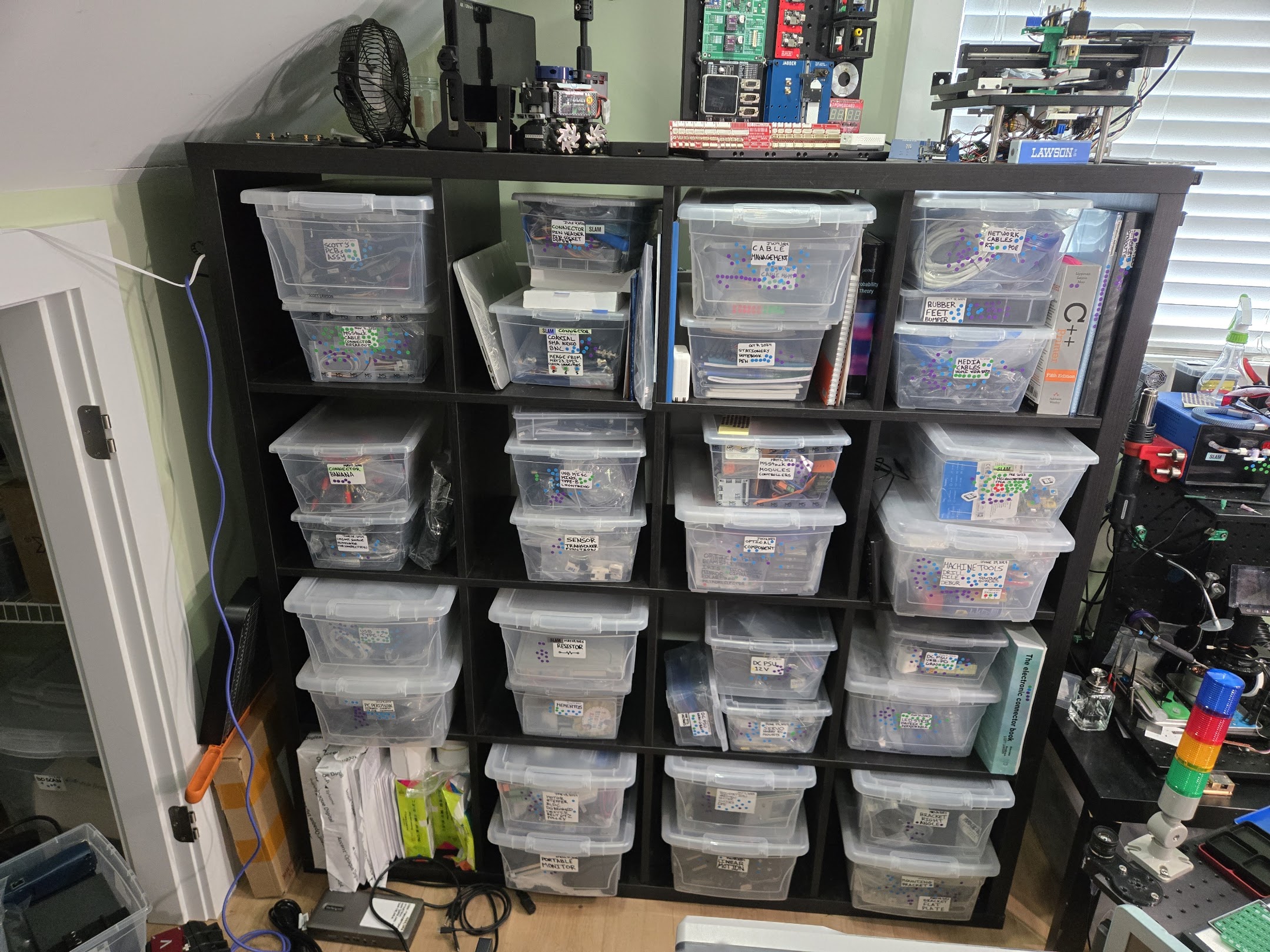
My lab shelves. Every box is labeled, dated, and covered in colored dots. You can see at a glance which boxes get used and which don't.
The first thing I did was get rid of every opaque container I owned. Every toolbox, every parts organizer with little pockets, anything I couldn't see through. I replaced everything with standardized 4L clear boxes from Superstore.
I learned this lesson early and it stuck: if I can't see what's in a box, I forget it exists. Clear boxes fixed that. I started sorting parts into categories that emerged naturally over time. A box for capacitors, a box for resistors, a box for motors, a box for LEDs.
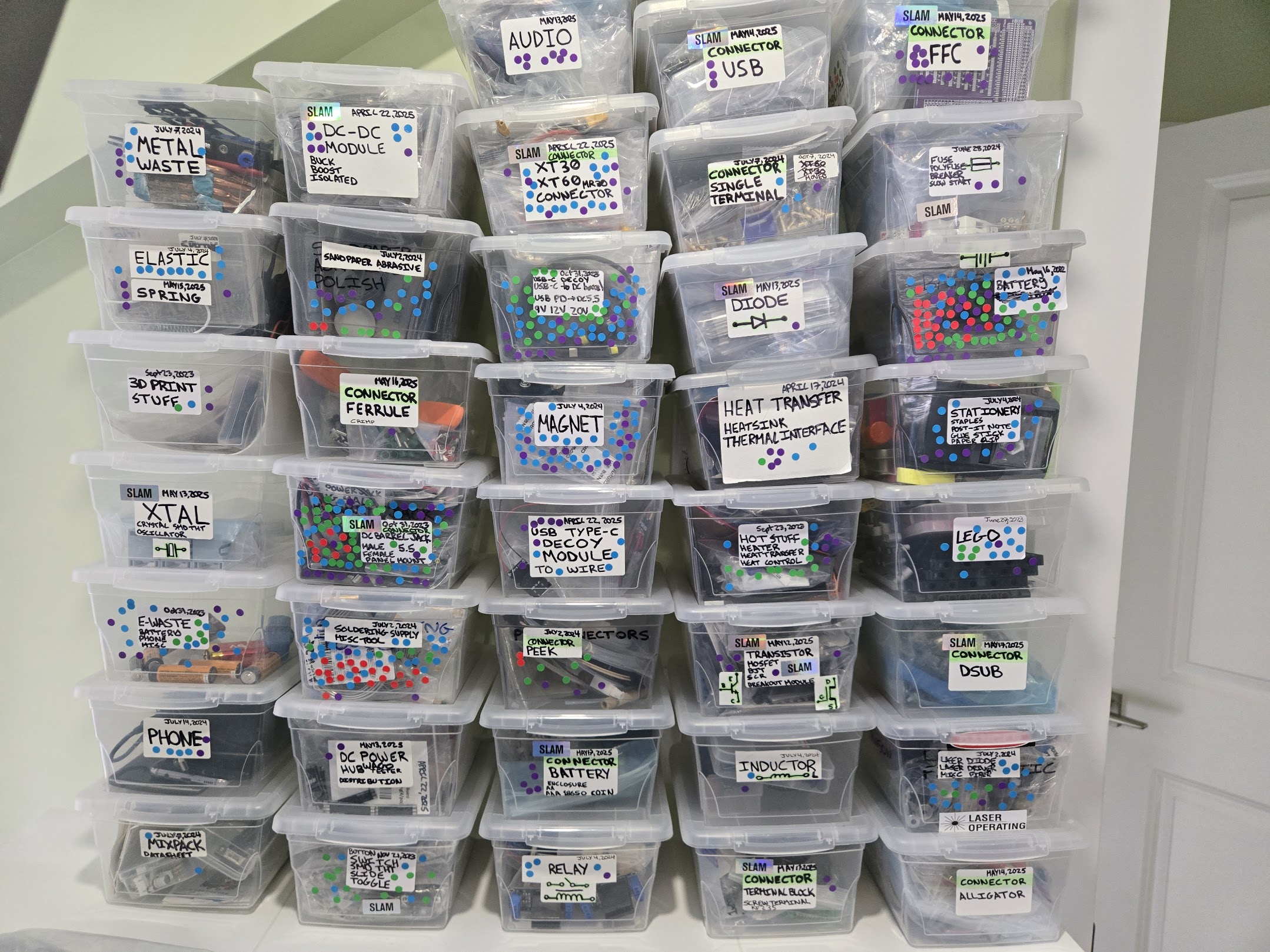
31 boxes within arm's reach. Same size, same shape, all labeled and dated. The dots tell the story: power, connectors, and magnets get used constantly. Crystals and inductors barely get touched.
The parts organizers with individual pockets were the first to go. They seem like a good idea when your collection is small, but as you keep adding parts, the fixed compartments become a problem. Components outgrow the pockets, and eventually you run out of pockets. The whole organizer becomes a constraint instead of solving the problem. Clear boxes don't have this problem and the system can scale by simply buying more boxes.
As I worked on projects over months and years, I started to build an intuition about which boxes I was reaching for and which ones were collecting dust. My box of batteries was always on my desk. My box of fuses hadn't been opened in my entire memory. But it was just a feeling. I couldn't quantify it. I couldn't tell you whether I opened my LED box twenty times last year or five. My memory is not good enough to track usage patterns across years of different projects.
And meanwhile, I had a constant influx of new parts. I'd work on an LED project, then move on to something that needed pneumatic components, so I'd order pumps and fittings. Then I'd get interested in piezoelectrics and order a bunch of piezos. Parts kept being added to my collection but my available space did not increase.
As Kirchhoff's current law states, the current into a node must equal the current out. If I kept acquiring parts at this pace without getting rid of anything, I would eventually drown. I needed a way to figure out what was worth keeping and what should go, so the system can reach a steady state.
I considered RFID tags, barcode scanners, a spreadsheet. All of them felt like too much. Then I found the simplest possible solution on AliExpress for a few dollars.
I ordered sheets of colored dot stickers. Six millimeters in diameter. Hundreds of them for almost nothing.
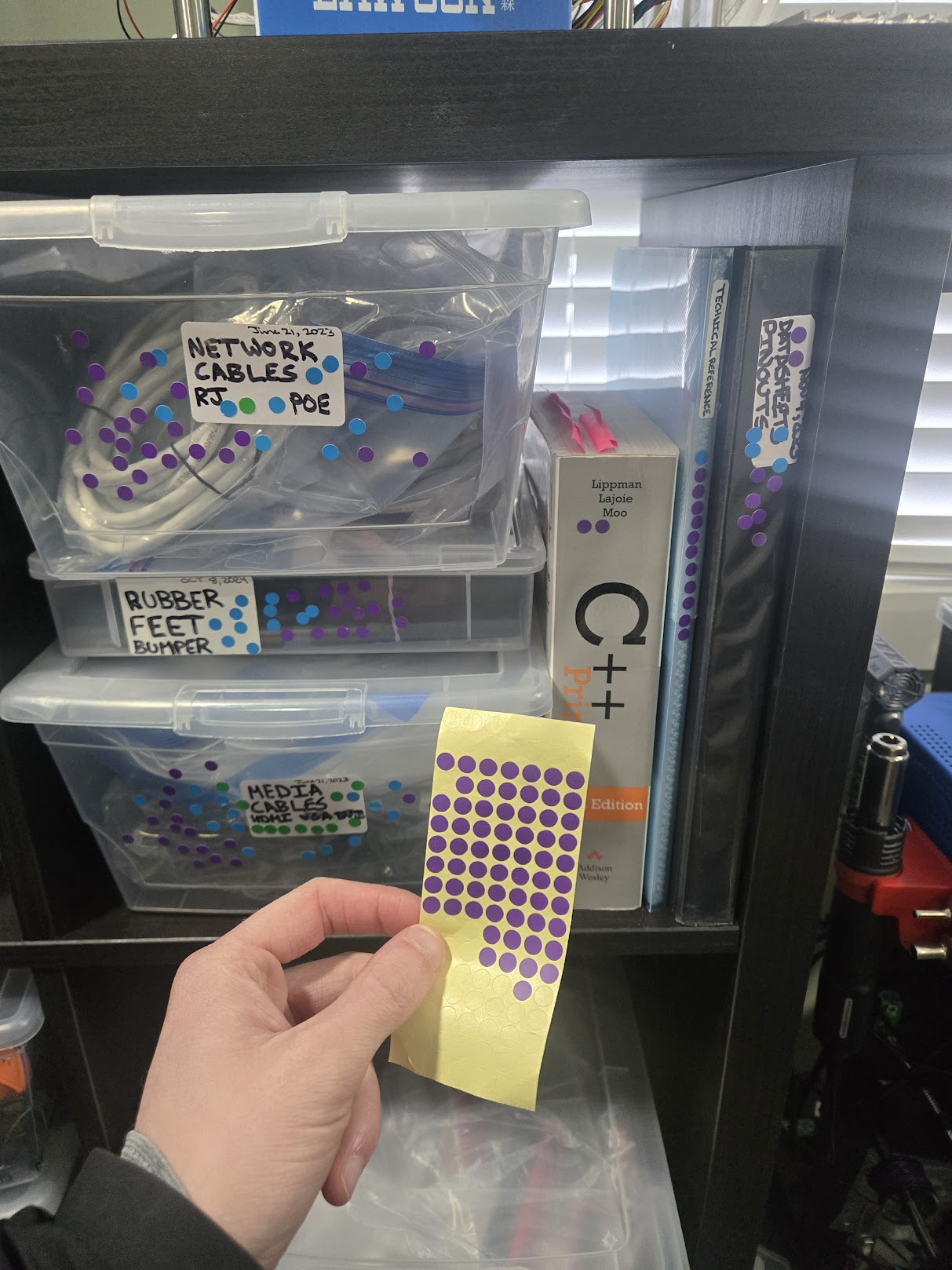
Applying dots. The sticker sheets are always within arm's reach. The system extends beyond boxes to books and binders too.
Every box already had a label on the front with its category and the date I created the box. The new rule was simple: every time I open a box, I place one colored dot sticker near the label. That's it. Use the box, add a dot.
I quickly realized that on days when I'm deep in a project, I might open the same box five or ten times. Tracking every single opening would be noise. So I refined the rule: one dot per box per day. If I open my LED box ten times on a Tuesday, it still gets one dot. What I actually care about is how many days per year I use a box.
Then, because I had all of these different colors, I decided to assign one color per year. I have over ten colors, so the system works for at least a decade. A piece of paper in my technical reference binder maps each color to its year so I never forget.
That's the entire system. Sticker sheets cost a few dollars, and there is no database, no server, and no app. The system that works is the one simple enough to do every day for four years.
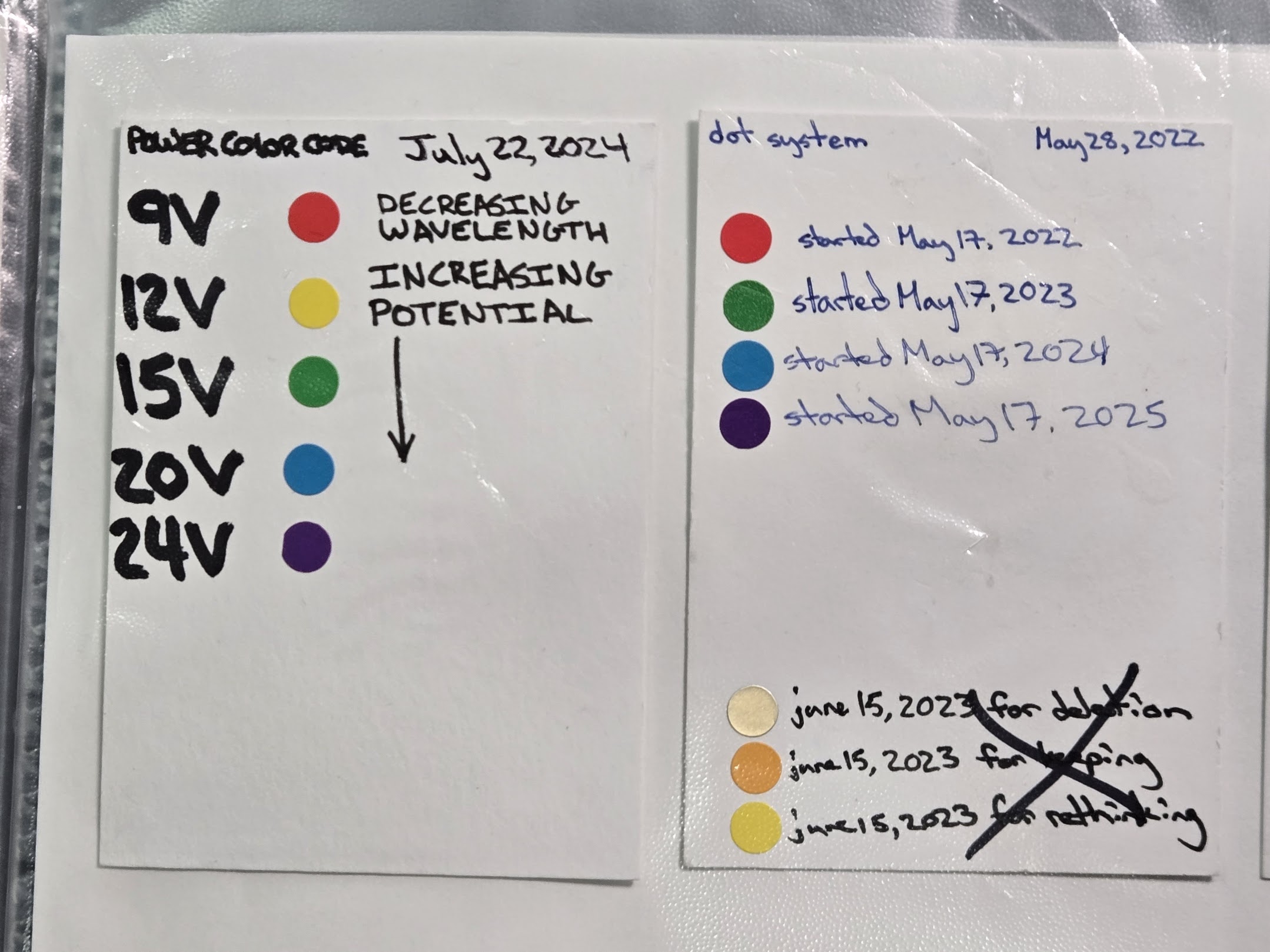
Two cards from my technical reference binder. Left: a color-coded voltage system I use on power cables, mapping colors to voltages following the visible spectrum (red is lowest, purple is highest). Right: the dot system, one color per year, started May 17, 2022. Handwritten, simple, and it works.
I wondered at first whether I'd actually keep up with it. Would I forget? Would it be annoying to find a sticker sheet every time I opened a box?
Both problems solved themselves. I keep sheets of stickers in multiple locations around the lab, so I'm always within arm's reach of one. Applying a dot is muscle memory at this point. And forgetting turns out to be hard, because the dots are their own reminder. Even if the box I just opened has no dots, the neighboring boxes are covered in them. The visual prompt is everywhere.
Visitors always ask about the dots as they're impossible to miss. When I explain the system and show how I add a dot whenever I use a box, there's usually a pause, and then it clicks. A single dotted box doesn't mean much on its own. It's seeing a whole shelf of them, some covered and some bare, that makes it obvious this is a system.
After four years, the data is hard to argue with. Walk into my lab and you can read the shelves like a dashboard. Some boxes are covered in dots of every color, used year after year, project after project. Others have a cluster of one color from a single project and nothing since. Others are completely bare.
The biggest surprise was which parts turned out to be essential. It wasn't sensors, even though I had many different kinds, it wasn't specialized components or "cool" things. The most-dotted boxes are:
Glue. Tape. Stickers. General-purpose connectors. Batteries. Magnets. LEDs. DC-DC power converters. USB-C to barrel jack cables. Capacitors. Resistors. Mechanical tools like files, drill bits, and cutters. Calipers. SD cards and USB drives. Rubber feet. Fasteners.
In retrospect, it makes a lot of sense. All of these things are cross-cutting concerns. Power components like batteries, DC-DC converters, and USB-C cables appear in nearly every project. Connection components like glue, tape, magnets, fasteners, and general-purpose connectors bridge different systems together. Rubber feet show up whenever anything needs to sit on a desk. These aren't the exciting parts. They're the common components that nearly every project shares.
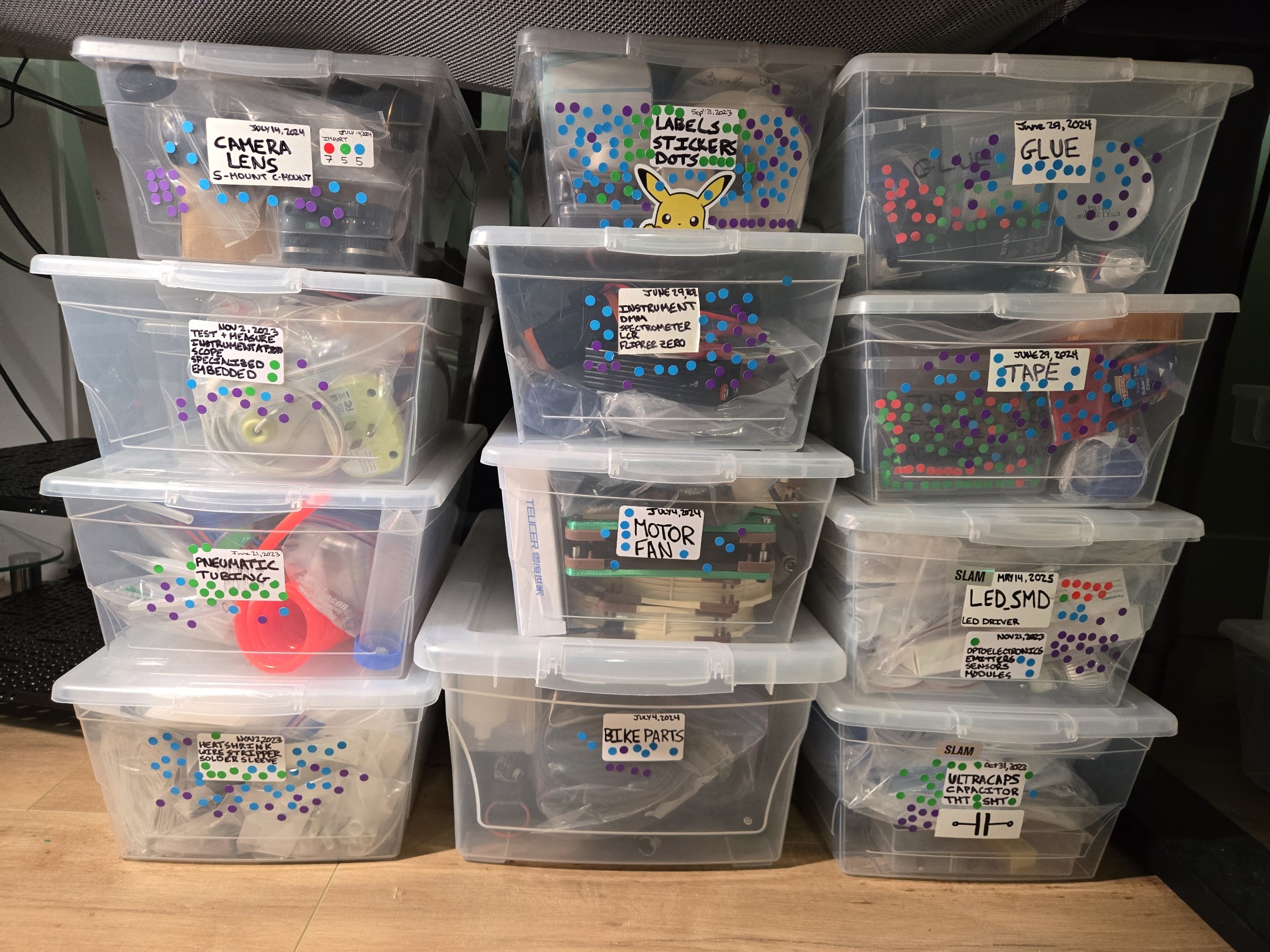
Under the desk. Heatshrink, tape, glue, stickers, and LEDs are covered in dots. They connect systems and apply to every project. Specialized bins like motors and bike parts are used less often.
Even within a category, the dots reveal patterns. My metric fastener boxes tell a clear story: M3 is by far the most used, with two boxes dedicated to it. M6 is next because I use it for optical breadboards. M2.5 barely gets dotted because it's specialized for things like Raspberry Pi mounting holes.
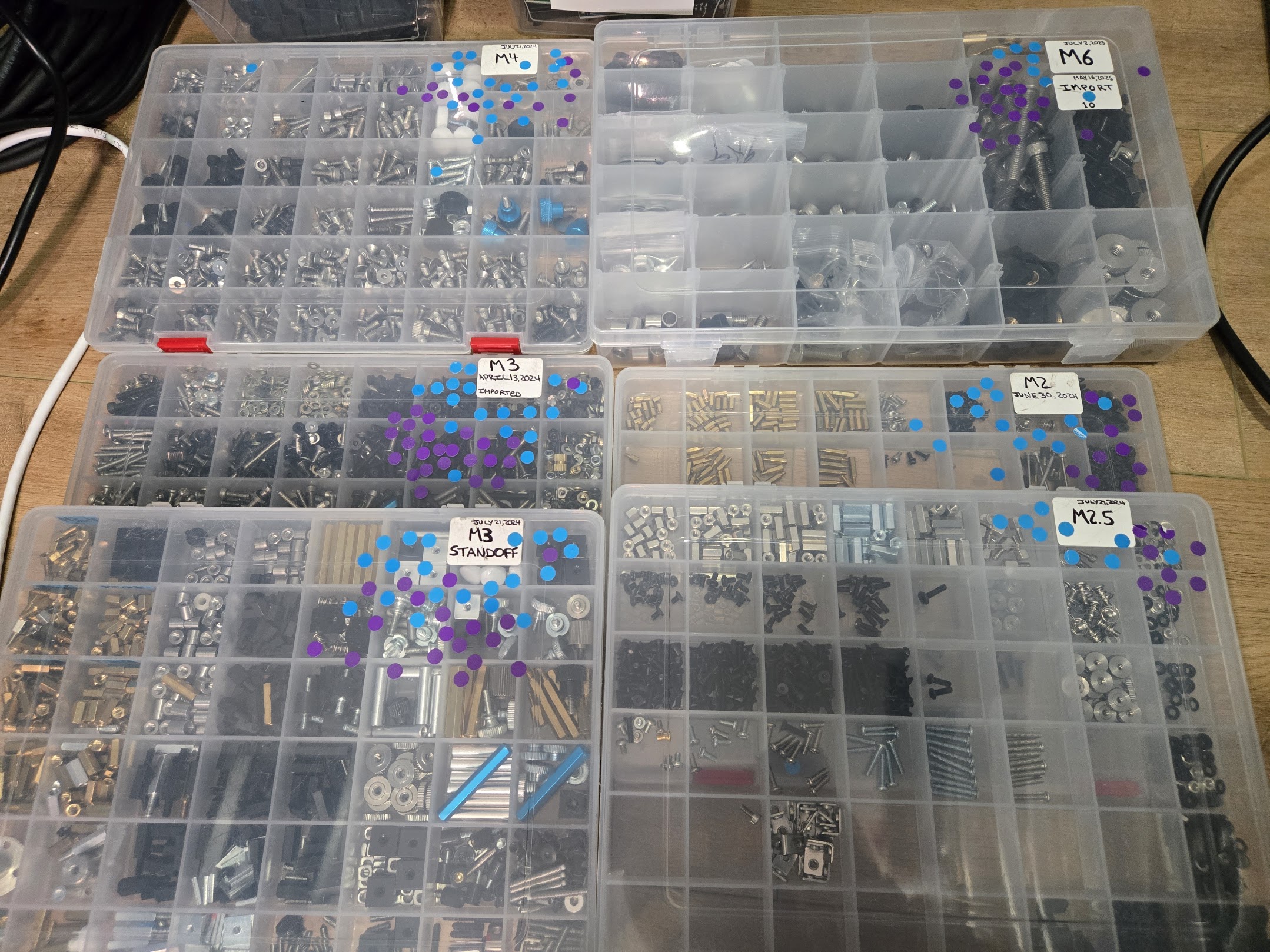
Metric fasteners. M3 dominates. M2.5 is the least used. The dots made the ranking obvious.
Meanwhile, sensors barely got dotted. Fuses, piezoelectric modules, specialized connectors: too application-specific to be core. Discrete LCD modules went unused after I started buying microcontrollers with integrated displays and buttons. I use capacitors and resistors constantly, but inductors got used maybe twice in four years.
And then there were the tools I thought were essential. My oscilloscope, function generator, and logic analyzer are commonly recommended as must-have tools for any electronics lab. Five dots on the oscilloscope in four years. I was genuinely surprised. I know for some people, in fields like RF, these tools are indispensable. But in my work, they're not. I wouldn't have had the confidence to say that without the data.
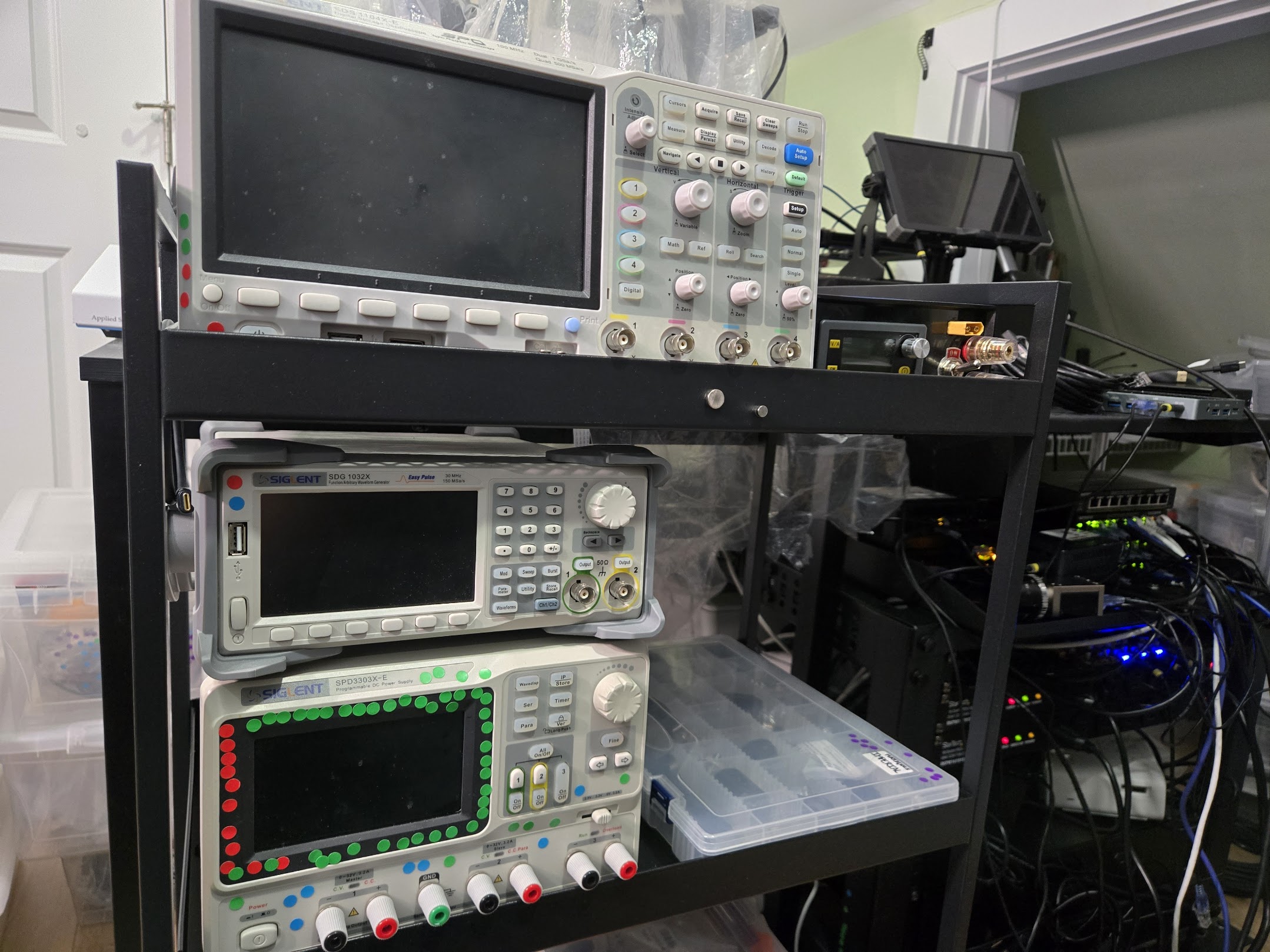
The power supply is covered in dots. The oscilloscope has five. The function generator has two. Cross-cutting tools like power get used 20x as often as specialized ones. The server rack on the right is hosting this website.
As I consolidated boxes and introduced larger sizes, finding specific parts inside a box became frustrating. I went through three generations of bags: ziplock bags from the grocery store, then clear logo-free bags from AliExpress (which wrinkled), then thick-walled clear bags that were more expensive but worth it. If you're starting from scratch, skip the first two and go straight to thick clear bags.
I started seeing the whole system like a file system on a computer. Boxes are top-level directories. Bags are subdirectories. Parts are files. Bags can contain other bags. The Johnny Decimal system recommends no more than ten items per category. I don't follow that rigidly, but I agree with the spirit: inside a box, aim for roughly ten bags. Inside a bag, aim for roughly ten sub-bags max. When things get too crowded, subdivide.
Every bag gets a handwritten label with its contents and the current date. I put dates on everything. Time turns out to be a great universal organizer, just like how a photo collection is wonderfully organized by date more than by any other single dimension.
Eventually my lab overflowed and I had to make real decisions about what stays and what goes. The dots helped me make those decisions.
I set up three tiers. My most-dotted boxes stay within fifteen feet of my desk. Less frequent boxes go in a closet in the lab. Boxes with no dots for a long time go to a separate storage shed outside of my lab, which I think of as "cold storage".
Cold storage examples: a box of liquid pumps (ink pumps, peristaltic pumps, air pumps). A box of piezo actuators and piezo motors. I find piezos fascinating, but I've reluctantly come to admit over time that they're just not that useful to me. A set of Parker linear motors I bought as lab surplus on eBay. Cool hardware, but the software for the ViX servo drives only works on Windows XP, and I didn't have much need for linear motors. Zero dots for two years and moved it to the shed.
Sometimes things come back. When I started building a pick-and-place machine, my pneumatic components came right out of cold storage. That's not a failure, I expect that some things will come back, just not very many things. Cold storage is like a staging area, not a graveyard. If a box sits there long enough untouched, the next step is donating or selling.
This closes a loop. When you constantly acquire new parts but have limited space, you need a system that tells you what should go out the door as new things come in. The dots provide that signal. A lot of people hoard things they don't need. Seeing clear evidence that a box has zero dots is what helps me overcome the hesitation to finally let go of it.
Principles I've learned over four years of the dot system.
Clear boxes, same size and shape. Having a common form factor is like having a common software interface. Lids become interchangeable. If a box breaks you can replace it. You'll probably need a few different sizes. Pick sizes where each jump is roughly double the last. I use four sizes total.
Labels on the front, not the lid. You will regret lid labels the moment you stack boxes.
Date everything. Every label, every bag. It feels unnecessary at first but it pays off over time. It's also a kind of time capsule for yourself.
Thick clear bags. Take the time to label them. A permanent marker works fine. I use name tag sized white labels.
Keep sticker sheets near your boxes. If applying a dot takes more than two seconds, you'll stop doing it. I put sticker sheets in half a dozen places around the lab near my boxes.
Everything needs a home. If only some things are in the system, the value is diminished. Everything you want to track needs to belong somewhere.
Don't dot the obvious. I put dots on my soldering iron, calipers, and isopropyl alcohol bottle but it was pointless. I already knew these tools were cornerstones of my lab. The dots are most valuable for things where usage is genuinely ambiguous.
Curate categories. A box of random miscellaneous parts teaches you nothing. Boxes of parts that are used together yield high-quality signal.
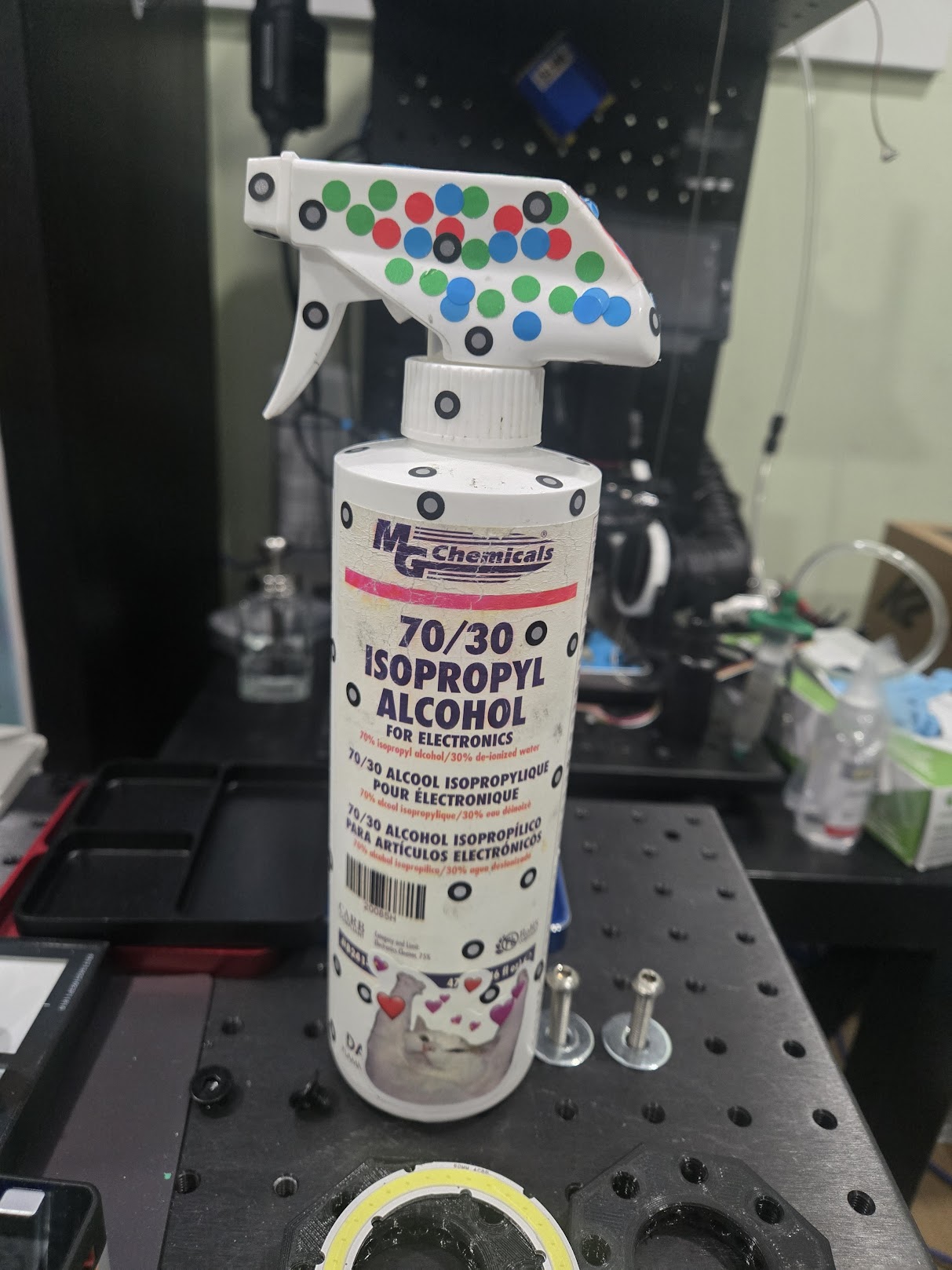
This bottle of isopropyl alcohol is covered in dots from three years of soldering. I stopped adding dots because the evidence is overwhelming. Some things don't need measuring anymore.
And then give it time. A year in, you'll start seeing patterns. Two years in, you'll trust them enough to know how to refactor your collection.
The dot system doesn't have to be figured out all at once. Mine evolved through three generations of bags and two major reorganizations. My interests changed, my domain of expertise grew, my collection expanded. The system evolved along with me. I like that it is a living, fluid system.
Walk into my lab and the dots will tell you everything you need to know. They told me too. It just took four years and a $3 pack of stickers. I'm still adding dots.
Decathlon and Zara both have RFID tags in their products.
https://sustainability.decathlon.com/product-traceability-an... (Decathlon)
https://www.inditex.com/itxcomweb/so/en/press/news-detail/7f... (Inditex is the parent company of Zara. Link is a press release from 2014.)
So if one were to buy all their clothes at Decathlon (clothes for sports and other outdoor activities) and Zara (everyday wear as well as fancier clothing), and found a reader that can read the RFID tags they use, one would save the time needed to add RFID tags to one’s clothes ;)
There might be other stores that have RFID tags on all of their products too. I only mention these two in particular because I have purchased products from both of them using their RFID-based self-checkout in their stores and thus seen it first-hand.
However, I am not sure if all of the products have the RFID label embedded in the actual fabric or if some or most have the RFID label attached to paper labels that you’d remove before using the clothes. So that would also need to be determined before deciding to replace one’s whole wardrobe with clothes exclusively from these stores.
A huge number of items at Walmart, Kohls, Target, Academy, Old Navy, and many other stores now (those are just the ones I've seen in store.)
Look for the 'EPC' logo, GS1 is the same standards body that controls the UPC barcode numbering.
https://www.gs1.org/standards/rfid/guidelines
Though - you don't want to use those types for this application, they are too long distance / not selective enough, and the readers are expensive.
Buy a big pack of NFC stickers instead, or print up some QR codes.
I would say that Decathlon stuff has the RFID inside the internal labels (the ones that you should cut off if you don't want them to scratch your skin but sometimes you don't notice them)
At least that was my experience when I was looking for an organisation system -and gave up =)