The Conet Project is an interesting listen -- very analogue, Cold War-ish, and a bit sinister. Seems to be available on the Internet Archive at https://archive.org/details/The-Conet-Project
48°41'26"N 9°05'12"E
https://www.google.com/maps/place/48%C2%B041'26.0%22N+9%C2%B...
> Considering the topical interest in this station, the Priyom team shares its further expertise regarding V32's attribution, beyond being transmitted from a US military facility. While this remains unconfirmed speculation, and not facts, a prime candidate for the operator of this station would be the CIA. Contrary to popular belief, US intelligence has not entirely moved away from numbers stations. Sources in the intelligence community indicate that the CIA provides extra training about numbers stations and one-time pads to clandestine agents assigned to locations with a very hostile operating environment, such as Iran or North Korea: it is envisioned as a last-resort means of communication with high-value sources. So according to this, numbers stations are actually still an institutional part of the CIA playbook. The war in Iran, and the Internet blackout installed by the regime, fulfill the very circumstances for which the CIA would have planned this.
> We already know that the CIA has a significant presence in Iran and involvement in the war, having provided crucial intelligence tracking Iranian leaders that enabled the assassination strikes that kickstarted the war. They most probably have had a network of infiltrated assets already in place and organized, ready to be reached through a numbers station if need be right when the war started - which makes the CIA a candidate for running V32 consistent with a legitimate intelligence operation. However, what we've observed from V32's operations - technical quirks and shifting formats - suggest that the technical deployment of the numbers station and shortwave transmissions themselves may have been a little rushed by the circumstances.
> Another noteworthy feature of V32 is how all its transmissions take place on the same frequency. Most other numbers stations in general are comprehensive operations targeting many different recipients in different countries, and making use of many different transmission times and frequencies suited to the particular signal propagation needs corresponding to all those areas. In contrast, the fact that V32 always uses a single, same frequency, at always two given times of the day, would be consistent with an operation that only needs to target a single geographical area: Iran.
For intelligence agencies,
it is important to
communicate with their
spies to gather intelligence,”
says John Sipher, a former
US intelligence officer
Is Sipher really his name. Nominative determinism strikes again.Sifr is also a valid word both in Farsi, I think. An Ironic and cruel pun.
Roosevelt told the Shah that he was in Iran on behalf of the American and British secret services, and that this would be confirmed by a code word the Shah would be able to hear on the BBC the next night. Churchill had arranged that the BBC would end its broadcast day by saying not 'it is now midnight' as usual, but 'it is now exactly midnight'However, the numbers stations transmissions are never a big secret. They're intentionally powerful so someone can pick them up on simple equipment without raising suspicion. A person can modify an off-the-shelf AM radio to pick up shortwave, for example, even in an oppressive regime.
It's a one-time pad, so the encryption is unbreakable.
It's called steganography, and it's a centuries if not millennia old technique.
So...
If its being broadcast by the US military or the CIA, why Persian?
Because they're issueing activation orders to their network of ani-regime operatives inside Iran? Who, mysteriously for spies, only know that language?
Or because they want the Iranian government to think that? And a numbers station broadcasting in - unusually - Persian, is an easy way to get the attention of the Iranians?
I'm thinking the latter.
Apple's maps version has that section blurred out though.
Bing's sattelite images seem to be older, the antenna isn't visible on there yet and there's just building foundations: https://www.bing.com/maps?cp=48.690103%7E9.086240&lvl=18.8&s.... Can't determine how old those images are though.
https://www.etymonline.com/word/cipher
(Al Jabr, the translator of Indian Mathematical texts was a Persian IIRC)
That is the root of 'cipher'; meaning zero/empty/nothingness.
https://en.wikipedia.org/wiki/Steganography#History
> The first recorded uses of steganography can be traced back to 440 BC in Greece, when Herodotus mentions two examples in his Histories. Histiaeus sent a message to his vassal, Aristagoras, by shaving the head of his most trusted servant, "marking" the message onto his scalp, then sending him on his way once his hair had regrown, with the instruction, "When thou art come to Miletus, bid Aristagoras shave thy head, and look thereon." Additionally, Demaratus sent a warning about a forthcoming attack to Greece by writing it directly on the wooden backing of a wax tablet before applying its beeswax surface. Wax tablets were in common use then as reusable writing surfaces, sometimes used for shorthand.
https://spectrum.ieee.org/wall-street-tries-shortwave-radio-...
@windytan did a fascinating audio clip highlighting the RDS data stream in a radio recording some while ago:
Distributing a one time pad like this is a stupid idea: it isn't hard to collect everything you ever send, and it takes a computer a few ms to check every encrypted message against every possible sequence. That is breaking a distribute one time pad via shortwave like this is something a single layperson can do, it doesn't even need a government scale attacker to break it.
Don't get me wrong, this can be used for good encryption. However it isn't a one time pad they are doing, it is something more complex.
The radio signal first started broadcasting on February 28, about 12 hours after the United States and Israel began bombing Iran.
On a scratchy shortwave signal almost twice a day -- in the early morning and early evening on Coordinated Universal Time -- a man's voice can be heard speaking Persian, counting out a series of apparently random numbers. The numbers are read out for varying stretches of time, followed by a pause in which the word tavajjoh -- which translates as "attention" -- is spoken three times.
The mystery of the transmission transfixed many in the global community of amateur radio sleuths, who have traded notes and tips on the signal, who's behind it, and what its purpose might be.
Five days later, it got more interesting.
Beginning on March 4, the signal started to be jammed, with a cacophonous screech of electronic noise that made it all but impossible to hear the numbers. The original transmission paused for a period of time, then moved to another shortwave frequency.
"It's interesting because it started to be jammed on the initial frequency," said Akin Fernandez, who is widely considered an authority on the decades-old encoded radio technology known as a numbers station. "Someone doesn't want the recipient [of the signal] to hear the numbers."
"It's an adversarial situation, two groups acting against one another. The question [is] who has the technical means to jam a station," Fernandez said. "The United States has the means, which means this is being transmitted by Iran. Or then it could be Iran, which means the United States is the transmission source."
"More likely this is an operation against Iran," he said.
Regardless of whose transmission it is and who is doing the jamming -- there are plenty of competing theories -- the mysterious broadcast is a throwback to another era, before the advent of digital encryption used widely in apps like WhatsApp and Signal and other places.
The transmission is called a numbers station, a Cold War-era tool that employs radio transmissions and old-school cryptology to transmit secret messages, usually to spies around the world.
The concept: Using a random series of a numbers, generated by some mechanical or electronic device or something more powerful, a person can send a coded message to another person in possession of a decoder, often called a "one-time pad."

An Iranian radar system system is seen during the first day of an Iranian military air defense exercise in October 2020
Anyone can listen to the transmission; shortwave transmissions travel long distances, signals bouncing off the atmosphere. But only a person with the decoder key can decipher it. The concept got a cameo in the US spy drama The Americans, set in the 1980s.
Numbers station code is "absolutely unbreakable," said Fernandez, who more than two decades ago published a four-CD audio compendium of hundreds of recordings from around the world called the Conet Project. It's considered the Bible for numbers-station enthusiasts.
"The number keys that are used are perfectly random. There are no mathematical operations you can use on them to brute force them," he said. "And even if the answer gets out, say in proper English, it's not necessarily understandable."
"You can't tell anything about a random set of letters or numbers by their length other than their length. The length of message is not the content of the information being transmitted," he said. "But it is possible to infer the purpose of stations by the length that they're online and the noise they transmit if there is no text message."
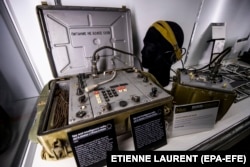
A spy and intelligence radio set (R-394KM) used by the Soviet-era KGB
The Persian language broadcast is the first new numbers station in years, according to Priyom, a blog run by radio enthusiasts who identified, cataloged, and analyzed the signal. The transmission was first dubbed V32 by a British-based group called Enigma2000. US-based reporter Seth Hettena also highlighted the signal in a blog post on March 4.
The group says its far-flung members have been able to triangulate the origin of the signal's transmitter: "somewhere in an area encompassing northern Italy, Switzerland, western Germany, eastern France, Belgium, and the Netherlands."
That narrowed the possibilities for the owner of the V32 transmission.
And then the jamming started.
During the Cold War, broadcasts such as those from the BBC, Deutsche Welle, and Radio Free Europe/Radio Liberty, among others, were routinely jammed by Soviet bloc authorities who wanted to discourage citizens from getting uncensored information: news about their own countries, or, say, jazz and rock music from the West.
You drown out the incoming broadcast with dissonant noise, something known as a bubble jammer.
On March 4, according to Priyom, a bubble jammer started broadcasting noise on the same shortwave frequency as the original V32 broadcast, rendering it difficult to understand.
The V32 transmissions were interrupted briefly and then switched to another nearby frequency, Priyom said.
"At first the station was thought to be a spy station for the Iran Islamic regime, but when the bubble jammer appeared to jam it, it was an eye-opener," said Mauno Ritola, a database administrator at the Radio Data Center, a German-based radio company.
"It is exactly the same kind of bubble jammer that is used against Radio Farda, VOA Farsi, Iran International TV shortwave relay, and BBC Farsi," he said. "Even Radio Free Iran suffered from it one night."
Radio Farda is the Persian-language service for Radio Free Europe/Radio Liberty, also known as RFE/RL.
As for the source of the transmission, the global radio community has competing theories; many appear to home in on the United States as the originator, potentially sending coded messages to agents within Iran.
Other theories focus on Israel or even Turkey, which is not a participant in the US-Israeli campaign but is a long-established regional rival to Tehran.
Or, the Priyom bloggers posited, it could be a psychological operation: "a pretty visible, single-frequency station, starting up out of nowhere for a prime-time show on the first day of the war, with relatively few reliability features to ensure recipients actually could copy messages in their entirety and without errors."
The CIA did not immediately respond to an e-mailed query from RFE/RL.
Further muddying the waters: ABC News on March 9 reported that the US government had sent an alert to law enforcement agencies regarding "intercepted encrypted communications."
The report did not specify what exactly the transmission was, or whether it was a numbers station signal.
"While the exact contents of these transmissions cannot currently be determined, the sudden appearance of a new station with international rebroadcast characteristics warrants heightened situational awareness," ABC quoted the alert as saying.
I knew 'sifr' was an Arabic word and only today I came to know that it works in Farsi too.
The double pun/irony is that the John Sipher's surname is related to the topic of cryptography and that the etymological roots is Middle-Eastern.
What would be suspicious is being in possession of the one-time pad needed to decode the messages, regardless of which media those messages are transmitted through.
For the record, "numbers stations" can be found in nearly every communication medium, including the web. The advantage of using shortwave (range, primarily) are large enough that the benefits outweigh the drawbacks.
Al-Khwarizmi authored the book Al-Jabr.
The numbers station should be transmitting a message encoded with a one time pad. The one time pad itself should be physically given in person to the spies who you want to communicate with.
Would it though?
All you need is something with sufficient entropy. I reckon you could do a "good enough" job with any plausible-looking data you have lying around on your hard disk right now. Say for example if you took a couple of sha256s of any random image you might post on social media, you'd have quite a lot of key right there.