She called the top of the ET (well, it's no longer an ET, but it's the stage that was the STS ET) the "upper stage". She said that the propellents are stored at thousands of degrees below zero. And so on. This is a NASA presenter?
People who want the actual details and numbers will read.
For the more adventurous and/or bilingual the beaches on the Mexican side seem to have awesome views too.
Kalshi is more optimistic. https://kalshi.com/markets/kxartemisii/artemis-ii-launch-dat...
I live in Dallas now and will be turning 50 soon, i want to catch the next Starship launch live but would have to time it perfectly to get time off of work ahead of time.
My personal perspective is that the resources are better used for other purposes, but it's possible that I just haven't encountered some compelling reason yet.
I'm all for human spaceflight, but the Senate Launch System seems the best argument for shutting down human spaceflight programs.
The experience of hearing factual things presented with passion and obvious expertise is in itself inspiring. Why settle for less?
To be fair to her, she seemed to explicitly refer to what sits on top of the core stage, it just wasn't in the diagram she was gesturing to the top of at the time.
To be fair to you, I think the cryogenic comment was worse and she actually said "thousands of degrees below Fahrenheit".
The problem is they're trying to run hours of programming leading up to this launch for some reason, but aren't willing to force the experts to come in to do the commentary. They should have given her a script.
to me it's inspiring and gives people something to cheer for. It also keeps a lot of people employed, productive, and at least has the possibility for new innovation. When looking at the mountains and mountains of wasted taxpayer dollars I dislike these the least.
But sending a human? That feels more real. If we have the power to go alive to the moon, we also have the power to go even further. And we lost it, now we are reclaiming it.
And it doesn't matter to me what I think of the US government - this is progress for all of humanity. Also the comment section on the youtube stream is interesting - lot's of different flags are posted, sending good wishes from all around the world, low effort comments otherwise of course, but largely positive. (Very rare I think)
So, more rockets into space please and less on earth.
Well, people are often obsessed with rationality, and seek reasons to do something, but there is one reason that works almost for anything: just because. If we want to go forward, we'd better try a lot of things, including those that do not look very promising. We don't know the future, the only way to uncover it is to try. Did you hear about gradient descent? It is an algo for finding local maxima and to do its work it needs to calculate partial derivatives to choose where to go next. In reality doing things and measuring things are sometimes indistinguishable. So society would better try to move in all directions at once.
A lot of people believe that to fly to the Moon is a good idea. Maybe they believe it due to emotional reasons, but it is good enough for me, because it allows to concentrate enough resources to do it.
> the resources are better used for other purposes
It is much better use for $$$ than the war with Iran. I believe that the war have eaten more then Artemis already, and... Voltaire said "perfect is an enemy of good". The Moon maybe not the perfect way to use resources, but it is good at least.
Let’s talk about this in terms of practicalities. The NASA budget for 2026, per Wikipedia, is $24.4B. I often find it hard to really reason about the size of federal budgets, and the impact on tax payers, but I have a thought experiment that I think helps put it into perspective. Suppose we decided to pay for the NASA budget with a new tax, just for funding NASA. And we did that in the simplest (and most unfair) possible way: a flat rate. Every working adult in the US has to pay some fixed monthly rate (so excluding children and retirees). Again, per Wikipedia, that’s around 170M people. Take the NASA budget, divide by 170M, and you get … $11.96/month.
Obviously, there’s lots of flaws in this. That’s not we pay for NASA, we have income tax as a percentage with different tax brackets. But it is a helpful way to frame how much a country is spending, normalized by population. And I think it puts a lot of things in perspective. $11.96/month is comparable to a streaming service. And we talk a lot about whether NASAs budget is better used for other purposes, but we don’t do the same thing for a streaming service.
Hell, look at US consumer spending: https://www.bls.gov/news.release/cesan.nr0.htm (note that that spending is in dollars per “consumer unit,” which is I think is equivalent to an adult US worker, but there might be some caveats). Based on that, the average US consumer spends around $26.17/month on “tobacco products and smoking supplies”. I just feel it’s a little silly to worry about the NASA budget when the US consumer spends twice that on what is objectively a luxury good. At least NASA won’t give you cancer.
Like sports, the objective is ultimately useless except as a showcase of what humanity has to offer, and people like to see that.
Edit: remember the Kennedy speech — We choose to go to the moon not because it is easy, but because we thought it would be easy.
Now, the military...
If the goal was just to flex on the rest of the world I would've much rather we focused on going somewhere new or returning to the moon in a more sustainable way
That doesn't mean Moon shots are the best possible use of that budget. There are strong arguments for creating more space stations first, and then using them as staging for other projects.
Mars and the Moon are ridiculously hostile environments. Hollywood (and Elon Musk) have sold a fantasy of land-unpack-build. There aren't enough words to describe how utterly unrealistic that is.
Current strategy is muddled, because it contains elements of patriotic Cold War PR fumes, contractor pork, and more than a hint of covert militarisation. Science and engineering are buried somewhere in the middle of that.
They could be front and centre, but they're not.
For-profits are of no benefit to society? Are SpaceX rockets a loser for society?
Most of the other big news events are ones where people get severely hurt, and political ones where one partly loses.
With this, we can look up at the moon, and say "Humanity did that."
To view this video please enable JavaScript, and consider upgrading to a web browser that supports HTML5 video
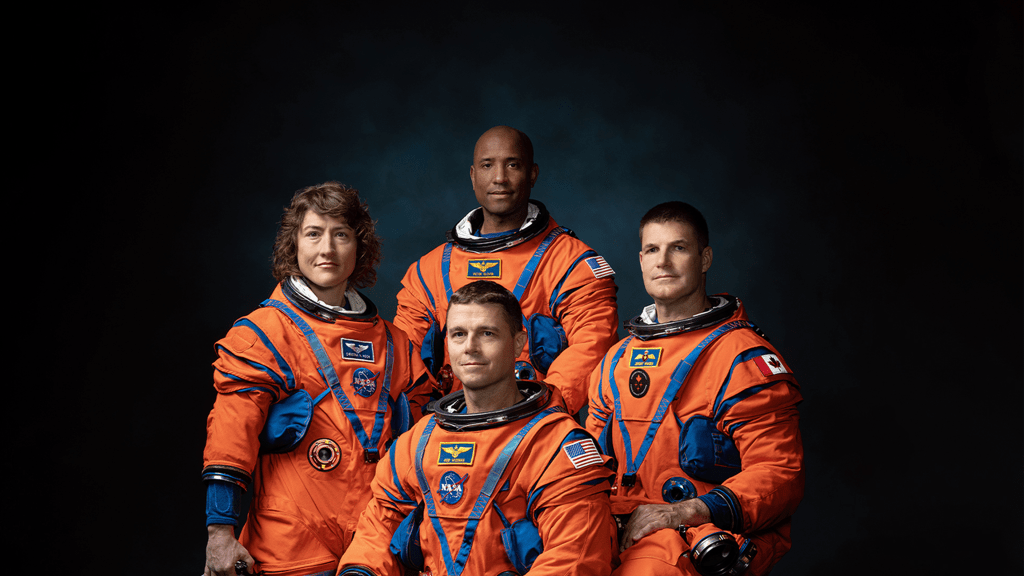
Artemis II is NASA’s first crewed mission under the Artemis program and will launch from the agency’s Kennedy Space Center in Florida. It will send NASA astronauts Reid Wiseman, Victor […]
00
Days
00
Hours
00
Min
00
Sec
This event has already occurred
Today 1:00 pm
Artemis II is NASA’s first crewed mission under the Artemis program and will launch from the agency’s Kennedy Space Center in Florida. It will send NASA astronauts Reid Wiseman, Victor Glover, Christina Koch, and CSA (Canadian Space Agency) astronaut Jeremy Hansen on an approximately 10-day journey around the Moon. Among objectives, the agency will test the Orion spacecraft’s life support systems for the first time with people and lay the groundwork for future crewed Artemis missions.
| Details |
|---|
| Date |
| Time |
| Timezone |
| Select Your Location or Timezone |
|
Isn't this the point of this mission? If your point is "it shouldn't take this much money", then I agree. But also point to almost everything else.
The Moon, I dunno, it’s at least in Earth’s gravity well so it isn’t like we’re going totally the wrong direction when we go there, right?
At best it could be a gas station on the trip to somewhere interesting like the Asteroid belt, though.
Fwiw do share your concerns about the methods (sending humans on this specific mission is questionable, SLS is questionable compared to SpaceX approach).
Then the senate mandates the new rocket to use specifically the most expensive, problematic, least reliable technology. Completely designed to fail.
Have such hopes for the Starship.
That remains to be seen. By giving Musk the prominence to set up DOGE and destroy USAID, they've indirectly led to the deaths of almost a million people.
By launching starlink, they're also increasing the amount of aluminum in the upper atmosphere, which may have catastrophic effects on the ozone layer.
Even in sports you do not get "nothing", it has certainty helped advance the field of medicine.
IMO the program is not optimized for cost or sustainability, it's optimized for creating jobs in various congressional districts. Of course that provides a certain amount of political sustainability to the so-called Senate Launch System.
I just don't see a future where NASA can afford multiple SLS launches per year to maintain a continuous Lunar presence
After (and if) Artemis III lands on the moon and brings home the astronauts there seems to be very little planned on how we actually get to the moon base which NASA is claiming this will lead to, let alone the manned Mars mission that is also supposed to follow.
In other words, I think NASA is greatly exaggerating, and possibly lying, about the utility of this mission.
It's nice that we can send humans to space and it's good to keep that capability going so that the knowledge doesn't die. But the unmanned missions tend to pull the weight of actually accomplishing useful things. Humans just get in the way.
We are sending humans to (or around) the moon now, but it may just turn out to be a wasted effort, done solely for the opulence (or more cynically bragging rights / nationalist propaganda).
We seem to have lost the technology of going to the moon we gained from Apollo. So without an actual follow-up and a tangible long term plan I suspect the exact same will happen this time around.
SpaceX rockets also are re-usable, which is environmentally better. They also cost about 10% of what non-profit rockets cost to launch.
> they've indirectly led to the deaths of almost a million people.
DOGE is a non-profit entity. Besides, why can't other non-profit governments pick up the aid?
P.S. I oppose patents.
> We are sending humans to (or around) the moon now, but it may just turn out to be a wasted effort, done solely for the opulence
My 4 year old is extremely excited to watch the launch tonight because it’s manned. I’d say a few billion is worth it if all it does is inspire a new generation of astronauts, engineers, and scientists.
> inspire a new generation of astronauts, engineers, and scientists
This is a good point. And I would like it to be true. However when you have to lie about (or exaggerate) the scientific value of the mission, that is not exactly inspiring is it. Your 4 year old could be equally inspired by the amazing photos James Webb has given us, and unlike Artemis, James Webb is providing us with unique data which is inspiring all sorts of new science.
We have the capability to do that. We don’t have the will to do it, but we have the technology. We don’t even have autonomous robots that are capable of building a moon base on earth.
> Your 4 year old could be equally inspired by the amazing photos James Webb has given us, and unlike Artemis, James Webb is providing us with unique data which is inspiring all sorts of new science.
He’s not though. People gather around as a family and watch manned space missions. It’s exciting in a way that a telescope or a probe isn’t.