"In general, the Apollo waste management system worked satisfactorily from an engineering standpoint. From the point of view of crew acceptance, however, the system must be given poor marks. The principal problem with both the urine and fecal collection systems was the fact that these required more manipulation than crewmen were used to in the Earth environment and were, as a consequence, found to be objectionable. The urine receptacle assembly represented an attempt to preclude crew handling of urine specimens but, because urine spills were frequent, the objective of “sanitizing” the process was thwarted.
The fecal collection system presented an even more distasteful set of problems. The collection process required a great deal of skill to preclude escape of feces from the collection bag and consequent soiling of the crew, their clothing, or cabin surfaces. The fecal collection process was, moreover, extremely time consuming because of the level of difficulty involved with use of the system. An Apollo 7 astronaut estimated the time required to correctly accomplish the process at 45 minutes.* Good placement of fecal bags was difficult to attain; this was further complicated by the fact that the flap at the back of the constant wear garment created an opening that was too small for easy placement of the bags.** As was noted earlier, kneading of the bags was required for dispersal of the germicide.
*Entry in the log of Apollo 7 by Astronaut Walter Cunningham.
**The configuration of the constant wear garments on later Apollo missions were modified to correct this problem."
1: https://ntrs.nasa.gov/api/citations/19760005603/downloads/19...
https://sites.google.com/site/theageofplastic3d/2001s-zero-g...
It sounds like that would have allowed them to fix the suit before they went?
They must have eaten the meals and such to be sure they could function, make sure they didn't have any intolerance, for example?
I found the language NASA and the astronauts used to communicate absolutely hilarious - "Yes, we're excited and eager to begin immediate fluid disposal!"
Glad they got it working - best of luck to Atemis II mission!
For liquid waste. This was not exactly the case for solid waste. Effectively it was just a tank. It had something like a "net" in it, this was connected to a shaft, through a gear, to another shaft at the front of the seat. The commander would, every 7 days or so, "actuate the mechanism" to rotate the net and to gather all the waste and compact it into one side of the toilet.
Many commanders said this was the most stressful part of the mission as the mechanism was somewhat delicate and could easily break. In that case you had to don a glove and manually do the work the net was otherwise doing.
If that completely failed, yes, the shuttle had backup "Apollo bags" stored in the middeck lockers.
But seriously, although I guess it’s fair to say that errors will occur, still: they couldn’t get the plumbing right?
Apparently one of the down sides about the previous system was that the separation of solid and liquid excreta ideally required someone to separate their excretion of both kinds. Apparently this is something that male astronauts found much much easier than female ones. Artemis's toilet can handle both at the same time.
I still think they have the good old fashioned Maximum Absorbency Garment for space walks though. (CF https://en.wikipedia.org/wiki/Maximum_Absorbency_Garment)
Of course, but the fundamental problem is that difficulties compound. It starts with: pooping is much harder when gravity isn't there to persistently tug on the turd. Something that is slightly obnoxious on Earth (using a bag, using a suit flap) turns into an absolute trainwreck when you have a bag, a suit flap, and turd separation failure. Now you have to do precise mechanical manipulation of an object you don't want to touch behind your back through a bag and a suit flap, every failure multiplies the work, and now the turds can float away to multiply the work outside your immediate vicinity. Ditto for kneading the antibacterial into the poo: if you fail to do this thoroughly on Earth, bacterial offgassing causes the bag to vent, but in all likelihood that's the end of it because you can arrange for gravity to keep the poo away from the vent. In fact, you would probably do this without even thinking or imagining how it could go wrong. In zero gravity, you can't simply arrange "vent on top, poo on bottom", so the event is likely to launch aerosolized poo into your living environment where you have to put up with it for the next few days.
It's difficult to fully appreciate gravity until it's gone.
Astronauts are heroes for the risks they take, but they are also heroes for dealing with this.
https://commons.wikimedia.org/wiki/File:Space_Shuttle_toilet...
Toilets are unglamorous in the extreme but absolutely vital. Humans make hazardous and potentially deadly waste. Every day. It needs to be safely discarded/contained. In a sealed environment in microgravity it's even more dangerous than it is on Earth.
Aerosolized fecal matter can enter the lungs and cause deadly infections. Entering the digestive system can cause debilitating (possibly deadly) illness. Temporary blindness if it gets in the eyes. It can also cause mechanical or electrical problems if it gets in equipment. All of these can lead to a mission failure and in extreme instances a total loss of the crew. Apollo 8 was extremely lucky that Frank Borman's illness didn't cause more problems.
If you're not thinking logistics and infrastructure you're not really serious about an endeavor.
[0] https://www.smithsonianmag.com/arts-culture/why-did-van-hale...
this invention might be of use in livestock farming.
> In a sealed environment in microgravity it's even more dangerous than it is on Earth. / Aerosolized fecal matter can enter the lungs and cause deadly infections.
Would the air filtration / recycling system minimize this risk?
A high power "eliminate aerosols" mode would be one of those infrastructure things that need to be designed (and tested). Even then a single compartment spacecraft like the Orion or Dragon wouldn't have anywhere for the crew to bivouac while some aerosol evacuation mode was active. So you'd want a whole procedure designed around it.
Part of the need for the Apollo Constant Wear Garments was to make up for the lack of faculties in the command module and LEM. Such a thing would be impractical for a long duration mission so toilets (and waste disposal in general) need to be a reliably solved problem.
> The air filtration will actually help spread aerosols because air currents will carry them through the cabin before they're captured by a filter.
The toilet facilities could have input / suction into the air filtration system. Maybe wise anyway.
> A high power "eliminate aerosols" mode would be one of those infrastructure things that need to be designed (and tested).
I expect the technology is mature in industrial settings, though of course that is much different than microgravity and the constrained resources of the spacecraft. Maybe it exists on the space station? That context still seems significantly different.
> a single compartment spacecraft like the Orion or Dragon wouldn't have anywhere for the crew to bivouac
In their spacesuits, though their exteriors may need decontamination. Maybe they just go outside, though probably not a great idea to have the entire crew outside the spacecraft simultaneously! Maybe in an emergency.
On their voyages to the moon, NASA’s astronauts are finally getting some creature comforts of terrestrial toilets—such as having a door and being able to pee and poop simultaneously
By K. R. Callaway edited by Lee Billings
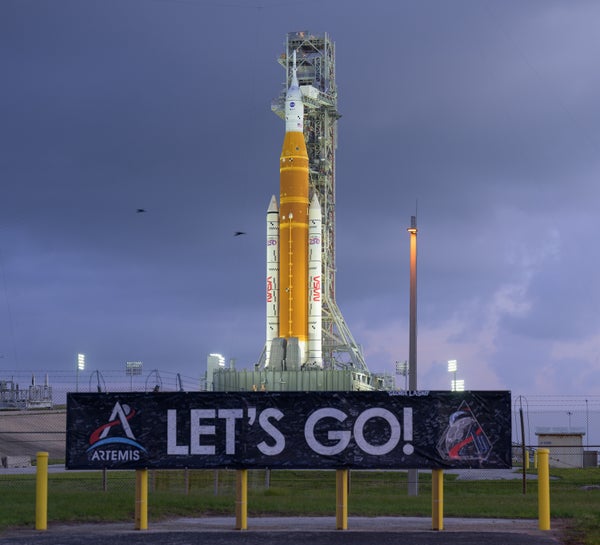
The lunar-bound astronauts of NASA’s Artemis II mission will go boldly where none have gone before, thanks to the space agency’s first-ever flight of a functional toilet around the moon.
NASA/Bill Ingalls
NASA has launched four astronauts on a pioneering journey around the moon—the Artemis II mission. Follow our coverage here.
When astronauts first made their way to the moon, they did so without a toilet. The Apollo program’s system of plastic bags and funnels was so unwieldy and messy that crew members found it “objectionable” and “distasteful,” according to a subsequent NASA report. But now, more than a half century since the last crewed lunar voyages and their toilet troubles, the four astronauts of NASA’s Artemis II mission will take flight with a more commodious bathroom in tow.
The space agency’s Universal Waste Management System (UWMS)—more colloquially called just “the toilet”—was created to solve longstanding potty problems faced by astronauts and to offer a more familiar bathroom experience on the final frontier. Lunar astronauts will now be spoiled by amenities that include handles to help them stay steady in microgravity, a system that can handle both urine and feces simultaneously, urine-collection devices that work for both male and female astronauts, and even a door for the helpful illusion of privacy in a cramped crew capsule.
The new design is more than a decade in the making. Space infrastructure company Collins Aerospace first entered into a contract with NASA to develop the project in 2015. In that time, project scientists have overcome fundamental issues with past space toilets while imagining and meeting future needs so that the same system used by Artemis II astronauts could be adapted for moon and Mars missions in decades to come.
If you're enjoying this article, consider supporting our award-winning journalism by subscribing. By purchasing a subscription you are helping to ensure the future of impactful stories about the discoveries and ideas shaping our world today.
“I think of waste management as an evolution of design,” says Melissa McKinley, project manager and principal investigator for NASA’s UWMS team. “The toilet has built on designs from Apollo, the space shuttle and even the International Space Station.... There is so much learning that goes into it.”
In the tight quarters of Apollo crew capsules, astronauts strapped adhesive-rimmed plastic bags and tubes to themselves whenever they had to defecate or urinate. Attaching the awkward bags was difficult enough in weightless conditions, but the astronauts also had to manually mix in a packet of germicide to prevent the buildup of bacteria and gases within the sealed bag.
The system was infamously prone to leaks, such as during the Apollo 10 mission, when astronauts noticed “a turd floating through the air,” and during the Apollo 8 mission, when the crew had to chase down blobs of vomit and feces that escaped into the cabin. A NASA report released after the end of the Apollo missions noted that waste disposal “must be given poor marks” when it comes to crew satisfaction.
“I used to want to be the first man to Mars,” said astronaut Ken Mattingly during the Apollo 16 mission, after describing the system. “This has convinced me that, if we got to go on Apollo, I ain’t interested.”
Based on these scathing reviews, NASA scientists knew they had to create a more streamlined system. After all, “the toilet is a ‘mission-critical’ system, so if it breaks down, the whole mission is in jeopardy,” says David Munns, a science and technology historian at the City University of New York.
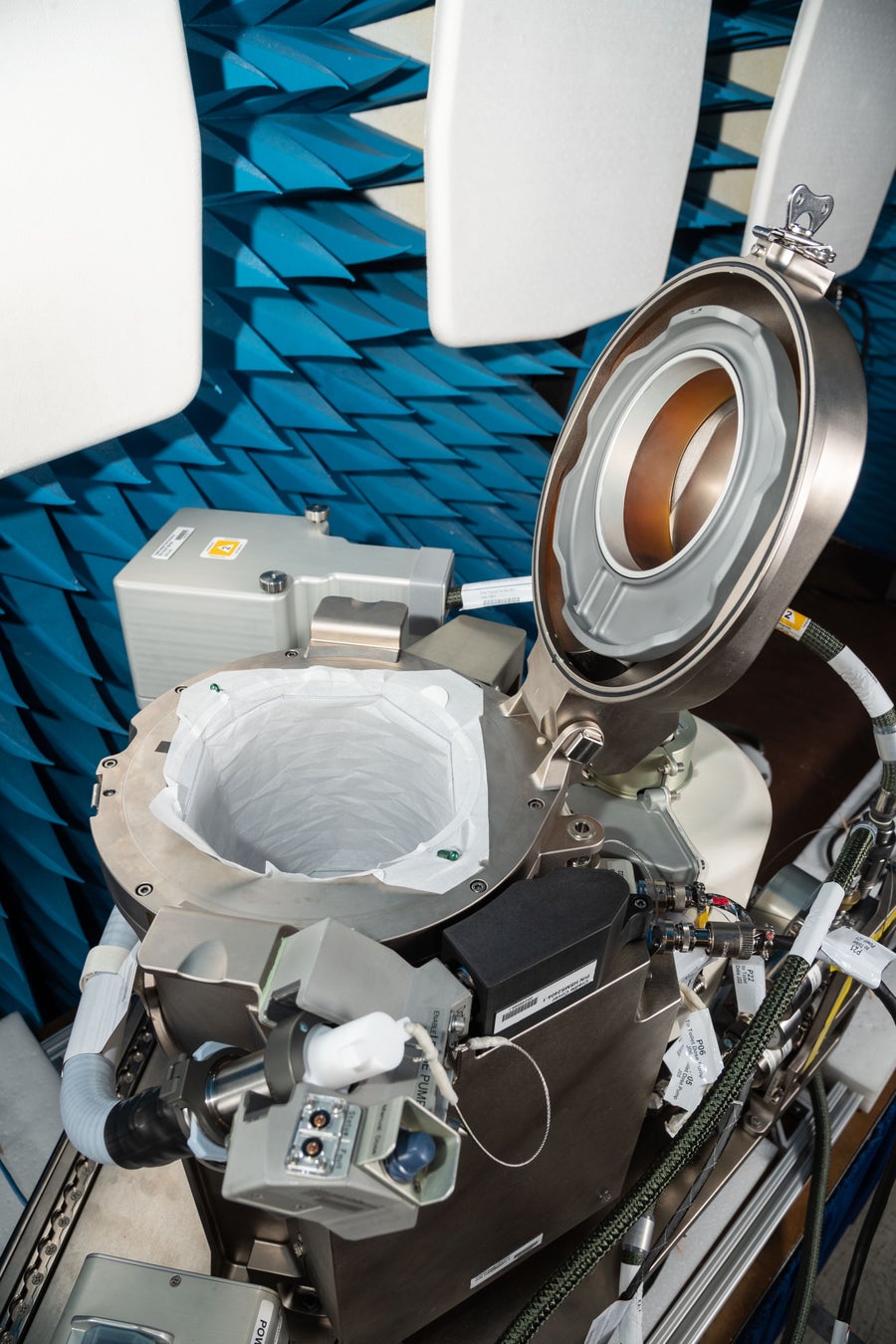
This version of NASA’s Universal Waste Management System was sent to the International Space Station; a special lunar version will accompany the space agency’s Artemis astronauts onboard Orion spacecraft bound for the moon.
NASA/JSC/James Blair
So before the space shuttle program, they engineered a toilet that could work in a low-gravity environment. It looked much like a typical terrestrial toilet but required the astronauts to strap in and use a vacuum hose to prevent waste from floating back up into the spacecraft.
Early toilets on both the space shuttle and the International Space Station (ISS) used this vacuum system—with the key difference being that the ISS model recycled some wastewater, whereas the space shuttle’s version vented it into space. Both systems were significantly improved over the “toilets” of the Apollo years but still had big limitations. They weren’t built with female anatomy in mind and couldn’t process urine and feces at the same time, and while they provided some semblance of privacy with a curtain, there wasn’t yet a solid door.
The UWMS is the aerospace-engineered culmination of all these pent-up problems with the user experience. 3D-printed from titanium, its lightweight, standardized design means it can easily fit in many different types of spacecraft, including the ISS, the Artemis missions’ Orion capsule and potential future vehicles that have yet to be built.
The first version of the UWMS was tested on the ISS in 2020, and final installation was completed in 2021. It featured urine and feces systems that could be used simultaneously, modifications to make these systems more unisex and the much-coveted bathroom door. With further modifications to help the same system function on a lunar mission, a version of the UWMS has also been installed in the Orion capsule for Artemis II, the program’s first crewed launch—and UWMS project scientists are on the edge of their seats, eager to learn whether the mission’s four astronauts are happy with the design.
“I am very excited for the crew to use this,” McKinley says. “We’ll know so much more when this mission comes back.... It’s really going to drive [waste management] on future Artemis missions and the lunar campaign—as well as the Mars campaign to come.”
If you enjoyed this article, I’d like to ask for your support. Scientific American has served as an advocate for science and industry for 180 years, and right now may be the most critical moment in that two-century history.
I’ve been a Scientific American subscriber since I was 12 years old, and it helped shape the way I look at the world. SciAm always educates and delights me, and inspires a sense of awe for our vast, beautiful universe. I hope it does that for you, too.
If you subscribe to Scientific American, you help ensure that our coverage is centered on meaningful research and discovery; that we have the resources to report on the decisions that threaten labs across the U.S.; and that we support both budding and working scientists at a time when the value of science itself too often goes unrecognized.
In return, you get essential news, captivating podcasts, brilliant infographics, can't-miss newsletters, must-watch videos, challenging games, and the science world's best writing and reporting. You can even gift someone a subscription.
There has never been a more important time for us to stand up and show why science matters. I hope you’ll support us in that mission.