Some things I remember:
* Seeing hired buffalos tilling our fields
* Playing with frogs and catching tadpoles in the fields
* Someone with a machine that removes the husks would come to our village during harvest
* The smell of rice fields. I recently smelled it again and it's very comforting.
Now I work in high tech, working on AI, and the fancy stuff. There is just something about rice fields that I love - maybe just memories, childhood, smell, how serene it looks when it's full.
My one hope for AI, robotics, self driving cars, is that they can enable more people in cities to migrate back to rural places. When I was younger, I used envy those who grew up privileged in a big modern city. Nowadays, I absolutely am glad I grew up in a little village in a farming community and I consider myself lucky to have.
Dad was a teacher in a rural school, mum stayed at home.
Until I went to school I would stay outside all day with my friends, playing in and around the rivers and dams, making our own fun with abandoned cars and rusted out farming equipment.
Our school had one computer, and I was lucky enough to get to use it after hours from time to time.
I would study the manual from front to back so I could optimise my time while on the computer.
Practiced typing on a typewriter to type in code listings faster later (aging myself here ;)
Today I build AI agents and infrastructure to run them for a hyperscaler, and my car drives me around. Feels like another lifetime ago.
I always wonder what made them become developers at all. Cause my primary motivation for selecting a job was that I explicitly didn't want to ever work manually, I knew that since early childhood and it still didn't change even after 2 burnouts. My secondary motivation was that I liked working with machinery/computers.
Also when I started coding, it immediately felt like my passion. And the thing I love most about coding is that mostly all changes I make have instantly visible results. I couldn't imagine working a job where I had to plant a seed and then wait a week to see if it sprouts.
Also what I love about development is that with modern Docker/Kubernetes setups you can make the environment where your code runs pretty predictable. And with proper backups configured and backup restore testing you aren't really worried about losing the stuff you worked on for months. Meanwhile while farming you can't predict how much sun is gonna shine or how much rain you're gonna get. And you can't prepare for natural disasters which can come anytime and ruin your crops.
So I wonder if it's all just people who never loved software engineering and just went into it for money, and now that they have money after years of working they start looking for their true passion.
I have been living in villages for about 5 years. I started a pig farm a month back. I have 16 piglets now. I still write software on a daily basis, a mix of client projects and own products. The pig farm needs about 2 hours of cleaning each day. I take care of cleaning. My business partner takes care of feeding.
I plan to grow the pig farm to a capacity of 100 pigs. It is a profitable business with roughly 30% return every 6-7 months. We give the pigs a lot more space and care than I have ever seen in any of those factory-style livestock business videos. With a 100 pigs, I will perhaps spend 5 hours a day in cleaning work - with more tools and employing a couple local folks.
Feel free to check out (links in my bio) or reach out if anyone wants to come and try this out in our little village in north eastern India. The village has large farms, growing all sorts of things.
I'd like my small son to have the same opportunities that I had, instead of a school where the playground has lots of very carefully manufactured play equipment and they get to sit and look at iPads instead of working out for themselves how to program a BBC Micro.
I particularly agree with this statement.
I don't know why manual work has been so denigrated over the last century. We believed that office labor was more important and healthier than manual labor. I don't think so.
As a developer, sitting all day typing in a stuffy office, without natural light, without sun, without air, is certainly no healthier than being outdoors, connecting with nature and other people. We come from nature and are made to be active, outdoors, and in the sunlight.
Today, with AI, many white-collar jobs are being called into question, and perhaps we can go back to loving certain traditional jobs.
There is one particularly funny point I'd quibble on:
> This was part of a system to discourage communism initially by encouraging ownership of business and preventing absentee landlords accumulating large tracts of land where people who work the fields would be forced into renting.
I'm dubious about the credibility of this assertion, but it is amusing to think that the goal would be to "discourage communism" by a policy that is essentially communistic in nature, in the true definition of the economic system (ownership of the means of production, ie. you own your own labour rather than renting it out).
I am, of course, nitpicking. It's rather easier for me to write comments complaining about things than praising them at length, but I was entertained by the view into the author's experiences and anecdotes.
- First of all a 95% increase in the price of rice means it less than doubled which is no big deal.
- I think maybe you meant it 20x'ed ? If so I will just eat corn until it comes down (my house eats 100kg of rice in a month)
- Can a suitcase of rice even get through customs?
It allows for supremely-intense end-game levels of automation, and also for personal productivity and a resulting increased joy, and for at least some aspects of free market economics to all work together.
(Can it happen? Perhaps we'll find out.)
In my career so far, I've spent most of my time troubleshooting AWS configs, combing through cloudwatch logs, and wringing requirements out of people, and a lot less of my time actually solving interesting problems.
The walls of my office are gray, as is the carpet, the desks, and the walls of the bullpens. There are awful fluorescent lights overhead, and my eyes are dry and tired. I am exhausted at the end of the day because of the sensory overload of people being on constant teams meetings all around me. They speak with their outside voices, like children.
So yes, I love software development, and maybe someday I will find a better job in this field that gives me the kind of challenging work and problem solving that I signed up for, but working outdoors? surrounded by the sounds of nature with the sun on my face? I'm sure there's a catch, but it sounds nice.
It's a very unique and fulfilling experience to be one with the nature. You get to learn that chickens eat almost anything. There's definitely a sense of belonging in nature that I miss
Someone who originally has coding as their passion, for example, might eventually come to dislike it due to overwork. And in doing so they overcompensate by imagining that the total opposite of office work, e.g. farming, would be a better way of life, even though it may not necessarily be true
That said, I think something like a week long course of farming targeted towards white collar workers, with all of the "fun and refreshing" parts but only educational exposure to the painful parts would be a great business idea (or maybe something like that already exists somewhere)
Yet I like planting stuff and gardening as well - why? I think it's a side effect of growing up with parents and grandparents who did that sort of thing as a hobby and I feel it's a bit of a comfort zone for me.
You'll end up burn out and hating the job (no matter the job) if the company you work for doesn't give a considerable weight to the wellbeing of employees (at the percieved cost of productivity and raw revenue).
As a farmer, it is funny to see how people react to you based on the current profitability winds. When farming is a money maker, everyone acts envious and treats you like a king. When times are tough, they think you're a slack-jawed yokel.
I expect in that lies the answer to your question: We denigrate anything that isn't, as a rule, making a lot of money. Manual jobs generally haven't made much money in the last century, and humorously the exceptions, like professional athlete, get exempted from being considered manual work.
The core idea of it, I think, is that those landlords must have been the mainsails of prewar Japanese military dictatorship regime and its expansionism under the strong leadership of its emperor, and breaking up land ownership will make it complicated for Japan to re-consolidate power and/or to somehow become closer to the Soviets.
I guess it did serve its core purpose of keeping China/Russia at bay, considering Japan has been extraordinary antagonistic to neighboring, and/or openly communist and/or totalitarian regimes, despite running on a rather ethnocentric communism-from-first-principle political system...
1: https://ja.wikipedia.org/wiki/%E8%BE%B2%E5%9C%B0%E6%94%B9%E9...
https://gist.github.com/olalonde/8a905bcd87e3bfcd4f6143a337e...
I have grown up in rural Russia in the 80s and that was also similar - a forest started 50m from our house and I would just get lost there from time to time - not fun for my parents but magical for me.
Then we moved to the middle of a European capital city (Sofia) and I _still_ had almost a forest right next to the apartment block we used to live in - enough of a forest that as a 10yo kid I could find a nook to build myself a small hut with a burning fireplace inside it and nobody complained.
There are plenty of big European cities that are 10-20mins short unsupervised trip to a wilderness that a kid can do.
For example - Valencia has an uninterrupted bicycle highway that gets you from the city center to a wilderness preserve and a beach in less than an hour cycling.
To me all of these nature vs city laments are just US car dependency. Cities donβt have to be this way at all.
I am always skeptical of urban people wanting to move back to little villages to do farming. Farming is a back-breaking and a tough job. You are exposed to all the vagaries of nature. The market forces are also not always in your favour. It is another version of "quit-job-and-open-a-coffee-shop" fallacy.
Wouldn't it be better, at least for the Earth, for everyone to live in cities? This way, more of the world can remain fairly untouched by humans, and it could still remain easy accessible from the city for recreational purposes.
The solarpunk ideal of living a rural life requires more road infrastructure, which cuts off wildlife routes and natural drainage, and even with EVs, still pollutes the air from tire wear.
Ah, the perennial dream of the technologist. Here's a Le Corbusier quote on the same theme from 100 years ago
> The cities will be part of the country; I shall live 30 miles from my office in one direction, under a pine tree; my secretary will live 30 miles away from it too, in the other direction, under another pine tree. We shall both have our own car.
The smell of paddy (and also of large quantity of cooked rice) is absolutely soothing for me and it brings back memory.
During my grandfather time, it was very common for a crab to grab your fingers when you are planting the paddy. My father would chase turtles and large frogs when he was a kid.
When I was a kid, the crabs and turtles were gone but frogs were pretty abundant. In last twenty years, there are hardly any frogs left. Earthworms are also under stress.
The Japanese style of planting paddy wasn't very common in India before green revolution. Then we had a some new varieties that took over almost all old varieties for a simple reason for yield. My grandmother used to complain about a lost variety a lot. Apparently it had such a strong aroma that whole village would know what rice you have cooked. Glad to see more efforts preserving old varieties [1].
Of course, I would like more flexibility in choosing how much I and where I do my sedentary labor, so I might devote time to, say, gardening. But it's easy to forget that humans have spent most of human history trying to escape subsistence farming.
I have worked subsistence farming for a small portion of my life, and I cannot tell you how hard it is, physically and psychologically. That was by choice, as part of essentially joining my wife's culture and family. If I were to do that for the remainder of my life it would destroy me.
Anyway, I'm going to go happily work from my desk 30 ft from my bedroom while drinking coffee likely farmed for about ~$0.30/hour while I make a few hundred times that.
Unfortunately, many of us are chained to the modern way of life.
The reasoning behind Gentan was that a landless peasantry was more likely to revolt. It's not dissimilar to pre-1929 kulaks, though the kulaks were encouraged/enabled to become a relatively wealthy/middle class peasantry who employed people and were directly involved in the production without owning large swathes of land, acting as a kind of a social dampener against a revolution.
Unsurprisingly the Soviet Union killed the kulak model and moved to collective farming[0], which was arguably actually communistic.
Anyway, yeah, in this context, Japan passed the Agricultural Land Act of 1952, which was intended to turn land owned by a few rich landlords into small, independently owned private farms. That may sound like the opposite of capitalism, and it is, but as I understand it, the idea was to turn what were basically serfs into a proper middle class, by redistributing the wealth and means of production directly down to them, which would then prevent communism from being as appealing. I don't know about the logic, but I guess it worked, since Japan isn't communist?
You are meant to "own the means of production" not in an actual, but more ideal sense. Owning a farm or workshop to the exclusion of other people makes you petit bourgeois and this is bad. Communism promotes collective farms. AFAIK Poland was the only European Eastern Bloc country to tolerate small private farms, as a concession to obstinate peasants after the death of Stalin.
Promoting small individual farms is a more Georgist, populist capitalist or possibly strictly conservative policy. Not speaking to its economic sense though.
The socialist/communist economy is the final extreme stage of monopolistic capitalism, towards which USA and other Western countries have been continuously evolving during the last quarter of century. The economy of USA in 2026 is much more similar to the economy of one of the former socialist countries in 1976 than it resembles the economy of USA in 1976.
Small farmers and businessmen were the main enemies of communism, everywhere.
So what Japan enacted was indeed a good anti-communist policy.
Fighting against big companies and supporting small businesses is the opposite of communist policies.
There were a lot of great differences between true communism and what the communists themselves claimed communism to be. There were also a lot of great differences between true communism and what communism has been claimed to be in USA.
Source: I have grown up in a country occupied by communist invaders, so I know what true communism is.
ps: Unfortunately I agree with you.
You can plant cash crops and sell them to buy industrial products. Or you can plant crops that boost your quality of life directly: fruit, vegetables, tobacco, animal fodder.
The "price scissors" (low price of wheat, high price of goods) meant that middling farmers stopped planting wheat that the USSR needed to feed the cities and to pay for imports. To make the peasants plant wheat again the Soviets took away their land in the name of economy of scale (collectivization), but the real goal was to limit the size of personal plots.
Any labor throughout human history.
I can tell by the houses in your wife's village that their area was likely wealthier than ours growing up. Our houses looked more like this: https://imgur.com/a/Pc9LuKF
When I was a kid, it felt like there were only 2 or 3 villages total in my area since our parents didn't allow us to go too far. As a visiting adult, I found out that there were hundreds of similar villages in the region. Most of these villages are generally empty nowadays as people moved to cities. However, I heard from locals that some younger people are beginning to return to villages and raise their kids there.
War is peace,
Freedom is slavery,
Ignorance is strength
The point, as I see it, being that politicians like to make contradicting statements. Good for sales you could say. It is possible to cut through such lies by using logic, good on you for doing that. Unfortunately, many people take such statements as true and mostly get confused by it.
Whether that's a big deal or not depends on the person, their finances, how much rice the family eats, etc etc.
Whatβs the maths on that? A cup of rice would seem a fair bit for a person for a meal. A cup is about 200g.
Thatβs 500 portions a month. 5.5 people for 3 meals a day?
Do you define human history as the last ~10k years or last ~100k-500k years?
But yes, certainly at least the last 3000 years for most humans have been spent farming to a large degree. But if we are even moderate in estimations of human origins, farming is very recent.
You can make a lot of money doing many skilled manual jobs in my country. Trades are highly paid and there is not enough supply. Better money than software development.
They often wreck their backs, or develop other chronic conditions. The successful ones stop doing manual work by the time they are in their 40s and move to running their own businesses employing 20 year olds.
A friend of mine just lost a family member a few weeks ago. He slipped on a roof.
So, it was an anti-revolutionary policy. Which at that time of history worked as well as an anti-communist policy.
> Unsurprisingly the Soviet Union killed the kulak model and moved to collective farming[0], which was arguably actually communistic.
Soviet Union, whatever it had preached, implemented state capitalism - concentration of the means of production under a single owner.
It's important for me to use words precisely. If somebody implies, for example, that capitalism is the opposite of communism, that's just snatching the words and waving them like banners.
Some human activities can have an outsized impact, but the overwhelming majority of those activities remain necessary regardless of where people live, and some will have an greater impact with widespread urbanity since some things like energy/food/water can be relatively cleanly decentralized in rural settings, at least partially, but require complete centralization in urban settings.
We're humans. We do that stuff.
And we're natural creatures like the rest of them are.
If there is a hell, Le Corbusier is currently in it, eating the equivalent in cement to all the monstrosities he concocted.
That can't really be said for downscaling rice farmers, can it? I mean, at best maybe the other rice farmers enjoy having them around.
The land that people live on, whether it's in a city, a suburb, or in a rural manner is a rounding error compared to those demands.
Where's the food going to come from?
Except this time, the dream is actually real and cheaper than ever thanks to small EVs, batteries and solar power. 100 years ago it was limited to people with large estates who owned cars (and probably needed secretaries for their work).
These days it's more affordable than ever (except land/housing)
I'm putting my money on more people (8-10) but eating less than 200g per meal (1/2 cup uncooked, ~100g for most people)
EDIT, just saw sibling, that's impressive for 5 people, unless the dogs eat a lot of rice too.
Iβve been inspired to write something for April Cools Club, and what fits better from my normal content than my experience rice farming in rural Japan!
For those who arenβt aware, in 2025 I spent January-July in Japan staying with my wifeβs family. During that time we helped out on the family rice farm near Shuzenji in the Shizuoka prefecture. I unfortunately had to leave before the full harvest process was done but Iβll take you as far as I got and also try and share other insights I gleaned.
Unfortunately, while I thought I took a lot of photos it seems Iβm missing things I would have liked to have captured for this. Where applicable thereβll be other sources and at least one video linked for more information.
The farm is primarily a rice farm, thereβs no animals (ignoring the koi fish that were in the garden pond). There is a portion of a bamboo forest and space to plant non-rice crops so we also grow or harvest for consumption:
And looking out from the driveway this is the view at the end of winter before everything starts growing and spring properly kicks in:
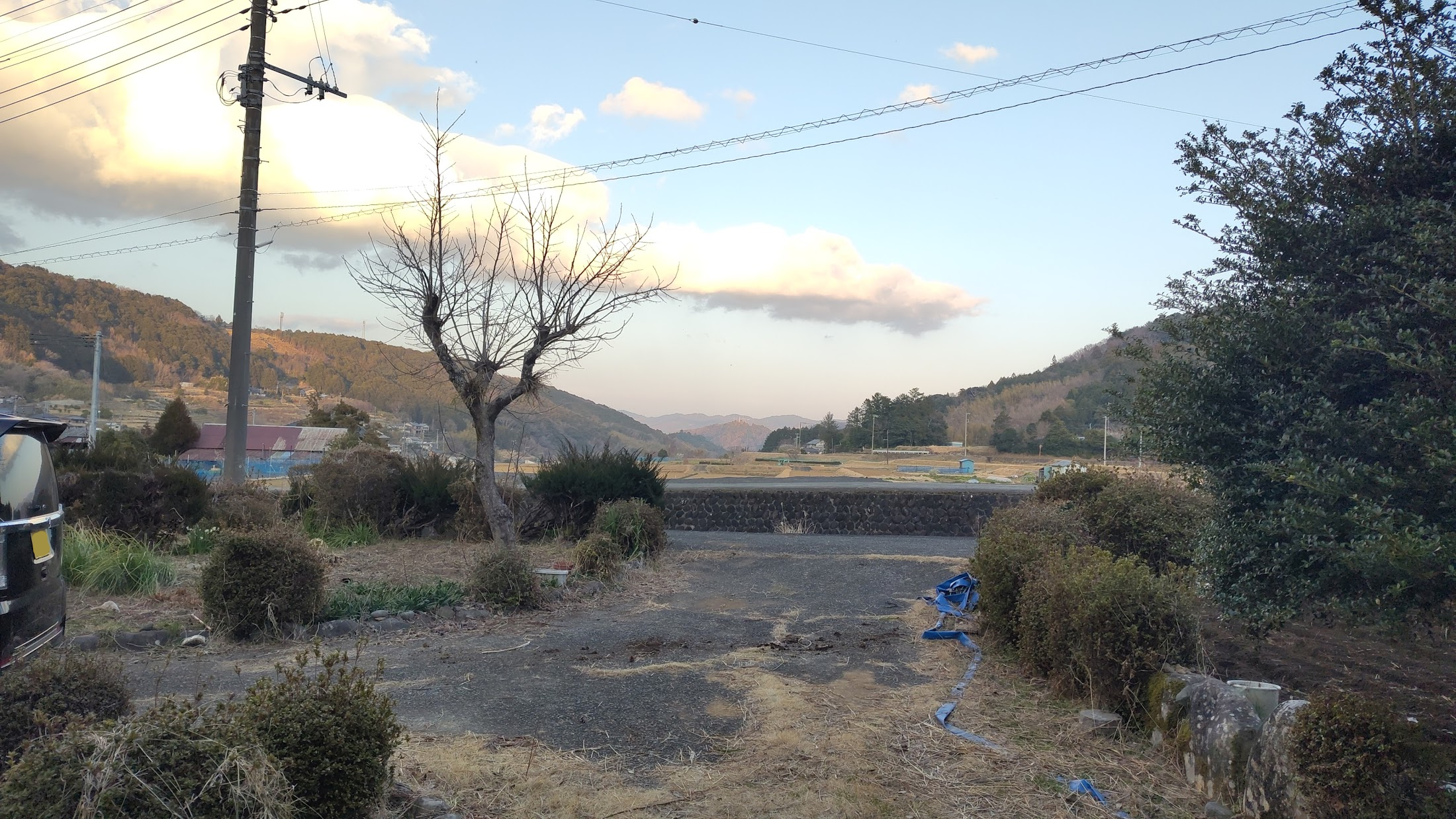
Obviously, me and my wife arenβt around all the time. When weβre not my brother-in-law and mother-in-law work on the farm part time often 1-2 days per week each.
At the start of spring we come back to the fields. Theyβve been left fallow over the winter and the dead rice plants from last year cover them. Theyβre currently dry, weβll flood them later on once theyβve been prepared. Because itβs hard and spiky we have cordless strimmers with metal blades to cut through this and not take forever.
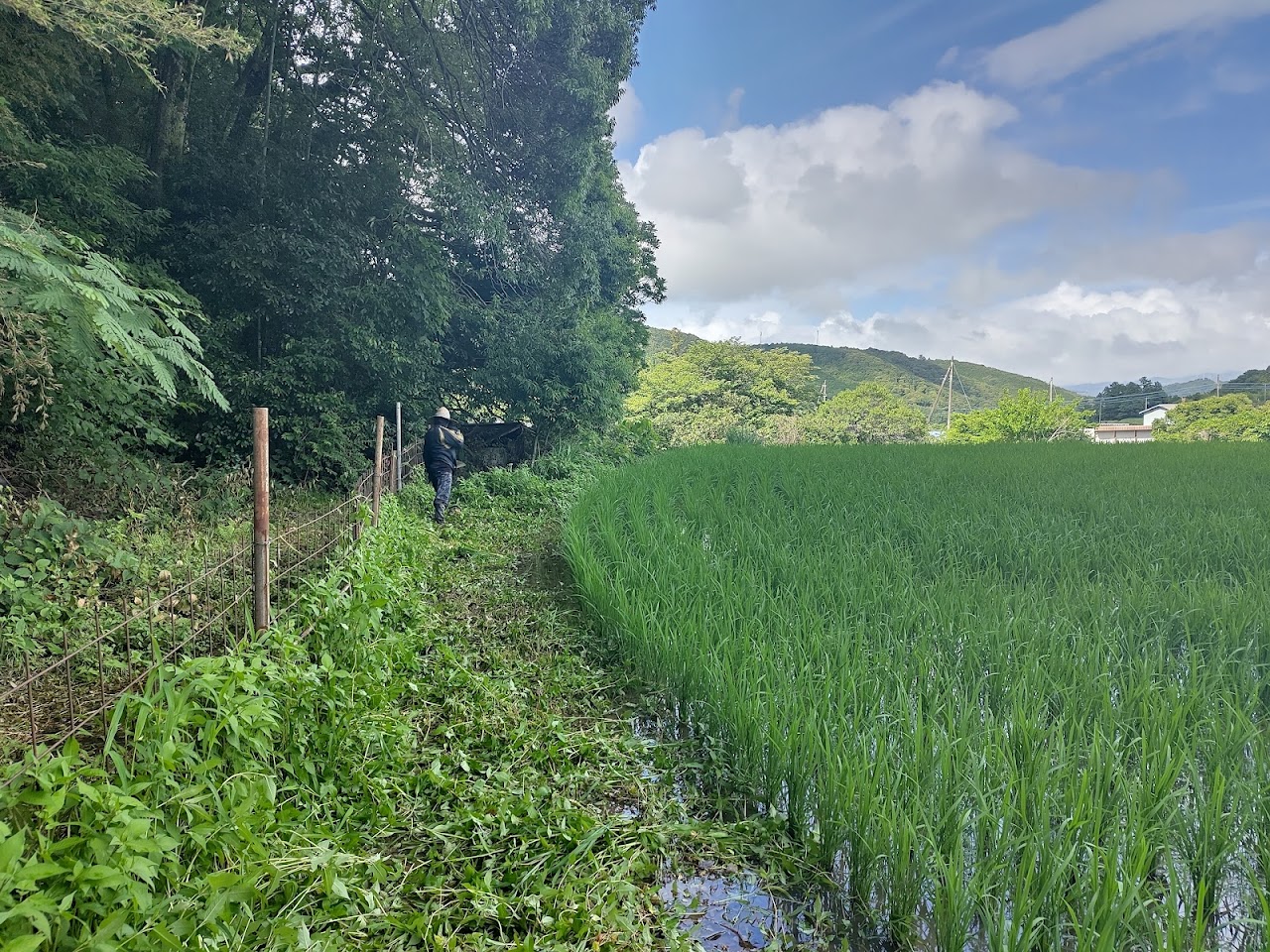
I donβt have a picture of a rice field before clearing but here is one of the fields partially cleared:
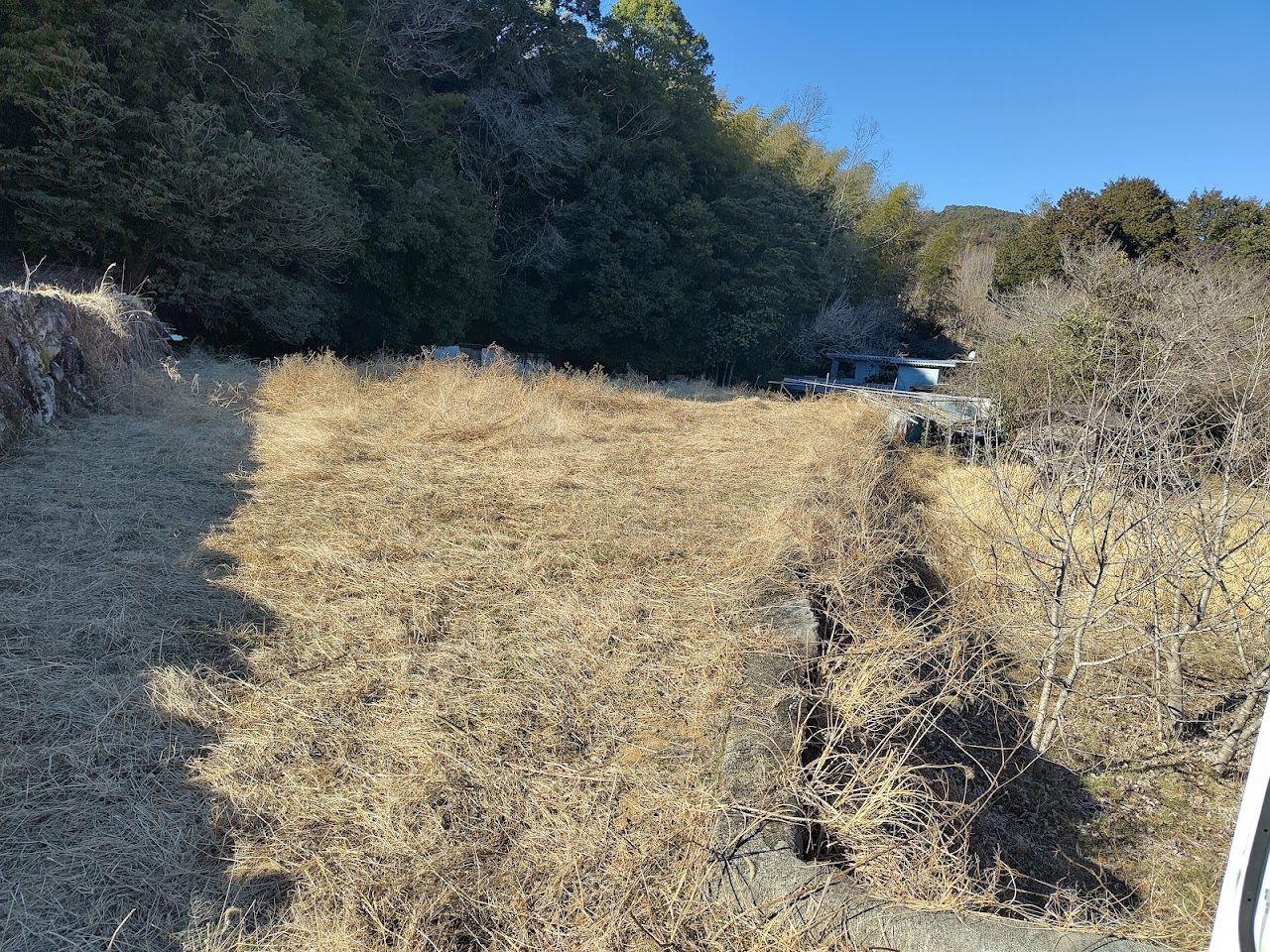
As part of clearing and getting ready we also dig the drainage ditches along the side of the fields. When the fields were drained last year the soft mud flows back into the ditches and hardens again so they need to be redug.
The field will also be ploughed to break up the soil and loosen it, and weβll remove large rocks we find. After ploughing we can level the field to flatten it. With the field level, the rice will be at equal depths and the planting process is more consistent.
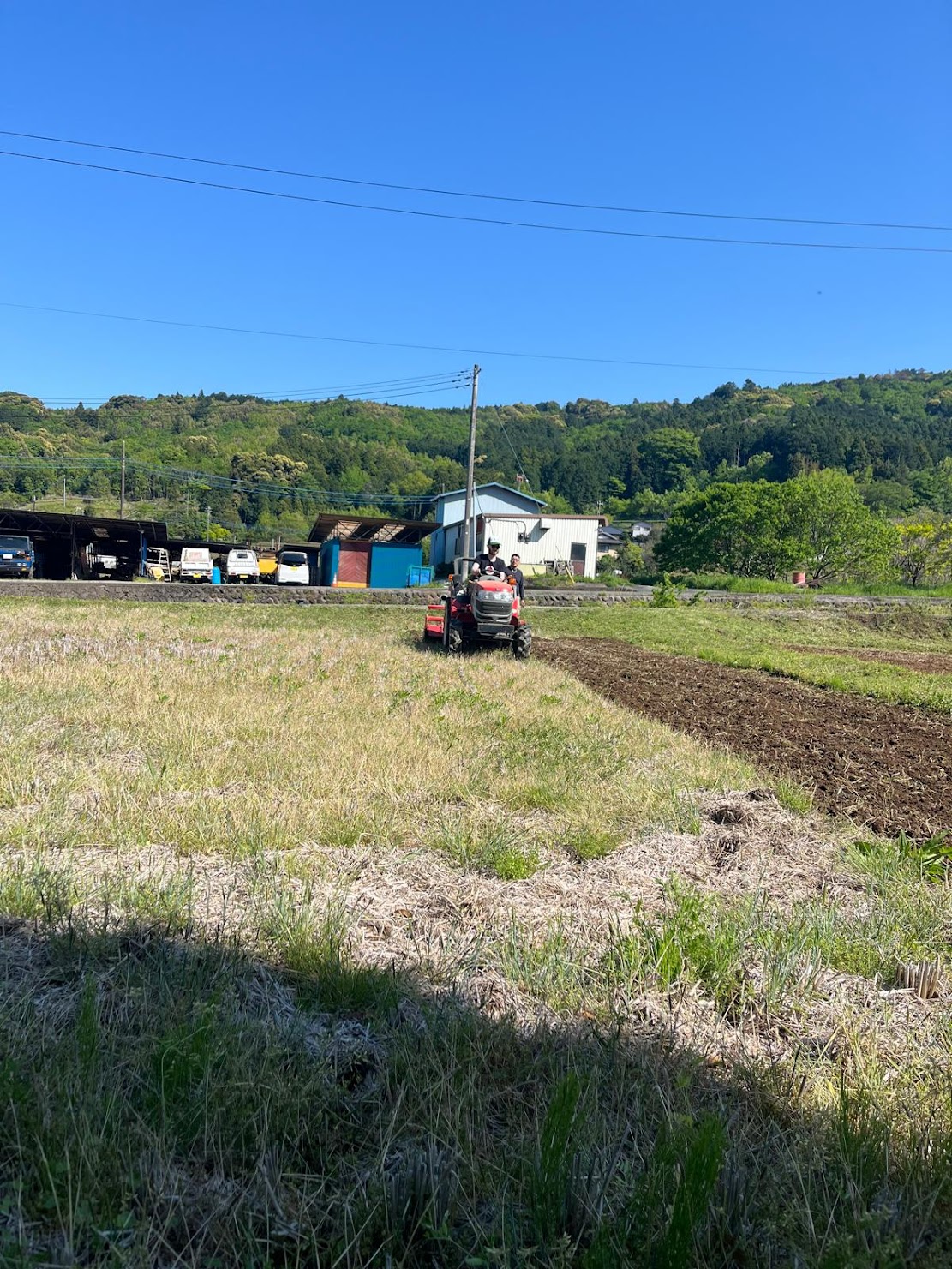
This might be the first time someoneβs prepared a rice field wearing a Rust London t-shirt. Itβs definitely my first time driving a tractor!
But before we get that far we have to prepare the route for the water to get into the field. This work is only actually needed for one of our fields, the others have a fairly direct route from the river to the field. But for one field we have to clear a few hundred metres of a channel that goes along the edge of a bamboo forest clearing the dead bamboo and other natural detritus.
I donβt have any pictures of this, but imagine all the joys of clearing out hundreds of meters of ditches among dense vegetation in high humidity.
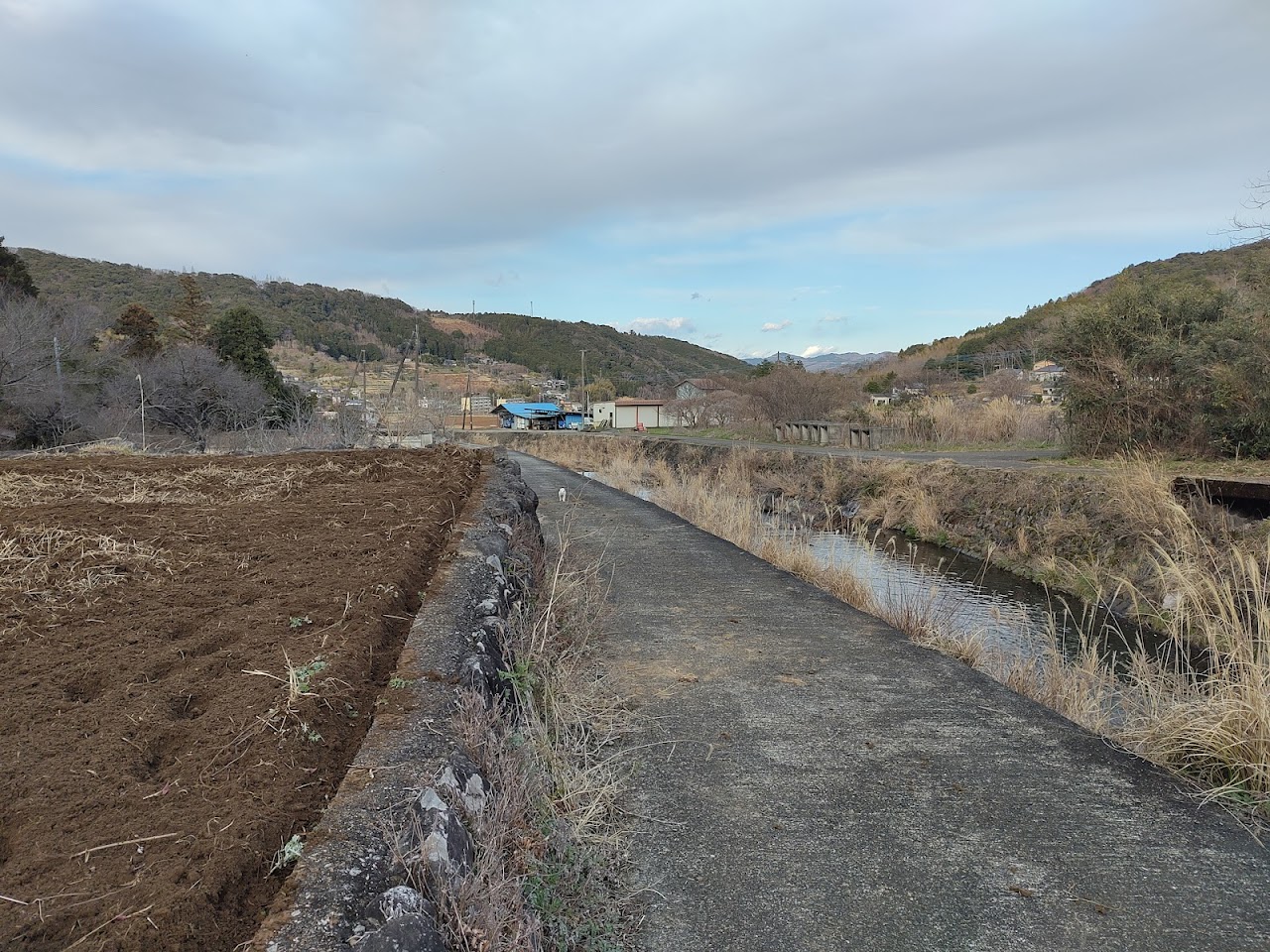
I do have a picture after ploughing with the drainage ditch for the field dug next to the river that will supply our water:
One last thing we might do before flooding is drive metal rods into the perimeter of the field as part of building a fence. This doesnβt have to be done for every field, just the ones that border the bamboo forest where the wild boar and deer might sneak through at night and eat the rice.
Rice fields are typically placed near rivers, before planting we have to flood and level the fields. Weβll go down into the river, and place a wooden board by a drainage pipe at the edge redirecting water down that pipe and into a channel next to the field. We can then open a hole and let water go from that channel into the field. Water can then drain out of the edge of the field when it gets full, continuing on into other fields and eventually back into the river. The water will rejoin the river in part so that farming doesnβt dry out rivers and ensure the longevity of the environment.
For the field with the more onerous ditch clearing that water flows under the field and eventually back into the river. For that thereβs an ad-hoc construction of some old drain and bamboo to move the water across into the field:
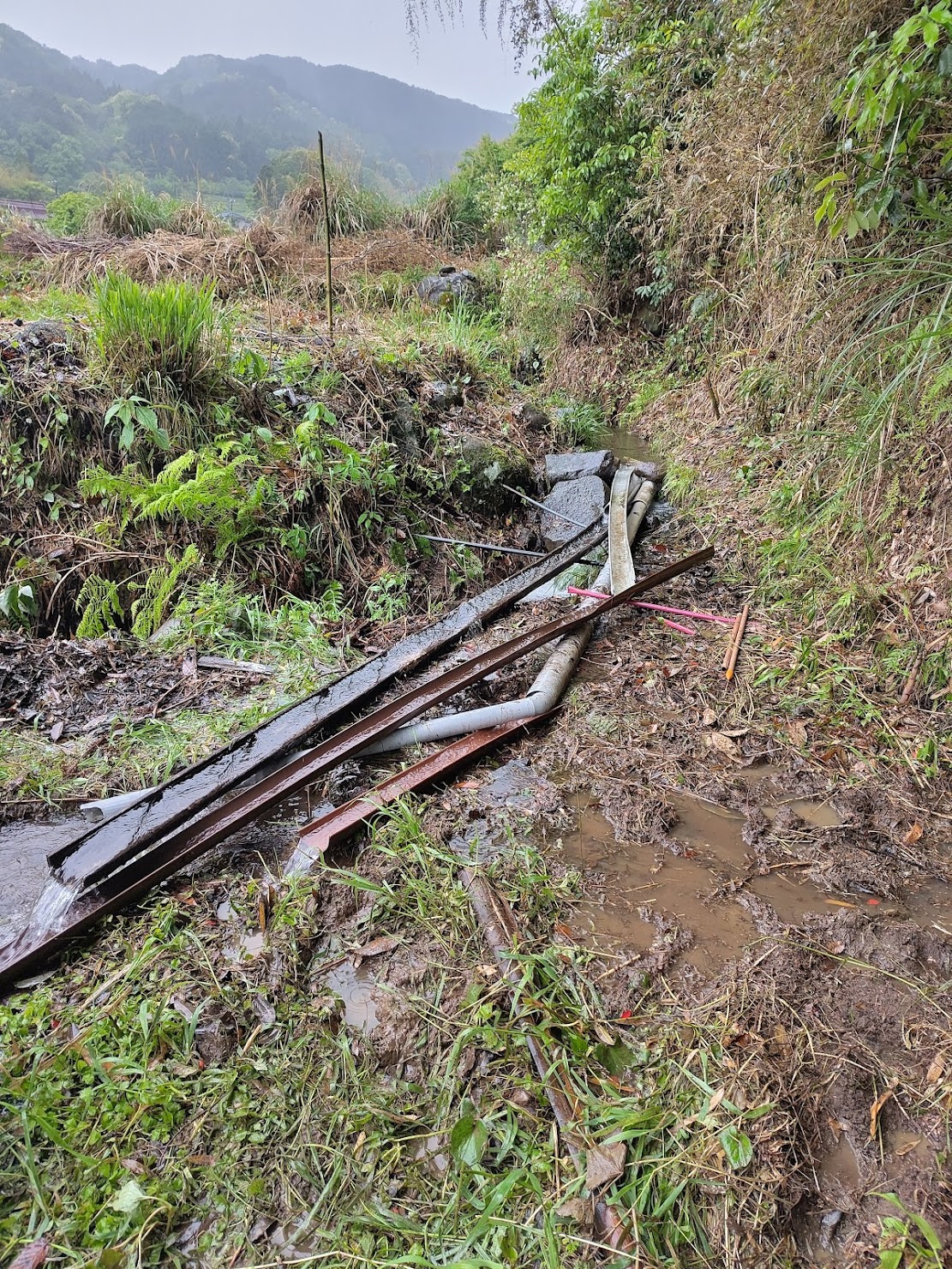
And the water entering that field:
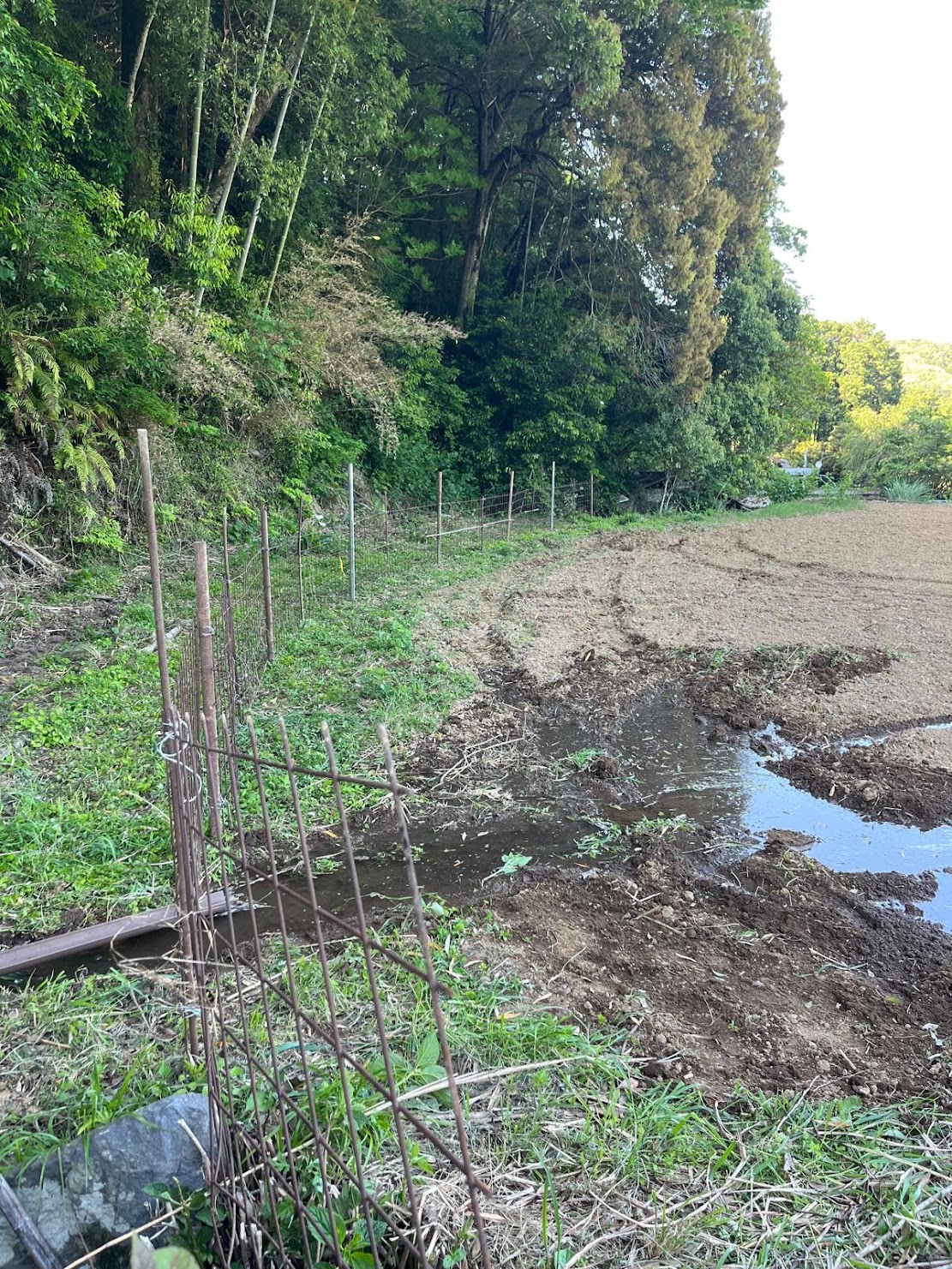
After flooding, a tractor with a flat rear blade will be moved over the field a few times to level it. When the planting vehicle goes over the field little arms pluck off some rice and stick it down. If the soil is too far from the arm you end up with loose rice floating around on top of the water. Obviously, we donβt want to waste rice like this so levelling is an important step.
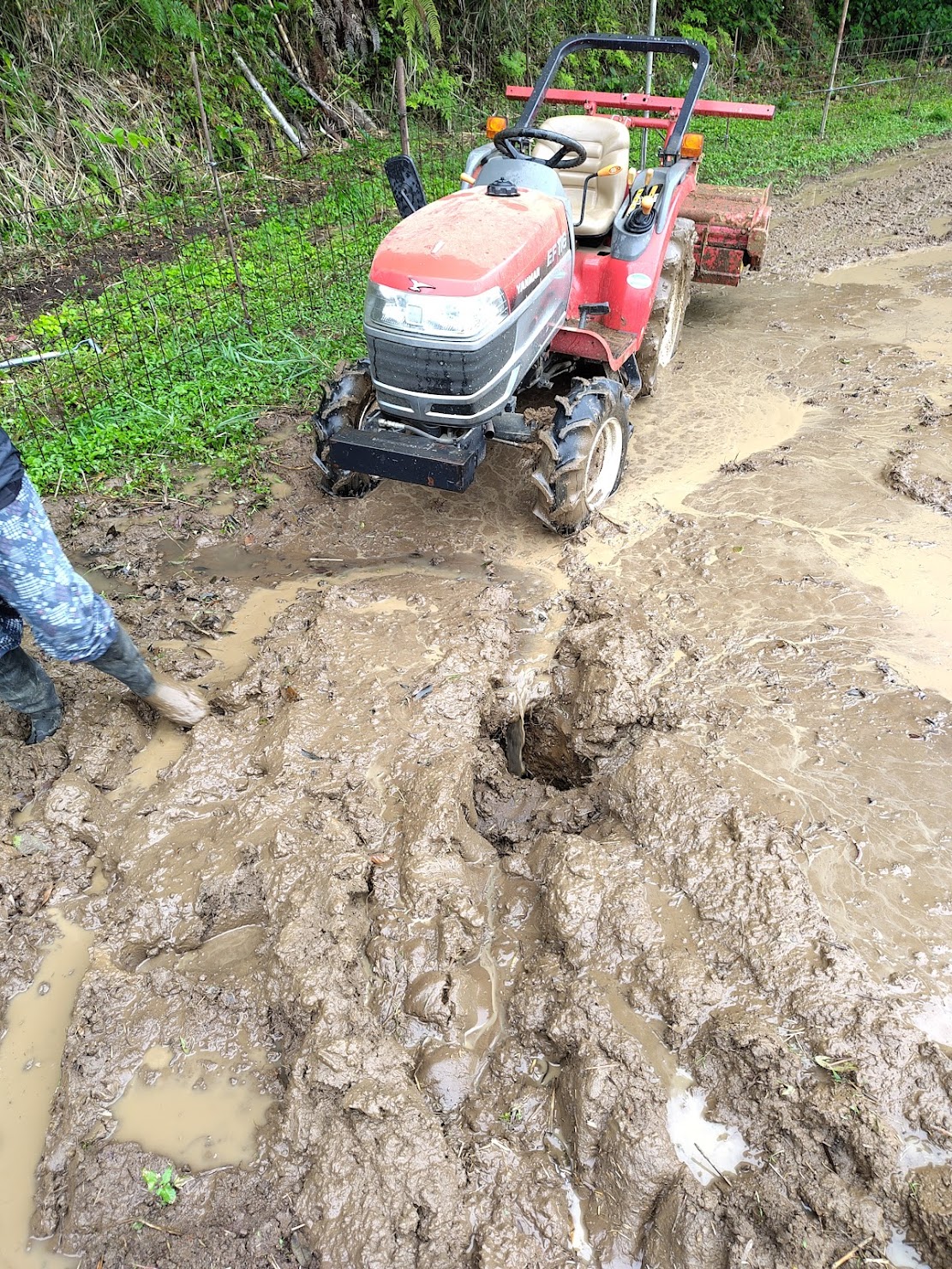
One thing to note, with a rice field the deeper soil is compacted and firm, it shouldnβt be able to drain by the water going into the water table and disappearing. However, our field with the tricky water intake did suffer from a minor sinkhole as water was able to go down and rejoin the stream that flows under the field. This resulted in some work to dig down and fill the area letting water out with rocks and harder mud and compacting it with the bucket of a digger. After this work was done the field held itβs water and we were able to think about planting.
After poking around to figure out why water was draining I managed to get this picture of the hole that started to open up. I guess thatβs a sinkhole of sorts.

An interesting fact is that rice doesnβt actually need standing water to grow. The water helps by stopping weeds growing around the rice taking resources and protects the rice from certain pests that would eat it.
For some further watching, this video shows a more advanced but very similar for a different farm. The main difference is that they donβt need to manually go to the inlet gates to open/close them and instead have some more modern gates controlled via mobile phone.
Itβs planting day, turning up I can see the neighbours have already planted and here you can see our ready but empty field next to their freshly planted field:
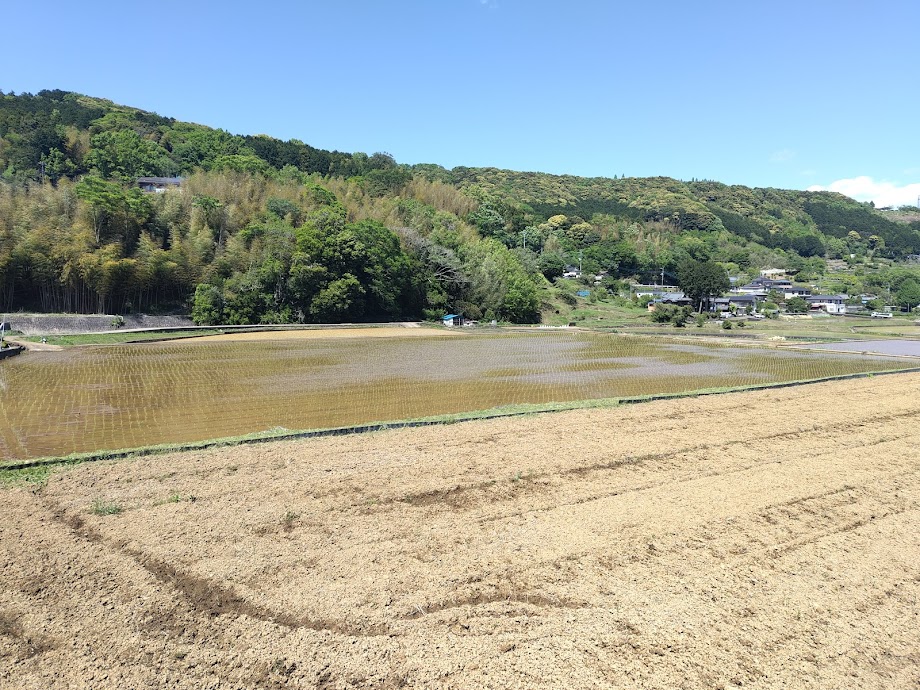
But here we go, everything weβve been working toward. The previous process has taken from mid-February and now itβs early May. We go off and buy seed trays of rice to load into the Rice Transplanter. Below you can see a picture of the planting process:
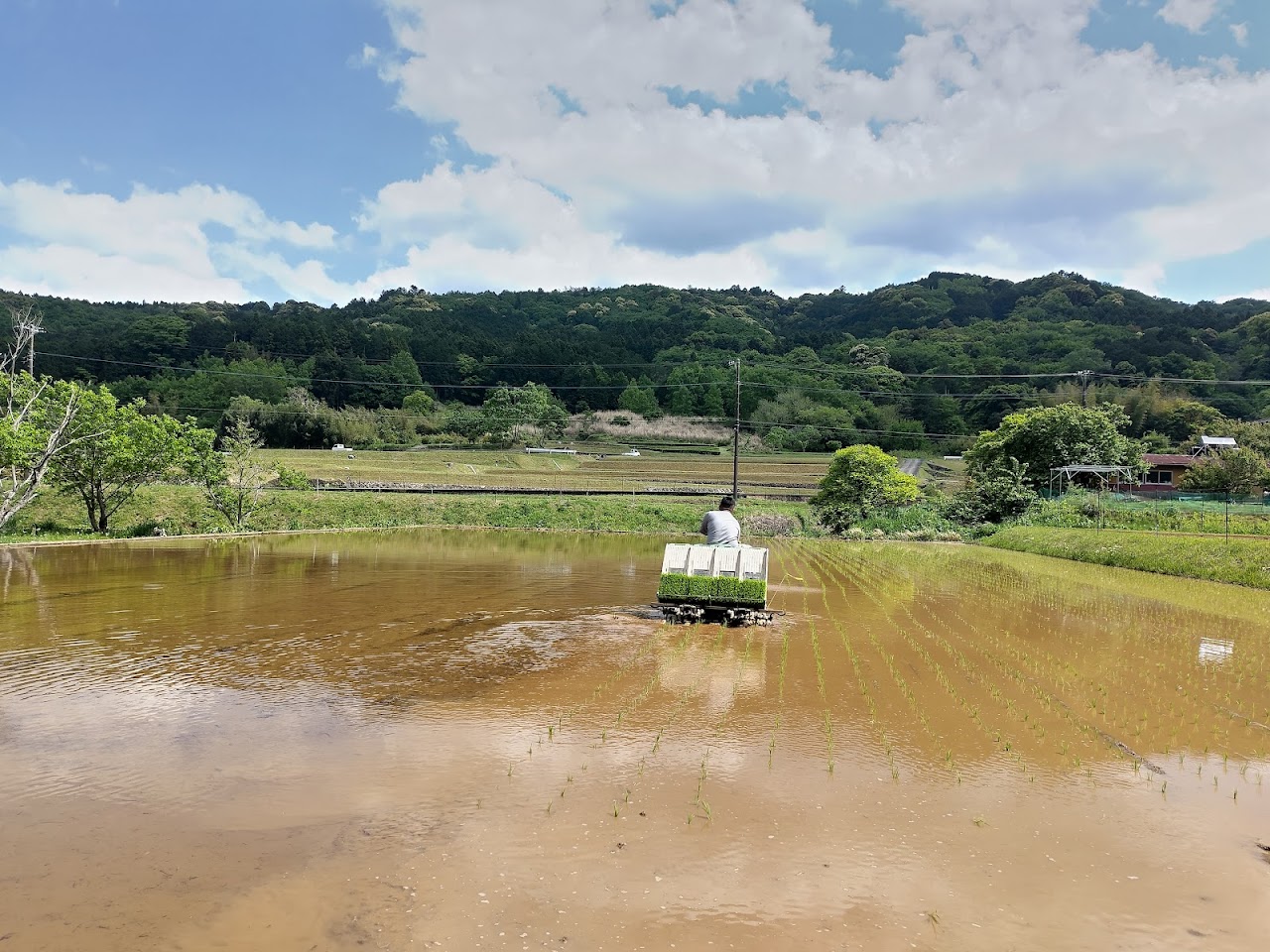
An arm will move along the bottom of the rice and pull off a clump of rice and then plunge it into the ground. It will keep moving back and forth doing this at regular intervals. It the motion of it working is reminiscent of a typewriter at work.
After itβs done thereβs some leftover rice, and there might be gaps where things werenβt perfectly level. We go out into the field wearing jika-tabi. These are boots with a split between the big toe and the other toes. Itβs meant to help our feet not get stuck in the wet mud. Grabbing rice in small bunches we pull them from the seed tray and plant them about an inch deep into the mud and compact some mud around it.
Fun language note, my wife asked me if I saw the tabi once and I thought she meant a tabby cat. I wasnβt aware of the name of the footwear.
Now the rice is in the field weβre at risk of attack. Wild boar and deer just love to snack on our hard work - this means itβs time to put up the electric fence. This is fairly simple drive the poles into the ground at regular intervals, then feed the wire along it wrapping it round the clips making sure itβs moderately taut. Also check for any breaks in the wire and if so get a bit of electrical tape and fix it.
After wiring we place a box which is just a solar panel and battery on a timer next to the fence and try to hammer it into the ground or prop it up securely enough with rocks where the dirt is too shallow.
Weβll have to come back every week or so to cut the grass that sprouts up on the edge of the field. If we donβt it will ground the fence and drain the battery and our rice will fall victim to the local wildlife.
After planting our fields look like this:
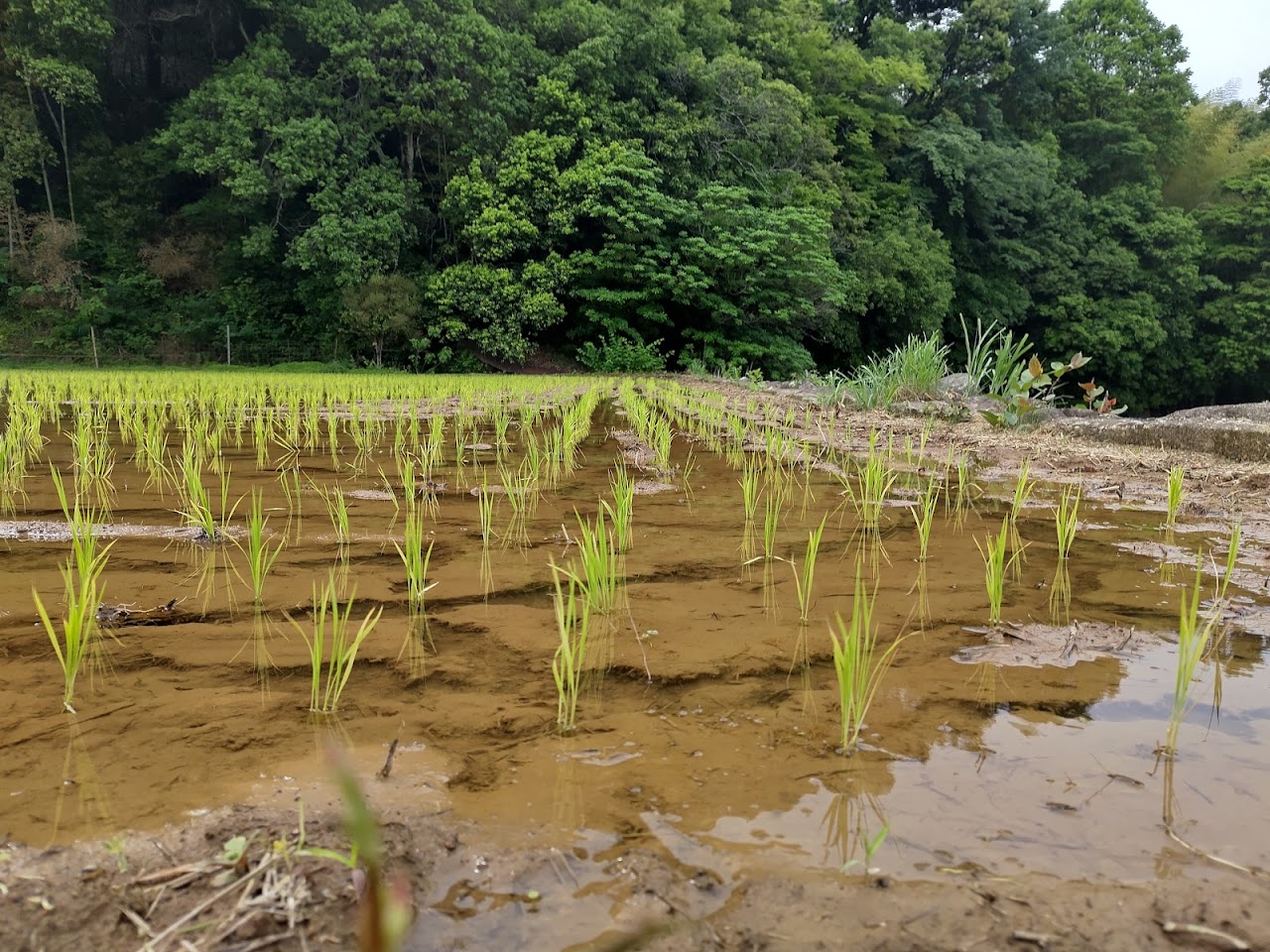
When the rice gets older - around waist height the field is drained. Some sort of narrow plough is moved between the rows pushing the mud up around the rice to hold it up and then the water intake is closed and the field left to drain and dry out. Then the rice will continue to grow until itβs harvest time.

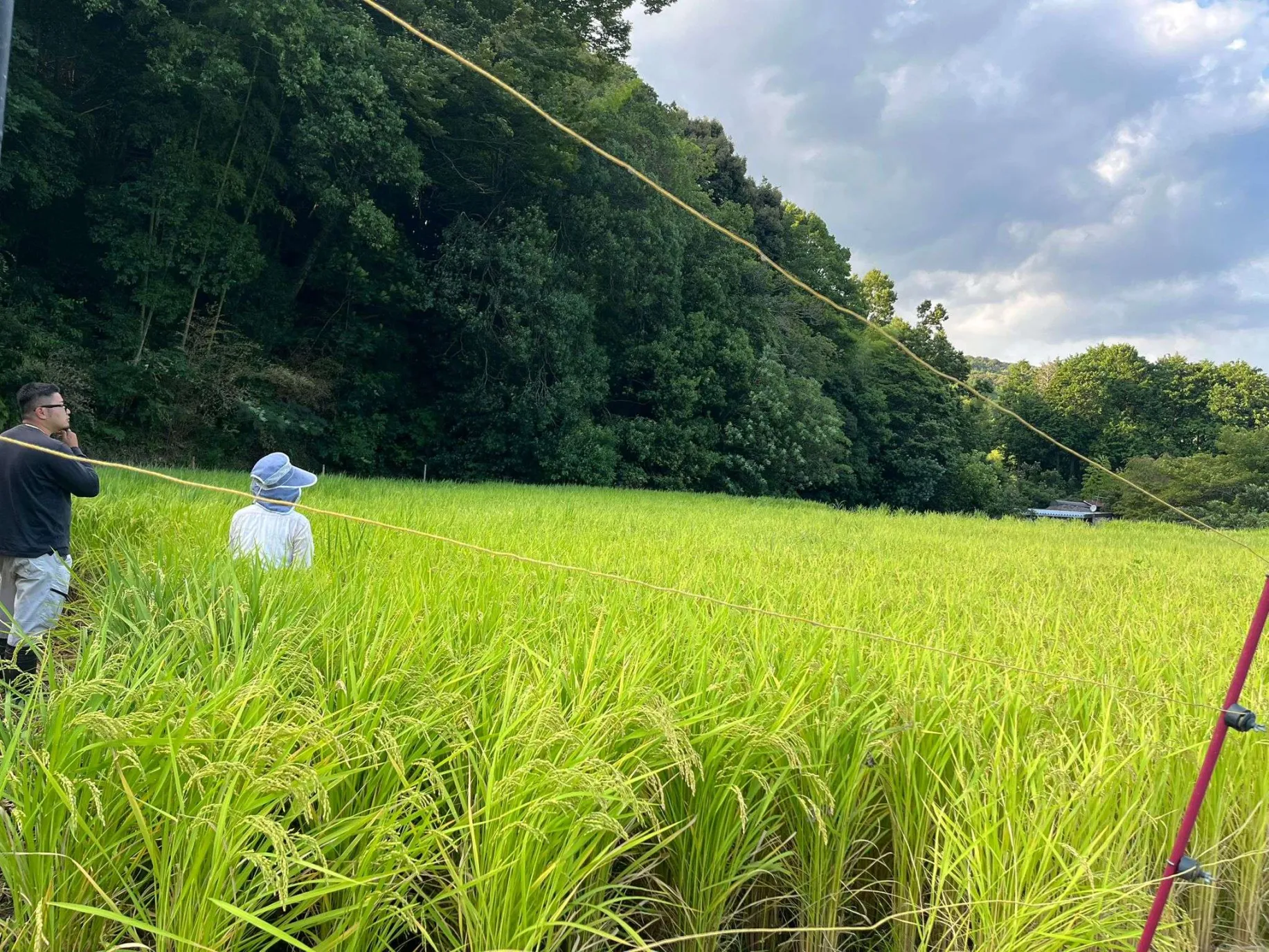
Unfortunately, I left Japan a couple of weeks after draining and I havenβt experienced the final stage of harvest yet. I have this picture I was sent of the rice near harvest time but the final stages will have to remain shrouded in mystery for now. Iβm not ready for spoilers when I may learn this in future firsthand:
A spectre has been looming over this post. The wild boar. I got an update one day it seems a baby boar managed to squeeze under an unelectrified part of the fence and help itself to an all you can eat buffet:
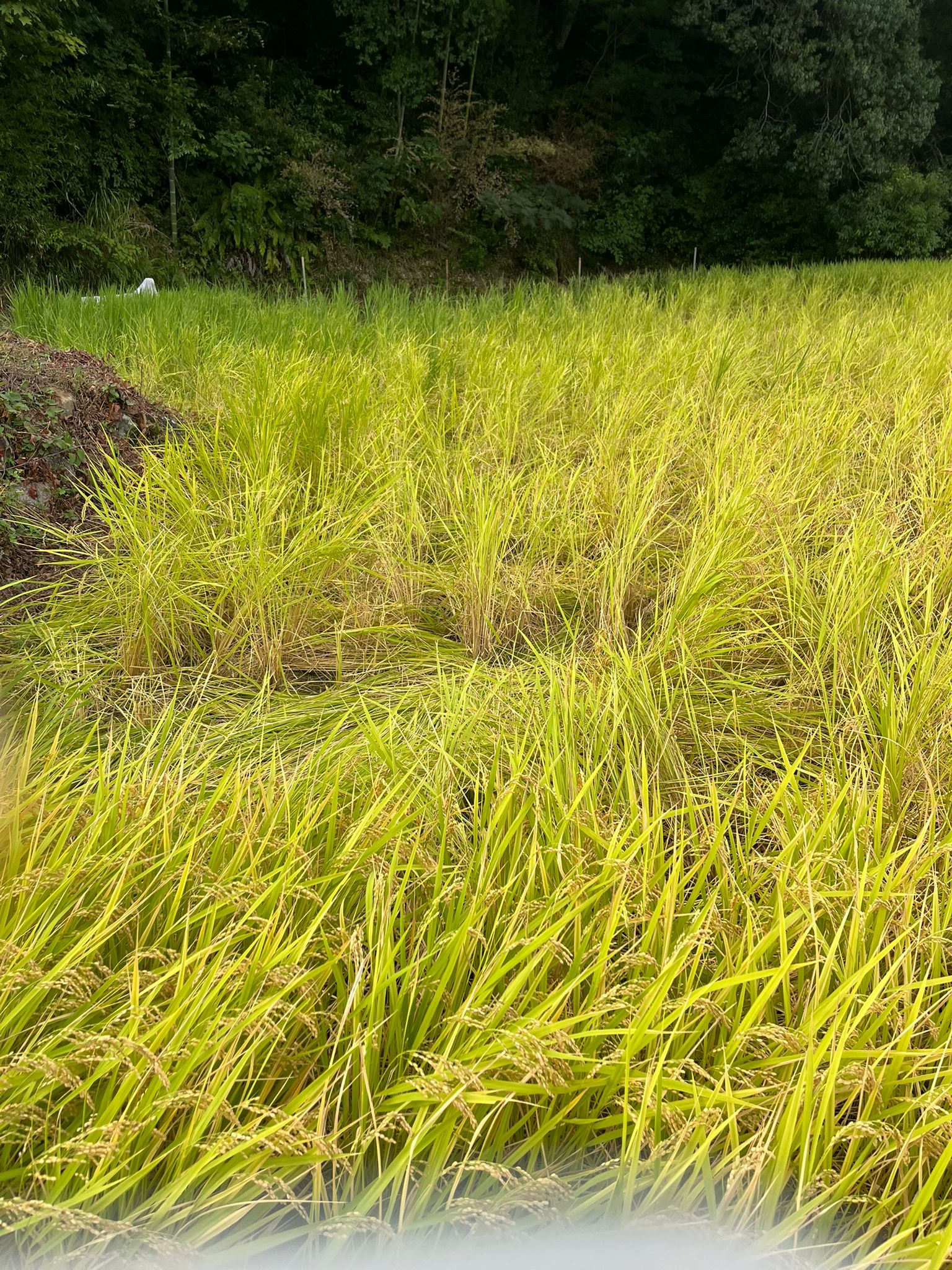
Luckily someone came to the farm the day before and the day after it happened and it was closed up before the boars started visiting nightly. But it seems important to remain vigilant of your defences. Iβve still not seen a boar in the wild even going through the nearby forests - theyβre nocturnal and rather dangerous so Iβm glad of that!
In rice fields you can see a lot of interesting wildlife. Frogs and salamanders help protect the crop by eating bugs that might feed on the rice. You also might see snakes nearby that feed on them as well.
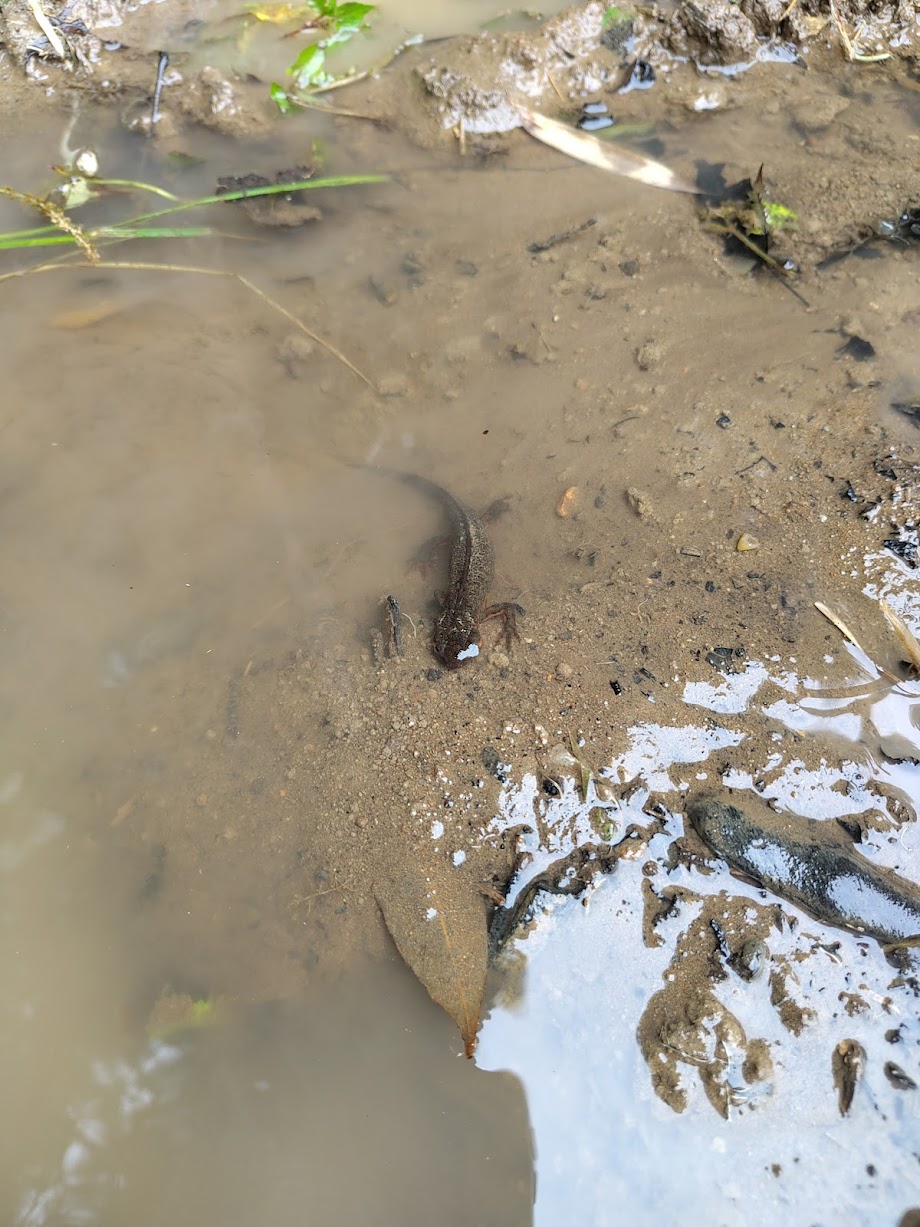
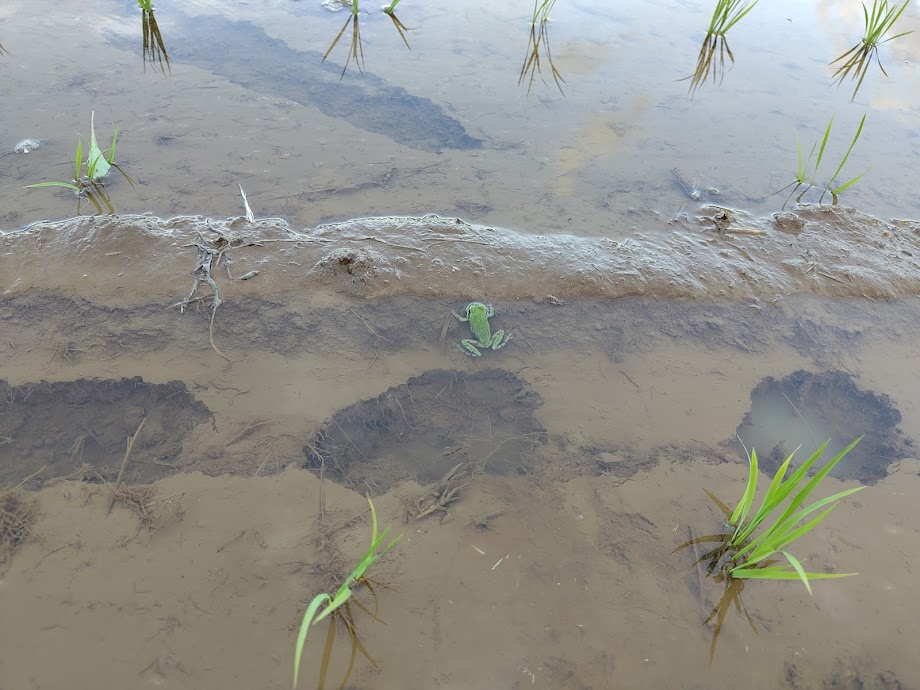
When clearing grass once I saw a snake dart out from under a pickup truck weβd had parked up for a few hours as I walked past. I then looked at the grass I was going to cut and saw it hunkered down in the grass but obscured enough to not get a picture and not wanting to disturb it I moved on. After all I donβt know how dangerous it might be.
I asked my brother-in-law about the snakes later on when he came to the truck to get a drink and asked if theyβre dangerous. He asked if itβs brown or βblueβ (aoi ιγ) - it was brown. Also blue here isnβt blue but green, historically ao used to mean the entire blue-green spectrum so for some older terms (often things like animal colours), aoi is still used instead of the more modern word for green (midori η·). Anyway, his response to my answer is how I first heard the Japanese word ζζ―γͺ (yΕ«dokuna) - or venomous in English. Not speaking any English, he further translated it by grabbing his throat and miming frothing at the mouth.
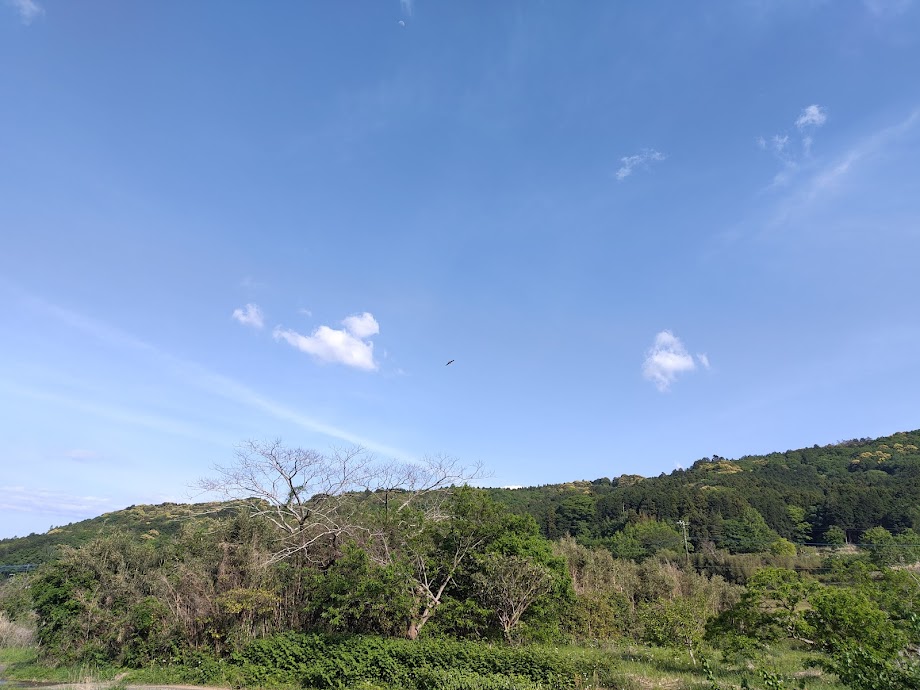
There are also black kites flying around, theyβve been known to swoop down and snatch up kittens and there are warning signs in some more populated places about keeping close to small pets. Iβve seen them circling in the heat but itβs hard to get a good photograph of birds with a normal smartphone camera. But I have my best capture of one:
When I was in Japan there was a rice price crisis (try saying that three times fast). With a 95% increase in price, it actually became cheaper to fly to South Korea, fill a suitcase with rice and fly back. Eventually, the government released part of its emergency rice supply kept in storage to tackle food shortages and mitigate against disasters. This situation is likely to occur again, and as an outsider looking at how Japanβs farming system is organised it seems unavoidable without significant reforms.
In Japan the average age of a full-time rice farmer is around 70. For younger generations they can only afford to do it part-time, 1 or 2 days a week. They also own 4-6 rice fields. There are no factory farms and large scale operations.
In this respect my wifeβs family is very average. Rice farming doesnβt generate enough income to do it full time so my Mother-in-law and Brother-in-law only farm 1 or 2 days a week maximum. Without more time theyβre able to just plant enough fields to account for the family rice consumption and not to sell rice.
Part of the reason of this is the Gentan system, designed to protect small-scale farmers income it prevents large scale factory farming of rice and encourages ownership of smaller farms. It has been officially abolished but it still shapes how the rice economy works. This was part of a system to discourage communism initially by encouraging ownership of business and preventing absentee landlords accumulating large tracts of land where people who work the fields would be forced into renting. It should be noted the UKβs system is like this with rich landowners accumulating more farmland for tax reasons and renting it to farmers who often struggle to make farming profitable.
Farmers also sell their crops via a centrally managed system which fixes the price. Historically, crops used for animal feed have fetched higher price than human quality rice leading to a number of farmers planting rice for themselves and then selling animal feed to make a living.
Another issue is automation of farming. Reading this account of rice farming you might think this seems very manual and it is. In America rice is aerially planted. With consistency in fields and the distribution of the rice leads to higher yields. And if youβre dealing with such small farm area that becomes more important - and things like aerial planting become less economically viable. An American farm can be roughly 100 times larger than a Japanese one.
Additionally, with rising cost of living a lot of the youth of Japan move to cities like Tokyo, Osaka and Nagoya where they can find better paid office work. Local rural economies struggle more as they lose people and income from work doesnβt scale with the costs of living. It seems unavoidable weβll see more and more rice farms close and further impacts due to decreased output.
If youβre interested in this thereβs a video about this on Asianometry.
Reading this last section it might seem to end in doom and gloom. This isnβt really how I wanted to sign off on things. Rice farming was a positive experience for me, a connection with nature, building relationships with my wifeβs family and growing my Japanese skills. Doing a day of manual labour, chatting shit, then going for the onsen and some BBQ and beers is far better than grinding away at some enterprise SaaS that will probably disappear in a few years.
Farming becoming economically unviable seems to be something afflicting many countries. At some point I expect a wakeup call or transition. Either things are changed to make it viable full-time or Japanβs system of small independent farms will gradually fade away. Only time will tell, but I hope that rural communities can continue to survive and also thrive.
Success and failure are choices. Accepting this allows us to take responsibility for the worlds we've created. Ignoring this is self-destructive act of cognitive dissonance and we pay for it years later.
Lenin preached for state capitalism as a transitory state towards socialism. It's an integral part of the communist ideas, part of the direction even if not part of the ideal final state.
Sure, but sedentary labor destroys the body through neglectβwhich is ultimately a choice.
I believe it's pretty quiet here too outside of CNY, although there is at least one active school nearby. Nice to hear some younger people are returning. It must be nice for kids to grow up in this kind of environment.
https://openknowledge.fao.org/server/api/core/bitstreams/2de...
There's a nasty interaction among those concerns: as the basic staple food of the diet, rice is consumed in larger amounts by poorer people who can't afford real food, like meat.
Which means that a spike in the price of rice is effectively targeted at people who can't afford to substitute other foods.
This is because often the rules and laws protects still human instead the profits.
Certainly, some people still live as hunter gatherers. I presume people can deduce I do not refer to them.
It's common enough, here at least, to have a small family cropping 13,000 old school acres - tilling, seeding, waiting, harvesting, etc with big machines and Ag-bots.
These genotypes are being lost to industrial mono-cropping. The government is doing nothing about it.
(In my previous post, I forgot to mention stunning rainforests near Sintra in Portugal.)
Our village didn't get electricity until the 90s, I think. I do remember having electricity growing up, and even a small TV. By the time I emigrated, some households had refrigerators.
I understand most cultures over-appreciate meat, but treating a premium carb source like rice lowly is a surprise.
Um, rice is real food too, right?
Huh? It's not clear to me what you're trying to say here.
Everyone wants a huge house with lots of land far from neighbors.
But then they want the state of the art hospital to be close. They want to be able yo reach the closest airport in max 1 hour. They want their kids to play with other kids, ideally without being chauffeured around endlessly, etc, etc.
What I've discovered is that humanity has mastered the ancestral art of "having the cake and eating it, too", also called delusion and/or hypocrisy :-)
You're going to need more farms and more farmers, and no-one can afford to be shipping food halfway round the planet.
This is happening worldwide and is one of the tragedies of modernity. Mexico for instance has tons of regional varieties of peppers that don't grow anywhere else except for in a very specific micro climate and they're disappearing in large part because of cheap imports that makes farming them unprofitable.
There's also a lot of owner/operator one-man shops.
I can't personally attest to that, but it certainly makes sense. Rice meals vs noodle meals are a fairly fundamental split in Chinese cuisine.
(It doesn't make rice any less of a staple food.)
I find this an interesting contrast with the United States, where the default cooking oil is Canola oil (if you're a person looking to cook your own food; this is the sense in which the Chinese default is corn oil) or soybean oil (if you're a company looking to sell packaged food in grocery stores). As far as I'm aware, traditional China would have had sesame oil and maybe soybean oil, and certainly not corn oil. The advantage of corn oil must be the price.
But if corn oil is so cheap, why does the cheapest oil available in the US seem to be soybean oil?
And I think when most people speak of the dream of returning to rural society to e.g. farm, they're speaking very much of the former rather than the latter.
https://www.wpr.org/news/locally-grown-fruits-veggies-expens...
I'm just here to point out farming and livestock at suprisng to many scales can be operated by fewer people than you might expect.
as for: > no-one can afford to be shipping food halfway round the planet.
what does the Atlas of Economic Complexity type datasets currently say about food volume tonnages and trip lengths? I know that our local farmers co-op
handles handysize to post-Panamax vessel shipments from Australia, United States, Canada, South America and Europe to key grain markets in Asia, Europe, Central America and the Middle East.
( from: https://www.cbh.com.au/exports-overview )and there are other grain basins about the globe.
The challenges for grain shipping going forward likely fall about getting sufficient production of non fossil origin methanol fuel variations for shipping engines.
That and making sure the front doesn't fall off.
Musk wants to be a founding father. And just as the OG founding fathers, his problem isn't necessarily with the centralization part in general, but with the centralizing being done by others. There's a reason the original American voters were all white land owning men (and in some cases, slave owning men!).
China also imports 80% of its soybeans which means it's based on the rising/falling prices of oil and whatnot.
In the US, soybeans are a very important crop that's fed to livestock and also used in biodiesel production. There's enormous soybean "crush" infrastructure in the US to support the biodiesel market and the side effect of this results in tons of extra soybean oil. It ultimately ends up with soybean oil being cheap compared to everything else.
The single biggest reason these farms exist is because American retail produce is mostly garbage. Itβs so economically micro-optimized that all flavour has been wrung out of it. The only way many of us immigrants can get back the flavors of our childhoods is by growing the fruits and vegetables ourselves, if only to have control over the varieties, the vast majority of which are not sold in stores (>95%). That nostalgia is what pays the margin.
We do not have the capacity to ship food halfway round the world because picky eaters don't like the idea of eating meat and potatoes.
That's the actual tragedy. Forests contain a lot more like per cubic km than pastures do.
Depends on the food, if you're clearing land for a new crop (which many countries have done historically and still do today) then it's not sustainable. And if the native crops are simply not as good nutritionally as the new crop then it's better to eat the new crop even at the ecological cost of the native one, e.g. potatoes vs barley in Ireland.
I'm not sure what you're referring to in your second sentence, not sure why picky eaters wouldn't like meat and potatoes or what that has to do with shipping in general, not even the fact that we do indeed have the capacity and will to ship food halfway around the world already today.
Urbanisation ratios have increased, farm worker percentages decreased, average land area holdings increased so stores, schools, etc. are closing.
As time passes now, more an more old farm hoses are vacant island in an ocean of larger consolidated workings.
BTW you do NOT want ten acres. That is a back breaking amount of work and even with modern technology you'll struggle to cope (it's not enough to afford most heavy equipment, but too much to do manually). You want an acre or two where you have enough space to plant trees. It takes a few years from nursery to fruiting, but they are far lower maintenance.