I understand funding cuts and all, but this is a once-in-a-generation moment and it’s filmed with no apparent effort whatsoever.
I guess not counting all the prior "views" that have been recorded since the Apollo missions, including Chinese orbiters which (according to Wikipedia) "scanned the entire Moon in unprecedented detail, generating a high definition 3D map that would provide a reference for future soft landings"
I had assumed they would've had a better plan to film the entire departure from orbit yesterday.
I'm at least happy they have one for the loop around the moon.
/s
https://svs.gsfc.nasa.gov/vis/a000000/a005500/a005536/a2_fly...
Hope we get to see something like this in 4K !
Honestly, they should consider outsourcing that bit.
The feeling it evoked in me was that a multi billion dollar PR program could surely afford to spend a little bit of money on reliable camera tracking, telemetry overlays, visualisations that run at more than 0.1 FPS, etc.
Absolutely bizarre.
For real?
I was rolling my eyes hard at:
GC systems go?
GC systems go for all for humanity!
And then the VERY scripted pre-launch speeches. It’s like everyone there had been taking notes from inspirational hero movies.It’s cool. But let’s not act like going around the moon is the most historic thing ever… since we’ve already done it plenty, right?
What SpaceX does goes in quarterly reports.
> "will be used to beam 4K moon footage at up to 260 Mbps."
> "Data rates of 260 Mbps can be achieved..."
I wonder what size stream will be available to us. The largest I see in general is 70-90 Mbps for a 4k Bluray Remux and that includes lossless audio. I imagine they would want as much data as possible—significantly more than would be visible to the human eye.
And when we do it again, maybe we should pay the dude from Iowa (who has made a career out of things like streaming rocket launches on video) to provide his team's shots and editing for the official live feed when launch time comes up.
You may not have noticed, but NASA was also launching an actual rocket at the time. Conducting a livestream and conducting a livestream while launching a rocket to the other side of the moon are hardly equivalent.
Absolute shit show.
You have a remarkably low threshold for "shit show."
Let's not foster any more of it.
NASA’s Artemis II mission blasted off on Wednesday. Now brace yourselves for exciting high-resolution 4K footage live-streamed from the surface of the moon thanks to NASA's laser-based O2O system. The cutting-edge Orion Artemis II Optical Communications system (O2O) will be used to beam 4K moon footage at up to 260 Mbps. We should also be treated to never-before-seen views of “the far side of the Moon, using Nikon digital cameras,” reports The BBC’s Sky at Night magazine.
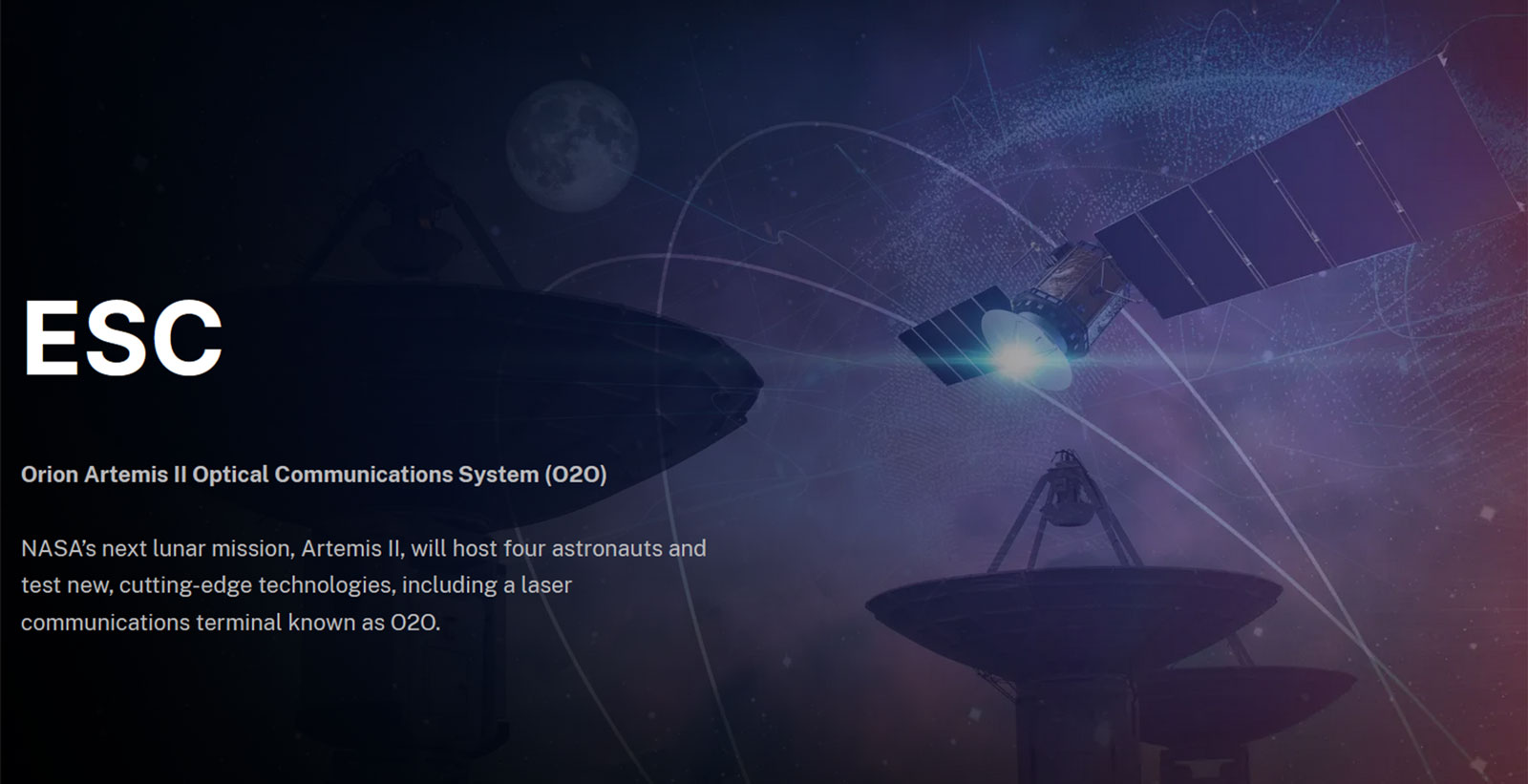
(Image credit: NASA)
So, what is O2O? NASA prepared a page dedicated to the technology ahead of the beginning of the Artemis II mission, here. Basically, O2O is a laser-based communications system that will be able to pipe the headlining 4K footage from astronauts on the moon to the Earth. Data rates of 260 Mbps can be achieved by O2O, and it isn’t just for fancy videos; it will also be used for fast and efficient transmission and receipt of procedures, pictures, flight plans, and more.
Meanwhile, on Earth, laser ground stations are situated in Las Cruces, New Mexico, and Table Mountain, California. These locations were chosen for their typically clear skies, important for fast and reliable laser communications.
Article continues below
However, the astronauts will also use traditional radio communications to stay in contact with the ground team via NASA's Deep Space Network (DSN). With prior mention of the potential for cloud interference, this could be an essential backup. DSN was the key communications tech used by Voyager, the Mars rover, and Artemis I.
Losing sight of the Earth on a planned mission to the far side of the Moon will block both laser and DSN comms, notes the source report. NASA is well aware of this ‘dark window,’ which is estimated to last for 41 minutes.
If you aren’t that impressed by the 260 Mbps O2O laser comms terminal's performance, NASA’s page about this laser tech highlights a Lunar Laser Communications Demonstration it has completed that achieved 622 Mbps. Moreover, some nearer-Earth space laser comms projects have reached data speeds up to 200 Gbps.

Follow Tom's Hardware on Google News, or add us as a preferred source, to get our latest news, analysis, & reviews in your feeds.
Get Tom's Hardware's best news and in-depth reviews, straight to your inbox.
But NASA's own in-house stream probably won't consist of 260 Mbps of video, either. Keeping headroom available during streams is important on packet-switched networks, which I [perhaps erroneously] assume this is.
(Later on, after the fact? That's what FOIA requests are for if you want to see every recorded bit. It will certainly come at a price, but if a person wants to compare the received friggin-laser-beams stream to that which the on-board video systems recorded internally, then it should be possible.)
Who is going to be the first to make a smartphone call from the moon?
Lag won't be too bad, just 1.5 seconds or less
It's just not super worth it.
If you want to look at a mission that did this, see China's Queqiao.
The Chinese have put Queqiao-1 in the earth-moon L2 point which seems to be working out for them, but I guess the Americans aren't likely to be asking permission to use it.
I generated this visual map about to help me understand it - https://vectree.io/c/aiming-space-lasers-gimbals-and-beam-di...
https://www.ll.mit.edu/news/lincoln-laboratory-laser-communi...
However: That quality was lost earlier than last year. Not sure exactly when, but it been like this for years now.
More thorough prep/training for camera operators, so they can pan the camera according to a plan, instead of by reaction.
Maybe this camera operator wasn't supposed to pan because it was trying to capture diagnostic imagery that wasn't really intended for viewers, but because of budget cuts, they opted to use diagnostic views as presentation views.
Maybe there was supposed to be a cut to a different camera. But the production room was not sufficiently staffed to coordinate the switch.
Maybe there was no broadcast plan at all and it wasn't clearly coordinated who should be taking what shots.
Maybe they were underpaying the operators and they were not qualified.
Maybe they were underpaying the operators and a single operator was stuck operating multiple cameras and was framing a different camera at the time.
Automated tracking systems.
Sure, it's very likely that this might have happened anyway, but there are a lot of ways that reducing budget reduces planning and coordination. Especially if there is enough budget squeeze to move funds from public support campaigns (this entire stream was a public support campaign) to critical things (like building a rocket).
So actually, yes, it could have affected it. Did it really? We will never know.
Also NASA has less experience in this than SpaceX, hopefully it will be better next time!
Tilting is up and down.
Panning is left to right.
You can't pan up, unless you've fallen over.
I've watched hours of athlete parents try to track their athlete kid and it's marginally useful at best. Lots of shaky cam even at Pop Warner football speeds. So panning at the right time, with the muscle control to keep the object centered, is harder than you think.
If they have a professional videographer on staff working that camera it almost certainly would have never happened. Elon, who was in charge of DOGE, didn't take communications and marketing seriously so I'm almost certain they were one of the first to be let go.
- No professional videographer was part of the staff?
- They were fired/cut by DOGE on behalf of Elon Musk?
Absent any other evidence, wouldn't it make more sense to simply assume that there was at least one professional videographer on staff, and an entire professional video team, but they just weren't very good/effective for a variety of reasons unrelated to Elon Musk?